Joshua 6:15
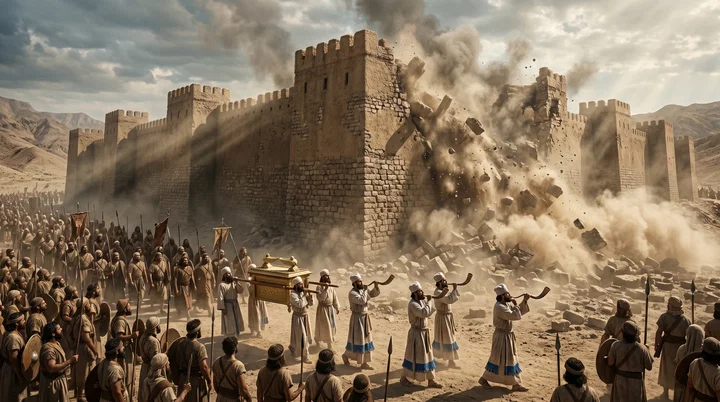
And it came to pass on the seventh day, that they rose early about the dawning of the day, and compassed the city after the same manner seven times: only on that day they compassed the city seven times.
Translations
American King James Version, King James Version, KJV Cambridge Paragraph Bible, Webster Bible
And it came to pass on the seventh day, that they rose early about the dawning of the day, and compassed the city after the same manner seven times: only on that day they compassed the city seven times.
Revised Version, American Standard Version
And it came to pass on the seventh day, that they rose early at the dawning of the day, and compassed the city after the same manner seven times: only on that day they compassed the city seven times.
And it cometh to pass, on the seventh day, that they rise early, at the ascending of the dawn, and compass the city, according to this manner, seven times; (only, on that day they have compassed the city seven times);
And it was so that on the seventh day they rose early, about the morning-dawn, and went round the city after the same manner seven times; only on that day they went round the city seven times.
And it came to pass, on the seventh day, that they rose early at the uprisings of the dawn, and compassed the city after this manner, seven times,—only on that day they compassed the city seven times.
Berean Standard Bible, Majority Standard Bible
Then on the seventh day, they got up at dawn and marched around the city seven times in the same manner. That was the only day they circled the city seven times.
On the seventh day, they rose early at the dawning of the day, and marched around the city in the same way seven times. On this day only they marched around the city seven times.
Then on the seventh day they got up early, at the dawn of the day, and went round the town in the same way, but that day they went round it seven times.
And when the seuenth day came, they rose early, euen with the dawning of the day, and compassed the citie after ye same maner seuen times: only that day they compassed the citie seuen times.
Douay-Rheims (Challoner revision)
But the seventh day, rising up early, they went about the city, as it was ordered, seven times.
Pictures
Cross-references
- Joshua 6:20
So the people shouted when the priests blew with the trumpets: and it came to pass, when the people heard the sound of the trumpet, and the people shouted with a great shout, that the wall fell down flat, so that the people went up into the city, every man straight before him, and they took the city.
The shout after the seventh circuit is followed by Jericho’s walls falling.
- Hebrews 11:30
By faith the walls of Jericho fell down, after they were compassed about seven days.
Jericho’s walls fell after Israel circled the city by faith.
- Joshua 6:4-5
And seven priests shall bear before the ark seven trumpets of rams’ horns: and the seventh day ye shall compass the city seven times, and the priests shall blow with the trumpets.
Commands seven circuits on the seventh day, followed by trumpet blasts and a shout.
- 1 Kings 16:34
In his days did Hiel the Beth-elite build Jericho: he laid the foundation thereof in Abiram his firstborn, and set up the gates thereof in his youngest son Segub, according to the word of the LORD, which he spake by Joshua the son of Nun.
Hiel’s rebuilding of Jericho fulfilled Joshua’s curse.
- Joshua 5:13-15
And it came to pass, when Joshua was by Jericho, that he lifted up his eyes and looked, and, behold, there stood a man over against him with his sword drawn in his hand: and Joshua went unto him, and said unto him, Art thou for us, or for our adversaries?
Christ appears as Captain of the Lord’s host before Jericho’s fall.
- Joshua 2:1
And Joshua the son of Nun sent out of Shittim two men to spy secretly, saying, Go view the land, even Jericho. And they went, and came into an harlot’s house, named Rahab, and lodged there.
Spies came to Jericho before its capture.
- Joshua 3:16
That the waters which came down from above stood and rose up upon an heap very far from the city Adam, that is beside Zaretan: and those that came down toward the sea of the plain, even the salt sea, failed, and were cut off: and the people passed over right against Jericho.
Jordan stood heaped up just before Jericho fell.
- Joshua 6:26
And Joshua adjured them at that time, saying, Cursed be the man before the LORD, that riseth up and buildeth this city Jericho: he shall lay the foundation thereof in his firstborn, and in his youngest son shall he set up the gates of it.
curse on rebuilding after destruction
- Luke 19:1-10
And Jesus entered and passed through Jericho.
Jesus met Zacchaeus at same city
- Exodus 20:8-11
Remember the sabbath day, to keep it holy.
The passage asks whether Israel’s actions around Jericho violated the Sabbath commandment.
- Genesis 2:2-3
And on the seventh day God ended his work which he had made; and he rested on the seventh day from all his work which he had made.
The seventh day marks the completion of work and is set apart.
- Leviticus 27:28-29
Notwithstanding no devoted thing, that a man shall devote unto the LORD of all that he hath, both of man and beast, and of the field of his possession, shall be sold or redeemed: every devoted thing is most holy unto the LORD.
Defines offerings wholly devoted to God, a term applied to Jericho.
- Hebrews 4:8
For if Jesus had given them rest, then would he not afterward have spoken of another day.
Connects the promised rest with Joshua’s time.
Commentary
Each commentary is drawn from primary sources: the writings of Ellen G. White and Adventist pioneers and periodicals. Each commentary is separate. Its own words are not a quotation; follow the references to read the source passages.
Ellen G. White
24 sources
On the seventh day Israel rose early about the dawning of the day and compassed Jericho seven times in the same manner as before, after a single circuit on each of the six days before, in the course the Lord had appointed for taking the city.ST Oct 19, 18881SP 349.2PP 487.3 They marched in perfect order with armed men first, then seven priests with trumpets, then the ark of God borne by priests, then the host tribe by tribe, keeping solemn silence with no sound but the tread and the trumpets, while the guarded city watched in terror and wonder.1SP 349.24T 161.1ST Apr 14, 1881 After the seventh circuit the priests sounded a longer blast and at command the people shouted because God had given them the city, and the wall fell flat so Israel took it.1SP 349.2ST Oct 19, 1888ST Apr 14, 1881 The fall was God's work by the Captain of the Lord's host with Christ and angels, with no human hand touching the walls and no human plan devising it, wrought by a simple act of marching and blowing made mighty by His Spirit rather than by military strength.SG4 64.1–21SP 399.2Ms 143, 1899, par. 22–23 He wrought thus because Israel then walked as an obedient and believing people bearing the ark in His appointed way, for their strength was not in carrying the ark itself but in obedience to the law it contained and the God it represented, that no flesh should glory but His name alone be exalted.Ms 143, 1899, par. 22–23SG4 105.1–2
The Seventh-Day Circuit
On the seventh day Israel rose early about the dawning of the day and compassed Jericho seven times after the same manner as before, unlike the single circuit on each of the preceding six days, following the course the Lord had instructed for taking the city.ST Oct 19, 18881SP 349.2PP 487.3ST Oct 19, 1888ST Apr 14, 1881 The rising was at the first dawn of light, with Joshua marshaling the armies for the sevenfold compassing that completed the commanded circuit before the fall.ST Oct 19, 18881SP 349.2ST Apr 14, 1881
The march went in perfect order with Joshua at the head, first a select body of armed men appointed not to fight but to believe and obey, then seven priests with trumpets, then the ark of God glittering with gold with a halo of glory over it borne by priests in sacred dress, then the vast army of Israel tribe by tribe under its standards.1SP 349.2ST Apr 14, 1881 The ark, priests, and warriors moved in solemn procession while the walls still stood.1SP 349.24T 161.1ST Apr 14, 1881
The people kept solemn silence for the seven days, with no sound but the tread of the host and the solemn trumpets echoing from the hills through Jericho.1SP 349.2ST Apr 14, 1881SG4 63.1 The silence held through the ordered procession of the earlier days and through the seventh day until the signal for the shout.1SP 349.2SG4 63.1
The watchmen of the doomed city watched every move in wonder and alarm, with the gates kept closely shut and guarded by mighty warriors.1SP 349.2ST Apr 14, 1881 Its leaders were struck with terror at the mystery and majesty of the procession, and they were too terrified to sport.1SP 349.2ST Apr 14, 1881 Some ridiculed and others were awed by the ark and priests and host, remembering the parting of the Red Sea forty years before and the passage just prepared through the Jordan.1SP 349.2ST Apr 14, 1881
After the seven circuits on that day the procession halted, the priests made a longer trumpet blast as the signal, and at Joshua's command the people shouted with a loud voice because God had given them the city.1SP 349.2ST Oct 19, 1888ST Apr 14, 1881SG4 63.1 Then the wall fell flat and Israel took the city.1SP 349.2PP 488.3–491.1SG4 63.1 The halt, the sounding of the trumpets, and the shout followed the seventh circuit in that order.ST Oct 19, 1888ST Apr 14, 1881PP 488.3–491.1
The march set out from Gilgal, which was the place from which Israel went forth for the conquest of Jericho and Ai.ST Jul 27, 1882 The circuit of the ark was attended by Christ and heavenly angels, with Jesus the Son of God followed by heavenly angels present with the ark around Jericho.1SP 399.2 Four heavenly angels always accompanied the ark in all its journeyings to guard it from danger and to fulfill missions connected with it.1SP 399.2
God's Power Through Obedience
The fall of the walls and the taking of Jericho were God's work through the Lord's power and by His host, not a conquest to be credited to Israel or gained by Israel's own strength.ST Oct 19, 1888PP 488.3–491.1SG4 64.1–2 Possession of Canaan depended on trusting God to fulfill His promise, not solely on military strength.4T 148.3 This miracle displayed God's power, strengthened Israel's faith, and rebuked their earlier unbelief.SG4 64.1–2
No human hand touched the massive walls and no human general devised the plan for taking the city.Ms 143, 1899, par. 22–23Lt 58, 1895, par. 22–25Lt 8a, 1896, par. 8–9 The city was compassed and taken by the armies of the Lord's host under their heavenly General, with the Captain of the Lord's host giving His orders to the heavenly army until down came the walls.Lt 8a, 1896, par. 8–9Ms 32, 1897, par. 7–10 Christ and His angels cast down the walls and delivered Jericho into Israel's hands, for Jesus the Son of God followed by heavenly angels was present with the ark in its circuit around Jericho.SG4 64.1–21SP 399.2 Four heavenly angels always accompanied the ark in all its journeyings to guard it from danger and to fulfill missions connected with it.1SP 399.2 It was a work accomplished by Christ rather than by Joshua alone.SG4 64.1–2
God cast down the walls by the most simple means, a simple divinely appointed act of marching and a trumpet blast made effective through God's power.Ms 143, 1899, par. 22–23PP 553.2–554.13MR 21.1–22.3 The victory was achieved through God's direction rather than ordinary military methods, and through simple means rather than human talent or influence.ST Jul 21, 1881Ms 40a, 1890, par. 65–67 Victory comes not by might nor by power but by His Spirit, proving that trust in God and obedience to His will are essential in spiritual warfare.PP 553.2–554.13MR 21.1–22.3 Success comes through God's help working with human effort, and His commands must be obeyed in faith rather than judged by worldly standards.ST Jul 21, 1881
The Lord wrought mightily because Israel was then walking as an obedient and believing people. The ark, which was but a symbol of the divine presence, was then borne by holy men in accordance with His express command, and the Captain of the Lord's host went before the repository of His law, and His arm brought deliverance for them. That obedient condition stands in wide contrast to a disobedient people following their own plans in opposition to divine counsel and authority, looking confidently to the ark itself for those blessings which God alone could bestow. Israel's strength was in obedience to the law contained in the ark, which represented God Himself, so the victory did not come from merely carrying the ark.1SP 402.3–403.1 The ark was not a charm or substitute for obedience to God's law and the covenant's conditions.SG4 105.1–21SP 402.3–403.1
Israel later remembered the easy conquest gained while bearing the ark, together with the passage over Jordan when bearing the ark, and wrongly concluded that bringing the ark to battle alone would guarantee triumph over enemies.SG4 105.1–21SP 402.3–403.1 The capture had been meant as an exhibition of God's power to be kept fresh in memory and repeated to the children, along with the deliverance from Egypt, the water provided from the rock, the bread sent from heaven, and the commandments of God.Lt 8a, 1896, par. 8–9 God planned the work in such simplicity that no human being could take glory to himself, with the people only having to do as told by rising early and compassing the city seven times on the seventh day while He did the rest.Ms 143, 1899, par. 22–233MR 21.1–22.3 The battle plan united heavenly and human agents, yet was arranged so that no human hand touched the city walls and no person could claim the credit, lest man take to himself the glory of the victory.Ms 143, 1899, par. 22–23Lt 58, 1895, par. 22–25Lt 63, 1895, par. 34–38 The victory was planned in such a simple way that Israel could not claim its own strength for bringing down the walls, so that no human being would be exalted and His name alone would receive all the glory.Ms 143, 1899, par. 22–233MR 21.1–22.3Lt 51, 1895, par. 8–13
The same God is still willing to work wondrously in this way by whom He will, and those heavenly armies will do many things for His people now if they give God a chance to work.3MR 21.1–22.3Ms 32, 1897, par. 7–10 Jesus the Captain of the Lord's host is with His workers against unseen foes more formidable than giants, since the devil can be overcome with no weapon save the sword of the Spirit.3MR 21.1–22.3 Human workers must therefore depend on God and carry out their part, follow His directions and have faith in Him, and move in accordance with His will in obedience to their great Captain.Lt 63, 1895, par. 34–383MR 21.1–22.3Ms 32, 1897, par. 7–10 Human beings must not desire power and control or attempt to manage the work that belongs in the hands of the great I AM, for God is the Instructor of His servants, the Lord alone is to be magnified, and the Lord God of Israel is to be exalted.Ms 143, 1899, par. 22–23Ms 40a, 1890, par. 65–67
Sources
Pioneers and periodicals
74 sources
On the seventh day they rose early about the dawning of the day and compassed the city seven times after the same manner as before, unlike the single circuit on each of the six preceding days.ST Oct 19, 1888ST Sep 12, 1895 The seven successive days of compassing must have included the weekly Sabbath, yet marching around the city on the Sabbath did not transgress the Sabbath law because it was not their own work, ways or pleasure but work done by God's direct command, following the ark as a religious procession rather than servile or ordinary work.RH Jan 21, 1862RH Jul 27, 1876ST Mar 15, 1910ST Dec 21, 1888RH Oct 15, 1872 Israel obeyed a weaponless method that looked foolish to human reasoning, and the fall was God's work and not Israel's strength, with unseen angels tearing down the massive walls when Israel did its commanded human part exactly in the right way and time.ST Mar 21, 1911ST Sep 12, 1895ST Mar 20, 1901RH Sep 8, 1904 The repeated circuits gave shut-up Jericho opportunity to turn and open to God, so the sevenfold circling on the seventh day was the final center of pleading invitation before probation ended and judgment came at the trumpet and shout.ST Mar 20, 1901 The victory won with the ark, which held the Ten Commandments spoken at Sinai, displays the divine power standing behind God's law and shows the Sabbath remains binding.RH Aug 11, 1853RH Dec 20, 1853RH Dec 10, 1861
Seventh-Day March Described
On the seventh day Israel rose early about the dawning of the day and compassed Jericho seven times after the same manner as before, unlike the single circuit on each of the six preceding days, following the course the Lord had instructed before the city fell.ST Oct 19, 1888ST Sep 12, 1895ST Oct 8, 1902RH Jan 21, 1862 The seventh-day march was made in obedience to a command not understood at the time, and the walled city that had stood before them through their journeyings became as nothing when the Lord worked.ST Sep 12, 1895RH Sep 8, 1904 The Ark went with the people, and after the seventh circuit the priests sounded their trumpets and Joshua told the people to shout, and the walls fell.RH Apr 21, 1851RH Feb 24, 1910
The circuits were made in perfect order with a chosen body of armed men first, seven priests with trumpets next, then the ark of God borne by priests, then the vast host following tribe by tribe under its standard.ST Apr 14, 1881RH Feb 24, 1910RH Sep 15, 1874 They marched solemnly in silence except for the tread of feet and the occasional trumpet, while the watchmen of Jericho watched with wonder and alarm with its gates kept closed and guarded by mighty warriors.ST Apr 14, 1881 Its leaders were struck with terror at the mystery and majesty of the procession, some ridiculing and some awed, until the seven circuits prepared the way for the halt, the mighty trumpet blast and the loud shout at God's command that He had given the city.ST Apr 14, 1881RH Sep 8, 1904 The verse belongs to an example of faith in which God removes an obstacle that people could not overcome by their own means.RH Sep 8, 1904RH Aug 24, 1905
The passage continues the account of the Captain of the Lord's host speaking with Joshua, a connection obscured by the division between chapters five and six.RH Jan 8, 1861 The march was the capture of Jericho, the first city taken by Israel after crossing the Jordan forty years after the spies came to Rahab, ending when its walls were overthrown by faith when God's appointed utter destruction overtook the city at the hands of Joshua.ST Jul 27, 1882RH Aug 24, 1905 It was made setting out from Gilgal, the place from which they set out for the conquest of Jericho and Ai.ST Jul 27, 1882 It occurred on the way to the promised land of Palestine when the heaped-up Jordan had stayed its flow, after which the ramparts fell, the heathen rulers fled and the usurping nations were driven out, so that Israel at last found the goodly land amid vine-clad hills and verdant vales, water-brooks and springs, milk and honey, and surrounded by every privilege.RH Nov 21, 1854
It occurred in the fifteenth century before Christ when the Hebrews were making inroads into the country.RH Aug 31, 1905 The troubled condition of the land and its divisions among rival powers made it easier for the Hebrews to take it.RH Aug 4, 1910 That condition is reflected in the Tel el-Amarna tablets, which include letters from Abdi-Hiba of Jerusalem and other Canaanite rulers imploring Egypt to send troops, saying that if troops are not sent the king's land will be lost to the Habiri, who are the Hebrews.RH Aug 31, 1905 Joshua is shown as the man God found to meet the crisis after Moses, who was permitted to lead Israel only to the border of Canaan.RH May 13, 1915 Joshua led Israel across Jordan, and the walls of Jericho fell before him, proving the Lord has a willing people to meet the issue in the day of His power.RH May 13, 1915
The seventh day provides the setting for the later trouble at Achor, when Israel's first attempt to advance through the defile failed because Achan broke God's law by taking spoil, bringing shame and defeat on the people.ST Feb 14, 1906 Achan was among those who had marched around Jericho and joined the triumphant shout when the Lord gave Israel the city. After Achan was punished and the camp purged, victory followed, and the valley was named Achor, meaning trouble.ST Feb 14, 1906 The seven circuits on the seventh day emphasize the number seven in Scripture, with seven persons bearing seven trumpets for seven days, and the walls falling after the seventh circuit on the seventh day at the end of the seventh round.RH Jan 22, 1857RH Sep 15, 1874
Sabbath Law Vindicated
The seven days of compassing in succession must have included the weekly Sabbath, since marching once each day for six days and seven times on the seventh day spans a full week.RH Jan 21, 1862ST Mar 15, 1910RH Feb 3, 1852ST Dec 21, 1888 The record does not identify which of those days was the Sabbath, and it does not require that the capture itself fell on the Sabbath.RH Jan 21, 1862ST Dec 21, 1888RH Oct 15, 1872 The first day and the seventh day named are the first and seventh days of compassing the city, not necessarily days of the week, just as the first day and seventh day in the feasts are days of the feast.RH Oct 15, 1872 Those who held this distinction taught there is no evidence or reasonable inference that the seven marches on the seventh day of the siege fell on the weekly Sabbath.RH Oct 15, 1872 Jericho's destruction probably did not begin until sundown on the seventh day of the siege, and the city was small enough for seven circuits and its subsequent destruction to be completed that day.RH Jan 21, 1862ST Dec 21, 1888
Marching around Jericho on the Sabbath did not transgress the Sabbath law, because it was not doing their own work, ways, pleasure or words but work done by God's direct command and following the ark.RH Jan 21, 1862RH Jul 27, 1876ST Mar 15, 1910ST Dec 21, 1888 It was a religious procession with the ark and priests sounding sacred trumpets rather than servile or ordinary work, and the seventh-day command did not forbid service God required.RH Jan 21, 1862RH Jan 21, 1862ST Dec 21, 1888 The day's circling is likened to a religious meeting with additional services, and refraining from their own work did not forbid carrying out His bidding.RH Jul 27, 1876ST Dec 21, 1888 Work God commands on that day is never a transgression.ST Mar 15, 1910RH Feb 3, 1852
Marching with the ark of the covenant on the Sabbath did not violate the law that was in the ark, and God's act in throwing down the walls on that day was not contrary to His own precepts for the day.RH Apr 11, 1854 The host therefore did not fall under the death penalty of the law for breaking the Sabbath.RH Apr 11, 1854 Traveling about the city by the Lord's command less than forty years after the law was written and presented on tables of stone does not prove the Sabbath was abolished at or before that time.RH Apr 28, 1853 The account gives no contrast between Sabbath and circumcision.RH Oct 15, 1872 Nor does it disprove that the Sabbath observed was the true seventh day from creation on which God rested when He made heaven and earth, the seventh day from the beginning.RH Oct 29, 1872
The victory was won with the ark of God when Israel marched around Jericho, and the ark held the Ten Commandments spoken at Sinai and engraved by God's finger in tables of stone, including the fourth commandment.RH Aug 11, 1853RH Dec 20, 1853 Overlaid and inlaid with pure gold and put in the Most Holy of the earthly sanctuary amid smoke, lightning and thunder, the ark was the centre of Israel's religious system and the glory of Israel.RH Aug 11, 1853RH Dec 20, 1853 The walls fell through obedience to God's command, not through the ram's horns alone, and the victory displays the divine power standing behind God's law and the Sabbath.RH Aug 11, 1853RH Dec 20, 1853RH Dec 10, 1861 Violation of the commandment in that ark brings the greatest curses pronounced by the prophets and Sabbath observance brings the greatest blessings promised, so the victory stands as proof that the Sabbath remains binding and cannot have been abolished without plain testimony.RH Dec 20, 1853 The marching does not show that Christ would abolish the Sabbath, for such a comparison would place abolition after entry into the heavenly Canaan, not in the present.RH May 12, 1868
Faith Obedience and Victory
On the seventh day Israel compassed Jericho seven times in obedience to a command they did not understand at the time, carrying out God's direction rather than ordinary military methods.ST Jul 21, 1881ST Sep 12, 1895RH Sep 8, 1904 The method was weaponless and looked absurd and foolish to human reasoning, using means feeble in themselves.RH Sep 8, 1904ST May 6, 1875 It shows that God accomplishes great results through weak human instrumentalities, and that success comes through His help working with human effort when His commands are obeyed in faith rather than judged by worldly standards.ST Jul 21, 1881ST May 6, 1875 As the Red Sea had not stopped Israel when God led them, so Canaan's walled cities could not withstand God.ST May 13, 1889
The seven days of marching were necessary to perfect faith, and by that faith the walls fell after being compassed about.ST Sep 12, 1895 The seventh-day march with its preparations was carried out with faith, persistence, order, and earnest haste, as practical, working faith, and the city was taken seven days after the siege began.RH Mar 21, 1912RH Apr 8, 1902 Israel marched around Jericho and on the seventh day went around it seven times, then shouted for victory before there was any visible sign that the walls would fall.ST Nov 17, 1898 The massive wall showed no sign of falling until the trumpet sounded and the people shouted, and it could not be brought down by human power.ST Apr 28, 1914 If Israel had given way to discouragement after the sixth day's march the victory would not have occurred.ST Apr 28, 1914 The account stands as a Bible incident of faith connected with victory.RH Nov 22, 1906
The victory and the fall of the walls were God's work, not a conquest to be credited to Israel, nor won by Israel's weapons or strength.ST Oct 19, 1888ST Mar 20, 1901 God's invisible army leveled the city's walls, with myriads of unseen angels tearing down the massive walls overhead while priests led and Israel marched silently.ST Mar 21, 1911 Christ as Captain of the Lord's host stood with that host, and the overthrow stands with the Red Sea and the dry crossing of Jordan as great wonders, yet even the most powerful testimony converts few.ST Mar 21, 1911 God directed His people to march and blow trumpets rather than wage battle themselves, and the army of heaven brought down the walls and conquered the people, showing that God could have preserved His people from war if they had trusted Him.ST Oct 20, 1914
The miracle-working power came from God, but the responsibility rested on Israel to do its commanded human part, and the walls would never have fallen if they had not done their part. The sevenfold compassing on the seventh day was one marked part of God's perfect, laid-out plan that had to be done in the right way at the right time and place.RH Feb 6, 1879 Their march took place on the days God had commanded, and acting at another time might have meant marching without the angels' cooperation. In advancing present truth, in developing individual character, and in preparing material for the spiritual temple to be reared without the sound of ax or hammer, success comes only by conforming exactly to His design and doing duty always when and where He directs.RH Feb 6, 1879 Any substitution or deviation mars the work, costs time and labor to correct, and can end in utter ruin, while working in harmony with His plan ensures success every time.RH Feb 6, 1879
Marching around the city through the six days and then seven times on the seventh day meant as much was accomplished on the seventh day, when the patience of many would have failed, as in the whole previous six days.RH Oct 24, 1854 Through such patient and unwearied continuance in following God's directions Joshua possessed the land promised to his fathers.RH Oct 24, 1854 Israel obeyed God's instructions rather than fighting the battle themselves, and when they completed the circuit and shouted, God brought about the victory.RH May 29, 1913 Their part was to follow through with zeal, service, consecration, and obedience, while God did the work, an example of prompt, united, unquestioning obedience to God's commands.RH May 29, 1913RH Aug 12, 1902
Probation Ark and Promise
On the seventh day Israel rose early about dawning and compassed Jericho seven times after the same manner as the single circuits before, and those repeated marches gave shut-up Jericho time to yield to God's mercy and welcome His people.ST Mar 20, 1901ST Oct 8, 1902 The city was devoted as first-fruits, yet it could still have opened its gates to God and turned its terror into reverence, for the weaponless, silent procession with priests and ark overhead attended by God's invisible army was God's pleading invitation filling the very atmosphere.ST Mar 20, 1901 It did not open; its hearts grew harder, its gates stayed closed, and the message of the scarlet cord was resisted. The sevenfold circling on the seventh day was the final center of that appeal, and when the last circuit was complete and the trumpets blew and the people were told to shout, probation ended and judgment came as God's invisible host threw the walls down by God's power and not by Israel's weapons or strength.ST Mar 20, 1901ST Mar 20, 1901ST Oct 8, 1902
The ark accompanied the procession, borne by holy men by express command with the Captain of the Lord's host going before the repository of His law, and His arm brought deliverance because Israel was then walking as an obedient and believing people.ST Mar 20, 1901ST Mar 20, 1901 Within it lay the law that defined sin, set beneath the mercy-seat, thus showing both the grounds of judgment and God's mercy toward the devoted city and its goods.ST Mar 20, 1901 Its strength for victory was not its wood but the law of God inside it, the ten commandments spoken at Sinai amid smoke, lightning and thunder and engraved by God's own finger on tables of stone, overlaid and inlaid with pure gold and placed in the Most Holy as the center of Israel's religious system and the glory of Israel.ST Jun 10, 1875RH Aug 11, 1853RH Dec 20, 1853 That victory displays the divine power standing behind God's law, including the fourth commandment whose Sabbath observance brings the greatest blessings promised and whose violation brings the greatest curses pronounced by the prophets, so that the Sabbath remains binding and cannot have been abolished without plain testimony.RH Aug 11, 1853RH Dec 20, 1853 The same victory belongs in the latter days to the remnant who keep God's law and refuse the mark of the beast, and so have the ark.ST Jun 10, 1875
The ark itself was but a symbol of the divine presence and no safeguard apart from God.RH Aug 28, 1856RH Aug 28, 1856 Its presence could not shield a sinful people when God had departed from them, as a later battle proved after the earlier success when it was carried around Jericho's walls and into battle.RH Aug 28, 1856RH Aug 28, 1856RH Apr 20, 1876 Victory came only where the sacred principles of God's holy law were part of life, on the moral and spiritual conditions of His cooperation, not by form or external machinery or the material symbol alone. Israel later remembered Jericho as evidence of God's power won while the ark of God was with Israel, but its presence did not guarantee victory apart from obedience to God's law and the covenant's conditions, in wide contrast to a disobedient people following their own plans in opposition to divine counsel and authority while looking confidently to the ark itself for blessings which God alone could bestow.RH Aug 13, 1857
The overthrow of Jericho by God's invincible army pledged what God would do for Israel when they trusted Him, that had they obeyed and been wholly faithful His power would have given them deliverance and victory throughout their way in entering and conquering the promised land.ST Mar 10, 1909ST Jan 22, 1894ST Mar 10, 1909ST May 27, 1913 It was a sign of the greater victory God could have accomplished through a fully sanctified people in their gradual possession of the land according to their faith.ST Jan 22, 1894ST Mar 10, 1909 Their later failure to conquer other enemies came from lack of faith and unfaithfulness, not from any inability on God's part.ST May 27, 1913
Present-Day Applications
The final day's march stands as a call to earnest, persistent prayer, rising early about the dawning to intercede for the field, as for New England, until walls fall as Jericho's fell.RH Aug 3, 1876 The wall to be brought down in this manner is debt, as the debt upon the Christiania publishing house, leveled by united faithful marching in which the ark is the ark of truth and the marching is all believers pulling together.RH Jul 2, 1901 That marching is prayer joined with liberal donations, done courageously in the fear of the Lord without discouragement, doubt, criticism, talk of wrong management, or finding fault, until God moves hearts to liberality and the wall is leveled eternally never to rise again.RH Jul 2, 1901 The fall of Jericho pictures complete victory over deeply entrenched sin and wrong habit, as the tobacco-using habit, given by Christ when conviction is met at once with full purpose of heart and whole-soul dependence on His grace.ST Nov 29, 1910ST Feb 11, 1889 If the wrong is temporized with and yielded to again and again, victory is held for a while then lost because appetite is kept alive, and God suffers the foe to remain as thorns and pricks until all compromise and temporizing is utterly abandoned and the whole soul is cast upon God.ST Nov 29, 1910
Implicit faith in God's promises and willing obedience to do anything He asks, even by those naturally weakest, accustoms the soul to obedience in present duties, as David's obedience against the lion and bear prepared him for Goliath. That same trust will enable the one hundred and forty-four thousand to stand calmly trusting God when the sun scorches with great heat, when fearful earthquakes make islands flee and mountains sink, when nature is turned out of its course and great hail falls, while great men and rich men and chief captains and mighty men and every bondman and freeman hide in dens and rocks, and will make it possible for them to sing the song of Moses and the Lamb. Circling Jericho seven times on the seventh day and crossing the Red Sea were easy work done in obedience to what God commanded, and walls and obstacles did not prevent God from leading His people to do the work He required.RH Oct 8, 1908RH Jan 28, 1902 When the worker has the Spirit of Christ and angels go before to prepare hearts, present commanded work such as selling truth-filled books like Christ's Object Lessons becomes just as easy.
Means feeble in themselves are made mighty by God to accomplish great results through weak human instrumentalities, as the seventh-day sevenfold compassing without weapons overthrew Jericho.ST May 6, 1875RH Apr 15, 1875 So spreading truth by the press in many languages in Europe is certain of success when done in God with His special blessing and providential interposition, despite immense severe toil and painful labor to get grammar and idiom right.ST May 6, 1875RH Apr 15, 1875 The advancing army approaching the walls is the image of the advancing canvassing effort moving forward by a humble, despised means. The seven-day march ending in the fall of the walls is likewise medical missionary work breaking down prejudice and opening people to the gospel.RH Sep 14, 1911 Final victory comes when all the people from least to greatest are taken and organized for finishing the conflict, as Joshua organized Israel for seven circuits on the seventh day.RH Oct 29, 1914 While the winds are held the third angel's message is finished by a mighty missionary movement embracing every believer from oldest pioneer to little children giving out a paper or tract, with whole-hearted consecration and complete surrender of life and property, to speedily finish the work and bring glorious consummation and certain victory when the Lord is about to appear.RH Oct 29, 1914
The taking of Jericho was a campaign in which priests were the chief campaigners and Joshua remained with the people, lodging among them, dipping the feet in Jordan and standing firm in midstream until all passed over, going in front through battle and denying himself glory with picked men to lead the most trying feat of feigned flight and turning upon the enemy at Ai.RH Nov 16, 1905 So leaders in every church must now know the times, sound courage, marshal forces, remain with the people and take position in front, and win victories.RH Nov 16, 1905 The capture teaches children that they face real battles and must fight the battle of faith, and great undertakings written for learning are accomplished through God's strength.RH Nov 17, 1910RH Dec 18, 1900 It pictures moving forward in faith to gain converts and take heavenly Canaan, calling the church to take some Jerichos.RH Apr 3, 1913 The repeated march with rams' horns pictures bold coordinated Christian preaching that collapses superstition, as the ministers' campaign in Salt Lake City circled that stronghold in hope its religious error would fall as Jericho's walls fell.RH Sep 5, 1871 The same circuits are the course for confronting treason and oppression by standing firm rather than fighting directly.RH Sep 23, 1862RH Sep 23, 1862
Sources