Judges 15:17
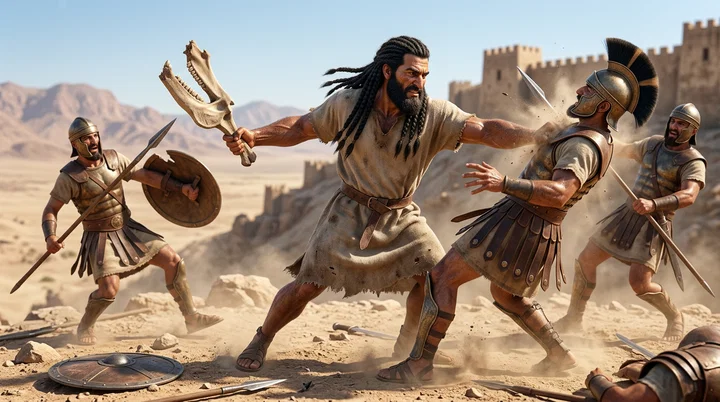
And it came to pass, when he had made an end of speaking, that he cast away the jawbone out of his hand, and called that place Ramath-lehi.
Translations
And it came to pass, when he had made an end of speaking, that he cast away the jawbone out of his hand, and called that place Ramathlehi.
King James Version, KJV Cambridge Paragraph Bible
And it came to pass, when he had made an end of speaking, that he cast away the jawbone out of his hand, and called that place Ramath-lehi.
And it came to pass when he had made an end of speaking, that he cast away the jaw-bone out of his hand, and called that place Ramath-lehi.
Revised Version, American Standard Version
And it came to pass, when he had made an end of speaking, that he cast away the jawbone out of his hand; and that place was called Ramath-lehi.
And it cometh to pass when he finisheth speaking, that he casteth away the jaw-bone out of his hand, and calleth that place Ramath-Lehi;
And it came to pass when he had ended speaking, that he cast away the jawbone out of his hand, and called that place Ramath-Lehi.
And it came to pass, when he had made an end of speaking, that he cast away the jawbone out of his hand,—and called the name of that place, Ramath-lehi.
Berean Standard Bible, Majority Standard Bible
And when Samson had finished speaking, he cast the jawbone from his hand; and he named that place Ramath-lehi.
When he had finished speaking, he threw the jawbone out of his hand; and that place was called Ramath Lehi.
And having said these words, he let the mouth-bone go out of his hand; so that place was named Ramath-lehi.
And when he had left speaking, hee cast away the iawebone out of his hande, and called that place, Ramath-Lehi.
Douay-Rheims (Challoner revision)
And when he had ended these words singing, he threw the jawbone out of his hand, and called the name of that place Ramathlechi, which is interpreted the lifting up of the jawbone.
Pictures
Cross-references
- Judges 15:9
Then the Philistines went up, and pitched in Judah, and spread themselves in Lehi.
shows Lehi is a place name
Commentary
Each commentary is drawn from primary sources: the writings of Ellen G. White and Adventist pioneers and periodicals. Each commentary is separate. Its own words are not a quotation; follow the references to read the source passages.
Ellen G. White
2 sources
The moment marks the close of the jawbone victory over the Philistines, when speaking was finished and the bone was cast from the hand and the place was called Ramath-lehi.PP 564.2 That triumph might have become the opening for throwing off Philistine oppression, but cowardice and disobedience and accommodation with the oppressors kept any follow-through from happening.PP 564.2 Such abandonment of the deliverer raised up for them, even to the point of joining their enemies, fit the wider pattern of their conduct.PP 564.2 In the larger history the episode belongs to a life yielded to passion rather than lived in dependence on divine strength, a course whose end is shame and disaster and death.ST Oct 13, 1881
Sources
Pioneers and periodicals
8 sources
When he had finished killing, Samson threw the jawbone out of his hand and called that place Ramath-lehi, which in English means the height of a jawbone, because Lehi is the Hebrew word for jawbone.ST Jul 13, 1904 The verse marks the end of his slaughter of the Philistines with the jawbone, which he celebrated in his own words, praising himself for the victory instead of ascribing the glory to God.ST Oct 6, 1881 No sooner had he finished speaking than, exhausted by his prodigious labor with no water at hand, he was seized by intense and painful thirst to remind him of his weakness, and that thirst made him feel his utter dependence on God, convinced him he had triumphed not by his own power but in the strength of the Omnipotent One, and led him to give God the praise and pray for relief.ST Oct 6, 1881
The verse belongs to the judgeship of Samson and is included in the reading of his final conflict with the Philistines.STST Mar 24, 1909 Samson was a man of very weak character, marked by selfishness, sensuality, carnality and sins, who gave in to passion rather than relying on God's strength and squandered the opportunities of his life.ST Oct 13, 1881ST Apr 2, 1912ST Apr 4, 1911ST Mar 24, 1909 Yet he believed in God and Israel's mission and was ultimately willing to give his life to avenge Israel's foes, so his story is presented as an example of faith.ST Apr 2, 1912ST
God did not use Samson because of those faults but in spite of them, using him as the best instrument and the very best material available in the situation involving Israel and the Philistines, and in great pity using even a failing instrument to save His people when they had departed far from Him.ST Apr 2, 1912ST Apr 4, 1911ST Mar 24, 1909 His history shows that the path he chose ended in shame, disaster, and death.ST Oct 13, 1881 The account to which the verse belongs is ridiculed by some who reject Old Testament narratives, but it is part of Scripture whose truth and importance Christ and the apostles upheld.ST Mar 9, 1888
Sources