Judges 5:26
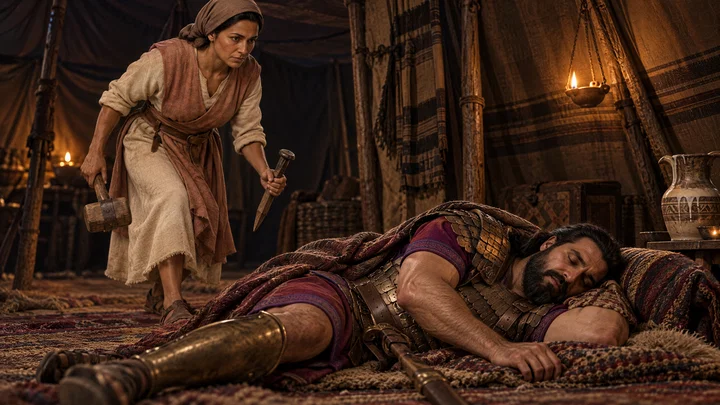
She put her hand to the nail, and her right hand to the workmen’s hammer; and with the hammer she smote Sisera, she smote off his head, when she had pierced and stricken through his temples.
Translations
American King James Version, King James Version
She put her hand to the nail, and her right hand to the workmen’s hammer; and with the hammer she smote Sisera, she smote off his head, when she had pierced and stricken through his temples.
She put her hand to the nail,
And her right hand to the workmen’s hammer;
And with the hammer she smote Sisera, she smote off his head,
When she had pierced and stricken through his temples.She put her hand to the nail, and her right hand to the workmen's hammer; and with the hammer she smote Sisera, she smote off his head, when she had pierced and struck through his temples.
She put her hand to the nail, and her right hand to the workmen’s hammer; and with the hammer she smote Sisera, she smote through his head, yea, she pierced and struck through his temples.
She put her hand to the tent-pin,
And her right hand to the workmen’s hammer;
And with the hammer she smote Sisera, she smote through his head;
Yea, she pierced and struck through his temples.Her hand to the pin she sendeth forth, And her right hand to the labourers' hammer, And she hammered Sisera — she smote his head, Yea, she smote, and it passed through his temple.
She put her hand to the tent-pin, And her right hand to the workmen's hammer; And she smote Sisera, she struck through his head, Shattered and pierced through his temples.
Her hand, to the tent-pin, put she forth, and, her right hand, to the toilers’ mallet,—Then smote she Sisera, She shattered his head, Yea she split open and pierced through his temples:
Berean Standard Bible, Majority Standard Bible
She reached for the tent peg,
her right hand for the workman’s hammer.
She struck Sisera and crushed his skull;
she shattered and pierced his temple.She put her hand to the tent peg,
and her right hand to the workmen’s hammer.
With the hammer she struck Sisera.
She struck through his head.
Yes, she pierced and struck through his temples.She put out her hand to the tent-pin, and her right hand to the workman's hammer; and she gave Sisera a blow, crushing his head, wounding and driving through his brow.
She put her hand to the naile, and her right hand to the workemans hammer: with the hammer smote she Sisera: she smote off his head, after she had wounded, and pearsed his temples.
Douay-Rheims (Challoner revision)
She put her left hand to the nail, and her right hand to the workman’s hammer, and she struck Sisara, seeking in his head a place for the wound, and strongly piercing through his temples.
Pictures
Cross-references
- Judges 4:4-24
And Deborah, a prophetess, the wife of Lapidoth, she judged Israel at that time.
Deborah and Jael help bring about Barak’s victory over Sisera.
- Judges 4:21
Then Jael Heber’s wife took a nail of the tent, and took an hammer in her hand, and went softly unto him, and smote the nail into his temples, and fastened it into the ground: for he was fast asleep and weary. So he died.
Narrates Jael killing Sisera with a tent peg.
- Judges 4:14
And Deborah said unto Barak, Up; for this is the day in which the LORD hath delivered Sisera into thine hand: is not the LORD gone out before thee? So Barak went down from mount Tabor, and ten thousand men after him.
Deborah directs Barak as Israel goes into battle.
- Judges 5:19-21
The kings came and fought, then fought the kings of Canaan in Taanach by the waters of Megiddo; they took no gain of money.
The song describes the battle at Megiddo.
- Judges 4:16
But Barak pursued after the chariots, and after the host, unto Harosheth of the Gentiles: and all the host of Sisera fell upon the edge of the sword; and there was not a man left.
pursuit leaves Sisera to flee alone
Commentary
Each commentary is drawn from primary sources: the writings of Ellen G. White and Adventist pioneers and periodicals. Each commentary is separate. Its own words are not a quotation; follow the references to read the source passages.
Ellen G. White
Judges 5:26 stands in Deborah's most sublime and impassioned song celebrating the triumph of Israel and the destruction of Sisera and his forces. The song ascribes to God all the glory of the deliverance and bids the people praise Him for His wonderful works. It calls upon the kings and princes of the surrounding nations to hear what God wrought for Israel and to take warning not to do them harm, showing that honor and power belong to God and not to men or to their idols. It portrays the awful exhibitions of divine power and majesty displayed at Sinai.
It sets before Israel their helpless and distressed condition under the oppression of their enemies. It relates in glowing language the history of their deliverance, which effectually subdued the Canaanites. After this the land had peace forty years, but prosperity did not bring Israel nearer to God.
Pioneers and periodicals
14 sources
She put her hand to the tent peg and her right hand to the workman's hammer to drive it through the temples of Sisera, Jabin's general, and take his life when he slept in her tent after fleeing Barak's army.RH Jun 29, 1911ST May 27, 1913RH Oct 20, 1874 The deed is celebrated in the triumphant song of Deborah and Barak over Israel's deliverance from twenty years of oppression by Jabin, king of Canaan, and the routing of his nine hundred chariots of iron.ST Feb 27, 1901RH Apr 1, 1902ST The song ascribes all the glory of the deliverance to Jehovah and bids kings and princes hear what God wrought for Israel and take warning not to harm them.RH Nov 7, 1912 God has in all ages used women in public capacity to His glory, so that Jael is blessed above women in the tent and Barak must join Deborah in praising the woman who destroyed Israel's enemy because he would not trust the Lord's word through His prophetess alone.RH Jun 29, 1911ST Feb 27, 1901ST Mar 5, 1896 The battle at Megiddo in the days of Deborah and Barak stands as an object lesson of the final gathering of the nations under the sixth and seventh plagues, calling all in crisis to discern the time, accept God's message, and come to the help of the Lord against the mighty.RH Mar 19, 1901RH Aug 17, 1911RH Feb 2, 1905
Story and Historical Setting
Judges 5:26 belongs to the song of Deborah and Barak in Judges 5:1-31, a triumphant song celebrating Jael's part in Israel's deliverance from Jabin king of Canaan after twenty years of oppression and in Israel's victory over Sisera's army.ST Feb 27, 1901ST It is identified as part of Deborah's triumph song over that army.
The verse recounts how Jael, wife of Heber the Kenite whose tent stood among Israel's allies, destroyed Sisera, Jabin's general and captain of his heathen idolatrous host.RH Jun 29, 1911RH Nov 7, 1912RH Apr 1, 1902 She laid her right hand to the workman's hammer and drove a nail or tent peg through his temples to take his life and cut off his head.RH Jun 29, 1911ST May 27, 1913RH Oct 20, 1874RH Nov 7, 1912RH Apr 1, 1902 Her praised deed made her right hand an example of power and strength in action.RH Oct 20, 1874
Sisera's end came after Barak with ten thousand men of Zebulon and Naphtali routed his nine hundred chariots of iron near Mount Tabor and down the Kishon valley toward Harosheth of the Gentiles, where the whole host fell by the sword.RH Apr 1, 1902 Sisera then fled on foot over or around Mount Tabor to the opposite side to seek protection from Heber as a supposed friend, and stopped to rest at Jael's tent.RH Jun 29, 1911RH Apr 1, 1902 There she gave him milk to drink and covered him with a mantle while he told her to stand in the tent door and turn away inquirers, and when he fell asleep she drove the spike through the sleeper's temples, leaving the pin still projecting, then directed Barak and his men to their enemy lying in the toils of death.RH Jun 29, 1911 Thus despite his iron chariots and oppression of Israel he was defeated through Jael's action.ST May 27, 1913
The verse falls within the record of Judges 3-17 of Israel's backsliding, suffering and oppression, return to God, forgiveness and deliverance.ST It belongs to the earliest poetry of Israel that rose among the hills of Galilee when Barak of Naphtali triumphed over the Canaanites, proving the intellectual vigor and mental freshness and force of the Galilean people.ST Feb 10, 1881 Through the victory of Barak and Deborah the Israelites first gained possession of the plain of Jezreel, the Canaanites were effectually subdued, and afterward the land had peace forty years, though prosperity did not bring Israel nearer to God.ST May 9, 1916
Theology Prophecy and Duty
The song in which the verse stands presents the battle as a deliverance accomplished with Jehovah's help.RH Nov 7, 1912 It ascribes to God all the glory of the deliverance and bids the people praise Him for His wonderful works. It calls upon the kings and princes of the surrounding nations to hear what God wrought for Israel and to take warning not to do them harm, showing that honor and power belong to God and not to men or to their idols. It portrays the awful exhibitions of divine power and majesty displayed at Sinai, sets before Israel their helpless and distressed condition under the oppression of their enemies, and relates in glowing language the history of their deliverance. That deliverance effectually subdued the Canaanites, after which the land had peace forty years, but prosperity did not bring Israel nearer to God.
The verse belongs to the account of the battle of Megiddo in the days of Deborah and Barak.RH Mar 19, 1901 Barak's victory over the Canaanites is one of the great victories connected with the battlefield of Megiddo.RH Feb 2, 1905 That battle serves as an object lesson connected with the final gathering of the nations under the sixth plague and the events of the sixth and seventh plagues.RH Mar 19, 1901
Hands are emblems of human actions, and the right hand in particular is the symbol of power and strength.RH Oct 20, 1874 Jael is praised in the song for laying her right hand to the workman's hammer and taking the oppressor Sisera's life.RH Oct 20, 1874 Her deed therefore stands as one instance of the right hand as a continual emblem of favor, protection, and power.RH Oct 20, 1874
God has used women in a public capacity in all ages to His glory.ST Feb 27, 1901 The account of women taking an active public part in God's work shows that the instruction for women to keep silent does not forbid them from bearing testimony, helping in God's work, or proclaiming truth in a womanly, Christian way.ST Mar 5, 1896 Barak refused to go on his heaven-sent mission to array ten thousand men of Naphtali and Zebulon at Mount Tabor on God's call through the prophetess Deborah unless Deborah went with him, for lack of trust in the Lord's word through her, so a woman gained the honor that ought to have been his under God.RH Jun 29, 1911 Jael the wife of Heber the Kenite destroyed Sisera, Jabin's general, after he fled from Barak's army and stopped to rest at her tent, where she gave him milk to drink and covered him with a mantle while he told her to stand in the tent door and turn away inquirers, and when he fell asleep she would not risk the wrath of his pursuers by hiding him but drove the spike through the sleeper's temples, leaving the tent pin still projecting when she directed Barak and his men to their enemy lying in the toils of death.RH Jun 29, 1911 Barak was then obliged to join Deborah in a song of praise for the woman who had destroyed Israel's enemy, and God thereby established her sex on an equality with the men of Israel.RH Jun 29, 1911
Jael was a tender-hearted woman of a tender-hearted family on friendly terms with the enemy, yet she defended the cause of God in a time of crisis by killing Sisera the enemy of Israel.RH Aug 17, 1911 To do so means discerning the importance of the time and accepting the message God sends, thereby justifying God and bringing salvation to herself and to the people.RH Aug 17, 1911 For this she is blessed above women in the tent, in contrast to those who fail to come to the help of the Lord against the mighty and bring a curse upon themselves.RH Aug 17, 1911
Sources