Judges 5:27
At her feet he bowed, he fell, he lay down: at her feet he bowed, he fell: where he bowed, there he fell down dead.
Translations
American King James Version, King James Version, Webster Bible
At her feet he bowed, he fell, he lay down: at her feet he bowed, he fell: where he bowed, there he fell down dead.
At her feet he bowed, he fell, he lay down:
At her feet he bowed, he fell:
Where he bowed, there he fell down dead.At her feet he bowed, he fell, he lay: at her feet he bowed, he fell: where he bowed, there he fell down dead.
At her feet he bowed, he fell, he lay;
At her feet he bowed, he fell:
Where he bowed, there he fell down dead.Between her feet he bowed — He fell, he lay down; Between her feet he bowed, he fell; Where he bowed, there he fell — destroyed.
Between her feet he bowed, he fell, he lay down: Between her feet he bowed, he fell; Where he bowed, there he fell, overcome.
Between her feet, he bowed—he fell, he lay,—Between her feet, he bowed—he fell, Where he bowed, There, he fell—destroyed!
Berean Standard Bible, Majority Standard Bible
At her feet he collapsed, he fell,
there he lay still;
at her feet he collapsed, he fell;
where he collapsed, there he fell dead.At her feet he bowed, he fell, he lay.
At her feet he bowed, he fell.
Where he bowed, there he fell down dead.Bent at her feet he went down, he was stretched out; bent at her feet he went down; where he was bent down, there he went down in death.
He bowed him downe at her feete, he fell downe, and lay still: at her feete hee bowed him downe, and fell: and when he had sunke downe, he lay there dead.
Douay-Rheims (Challoner revision)
At her feet he fell: he fainted, and he died: he rolled before her feet, and he lay lifeless and wretched.
Pictures
Cross-references
- Judges 4:17-22
Howbeit Sisera fled away on his feet to the tent of Jael the wife of Heber the Kenite: for there was peace between Jabin the king of Hazor and the house of Heber the Kenite.
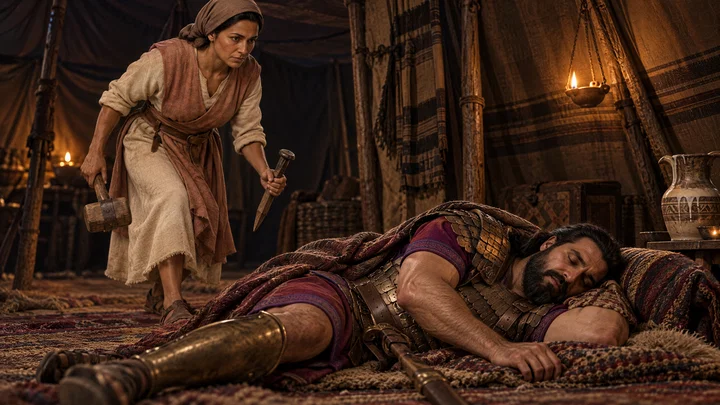
Jael kills Sisera, the deed celebrated in Deborah’s song.
- Judges 4:21
Then Jael Heber’s wife took a nail of the tent, and took an hammer in her hand, and went softly unto him, and smote the nail into his temples, and fastened it into the ground: for he was fast asleep and weary. So he died.
Jael drives a tent nail through Sisera’s temples, and he dies.
- Judges 4:15-16
And the LORD discomfited Sisera, and all his chariots, and all his host, with the edge of the sword before Barak; so that Sisera lighted down off his chariot, and fled away on his feet.
Barak’s forces defeat Sisera, who flees on foot.
Commentary
Each commentary is drawn from primary sources: the writings of Ellen G. White and Adventist pioneers and periodicals. Each commentary is separate. Its own words are not a quotation; follow the references to read the source passages.
Ellen G. White
Judges 5:27 belongs to Deborah's sublime and impassioned song celebrating Israel's triumph in the destruction of Sisera and his forces. That song portrays the awful exhibitions of divine power and majesty displayed at Sinai. It sets before Israel their helpless and distressed condition under oppression. It relates the history of Israel's deliverance, and this verse records the death of Sisera as part of that deliverance. That deliverance gives glory wholly to God and not to men or to their idols, calling Israel to praise Him for His wonderful works.
What God wrought for Israel as celebrated in the song stands as a warning to the kings and princes of surrounding nations not to harm them. The destruction of Sisera described in the verse effectually subdued the Canaanites. After that subduing, the land had peace for forty years. Yet the prosperity that followed did not bring Israel nearer to God.
Pioneers and periodicals
14 sources
The verse records the death of Sisera at the feet of Jael, the wife of Heber, who drove a tent pin through his temples while he slept in her tent and left him dead.RH Jun 29, 1911STRH Apr 1, 1902 He was the captain of Jabin's Canaanite host who had oppressed Israel twenty years with iron chariots, and he had fled on foot from Barak's pursuit to seek shelter as a supposed friend.RH Jun 29, 1911ST May 27, 1913RH Apr 1, 1902 It stands in the triumphant victory song of Deborah and Barak celebrating what God wrought for Israel in overthrowing his army.ST Feb 27, 1901ST The song ascribes the glory wholly to God and not to men, setting forth Israel's helpless condition under oppression and His mighty deliverance as a warning to surrounding kings and princes. God gave the honor of the victory to a woman because Barak would not go forward in faith on God's word alone, thereby showing that women may speak and serve publicly to His glory, and the battle at Megiddo thus described stands as a lesson for the final gathering of the nations at Armageddon.RH Jun 29, 1911RH Mar 19, 1901ST May 9, 1916ST Feb 27, 1901ST May 13, 1903
Sisera's Fall in Song
At her feet he bowed and fell and lay down dead, for Jael the wife of Heber struck Sisera in her tent with a tent nail-pin driven through his temples.RH Jun 29, 1911STRH Apr 1, 1902 She used a peg and hammer to smite him, and left him dead with the pin still in his head.RH Jun 29, 1911STRH Apr 1, 1902 Sisera was the captain of Jabin's heathen army, of Jabin king of Canaan.RH Apr 1, 1902ST He had oppressed Israel twenty years with iron chariots.ST May 27, 1913ST After Barak pursued his chariots and host down the Kishon valley to Harosheth of the Gentiles and left none alive, Sisera fled on foot over or around Mount Tabor to the opposite side of the mountain to seek protection from Heber, a supposed friend, where he slept in Jael's tent.RH Jun 29, 1911RH Apr 1, 1902
When Jael showed him to Barak, Barak found him so.RH Jun 29, 1911 Deborah and Barak joined in a song of praise for Jael for the deed.RH Jun 29, 1911 The verse belongs to the triumphant, sublime and impassioned victory song and poem of Deborah and Barak celebrating Israel's triumph over Sisera's army and forces.ST Feb 27, 1901ST It is counted among the earliest poetry of Israel, which rose among the Galilean hills when Barak of Naphtali triumphed over the Canaanites.STST Feb 10, 1881 That poetry shows the intellectual vigor and mental freshness and force of the Galilean people.ST Feb 10, 1881
What God wrought for Israel in the song calls Israel to praise Him for His wonderful works, with the glory belonging wholly to God and not to men or their idols. It holds up the deliverance as a warning to the kings and princes of surrounding nations not to harm Israel, and portrays the awful exhibitions of divine power and majesty displayed at Sinai. It sets before Israel their helpless and distressed condition under oppression, and relates the history of their deliverance. The destruction of Sisera described in the verse effectually subdued the Canaanites, after which the land had peace forty years. Yet prosperity did not bring Israel nearer to God.
Faith, Women, and Prophecy
The verse belongs to the account of Sisera's defeat by Israel under Deborah and Barak, the overthrow of an enemy who had oppressed Israel with iron chariots, presented as an example of what Israel could accomplish through faith.ST May 27, 1913 Jehovah's help brought the enemy's forces to flight, and one telling of the battle led by Deborah and Barak centers on that flight and does not describe the specific scene of Sisera falling dead at Jael's feet.RH Nov 7, 1912 After Sisera fled from Barak's army and slept in her tent, Jael drove a tent nail through his temples and left him dead with the pin still in his head, and Barak found him so when Jael showed him to him, for which Deborah and Barak joined in a song of praise for Jael.RH Jun 29, 1911 The honor of victory was given to a woman because Barak would not trust God's word through Deborah and go in faith alone, and by this woman was established on an equality with the men of Israel as representatives of His will.RH Jun 29, 1911
The verse shows God using a woman in a public capacity to His glory in the song of Deborah and Barak.ST Feb 27, 1901 Deborah the prophetess helping Barak proves that women may speak and serve publicly for God without usurping authority over men.ST May 13, 1903 The chapter shows a woman having a part in God's work and proves that the command for women to keep silence in the churches does not forbid women bearing testimony for Christ, helping in His work, and proclaiming His truth in womanly, Christian ways.ST Mar 5, 1896
Jael defended the cause of God by killing the enemy of Israel in a time of crisis.RH Aug 17, 1911 Though tender-hearted, belonging to a tender-hearted family, and on friendly terms with the enemy, she discerned the importance of the time and accepted the message God sent.RH Aug 17, 1911 By this act she justified God and brought salvation to herself and to the people.RH Aug 17, 1911
The verse belongs to the account of the battle of Megiddo in Deborah and Barak's time, one of the two great victories associated with Megiddo, the Old Testament battlefield where Israel fought the enemies of God's people.RH Feb 2, 1905 Through Barak and Deborah's victory the Israelites first gained possession of the Plain of Jezreel.ST May 9, 1916 That battle of Megiddo serves as an object lesson for the final gathering of the nations at Armageddon under the sixth plague, and the chapter is important to study in connection with the sixth and seventh plagues.RH Mar 19, 1901
Sources