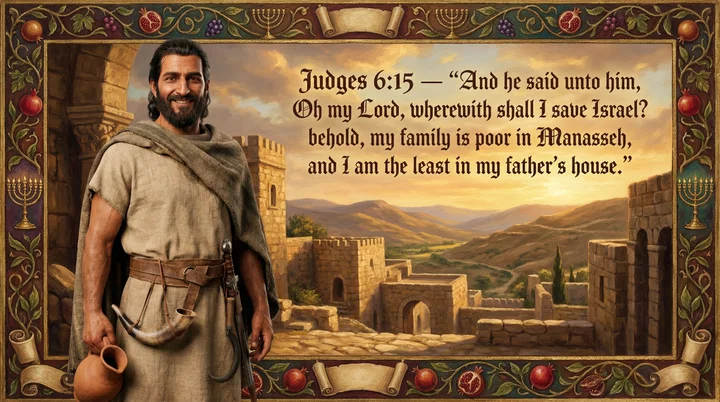
Judges 6:15
And he said unto him, Oh my Lord, wherewith shall I save Israel? behold, my family is poor in Manasseh, and I am the least in my father’s house.
Translations
And he said to him, Oh my Lord, with which shall I save Israel? behold, my family is poor in Manasseh, and I am the least in my father’s house.
And he said unto him, Oh my Lord, wherewith shall I save Israel? behold, my family is poor in Manasseh, and I am the least in my father’s house.
And he said unto him, O my Lord, wherewith shall I save Israel? behold, my family is poor in Manasseh, and I am the least in my father’s house.
And he said to him, O my LORD, by what means shall I save Israel? behold, my family is poor in Manasseh, and I am the least in my father's house.
And he said unto him, Oh Lord, wherewith shall I save Israel? behold, my family is the poorest in Manasseh, and I am the least in my father’s house.
And he said unto him, Oh, Lord, wherewith shall I save Israel? behold, my family is the poorest in Manasseh, and I am the least in my father’s house.
And he saith unto him, 'O, my lord, wherewith do I save Israel? lo, my chief [is] weak in Manasseh, and I the least in the house of my father.'
And he said to him, Ah Lord, wherewith shall I save Israel? behold, my thousand is the poorest in Manasseh, and I am the least in my father's house.
And he said unto him—Pardon, O my Lord! How, shall I save Israel? Lo! my thousand, is the poorest in Manasseh, and, I, am the youngest in the house of my father.
Berean Standard Bible, Majority Standard Bible
“Please, my Lord,” Gideon replied, “ how can I save Israel? Indeed, my clan is the weakest in Manasseh, and I am the youngest in my father’s house.”
He said to him, “ O Lord, how shall I save Israel? Behold, my family is the poorest in Manasseh, and I am the least in my father’s house.”
And he said to him, O Lord, how may I be the saviour of Israel? See, my family is the poorest in Manasseh, and I am the least in my father's house.
And he answered him, Ah my Lord, whereby shall I saue Israel? beholde, my father is poore in Manasseh, and I am the least in my fathers house.
Douay-Rheims (Challoner revision)
He answered and said: I beseech thee, my lord, wherewith shall I deliver Israel? Behold my family is the meanest in Manasses, and I am the least in my father’s house.
Pictures
Cross-references
- Judges 7:16-22
And he divided the three hundred men into three companies, and he put a trumpet in every man’s hand, with empty pitchers, and lamps within the pitchers.
shows the humble man's victory with lamps and pitchers
- Judges 6:4-5
And they encamped against them, and destroyed the increase of the earth, till thou come unto Gaza, and left no sustenance for Israel, neither sheep, nor ox, nor ass.
Describes the devastation Gideon was called to deliver Israel from.
- Judges 8
And the men of Ephraim said unto him, Why hast thou served us thus, that thou calledst us not, when thou wentest to fight with the Midianites? And they did chide with him sharply.
The account tells of Gideon delivering Israel.
- 1 Corinthians 1:27
But God hath chosen the foolish things of the world to confound the wise; and God hath chosen the weak things of the world to confound the things which are mighty;
God uses the weak to confound the mighty.
- Hebrews 11:32
And what shall I more say? for the time would fail me to tell of Gedeon, and of Barak, and of Samson, and of Jephthae; of David also, and Samuel, and of the prophets:
Gideon is named among the heroes of faith.
- Judges 6:37-40
Behold, I will put a fleece of wool in the floor; and if the dew be on the fleece only, and it be dry upon all the earth beside, then shall I know that thou wilt save Israel by mine hand, as thou hast said.
The fleece was another sign that strengthened Gideon.
- Isaiah 9:4
For thou hast broken the yoke of his burden, and the staff of his shoulder, the rod of his oppressor, as in the day of Midian.
Gideon’s day of Midian is the pattern for breaking the yoke of oppression.
- Exodus 4:10-12
And Moses said unto the LORD, O my Lord, I am not eloquent, neither heretofore, nor since thou hast spoken unto thy servant: but I am slow of speech, and of a slow tongue.
Both show God supplying words to the inadequate.
- Amos 7:2
And it came to pass, that when they had made an end of eating the grass of the land, then I said, O Lord GOD, forgive, I beseech thee: by whom shall Jacob arise? for he is small.
Both express smallness in a plea concerning Israel’s deliverance.
- Judges 6:25-27
And it came to pass the same night, that the LORD said unto him, Take thy father’s young bullock, even the second bullock of seven years old, and throw down the altar of Baal that thy father hath, and cut down the grove that is by it:
Gideon obeys God by destroying Baal’s altar and building an altar to the Lord.
- Judges 6:1
And the children of Israel did evil in the sight of the LORD: and the LORD delivered them into the hand of Midian seven years.
Begins the Midianite oppression from which Israel needed deliverance.
- Judges 6:21
Then the angel of the LORD put forth the end of the staff that was in his hand, and touched the flesh and the unleavened cakes; and there rose up fire out of the rock, and consumed the flesh and the unleavened cakes. Then the angel of the LORD departed out of his sight.
The accepted offering had already given Gideon evidence of God’s guidance.
- Judges 7:9-11
And it came to pass the same night, that the LORD said unto him, Arise, get thee down unto the host; for I have delivered it into thine hand.
God strengthens Gideon with encouragement before the attack.
- Exodus 4:1-9
And Moses answered and said, But, behold, they will not believe me, nor hearken unto my voice: for they will say, The LORD hath not appeared unto thee.
Moses, like Gideon, voices human weakness, and God gives him signs.
- Judges 6:28-30
And when the men of the city arose early in the morning, behold, the altar of Baal was cast down, and the grove was cut down that was by it, and the second bullock was offered upon the altar that was built.
The city discovers Gideon destroyed Baal’s altar and demands his death.
Commentary
Each commentary is drawn from primary sources: the writings of Ellen G. White and Adventist pioneers and periodicals. Each commentary is separate. Its own words are not a quotation; follow the references to read the source passages.
Ellen G. White
8 sources
This verse belongs to the account of God raising up a helper to deliver Israel from Midian after apostasy and oppression, as part of Israel's repeated cycle of backsliding, chastisement, confession, and rescue.PP 544.2–545.1 Its setting is when Israel did evil and was delivered into the hand of Midian for seven years, with the Amalekites and the desert peoples joining in ravaging the land from Jordan to the Philistine plain, stripping harvests and forcing Israel into walled towns and caves.PP 545.2–3 This continued until the people heeded reproof, confessed their sins, and God raised up a helper for them.PP 545.2–3
Gideon was from a division of Manasseh that held no leading position, though the household of Joash was known for courage and integrity, and he was called to deliver Israel from Midian.PP 546.1–547.2 He was taken from humble work threshing wheat at the threshing floor to become God's instrument for delivering Israel.GW92 316.1GW 332.3–333.1 In the verse he answers the call to save Israel by stressing his lack of standing and ability, that his clan is poor and insignificant in Manasseh and he is the least in his father's house.ST Jun 23, 1881ST Jun 30, 1881PP 553.2–554.1
By asking how he could save Israel he expresses his sense of personal unfitness as an unlikely deliverer.ST Jun 23, 1881ST Jun 30, 1881PP 553.2–554.1 His low position and sense of insufficiency did not prevent God from choosing him, for God saw his integrity and courage and moral courage, his distrust of self, and his willingness to listen, obey, and follow divine guidance.ST Jun 30, 1881PP 553.2–554.1 The verse shows that God's work does not depend on human rank, intellect, or influence, and that He can use humble and apparently weak people to accomplish His purposes.ST Jun 30, 1881 It shows that God can use humble people who distrust their own strength and rely on Him, joining their weakness to His might and their lack of wisdom to His wisdom.PP 553.2–554.1
Sources
Pioneers and periodicals
21 sources
Gideon was called by the angel of the Lord to save Israel from the Midianites and Amalekites who came in multitude to destroy their sustenance, with assurance that the Lord was with him and would deliver Israel through him.ST Apr 1, 1913 Threshing wheat in hiding as a poor farmer's son, he answered in astonishment by pleading that his clan was the poorest in Manasseh and he was the least in his father's house, expressing humility and a sense of personal unfitness and inability for the work.GSAM 34.1ST Mar 4, 1886RH Jun 4, 1901RH Oct 17, 1907 God met that inadequacy by sending him Himself, promising His presence and victory over Midian and giving signs to support His servant's weakness.ST Sep 26, 1895ST Aug 7, 1901 His low place did not prevent his choosing, for true fitness for God's work lies not in rank, ability, or influence but in fear of the Lord, and God uses humble and weak instruments to do exalted work and confound the mighty, since He cannot use a self-confident man who would take the glory to himself.ST Jun 30, 1881RH Mar 13, 1900ST Apr 1, 1913RH Jun 4, 1901 So the victory with three hundred men with only lamps, pitchers and trumpets depended on God and not human strength, and the account was written to give comfort in discouragement and confidence in His promises to deliver when greatly outnumbered.GSAM 34.1RH Jun 23, 1903ST Jun 18, 1885ST Sep 26, 1895
Gideon's Call and Objection
The verse belongs to God's calling of Gideon to deliver Israel in a national crisis, when leaders raised up for that work were called saviours.ST Apr 1, 1913 The oppression came from the Midianites and Amalekites, who swarmed in multitude and destroyed all sustenance.GSAM 34.1 The call came by the appearance of the angel of the Lord, bringing the message that the Lord was with Gideon and calling him to the work of delivering his people through him.RH Mar 30, 1916 That direct call from God gave assurance that its source was divine.
Gideon was the son of Joash, a young man and poor farmer's son engaged in humble work when the Lord called him.GSAM 34.1RH May 13, 1915RH Jul 14, 1910 He had been reduced to threshing a little wheat in hiding from his enemies.GSAM 34.1 His clan was the poorest and weakest in Manasseh and he himself was the least in his father's house, an obscure and socially low-ranking condition.GSAM 34.1RH Mar 13, 1900ST Jul 17, 1884 That literal poverty is proved by his later saying to the Ephraimites that the gleaning of Ephraim was better than the whole vintage of Abiezer.RH Mar 13, 1900
His question about how he shall save Israel is an astonished reply pleading his family's poverty and his own low place.ST Jun 23, 1881GSAM 34.1ST Mar 4, 1886 It expresses humility, modesty, and a sense of weakness, smallness, personal unfitness, inability and unworthiness for the work entrusted to him.ST Jun 23, 1881ST Jun 30, 1881RH Jun 4, 1901RH Oct 17, 1907ST Jul 17, 1884 It voices doubt that one from so poor a family and so low a position could undertake the task of deliverance.ST Jun 23, 1881ST Jun 30, 1881ST The humble poor who count themselves least are likewise tempted on that ground to beg off from a specified work.ST Mar 4, 1886
God answered that inadequacy by sending him, assuring His presence, and promising victory over Midian.RH Oct 17, 1907 He gave him a sign that He would be with him, for God gave extraordinary signs to support the weakness of His servants, not as evidence that asking for a sign is skepticism.ST Aug 7, 1901RH May 13, 1915 Gideon responded to the encouragement with worship and renewed readiness to act on the assurance that God would deliver Israel, strengthened as he prepared to face Midian with a small company.ST Sep 26, 1895 Yet he later struggled to trust God's promise when he faced a vast enemy army with only three hundred men.
God Uses Humble Instruments
Gideon's low position did not prevent his being chosen to deliver Israel from the Midianites, for when called he was a young man engaged in humble work who had faithfully done the tasks at hand rather than despising them.ST Jun 30, 1881ST Apr 1, 1913RH Jul 14, 1910 God sometimes uses very unpromising people, choosing the best available for His purpose.ST Apr 1, 1913 He saw in Gideon integrity and moral courage, distrust of self, and willingness to listen and obey.ST Jun 30, 1881
True worth for God's work does not lie in knowledge, ability, greatness, human rank, intellect, or influence, but in the fear of the Lord and departing from evil, which the poorest can obtain as easily as the mighty.ST Jun 30, 1881RH Mar 13, 1900 His poverty was literal, for his family was the poorest in Manasseh and he was the least in his father's house, as proved by his later answer that the gleaning of Ephraim was better than the whole vintage of Abiezer.RH Mar 13, 1900 For this reason God uses humble and weak instruments to do exalted work and to confound the mighty.ST Jun 30, 1881RH Mar 13, 1900 His answer reveals a man who realized his inability and unworthiness, and therefore God could use him, for God cannot use a self-confident man.RH Jun 4, 1901 If God gave such a man victory he would take to himself the glory that belongs to God, and this would hinder the people from seeing the Lord's power and being drawn to Him, and it would also so exalt the man that he would be in danger of losing his own soul.RH Jun 4, 1901
The call and promise answer that inadequacy, for Gideon is sent, assured of God's presence, and promised victory over Midian.RH Oct 17, 1907 The victory depended on God and not human strength, for God supplies His Spirit and power for the task He calls people to do, and the account was written to give courage to all in trouble and confidence in His promises to be a stronghold in trouble and to make a way of escape in temptation.ST Jun 18, 1885RH Oct 17, 1907 Depending on that promise and following God's battle instructions, Gideon and three hundred men with no visible weapons except lamps, pitchers, trumpets and torches won a mighty and decisive victory.GSAM 34.1RH Jun 23, 1903RH Oct 17, 1907 They needed to wield no sword but only to break pitchers, hold aloft torches and shout for God, an action that looked like foolishness to human judgment, proving that victory comes by God Himself.GSAM 34.1ST Dec 16, 1903 It shows how mightily God can work with few against many when they believe and trust in the Lord, and it points to the final destruction when all armor and blood-stained garments shall be for burning.ST Jun 18, 1885ST Dec 16, 1903ST Mar 24, 1909
Strength for Present Service
The story of Gideon and his army was set down to give comfort in discouragement and courage to all who are in trouble.ST Jun 18, 1885 It was not written to teach that God will fight for His people in physical warfare, but to stand as visible proof of His wonderful power to deliver when His people are greatly outnumbered because they believe and trust in Him.ST Jun 18, 1885 It gives confidence in His promises to be a stronghold in trouble and to make a way of escape in temptation.ST Jun 18, 1885 The encouragement Gideon received led him to worship and to renewed readiness to act on the assurance that God would deliver Israel through him, strengthening him to face Midian with a small company, though he later struggled to trust that promise when he faced a vast enemy army with only three hundred men.ST Sep 26, 1895
The call belongs to the Lord's way of instructing His people by the ministration of angels in calling and strengthening Gideon.RH Jun 23, 1903ST Apr 14, 1898 Angels are a created race higher than men and not the spirits of dead men.RH Jun 23, 1903 Through the angel's appearance the Lord promised to deliver Israel from oppressors through Gideon and gave instruction for preparing and carrying out His plan to defeat a mighty host with three hundred men having no visible weapons except lamps, pitchers, and trumpets.RH Jun 23, 1903
Gideon stands as the pattern of workers called by God who know their task and persist despite obstacles and a hard struggle, even while recognizing weakness and humble standing. The plea of poverty in Manasseh and of being least in his father's house is the temptation of the humble poor in the church who count themselves least in the Father's house to beg off from a specified work for the Lord.ST Mar 4, 1886 The feeling of being too weak for the task and doubting that one so low can undertake it leads to seeking help for a mission requiring power beyond one's own.ST The remedy is to look away from and above self to Him who sends and to go to work trusting His sending, so that the promise of His presence is realized in personal experience and the Midianites suffer defeat.ST Mar 4, 1886 Public strength grows out of private practice with God, for Gideon first became valiant before the Lord and afterward was strong before men, so that faithfulness before God in private prepares for courage and usefulness before men in public. Being alone with God when commissioned shows that when God's children wrestle with Him in secret prayer they draw nearest to Him and receive the richest blessings from on high for themselves and others, fulfilling the promise that the Father who sees in secret will reward openly.ST Nov 24, 1887
Sources