Leviticus 10:3
Then Moses said unto Aaron, This is it that the LORD spake, saying, I will be sanctified in them that come nigh me, and before all the people I will be glorified. And Aaron held his peace.
Translations
Then Moses said to Aaron, This is it that the LORD spoke, saying, I will be sanctified in them that come near me, and before all the people I will be glorified. And Aaron held his peace.
King James Version, Revised Version
Then Moses said unto Aaron, This is it that the LORD spake, saying, I will be sanctified in them that come nigh me, and before all the people I will be glorified. And Aaron held his peace.
Then Moses said unto Aaron, This is it that the Lord spake, saying, I will be sanctified in them that come nigh me, and before all the people I will be glorified. And Aaron held his peace.
Then Moses said to Aaron, This is what the LORD spoke, saying, I will be sanctified in them that come nigh me, and before all the people I will be glorified. And Aaron held his peace.
Then Moses said unto Aaron, This is it that Jehovah spake, saying, I will be sanctified in them that come nigh me, and before all the people I will be glorified. And Aaron held his peace.
And Moses saith unto Aaron, 'It [is] that which Jehovah hath spoken, saying, By those drawing near to Me I am sanctified, and in the face of all the people I am honoured;' and Aaron is silent.
And Moses said to Aaron, This is what Jehovah spoke, saying, I will be hallowed in them that come near me, and before all the people I will be glorified. And Aaron was silent.
Then said Moses unto Aaron—The very thing, that Yahweh spake, saying—In them that draw near to me, must I be hallowed, And before the faces of all the people, must I get myself honour,—And Aaron, was dumb.
Berean Standard Bible, Majority Standard Bible
Then Moses said to Aaron, “ This is what the LORD meant when He said:
‘ To those who come near Me
I will show My holiness,
and in the sight of all the people
I will reveal My glory.’”But Aaron remained silent.Then Moses said to Aaron, “ This is what the LORD spoke of, saying,
‘ I will show myself holy to those who come near me,
and before all the people I will be glorified.’”Aaron held his peace.Then Moses said to Aaron, This is what the Lord said, I will be holy in the eyes of all those who come near to me, and I will be honoured before all the people. And Aaron said nothing.
Then Moses sayde vnto Aaron, This is it that the Lord spake, saying, I will bee sanctified in the that come neere me, and before all the people I will be glorified: but Aaron held his peace.
Douay-Rheims (Challoner revision)
And Moses said to Aaron: This is what the Lord hath spoken: I will be sanctified in them that approach to me, and I will be glorified in the sight of all the people. And when Aaron heard this, he held his peace.
Pictures
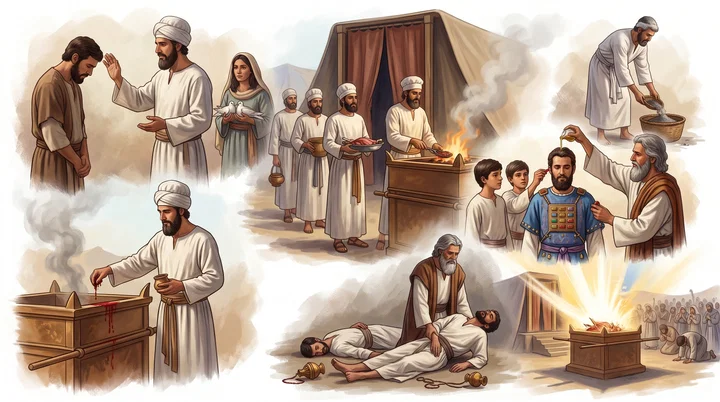
Cross-references 20 of 31
- Leviticus 9:24
And there came a fire out from before the LORD, and consumed upon the altar the burnt offering and the fat: which when all the people saw, they shouted, and fell on their faces.
God’s fire consumed the first offerings, revealing the sacred fire later rejected.
- Leviticus 10:10
And that ye may put difference between holy and unholy, and between unclean and clean;
Priests must distinguish holy from common and clean from unclean.
- Exodus 24:9-10
Then went up Moses, and Aaron, Nadab, and Abihu, and seventy of the elders of Israel:
Nadab and Abihu witnessed God’s glory on the mountain before their fall.
- 2 Samuel 6:6-7
And when they came to Nachon’s threshingfloor, Uzzah put forth his hand to the ark of God, and took hold of it; for the oxen shook it.
parallel proof God punishes irreverence despite good motive
- Numbers 16:3-35
And they gathered themselves together against Moses and against Aaron, and said unto them, Ye take too much upon you, seeing all the congregation are holy, every one of them, and the LORD is among them: wherefore then lift ye up yourselves above the congregation of the LORD?
Korah’s rebellion and punishment show the seriousness of disregarding God’s appointments.
- Ezekiel 22:26
Her priests have violated my law, and have profaned mine holy things: they have put no difference between the holy and profane, neither have they shewed difference between the unclean and the clean, and have hid their eyes from my sabbaths, and I am profaned among them.
Both condemn priests for treating holy things as common and failing to distinguish holy from profane.
- Hebrews 12:28-29
Wherefore we receiving a kingdom which cannot be moved, let us have grace, whereby we may serve God acceptably with reverence and godly fear:
God is to be approached and served with reverence and godly fear.
- Exodus 19:10-11
And the LORD said unto Moses, Go unto the people, and sanctify them to day and to morrow, and let them wash their clothes,
Israel is sanctified and washed before meeting God, who comes before all the people.
- Exodus 19:12-13
And thou shalt set bounds unto the people round about, saying, Take heed to yourselves, that ye go not up into the mount, or touch the border of it: whosoever toucheth the mount shall be surely put to death:
Both set apart what God makes holy.
- Exodus 19:22
And let the priests also, which come near to the LORD, sanctify themselves, lest the LORD break forth upon them.
cited as same prior warning to approaching priests
- Exodus 28:43
And they shall be upon Aaron, and upon his sons, when they come in unto the tabernacle of the congregation, or when they come near unto the altar to minister in the holy place; that they bear not iniquity, and die: it shall be a statute for ever unto him and his seed after him.
cited as same prior warning to ministering priests
- Isaiah 8:13
Sanctify the LORD of hosts himself; and let him be your fear, and let him be your dread.
Both declare God’s holiness and call his people to treat him with reverence.
- Isaiah 42:8
I am the LORD: that is my name: and my glory will I not give to another, neither my praise to graven images.
God does not give his glory to another.
- 1 Peter 3:15
But sanctify the Lord God in your hearts: and be ready always to give an answer to every man that asketh you a reason of the hope that is in you with meekness and fear:
Believers are called to sanctify and honor God.
- Numbers 16:46-47
And Moses said unto Aaron, Take a censer, and put fire therein from off the altar, and put on incense, and go quickly unto the congregation, and make an atonement for them: for there is wrath gone out from the LORD; the plague is begun.
Aaron’s incense intercedes for the people and the plague stops.
- Joshua 5:14-15
And he said, Nay; but as captain of the host of the LORD am I now come. And Joshua fell on his face to the earth, and did worship, and said unto him, What saith my lord unto his servant?
Both show worship before God’s holiness.
- 1 Chronicles 13:9-10
And when they came unto the threshingfloor of Chidon, Uzza put forth his hand to hold the ark; for the oxen stumbled.
Uzzah dies after touching the ark, showing God’s care for his commands.
- Psalms 89:7
God is greatly to be feared in the assembly of the saints, and to be had in reverence of all them that are about him.
God is greatly feared and revered among those who draw near him.
- Exodus 30:9
Ye shall offer no strange incense thereon, nor burnt sacrifice, nor meat offering; neither shall ye pour drink offering thereon.
Forbids offering unauthorized incense on the altar.
- Exodus 19:16-18
And it came to pass on the third day in the morning, that there were thunders and lightnings, and a thick cloud upon the mount, and the voice of the trumpet exceeding loud; so that all the people that was in the camp trembled.
Sinai’s thunder, smoke, and trembling taught reverence before God.
Commentary
Each commentary is drawn from primary sources: the writings of Ellen G. White and Adventist pioneers and periodicals. Each commentary is separate. Its own words are not a quotation; follow the references to read the source passages.
Ellen G. White
56 sources
God requires all who come near Him in sacred service to treat Him as holy, and He will uphold His glory before all the people rather than exalting human praise.1SP 276.2–277.1SG4 11.2–3CEv 91.3 Moses spoke this to Aaron after his sons Nadab and Abihu offered unauthorized common fire which God had not commanded and were consumed by fire from His presence, showing how serious it is to approach God carelessly.1SP 276.2–277.1GW 20.2–3Ms 27, 1893, par. 14Ms 94, 1899, par. 31Ms 29, 1895, par. 4–6 Their sin was careless, self-indulgent disobedience that replaced what God appointed with what is common, and having freely used wine they were benumbed in senses and intellect and unable to distinguish between the sacred and the common.1SP 276.2–277.1Ms 27, 1893, par. 14Lt 49a, 1896, par. 26–27Lt 5, 1897, par. 26–292RED 82.1–2 Aaron held his peace in patient, humble submission under severe sorrow, recognizing the justice of the punishment and refusing to murmur or cast blame in a way that would lead the congregation to complain.1SP 276.2–277.1SG4 11.2–3Ms 27, 1893, par. 14Ms 29, 1895, par. 4–6PP 361.1 All who serve God must therefore examine themselves whether their offering is holy or common, keep strict temperance and humility in close union with Christ, and carefully distinguish the sacred from the common in worship, speech, and work.Ms 109, 1899, par. 5–6Ms 94, 1899, par. 31Ms 163, 1899, par. 1–4Ms 127, 1899, par. 52–54ST Jul 1, 1880
Words and Historical Setting
The declaration is that God will be treated as holy by those who come near Him in sacred service and will be glorified before all the people, with His holiness honored and His own glory upheld rather than human praise.1SP 276.2–277.1SG4 11.2–3CEv 91.3GW 20.2–33MR 324.3 It belongs to all who serve God and profess truth, warning them not to treat His sacred work as common.CEv 91.3Ms 94, 1899, par. 31 Outward religious ceremony is not enough, for consecration to sacred office does not excuse disobedience, and the offering must be holy and not common.GW 20.2–3Ms 94, 1899, par. 31Lt 49a, 1896, par. 26–27
The word was spoken by Moses to Aaron after Aaron's sons Nadab and Abihu offered unauthorized common fire which God had not commanded and died before the Lord.Ms 27, 1893, par. 14Ms 94, 1899, par. 31Ms 29, 1895, par. 4–6STMW10 10.1–2HSFM 208.1–2 They were sons of Aaron ministering in the holy office of priesthood, honored by God as elders who had witnessed His glory, yet they put common fire in place of the sacred in careless, reckless disregard of express direction.Ms 174, 1898, par. 8–12ST Jul 1, 18802RED 82.1–2STMW10 10.1–2RH Jul 29, 1873 With senses beclouded by wine they could not distinguish between the sacred and the common, though with clear minds they would have recoiled with horror from the act.ST Jul 1, 18802RED 82.1–2HSFM 208.1–2
The sacred fire alone was commanded for sanctuary worship and for burning incense, kindled by God Himself from heaven by divine power and kept burning continually day and night on the altar without ever being extinguished.3MR 324.3Ms 174, 1898, par. 8–12ST Jul 1, 18802RED 82.1–2RH Jul 29, 1873 That fire represented God Himself and His connection with humanity, the communication between God and man opened through Jesus Christ alone.3MR 324.3Lt 49a, 1896, par. 26–272RED 82.1–2 No sacrifice is acceptable to God unless salted and seasoned with that divine fire.2RED 82.1–2 The incense kindled by holy fire, rising before God mingled with the earnest prayers of the people without, is an emblem of the mediation of Christ, while strange fire presents no divine Saviour and is as the offering of Cain.2RED 82.1–2
God vindicated His holiness by justice, sending fire from His presence to consume the offenders for positive disregard of His directions and insult to Him.2RED 82.1–2RH Jul 29, 1873 Through such judgments His holiness is shown and He is glorified, and their punishment shows how serious it is to approach God carelessly and violate His command in sacred service.1SP 276.2–277.1SG4 11.2–3GW 20.2–32RED 82.1–2SG4 13.3
Cause and Seriousness of Sin
Nadab and Abihu had freely partaken of wine, and even partial intoxication benumbed their senses, debased their faculties, beclouded their intellects and unfitted them for sacred service.1SP 276.2–277.1Ms 27, 1893, par. 14CH 396.3STB 640.3–4ST Jul 1, 1880 Strong drink enervated the brain and weakened nerve power, confusing the intellect until it became impossible to distinguish between right and wrong and between the sacred and the common, leaving them unable to exercise clear, sober reasoning.Ms 174, 1898, par. 8–12Ms 53, 1907, par. 24Lt 5, 1897, par. 26–29ST Jul 1, 18802RED 82.1–2 In that beclouded condition they went in to minister and took common fire instead of the sacred fire, and no deliberate departure from light in order to indulge appetite can expect God to work a miracle to avert its result, for a heavenly Watcher constantly beholds the work and the spirit brought into it.CH 396.3Ms 174, 1898, par. 8–12Ms 53, 1907, par. 24 Those who have to do with sacred things must therefore do nothing that will mar the perfection of their work.Ms 174, 1898, par. 8–12Ms 53, 1907, par. 24
With clear minds they would have recoiled with horror from their act, for as elders who had witnessed God's glory in the mount they fully knew what was required in presenting themselves before Him.ST Jul 1, 18802RED 82.1–2 Their gratification of appetite as their custom had debased their faculties until the power of discernment was gone, so they no longer realized the difference between common and sacred fire.ST Jul 1, 18802RED 82.1–2 Long-cherished self-indulgence had prepared them for judgment, and the responsibility of sacred office could not break those habits.ST Jul 1, 18802RED 82.1–2CE 226.3–227.1
Their sin was careless, reckless, self-indulgent disobedience and positive disregard of express direction, an insult to God.Lt 49a, 1896, par. 26–27Lt 5, 1897, par. 26–292RED 82.1–2STMW10 10.1–2RH Jul 29, 1873 God had given specific direction that sacred fire only was to be used, yet they put themselves where they could not distinguish between the sacred and the common and offered common fire that He had commanded them not to use.Lt 5, 1897, par. 26–29STMW10 10.1–2RH Jul 29, 1873 In so doing they put common fire in place of the sacred and replaced what He appointed with what is common, showing that outward religious ceremony is not enough when sacred service does not follow God's direction.Lt 49a, 1896, par. 26–27Lt 5, 1897, par. 26–292RED 82.1–2
Loose discipline at home had led them to disregard parental authority, indulging appetite for wine until reason was beclouded.RH Jul 29, 1873 Misplaced indulgence and gentle remonstrance without firm restraint fails to command respect and reverence and prepares children for the displeasure and wrath of God to their destruction, and such tenderness is extreme cruelty.RH Jul 29, 1873 The verse therefore requires exact reverence and obedience in sacred office, with careful distinction between the sacred and the common, clear and sober reasoning powers, and careful self-examination and sanctification before entering the sanctuary where His presence is manifested.Ms 109, 1899, par. 5–6ST Jul 1, 18802RED 82.1–2 God requires strict obedience from those who serve Him, and the sacredness of His work must be preserved.Ms 109, 1899, par. 5–6ST Jul 1, 18802RED 82.1–2
Aaron's Silent Submission
Aaron held his peace in patient, humble submission under severe sorrow, recognizing that God was just in punishing his disobedient sons and refusing to murmur or rebel.1SP 276.2–277.1SG4 11.2–3Ms 27, 1893, par. 14Ms 174, 1898, par. 8–12ST Jul 1, 1880 His sons Nadab and Abihu had violated express direction by offering unauthorized common fire which God had not commanded, and their judgment showed how serious it is to approach God carelessly in sacred service.1SP 276.2–277.1SG4 11.2–3Ms 27, 1893, par. 14Ms 29, 1895, par. 4–6PP 361.1 Their minds had been clouded by wine and intemperance so that they could not distinguish the sacred from the common and were unfitted for holy work.1SP 276.2–277.1Ms 27, 1893, par. 14Ms 174, 1898, par. 8–12 Moses declared to Aaron that this judgment fulfilled the word that God will be treated as holy by those who come near Him and will be glorified before all the people.1SP 276.2–277.1SG4 11.2–3Ms 27, 1893, par. 14Ms 29, 1895, par. 4–6Ms 174, 1898, par. 8–12
His silence is the model of reconciliation to God's just punishments even when wrath comes very near.ST Jul 1, 1880SG4 13.3SG4 12.1–13.1 He would not express grief in a way that appeared to excuse their sin, that cast blame on God's judgment, or that led the congregation to complain against God.Ms 29, 1895, par. 4–6PP 361.1RH Feb 27, 1900ST Jul 1, 1880SG4 13.3 His family was therefore forbidden to display such grief, lest they share the punishment of the transgressors and bring God's wrath upon the congregation.RH Feb 27, 1900ST Jul 1, 1880SG4 12.1–13.1 The people were to recognize from this restraint the seriousness of God's judgment rather than being led to sympathize against it.Ms 29, 1895, par. 4–6PP 361.1RH Feb 27, 1900
God's people must acknowledge the justice of His corrections so that others may fear.ST Jul 1, 1880SG4 13.31SP 278.2 Sorrow is to be for the sin that dishonored God, not sympathy for the one punished as if God had dealt unjustly.1SP 277.2–278.1ST Jul 1, 1880SG4 13.3 Sympathizing with the punished instead of sorrowing for the sin sides against God and His servants and makes the sympathizer share in the guilt.1SP 277.2–278.1SG4 13.31SP 278.2 Such false sympathy infects the congregation with the same spirit, brings wrath, and can keep erring persons from being saved.ST Jul 1, 1880SG4 13.31SP 278.2
Reverence Obedience and Discernment
The word spoken at the death of Nadab and Abihu applies to all who serve God and profess to believe the truth, requiring God to be treated as holy by those who come near Him in His service and to be honored before all the people.Ms 94, 1899, par. 31 It calls each one to closely examine himself to see whether he is in the faith, whether his offering is holy or common, and to turn away from all wrongdoing.Ms 94, 1899, par. 31
Those connected with proclaiming His truth must therefore work under God's wisdom and not their own pride or judgment.Ms 29, 1895, par. 7 Those serving in positions of responsibility must keep attention and aim fixed on God's glory rather than let another person's or any man's judgment control them.Lt 59a, 1895, par. 24–2519MR 276.1–3Lt 59, 1895, par. 28 Because the Lord lives and reigns, they must pray earnestly for a healthful experience, for clear understanding of His mind and will, and to be constantly imbued with the Holy Spirit.19MR 276.1–3
God is honored in those who come before Him and will work by His power for His people when they humble their hearts before Him in faith instead of unbelief and self-exaltation.Ms 163, 1899, par. 1–4 Self-exaltation turns blessings away, while close union with Jesus Christ gives His meekness, ends hateful criticism, silences self-important words, and brings humility under the hand of God with kindness, truth, tenderheartedness, and love for one another as Christ loved, lived out in daily life.Ms 163, 1899, par. 1–4 His human workers must be purified and sanctified with human selfishness purged away and never mingled with His work.Ms 85, 1899, par. 28–2910MR 243.2–247.4 In sanitariums and in all institutions the sacred fire is to be used and all things set in order, with strict self-denial, neatness, and no unnecessary expenditure or outward show, letting the light of truth shine from good works done to restore the sick and relieve suffering so God is glorified, constantly pressing upward and forward to the light with the ornament of a meek and quiet spirit.Ms 85, 1899, par. 28–29
Those who advocate truth honor Him by receiving His Spirit to mold and fashion the character after the divine likeness, making them new creatures in Christ Jesus.Lt 84, 1899, par. 6–8 Then the truth is exalted and every word and act reveals the exceeding grace and mercy and love of Christ and the pardoning love of God, which is salvation through the tender mercy of God.Lt 84, 1899, par. 6–8 Speaking the truth in love with meekness and lowliness, tenderness and kindness, shows this honor, while working and speaking without the Spirit's molding influence, with selfishness, sharpness, and harsh and condemning words, dishonors God.Lt 84, 1899, par. 6–8
Nadab and Abihu fulfilled the word when their disobedience cost them their lives, slain before the Lord for using common fire in place of the sacred with senses confused by wine.Ms 127, 1899, par. 52–54 The verse therefore means workers for God must sanctify Him by obedience and strict temperance, keeping body, soul, and spirit under God's protecting shield and never tempting His Spirit.Ms 127, 1899, par. 52–54 Sowing to the flesh reaps corruption and can lead to the sin against the Holy Ghost which has no forgiveness in this life or the life to come.Ms 127, 1899, par. 52–54
It teaches that God must be treated as holy by those who come near Him in worship, and His glory must be honored before the people.Ms 126, 1901, par. 7–11 This calls for reverence and purity in the worshiper, including cleanliness of body and clothing as well as a sanctified heart.Ms 126, 1901, par. 7–11 Approaching God calls for cleanliness: Israel was told to wash before hearing the Ten Commandments and to keep the camp free of uncleanness.3MR 353.4–354.1 People must do their part intelligently to keep their bodies, clothing, and homes clean, and they cannot expect God to prevent disease by a miracle while neglecting measures that help prevent it.3MR 353.4–354.1
When Christ's life-blood is not circulating in those with sacred responsibilities they mingle common fire with the sacred.STMW10 7.4–8.1 Their counsels and decisions are worthless and do harm by misleading others.STMW10 7.4–8.1 Growth is impossible for them unless they are born again of incorruptible seed by the word of God, coming with a sense of weakness, confessing sin and being purified from every moral defilement, dying to self so the life of Christ is revealed in them.STMW10 7.4–8.1 The fate of Nadab and Abihu shows the danger of dishonoring God in sacred service, warning that priests entering His presence with polluted mouths would face the same judgment.SG4 126.2–128.1
Sacred Work in Practice
The same violation occurs whenever divine work is mixed in a careless way with common ideas, human opinions, and unsanctified proposals born wholly of self.Lt 5, 1897, par. 26–29STMW10 10.1–2 Such mingling cheapens the truth and turns things upside down, bringing serious consequences.Lt 5, 1897, par. 26–29STMW10 10.1–2 It repeats the disobedience of offering common fire instead of sacred fire only, in careless, reckless self-indulgence with senses beclouded so that sacred and common cannot be distinguished.Lt 5, 1897, par. 26–29STMW10 10.1–2
Those laboring with the Lord to save souls must bring no commonness or cheapness into sacred service.CEv 91.3MC 22.3–23.2Ms 23, 1890, par. 4 The work is to be regarded as service performed with God, with the mind kept filled with pure, holy thoughts.CEv 91.3MC 22.3–23.2Ms 23, 1890, par. 4 Words must be chosen well, with light and careless speech avoided, especially among unbelievers who are measuring those who serve.CEv 91.3MC 22.3–23.2Ms 23, 1890, par. 4 Such careless words hinder success in reaching souls.CEv 91.3MC 22.3–23.2
Sacred things must not be mingled with common things by those who handle sacred truth for the world.7T 152.3–153.2Lt 89, 1899, par. 6–76MR 277.2–279.2 This applies especially to editors of papers with wide circulation and to workers in publishing houses dedicated to defending truth.7T 152.3–153.2Lt 89, 1899, par. 6–76MR 277.2–279.2 They must distinguish holy from common and truth from error, refusing to handle deceptive, spiritually dangerous literature.7T 152.3–153.2Lt 89, 1899, par. 6–76MR 277.2–279.2 They are to give precious, solid spiritual food, pure wheat thoroughly winnowed from chaff and meat in due season giving the trumpet a certain sound, rather than too much common matter, long articles with no reference to vital issues, and dependence on pictures and other things unrelated to the vital issues for this time.Lt 89, 1899, par. 6–76MR 277.2–279.2Lt 89, 1899, par. 1–2
Those granted the privilege of handling sacred fire must not turn from it to common fire.Lt 98, 1899, par. 1121MR 144.5 To turn is to follow a worldly, fraudulent, selfish, covetous course.Lt 98, 1899, par. 1121MR 144.5 It includes leaders at the head of the work diverting means the Lord moved His people to give for a certain purpose.Lt 98, 1899, par. 1121MR 144.5 Instead they must act with sharp justice, equity, and strength of righteous principle.Lt 98, 1899, par. 1121MR 144.5
Appetite and habits of life must be kept under strict control by all who serve God.CH 396.3STB 640.3–4Ms 174, 1898, par. 8–12 Strong drink enervates the brain and weakens nerve power, benumbing the senses and confusing the intellect until right and wrong cannot be distinguished.CH 396.3STB 640.3–4Ms 174, 1898, par. 8–12 Those who have to do with sacred things must do nothing that mars the perfection of their work, remembering that a heavenly Watcher constantly beholds the work and the spirit brought into it.CH 396.3STB 640.3–4Ms 174, 1898, par. 8–12 This applies especially to physicians and others serving their fellow men.CH 396.3STB 640.3–4 God will not work a miracle to keep men from the consequence of deliberate departure from light to indulge appetite, and those who disregard His directions must bear the result.Ms 174, 1898, par. 8–12
Work done in His name should represent His holiness.Ms 51, 1903, par. 10Lt 145, 1899, par. 7 When self-seeking replaces Christ's character, the work becomes like common fire rather than holy fire.Ms 51, 1903, par. 10Lt 145, 1899, par. 7 Weaving threads of selfishness into sacred things, using common fire in place of fire of God's own kindling, brings displeasure upon those in positions of sacred responsibility.Ms 51, 1903, par. 10Lt 145, 1899, par. 7 The fault includes letting things of apparently little consequence attract mind and eye and absorb attention at the very time when attention should be given to God.Lt 145, 1899, par. 7 The Holy Spirit must work upon human hearts and bring conviction to human minds concerning this danger.Lt 145, 1899, par. 7
When an institution connected with His service is humbled and loses public favor, this can be His chastisement.Ms 131, 1899, par. 11–13STMW10 11.1–215MR 108.2–109.1 Those responsible should investigate its cause, heed the light He has given, and put away practices contrary to His will.Ms 131, 1899, par. 11–13STMW10 11.1–215MR 108.2–109.1 His institutions are to be cleansed and upheld to a high, holy standard, using the sacred fire and setting all things in order.STMW10 11.1–2Ms 85, 1899, par. 28–29 This requires purification of workers with human selfishness purged away and never mingled with His work, with strict self-denial, neatness, no unnecessary expenditure or outward show, and constant pressing upward and forward to the light with the ornament of a meek and quiet spirit.Ms 85, 1899, par. 28–29 The light of truth is then to shine from good works done to restore the sick and relieve suffering so that God is glorified.Ms 85, 1899, par. 28–29
Teachers who blur the distinction between sacred and common bring displeasure.Lt 27, 1896, par. 26–286T 159.1 The death for offering unauthorized, common fire shows the seriousness of the requirement for clear judgment and reverence in sacred service.Lt 27, 1896, par. 26–286T 159.1 Those entrusted with God's work must feel responsibility and devotion in proportion to their sacred trust.Lt 27, 1896, par. 26–28
Sources
Pioneers and periodicals
52 sources
Moses spoke these words to Aaron immediately after the death of Nadab and Abihu to remind him that the Lord had already warned that he would be treated as holy by those who come near him and glorified before all the people.ST Jul 30, 1902ST Jul 30, 1902RH Jan 14, 1862ST Nov 10, 1881 God is sanctified when those who approach him in worship and sacred office honor his holiness with reverence, godly fear and exact obedience, and he is glorified before the people when his commands are obeyed without questioning his right to command.RH Dec 1, 1868RH Jun 23, 1868ST Jul 30, 1902ST Sep 12, 1895ST Nov 10, 1881 Their offering of common fire which he had not commanded shows that human invention, human wisdom and substitutes judged equivalent can never replace what God has expressly required, even in what seems a small detail.RH Oct 7, 1862RH Dec 1, 1868ST Mar 1, 1883RH Mar 15, 1870ST Oct 17, 1895 Their disregard was connected with wine that beclouded reason so they no longer discerned between holy and common, teaching that God's servants must be clear-headed and temperate and cannot join service of selfish appetite to service of God.RH Jun 23, 1868ST Sep 12, 1895ST Sep 22, 1890ST Feb 3, 1909 Aaron held his peace in humble, patient submission under severe sorrow, recognizing the justice of God without murmuring, while he and his remaining sons were forbidden to mourn lest they appear to excuse rebellion and bring wrath upon the congregation.RH Jul 29, 1873RH Feb 27, 1900ST Jul 1, 1880ST Apr 22, 1889RH Jan 24, 1865
Context and Wording
Leviticus 10:3 belongs to the historical portion of Leviticus in chapters 8-10, which records the consecration of Aaron and his sons and the duties of the priests with the laws relating to sacrifices and offerings.ST Feb 7, 1911ST Feb 3, 1909RH Feb 3, 1916 It stands just after that consecration in chapters 8 and 9, within the book regulating the priesthood and its offerings.ST Feb 3, 1909RH Feb 3, 1916 Each detail of those sacrifices and offerings had its meaning now found more fully in the sacrifice, life, and work of Jesus Christ, though spending much time on the meaning of all such details may not be comparatively profitable.ST Feb 7, 1911ST Feb 3, 1909 Those offerings show God's hatred of sin and that sin demands its penalty, as shadows of what is found in Christ.ST Feb 3, 1909
The verse records Moses speaking to Aaron immediately after the death of Nadab and Abihu.ST Jul 30, 1902ST Jul 30, 1902 In doing so Moses reminded him of what the Lord had already spoken, showing their deaths fulfilled a prior warning.ST Jul 30, 1902ST Jul 30, 1902 And Aaron held his peace.ST Jul 30, 1902ST Jul 30, 1902
The sacred fire had been kindled by God himself from heaven and commanded to be kept burning continually on the altar for burning incense, in contrast to the common fire Nadab and Abihu offered.ST Jul 1, 1880RH Jul 29, 1873 God had chosen Aaron and his sons for the priesthood and on pain of death had forbidden offering common fire with incense, commanding sacred fire only.ST Jul 1, 1880RH Jul 29, 1873 Their offering of common fire was contrary to his express direction.ST Jul 1, 1880RH Jul 29, 1873
To be sanctified in them that come nigh means God is revealed as a holy Being only by pure and sincere worship.ST Jul 1, 1880ST Nov 10, 1881 To be glorified before all the people means his holiness is displayed and honored before them.ST Jul 1, 1880ST Jul 30, 1902 He is glorified when those he commands obey him without demanding a reason.ST Jul 30, 1902RH Jan 14, 1862 The requirement to treat God as holy was laid down before Nadab and Abihu acted and applies with special force to priests and ministers who stand before the people as representatives of Jehovah, from whom blameless deeds and guileless speech are justly expected.ST Jul 1, 1880RH Jul 29, 1873ST Nov 10, 1881 The passage with its context in Leviticus 10:1-4 is evidence that priests ministered in the earthly sanctuary.ST Feb 3, 1909ST Nov 1, 1877
Holiness and Obedience
God must be treated as holy by those who come near him in worship and sacred office and serve him, and his glory and holiness must be honored before all the people.RH Dec 1, 1868RH Jun 23, 1868ST Jul 30, 1902ST Sep 12, 1895ST Nov 15, 1905 This requires reverence, godly fear, and careful self-examination and sanctification before entering where his presence is manifested, for he is glorified before the people through reverence for his appointments.RH Jun 23, 1868ST Sep 12, 1895ST Oct 17, 1895 Nadab and Abihu failed to sanctify him when they offered unauthorized fire he had not commanded, treating their own way as equal to the way he had prescribed.RH Dec 1, 1868ST Sep 12, 1895ST Nov 15, 1905 Their unauthorized substitution of the profane for the holy ended in death, showing there is no safe substitute for obedience and that unfaithfulness in a seemingly small duty reveals unfaithfulness toward divine authority in greater matters.ST Nov 15, 1905ST Oct 17, 1895
Exact, reverent obedience to express commands is required, with careful distinction between the sacred and the common.RH Jun 23, 1868ST Sep 12, 1895ST Sep 17, 1902RH Mar 15, 1870 Even priests set apart to officiate in sacred things are not permitted to make common what God has made holy, and holy things, his house, and worship must be given their rightful position with holy veneration rather than treated carelessly or irreverently.RH Jun 23, 1868RH Mar 15, 1870RH Oct 28, 1873 Nadab and Abihu lost their lives because they did not sense the sacredness of his house and presence and service and did not discern the difference between the holy and the common.ST Sep 12, 1895ST Sep 17, 1902 Their fate shows the seriousness of failing to discern what is holy and what is profane.ST Sep 12, 1895ST Sep 17, 1902RH Oct 28, 1873
Human inventions, human wisdom, and substitutes people judge equivalent must not replace divine commands.RH Oct 7, 1862RH Dec 1, 1868ST Mar 1, 1883ST Nov 15, 1905RH Jun 26, 1866 Worship must follow his directions, not what people consider equivalent, and a substitute for what he has commanded is not acceptable even when supported by custom.RH Dec 1, 1868ST Mar 1, 1883RH Jun 26, 1866 Faith trusts his word and obeys it even when human judgment calls that obedience foolish, rather than following human wisdom instead of obeying what he has commanded.RH Oct 7, 1862RH Dec 1, 1868ST Apr 19, 1910 To question his right to command is presumption, and human reasoning against his plain requirement brings only harm.ST Apr 19, 1910ST Aug 25, 1909
Nadab and Abihu, sons of Aaron the high priest, thought it would make no difference whether they offered incense with strange fire or with holy fire.RH Mar 15, 1870ST Oct 17, 1895RH Jan 6, 1874 They reasoned that any fire would burn the incense and treated the prescribed fire from the altar as an unimportant detail, valuing their own judgment above his command.RH Mar 15, 1870ST Oct 17, 1895RH Jan 6, 1874 Their fire may have served its intended purpose, but it was not the kind he had prescribed.RH Mar 15, 1870RH Dec 18, 1860RH Jan 6, 1874 He showed that it did make a difference by devouring them with fire of his own kindling, and they died before him.RH Mar 15, 1870RH Dec 18, 1860RH Jan 6, 1874
Their presumptuous, careless will-worship in even one particular brought death.ST Sep 12, 1895RH Sep 12, 1865ST Oct 17, 1895ST Mar 19, 1885ST Jun 17, 1889 Swift, certain punishment came by supernatural fire from his presence, demonstrating the holiness of his work and the sacredness of his ordinances and showing that worship must be performed exactly as instructed.ST Aug 25, 1909ST Mar 19, 1885ST Jun 17, 1889 Carelessness in sacred service could bring death, for when sacred fire was required, offering common fire instead was sacrilege calling for certain and swift punishment.RH Sep 12, 1865ST Aug 25, 1909ST Mar 19, 1885 His right to command is absolute, and unfaithfulness in a seemingly small duty reveals an attitude of unfaithfulness toward his authority in greater matters.ST Sep 12, 1895ST Oct 17, 1895ST Aug 25, 1909
The God of the Old Testament is unchanged in the gospel dispensation and is just as particular now as then about having his laws obeyed and his precepts kept.ST Mar 21, 1906ST Mar 19, 1885 Disregarding his ordinances brings judgment, as shown when those who offered forbidden strange fire died.ST Mar 21, 1906ST Mar 19, 1885 The letter can be kept without the spirit, but the spirit cannot be kept while disregarding the letter, for exact, reverent obedience is demanded.ST Mar 19, 1885RH Jan 6, 1874 Careless and irreverent service therefore invites his indignation now as then.ST Mar 19, 1885
His judgment for disregarding his word may not come at once, but people will receive according to their works.RH Dec 1, 1868 Ancestral ignorance does not excuse disobedience.RH Dec 1, 1868 His word concerning the sanctuary could not be made void, as shown when fire from him devoured the two men who acted against his instruction about common fire.RH Dec 1, 1868ST Apr 22, 1903
Temperance and Discernment
The verse applies as a temperance lesson, for disregard of God's instructions by Nadab and Abihu was connected with indulgence of appetite, teaching that God's servants must be clear-headed, temperate people with clear and sober reasoning powers, and that God is as particular now as then.ST Jul 1, 1880ST Sep 22, 1890ST Jul 30, 1902 Their minds had become confused by the wine they drank, so that having identified themselves with sin and broken God's express commandments they were destroyed before the Lord.ST Jul 1, 1880ST Feb 3, 1909 Free use of wine had partially intoxicated them, debased their faculties, beclouded their intellects and reason, and confused their senses so they no longer realized the difference between the sacred and the common.ST Jul 1, 1880RH Jul 29, 1873RH Feb 27, 1900ST Sep 12, 1895ST Feb 3, 1909 With clear minds they would have recoiled with horror from offering common fire instead of the sacred fire God himself had kindled from heaven and commanded to be kept burning continually on the altar for incense, yet in that state they treated their own way as equal to the way God had prescribed.ST Jul 1, 1880ST Sep 12, 1895 The chapter therefore directs Aaron and his sons to refrain from strong drink so they can distinguish holy from common and honor God's holiness by reverence for his appointments.RH Jun 23, 1868ST Sep 12, 1895
The overt act was drinking wine and using common fire in the tabernacle, but the underlying sin that led to it was unbelief, heeding selfish desire rather than the commandment of God.ST Sep 17, 1902 The verse therefore teaches more than an ordinary temperance lesson, that the service of selfish desire and the service of God cannot be combined in one person, and that loss of the sense of the sacredness of God's house and presence and service brings death.ST Sep 17, 1902 Those who come near God must serve the Holy One in holiness rather than serve a perverted and filthy appetite such as tobacco.ST Apr 11, 1878 Those who handle the affairs of the Lord's house must therefore live respecting its sacred character, so that smoking while conducting church business is inconsistent with that duty.ST Apr 11, 1878ST Aug 27, 1902 When the duty to cleanse from filthiness is presented and refused, God lets people have their own way so that they soon give up the Sabbath.ST Apr 11, 1878
Nadab and Abihu as elders had witnessed God's glory in the mount and knew what was required, yet they disregarded parental authority because of loose discipline at home and indulged appetite for wine until reason was beclouded.ST Jul 1, 1880RH Jul 29, 1873 Misplaced indulgence, gentle remonstrance without firm restraint, and failure to command respect and reverence prepare children for God's displeasure and wrath to their destruction.RH Jul 29, 1873 Such tenderness is extreme cruelty.RH Jul 29, 1873
Sabbath and Worship
As God appointed the fire for the altar, so He appointed and reserved the seventh day, and keeping another day cannot be treated as the same. RH Dec 1, 1868RH Oct 28, 1873 To say it makes no difference what day is offered to the Lord, when He has sanctified and claimed the seventh day for a wise reason, commits the same sin as offering common fire which He had not commanded. RH Dec 1, 1868RH Oct 28, 1873 Nadab and Abihu died because they offered incense kindled with common fire from their censers, thinking God would accept it, when He had commanded incense kindled with sacred fire. RH Oct 28, 1873 His judgment may not come at once, but people will receive according to their works, ancestral ignorance does not excuse disobedience, and He is as jealous of His word now as then. RH Dec 1, 1868RH Oct 28, 1873
A substitute for what God has commanded is not acceptable even when supported by custom. ST Mar 1, 1883RH Jun 26, 1866RH Jan 28, 1858RH Jun 26, 1866 Those with the light of ancient Israel's experience, fulfilled prophecy, and the apostles' warnings about apostasy cannot disregard what He has plainly said and do instead what He has not commanded, such as keeping a rival popular sabbath in place of the God-appointed day, and still hope to be accepted in His sight and live. ST Mar 1, 1883RH Jun 26, 1866 Their death is recorded for instruction and admonition to those upon whom the ends of the world are come, to learn the lesson, take heed lest they fall, and escape imminent danger. ST Mar 1, 1883 Their unauthorized offering illustrates the danger of replacing His command with what people consider equivalent or interchangeable. RH Jun 26, 1866RH Jan 28, 1858RH Jun 26, 1866
To know that God appointed the seventh day as the Sabbath and yet observe the first day in preference is the same presumptuous sin and cannot be accredited by the Lord. RH Oct 28, 1873RH Jan 6, 1874 Nadab and Abihu reasoned that any fire would burn the incense, though they were sons of Aaron the high priest, and their will-worship in disregarding the letter while claiming the spirit brought death before the Lord. RH Jan 6, 1874 Failing to distinguish holy from profane makes disobedience a light thing and leads to hiding the eyes from His Sabbaths, while distinguishing holy from profane leads to obeying God and hallowing His Sabbaths. RH Oct 28, 1873 The same principle proves the Sabbath is moral, because God has decreed the seventh day is His and man may not set up a counter claim or substitute another day. ST Aug 25, 1909 His right to command is absolute, to question it is the height of presumption, and human reasoning against His plain requirement brings only harm. ST Aug 25, 1909
Those who approach God must honor His holiness and use only what He has appointed, and their fate warns against coming before Him in one's own righteousness rather than in Christ's perfect righteousness. ST Nov 26, 1912ST Nov 26, 1912 His holiness and watchful presence call for reverence and godly fear in religious duties, not lightness or wandering attention, and He must have supreme place rather than be left no place by giving the world first place. RH Dec 4, 1856ST Jul 14, 1887 Careless and irreverent service, Sabbath breaking, ease, worldly thoughts and plans, self-pleasing worship, and following worldly fashions to please others invite His indignation, for the God of the Old Testament is unchanged in the gospel dispensation and is just as particular now about having His laws obeyed. ST Jul 14, 1887ST Mar 19, 1885 Left unrebuked, the priests' disobedience could have led all Israel to sin because the people might follow their example. ST Apr 22, 1889 Their swift judgment vindicated God's holiness and protected His people, so no expression of grief was to excuse or condone the rebellion. ST Apr 22, 1889ST Mar 19, 1885
Aaron's Silence and Submission
Aaron held his peace in patient, humble and meek submission under severe sorrow and agony, satisfied and saying nothing against what had happened.RH Jul 29, 1873ST Jul 1, 1880RH Jan 24, 1865 His silence illustrated quiet submission to God's providence, receiving affliction from God's hand without disputing or prescribing what He should do.RH Jul 29, 1873RH Jan 24, 1865 When Moses reminded him of the word that God would be sanctified in those who come near Him and glorified before all the people, Aaron did not murmur because he knew God was just, though his heart was grieved at the dreadful death of his sons in their disobedience.ST Jul 1, 1880ST Nov 10, 1881
As priest he must glorify God, and that consideration swallowed up parental grief over the bereavement of his eldest sons and led him to recognize the justice of the punishment.ST Jul 1, 1880ST Nov 10, 1881 He was convicted of his neglect as God's priest to make atonement and as priest of his household to train his children to obedience, self-denial, and reverence for parental authority.RH Jul 29, 1873
He with his remaining sons Eleazar and Ithamar was told not to grieve, so the people would recognize the seriousness of God's judgment.RH Feb 27, 1900ST Apr 22, 1889ST Nov 10, 1881 They were forbidden to mourn by uncovering the head, disheveling the hair, or rending the clothes, because any such bewailing could be interpreted as sympathy with sin or as complaint against the righteousness of the condemnation.ST Jul 1, 1880ST Nov 10, 1881 God's people must acknowledge the justness of His corrections so that others may fear, making no expression of sorrow or sympathy that implies unreconciliation with God or excuses rebellion.ST Jul 1, 1880ST Apr 22, 1889ST Nov 10, 1881 To do otherwise would risk sharing the transgressor's fate, infecting the congregation with the same spirit, and bringing God's wrath upon them.ST Jul 1, 1880ST Apr 22, 1889
Sin Judgment and Salvation
Nadab and Abihu were put to death because they disobeyed clear divine instructions and treated what God had commanded as unimportant, thereby identifying themselves with sin rather than separating from it.ST Aug 29, 1911ST Nov 29, 1899ST Feb 13, 1912 Divine wrath is directed against sin itself, and it falls upon persons when they cling to sin instead of putting it away from themselves.ST Aug 29, 1911ST Nov 29, 1899 Their transgression of the spoken word meant they perished together with their sin.ST Nov 29, 1899ST Feb 13, 1912
The holy presence of God consumes those who come near while still joined to sin, as they came in drunkenness and disobedience and were devoured by fire from before him.ST Apr 15, 1897ST Those who surrender sin and are separated from it are saved, for the same presence that destroys sin preserves the one cleansed from it.ST Apr 15, 1897ST So it will be at the return of Christ in unveiled glory: those who have not received his indwelling presence will perish, while he will be glorified in his saints.ST Apr 15, 1897
The book regulating the priesthood and its offerings declares hatred of sin and that sin demands its penalty, standing just after the consecration of Aaron and his sons in chapters 8 and 9.ST Feb 3, 1909 Those offerings and the Levitical sanctuary service are shadows of what is found more fully in Jesus Christ.ST Feb 3, 1909ST Nov 28, 1895 That yearly service is a type of his once-for-all ministry and of the cleansing of the heavenly sanctuary.ST Nov 28, 1895
Sources