Leviticus 9:24
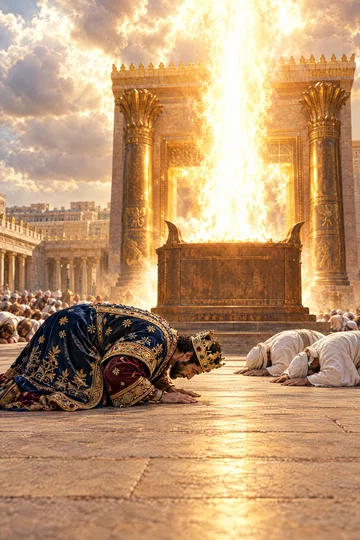
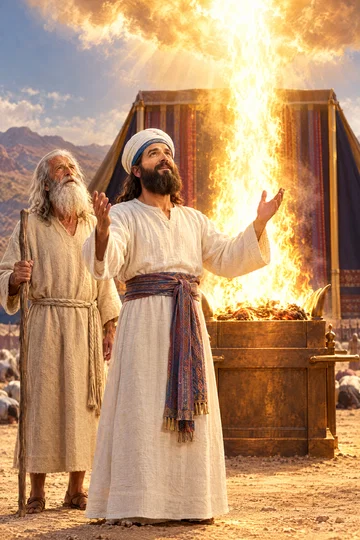
And there came a fire out from before the LORD, and consumed upon the altar the burnt offering and the fat: which when all the people saw, they shouted, and fell on their faces.
Translations
And there came a fire out from before the LORD, and consumed on the altar the burnt offering and the fat: which when all the people saw, they shouted, and fell on their faces.
And there came a fire out from before the LORD, and consumed upon the altar the burnt offering and the fat: which when all the people saw, they shouted, and fell on their faces.
And there came a fire out from before the Lord, and consumed upon the altar the burnt offering and the fat: which when all the people saw, they shouted, and fell on their faces.
And there came out a fire from before the LORD, and consumed upon the altar the burnt-offering and the fat: which, when all the people saw, they shouted, and fell on their faces.
And there came forth fire from before the LORD, and consumed upon the altar the burnt offering and the fat: and when all the people saw it, they shouted, and fell on their faces.
And there came forth fire from before Jehovah, and consumed upon the altar the burnt-offering and the fat: and when all the people saw it, they shouted, and fell on their faces.
and fire cometh out from before Jehovah, and consumeth on the altar the burnt-offering, and the fat; and all the people see, and cry aloud, and fall on their faces.
And there went out fire from before Jehovah, and consumed on the altar the burnt-offering, and the pieces of fat; and all the people saw it, and they shouted, and fell on their face.
yea, there came forth fire from before Yahweh, and consumed upon the altar, the ascending-sacrifice and the portions of fat,—and all the people beheld and shouted, and fell down upon their faces.
Berean Standard Bible, Majority Standard Bible
Fire came out from the presence of the LORD and consumed the burnt offering and the fat portions on the altar. And when all the people saw it, they shouted for joy and fell facedown.
Fire came out from before the LORD, and consumed the burnt offering and the fat upon the altar. When all the people saw it, they shouted, and fell on their faces.
And fire came out from before the Lord, burning up the offering on the altar and the fat: and when all the people saw it, they gave a loud cry, falling down on their faces.
And there came a fire out from the Lord and consumed vpon the Altar the burnt offring and the fatte: which when all the people sawe, they gaue thankes, and fell on their faces.
Douay-Rheims (Challoner revision)
And behold a fire, coming forth from the Lord, devoured the holocaust, and the fat that was upon the altar: which when the multitude saw, they praised the Lord, falling on their faces.
Pictures


Cross-references 20 of 23
- Leviticus 10:1-2
And Nadab and Abihu, the sons of Aaron, took either of them his censer, and put fire therein, and put incense thereon, and offered strange fire before the LORD, which he commanded them not.
God’s fire consumes Nadab and Abihu after they offer unauthorized fire.
- Leviticus 6:13
The fire shall ever be burning upon the altar; it shall never go out.
The fire kindled by the Lord was kept burning continually.
- Hebrews 12:29
For our God is a consuming fire.
God is called a consuming fire, as shown by the altar fire.
- Leviticus 8
And the LORD spake unto Moses, saying,
The priests’ consecration leads into the fire at the altar.
- Judges 6:21
Then the angel of the LORD put forth the end of the staff that was in his hand, and touched the flesh and the unleavened cakes; and there rose up fire out of the rock, and consumed the flesh and the unleavened cakes. Then the angel of the LORD departed out of his sight.
Fire consumes an offering as a sign of the Lord’s acceptance.
- 2 Corinthians 5:21
For he hath made him to be sin for us, who knew no sin; that we might be made the righteousness of God in him.
Christ was made sin for us, fulfilling the offering’s symbolism.
- Exodus 29:38-43
Now this is that which thou shalt offer upon the altar; two lambs of the first year day by day continually.
Prescribes the daily burnt offerings in priestly service.
- 1 Kings 18:38
Then the fire of the LORD fell, and consumed the burnt sacrifice, and the wood, and the stones, and the dust, and licked up the water that was in the trench.
Fire consumes the offering, showing God’s response and revealing the true God.
- 2 Chronicles 7:3
And when all the children of Israel saw how the fire came down, and the glory of the LORD upon the house, they bowed themselves with their faces to the ground upon the pavement, and worshipped, and praised the LORD, saying, For he is good; for his mercy endureth for ever.
The people respond to fire from God’s presence with worship.
- Exodus 24:17
And the sight of the glory of the LORD was like devouring fire on the top of the mount in the eyes of the children of Israel.
God’s glory and presence are manifested as devouring fire.
- John 1:29
The next day John seeth Jesus coming unto him, and saith, Behold the Lamb of God, which taketh away the sin of the world.
Christ is the Lamb who takes away sin, fulfilling the sacrificial picture.
- Isaiah 33:14-16
The sinners in Zion are afraid; fearfulness hath surprised the hypocrites. Who among us shall dwell with the devouring fire? who among us shall dwell with everlasting burnings?
God’s devouring fire is endured by those who live righteously.
- Exodus 40:34-35
Then a cloud covered the tent of the congregation, and the glory of the LORD filled the tabernacle.
God’s glory fills the sanctuary at its dedication.
- Hebrews 10:10
By the which will we are sanctified through the offering of the body of Jesus Christ once for all.
The altar sacrifice prefigures Christ’s once-for-all offering.
- Leviticus 1:7-9
And the sons of Aaron the priest shall put fire upon the altar, and lay the wood in order upon the fire:
Both describe burnt offerings consumed by fire on the altar.
- Numbers 16:46
And Moses said unto Aaron, Take a censer, and put fire therein from off the altar, and put on incense, and go quickly unto the congregation, and make an atonement for them: for there is wrath gone out from the LORD; the plague is begun.
Uses coals from the altar fire for incense.
- Hebrews 9:12
Neither by the blood of goats and calves, but by his own blood he entered in once into the holy place, having obtained eternal redemption for us.
Christ’s entry into the holy place with his own blood fulfills the sacrificial ministry.
- Leviticus 16:12
And he shall take a censer full of burning coals of fire from off the altar before the LORD, and his hands full of sweet incense beaten small, and bring it within the vail:
Incense coals are taken from the altar fire.
- Matthew 26:28
For this is my blood of the new testament, which is shed for many for the remission of sins.
Christ’s blood is shed for remission of sins, corresponding to sacrificial blood.
- Romans 5:9
Much more then, being now justified by his blood, we shall be saved from wrath through him.
The accepted sacrifice is linked to justification through Christ’s blood.
Commentary
Each commentary is drawn from primary sources: the writings of Ellen G. White and Adventist pioneers and periodicals. Each commentary is separate. Its own words are not a quotation; follow the references to read the source passages.
Ellen G. White
11 sources
The fire that came out from before the Lord and consumed the burnt offering and the fat upon the altar signified God's acceptance of the sacrifice.PP 359.1ST Jul 17, 1884ST Jul 15, 1880 The offering He thus accepted was one made as He had commanded.ST Jul 17, 1884 That consuming fire also revealed God's glory and was a sign of His glory and favor toward the people.PP 359.1ST Jul 17, 1884 When the people saw it they responded with awe, praise and adoration, shouting and falling on their faces before Him.PP 359.1ST Jul 17, 1884
The fire on the altar was sacred fire kindled by God Himself from heaven, from before the Lord.1SP 276.2–277.1ST Jul 1, 18801SP 273.3FE 427.3SG4 11.2–3 That divine fire was to be kept burning continually in the sanctuary.1SP 276.2–277.1ST Jul 1, 18801SP 273.3SG4 11.2–3RH Mar 25, 1875 It was to be kept burning day and night and never allowed to go out.RH Mar 25, 1875 God commanded that this sacred fire be used for burning incense, for the fire put upon the censer.1SP 276.2–277.1ST Jul 1, 18801SP 273.3SG4 11.2–3PP 359.2 It was also to be used for all sacrifice, and no sacrifice was acceptable to God unless salted and seasoned with this divine fire.RH Mar 25, 1875
The sacred fire was to be distinguished from common or ordinary fire.1SP 276.2–277.1ST Jul 1, 1880FE 427.3SG4 11.2–3 God had forbidden the use of common fire in His service, so using ordinary fire instead violated His express command.ST Jul 1, 1880SG4 11.2–3 Nadab and Abihu's strange fire stood in opposition to this divinely kindled fire, for they sinned by using common fire for incense instead of the sacred fire.FE 427.3PP 359.2Ms 11, 1895, par. 25–27 They did so with minds clouded by wine, disregarding God's requirement.FE 427.3 Fire from the Lord then devoured them for this act.FE 427.3PP 359.2
The divine fire represented the communication between God and man opened through Jesus Christ alone.RH Mar 25, 1875 While the people of God prayed without, the incense kindled by this holy fire arose before God mingled with their prayers as an emblem of the mediation of Christ.RH Mar 25, 1875 Any common fire used in His service was strange fire that insulted the infinite God and was punishable with death.RH Mar 25, 1875
Sources
Pioneers and periodicals
41 sources
When Aaron and his sons were consecrated and the offerings made and the people blessed, the glory of the Lord appeared and fire came out from before Him to burn up the burnt offering and the fat on the altar, publicly confirming them as His appointed mediators.ST Jul 8, 1930ST Jun 27, 1911ST Nov 17, 1909ST Dec 29, 1909ST Jun 30, 1898
That fire showed that He accepted the offerings, pardoned sin, revealed His glory, and received the people into favor so they could stand forgiven before Him.ST Jul 17, 1884ST Feb 13, 1912ST May 29, 1901RH Oct 31, 1854ST Mar 24, 1898
The slain animal bore the confessed sins of the people in figure, and when the brightness of His presence devoured the offering, the sin represented in it was destroyed and taken away while the people themselves lived cleansed and made holy.ST Feb 8, 1899ST Mar 12, 1896STST Nov 29, 1899
The fire was kindled by the Lord Himself and was holy and set apart from common fire kindled by man, to be kept burning continually and to supply the coals for the incense, so that to offer common fire as Nadab and Abihu did was to despise His gift and insult Him.ST Jul 1, 1880RH Sep 19, 1912ST Apr 22, 1889RH Feb 2, 1911ST Nov 10, 1881
The burnt offering pointed forward to Jesus Christ the Lamb of God, and the fire foreshadows the revealing of God's glory in the last days, when those separated from sin will be accepted and those who cling to sin and are identified with it will be consumed with it.ST Aug 29, 1911ST Jun 14, 1899ST Nov 28, 1895
Historical Setting and Wording
Leviticus 9:24 stands in the historical portions of Leviticus in chapters 8-10, which record the consecration of Aaron and his sons and the dedication of the sanctuary and of Aaron's sons and the people, distinct from the legislative instructions for sanctuary service that occupy most of the book and regulate the tribe of Levi and the priesthood and its offerings.ST Feb 13, 1912RH Feb 3, 1916ST Feb 3, 1909 More narrowly it belongs to chapters 8 and 9 as the record and account of the consecration of the priests, of Aaron and his sons.ST Feb 3, 1909 It also belongs with the account of the death of Nadab and Abihu in chapter 10.RH Feb 3, 1916
The verse inaugurates the Levitical priesthood's ministry before God in the typical sanctuary before the ark, in which God manifested His glory during that ministry before Him.RH Dec 12, 1854RH Jul 8, 1852 That priestly service began under the Levitical order and included service in the earthly sanctuary's two holy places, and it continued throughout the Old Testament period.RH Dec 12, 1854RH Feb 3, 1853 Its account of the sanctuary's inauguration is part of the pattern for Christ's ministry in the true tabernacle in heaven.RH Feb 3, 1853
The verse publicly confirms Aaron and his sons as the appointed earthly mediators after their consecration, for fire from God consumed Aaron's first offering for the people.ST Jul 8, 1930 That sending of fire to consume the sacrifice revealed Him again as the God who accepts every true-hearted offering made to Him and who regards righteous offerings as pleasing.ST Mar 13, 1901ST Dec 29, 1909 In its immediate setting, holy garments for glory and for beauty had been put on them, anointing oil had been poured on Aaron and on the tabernacle and all belonging to it, offerings had been made, and Moses and Aaron came out of the tabernacle to bless the people.ST Jun 27, 1911 Then the glory of the Lord appeared to all the people and filled the tabernacle, and fire from before the Lord consumed the burnt offering and its fat on the altar, so that when the people saw this they shouted and fell facedown in joyful worship.ST Jun 27, 1911ST Nov 17, 1909 That consuming of the offering on the altar publicly demonstrated that the answer came from God, as the fire on Elijah's altar likewise showed that God witnessed to the faithfulness of His servant and acknowledged the sacrifices of His servants in the past.ST Jun 30, 1898
In the verse, "consumed" means the burnt offering was destroyed by fire and reduced to ashes.ST May 2, 1878ST Apr 17, 1879ST Apr 15, 1875 The fire came from before the Lord and destroyed what was on the altar.ST Apr 17, 1879ST Apr 15, 1875
Divine Acceptance and Glory
The fire coming out from before the Lord to consume the burnt offering and the fat belongs to the dedication of the sanctuary and of Aaron's sons and the people.ST Feb 13, 1912 It shows that He accepts their offerings, pardons their sin, and reveals His glory, so that the people stand before Him forgiven in full and in favor.ST Jul 17, 1884ST Feb 13, 1912ST May 29, 1901 The consuming of the offering made as He commanded is the sign by which the Lord signifies His acceptance of an offering upon the altar.ST Jul 17, 1884ST Jul 15, 1880ST May 27, 1880 When selfish interests are given up on the altar of truth, that sacrifice is likewise evidence of divine favor.ST May 27, 1880
The fire signifies God's acceptance of the sacrifice as a substitute for the penitent.RH Oct 31, 1854 Whether the offering was consumed by the altar's continually burning fire or by fire coming directly from heaven, it was accepted only when offered by a believing and truly penitent person.RH Oct 31, 1854 When the first offerings were presented according to God's instructions, fire from the Lord consumed the sacrifice before the people, manifesting God's approval of obedience.ST Mar 24, 1898 God's requirements are exact, and all are responsible for the light they have received.ST Mar 24, 1898
The brightness of God's presence came forth as fire when the people had laid their sins upon the altar in sacrifice and confessed sin placed in figure upon the offering.ST Apr 15, 1897 For those cleansed from sin this fire does not destroy the worshipers but accepts their offering as a sign that the people are clean and holy through the coming One who would bear sin.ST Apr 15, 1897 The people saw the fire as a sign of God's glory and favor.ST Jul 17, 1884 When all the people saw it they shouted for joy and fell on their faces in awe, praise, adoration, and humble worship.ST Jul 17, 1884ST Apr 15, 1897ST Nov 17, 1909
Sin Consumed, Sinners Cleansed
The burnt offering and its fat on the altar represented the people's sin, for confessed sins were transferred in figure to an innocent substitute animal laid there in their place.ST Feb 8, 1899ST Mar 12, 1896STST Apr 15, 1897 That substitute signified their own worthiness of death and their faith in the coming One, the Lamb of God who would bear sin.ST Mar 12, 1896ST Apr 15, 1897 By confessing sin, laying it upon the offering, and presenting it through the priest, the people renounced that sin and yielded it to God.ST Mar 12, 1896ST Nov 29, 1899ST Jul 30, 1902 In that act they gave up their sin and themselves to the Lord, separating themselves from sin in dedication to God.ST Mar 12, 1896STST Aug 29, 1911ST Jun 14, 1899ST Jul 30, 1902
The fire coming out from before the Lord was the brightness of His presence going forth to consume what lay on the altar.ST Feb 8, 1899ST Nov 29, 1899 It showed God's abhorrence of sin and the destruction of sin, for His wrath is founded in eternal justice and is always against sin itself.ST Feb 8, 1899ST Aug 29, 1911ST Jun 14, 1899 Therefore His fire devours sin, not those who are separated from sin.ST Nov 29, 1899ST Aug 29, 1911ST Jun 14, 1899ST Sep 4, 1907
When the fire consumed the offering in which sin was represented, the sin was destroyed and taken away while the people themselves lived.ST Feb 8, 1899ST Mar 12, 1896ST Nov 29, 1899 They were cleansed and saved, forgiven and freed from sin, made clean and holy to stand before Him.ST Feb 8, 1899ST Mar 12, 1896STST Aug 29, 1911ST Apr 15, 1897 Separated from sin, they were free to rejoice and worship in His presence, and at the sight they shouted for joy and fell on their faces.ST Feb 8, 1899STST Apr 15, 1897 To them the consuming of the offering was blessed evidence that all their sins were forgiven and they stood free and clear with God.STST Aug 29, 1911
God's wrath falls upon persons only when they have identified themselves with sin and cling to it.ST Aug 29, 1911ST Jun 14, 1899 Those who approach while still identified with sin, so as to become part of it, are devoured with the sin when God's glory is revealed.ST Aug 29, 1911ST Jun 14, 1899ST Sep 4, 1907 This stands opposite to the rejoicing of those separated from sin, whose offering is accepted and whose sin is taken away.ST Aug 29, 1911ST Sep 4, 1907
Sacred Fire and Strange Fire
The Lord Himself kindled the fire on the altar of burnt offerings, sending fire out from before Him to consume the burnt offering and the fat upon it.RH Sep 19, 1912ST Apr 22, 1889RH Feb 2, 1911RH Jul 10, 1860 It appeared suddenly among the sacrifices, like a flash of lightning, and consumed what was on the altar, and in this way the ancient sacrifices were kindled by fire from heaven.RH Sep 19, 1912RH Feb 2, 1911RH Jul 10, 1860 This divinely kindled fire was holy and sacred, set apart for sacred use, and unlike common fire kindled by man.ST Jul 1, 1880RH Mar 25, 1875ST Nov 10, 1881RH Sep 11, 1913 All fire is not alike, for God had forbidden the use of common fire and had sanctified what He Himself provided.ST Jul 1, 1880RH Mar 25, 1875RH Sep 11, 1913
That sacred fire was to be kept burning continually day and night and never to be extinguished.ST Jul 1, 1880RH Mar 25, 1875ST Apr 22, 1889RH Feb 2, 1911RH Sep 11, 1913 Its coals were the required source for the incense offered to God, to be used by the priests when offering incense and for the fire put upon the censer to burn incense.ST Jul 1, 1880RH Mar 25, 1875ST Apr 22, 1889 The fire on the altar of incense was likewise kindled by God and was kept sacred and reserved for sacred use.ST Jul 1, 1880ST Nov 10, 1881ST Nov 5, 1894 Using any other fire in its place disregarded what God had set apart.ST Jul 1, 1880ST Nov 10, 1881
No sacrifice was acceptable to God unless salted and seasoned with this divine fire.RH Mar 25, 1875 That fire represented the communication between God and man opened through Jesus Christ alone.RH Mar 25, 1875 While the people of God prayed without, the incense kindled by this holy fire arose before God mingled with their prayers as an emblem of the mediation of Christ.RH Mar 25, 1875
When the first offerings were presented according to God's instructions, fire from the Lord consumed the sacrifice before the people, manifesting God's approval of obedience, in contrast with Nadab and Abihu's unauthorized offering.ST Mar 24, 1898ST Nov 10, 1881ST Nov 10, 1881 Their offering of common fire in place of what God set apart disregarded God's exact requirements, treated as common what God made sacred, and insulted the infinite God.RH Mar 25, 1875ST Nov 10, 1881ST Nov 10, 1881RH Sep 11, 1913 To treat that divinely sent fire as useless or meaningless was to despise God its Author, for the people's falling on their faces showed reverence for the divine gift and its purpose.ST Nov 10, 1881ST Nov 10, 1881 Failing to distinguish between the sacred fire and common fire is no slight offense but a serious and punishable sin, for God is particular, all are responsible for the light they have received, and any common fire used in His service was strange fire punishable with death.RH Mar 25, 1875ST Mar 24, 1898RH Sep 11, 1913 The punishment of those who did so reveals the final fate of all who trample upon and disrespect His sacred things.RH Sep 11, 1913
Type, Judgment and Application
The Levitical sanctuary services belong to the type of Christ and His priesthood in the heavenly sanctuary.ST Nov 28, 1895 In that mighty object-lesson the burnt offering is a type of Jesus Christ, and all the slain beasts point forward to the Lamb of God that takes away the sin of the world, showing the exceeding sinfulness of sin. The service stands in the yearly round of priestly ministry that closed every year on the tenth day of the seventh month on the Day of Atonement, when sins remembered in the sanctuary day by day were brought out, placed upon the head of the scapegoat, and sent away to a land of forgetfulness. That yearly closing is typical of the great final judgment day when every soul not in living connection with God will be cut off from his people.
The fire coming from God's presence to consume the burnt offering foreshadows the last days when God's presence is revealed.ST Jun 14, 1899 It wholly consumed the offering in which the sins of a people putting sin away were represented, showing that God blessed His people by taking away their sin and accepting the offering.ST Jun 14, 1899 God's presence destroys sin, so those cleansed from sin have their offering accepted, while those who identify themselves with sin so as to become part of it and go into the presence of the Lord are devoured with the sin.ST Jun 14, 1899 Those who cling to sin will therefore be destroyed with it when God's glory is revealed.ST Jun 14, 1899
The same pattern holds for believers following the consecration of Aaron and his sons for ministry for others.ST Jun 27, 1911 After holy garments for glory and for beauty were put on them and anointing oil was poured on Aaron and on the tabernacle and all belonging to it, Moses and Aaron came out of the tabernacle to bless the people, the glory of the Lord appeared to all the people and filled the tabernacle, and fire from before the Lord consumed the burnt offering.ST Jun 27, 1911 So when all is consecrated to God, the anointing oil of the Holy Spirit is poured out, the glory of the Lord fills these temples of clay, and they are fitted for service and for the indwelling of the Most High.ST Jun 27, 1911 The fire that descended to consume the burnt offering and its fat, while the people shouted and fell on their faces, was a devouring fire that accepted the offering, illustrating the Spirit's work of consuming sin and purifying the soul.ST May 27, 1880 In the same way, when selfish interests are given up on the altar of truth, that sacrifice is evidence of divine favor as the consuming of the people's offerings was evidence that God accepted them.ST May 27, 1880
Sources