Leviticus 10:2
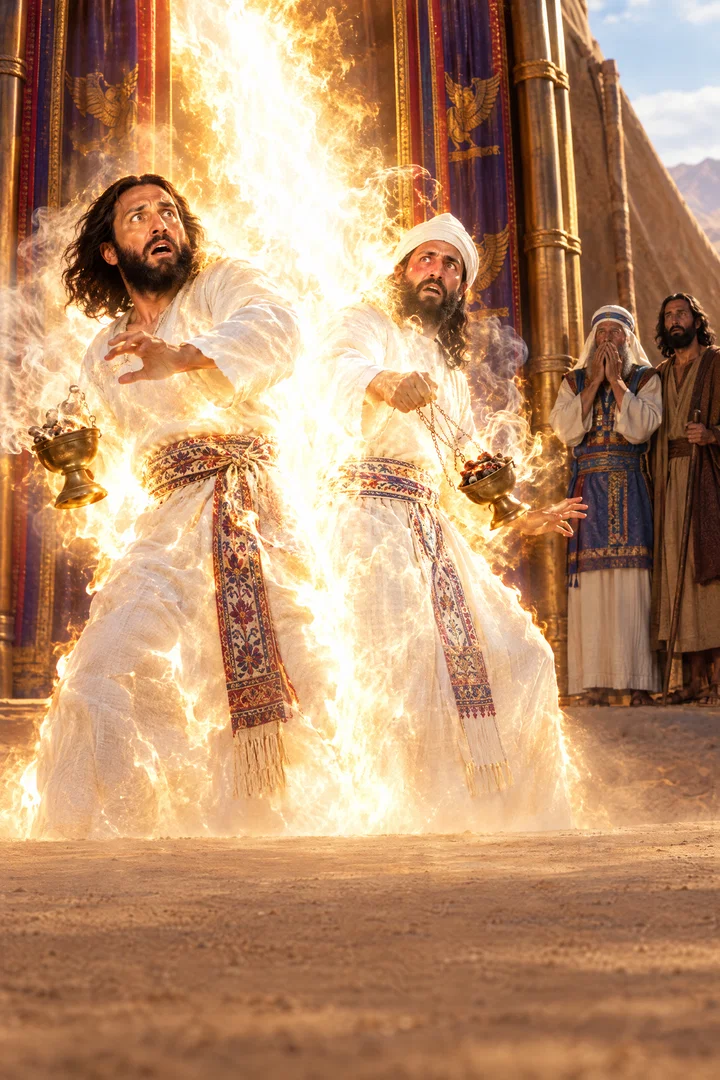
And there went out fire from the LORD, and devoured them, and they died before the LORD.
Translations
American King James Version, King James Version, Webster Bible
And there went out fire from the LORD, and devoured them, and they died before the LORD.
And there went out fire from the Lord, and devoured them, and they died before the Lord.
And there came forth fire from before the LORD, and devoured them, and they died before the LORD.
And there came forth fire from before Jehovah, and devoured them, and they died before Jehovah.
and fire goeth out from before Jehovah, and consumeth them, and they die before Jehovah.
And there went out fire from before Jehovah, and devoured them, and they died before Jehovah.
Then came there forth fire from before Yahweh, and consumed them,—and they died before Yahweh.
Berean Standard Bible, Majority Standard Bible
So fire came out from the presence of the LORD and consumed them, and they died in the presence of the LORD.
Fire came out from before the LORD, and devoured them, and they died before the LORD.
And fire came out from before the Lord, burning them up and causing their destruction before the Lord.
Therefore a fire went out from the Lord, and deuoured them: so they dyed before the Lord.
Douay-Rheims (Challoner revision)
And fire coming out from the Lord destroyed them, and they died before the Lord.
Pictures
Cross-references 20 of 40
- Leviticus 9:24
And there came a fire out from before the LORD, and consumed upon the altar the burnt offering and the fat: which when all the people saw, they shouted, and fell on their faces.
The Lord’s fire accepts the offering, contrasting with the fire that consumes Nadab and Abihu.
- 2 Samuel 6:6-7
And when they came to Nachon’s threshingfloor, Uzzah put forth his hand to the ark of God, and took hold of it; for the oxen shook it.
Both describe death as judgment for disregarding God’s prescribed order concerning holy things.
- Leviticus 10:8-11
And the LORD spake unto Aaron, saying,
The instructions on wine and distinguishing holy from common explain the lesson drawn from Nadab and Abihu.
- Hebrews 12:29
For our God is a consuming fire.
God is called a consuming fire, explaining the fire that devoured them.
- Exodus 30:9
Ye shall offer no strange incense thereon, nor burnt sacrifice, nor meat offering; neither shall ye pour drink offering thereon.
Forbids the unauthorized incense offering for which Nadab and Abihu were punished.
- Exodus 24:9-10
Then went up Moses, and Aaron, Nadab, and Abihu, and seventy of the elders of Israel:
Nadab and Abihu had seen God’s glory on the mountain before their death.
- Exodus 24:17
And the sight of the glory of the LORD was like devouring fire on the top of the mount in the eyes of the children of Israel.
God’s glory appears as devouring fire.
- 2 Chronicles 26:16-19
But when he was strong, his heart was lifted up to his destruction: for he transgressed against the LORD his God, and went into the temple of the LORD to burn incense upon the altar of incense.
Both show divine judgment for presuming to approach God unlawfully.
- Acts 5:1-10
But a certain man named Ananias, with Sapphira his wife, sold a possession,
Ananias and Sapphira suffer sudden judgment in God’s presence, like Nadab and Abihu.
- Numbers 16:35
And there came out a fire from the LORD, and consumed the two hundred and fifty men that offered incense.
Fire from the Lord consumed those offering incense.
- Revelation 20:9
And they went up on the breadth of the earth, and compassed the camp of the saints about, and the beloved city: and fire came down from God out of heaven, and devoured them.
Both describe God’s fire devouring the wicked.
- Leviticus 6:13
The fire shall ever be burning upon the altar; it shall never go out.
The perpetual altar fire was the sacred fire they rejected.
- Isaiah 33:14-15
The sinners in Zion are afraid; fearfulness hath surprised the hypocrites. Who among us shall dwell with the devouring fire? who among us shall dwell with everlasting burnings?
Only the righteous can dwell with God’s devouring fire.
- Leviticus 10:6
And Moses said unto Aaron, and unto Eleazar and unto Ithamar, his sons, Uncover not your heads, neither rend your clothes; lest ye die, and lest wrath come upon all the people: but let your brethren, the whole house of Israel, bewail the burning which the LORD hath kindled.
Aaron and his sons are forbidden to mourn for Nadab and Abihu.
- Hebrews 10:27
But a certain fearful looking for of judgment and fiery indignation, which shall devour the adversaries.
fiery indignation devours adversaries
- 1 Corinthians 10:11
Now all these things happened unto them for ensamples: and they are written for our admonition, upon whom the ends of the world are come.
Israel’s recorded death serves as an example and admonition for later generations.
- Numbers 3:4
And Nadab and Abihu died before the LORD, when they offered strange fire before the LORD, in the wilderness of Sinai, and they had no children: and Eleazar and Ithamar ministered in the priest’s office in the sight of Aaron their father.
Nadab and Abihu died before the Lord for offering unauthorized fire.
- Exodus 28:43
And they shall be upon Aaron, and upon his sons, when they come in unto the tabernacle of the congregation, or when they come near unto the altar to minister in the holy place; that they bear not iniquity, and die: it shall be a statute for ever unto him and his seed after him.
Priests were warned to serve holy before the LORD lest they die.
- Exodus 19:22
And let the priests also, which come near to the LORD, sanctify themselves, lest the LORD break forth upon them.
God warns that those who draw near must be sanctified, lest he break forth upon them.
- Psalms 21:9
Thou shalt make them as a fiery oven in the time of thine anger: the LORD shall swallow them up in his wrath, and the fire shall devour them.
fire devours the wicked
Commentary part 1 of 2
Each commentary is drawn from primary sources: the writings of Ellen G. White and Adventist pioneers and periodicals. Each commentary is separate. Its own words are not a quotation; follow the references to read the source passages.
Ellen G. White
108 sources
Fire came out from God's presence and consumed Aaron's two priest sons because in public worship they burned incense with common fire of their own taking instead of the sacred fire He had commanded to be kept burning continually.GW 20.2–31SP 276.2–277.1SG4 11.2–3CEv 91.3MC 22.3–23.2 They were partially intoxicated from wine freely drunk, which beclouded intellect and moral perception so they could no longer distinguish between holy and unholy, sacred and common.GW 20.2–31SP 276.2–277.1SG4 11.2–3ST Feb 17, 1888LC1 187.1–2 Their death fulfills His word that He will be sanctified in those who come near Him and glorified before all the people, demanding strict exact obedience without substitution.GW 20.2–31SP 276.2–277.13MR 324.3Ms 109, 1899, par. 5–6Ms 30, 1900, par. 18–22 God has not changed and is as particular and exact now as then, rejecting all worship polluted by liquor, stimulants and uncontrolled appetite as strange fire and requiring clear judgment and reverence in His service.CH 396.3ST Feb 17, 1888ST Mar 4, 1875LC1 189.2–190.12RED 86.2 Substituting human wisdom, self, harshness, grasping for gain, or theatrical display for God's appointed methods and Spirit is still offering common fire, while sacred fire is work done with self hidden in Christ in tenderness, love and consecration.Lt 81, 1896, par. 6–8STMW10 10.1–27T 267.2STMW9 12.2–3Ms 14, 1896, par. 3
Offense and Immediate Judgment
Nadab and Abihu were the sons of Aaron, priests honored in sacred office, who had been permitted to go up with Moses and Aaron and seventy elders and see the God of Israel.Ms 174, 1898, par. 8–12Ms 78, 1897, par. 67–69ST Jul 1, 1880 Only those who had in a most solemn manner been ordained to the office could minister as priest before the Lord, and their destruction enforces that boundary.ST Sep 9, 1880 Their high privilege made their failure the more solemn, for as favored witnesses of God's glory in the mount they knew that careful self-examination and sanctification were required before entering the sanctuary.ST Jul 1, 1880
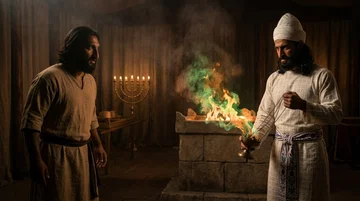
They took common fire and placed it upon their censers and offered incense with strange, unauthorized fire which He commanded them not.GW 20.2–31SP 276.2–277.1MC 22.3–23.2 The sacred fire God Himself had let fall from heaven represented God, never went out day nor night, was kept burning continually on the altar, and by express positive command was to be used for incense and in all service.3MR 324.3Ms 109, 1899, par. 5–6ST Jul 1, 1880 Instead they used fire of their own taking, and their outward performance of the ceremony did not make the act acceptable.SG4 11.2–3Lt 49a, 1896, par. 26–27 Their act was presumptuous transgression and direct violation of the holiness required of those who come near Him where His presence is manifested.ST Jul 1, 1880
The offense occurred in the sanctuary during public worship in a solemn season of worship before the Lord.GW 20.2–3PP 359.2ST Jul 17, 1884 It came just after He had accepted Aaron's commanded sacrifices with fire, when Nadab and Abihu took their censers and burned fragrant incense as a sweet odor before God but with strange fire contrary to the Lord's commandment.ST Jul 17, 1884 The Lord's fire devoured them in front of the people as punishment for offering incense with common fire instead of the sacred fire God had kindled and commanded them to use.PP 359.2
Fire went out from the Lord's presence and devoured and consumed them, and they died before the Lord.CEv 91.3Ms 109, 1899, par. 5–6MC 22.3–23.2 They died before Him in the sight of the people, and were cut off from the congregation, because God did not excuse their sin.ST Jul 17, 1884ST Feb 17, 1888 They were destroyed because they disregarded God's express command by putting common fire in place of sacred fire upon their censers.ST Oct 14, 1880
Aaron did not murmur or rebel when his two sons died by this terrible manifestation of divine judgment for disregarding God's express command.ST Oct 14, 1880PP 425.4 God's directions to Aaron teach that His corrections are just and should be acknowledged so that others may fear.SG4 13.3 Sympathizing with those punished instead of recognizing God's dishonor makes the sympathizers guilty with the transgressor.SG4 13.3
Wine and Character Causes
Nadab and Abihu had drunk wine too freely and were partially intoxicated when they ministered, with benumbed brains, weakened nerve power, beclouded intellect, dulled senses and dulled moral perception.GW 20.2–31SP 276.2–277.1SG4 11.2–3Ms 27, 1893, par. 14CH 396.3 That intoxication left them unable to distinguish between holy and unholy, between clean and unclean, and between sacred fire and common fire.GW 20.2–31SP 276.2–277.1SG4 11.2–3Ms 27, 1893, par. 14CTBH 18.2–19.1 Wine had dulled their senses and clouded their minds so that they failed to discern the sacred from the common and disobeyed God's requirements for incense.1SP 276.2–277.1SG4 11.2–3Ms 27, 1893, par. 14CH 396.3STB 640.3–4 Appetite and habits must therefore be kept under strict control by all who serve, under God's watchful eye upon their work.CH 396.3STB 640.3–4
Their error did not begin with one cup, for long-practiced self-indulgence, gratified appetite and passion, lack of self-control, and failure to learn respect for authority and exact obedience had left them unprepared for sacred responsibility.GW 20.2–3ST Jul 8, 1880STMW10 10.1–2ST Jul 1, 18801SP 279.1–2 Even elevation to honored office could not break the habit, and through indulgence spiritual and holy things lost their sacredness until disobedience looked pleasing rather than exceeding sinful.GW 20.2–3ST Jul 1, 18801SP 279.1–2ST Jul 8, 1880 Indulged appetite perverted their reasoning powers, beclouded their senses with wine, and led them through careless, reckless self-indulgence to place themselves where they could not distinguish sacred from common.ST Jul 8, 1880STMW10 10.1–2ST Jul 1, 1880ST Jul 8, 1880 God had purposed to connect them with Himself and to call out the highest powers of the mind by testing character, teaching firm principle, strictly temperate habits, and a continual sense of the sacredness of the work, but habit had chained them and the repeated intoxicating draught controlled them.ST Jul 8, 1880ST Jul 1, 1880
That disregard had been nourished by loose home discipline, for Aaron with misplaced tenderness failed to command respect and reverence, to train them to obedience, self-denial and reverence for parental and divine authority, and to restrain them with firmness.3T 295.1–3RH Jul 29, 18733T 293.3–294.1 He indulged them with gentle remonstrance instead of firm restraint, until self-gratification ruled their characters and they did not know their own weakness.RH Jul 29, 1873ST Jul 1, 1880 So they disregarded parental authority and did not realize the necessity of explicitly following God's requirements, and their failure to learn obedience and reverence contributed directly to their death by God's justice.3T 295.1–3RH Jul 29, 18733T 293.3–294.1
Their act was presumptuous transgression, positive disregard and insult of God's express positive command to use only the sacred fire He Himself had let fall from heaven and commanded to be kept burning continually on the altar.ST Jul 1, 1880ST Jul 17, 18841SP 279.3–280.1Ms 25, 1887, par. 19ST Jul 8, 1880 With full and clear use of reason they would have recoiled with horror, especially as favored men who had witnessed God's glory and knew that careful self-examination and sanctification were required before entering the sanctuary where His presence is manifested.ST Jul 1, 1880 No plea of meaning no harm or thinking to do God service excuses disregard of light, for God exactly marks iniquity and visits sins of thoughtlessness, negligence, forgetfulness, and even ignorance when light has shone.ST Jul 17, 1884 It is not enough that nearly everything in worship is done as commanded, for God is not pleased with partial obedience, and to say a common thing will do as well as what He declared sacred insults Him and means just what He says must be followed exactly.ST Jul 17, 18841SP 279.3–280.1ST Jul 8, 1880 Those who have seen the glorious manifestation of God's character with melted and subdued hearts, lost to self in consciousness of His wonderful glory and their own utter unworthiness, will not exalt themselves or offer such heedless presumption as mingling common fire with the fire of God's own kindling.Lt 87, 1896, par. 31
Drink did not excuse them, for they became responsible for all acts committed under its influence when they put the cup to their lips and chose to drink before sacred duty.ST Feb 17, 1888LC1 187.1–2CTBH 18.2–19.1SG4 124.3–125.2SG4 124.1–2 Their impaired judgment and lost sense of sacred things after drinking did not excuse the breach of trust for which they were slain and cut off from the congregation.ST Feb 17, 1888CTBH 18.2–19.1SG4 124.3–125.2SG4 124.1–2ST Mar 4, 1875 God expressly forbade wine that beclouds the intellect and required abstinence so that power of discrimination stays clear to discern between holy and unholy and between clean and unclean.ST Mar 4, 1875 God will not work a miracle to keep men from the consequence of deliberate departure from light, and the same warning reaches wine, beer, tea, coffee and other intoxicants and stimulants, with tobacco and indulged appetite, which corrupt the blood, benumb the faculties, blunt moral perception, inflame and strengthen animal passions over the intellectual and spiritual nature, and harden the conscience until common and sacred lose all difference and men are unfitted to offer a living sacrifice holy and acceptable.ST Feb 17, 1888ST Mar 4, 1875
Holiness and Exact Obedience
The judgment fulfills the word that God will be sanctified in those who come near Him and glorified before all the people, requiring all who approach Him in sacred service to honor His holiness and His commands.GW 20.2–31SP 276.2–277.13MR 324.3MC 22.3–23.2Lt 49a, 1896, par. 26–27 The sacred fire He commanded represented God Himself, was to remain alight day and night, and was to be used in all service, yet they offered unauthorized common fire, and fire went out from the Lord and devoured them so that they died before the Lord.3MR 324.3Ms 109, 1899, par. 5–6MC 22.3–23.2Lt 49a, 1896, par. 26–27 Their outward performance of the ceremony did not make the act acceptable, for it is not man who is to be praised and honored, but God.Ms 109, 1899, par. 5–6Lt 49a, 1896, par. 26–27 Those working with the Lord to save souls must therefore bring no commonness or cheapness into His sacred service, but a mind filled with pure, holy thoughts and well-chosen words, with no careless, light words that would hinder the work.MC 22.3–23.2
God demands strict obedience to every word that proceeds out of His mouth, exact compliance without substitution, and He does not sanction wrongdoing in His work even when a good purpose is claimed.Ms 109, 1899, par. 5–6Ms 30, 1900, par. 18–22ST Jul 17, 1884 Zeal does not make unholy, humanly devised service acceptable, and those called to holy work must use only what God has appointed and not mix human, unholy means with His offering.Ms 30, 1900, par. 18–22STMW6 17.4 He exactly marks iniquity and visits sins of thoughtlessness, negligence, forgetfulness, and even ignorance when light has shone, and no plea of meaning no harm or thinking to do God service excuses disregard of light.ST Jul 17, 1884 It is not enough that nearly everything in worship is done as He commanded, for He is not pleased with partial obedience, and to deviate from His explicit directions and substitute human choice for what He has declared sacred is no light matter.ST Jul 17, 18841SP 279.3–280.1ST Jul 8, 1880 To say a common day will do just as well insults the Maker, for God means just what He says.ST Jul 8, 1880
Putting the common in place of the sacred brings sure punishment and death, and though God bears long with him the transgressor must surely bear the consequence of his own sin.Ms 78, 1897, par. 67–69ST Oct 6, 1898Lt 6, 1896, par. 2 Not even a spark of common fire was to kindle the incense, sacred things must not be brought down to the level of common things, and treating sacred service as common or cherishing what God has not appointed brings His displeasure and judgment.Lt 6, 1896, par. 2Ms 195, 1903, par. 14–1915MR 115.2–44MR 154.3–4 The same sure consequence will fall upon those who exalt Sunday, a spurious Sabbath and common working day, in place of the seventh day which the Lord sanctified and blessed, and upon all who strive to make His law a dead letter and set it aside as of no consequence.Ms 78, 1897, par. 67–69ST Oct 6, 1898 His statutes are to be reverenced and obeyed, for God is supreme authority in all His requirements, and those who set aside His law He will certainly punish.Ms 78, 1897, par. 67–69ST Oct 6, 1898
Unrighteousness by those responsible for God's service greatly dishonors Him and He will not tolerate it, and offering unauthorized worship and saying it makes no difference is abhorrent to Him.3MR 324.3Ms 109, 1899, par. 5–6STMW9 30.1–3Lt 4, 1895, par. 29 He shows no partiality and does not excuse wickedness, especially in those entrusted with responsible places, but holds people accountable now as then, with greater severity where greater light, privileges, and responsibility have been given.Ms 10, 1899, par. 9Ms 25, 1887, par. 19 He judges such disregard for His authority and opposes injustice, and will cleanse and purify His church of moral defilement.STMW9 30.1–3Lt 4, 1895, par. 29 God has not changed and is as particular and exact in His requirements now as in the days of Moses, noticing defilement even when sentence against an evil work is not executed speedily.ST Mar 4, 1875LC1 189.2–190.1RH Mar 25, 1875 He will no more receive prayer, song, preaching, and teaching mingled with the stench of tobacco, liquor, and narcotics, offered with stained lips and benumbed brains, than He received their offering, for such polluted worship is strange fire and positive defilement, an offense and insult to a holy, sin-hating God dwelling in light unapproachable, and an incense most acceptable to Satan.ST Mar 4, 1875LC1 189.2–190.1RH Mar 25, 1875
The sacredness of His work is to be preserved fully as much now as in the days of ancient Israel, with sacred things treated as holy and distinguished from the common.Ms 109, 1899, par. 5–67T 152.3–153.2Ms 29, 1895, par. 4–6 Their deaths illustrate the seriousness of treating God's sacred service as common and the need to honor Him before the people.CEv 91.3Ms 23, 1890, par. 4 People must approach Him with reverence and awe and in His own appointed manner, within the duties and boundaries He appoints, bringing no commonness or cheapness into sacred work.Ms 29, 1895, par. 4–6Ms 23, 1890, par. 4ST Jul 17, 1884
Typology Sabbath and Warnings
The fire God commanded never to go out day or night represented God Himself and the communication between God and man opened through Jesus Christ alone.3MR 324.3Ms 109, 1899, par. 5–6ST Mar 4, 18752RED 82.1–2RH Mar 25, 1875 No sacrifice salted and seasoned with that divine fire was acceptable, for Christ is the true altar and the Holy Spirit is the true fire kindled from God's coals that must consume selfishness and inspire the offerings brought to Him.3MR 324.3ST Mar 4, 1875 That sacred fire was to be used in all service, and unrighteousness by those bearing responsibility in God's service greatly dishonors Him and He will not tolerate it, demanding strict obedience to every word and the preservation of the sacredness of His work fully now as in ancient Israel.3MR 324.3Ms 109, 1899, par. 5–6
The incense kindled by holy fire, rising before God mingled with the earnest prayers of the people without, was an emblem of the mediation of Christ.LC1 186.1ST Mar 4, 18752RED 82.1–2RH Mar 25, 1875 Strange common fire with no divine Saviour represented was positive disregard and insult to the infinite God, as the offering of Cain.LC1 186.1ST Mar 4, 18752RED 82.1–2RH Mar 25, 1875 Though priests who fully understood the holy character, awful solemnity and responsibility of the typical service, Nadab and Abihu lost discernment between sacred and common because free indulgence in wine gratified appetite, debased faculties and beclouded intellect.LC1 186.1ST Mar 4, 18752RED 82.1–2RH Mar 25, 1875
Putting the common in place of the sacred brings sure punishment, for the transgressor must surely bear the consequence of his own sin though God bears long with him, and God is supreme authority in all His requirements whose statutes are to be reverenced and obeyed.Ms 78, 1897, par. 67–69Ms 63, 1897, par. 6–8ST Oct 6, 1898 To exalt Sunday, a spurious Sabbath and common working day upon which God placed no sanctity, in place of the seventh day which the Lord sanctified and blessed, is to offer strange fire and a strange Sabbath He commanded not and will not accept.Ms 78, 1897, par. 67–69Ms 63, 1897, par. 6–8ST Oct 6, 1898 Clothing a common day with sacred prerogatives and declaring it holy gives it no sanctity, dishonors God by human institution, presents to the world as the Christian Sabbath a day with no Thus saith the Lord for its authority, strives to make His law a dead letter, and insults the Maker who instituted the Sabbath to commemorate His rest after six days of creation.Ms 78, 1897, par. 67–69Ms 63, 1897, par. 6–8ST Jul 8, 1880 Violation of the fourth commandment by laboring on God's holy time and resting on the first day instead of keeping holy the very seventh day He specified is not now immediately visited with temporal death, yet God regards it no more lightly than the transgression of Aaron's sons, and death is the final punishment of all who reject light and continue in transgression.SG4 14.1–21SP 279.3–280.1ST Jul 8, 1880 God means just what He says and means the particular day He sanctified, so men must follow His explicit directions for worship exactly rather than substitute what they think will do just as well.SG4 14.1–21SP 279.3–280.1ST Jul 8, 1880
Their history was known from the Pentateuch and stood as a warning to youth against all customs, practices and indulgences that would dishonor God, teaching that wine was prohibited to all engaging in God's service because it confuses the senses, benumbs the brain and beclouds discernment between sacred and common.Ms 122, 1897, par. 25–26Ms 51, 1898, par. 4–8PK 482.112MR 121.3–123.1Ms 122, 1897, par. 27–29 Daniel and his companions applied that lesson when tested in Babylon by determining not to defile themselves with the king's wine, refusing it to protect physical and mental powers and keeping the straight path of strict temperance.Ms 122, 1897, par. 25–26Ms 51, 1898, par. 4–8PK 482.112MR 121.3–123.1 They understood that indulgence of appetite places a person where discernment fails and could cloud judgment and lead into dishonoring God.Ms 51, 1898, par. 4–812MR 121.3–123.1
Indulged appetite perverted reasoning powers and led to breaking an express command, illustrating that people reap what they sow and sowing to the flesh brings corruption.ST Jul 8, 1880RH Feb 27, 1900 Their history warns parents and children to control inclination and passion, bring the will with faith and courage into submission to the will of God, and win daily victories over Satan's temptations in the strength of Jesus, whom God purposed to connect with them as He purposes with obedient children whose lives become pure and fragrant like a white lily on stagnant waters.ST Jul 8, 1880 Those engaged in God's work are taught to practice strict temperance, keep the whole being under God's protection, and never tempt the Spirit of God, lest doing so lead to the unforgivable sin against the Holy Ghost, while God is to be sanctified by those who come near Him and glorified before the people.RH Feb 27, 1900
Sacred Service and Leadership
In God's service common fire is any human substitute for His appointed methods and divine principles — human wisdom, inventions, plans, opinions, unsanctified self-originated light, worldly ideas, politics, false science and philosophy — and it cheapens truth, turns things upside down, and brings judgment when sacred work is mingled carelessly with common ideas born of self.STMW10 10.1–27T 267.2FE 409.1–2SPBC 170.1RCOC 51.1 It includes human principles that find no sanction in the Word, self and pride of opinion, Pharisaism separated from the Bible standard, a controversial combative attitude when preconceived ideas are crossed, pride and loftiness and a spirit that desires to rule, and human inventions and plans eclipsing sacred things and excluding divine instruction.Lt 81, 1896, par. 6–8 It is men taking the place of God by assuming authority over fellow men without a vestige of His authority, and replacing God's holy principles with human devisings even under claim of advancing His cause, which leads to oppression, injustice and wickedness abhorrent to Him.Lt 81, 1896, par. 6–8RCOC 51.1SPBC 177.7–8STMW9 16.4Lt 55, 1895, par. 3–7 Such misuse of God-given abilities and departure from God's methods profanes sacred service, rejects the offering, and was done in the past and is still being done.Lt 81, 1896, par. 6–8FE 409.1–2SPBC 170.1
Strange fire is self, self-importance, self-exaltation, self-righteousness, pride, Pharisaism, combativeness, harsh domineering oppression, arbitrary authority, restricting God's people by rules He did not establish, and exalting human authority above the divine.Lt 81, 1896, par. 6–8STMW9 14.2 Harsh words, domineering, oppression, and man-made restrictions misrepresent His character, and He does not acknowledge or accept them.STMW9 14.2 Invoking His cause cannot justify dishonest or oppressive conduct, for practices that violate truth and righteousness, deny people's rights, and rob them are abhorrent to Him and bring no true advancement.SPBC 177.7–8STMW9 16.4Lt 55, 1895, par. 3–7 Handling strange fire is moving in strange ways while handling sacred responsibilities: trusting self instead of making God the trust, planning and devising methods to carry out projects of one's own mind in order to make a show, rather than hiding in Christ and being worked by the Holy Spirit.Lt 89, 1896, par. 2–39MR 165.2–3 It comes when men kept year after year in presidency and as advisors in committees or boards come to think themselves a necessity until their wisdom becomes foolishness, when Satan's artful deception enters, when they feel no sacredness of the work nor the importance of working in humility and contrition, cherish little earnest desire for God to lead and inspire their hearts and give wisdom, and voice resolutions never thought of in the councils of heaven.Lt 89, 1896, par. 2–3
Common fire is also self woven into the work, especially in speech: sharp critical harsh condemning words, quick severe ill-advised utterances, careless and perverse words, drops of gall, murmuring, jealousy, suspicion and evil speech.Ms 14, 1896, par. 3Ms 17, 1895, par. 4–5Ms 31, 1903, par. 9Lt 91, 1899, par. 13–15Ms 2, 1899, par. 3 The sacred fire is work done in the right spirit without self, and no one who cannot distinguish the sacred from the common should touch the work, for right performance and the salvation of souls depend in great degree on the worker's own spiritual condition and the spirit cherished.Ms 14, 1896, par. 3 Even when teaching or writing is all truth, one drop of gall poisons it, causing hearers and readers to discard the good or to feed on the poison and copy the harsh example, multiplying evil; words must therefore be spoken as Christ would have them spoken, truth in love, with tongue restrained and heart purified so divine power joins human effort.Ms 17, 1895, par. 4–5Lt 91, 1899, par. 13–15 Forbidden words can destroy hope, courage and faith and wound those who belong to Christ, and murmuring, jealousy, suspicion and evil speech have no place in the Lord's house where wicked thoughts and mistrust must be put away.STMW9 6.1Ms 2, 1899, par. 3 Harsh rash words are to be avoided, and all are to speak as Christ spoke.Ms 31, 1903, par. 9
Mingling selfish grasping wage-seeking, fraud, unjust dealing, misapplied and diverted means, appropriating treasury funds, and worldly business policy with sacred work is offering common fire and robbing God.Ms 24, 1891, par. 89Lt 94, 1899, par. 15–17Lt 98, 1899, par. 11Ms 19a, 1891, par. 3Lt 127, 1899, par. 10–11 It is handling what God made sacred in a common unholy way, a selfish covetous fraudulent course abandoning justice, equity and righteous principle, as when men at the head of the work divert means the Lord moved His people to give for a certain purpose and partake in worldly policy instead of keeping the sacred trust holy.Lt 94, 1899, par. 15–17Lt 98, 1899, par. 11 Working to secure higher wages while thinking duty is done, bringing a selfish grasping spirit, trading upon God's goods with covetous appropriation, warping the message to meet the convenience of men who desire worldly business success, investing money in worldly enterprises and binding it up in schemes not after God's order, and making of no effect by spoken words the message of servants sent to oversee His vineyard, all dishonor Him and fail to represent the work for this time.Ms 19a, 1891, par. 3Lt 127, 1899, par. 10–11 That selfish spirit is as contagious as leprosy, spreading as plague spots that others catch, a partial blindness as happened to Israel, grieving the Spirit; the offense is measured by the position of trust occupied, for responsibility for influence of mind upon mind is proportionate to trust given.Lt 94, 1899, par. 15–17Ms 19a, 1891, par. 3 Those handling sacred things must not defile sacred work by mingling common fire in business lines, but bring permanently into work the pure holy principles of heaven, giving themselves without reserve so individual influence becomes holy power in family, school and church through practical benevolence, self-denial and self-sacrifice.Ms 24, 1891, par. 8919MR 259.4Lt 94, 1899, par. 15–17
Theatrical preaching, outward display, storytelling mixed with the Word, common cheap illustrations and pictures, long articles unrelated to present vital truth, worldly theories, politics brought into the pulpit, and deceptive spiritualism are common fire that God does not kindle or accept.Lt 89, 1899, par. 6–7STMW8 22.3–23.1Lt 51, 1902, par. 18–193MR 277.4 Fire associated with worship is common rather than sacred when not of His kindling, and ministers dishonor Him when they bring worldly or unverified ideas instead of faithfully presenting truth received from Him.STMW8 22.3–23.1Lt 51, 1902, par. 18–19 Strained, poorly prepared, worn-down service without time to seek God cannot take the place of work empowered by the Holy Spirit, and God's work must be carried out with humility and Christlike methods rather than human inventions and display.GW 271.4Ms 101, 1902, par. 1–33MR 277.4 Papers with wide circulation must contain more precious instruction than common publications of the day, pure wheat thoroughly winnowed from all chaff, for true higher education is not gained by dealing with lives and sentiments of men who do not know the Word of the Lord.Lt 89, 1899, par. 6–7
Sacred fire is work done in the right spirit without self, with a heart controlled by the Holy Spirit, Christlike tenderness, love, humility, contrition and consecration, hiding self in Christ, walking with God, denying self and restraining passion rather than acting on impulse, and giving pure wheat and solid spiritual food.STMW9 12.2–3STMW9 13.3Ms 14, 1896, par. 313MR 310.2Lt 89, 1896, par. 2–3 It represents Christ's character and the holy influence of a life honoring the sacredness of the work, and God's sacred fire of love makes people tender, kind and sympathetic toward those in danger, while harsh overbearing treatment reflects pride rather than that love.STMW9 12.2–3STMW9 13.3 Zeal offered in an unsanctified self-chosen way dishonors God and harms truth, and is especially offensive when offered by one with greater responsibility.STMW9 13.313MR 310.2 Each worker must cultivate a vivid sense of responsibility, for his own well-being and eternal destiny are decided by the spirit he cherishes.Ms 14, 1896, par. 3
Those handling sacred trusts — ministers, teachers, managers, boards, physicians, canvassers and editors — must distinguish sacred from common, depend on God not unsanctified men, avoid backslidden counsels and commercial defilement, and serve with prayer, pure thoughts and well-chosen words rather than strained human effort.CH 396.3STB 640.3–4MC 22.3–23.2Lt 89, 1899, par. 6–7Ms 91, 1899, par. 2 Those working to save souls must bring no commonness or cheapness into sacred service, but keep a mind filled with pure holy thoughts and well-chosen words with no careless light words that would hinder success, especially in speech among unbelievers who are taking the measure of the worker.MC 22.3–23.2 All who sit in the editorial chair and handle matter going forth to the world must not mingle sacred with common, and God's institutions must be guarded with earnest solemn work in full dependence on Him, for to consult lawyers in church matters and put trust in unsanctified men is to use common fire as men destitute of the Spirit and under Satan's control.Lt 89, 1899, par. 6–7Ms 91, 1899, par. 2 Appetite and habits must be kept under strict control with clear judgment, for wine dulled the senses of Nadab and Abihu, and physicians and all serving others work under God's watchful eye.CH 396.3STB 640.3–4Ms 53, 1907, par. 24
Temperance and Pure Worship
The fire that consumed Nadab and Abihu marks all worship polluted by liquor, wine, tobacco, narcotics, tea, coffee and other intoxicants and stimulants as strange fire and positive defilement that a holy, sin-hating God dwelling in unapproachable light rejects and punishes.ST Feb 17, 1888ST Mar 4, 18752RED 85.2–86.1 Under strong drink they lost all sense of sacred things, kindled incense from common fire in disregard of the command to take coals only from the sacred fire God Himself had kindled, and were cut off from the congregation because drink did not excuse unfitness for sacred duty.ST Feb 17, 1888CTBH 18.2–19.1ST Mar 4, 1875 Prayers, songs and preaching of Bible truth and holiness mingled with the stench of tobacco and brandy, offered with lips stained and nerves half-paralyzed, is not merely strange fire but an offense and insult most acceptable to Satan.ST Mar 4, 18752RED 86.22RED 85.2–86.1 Because sentence against an evil work is not executed speedily, defiled ministers and worshippers think defilement is unnoticed, yet indulgence in eating, drinking, smoking, chewing, gluttony and drunkenness corrupts the blood, benumbs the faculties, blunts moral perception, inflames animal passions over the intellectual and spiritual nature, hardens conscience to sin, and leaves no difference between common and sacred so men cannot offer a living sacrifice holy and acceptable.ST Feb 17, 1888ST Mar 4, 18752RED 86.2 Priests entering the sanctuary with mouths polluted by tobacco would have met the same fate, for blunted senses keep men from recognizing the difference and make worship defiled by appetite and passion unacceptable.2RED 86.2CH 81.3CH 82.1–2
Appetite and habits must be kept under strict control because wine dulled the senses of Nadab and Abihu and unauthorized fire brought consuming fire from the Lord upon them.CH 396.3STB 640.3–4Ms 53, 1907, par. 24 Those serving God and serving others, including physicians serving patients, work under God's watchful eye and must keep clear judgment to discern holy from unholy.CH 396.3STB 640.3–4Ms 53, 1907, par. 24 Having drunk wine before sacred duty they could not distinguish common fire from consecrated fire, and were slain for breach of trust, yet remained responsible because responsibility begins when the cup is put to the lips.CTBH 18.2–19.1ST Mar 4, 1875 God expressly forbids wine that beclouds the intellect and requires abstinence so the power of discrimination stays clear to discern between holy and unholy and between clean and unclean.CTBH 18.2–19.1LC1 190.2ST Mar 4, 1875 Intemperance in eating and drinking blunts sensibilities, paralyzes intellect, brings the common and defiling into holy things, and disqualifies mental powers for responsible sacred service.LC1 190.2ST Mar 4, 1875
Indulged appetite perverted reasoning powers, destroyed the fine feelings of the soul, took sacredness from spiritual and holy things, and made disobedience look pleasing instead of exceeding sinful, leading to breach of express command.ST Jul 8, 1880RH Jul 29, 1873ST Jul 8, 1880 Satan rejoices to see men formed in the Maker's image yield as slaves to depraved appetite, for he can then control the mind, lead the intemperate to debase themselves, and cause them to dishonor God by losing the high sense of His sacred requirements.ST Jul 8, 1880ST Jul 8, 1880 Their disobedience also grew from loose home discipline, where misplaced tenderness, gentle remonstrance and failure to command respect, train to obedience, self-denial and reverence, and restrain with firmness left them disregarding parental authority and God's explicit requirements, until God's own work of justice was awakened against them.RH Jul 29, 1873 Their history was recorded for God's people and especially for those preparing for the second coming of Christ, warning parents and children to control inclination and passion, bring the will with faith and courage into submission to God's will, and win daily victories over temptation in the strength of Jesus.ST Jul 8, 1880ST Jul 8, 1880 It was known to Daniel and his companions as a warning to youth to avoid all customs, practices and indulgences dishonoring God, teaching that wine was prohibited to all engaging in God's service because it confuses the senses and beclouds discernment, a lesson they applied in Babylon by determining not to defile themselves with the king's wine and keeping the straight path of strict temperance.ST Jul 8, 1880Ms 51, 1898, par. 4–8 God purposed to connect Nadab and Abihu with Himself, and purposes the same connection with obedient children whose lives become pure and fragrant like a white lily on stagnant waters, which is the way marked out for men to serve His high purposes, while the same indulgence of children in wrong by Christian parents now prepares them for certain displeasure and destroying wrath.ST Jul 8, 1880RH Jul 29, 1873
Those who minister in sacred things must approach God with reverence and cleanliness, for His sacred holiness consumed those who dishonored Him.CH 81.3CH 82.1–2 All in God's service professing truth must closely examine themselves whether they are in the faith and whether they offer sacred or common fire, for God will be sanctified in all who come near Him and glorified before all the people, so all naming Christ's name must depart from iniquity.Ms 94, 1899, par. 31Lt 41, 1898, par. 27–28 Nadab and Abihu made no difference between sacred and common and neglected the special requirement that joins human service to a holy God, offering in supposed superior qualifications and self-sufficiency without the holy fire, the vital sanctifying element that makes service acceptable.Ms 94, 1899, par. 31Lt 41, 1898, par. 27–28PP 398.3 Devotion to common business without spiritual discernment and work done without faith walking with God is rejected and punished, illustrating the danger of taking up sacred duties without divine authorization.Lt 41, 1898, par. 27–28PP 398.3
Sources