Leviticus 7:12
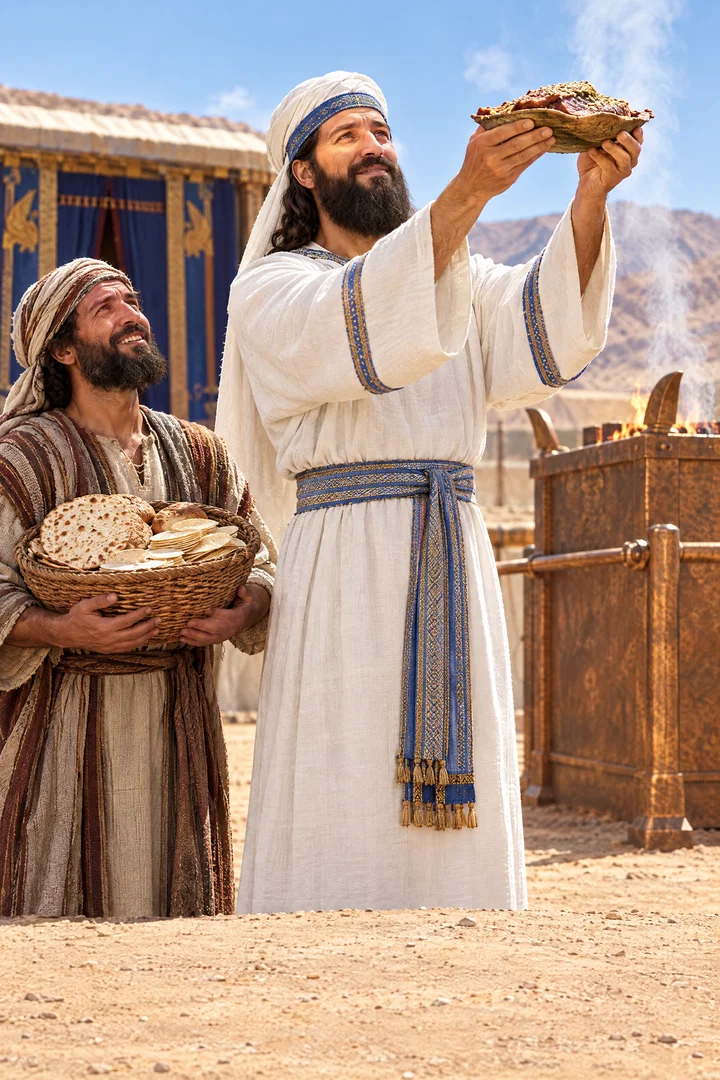
If he offer it for a thanksgiving, then he shall offer with the sacrifice of thanksgiving unleavened cakes mingled with oil, and unleavened wafers anointed with oil, and cakes mingled with oil, of fine flour, fried.
Translations
American King James Version, King James Version, KJV Cambridge Paragraph Bible
If he offer it for a thanksgiving, then he shall offer with the sacrifice of thanksgiving unleavened cakes mingled with oil, and unleavened wafers anointed with oil, and cakes mingled with oil, of fine flour, fried.
If he shall offer it for a thanksgiving, then he shall offer with the sacrifice of thanksgiving unleavened cakes mingled with oil, and unleavened wafers anointed with oil, and cakes mingled with oil, of fine flour, fried.
Revised Version, American Standard Version
If he offer it for a thanksgiving, then he shall offer with the sacrifice of thanksgiving unleavened cakes mingled with oil, and unleavened wafers anointed with oil, and cakes mingled with oil, of fine flour soaked.
if for a thank-offering he bring it near, then he hath brought near with the sacrifice of thank-offering unleavened cakes mixed with oil, and thin unleavened cakes anointed with oil, and of fried flour cakes mixed with oil;
If he present it for a thanksgiving, then he shall present with the sacrifice of thanksgiving unleavened cakes mingled with oil, and unleavened wafers anointed with oil, and fine flour saturated with oil, cakes mingled with oil.
If, for thanksgiving, he bring it near, then shall he bring near, with the thanksgiving sacrifice perforated cakes unleavened, overflowed with oil, and wafers unleavened anointed with oil,—and of fine flour moistened, perforated cakes overflowed with oil.
Berean Standard Bible, Majority Standard Bible
If he offers it in thanksgiving, then along with the sacrifice of thanksgiving he shall offer unleavened cakes mixed with olive oil, unleavened wafers coated with oil, and well-kneaded cakes of fine flour mixed with oil.
If he offers it for a thanksgiving, then he shall offer with the sacrifice of thanksgiving unleavened cakes mixed with oil, and unleavened wafers anointed with oil, and cakes mixed with oil.
If any man gives his offering as a praise-offering, then let him give with the offering, unleavened cakes mixed with oil and thin unleavened cakes covered with oil and cakes of the best meal well mixed with oil.
If he offer it to giue thankes, then he shall offer for his thankes offering, vnleauened cakes mingled with oyle, and vnleauened wafers anointed with oyle, and fine floure fryed with the cakes mingled with oyle.
Douay-Rheims (Challoner revision)
If the oblation be for thanksgiving, they shall offer leaves without leaven tempered with oil, and unleavened wafers anointed with oil, and fine flour fried, and cakes tempered and mingled with oil:
Pictures
Cross-references
- 1 Corinthians 5:8
Therefore let us keep the feast, not with old leaven, neither with the leaven of malice and wickedness; but with the unleavened bread of sincerity and truth.
Unleavened bread represents sincerity and truth, contrasted with malice and wickedness.
- Hebrews 13:15
By him therefore let us offer the sacrifice of praise to God continually, that is, the fruit of our lips giving thanks to his name.
Applies the offering as continual praise and thanksgiving to God.
- Psalms 50:14
Offer unto God thanksgiving; and pay thy vows unto the most High:
both command offering thanksgiving
- Hebrews 10:1
For the law having a shadow of good things to come, and not the very image of the things, can never with those sacrifices which they offered year by year continually make the comers thereunto perfect.
The law’s offerings are described as a shadow of what was to come.
- Leviticus 7:16-17
But if the sacrifice of his offering be a vow, or a voluntary offering, it shall be eaten the same day that he offereth his sacrifice: and on the morrow also the remainder of it shall be eaten:
Contrasts vow and freewill offerings with thanksgiving offerings.
- Leviticus 3:2-5
And he shall lay his hand upon the head of his offering, and kill it at the door of the tabernacle of the congregation: and Aaron’s sons the priests shall sprinkle the blood upon the altar round about.
Describes how peace offerings were presented.
Commentary
Each commentary is drawn from primary sources: the writings of Ellen G. White and Adventist pioneers and periodicals. Each commentary is separate. Its own words are not a quotation; follow the references to read the source passages.
Ellen G. White
6 sources
The instruction concerns the peace offering when brought as thanksgiving, which is especially an expression of gratitude to God.ST Jul 20, 1882PP 576.1–2 The thanksgiving sacrifice was to be brought with specified cakes and wafers prepared with oil.ST May 6, 1875 Only the fat was to be burned on the altar, while a specified portion was reserved for the priests and the greater part was returned to the offerer.PP 576.1–2 That returned portion was to be shared with family and friends in a solemn but joyful sacred feast, with a blessing asked upon it before eating and the remainder distributed among the family.ST Jul 20, 1882PP 576.1–2ST Oct 27, 1881
The law was corrupted by Eli's sons, who were not content with the allotted priestly portion but demanded an additional portion, refused to wait until the fat had been burned to God, claimed whatever portion pleased them with threats of violence, and used the great number of sacrifices at the annual feasts to enrich themselves at the people's expense.PP 576.1–2 Like the other sacrifices, it pointed forward to the death of Christ to preserve faith in the coming Redeemer and to direct all hearts in gratitude and faith to the great Sacrifice that would take away the sin of the world, so its directions were to be strictly heeded.PP 576.1–2 Thanksgiving offerings were required in addition to the tithe, or tenth of increase, as part of a system of required returns that made many claims on property, proportioned to what each possessed, to support religious service and benefit the poor.4T 467.1–2ST May 6, 1875 Through such offerings people return a portion to God in gratitude for His blessings, including health and the ability to acquire means.5T 150.1 This shared worship was meant to encourage true devotion, piety, kindness, and sympathy, not to become empty ceremony or self-gratification.ST Jul 20, 1882
Sources
Pioneers and periodicals
26 sources
The verse lays down the bread to be brought with a thanksgiving sacrifice, unleavened cakes mixed with oil, unleavened wafers spread with oil, and fried cakes of fine flour mixed with oil, along with leavened bread, with the meat to be eaten the same day and none left until morning.ST Sep 22, 1914ST Jun 5, 1901ST Jun 5, 1901 It is one form of peace-offering, a joyful yet solemn family feast whose flesh, unlike most offerings, could be eaten by the people after the priest received his portion.ST Apr 6, 1888ST Jul 20, 1882ST Oct 27, 1881RH Jun 6, 1912RH Feb 2, 1911 The details point to Jesus Christ, in whom the ceremonial sacrifices find their meaning as shadows of the coming Redeemer and His priestly work.ST Feb 7, 1911ST Jun 19, 1907ST Feb 3, 1909 The unleavened bread pictures sincerity and truth and the oil pictures Christ's righteousness, together showing the sincere testimony of one who praises God for deliverance and acceptance.ST Sep 22, 1914ST Sep 22, 1914 God thereby shows that He expects thankfulness, and the same spirit is still necessary when His people receive signal mercies, peace, and abundant provision, to express gratitude by freely giving of worldly substance and by public confession of His blessing rather than selfishly keeping it all.ST Sep 22, 1914RH Aug 18, 1868RH Jul 22, 1915RH Nov 23, 1869RH Nov 5, 1872
The Thanksgiving Offering
The thanksgiving sacrifice was to be brought with unleavened cakes mingled with oil, unleavened wafers anointed with oil, and cakes of fine flour mingled with oil and fried.ST Apr 6, 1888ST Sep 22, 1914ST Jun 5, 1901ST Jun 5, 1901ST Apr 2, 1912 These accompanying breads marked out a peace-offering given in thanksgiving and showed its purpose.ST May 6, 1875ST Sep 22, 1914ST Jun 5, 1901 The related instruction joins leavened bread to these unleavened preparations, and the meat of the thanksgiving offering was to be eaten on the day it was offered and not kept until morning.ST Jun 5, 1901
Thanksgiving is one form of peace-offering, standing alongside offerings for vows, voluntary gifts, first-fruits, firstlings, and tithes.RH Jun 6, 1912RH Feb 2, 1911 Peace-offerings were made at times of special rejoicing and to confirm a vow or contract, and the animal offered had to be without blemish.RH Jun 6, 1912 Unlike most offerings its flesh could be eaten by the people, and unlike the Passover it could be celebrated on any day of the year.RH Jun 6, 1912
After a portion was given to the priest and a blessing asked, the remainder was distributed and shared as a solemn but joyful family and sacred feast.ST Apr 6, 1888ST Jul 20, 1882ST Oct 27, 1881 The whole service was governed by specific sacred directions, with designated portions eaten by the priests.ST Apr 6, 1888ST Jul 20, 1882ST Oct 27, 1881 The peace-offering followed pardon and acceptance through a sin or trespass offering and renewed consecration represented by the burnt offering, with its fat burned upon that offering, showing that peace with God follows reconciliation and a life given to God's service.ST Sep 19, 1900
The verse belongs to the setting of Leviticus 7:11-34 and to the individual offerings of the first seven chapters of Leviticus.ST It is part of the service of the earthly sanctuary and its yearly round.ST Jun 19, 1907ST Nov 28, 1895 Offered in faith with the daily offering, it transferred in figure through the blood of the sacrifice or the person of the priest the penitent's sins to the sanctuary, where through the sprinkled blood before the ark they remained through the year until the cleansing on the tenth day of the seventh month.ST Jun 19, 1907ST Nov 28, 1895ST
Christ Foreshadowed in Offering
The verse belongs to the ceremonial law, which was instituted in consequence of sin.RH Jan 10, 1916 It stands among laws about sacrifices and offerings whose details have meaning, and their fuller meaning is found in the sacrifice, life, and work of Jesus Christ.ST Feb 7, 1911ST Feb 13, 1912 The instructions describing the service of the earthly sanctuary teach about God's way and Christ's priestly work in the heavenly sanctuary.ST Jun 19, 1907 The various offerings are shadows of Jesus Christ as the great reality to which they point, showing that God hates sin and that sin demands its penalty.ST Feb 3, 1909 The yearly round of services in the Levitical sanctuary typified Christ's service, completed once for all, in the heavenly sanctuary.ST Nov 28, 1895 The individual offering brought in thanksgiving, with its unleavened cakes mixed with oil, unleavened wafers anointed with oil, and fine-flour cakes cooked in oil, belongs among the sacrifices that expressed faith in the coming Redeemer, each having something in type concerning the work of Jesus Christ.ST Apr 2, 1912ST Feb 13, 1912
The unleavened bread represents sincerity and truth, and the oil represents Christ's righteousness, together picturing the sincere testimony of one who praises God for deliverance and acceptance.ST Sep 22, 1914ST Sep 22, 1914 The thanksgiving offering is thus a model testimony to God's goodness and the joy of His child.ST Sep 22, 1914 Thanksgiving for freedom from sin should be followed by a public confession of that blessing before others, a confession of God's deliverance from sin made before others and marked by sincerity and truth.ST Sep 22, 1914
In type and shadow the peace-offering service teaches that true, abiding peace comes from the Prince of Peace, not from riches, worldly fame, war, bloodshed, or greed.RH Jun 6, 1912 The sacrifice represented Christ bearing sin, and its service was governed by specific sacred directions with designated portions eaten by the priests.ST Apr 6, 1888 Taking by force the portion reserved for the altar violated the offering's solemn meaning and obscured its witness to Christ's sacrifice.ST Apr 6, 1888
Thankfulness Required Today
Thank-offerings were special offerings made in addition to tithes and to the tenth of a person's increase, with specified cakes and wafers prepared with oil accompanying the thanksgiving.ST May 6, 1875ST Aug 16, 1883RH Feb 2, 1911 Such giving cost the worshiper something tangible as an expression of devotion rather than cost-free participation, and the cost varied with wealth or position.ST Aug 16, 1883 First-fruits, firstlings, and tithes could be offered in peace-offerings, while the tithe itself was always the Lord's, the tenth of everyone's income reserved to Himself to be applied for the support of His ministers, as then so now.RH Feb 2, 1911
By requiring a thank offering among numerous sacrifices, God shows that He expects thankfulness, just as the Levites were required every morning and evening to thank and praise God.RH Jul 22, 1915 When signal mercy preserved His people from danger or calamities they were to offer Him a thank-offering, and that requirement kept the spirit of sacrifice alive in their hearts and guarded them from worldly-mindedness.RH Aug 18, 1868 The same spirit is still necessary, so those who enjoy peace and have received signal mercies should make a sacrifice of worldly substance as an offering to God in acknowledgment.RH Aug 18, 1868 Those blessed with abundant crops and other blessings of God's provision should likewise freely give part of what God has provided rather than selfishly keep it all, giving thank-offerings to God in gratitude for blessings, with the thanksgiving accompanied by unleavened cakes mixed with oil, unleavened wafers anointed with oil, and fine-flour cakes mixed with oil and fried.RH Aug 18, 1868RH Nov 23, 1869RH Nov 5, 1872
The thanksgiving offering provides a model for the social meeting, which is chiefly a time to give thanks to God, not an instruction meeting.RH Nov 23, 1911 That worship, in which after a blessing was asked a portion set aside for the people was shared as a sacred feast, was meant to encourage true devotion, piety, kindness, and sympathy, not to become empty ceremony or self-gratification.ST Jul 20, 1882
Sources