Leviticus 8:13
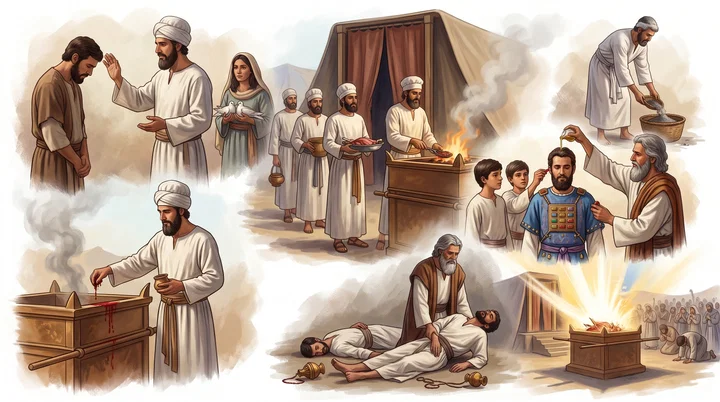
And Moses brought Aaron’s sons, and put coats upon them, and girded them with girdles, and put bonnets upon them; as the LORD commanded Moses.
Translations
And Moses brought Aaron’s sons, and put coats on them, and girded them with girdles, and put bonnets on them; as the LORD commanded Moses.
And Moses brought Aaron’s sons, and put coats upon them, and girded them with girdles, and put bonnets upon them; as the LORD commanded Moses.
And Moses brought Aaron’s sons, and put coats upon them, and girded them with girdles, and put bonnets upon them; as the Lord commanded Moses.
And Moses brought Aaron's sons, and put coats upon them, and girded them with girdles, and put bonnets upon them; as the LORD commanded Moses.
And Moses brought Aaron’s sons, and clothed them with coats, and girded them with girdles, and bound headtires upon them; as the LORD commanded Moses.
And Moses brought Aaron’s sons, and clothed them with coats, and girded them with girdles, and bound head-tires upon them; as Jehovah commanded Moses.
And Moses bringeth near the sons of Aaron, and doth clothe them [with] coats, and girdeth them [with] girdles, and bindeth for them turbans, as Jehovah hath commanded Moses.
And Moses brought Aaron's sons near and clothed them with the vests, and girded them with the girdles, and bound the high caps on them, as Jehovah had commanded Moses.
And Moses brought near the sons of Aaron and clothed them with tunics and girded them with bands, and wrapped round for them turbans,—As Yahweh commanded Moses.
Berean Standard Bible, Majority Standard Bible
Then Moses presented Aaron’s sons, put tunics on them, wrapped sashes around them, and tied headbands on them, just as the LORD had commanded him.
Moses brought Aaron’s sons, and clothed them with tunics, and tied sashes on them, and put headbands on them, as the LORD commanded Moses.
Then he took Aaron's sons, clothing them with the coats, and putting the bands round them, and the head-dresses on their heads, as the Lord had given him orders.
After, Moses brought Aarons sonnes, and put coates vpon them, and girded them with girdles, and put bonets vpon their heades, as the Lord had commanded Moses.
Douay-Rheims (Challoner revision)
And after he had offered his sons, he vested them with linen tunicks, and girded them with girdles, and put mitres on them as the Lord had commanded.
Pictures
Cross-references
- Exodus 29
And this is the thing that thou shalt do unto them to hallow them, to minister unto me in the priest’s office: Take one young bullock, and two rams without blemish,
Both describe setting apart the priests for Levitical ministry.
- Exodus 28:1
And take thou unto thee Aaron thy brother, and his sons with him, from among the children of Israel, that he may minister unto me in the priest’s office, even Aaron, Nadab and Abihu, Eleazar and Ithamar, Aaron’s sons.
God appoints Aaron and his sons to minister as priests.
- Leviticus 9
And it came to pass on the eighth day, that Moses called Aaron and his sons, and the elders of Israel;
Continues the priests’ consecration with their first service and the Lord’s appearing.
- Hebrews 8:5
Who serve unto the example and shadow of heavenly things, as Moses was admonished of God when he was about to make the tabernacle: for, See, saith he, that thou make all things according to the pattern shewed to thee in the mount.
Earthly priestly service follows a pattern of heavenly realities.
- Exodus 30:30
And thou shalt anoint Aaron and his sons, and consecrate them, that they may minister unto me in the priest’s office.
Commands the anointing and consecration of Aaron and his sons for priestly service.
- Exodus 28:41
And thou shalt put them upon Aaron thy brother, and his sons with him; and shalt anoint them, and consecrate them, and sanctify them, that they may minister unto me in the priest’s office.
Both describe Aaron’s sons being prepared for priestly service.
- Leviticus 9:24
And there came a fire out from before the LORD, and consumed upon the altar the burnt offering and the fat: which when all the people saw, they shouted, and fell on their faces.
Fire consumes the offering, publicly confirming God’s acceptance of Aaron’s ministry.
- Leviticus 9:2-6
And he said unto Aaron, Take thee a young calf for a sin offering, and a ram for a burnt offering, without blemish, and offer them before the LORD.
Aaron begins his priestly service with the people’s offering.
- Hebrews 5:1-3
For every high priest taken from among men is ordained for men in things pertaining to God, that he may offer both gifts and sacrifices for sins:
Describes the priest’s work and need for consecration.
- Exodus 28:29
And Aaron shall bear the names of the children of Israel in the breastplate of judgment upon his heart, when he goeth in unto the holy place, for a memorial before the LORD continually.
Aaron bears Israel’s names before God.
- Hebrews 7:11
If therefore perfection were by the Levitical priesthood, ( for under it the people received the law,) what further need was there that another priest should rise after the order of Melchisedec, and not be called after the order of Aaron?
The Levitical priesthood serves as a shadow of Christ’s priesthood.
- Hebrews 7:26-28
For such an high priest became us, who is holy, harmless, undefiled, separate from sinners, and made higher than the heavens;
Describes Christ’s priestly ministry.
Commentary
Each commentary is drawn from primary sources: the writings of Ellen G. White and Adventist pioneers and periodicals. Each commentary is separate. Its own words are not a quotation; follow the references to read the source passages.
Ellen G. White
1 source
Leviticus 8:13 stands within the record of Aaron's consecration, marking the moment when the priesthood was established in his family.PP 425.4 At that time Aaron's sons were set apart and clothed for priestly service.PP 425.4 Moses himself brought them forward and put coats upon them, girded them with girdles, and put bonnets upon them.PP 425.4 All of this was done exactly as the Lord had commanded Moses.PP 425.4
Sources
Pioneers and periodicals
13 sources
Moses clothed Aaron's sons with coats, girdles, and bonnets to consecrate them to serve in the priest's office in the earthly sanctuary, exactly as the Lord commanded Moses.ST Feb 7, 1911ST Jun 27, 1911RH Feb 18, 1858 That consecration set them apart to minister to God and to serve others, lasted seven days, and set apart their holy garments to God for glory and beauty.ST Jun 27, 1911ST Jul 8, 1930ST Jan 17, 1878 This clothing and service was the pattern, example, and shadow of the true tabernacle in heaven where Christ serves as High Priest, and its garments and appointments were object lessons about sin that typified Christ, his sacrifice, life, work, and priesthood.ST Feb 7, 1911RH Jan 20, 1853RH Aug 18, 1863RH Feb 18, 1858 The Levitical ministration thus appointed could in itself only exhibit guilt, condemnation, and death with no sacrifice that could take away sin, while Christ fulfilled the pattern after His ascension by entering within the veil to anoint the Most Holy, not made with hands, as foretold in Daniel 9:24.RH May 8, 1856ST Jun 10, 1880RH Dec 12, 1854RH Feb 3, 1853
Priestly Consecration Described
Moses brought Aaron's sons forward and put coats upon them, girded them with girdles, and put bonnets upon them, clothing and preparing them for priestly service in consecrating them to serve in the priest's office in the earthly sanctuary.ST Feb 7, 1911RH Feb 18, 1858ST Jul 8, 1930RH Feb 3, 1853 This clothing was done as the Lord commanded Moses, as part of a divinely prescribed service of consecration and priestly duty that prepared them to begin ministry.ST Jun 27, 1911RH Feb 18, 1858ST Jan 17, 1878 Their consecration served as object lessons about sin pointing forward to Jesus, with their fuller meaning found in Christ's sacrifice, life, and work and in what Christ as High Priest was to do in the true tabernacle in heaven.ST Feb 7, 1911RH Feb 18, 1858
The consecration set the sons apart to minister to God and to serve others, and it lasted seven days.ST Jun 27, 1911ST Jul 8, 1930 The holy garments themselves, like the priests themselves, were set apart to God, made for glory and beauty.ST Jun 27, 1911ST Jan 17, 1878 The account belongs to one of the book's few historical sections, its details had meaning, and it shows God remains particular about the conduct of his servants.ST Feb 7, 1911RH Feb 3, 1916
Earthly Pattern of Christ
The clothing of Aaron's sons with coats, girdles and bonnets belonged to the service of the earthly sanctuary, which was the pattern, example and shadow of the true tabernacle in heaven.RH Jan 20, 1853RH Aug 18, 1863RH Feb 18, 1858RH Feb 3, 1853 What Moses did there in obedience to the Lord's command corresponded to what Christ as High Priest was to do in the true tabernacle.RH Jan 20, 1853RH Aug 18, 1863RH Feb 18, 1858 In consecrating the Levitical order to perform the ministration in its two holy places, that earthly service foreshadowed Christ's more excellent ministry in heaven.RH Feb 3, 1853
The appointments, garments and services of that priesthood were object lessons about sin whose fuller meaning is found in Christ's sacrifice, life, work and priesthood.ST Feb 7, 1911ST Nov 28, 1895 They typified Christ and his priesthood in the heavenly sanctuary and pointed forward to Jesus.ST Feb 7, 1911ST Nov 28, 1895 By this clothing the Levitical order was set apart to minister through the whole Old Testament period in the two holy places and before the ark containing the tables of the law in the Most Holy Place of the typical sanctuary.RH Dec 12, 1854RH Feb 3, 1853 That ministration, begun when the holy law was brought down, could in itself only exhibit guilt, condemnation and death with no promise of pardon.RH Dec 12, 1854 It offered no sacrifice that could take away sin, but could only point penitent sinners forward to the great Sacrifice to be offered for the sins of men.RH Dec 12, 1854
In the pattern, the anointing of the tabernacle, its holy places and all its sacred vessels came first as preparatory work before the presentation of the sin offering and the beginning of ministration.RH May 8, 1856ST Jun 10, 1880 Christ had to enter within the veil to fulfill this pattern, which He did after His ascension.RH May 8, 1856 What Moses and Aaron did in the earthly pattern He fulfills in the heavenly sanctuary by anointing the Most Holy to begin His ministration there.RH May 8, 1856ST Jun 10, 1880 That anointing is not of an earthly Holy of Holies made with hands but of the true tabernacle in heaven, foretold in Daniel 9:24 as the last event of the seventy weeks.ST Jun 10, 1880
Sources