Exodus 28:29
And Aaron shall bear the names of the children of Israel in the breastplate of judgment upon his heart, when he goeth in unto the holy place, for a memorial before the LORD continually.
Translations
And Aaron shall bear the names of the children of Israel in the breastplate of judgment on his heart, when he goes in to the holy place, for a memorial before the LORD continually.
King James Version, Revised Version
And Aaron shall bear the names of the children of Israel in the breastplate of judgment upon his heart, when he goeth in unto the holy place, for a memorial before the LORD continually.
And Aaron shall bear the names of the children of Israel in the breastplate of judgment upon his heart, when he goeth in unto the holy place, for a memorial before the Lord continually.
And Aaron shall bear the names of the children of Israel in the breast-plate of judgment upon his heart, when he entereth into the holy place, for a memorial before the LORD continually.
And Aaron shall bear the names of the children of Israel in the breastplate of judgment upon his heart, when he goeth in unto the holy place, for a memorial before Jehovah continually.
'And Aaron hath borne the names of the sons of Israel in the breastplate of judgment, on his heart, in his going in unto the sanctuary, for a memorial before Jehovah continually.
And Aaron shall bear the names of the children of Israel in the breastplate of judgment on his heart, when he goes in to the sanctuary, for a memorial before Jehovah continually.
So shall Aaron bear the names of the sons of Israel in the breastpiece for giving sentence upon his heart when he goeth into the holy place,—for a memorial before Yahweh continually.
Berean Standard Bible, Majority Standard Bible
Whenever Aaron enters the Holy Place, he shall bear the names of the sons of Israel over his heart on the breastpiece of judgment, as a continual reminder before the LORD.
Aaron shall bear the names of the children of Israel in the breastplate of judgment on his heart, when he goes in to the holy place, for a memorial before the LORD continually.
And so Aaron will have the names of the children of Israel on the priest's bag over his heart whenever he goes into the holy place, to keep the memory of them before the Lord.
So Aaron shall beare the names of the children of Israel in the brest plate of iudgement vpon his heart, when he goeth into the holy place, for a remembrance continually before the Lord.
Douay-Rheims (Challoner revision)
And Aaron shall bear the names of the children of Israel in the rational of judgement upon his breast, when he shall enter into the sanctuary, a memorial before the Lord for ever.
Pictures

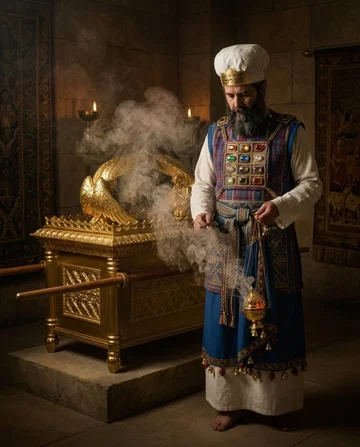
Cross-references 20 of 29
- Hebrews 7:25
Wherefore he is able also to save them to the uttermost that come unto God by him, seeing he ever liveth to make intercession for them.
Christ continually intercedes for those who come to God through him.
- Hebrews 8:1-2
Now of the things which we have spoken this is the sum: We have such an high priest, who is set on the right hand of the throne of the Majesty in the heavens;
Christ ministers as High Priest in the true heavenly sanctuary.
- Hebrews 8:5
Who serve unto the example and shadow of heavenly things, as Moses was admonished of God when he was about to make the tabernacle: for, See, saith he, that thou make all things according to the pattern shewed to thee in the mount.
Earthly priestly service is a pattern and shadow of heavenly things.
- Hebrews 9:7
But into the second went the high priest alone once every year, not without blood, which he offered for himself, and for the errors of the people:
The high priest entered the holy place yearly wearing Israel’s names before the LORD.
- Hebrews 9:24
For Christ is not entered into the holy places made with hands, which are the figures of the true; but into heaven itself, now to appear in the presence of God for us:
Christ enters the true heavenly sanctuary to appear before God for us, as Aaron served in the earthly sanctuary.
- Exodus 25:8-9
And let them make me a sanctuary; that I may dwell among them.
The sanctuary is made so God may dwell among his people.
- Exodus 28:21
And the stones shall be with the names of the children of Israel, twelve, according to their names, like the engravings of a signet; every one with his name shall they be according to the twelve tribes.
The stones bear the names of all twelve tribes on the breastplate.
- Leviticus 16:4
He shall put on the holy linen coat, and he shall have the linen breeches upon his flesh, and shall be girded with a linen girdle, and with the linen mitre shall he be attired: these are holy garments; therefore shall he wash his flesh in water, and so put them on.
Aaron wears holy linen garments when entering the holy place.
- Isaiah 49:16
Behold, I have graven thee upon the palms of my hands; thy walls are continually before me.
Both picture God continually bearing his people in remembrance.
- Exodus 29
And this is the thing that thou shalt do unto them to hallow them, to minister unto me in the priest’s office: Take one young bullock, and two rams without blemish,
Priestly garments are followed by the consecration of priests for ministry.
- Hebrews 9:1-5
Then verily the first covenant had also ordinances of divine service, and a worldly sanctuary.
Describes the earthly sanctuary and its furnishings.
- Leviticus 16:2
And the LORD said unto Moses, Speak unto Aaron thy brother, that he come not at all times into the holy place within the vail before the mercy seat, which is upon the ark; that he die not: for I will appear in the cloud upon the mercy seat.
Both describe Aaron entering the holy place before the LORD.
- Hebrews 4:14
Seeing then that we have a great high priest, that is passed into the heavens, Jesus the Son of God, let us hold fast our profession.
Christ is the great High Priest who represents believers.
- Hebrews 9:11
But Christ being come an high priest of good things to come, by a greater and more perfect tabernacle, not made with hands, that is to say, not of this building;
Christ ministers as High Priest in the greater heavenly sanctuary.
- Leviticus 8
And the LORD spake unto Moses, saying,
Both concern setting apart Aaron and his sons for priestly service before the LORD.
- Revelation 21:19-20
And the foundations of the wall of the city were garnished with all manner of precious stones. The first foundation was jasper; the second, sapphire; the third, a chalcedony; the fourth, an emerald;
The breastplate stones are also named among the city’s foundations.
- Leviticus 16:14-19
And he shall take of the blood of the bullock, and sprinkle it with his finger upon the mercy seat eastward; and before the mercy seat shall he sprinkle of the blood with his finger seven times.
The high priest makes atonement and cleanses the sanctuary with blood.
- Exodus 28:15
And thou shalt make the breastplate of judgment with cunning work; after the work of the ephod thou shalt make it; of gold, of blue, and of purple, and of scarlet, and of fine twined linen, shalt thou make it.
Describes the breastplate of judgment Aaron bears before the LORD.
- Exodus 28:4
And these are the garments which they shall make; a breastplate, and an ephod, and a robe, and a broidered coat, a mitre, and a girdle: and they shall make holy garments for Aaron thy brother, and his sons, that he may minister unto me in the priest’s office.
Lists the priestly garments, including the breastplate.
- Romans 8:34
Who is he that condemneth? It is Christ that died, yea rather, that is risen again, who is even at the right hand of God, who also maketh intercession for us.
Christ intercedes for the elect, as Aaron bore Israel’s names before the Lord.
Commentary
Each commentary is drawn from primary sources: the writings of Ellen G. White and Adventist pioneers and periodicals. Each commentary is separate. Its own words are not a quotation; follow the references to read the source passages.
Ellen G. White
20 sources
Aaron bore the names of the twelve tribes engraved on precious stones set in gold in the breastplate, the most sacred of the priestly vestments, upon his heart whenever he entered the holy place as a continual memorial before the Lord.PP 351.1–2 Aaron in this service was a type of Christ the great High Priest, and his bearing the names is a beautiful figure of Christ's unchanging love and tender care for His church.GW 34.2Ms 143, 1902, par. 11–13RH Mar 17, 1903 Jesus now bears upon His heart continually the name of every repentant, believing soul, pleading His blood before the Father in the sinner's behalf and binding His chosen to His great heart of love as a memorial before God.PP 351.1–24MR 245.2Lt 23, 1892, par. 6 His advocacy assures helpless sinners that they may come to Him and trust His abundant mercy, and gives burdened workers certainty that the chosen are remembered, justified, and safe from condemnation because He died, rose again, and intercedes at the right hand of God.Lt 17, 1862, par. 5Lt 23, 1892, par. 65MR 10.1 Earthly ministers are to keep this lesson in mind and labor together following His example, sharing that same love, sympathy, tenderness, and solicitude toward one another.GW 34.2Ms 143, 1902, par. 11–13RH Mar 17, 1903
Garment and Holy Service
The direction about Aaron carrying the names in the breastplate of judgment upon his heart into the holy place for a continual memorial was spoken by Jesus Himself as the great I AM while enshrouded in the pillar of cloud to educate His church in the wilderness.Ms 92, 1899, par. 10–12 It sets forth the outline of God's expressed will, His covenant with the people He is seeking to save, and the terms of salvation.Ms 92, 1899, par. 10–12 It provides the most valuable education for today, the higher education and highest knowledge a human being can possess, the knowledge of the only true God and Jesus Christ whom He has sent.Ms 92, 1899, par. 10–12 That knowledge gives mental discipline, strengthens the mental powers, and teaches how to conduct life as a citizen of heaven for present and eternal good.Ms 92, 1899, par. 10–12
The breastplate was the most sacred of the priestly vestments, made of the same material as the ephod, square and measuring a span.PP 351.1–2 It was suspended from the shoulders by a blue cord from golden rings, with a border of precious stones and twelve stones set in gold inside in four rows, engraved with the names of the twelve tribes.PP 351.1–2 Those engraved names Aaron bore upon his heart whenever he went into the holy place, for a memorial before the Lord continually.PP 351.1–2 God distinctly specified the particular style of garments the priests were to wear when doing service in the holy place and ministering in the priest's office, with clothing made in accordance with their sacred work.GW92 162.2 Entering the presence of a high and holy God required meeting His conditions and putting away every particle of defilement on pain of death.GW92 162.2
God gave special directions about everything connected with His service, including the dress of those who minister before Him.GW92 161.1 The apparel of those who officiate before God can honor or dishonor Him.GW92 161.1 His directions for ministerial dress require order in everything and especially cleanliness.GW92 161.1 What the priests wore while ministering before God was part of the sacred order He required, and their service was to reflect reverence for His holiness.2T 610.3–612.1 The high priest wore the breastplate of judgment before the Lord as part of the service God had appointed, and its sacred use depended on that appointment and was not authorized for others to wear in worship.ST Jul 28, 1881
Aaron's robes were symbolic, and the setting of this direction illustrates that dress can carry meaning, so that Christ's followers are likewise to dress as representatives of Him.Ms 56, 1900, par. 11–12 The breastplate set with precious stones served as the means by which messages from Jehovah were received and His will revealed.ST Feb 21, 1911ST Oct 7, 1886 The light of His glory flashed forth upon the stones in approval, and the cloud of His disapproval shadowed them.ST Oct 7, 1886 When Christ died the veil of the temple was rent in twain from top to bottom and the most holy place was exposed, and this divine communication through the breastplate ceased.ST Oct 7, 1886 No longer would the presence of God overshadow the earthly mercy-seat, and no longer would His glory and disapproval be shown upon the breastplate.ST Oct 7, 1886
The sanctuary ministration to which this bearing of the names belongs served as an example and shadow of heavenly things.PP 351.4 The priestly breastplate and its names are reflected in Jesus' garments as He completes His ministry in the heavenly holy place and passes through the second veil in 1844.EW 213.1 In that heavenly completion He keeps the people continually in remembrance before the Lord, as Aaron bearing Israel's names on his heart when entering the holy place foreshadowed.EW 213.1
Christ the Great High Priest
Aaron was a type of Christ the great High Priest, and his bearing of the names of the children of Israel in the breastplate of judgment upon his heart when entering the holy place as a continual memorial is a beautiful and expressive figure of Christ's unchanging love for His church.GW 34.2Ms 143, 1902, par. 11–13RH Mar 17, 19035MR 11.3 As Aaron bore Israel upon his heart, so Christ bears His people and God's chosen upon His own heart with enduring love and care.GW 34.2Ms 143, 1902, par. 11–13RH Mar 17, 19035MR 11.3 That bearing of the engraved names of the twelve tribes is fulfilled in Christ as the great High Priest, who pleads His blood before the Father in the sinner's behalf.PP 351.1–2 He bears upon His heart the name of every repentant, believing soul, so that though the believer is poor and needy, he is thought upon by the Lord.PP 351.1–2
Jesus as the great High Priest bears the names of all the chosen upon His breastplate over His heart continually as a memorial before God.Lt 23, 1892, par. 6 This means He has bound His people to His great heart of love, has graven them on the palms of His hands, and loves them.Lt 23, 1892, par. 6 Christ, whom Aaron symbolized, thus bears the names of all His people in the holy place as their great High Priest.4MR 245.2COL 148.1–3 There He remembers the words He used to encourage them to trust, and He remains mindful of His covenant.4MR 245.2COL 148.1–3
Assurance and Ministerial Example
Jesus keeps the believer's name upon His breastplate and pleads for that person before the Father, and that advocacy assures sinners that they may come to Him helpless and trust His abundant mercy and willingness to receive them.Lt 17, 1862, par. 5 He bears the names of all the chosen upon His breastplate over His heart continually as a memorial before God, which means He has bound His people to His great heart of love, has graven them on the palms of His hands, and loves them.Lt 23, 1892, par. 6 This gives certainty and comfort to burdened workers, for though men are daily deciding their destiny and many refuse light, the chosen are remembered.Lt 23, 1892, par. 6 They are justified by God and safe from any charge or condemnation, because Christ died, rose again, is at the right hand of God, and makes intercession for them.Lt 23, 1892, par. 6
Jesus is the High Priest who can bear the burden of representing the people before God continually, as the high priest bore Israel's names over his heart when entering the holy place.5MR 10.1 He can bear also all the burdens of those who look to Him, so believers may entrust their cares to Him.5MR 10.1 Aaron bearing the names of the children of Israel in the breastplate of judgment upon his heart when going into the holy place for a memorial continually is a beautiful and expressive figure of the unchanging love of Christ for His church, with Aaron as a type of Christ the great High Priest who bears His people upon His heart.GW 34.2Ms 143, 1902, par. 11–13RH Mar 17, 1903
His earthly ministers should share that same love and sympathy and solicitude.GW 34.2RH Mar 17, 1903 They should keep this lesson in mind and show one another Christ's tenderness, kindness, courtesy, and love.Ms 143, 1902, par. 11–13RH Mar 17, 1903 His death on the cross is the measure of the value of souls in God's sight, and His ministers must labor together in connection with one another following His example.RH Mar 17, 1903
Sources
Pioneers and periodicals
68 sources
Aaron alone as high priest wore the breastplate with the names of the twelve tribes over his heart whenever he entered the holy place, to keep the whole nation continually remembered before the Lord.RH Aug 15, 1865ST Mar 25, 1889ST Jun 19, 1907ST Jun 26, 1907 The engraved names showed he carried their welfare and their judgment upon his heart as their representative and mediator before God, especially in making atonement and seeking direction for all Israel.ST Oct 14, 1880ST Feb 17, 1890ST Aug 12, 1880RH Feb 3, 1853RH Dec 15, 1910 This is a figure of Christ the great High Priest, who bears His church and humanity upon His heart with unchanging love.RH Mar 17, 1903ST Jun 10, 1889 He carries the name of every repentant, believing person near His heart before the Father, pleading His blood as Surety to obtain mercy and reconciliation.ST Nov 12, 1894RH Feb 2, 1911RH Dec 9, 1862 With the continual burnt offering, incense, showbread and lamp, that continual memorial reveals His continual intercession by which union between God and His people is maintained, assuring them they are not forgotten before the throne.ST Nov 19, 1902RH Nov 25, 1902RH Sep 11, 1866RH Oct 10, 1912
Context in Exodus Story
The verse stands in the second, chiefly legislative division of Exodus as part of the detailed instructions for the construction of the tabernacle and its furniture in Exodus 25-31, given by God to Moses during his forty days' stay in the mountain after the Ten Commandments were proclaimed, the book of the covenant was ratified, and the tables of stone were given.ST Jan 31, 1911 It belongs to the instruction God gave through Moses during those forty days after the people asked Moses to hear God for them, distinct from the Ten Commandments God spoke directly to the people and wrote on the two tables of stone with nothing added.ST Apr 15, 1886 It is part of the precepts, statutes, and laws commanded by the hand of Moses recorded chiefly in Exodus 25-30 and Leviticus, which included burdensome ceremonies and carnal ordinances imposed until the time of reformation, a yoke neither the fathers nor their children were able to bear.ST Apr 15, 1886 Exodus 28 is part of the sanctuary instruction God gave Moses on the mount, before the sanctuary was built and set up.ST Dec 10, 1896
The verse belongs to the minute description in Exodus 25-40 of the sanctuary built in the days of Moses, which was made exactly according to the pattern shown in the mount.ST Oct 29, 1894RH Feb 11, 1858ST May 16, 1878RH Jan 4, 1870 That sanctuary was composed of two apartments separated by a veil, the holy place twenty cubits long, ten cubits wide, and ten cubits high, and the most holy place ten cubits in each dimension and half as large as the holy place.ST Oct 29, 1894 Its sides and west end were of acacia wood boards overlaid with gold secured at the bottom by tenons fitting into silver sockets weighing a talent each and at the top by bars placed through rings attached to the boards.ST Oct 29, 1894 The chapter is part of the instructions for making the sanctuary and its sacred vessels, which were made according to the pattern God showed Moses in the mount and which served as a pattern of the heavenly temple.ST May 16, 1878RH Jan 4, 1870 In that setting Aaron bore the names of the tribes of Israel on his heart when he entered the sanctuary, as a continual memorial before the Lord.ST May 16, 1878
After redeeming Israel from Egyptian bondage, God commanded the sanctuary to be built from free-will offerings so He might dwell among them, as a great multiple object-lesson by forms and rites teaching the great plan of salvation. It was the sacred dwelling built according to God's explicit pattern so that His glory would remain among Israel and their worship would center there, set with the holy place where the priests ministered.ST Feb 17, 1890 The center was the holy of holies where was placed the ark of the covenant containing God's holy law written on tables of stone.ST Jan 27, 1909 God placed His Spirit upon the builders Bezalel and Oholiab together with other devoted men and women and other workmen He specially endowed, so the building might be properly erected and the work properly done.ST Jan 27, 1909 The instructions given in Exodus 25-31 were carried out exactly as directed in Exodus 35-40, with the ark built with all its furniture and equipment just as God directed, and blessing and glory came down upon the congregation and the building when it was completed.ST Jan 27, 1909 The verse is thus part of the account of Israel's worship and priestly service, within the book's story of Israel becoming a nation with an established form of worship, in a marvelously beautiful structure given to Moses in the mount as a divine pattern.RH Jan 20, 1916
The direction for Aaron's breastplate shares in the extreme exactness and minute detail of the tabernacle and the priestly attire for Aaron and his sons, made with profuse gold, silver, costly gems, and fine linen.ST Jun 10, 1908 Exodus 25-31 is a wonderfully itemized text that repays slow, careful, very thoughtful reading with a multitude of invigorating and instructive ideas, suggestions, and lessons.ST Jun 10, 1908 Its depths of meaning cannot be fully seen, its reasons cannot be fully fathomed, and its complete motive cannot be fully appreciated.ST Jun 10, 1908 Yet study gives vitalizing food to strengthen famishing hearts and water of life to refresh worn spirits through long, long days.ST Jun 10, 1908
The Hebrew word so rendered means continual or perpetual, describing Aaron bearing Israel's names on his breastplate over his heart as a lasting memorial before the Lord.ST Mar 12, 1912 It is one example of the word's use for what is constant in God's worship and in the relationship between God and His people.ST Mar 12, 1912 The breastplate of judgment bearing the names of Israel upon Aaron's heart when going into the holy place was a continual memorial before the Lord, standing with the continual burnt offering, the continual incense, the perpetual showbread, and the continual lamp light as part of the continual daily service.ST Nov 19, 1902 The directions specify even the priests' clothing and how they are to appear before God, showing no detail of that service is too small to escape God's notice.ST Mar 15, 1883
Priestly Garments and Service
A special dress was appointed for the priests according to office.ST Nov 12, 1894 The common priest wore a white linen robe woven in one piece extending nearly to the feet, confined by a white linen girdle embroidered in blue and purple and red, with a linen turban or miter.ST Nov 12, 1894 As Moses at the burning bush was told to put off his sandals because the ground was holy, the priests entered the sanctuary without shoes, leaving them in the court lest dust desecrate the holy place.ST Nov 12, 1894 They washed their hands and their feet before ministering in the tabernacle or at the altar of burnt offering, constantly teaching that all defilement must be put away from those who approach into the presence of God.ST Nov 12, 1894 The high priest wore garments of costly material and beautiful workmanship befitting his exalted station, including in addition to the linen dress a blue robe also woven in one piece.ST Nov 12, 1894
The breastplate of judgment was a portion of the holy garments belonging to the high priest alone.RH Aug 15, 1865 It was to be worn continually before the Lord for a memorial, every day in the year and not only on the Day of Atonement.RH Aug 15, 1865 Aaron as first high priest superintended the daily offerings in the holy place and before the door of the tabernacle of the congregation as well as going in once a year into the most holy place, while his sons did the work of the other priests.RH Aug 15, 1865 It contained the same twelve names according to the twelve tribes on the Day of Atonement as on other days and represented no more on that day than on other days, so its wearing on that day does not mean only those who had previously confessed their sins were borne before the Lord.RH Aug 15, 1865
On other occasions the high priest ministered in the splendid dress prescribed in Exodus 28.RH Jan 11, 1870ST Jun 6, 1878 On the tenth day of the seventh month, when entering the most holy place, he laid that splendid dress aside and put on the plainest and humblest dress.RH Jan 11, 1870ST Jun 6, 1878 With his sin-offering for himself, that laying aside was expressly designed to impress his infirmity and sinfulness.RH Jan 11, 1870ST Jun 6, 1878 That change shows the Levitical high priest was priest only in a typical sense and not in reality, and was typical only with no part of it shadowing the work of Christ.RH Jan 11, 1870ST Jun 6, 1878
The breastplate was among Aaron's distinctive high-priestly garments, unlike the garments of the under-priests.RH Dec 8, 1910 It supported the Urim and Thummim, by which direction was sought and messages from Jehovah were received.ST Jun 3, 1886ST Feb 21, 1911RH Dec 8, 1910 It also bore the inscription Holiness to the Lord. The priests' white linen garments signified the purity of their priestly character and work.RH Dec 8, 1910
The breastplate belonged to the sanctuary worship of the Jewish age, first with the tabernacle in the wilderness and afterward with the temple.ST Jun 3, 1886 It was set with precious stones and stood where God was worshiped and where sacrificial offerings were presented before Him.ST Jun 3, 1886ST Feb 21, 1911 It belonged to the typical service and was used in a definite manner for a definite purpose.ST Nov 19, 1902 The light of God's glory flashed forth upon its stones in approval, and the cloud of His disapproval shadowed them.ST Oct 7, 1886
When Christ died the veil of the temple was rent in twain from top to bottom and the most holy place was exposed, and this divine communication through the breastplate ceased.ST Oct 7, 1886 No longer would the presence of God overshadow the earthly mercy-seat, and no longer would His glory and disapproval be shown upon the breastplate.ST Oct 7, 1886
The priesthood was committed to Aaron and his sons, so that after that time no one else was to perform the rites of a priest unless especially directed by the Lord.ST Mar 3, 1914 Saul's offering of burnt offerings without waiting for Samuel at Gilgal was therefore displeasing to God because he had not been ordained for such service.ST Mar 3, 1914 The verse illustrates sanctification in the sense of setting apart or consecrating to a sacred or religious use, with the priests sanctified in that sense.RH Jul 26, 1864 Its sacred use depended on God's appointment, and it was not authorized for others to assume or wear in worship.ST Jul 28, 1881RH Jul 26, 1864
Bearing Names as Memorial
Aaron bore the names of the twelve tribes of Israel on the breastplate over his heart when he went into the holy place, keeping the people continually remembered before the Lord as a continual memorial.ST Mar 25, 1889ST Jun 19, 1907ST Jun 26, 1907ST May 16, 1878ST Nov 12, 1894 The high priest in this service represented the people as he ministered on their behalf before the Lord.ST Jun 19, 1907RH Feb 3, 1853 These sanctuary rites were object lessons pointing to Christ and His work of forgiving sin and transforming character.ST Jun 26, 1907 In the same way Christ the great High Priest carries the name of every repentant, believing person on His heart as He pleads His blood before the Father on the sinner's behalf.ST Nov 12, 1894
The names engraved on the priestly garments signified his responsibility for the welfare of the whole nation.RH Dec 15, 1910 His bearing the people's names expressed his representative care for them before God as he served before God.ST Oct 14, 1880RH Dec 15, 1910 He communicated God's will to the people and entered the Most Holy Place on the Day of Atonement with blood as mediator for all Israel.ST Oct 14, 1880 The breastplate of judgment was associated with seeking accurate direction from God in weighty personal matters.RH Dec 15, 1910
Aaron carried the people's judgment on his heart before the Lord, and the priest in bearing the people's judgment explains why Christ as High Priest takes the people's sins upon Himself.ST Feb 17, 1890 In the yearly national atonement the breastplate also bore their judgment as the high priest entered the Most Holy Place to make atonement and cleanse the people from their sins and to make atonement for the sanctuary and the people.ST Aug 12, 1880RH Sep 16, 1852 This ministry connected with atonement is a work of judgment, and the high priest putting on the breastplate of judgment as he prepared to cleanse the sanctuary signals that this cleansing is a work of judgment.ST Aug 12, 1880RH Feb 14, 1854 The high priest carried the names of all twelve tribes on the breastplate when he entered the most holy place on the Day of Atonement, and their names represented the tribes before God.ST Jun 12, 1884 That ministry and the counsel sought through the Urim and Thummim concerned the common interest of all Israel, namely those who continued in the worship of the true God, and the breastplate as a means through which God gave direction to His people serves as a type of divine aid and guidance continued in the Christian era through God's revelations, miracles, and help to His people in danger.ST Jun 12, 1884RH Jul 16, 1872
Type of Christ's Ministry
Aaron is a type of Christ the great High Priest, and his bearing the tribes of Israel upon his breast in the breastplate of judgment is a beautiful and expressive figure of Christ's unchanging love in bearing His church and humanity upon His heart.RH Mar 17, 1903ST Jun 10, 1889 Christ's death on the cross is the measure of the value of souls in God's sight, and His earthly ministers must share His love and sympathy and solicitude, laboring together in connection with one another following His example with tenderness, kindness, courtesy and love.RH Mar 17, 1903 The great High Priest carries the name of every repentant, believing person on His heart as He pleads His blood before the Father on the sinner's behalf.ST Nov 12, 1894RH Feb 2, 1911 He is the believer's Surety, bearing the believer's name before God and pleading for mercy on the believer's behalf.RH Dec 9, 1862 Each believer's name is there with the rest, very near His heart when He goes into the holy place before the ark to plead for them, which proves Jesus loves His people and through Him they are reconciled to the Father.RH Feb 20, 1866
The verse belongs to God's explicit instructions in Exodus 25-31 to Moses concerning the building of the sanctuary and preparation for its services, to be made known to the people. The sanctuary and its service are the object-lesson let down upon earth that sets forth God's plan of government and how He deals with those who have sought to dethrone Him. It shows Christ as still King while executing the office of priest upon the throne in dealing with sinners, setting forth the plan devised from eternity for salvation from sin. God's purpose is to dwell among His people, who are so intimately related to the sanctuary that they cooperate with God in His work through Christ in the sanctuary, with the divine and the human cooperating at every step. That ancient tabernacle with its priests ministering through sacrifices and offerings typified the heavenly temple where Jesus now ministers, and its sacrificial services passed away when Christ died once for all.ST Jan 24, 1911 The priestly service with Aaron carrying the tribal names over his heart as a continual memorial belongs among the sanctuary's rites, which were object lessons pointing to Christ and His work of forgiving sin and transforming character.ST Jun 26, 1907
The Levitical order of priesthood was set apart to minister before the ark of the law in the typical sanctuary while that sanctuary continued.ST Jul 8, 1886RH Dec 12, 1854 That priesthood ministered before the ark of the testament but offered no sacrifice that could take away sin, and among its instructions concerning sacrifices and flesh its offerings could not themselves take away sin.ST Jul 8, 1886RH Dec 12, 1854 It could only point penitent sinners forward to the great Sacrifice that would be offered for the sins of men, fulfilled in Christ.ST Jul 8, 1886RH Dec 12, 1854 Christ the Great High Priest bore the names of true Israel into the heavenly sanctuary when in 1844 He entered the Most Holy Place and presented those names before the Father and the angels.RH Aug 19, 1851 On October 22, 1844, He bore in with Himself, as branches are with the Vine, those who had not rejected enough light and truth to be cut off from Israel and who could benefit from the Day of Atonement.RH Jun 9, 1851
In the antitype Christ entered the Most Holy Place of the heavenly sanctuary in 1844, bearing the names of His people to complete the work of redemption and perform His final work of mercy.RH Mar 2, 1852 The names are to remain on the breastplate and be confessed before the Father and the holy angels, and when Christ comes out the sins and errors of those whose names are retained will be blotted out.RH Mar 2, 1852 His all-seeing eye examines every name as He presents them before the Father in the heavenly judgment scene.RH Dec 1850 As their Advocate He pleads for them, but His pleading will end before the seven last plagues are poured out, which urges each person to seek assurance that his name is among those Christ bears and in that light to keep all God's commandments.RH Dec 1850 The breastplate bears the names of commandment keepers, including children not yet accountable, while the names of those who do not keep the commandments are erased before He leaves the Most Holy Place.RH Jan 1851
Children were represented by name on the breastplate of judgment borne over Aaron's heart before the Lord continually, and their names were borne there at the end of the 2300 days.RH Apr 7, 1851 Children too young to understand or reject the truth when Christ's mediation in the Holy Place ended at the close of the 2300 days were represented among those names and are included in Jesus' mediation, showing God gives every intelligent being an opportunity for salvation.RH Apr 7, 1851 This underscores parents' duty to teach them God's commandments and the Sabbath.RH Apr 7, 1851 All who are borne in on the breastplate of judgment are still carried in intercession before the Lord, and if they have not sinned wilfully they may still repent and find forgiveness, proving there is still repentance unto life and forgiveness of sins and the door of mercy is not shut.RH Sep 1, 1904
The yearly ministry connected with atonement for the sanctuary and the people, with the high priest bearing the tribal names on the breastplate of judgment when he entered the holy place, prefigured the final judgment and the blotting out of sins in the closing work of the heavenly sanctuary.RH Apr 8, 1858 The breastplate containing the names of all the tribes worn upon the high priest's heart when he went into the holy place on the great Day of Atonement is a type of Christ's mediatorial priestly work in the second apartment of the heavenly sanctuary.RH May 21, 1857 It proves He does not receive His kingdom in the first part of the antitypical Day of Atonement but only after mercy closes.RH May 21, 1857 He will not wear the priestly mitre and the kingly crown at the same time, nor minister before the ark and mercy-seat in kingly and priestly robes together; only after finishing mediation in the breastplate does He receive the kingdom symbolized by the marriage of the Lamb and take the golden crown.RH May 21, 1857
As the earthly high priest carried Israel's names on his person and kept them continually before the Lord as a memorial, the engraved names assure God's people they are not forgotten before the Father's throne.RH Sep 11, 1866RH Oct 10, 1912 Even when human love fails, Christ keeps them in remembrance, and the marks of the nails in His hands testify to His care.RH Oct 10, 1912 The breastplate bearing the names upon Aaron's heart as a continual memorial stands with the continual burnt offering, the continual incense, the perpetual showbread, and the continual lamp light as part of the continual daily service.ST Nov 19, 1902 Through this is revealed the continual intercession of Christ the continual One, by which abiding continual union between God and His people is maintained.ST Nov 19, 1902 This provision for continual service to God is fulfilled for the Christian through the indwelling presence of Christ.RH Nov 25, 1902
Law Covenant and Prophecy
Exodus 28:29 stands in the fuller written record of the law of ordinances given through Moses, set alongside the moral law and written out in full in the books of Moses.ST May 6, 1875 It belongs to the instruction God gave through Moses during forty days in the mount after the people asked Moses to hear God for them, distinct from the Ten Commandments which God spoke directly to the people and wrote on the two tables of stone with nothing added.ST Apr 15, 1886 It is part of the precepts, statutes, and laws commanded by the hand of Moses, recorded chiefly in Exodus 25-30 and Leviticus.ST Apr 15, 1886 Those laws included burdensome ceremonies and carnal ordinances imposed until the time of reformation, a yoke which neither the fathers nor their children were able to bear.ST Apr 15, 1886
The priestly service and its laws were given after the Ten Commandments, under the Levitical priesthood, showing that the commandments and the priestly law were distinct.ST Mar 22, 1883 Comparison with Exodus 20 shows the priesthood was appointed after the commandments were given.ST Mar 22, 1883 Exodus 28 shows the appointment of that Levitical priesthood coming after the giving of the Ten Commandments in Exodus 20.ST Feb 20, 1879 This timing proves the law received under the Levitical priesthood is different from the Ten Commandments, and that the Ten Commandments are not the faulty law or the first covenant.ST Feb 20, 1879
Exodus 28:29 is part of the law of Moses commanded through Moses in Horeb, to be remembered especially in the last days together with the Ten Commandments and all the statutes and judgments. Those statutes and judgments are civil, moral, health, sacrificial, and ceremonial. Among them this law belongs with those revealing offerings, sacrifices, and types whose shadows trace to the substance of the new dispensation.
Assurance and Daily Application
Jesus as the great High Priest in heaven still bears His people's names upon His heart as Aaron bore the names of Israel upon his heart, and this is sweet assurance of His continual care amid fear and trouble.RH Mar 16, 1916RH Feb 20, 1866 He bears the names on the breastplate upon His heart when He goes into the holy place before the ark to plead for them, with each believer's name there with the rest very near His heart.RH Mar 16, 1916RH Feb 20, 1866 This nearness proves His love for His people and that through Him they are reconciled to the Father.RH Feb 20, 1866 It gives assurance to sin-burdened pilgrims longing for deliverance from sin and a place in the coming kingdom that He carries them personally before God in love until He comes to give them victory and the kingdom.RH Mar 16, 1916RH Feb 20, 1866
The high priest bearing the breastplate with the names over his heart when he goes into the holy place before the mercy-seat pictures the love of one conformed to the image of Christ.RH May 21, 1861 It means having a heart on which the name of the church is written and a breast that bears the name of all the redeemed.RH May 21, 1861 That love is true and honest, not in words only but visible in the life.RH May 21, 1861 Pride, toil-shunning, sloth, crabbed sternness, intolerance and bigotry are cast out where it exists.RH May 21, 1861
Aaron bearing the names of the children of Israel upon his heart in the breastplate of judgment is a beautiful and expressive figure of Christ's unchanging love for His church, who bears His people upon His heart.RH Mar 17, 1903 Christ's death on the cross is the measure of the value of souls in God's sight.RH Mar 17, 1903 His earthly ministers must therefore share His love and sympathy and solicitude, laboring together in connection with one another following His example.RH Mar 17, 1903 They are to follow Him in His tenderness, kindness, courtesy and love.RH Mar 17, 1903
Bearing names upon the heart in the breastplate of judgment is the pattern for a Sabbath-school teacher's work.RH Mar 25, 1902 It requires often looking at the names of pupils in the class book with the judgment in mind.RH Mar 25, 1902 It requires bearing each pupil on the heart in daily prayer.RH Mar 25, 1902 Their salvation is to be the great object.RH Mar 25, 1902
The verse belongs to the detailed instructions for the priests' garments and service in the holy place, showing Aaron bearing Israel's names on his heart before the Lord continually.RH Oct 30, 1913 Those instructions teach that careful, orderly dress for sacred service expresses reverence for God.RH Oct 30, 1913 Such dress teaches the people that God is holy and His work sacred.RH Oct 30, 1913
Sources