Luke 15:9
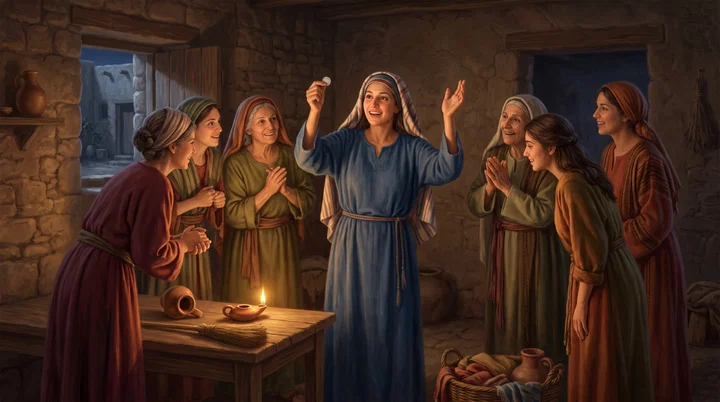
And when she hath found it, she calleth her friends and her neighbours together, saying, Rejoice with me; for I have found the piece which I had lost.
Translations
And when she has found it, she calls her friends and her neighbors together, saying, Rejoice with me; for I have found the piece which I had lost.
King James Version, KJV Cambridge Paragraph Bible
And when she hath found it, she calleth her friends and her neighbours together, saying, Rejoice with me; for I have found the piece which I had lost.
And when she hath found it, she calleth her friends and her neighbors together, saying, Rejoice with me; for I have found the piece which I had lost.
And when she hath found it, she calleth together her friends and neighbours, saying, Rejoice with me, for I have found the piece which I had lost.
And when she hath found it, she calleth together her friends and neighbors, saying, Rejoice with me, for I have found the piece which I had lost.
and having found, she doth call together the female friends and the neighbours, saying, Rejoice with me, for I found the drachm that I lost.
and having found it she calls together the friends and neighbours, saying, Rejoice with me, for I have found the drachma which I had lost.
And, having found it, she calleth together her female friends and neighbours, saying—Rejoice with me! because I have found the piece of silver which I had lost.
Berean Standard Bible, Majority Standard Bible
And when she finds it, she calls together her friends and neighbors to say, ‘ Rejoice with me, for I have found my lost coin.’
When she has found it, she calls together her friends and neighbors, saying, ‘ Rejoice with me, for I have found the drachma which I had lost!’
And when she has it again, she gets her friends and neighbours together, saying, Be glad with me, for I have got back the bit of silver which had gone from me.
And when shee hath found it, shee calleth her friendes, and neighbours, saying, Reioyce with me: for I haue found the groate which I had lost.
Douay-Rheims (Challoner revision)
And when she hath found it, call together her friends and neighbours, saying: Rejoice with me, because I have found the groat which I had lost.
Pictures
Cross-references
- Luke 19:10
For the Son of man is come to seek and to save that which was lost.
The woman’s search for her lost coin illustrates Jesus’ mission to seek and save the lost.
- Luke 15:1-2
Then drew near unto him all the publicans and sinners for to hear him.
The lost-and-found parables answer the complaint that Jesus welcomed sinners.
- Matthew 18:12-13
How think ye? if a man have an hundred sheep, and one of them be gone astray, doth he not leave the ninety and nine, and goeth into the mountains, and seeketh that which is gone astray?
Both texts connect finding the lost with rejoicing.
- Luke 15:32
It was meet that we should make merry, and be glad: for this thy brother was dead, and is alive again; and was lost, and is found.
The father says it is right to celebrate his recovered son.
- Luke 15:24
For this my son was dead, and is alive again; he was lost, and is found. And they began to be merry.
The father celebrates because his lost son is found.
- Psalms 119:176
I have gone astray like a lost sheep; seek thy servant; for I do not forget thy commandments.
Both describe what is lost and the need to find it.
- Matthew 18:11
For the Son of man is come to save that which was lost.
The joy over finding the lost reflects the Son of man’s mission to save them.
- Ezekiel 34:16
I will seek that which was lost, and bring again that which was driven away, and will bind up that which was broken, and will strengthen that which was sick: but I will destroy the fat and the strong; I will feed them with judgment.
God promises to seek and recover what was lost.
Commentary
Each commentary is drawn from primary sources: the writings of Ellen G. White and Adventist pioneers and periodicals. Each commentary is separate. Its own words are not a quotation; follow the references to read the source passages.
Ellen G. White
55 sources
The woman who loses one piece of her treasured silver searches carefully until she finds it, then gathers her friends and neighbors to share her gladness over its recovery.Lt 419, 1907, par. 22–25COL 193.1ST Apr 13, 1915ST Jan 22, 1894 The lost coin stands for sinners estranged from God who do not feel their peril, yet remain precious in His sight because His image, though marred and dimmed by sin, still lingers in every soul.COL 193.3–194.1COL 194.3MH 163.13T 99.3ST It shows that Christ truly receives sinners, seeking the straying with pitying love even to the edge of the precipice rather than condemning or abandoning them.COL 185.1–186.3COL 182.111MR 367.1Ms 118, 1898, par. 11–12 Its recovery pictures the joy in the presence of the angels, with the Father and with Christ, over one sinner that repents.7T 241.1–2ST Nov 20, 1893ST Jan 22, 1894 That joy calls for diligent seeking of the lost by every available means, lighting the candle by earnest prayer and searching God's word, sweeping away hindrances, and laboring in tender sympathy until they are brought back to the light.ST Jan 22, 18943T 99.34T 263.3–264.1RH Apr 29, 19093T 99.4
Parable Setting and Imagery
The verse belongs to the parable of the lost silver, spoken when the scribes and Pharisees murmured because He received sinners and ate with them.ST Nov 20, 1893Ms 102, 1894, par. 12–14 With the lost sheep and the prodigal son it teaches mercy and forgiveness, that His mission is to recover the lost, not to condemn or destroy them, since sinners need a Saviour while those who consider themselves spiritually complete fail to see their need of repentance.Ms 102, 1894, par. 12–14ST Jan 29, 1894 It carries still farther the lesson of the lost sheep, whose full force was not appreciated by the disciples at the time it was spoken.DA 495.4 The woman who lighted a candle and swept the house and sought diligently finds what was lost and calls her friends and neighbors to rejoice with her, showing joy in the presence of the angels of God over one sinner that repents.ST Nov 20, 1893
The search takes place in the dark, windowless, one-room house of the poor in the East, a room rarely swept where a fallen coin would quickly be covered by dust and rubbish.COL 192.4 Finding the lost piece and calling others to rejoice over it required lighting a candle even in the daytime and sweeping the house diligently.COL 192.4 The ten pieces of silver were the wife's marriage portion, carefully kept as her most cherished possession to be transmitted to her own daughters.COL 193.1 The loss of one piece was therefore regarded as a serious calamity and its recovery caused great rejoicing in which the neighboring women would readily share.COL 193.1ST Apr 13, 1915
Unlike the lost sheep, which represents those who know they are separated from God, the lost coin is close at hand, inside the house, yet can be recovered only by diligent searching.ST Apr 13, 1915 The parable is an illustration drawn from familiar facts of life and ordinary experience to teach lessons of truth and immortal truth about the spiritual and the unseen.3MR 333.2–3ED 102.3–4Lt 223, 1905, par. 8–10 It shows openness to the influences of nature and delight in gathering spiritual teaching from the surroundings of daily life.3MR 333.2–3 Having something to interest every mind and appeal to every heart, it makes the daily task instead of being a mere round of toil brightened and uplifted by constant reminders of the spiritual and the unseen.3MR 333.2–3ED 102.3–4GW 408.2ST Nov 30, 1915
Meaning of Lost Coin
The lost coin stands for those cut off from God who do not know they are lost and feel no alarm at their danger.COL 193.3–194.1 Though indifferent to His claims, they are the objects of His pitying love and are to be sought out and brought back to Him.COL 193.3–194.1 As the coin was lost inside the house, such persons may be close at hand, yet their recovery calls for diligent searching.COL 193.3–194.1
In the house the coin can mean a father, mother, husband, wife, or child lost in trespasses and sins yet with no sense of condition.Ms 118, 1898, par. 8–10 That soul is in constant danger and peril while as unconcerned as the coin, estranged from God without knowing it.Ms 118, 1898, par. 8–10 The parable warns that a member of the household may be thus estranged while the household feels little concern, though that soul is one of God's entrusted gifts.COL 194.2
The lost silver also stands for those precious to God who are helpless, outcast, or unaware of spiritual need.11MR 369.2 God does not count them hopeless but seeks to bring them to repentance and back to Himself.11MR 369.2 This includes the erring, straying sinner who has left the path of right, and the duty toward such straying ones is taught by the woman's care in lighting a candle to increase her light and sweeping the house and seeking diligently till the silver is found.3T 99.3
Even lying among dust and rubbish in dirt, the coin remains valuable to its owner, so seeking its recovery is worthwhile.COL 194.3MH 163.1ST As the coin bears the image and inscription of the ruling power, humanity bore God's image at creation.COL 194.3MH 163.1ST Sin has marred and dimmed that image, yet traces remain in every soul however degraded by sin.COL 194.3MH 163.1ST God seeks to recover each soul, which remains precious in His sight, and to restore His image in righteousness and holiness.COL 194.3MH 163.1ST
One soul is precious and very precious in the eyes of God, and it is not the will of the Father in heaven that one of these little ones should perish.STMW11 25.2–26.1 That seeking love reaches even poor outcasts who have destroyed the moral image of God in themselves.STMW11 25.2–26.1
God's Love for Sinners
The call to rejoice over the found piece shows that Christ truly receives sinners.COL 185.1–186.3 Publicans and sinners were drawn to Him because in His presence they felt escape from the pit of sin, for He greeted them as children of God estranged from the Father's house but not forgotten by the Father's heart.COL 185.1–186.3 Their very misery and sin made them only more the objects of His compassion, and the farther they had wandered from Him the more earnest was His longing and the greater His sacrifice for their rescue.COL 185.1–186.3 This stood in contrast to the scorn and condemnation of those who regarded themselves as educated, refined and preeminently religious.COL 185.1–186.3
The parable presents God's pitying love for those who stray from Him.11MR 367.1Lt 80, 1898, par. 1ST Apr 20, 1915ST May 26, 1909COL 198.1 When they turn away He does not leave them in their misery or abandon them.11MR 367.1Lt 80, 1898, par. 1ST Apr 20, 1915ST May 26, 1909COL 198.1 He shows kindness and tender pity and lovingkindness toward those who are erring and straying and exposed to temptation and the tempter's influence.11MR 367.1ST Apr 20, 1915ST May 26, 1909COL 198.1 The woman's joy at finding the coin reflects that lovingkindness toward the lost.11MR 367.1Lt 80, 1898, par. 1
The verse shows God's seeking love for the lost, drawing them with cords of a man, with bands of love.COL 182.1 He seeks the straying, going to the very edge of the precipice at the risk of His own life to find them.COL 182.1 It sets forth His work for this world to seek the one fallen world that broke God's law and bring it back to the fold.Ms 118, 1898, par. 11–12
Christ's mission is to recover the lost, not to condemn or destroy them.ST Jan 29, 1894 Sinners need a Saviour, while those who consider themselves spiritually complete fail to see their need of repentance.ST Jan 29, 1894 Each person endangered by temptation receives His tender sympathy and earnest care.5T 604.1 The search for a lost soul should be even more diligent because a human soul is of greater value than a piece of silver.ST Jan 22, 1894 A person converted through faith in Christ is joined to Him and can show Christianity's power in the life, and the faithful and obedient who lay hold of Christ will have eternal life.ST Jan 22, 1894
Joy When Lost Is Found
When the piece is found the next step is to call friends and neighbours together, tell them about it, and invite them to rejoice, and they rejoice together, and this shared telling and rejoicing is an experience of great value.Lt 419, 1907, par. 22–25ST Jan 22, 1894 The finding illustrates the joy in heaven over a sinner who repents and is restored.ST Jan 22, 1894 It is to be followed by those entrusted with responsibility by making the saving of souls their chief work, remembering that every soul saved causes heaven to rejoice because of the power of God shown through converted lives.Lt 419, 1907, par. 22–25
The woman's celebration means there is joy in the presence of God's angels when one sinner repents.7T 241.1–2ST Nov 20, 1893ST Jan 22, 1894COL 193.2ST Apr 13, 1915 There is more joy in the presence of the angels in heaven over one sinner that repents than over ninety and nine just persons who need no repentance, there is joy with the Father and with Christ, and all heaven is interested in the salvation of man.4T 263.3–264.1 The rescue of one soul from Satan's power causes joy among the heavenly angels, reflecting the same rejoicing over the lost being found when a sinner is convinced of error and converted.GW92 73.4–74.24T 263.3–264.1 The scorn of accusers should not discourage efforts to seek the lost.ST Jan 22, 1894
Those who help save a soul may rejoice with the angels over that success.GW92 73.4–74.2 The one who is instrumental in saving a soul is at liberty to rejoice, because angels of God have witnessed his efforts with intense interest and rejoice with him in his success, which requires deep sympathy and thorough labor as a co-worker with Christ in rescuing fallen man from sin.4T 263.3–264.1 Every soul saved causes heaven to rejoice because of the power of God shown through converted lives, and this calls everyone who has experienced grace to keep that experience alive by earnest labor and prayer for those who do not know God, with intense interest for souls and diligent effort for them.Lt 419, 1907, par. 22–25
The recovery illustrates the joy over an erring sinner who repents and returns to fellowship.TCBMP 121.1–2 It is the proper response when an erring person recognizes mistake, sees and confesses wrongs, and returns to fellowship and to the fellowship of brethren, including one deceived by sophistry who took a wrong course and suffered because of it.TCBMP 121.3–122.13T 100.1 Christ's followers should welcome that return with joy, remembering their own need for forgiveness of God and of brethren every day.TCBMP 121.3–122.13T 100.1 They should feel even greater joy than the angels when a brother or sister returns, because they themselves are erring and need forgiveness every day.3T 100.1
When the lost one is found and made safe, the call to rejoice means shared rejoicing on earth over the recovery.Ms 118, 1898, par. 8–10 It invites others to share the gladness because Satan has lost his prey.Ms 118, 1898, par. 11–12 It promises success and not failure, giving reason to sing when the search succeeds.Ms 118, 1898, par. 11–12
Work of Seeking the Lost
The verse lays upon the church the work of seeking the lost and bringing them back into the fold, and failure to do so leaves the church accountable for neglecting its duty, while one who might be brought in is brought in when the church recognizes and acknowledges its own wrong.Ms 16, 1868, par. 2–3 The woman's carefulness in lighting a candle to increase her light and sweeping the house and seeking diligently till the lost silver is found sets forth the duty toward erring ones straying from the path of right.3T 99.3 They are not to be left in darkness and error, but every available means is to be used to bring them back to the light, for people who are lost can be recovered, and more will be recovered when others earnestly work to reach them.RH Apr 29, 19093T 99.4 The scorn of accusers should not discourage efforts to seek the lost, and indifference or neglect in this work meets the frown of God.ST Jan 22, 18943T 99.4
Lighting the candle means praying earnestly for heavenly light to meet the cases of those enshrouded in darkness and unbelief and searching the word of God for clear points of truth, so that workers are fortified with its reproofs, threatenings, and encouragements to reach the erring.3T 99.4 That searching unto finding and then calling neighbors together to rejoice requires thorough, sympathetic labor and deep sympathy as a co-worker with Christ in rescuing fallen man from sin.4T 263.3–264.1 Wherever people are found, Christians are to seek them, care about their spiritual welfare, and present Christ to them as the Saviour who forgives sin, moved by Christ's love for them.COL 196.3ST Apr 13, 1915
In practice this means seeking the lost in order to save them, welcoming and rejoicing when they return instead of wounding them and driving them away, and not taking the complaining attitude of the elder brother when the prodigal returns.Lt 71, 1895, par. 27 The parable means much and must be carefully studied with the lost sheep and the prodigal son, because practicing its lesson involves eternal interests.Lt 71, 1895, par. 27 Applied to the home, the persevering search for one lost soul ending in shared joy calls for close, earnest, persevering prayer and labor for a father, mother, husband, wife, or child who is lost in trespasses and sins yet has no sense of his condition, in constant danger and peril but as unconcerned as the coin, estranged from God without knowing it.Ms 118, 1898, par. 8–10
No one is to be forgotten, and parents should seek a wayward child, examine their own conduct and family care and use God's Word in family life to help their children serve Him.11MR 368.3–369.1Lt 80, 1898, par. 6–8 When one member of a family is lost to God, the others should use every means to seek that person's recovery and examine their own conduct for mistakes that may have helped confirm the person in impenitence.COL 194.4 They should search diligently, use God's Word as light, and examine their own hearts, habits, and home practices to discover obstruction, mistake, or error in management and what may be leading the child away and confirming impenitence, using every means to reach the impenitent, because such souls are the Lord's property to bear His likeness in righteousness and true holiness.Ms 118, 1898, par. 8–10COL 195.1ST Apr 13, 1915
Those guilty of neglecting their children spiritually are not to despair but to keep working as the woman kept searching until she found.COL 195.3 Parents are to work patiently and persistently for their households and children's spiritual recovery in love, faith, and prayer until with joy they can come to God presenting themselves and the children given to them as found.COL 195.3ST Apr 13, 1915 Everyone entrusted with responsibility is to make the saving of souls the chief work with intense interest for souls and diligent effort for them, and everyone who has experienced grace is to keep that experience alive by earnest labor and prayer for those who do not know God, since every soul saved causes heaven to rejoice because of the power of God shown through converted lives.Lt 419, 1907, par. 22–25
Faithful workers must have a burden of soul to find the lost, wrenching them from Satan's hand, and angels of God cooperate with those who make every effort to save perishing souls.STMW11 25.2–26.1 The work calls for earnest, untiring effort to find souls separated from God who do not know the way back, going after them to encourage and help them return, not only inviting them but taking hold of them in tender, pitying love and giving courage, hope, and strength in their helpless, hopeless condition.Ms 118, 1898, par. 11–12 It promises success and not failure, giving reason to sing when the search succeeds, and invites others to share the gladness because Satan has lost his prey, in a work in which all heaven is interested.Ms 118, 1898, par. 11–12 It is done in Christ's way by laboring in love, relieving suffering, teaching righteousness, feeding, cleansing, and clothing those in need so they are prepared to know someone cares for their souls, reaching even poor outcasts who have destroyed the moral image of God in themselves, and those restored will then seek to restore the moral image of God in others for whom Christ paid the price of His own blood and will be called the elect of God, precious, standing next to the throne of God.STMW11 25.2–26.1
Sources
Pioneers and periodicals
73 sources
In the parable of the lost coin the woman who loses one piece of silver lights a lamp, sweeps the house and seeks diligently until she finds it, then calls her friends and neighbors together to rejoice with her because what was lost is found.ST Nov 20, 1893ST Aug 6, 1894ST Aug 6, 1894 The woman pictures God as the great Seeker, who searches patiently for lost people by His Word, His Spirit, His servants and angels until He finds them.RH Nov 6, 1913RH Jun 24, 1858ST Oct 10, 1900ST May 19, 1898 The lost coin represents a person lost in sin, helpless and unaware of peril, yet still precious because bearing God's image which sin has marred but not erased and which He seeks to restore in righteousness and holiness.ST Aug 25, 1914STST Oct 27, 1898ST Dec 11, 1901 Her call to rejoice pictures the joy in the presence of God shared by Jesus, the angels and the heavenly family over one sinner who repents and is restored to the Father's family.ST Oct 10, 1900ST Oct 10, 1900ST Jan 3, 1905ST Nov 22, 1899 The recovered piece is also the long-lost seventh-day Sabbath, buried under human tradition and rubbish, found by searching God's Word by lamplight after 1844, to be shared with friends and neighbors with rejoicing.RH Jun 24, 1858RH Jun 24, 1858RH Oct 20, 1859
Parable Setting and Story
Luke 15:9 belongs to the parable of the lost coin, the second of the three parables of the lost in Luke 15 — the lost sheep, the lost coin, and the prodigal son — which together show God's pitying love for those who have strayed from Him.ST May 4, 1904ST Jan 3, 1905ST Nov 22, 1899RH Sep 3, 1872 The parables were spoken to answer the murmuring of the Pharisees and scribes because Jesus received sinners and ate with them, showing that God has compassion for the erring and fallen rather than shunning them.ST Nov 20, 1893ST May 4, 1904ST Aug 6, 1894ST Nov 22, 1899ST Mar 28, 1906 The woman's gladness and call to rejoice when lost property is found pictures how lost men should be received when they come to be saved.ST Mar 28, 1906
In the story a woman who has lost one piece of silver lights a lamp or candle, sweeps the house, and seeks diligently until she finds it.ST Nov 20, 1893ST Aug 6, 1894RH Nov 12, 1914 When she has found it she calls her friends and neighbors together, saying rejoice with her because she has found the piece which she had lost, which is the middle and finding half of Christ's second illustration of the lost found.ST Aug 6, 1894ST Aug 6, 1894RH Nov 12, 1914 Her call to rejoice carries the lesson Jesus teaches from it, picturing the joy in the presence of the angels of God over one sinner that repents.ST Nov 20, 1893ST Aug 6, 1894RH Nov 12, 1914 The finding completes a pattern of loss followed by recovery and shared rejoicing that runs through the chapter. Finding what was lost is reason for shared celebration, connecting the joy over the recovered coin with the festivities over the son who was lost and is found.ST Sep 6, 1899
The three parables form a progression in scale — one lost sheep out of one hundred, one coin out of ten, and one son out of two — with finding the coin completing a search that takes effort and trouble.ST Oct 10, 1900 The first two parables were addressed to the Pharisees and the third to both publicans and Pharisees, given at the same gathering as the lesson in Luke 16 and standing in the long parabolic sequence of Luke 14-16.ST Oct 24, 1900 Together they illustrate the same work seen in Zacchaeus the publican, that the Son of man is come to seek and to save that which was lost, showing how even a rich man can be saved.ST Nov 21, 1900 The verse uses familiar everyday life to teach spiritual truth, for Jesus uses the sweeping of a dusty floor to illustrate the kingdom of God and His gospel work.ST Nov 30, 1915ST Dec 20, 1910 Even the drudgery of a housewife seeking a lost coin is made a likeness of divine labor, so that busy housework and daily tasks need not divert the mind from God and the future life but should lead thought toward heavenly things, and no employment need keep the soul from God.ST Nov 30, 1915ST Dec 20, 1910
Symbols of Seeker and Coin
The woman in the story is God, not the sinner, and she is the great Seeker who searches for lost people until they are found.RH Nov 6, 1913 Her seeking is persistent and patient, taking effort and trouble until the search is complete, and it includes the work of the Holy Spirit seeking people.ST Oct 10, 1900 The three parables together form a progression in scale, from one lost sheep out of one hundred, to one coin out of ten, to one son out of two.ST Oct 10, 1900
The lost piece of silver is a person lost in sin who does not recognize peril or separation from God.ST Dec 11, 1901ST Feb 17, 1904 Unlike the lost sheep, which stands for those who know they are separated from God, the lost coin lies close at hand inside the house yet can be recovered only by diligent searching.ST Apr 13, 1915 Like a coin the lost person lies helpless and cannot bring himself back to God, though even when lost he still bears God's mark.ST Oct 27, 1898 God draws such unknowing ones back into His ownership and protection through followers whom He sends to seek and rescue them.ST Feb 17, 1904
Though lost, the coin remains valuable because it bears the seeker's image, even when rough with ragged edges, and the owner searches until it is found. It may lie in dirt and rubbish, yet its worth remains, and so every soul however degraded by sin remains precious to God.ST Aug 25, 1914ST Humanity was created bearing God's image, as the coin bore its ruler's image, and sin has marred and dimmed that image but has not erased it.ST Aug 25, 1914ST God seeks to recover each soul and to restore His image in righteousness and holiness.ST Aug 25, 1914ST
The piece was a cherished part of a wife's portion, carefully preserved, so its loss was a serious calamity and its recovery a cause for shared celebration.ST Apr 13, 1915ST May 19, 1898 Finding it means her garland is complete and her enemy cannot triumph over her, which shows how precious the lost is to its owner.ST May 19, 1898 That rejoicing over what is found illustrates the joy in the presence of God's angels over one sinner who repents.ST Apr 13, 1915 The search itself pictures God using the light of His Word, the power of His Spirit, faithful servants, and angels to find and save the lost, expressing the loving concern of Jesus Christ and the heavenly host and the love the church should have for every lost person.ST May 19, 1898 The lamplight means searching God's Word, and clearing away dust and rubbish means removing ignorance and superstition.RH Jun 24, 1858
God's Love and Heavenly Joy
The whole drift of the chapter is to display mercy and pitying love toward the undeserving, whether Jew or Gentile, backslider or sinner, for God is no respecter of persons and is willing to pardon all who truly repent.STRH May 9, 1871 In that setting the prodigal stands for the Gentiles and the elder brother stands for the Jews.ST
Wayward people who return are welcomed lovingly, received joyfully without reproach and restored as sons and heirs.ST Aug 29, 1895 Forgiveness is for those who are truly humble, penitent and repentant, and the seeking begins with God, who takes the first step toward sinners while they are still in rebellion and brings wanderers back to His family when they let Him.ST Jun 25, 1912ST Aug 29, 1895RH Dec 27, 1855 The recovery when found is worth sharing, and heaven rejoices with the one who sought.ST Jun 25, 1912
Christ's mission is to recover the lost, not to condemn or destroy them, for sinners need a Saviour while those who count themselves spiritually complete fail to see their need of repentance.ST Jan 29, 1894 Like the woman recovering what belongs to her, He seeks those who are His, and the parables show the great value the Son of God places on a soul.RH Nov 12, 1914 People remain precious to God even when deeply sinful or far from Him, and He makes infinite effort to redeem them, caring for each one as the way the whole is kept.ST Feb 10, 1914 That search involves suffering, yet heaven rejoices when He brings the lost back, as the finder invites others to rejoice with her.RH Sep 26, 1871RH Jan 23, 1913
The woman's call to friends and neighbors to rejoice because the lost piece is found pictures the joy in the presence of God and His angels when one sinner repents and is restored.ST Oct 10, 1900ST Oct 10, 1900ST Dec 11, 1901 The finding of one lost sinner is cause for rejoicing, a celebration shared by Jesus and the angels and the heavenly family when a lost soul is recovered and joins the Father's family.ST Oct 10, 1900ST Oct 10, 1900ST Aug 11, 1914 The joy at recovery is meant to be expressed and shared with others.
That rejoicing expresses pitying love for those who have strayed from Him.ST Apr 20, 1915ST May 26, 1909 When they turn away He does not abandon them in their misery, but is kind and tender and compassionate toward those exposed to the tempter's influence.ST Apr 20, 1915ST May 26, 1909
The celebration also rebukes those who grudge mercy to the recovered, for special effort is made to find lost sheep and lost money with gladness when found, yet the lost prodigal when received is met like the elder brother who was offended and would not enter the house.ST Mar 28, 1906 The scorn of scribes and Pharisees should not discourage efforts to seek the lost, since lost men coming to be saved should be received with the same gladness as lost property found.ST Jan 22, 1894ST Mar 28, 1906
Links to Other Scripture
Its place as one of the three parables in Luke 15 puts the finding of the coin together with the lost sheep and the prodigal son.RH Sep 3, 1872ST Mar 20, 1879 It stands in the long parabolic sequence of Luke 14-16 alongside the lost sheep, the prodigal son, the unfaithful steward and others, with Luke 15:8-10 placing the lost-coin story among parables.ST Mar 20, 1879 That parable context helps show that the account of the rich man and Lazarus that follows in Luke 16 is also a parable.RH Sep 3, 1872ST Mar 20, 1879
The call belonging to Luke 15 to arise and go to the Father saying Father, I have sinned against heaven and before thee, like the prodigal, is to be expounded with stress on instructing children and draws a determined response to return.ST Apr 25, 1878 The three parables in Luke 15 illustrate the same work seen in Zacchaeus the publican, that the Son of man came to seek and to save that which was lost, showing how a rich man can be saved.ST Nov 21, 1900 That something of value once possessed can be lost proves that the eternal life received at conversion is received in a losable way.ST Aug 1, 1916 A converted person can backslide and turn away again, so denial of this leaves only once converted, always converted, which the Bible rejects.ST Aug 1, 1916
Sabbath Truth Long Lost
The recovered piece is the neglected seventh-day commandment, lost sight of for a long time and buried beneath human rubbish and traditions, found through diligent searching by the light of God's word after the disappointment of 1844.RH Jun 24, 1858RH Jun 24, 1858RH Jul 2, 1901 The search by lamplight is searching God's Word, and the clearing away of dust and rubbish is the removal of ignorance and superstition.RH Jun 24, 1858 The church in recovering the lost Sabbath commandment rejoices, and from love for neighbors wants them to share in that discovery, calling others to rejoice and seeking to convince them of its truth.RH Jun 24, 1858RH Jun 24, 1858RH Oct 20, 1859
The Sabbath truth comes home to the conscience with much assurance and brings great joy to those who receive it.RH Aug 17, 1876RH Jun 24, 1858 Those who accept it honestly receive light, and the Word and Spirit confirm its truth.RH Jun 24, 1858 The joy of finding what was lost carries with it the desire to share that joy with others.RH Jun 24, 1858RH Jun 24, 1858
Those who have found the lost truth are to do what the woman did and call friends and neighbors together to rejoice with them over it.RH Jun 24, 1858RH Jul 2, 1901 Rejoicing over the recovery of precious, long-forgotten truth is warranted, just as finding one coin calls for celebration.RH Mar 20, 1866 That invitation is given through personal effort and through the missionary work of the threefold message, helping others come to know the truth so they may rejoice in it.RH Jun 24, 1858RH Oct 20, 1859RH Oct 8, 1903 Finding the coin is like finding a final link in the chain of biblical truth, and calling others to rejoice is sharing that discovery.RH Aug 4, 1853
Seeking and Rejoicing Today
The lost coin is the picture of one needy person to be sought diligently, and the lesson is to focus personal sympathy and service on an individual rather than speaking only of saving the masses.RH Apr 29, 1909ST May 3, 1899RH Jun 29, 1869ST Aug 19, 1897ST Sep 29, 1909 The church is to search for those who are lost as carefully as a woman searches for her lost piece of silver, because the lost are precious to God and their recovery calls for rejoicing.RH Jun 29, 1869ST Aug 19, 1897ST Sep 29, 1909 People who are lost can be recovered, and more will be recovered when others earnestly work to reach them.RH Apr 29, 1909 That reaching is done through sacrificial, winning love rather than legislation, compulsion, or coercion.ST Aug 19, 1897 The parables teach God's love for those who have gone astray, giving hope to one who feels lost because of sin, since God desires return and heaven is interested in salvation.RH Apr 29, 1909
In the home the coin represents a member or child spiritually lost in sin who does not recognize peril, separation, condition, or danger.ST Apr 13, 1915ST Apr 13, 1915 Even the indifferent remain objects of pitying love and are to be sought until brought back. If one member is spiritually lost, the others should examine their own lives and the home carefully and use every means to seek recovery.ST Apr 13, 1915 That diligent work includes using the light of God's word to uncover what keeps the person in impenitence, caring about spiritual welfare, and presenting Christ as the Saviour who forgives sin, motivated by Christ's love.ST Apr 13, 1915ST Apr 13, 1915 Parents must work patiently and persistently with love, faith, and prayer until they can rejoice before God together with their children.ST Apr 13, 1915ST Apr 13, 1915
The joy after finding points to heaven's joy when a sinner is saved, and the search for a lost soul should be even more diligent because a human soul is of greater value than a piece of silver.ST Jan 22, 1894RH Sep 15, 1910RH May 9, 1912 When with Christ's help His followers bring back people who have strayed or forgotten Him, Christ lets them share in the joy of seeing souls yield to God.ST Jan 22, 1894RH Sep 15, 1910 Some need to be sought and brought back without recognizing their own condition, as the coin did not know it was lost.ST Jan 22, 1894RH Sep 15, 1910 A person converted through faith is joined to Christ and can show Christianity's power in the life, and the faithful and obedient who lay hold of Christ will have eternal life.ST Jan 22, 1894
The finder calling friends and neighbors to share joy challenges people not to abandon those who have gone astray but to seek and find them for the Master and rejoice when they are found.ST Aug 4, 1881ST Aug 4, 1881RH Jul 8, 1852ST Aug 4, 1881ST Aug 4, 1881 The piece represents a person lost and precious to God, including a sinner neglected and left to remain lost or carelessly abandoned.ST Aug 4, 1881ST Aug 4, 1881ST Aug 4, 1881 A wanderer's return welcomed into the community brings joy on earth and in heaven, and private joy over the wanderer echoes the woman's public rejoicing.RH Jul 8, 1852ST Aug 4, 1881 That shared rejoicing is illustrated in a neglected sinner restored, a baptism of children over which angels rejoice, an orphaned poor child brought into the fold, a penny found beneath a trunk, and one who wandered far and squandered what was precious returning with repentance to boundless love.ST Aug 4, 1881ST Aug 4, 1881RH Jul 8, 1852ST Aug 4, 1881RH Feb 25, 1915 Those who help restore the lost share in heaven's joy.ST Aug 4, 1881ST Aug 4, 1881RH May 9, 1912
The recovery of the lost is good news for a lost world.ST May 19, 1898RH Oct 8, 1861 Christ's parables teach love for people who are lost or despised and affirm their worth and place in the brotherhood of humanity.RH Oct 8, 1861 The lost pieces of silver are restored to the garland of the bride, and their recovery belongs to the future completion of the work, when the lost are found and the universe praises God and the Lamb.ST May 19, 1898
Sources