Luke 15:24
For this my son was dead, and is alive again; he was lost, and is found. And they began to be merry.
Translations
American King James Version, King James Version, Webster Bible
For this my son was dead, and is alive again; he was lost, and is found. And they began to be merry.
KJV Cambridge Paragraph Bible, Revised Version, American Standard Version
for this my son was dead, and is alive again; he was lost, and is found. And they began to be merry.
because this my son was dead, and did live again, and he was lost, and was found; and they began to be merry.
for this my son was dead and has come to life, was lost and has been found. And they began to make merry.
Because, this my son, was, dead, and hath come to life again, was lost, and is found. And they began to be making merry.
Berean Standard Bible, Majority Standard Bible
For this son of mine was dead and is alive again! He was lost and is found!’ So they began to celebrate.
for this, my son, was dead and is alive again. He was lost and is found.’ Then they began to celebrate.
For this, my son, who was dead, is living again; he had gone away from me, and has come back. And they were full of joy.
For this my sonne was dead, and is aliue againe: and he was lost, but he is found. And they began to be merie.
Douay-Rheims (Challoner revision)
Because this my son was dead, and is come to life again: was lost, and is found. And they began to be merry.
Pictures

Cross-references 20 of 33
- Luke 15:7
I say unto you, that likewise joy shall be in heaven over one sinner that repenteth, more than over ninety and nine just persons, which need no repentance.
Heaven rejoices over one sinner who repents.
- Luke 15:10
Likewise, I say unto you, there is joy in the presence of the angels of God over one sinner that repenteth.
God’s angels rejoice over one sinner who repents.
- Luke 15:20
And he arose, and came to his father. But when he was yet a great way off, his father saw him, and had compassion, and ran, and fell on his neck, and kissed him.
The father sees his returning son, has compassion, and welcomes him.
- Luke 15:18-19
I will arise and go to my father, and will say unto him, Father, I have sinned against heaven, and before thee,
The son confesses his sin and unworthiness before returning to his father.
- Luke 19:10
For the Son of man is come to seek and to save that which was lost.
Jesus came to seek and save the lost.
- Luke 15:2
And the Pharisees and scribes murmured, saying, This man receiveth sinners, and eateth with them.
The Pharisees’ complaint about Jesus receiving sinners prompts the parable’s feast.
- Luke 15:32
It was meet that we should make merry, and be glad: for this thy brother was dead, and is alive again; and was lost, and is found.
The father says the lost son’s return from death to life is cause for rejoicing.
- Luke 15:4-6
What man of you, having an hundred sheep, if he lose one of them, doth not leave the ninety and nine in the wilderness, and go after that which is lost, until he find it?
The shepherd finds the lost sheep and rejoices, paralleling the lost son found alive.
- Luke 15:17
And when he came to himself, he said, How many hired servants of my father’s have bread enough and to spare, and I perish with hunger!
The son’s hunger brings him to his senses as he remembers his father’s abundant bread.
- Ephesians 2:1
And you hath he quickened, who were dead in trespasses and sins;
Sinners are described as dead before being made alive.
- Isaiah 55:7
Let the wicked forsake his way, and the unrighteous man his thoughts: and let him return unto the LORD, and he will have mercy upon him; and to our God, for he will abundantly pardon.
The returning sinner receives God’s abundant pardon and welcome.
- Luke 15:13
And not many days after the younger son gathered all together, and took his journey into a far country, and there wasted his substance with riotous living.
The son leaves home and squanders his inheritance.
- Matthew 18:12-14
How think ye? if a man have an hundred sheep, and one of them be gone astray, doth he not leave the ninety and nine, and goeth into the mountains, and seeketh that which is gone astray?
Both portray the Father seeking the lost and rejoicing when they are found.
- Luke 15:16
And he would fain have filled his belly with the husks that the swine did eat: and no man gave unto him.
Husks with swine picture the son’s lost, destitute state before his return.
- Ezekiel 33:11
Say unto them, As I live, saith the Lord GOD, I have no pleasure in the death of the wicked; but that the wicked turn from his way and live: turn ye, turn ye from your evil ways; for why will ye die, O house of Israel?
Both express God’s desire that sinners turn from sin and live.
- Psalms 103:13
Like as a father pitieth his children, so the LORD pitieth them that fear him.
The welcoming father reflects the Lord’s pity for his children.
- Luke 15:6
And when he cometh home, he calleth together his friends and neighbours, saying unto them, Rejoice with me; for I have found my sheep which was lost.
The shepherd rejoices and invites others to rejoice when the lost sheep is found.
- Matthew 18:11
For the Son of man is come to save that which was lost.
Christ came to save those who are lost.
- Galatians 4:7
Wherefore thou art no more a servant, but a son; and if a son, then an heir of God through Christ.
The redeemed are received as sons and heirs, no longer servants.
- 1 John 3:1
Behold, what manner of love the Father hath bestowed upon us, that we should be called the sons of God: therefore the world knoweth us not, because it knew him not.
The Father’s love makes returning sinners his sons.
Commentary part 1 of 2
Each commentary is drawn from primary sources: the writings of Ellen G. White and Adventist pioneers and periodicals. Each commentary is separate. Its own words are not a quotation; follow the references to read the source passages.
Ellen G. White
115 sources
In Jesus' parable answering those who complained that He received sinners, the father declares his wayward son counted dead and lost while away from home but alive again and found on his return, and calls for merry celebration.Ms 186, 1898, par. 17Ms 102, 1894, par. 12–143T 101.3–102.2ST Jun 2, 1909 To be dead and lost is to be separated from the Father in sin, dead to affection and duty and wasting God-given powers in Satan's service unto ruin, while to be alive and found is to come to one's senses, confess, and be restored to life and place in the family.Ms 186, 1898, par. 173T 103.5–104.1ST Jun 2, 1909TCBMP 126.2–127.2Lt 59, 1886, par. 1–5 The Father meets the penitent while still far off with yearning love, embracing him with tears and gladness, freely pardoning and forgetting past sins without taunt or reproach, and clothing him in righteousness and honor as son rather than servant.ST Jan 29, 1894RH Jan 19, 1911Lt 76, 1898, par. 18–20Lt 15a, 1890, par. 32–34 His return brings joy to the Father, Christ, angels, heaven and earth, for finding the lost outweighs every other consideration and shows Christ came to recover sinners, not to condemn them.ST Jan 29, 1894Ms 194, 1898, par. 2Lt 89, 1894, par. 4–5COL 197.211MR 367.1 That welcome requires turning square about from sin in confession and obedient sonship, and calls all to share heaven's rejoicing rather than stand with the elder brother in jealous refusal to forgive.Ms 194, 1898, par. 2ST Jan 29, 1894GW 140.2Ms 183, 1901, par. 12Lt 120, 1893, par. 12
Parable Story and Context
This saying belongs to the parable of the prodigal son, told when scribes and Pharisees complained that Jesus associated with sinners, to teach mercy and forgiveness toward the lost who return and the welcome a repentant sinner should receive.Ms 102, 1894, par. 12–14 The son's separation from his father pictures sinners seeking happiness apart from God and wasting the gifts they have received.COL 198.4–199.1 A life centered on self squanders God-given years and powers and leads to bondage to sin and spiritual ruin.COL 199.2–200.3
The parable concerns those who once knew the Father's love but let the tempter lead them captive.COL 198.2–3 The son demanded his portion to manage by his own inclination, though he could rightfully claim nothing and should have had nothing, then withdrew to a distance to escape counsel, reproof, restraint and mutual obligation, bracing his selfish, rebellious spirit and feeling no obligation to his generous father.3T 100.3–101.2 He sought happiness in using what he had received without advice, despising restraint and determining to take pleasure in any way he chose, even forgetting he had a father, and spent all his father had given him in sinful indulgence and sinful pleasure.3T 100.3–101.2MYP 408.1 Famine and pinching want, hunger, friendlessness, and being brought down to feeding swine left him destitute.3T 100.3–101.2MYP 408.1TCBMP 124.1 His misery and extravagant course led him to regret, to remember his father's kindness, and to decide to return in humility, penitent and humbled after wasting his inheritance, acknowledging that he had brought his condition on himself.3T 100.3–101.2MYP 408.1TCBMP 124.1
Christ illustrated immortal truth from this familiar event of daily life and experience, making the unseen meaningful and turning ordinary experience into a reminder of spiritual realities.3MR 333.2–3ED 102.3–4Lt 223, 1905, par. 8–10ST Nov 30, 1915 He showed openness to the influences of nature and delight in gathering spiritual teaching from the surroundings of daily life, so that the daily task instead of being a mere round of toil bereft of higher thoughts is brightened and uplifted by constant reminders of the spiritual and the unseen.3MR 333.2–3 It is a most pathetic and touching illustration that touches the heart and awakens sympathy, commending truth to the conscience without long, farfetched, complicated reasoning, drawing from His treasure-house things new and old to illustrate and enforce truth.19MR 259.1–3 It has something to interest every mind and to appeal to every heart, and leaves hearers free to accept or reject it.19MR 259.1–33MR 333.2–3
The fatherly picture shows God's loving fatherly care for Israel and the mercy offered even as the people resisted it.ST Feb 27, 1896 Knowing that judgment would fall on Jerusalem, Jesus grieved over them with deep yearning.ST Feb 27, 1896 He was willing to suffer for their sins and bear their guilt.Ms 56, 1902, par. 5 Being lost is a terrible thing and being found is cause for rejoicing, for lost means a life trembling in the balance, in precarious condition, with a vacant place left behind.ST Dec 3, 1885 The cry that a child is lost stirs all to earnest search with lights through streets and woods until the shout comes that the child is found, and being found and raised as it were to life in this world brings rejoicing, yet it does not settle the final question, for a child found now may still go astray on the journey of life and be lost at last, leaving the issue whether he will be finally lost or saved to praise God forever in His kingdom.ST Dec 3, 1885
Dead, Lost, Found, Alive
Separation from the father through wrongdoing is like being dead and being lost, and repentant return restores to life and to belonging in the family.Ms 186, 1898, par. 173T 101.3–102.2ST Jun 2, 1909 The change from lost and spiritually dead to found and alive again offers hope to those who turn back to God and receive Jesus as personal Saviour, responding to God's invitation.Lt 27, 1890, par. 8Lt 52, 1899, par. 3Lt 15, 1899, par. 9–11 The one who left was lost and dead in a spiritual sense, but becomes found and alive again upon returning, welcomed in continuing love with celebration and a feast as a son and not as a hired servant.ST Jun 2, 1909Lt 52, 1899, par. 3Lt 15, 1899, par. 9–11
To be dead and lost is to be dead to filial affection and dead in sin and iniquity and trespasses.3T 103.5–104.1TCBMP 126.2–127.2 It is to be dead and lost in the service of Satan and of sin, away from the Father's house and the Father's service, robbing God of time, talent, and influence, with a record in the books of heaven to be met in the judgment.Lt 59, 1886, par. 1–53MR 64.5–65.3 The one who leaves Christ is in darkness and confusion like a sheep in a dreary wilderness, bewildered, miserable, dissatisfied and frightened, yet rushing farther and farther from heaven's gates and the Shepherd's care and protection, deceived by Satan away from pleasant pasture and from the love of Jesus.Ms 81, 1893, par. 61–63 Coming to moral senses means becoming aware of sin, abhorring the sinful course, and returning to the father to be found and alive again, a restoration that outweighs every other consideration.3T 103.5–104.1TCBMP 126.2–127.2
The lost condition pictures being far from the Father's home and perishing with hunger, illustrating the plight of people perishing in sin who need to be brought to saving knowledge of the truth and to salvation.9T 50.2RH Nov 26, 1901 The verse is applied to a person who had loved and served the Lord but had turned away.Lt 52, 1899, par. 1
The restored sinner is recognized as God's child, with a place beside the Father and in His work.COL 211.1–2 The joy in the restoration continues even when others refuse to welcome the lost person, and rejecting that person denies the family bond and shows lack of love for God.COL 211.1–2
Father's Forgiving Welcome
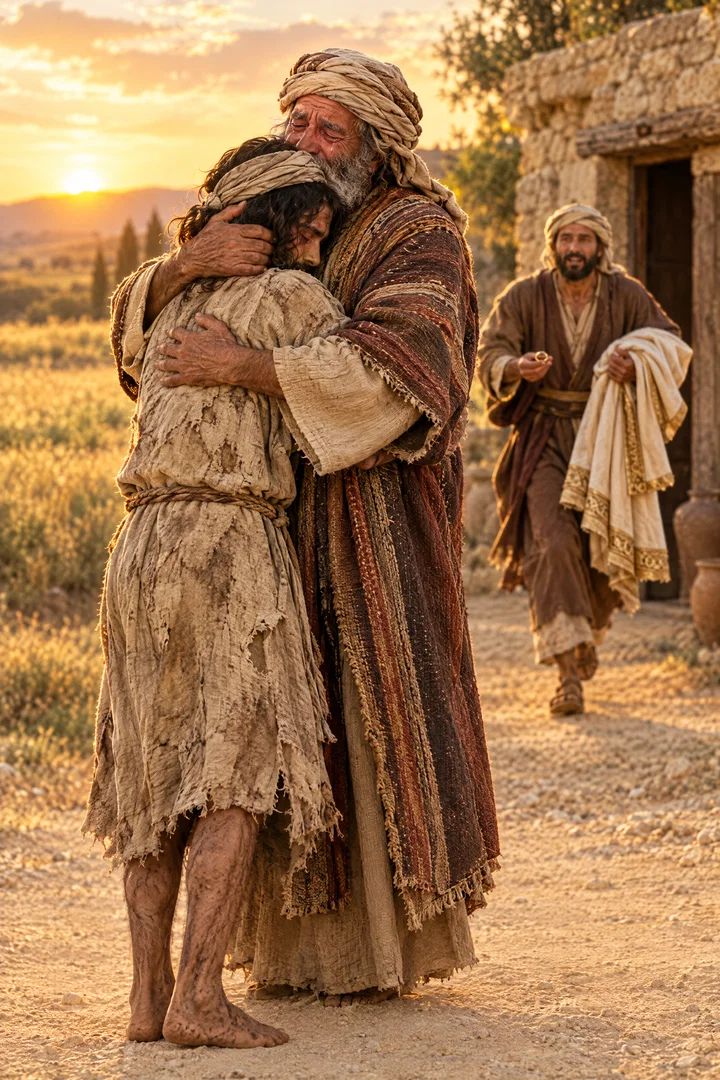
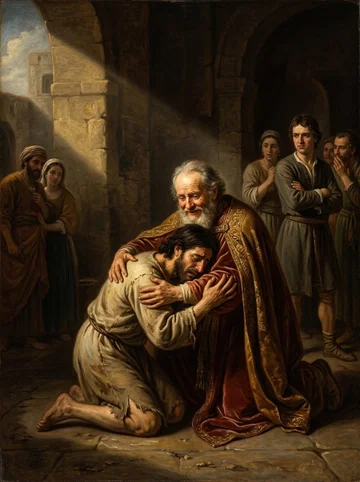
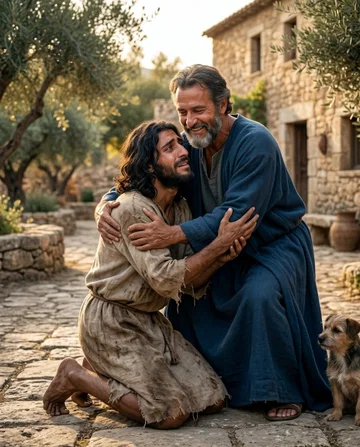
The father receives the repentant son who was dead and is alive again, lost and found, not as a hired servant but as a son restored to the family with honor and care.ST Jan 29, 1894ST Jun 2, 1909ST Apr 20, 1915 He brings him home and holds him close, embracing him with tears and gladness and celebrating his return rather than condemning or humiliating him.COL 203.2–205.1Lt 45, 1894, par. 21–24ST Apr 20, 1915 Former misery and unworthiness bring no contempt or rejection, and no word of reproach is spoken.ST Jan 29, 1894ST Apr 20, 1915ST Jan 29, 1894 The past is forgiven and forgotten, and the welcome shows compassion and willingness to receive every sinner who returns.COL 203.2–205.1ST Jan 29, 1894 Those who follow this example accept the repentant with pity, forgiveness, hope and joy rather than with the elder brother's coldness and resentment.Lt 45, 1894, par. 21–24
The welcome is joyful and complete, without accusations, taunts, reproach or reminders of past unworthiness.ST Jan 29, 1894RH Jan 19, 1911GW 157.3 Sins are forgiven, forgotten, blotted out and remembered no more, and the returning sinner is met not with angry accusations but with joy and celebration.RH Jan 19, 1911GW 157.3Lt 15a, 1890, par. 32–34 The son's return from spiritual death and loss to life and belonging is received as a son, and his recovery is celebrated as an expression of compassion toward the repenting sinner.ST Jan 29, 1894ST Apr 20, 1915ST Jan 29, 1894 Penitence is required for this reception.ST Jan 29, 1894
The father embraces the child, covers his rags with fine garments, and clothes him with the robe of righteousness, the robe of Christ's righteousness.Lt 80, 1898, par. 9–13Ms 40, 1899, par. 10–1211MR 370.2–371.1Lt 76, 1898, par. 18–20 He places a ring on his finger as a sign of royalty and restored family place, prepares a feast, and gives him a place at the Father's table.GW 140.2Ms 40, 1899, par. 10–12Lt 59, 1898, par. 12–14 The restoration calls for joy, not indifference or contempt, and the father's compassion stands in contrast to the elder brother's stubborn selfishness, contempt, complaint, resentment and refusal to forgive.GW 140.2Ms 40, 1899, par. 10–1211MR 370.2–371.1 Coming to God in repentance and seeking forgiveness is not degrading, for God is gracious and will not turn away anyone who comes with a contrite heart and asks in faith.Lt 76, 1898, par. 18–20 He encourages the child's return, values the erring one who returns, and works to bring home the one who separated from Him, so that heaven rejoices over the return.Lt 80, 1898, par. 9–13Ms 40, 1899, par. 10–12
The loving Father waits with yearning love and hastens to meet the repentant while still far off, embracing them in love.Lt 76, 1898, par. 18–20Lt 15a, 1890, par. 32–34 While the sinner is still far away the Father longs for him, and each desire to return is the drawing of the Holy Spirit back to the Father's love. The picture of this compassion still falls short of its full depth.
The reception comes through the mercy revealed at Calvary, where infinite love gave the beloved Son as a sacrifice to open a channel of love so that all who believe in Jesus are restored again to favor.Lt 85, 1886, par. 17–18ST Jan 29, 1894 God gave His beloved Son to endure a life of trial, shame and death to bring the prodigal home, and sent His Son to be the propitiation for sins for those far from the Father's house and perishing with hunger who need to be brought to saving knowledge of the truth.RH Nov 26, 1901Ms 41, 1890, par. 45–51 Christ's readiness to restore sinners and welcome them through the mercy shown at Calvary assures the returning sinner of acceptance, peace and love.Ms 82, 1894, par. 22–243MR 32.1–3 God in Christ daily pleads for men to be reconciled and restored to divine favor through Christ's goodness and mercy, for Christ came to seek and save the lost and with outstretched arms is ready to receive and welcome not only the sinner but the prodigal.3MR 32.1–3 This love from the cross is to be taught in the simplest form so the sin-darkened soul may see light shining from it, and those who have received this saving grace are to share it and help bring others to God, with believing bringing obedience to all God's commandments and life in Jesus Christ.Lt 85, 1886, par. 17–18Ms 41, 1890, par. 45–513MR 32.1–3
A wayward child who returns to the father confessing sin can be freely and fully pardoned, welcomed with pitying love, and restored from disgrace.21MR 429.3Lt 18e, 1890, par. 2 The father's tenderness does not make sin less grievous, but it helps the erring child recover.21MR 429.3Lt 18e, 1890, par. 2 Such forgiving love reflects the invitation to return, repent and receive pardon, and the willingness to pardon transgressions.21MR 429.3Lt 18e, 1890, par. 2
Joy Over Restoration
The return from spiritual death and loss to life and belonging calls for merriment and celebration.Ms 186, 1898, par. 17Lt 89, 1894, par. 4–53T 101.3–102.2ST Apr 20, 1915TCBMP 126.2–127.2 The father rejoices because the son he regarded as dead is alive again, and the son who was lost has been found, has returned and has come to his senses.Ms 186, 1898, par. 173T 101.3–102.2ST Apr 20, 1915TCBMP 126.2–127.2TCBMP 128.2 That finding and restoration outweighs every other consideration, so the celebration is right and the past sins are treated as forgiven and forgotten.3T 101.3–102.2ST Apr 20, 1915TCBMP 126.2–127.2TCBMP 128.2 The elder brother's complaints against that joy are natural but not right, and when an erring one repents and returns, brother must not try to make him feel his error by continually reminding him of it, but must give pity, help, sympathy and above all free forgiveness, because those who have erred suffer in feeling and are frequently desponding and discouraged.Lt 89, 1894, par. 4–5TCBMP 126.2–127.2TCBMP 128.2
The verse shows the Father and Christ and heaven and earth and angels rejoicing when a sinner confesses, seeks pardon and returns.Ms 194, 1898, par. 2COL 197.211MR 367.1COL 206.2–207.1STBk 14.1 The lost is found and the spiritually dead is alive, and heaven and earth join the Father's song of joy.Ms 194, 1898, par. 2COL 197.211MR 367.1COL 206.2–207.1 The welcome is marked by warmth, courtesy and love.Ms 19, 1890, par. 21COL 206.2–207.1STBk 14.1 Even the poorest person coming back brings joy among the heavenly host, and Christ has special sympathy and earnest care for those in danger of sin.Ms 194, 1898, par. 2COL 197.211MR 367.1Ms 19, 1890, par. 21
The verse declares Christ's gladness over the recovery of the lost, that those spiritually dead are made alive again and those lost are found, and His followers enter into His joy.Lt 89, 1894, par. 4–5DA 495.420MR 76.1–2 Its lesson was more fully appreciated after the outpouring of the Holy Spirit, when the ingathering of the Gentiles and the envious anger of the Jews revealed its meaning.DA 495.4 Christ, the true Shepherd who gave His life for the sheep, invites His friends and neighbors to rejoice because the lost is precious to Him.Lt 89, 1894, par. 4–520MR 76.1–2Lt 71, 1895, par. 25 The kingdom and work of Christ require rejoicing over the finding of the lost, with faith and patience and long-forbearance toward those not yet ready to rejoice, instead of indifference and careless disregard.Lt 89, 1894, par. 4–520MR 76.1–2Lt 71, 1895, par. 25
That kingdom is not after the similitude of the world's modes and practices nor after the order of any earthly government, but a dominion of principles originating from the character of God, reflecting His sufficiency, completeness and perfection, where carnal weapons and force and compulsion are banished.20MR 76.1–2 God Himself acts as the true shepherd toward those ready to die, going after the lost sheep, calling the distressed soul to return, healing backsliding and loving freely, and rejoicing with all heaven when the lost is found and alive again.Lt 89, 1894, par. 4–520MR 76.1–2Lt 71, 1895, par. 25 Those who claim to love God must partake of the Father's merry spirit over the returning wanderer.20MR 76.1–2Lt 71, 1895, par. 25
The joy of restoration is a mercy to be remembered with gratitude, bringing praise to the Lord and joyful weeping to those who hear of it.Lt 16, 1892, par. 31–33Ms 89, 1893, par. 1–2Lt 105, 1894, par. 2 Each soul brought to Christ is a precious result of His suffering and death, a sign that He did not die in vain.Lt 16, 1892, par. 31–33 Christ wants this joy, born of the triumphs of the cross, to remain in His followers and make their joy full, and returning to the Father's house means being led step by step in submission to His will and way unto rich experience.Lt 16, 1892, par. 31–33Ms 89, 1893, par. 1–2Lt 105, 1894, par. 2 The verse shows how the Heavenly Father receives those who have sinned, with pity and forgiveness and joy when they recognize their need, become aware of sin and return acknowledging His love and claims, for the son was once lost and as good as dead to filial affection.ST Apr 20, 1915TCBMP 128.1TCBMP 126.2–127.2
God's Love for Sinners
Luke 15:24 shows God's pitying love for those who have strayed from Him, for though they turn away and choose their own course He does not leave them in their misery but meets them with lovingkindness and tender pity while they face the tempter's temptations.COL 198.1Lt 80, 1898, par. 111MR 367.1 The father's celebration of a son who was lost and as good as dead but is found and alive again shows that Christ's mission is to recover the lost, not to condemn or destroy them.ST Jan 29, 1894 Sinners who recognize their need and return are the very ones who need a Saviour, in contrast to the self-righteous attitude of those who see no need for repentance.ST Jan 29, 1894
God's love remains strong for the one who has separated from Him, and He works to bring that person home, so that when the wanderer repents and returns the Father receives him with joy and covers the restored son with the robe of righteousness, and heaven rejoices over the restoration from death to life and from being lost to being found.Lt 80, 1898, par. 9–1311MR 370.111MR 367.1 He longs to do for His wayward sons and daughters the good He delights to do, yet perversity of character can hinder it.Ms 75, 1898, par. 13–14 This is seen in those who claim to be commandment keepers and Christians while transgressing the law, unthankful and unholy, employing their entrusted talents to counterwork God, with no light in them and an influence not unto sanctification or holiness.Ms 75, 1898, par. 13–14
God seeks the sinner who is still in rebellion and welcomes the one who returns, bringing the lost person back to the Father's house, for the sinner is precious to Him and heaven rejoices over the restoration.ST Jan 22, 1894 While the sinner is still far away the Father longs for him, and each desire to return is the Holy Spirit drawing him back to the Father's love, a compassion whose depth the parable's picture still falls short of. God in Christ daily pleads with men to be reconciled and restored to divine favor through Christ's goodness and mercy, for Christ came to seek and save the lost, and with outstretched arms He is ready to receive and welcome not only the sinner but the prodigal.3MR 32.1–3 His love shown on Calvary is the returning sinner's assurance of acceptance, peace and love, to be taught in the simplest form so the sin-darkened soul may see light shining from the cross.3MR 32.1–3
Repentance, Return, Obedience
Penitence is required for the dead to live again and the lost to be found, for when sinners confess their sins and seek pardon, surrender to God and accept Jesus in simple faith with feet planted on the solid Rock, they are forgiven and welcomed as restored children.Ms 194, 1898, par. 2ST Jan 29, 1894Lt 120, 1893, par. 12 After failure and sin a person can come to God, confess mistakes and ask strength to begin again, and that coming removes a great weight from the soul.Lt 120, 1893, par. 12MYP 97.1 The welcome given to every such returning sinner is without reproach or reminders of unworthiness, and heaven rejoices over returning souls.Ms 194, 1898, par. 2ST Jan 29, 1894
To be alive again and found means to turn square about at once, leaving sin and Satan's service even at loss of position, livelihood or trade, and declaring before God and angels and witnesses a decision to be a Christian from that day.Lt 59, 1886, par. 1–5 It means turning to the Lord under the convicting power of the Holy Spirit with confession and contrition of soul, both for those seeking God for the first time and for wanderers, confessing backsliding and entering the heavenward path without delay and without using mistreatment by brethren as excuse.Lt 59, 1886, par. 1–5Ms 21, 1889, par. 96–97Lt 27, 1890, par. 1Lt 27, 1890, par. 18–19 Upon that decision the one who was dead and lost in Satan's service, robbing God of time, talent and influence with a record in heaven's books to meet in judgment, enters a new channel with purified thoughts and changed purposes, feeling solemn responsibility, receiving evidence of pardon and love, and becoming happy and thankful.Lt 59, 1886, par. 1–5Ms 21, 1889, par. 96–97 This is illustrated by a thorough backslider returning to his Father's house, which is his Father's service, and by a wayward person called to come back humbly to family and to God to seek forgiveness, for the Father invites the sinner to return without delay as the privilege of repentance and restoration.Lt 59, 1886, par. 1–5Lt 18f, 1890, par. 2Lt 76, 1898, par. 3–5
Even one who separated long and stayed away, who denied Jesus, pierced the Son of God and put Him to open shame, can still come penitent to the Father's house, for God is ready even now to accept and pardon all transgressions and Christ is ready to cleanse from sin.2T 295.1Lt 1a, 1890, par. 1 He must grasp Jesus Christ by faith, fix the eye upon Him, cast himself helpless upon mercy, give life's remnant to Jesus, cease known sin, turn and live, and be saved by cleansing blood, because heaven must not be lost.2T 295.1Lt 1a, 1890, par. 1 The Majesty of Heaven sends the message of mercy that all things are now ready and invites him to come that he may have life, since serving sin and the flesh and the devil brings only poor wages ending in perishing in sins without certain hope of eternal life.2T 295.1
The welcome does not remove the conditions of sonship, for enjoying a son's privileges involves willing obedience and living in accordance with the father's authority and commands.Ms 183, 1901, par. 12Lt 164, 1900, par. 21–23ST May 8, 1901 Returning to claim the place and privileges of a son also means accepting a son's obligations, giving the whole life, remaining under the father's care and control, and not renewing wandering in disobedience.Ms 98, 1901, par. 17–2010MR 110.3–5 Receiving Christ means renouncing the favor and friendship of the world, making Him all and in all, walking according to His Word, acknowledging Him as King, submitting to His authority and dominion, consulting His will, making His law the rule of life and His life the pattern, obeying His commands, denying self, and being ready to part with all and make any sacrifice, with friendship measured by His rule over the life.ST May 8, 190110MR 110.3–5
Giving heart and soul to God with full commitment brings His blessing and enables helping others turn and be converted, and returning to the Father's house means being led step by step in submission to His will and way unto rich experience, bringing praise and joyful weeping to those who hear of it.Lt 33, 1896, par. 12Ms 89, 1893, par. 1–2 The Father's infinite love shown in the gift of His beloved Son as a sacrifice makes a channel for love so that all who believe in Jesus are restored again to favor, and believing in Him brings obedience to all God's commandments and life in Jesus Christ.Lt 85, 1886, par. 17–18 Those who decide to return to God can be wisely helped and saved when truth lived in the heart has saving power, and wanderers return in contrition and penitence upon hearing a message of love and hope rather than rebuke, with the family celebrating the one who was dead but is alive again.Lt 200, 1902, par. 8–10Lt 178, 1902, par. 28–30
Elder Brother Contrast
The elder son stands for unrepentant, unbelieving Israel, which would not acknowledge publicans and sinners as brothers to be forgiven, sought out, and guided to everlasting life.ST Jan 29, 1894 The full force of that lesson came into view after the outpouring of the Holy Spirit, when the gathering in of the Gentiles and the envious anger of the Jews made plain the gladness over the spiritually dead made alive again and the lost found.DA 495.4
Against the father's compassion stands the elder brother's stubborn, selfish, resentful, contemptuous, and jealous refusal to forgive and to rejoice.GW 140.2Ms 40, 1899, par. 10–1211MR 370.2–371.1 His coldness toward the homecoming contrasts with the father's tender embrace, clothing, ring as token of restored family place, robe of righteousness, and joy, which call for celebration rather than indifference or contempt.GW 140.2Ms 40, 1899, par. 10–1211MR 370.2–371.1RH Nov 25, 1902 His complaints about that joy may feel natural, yet they are not right, and his resentment warns against begrudging welcome to the repentant who comes home.TCBMP 128.2Lt 71, 1895, par. 27 The father's rejoicing that the one counted as dead is alive again and the lost is found teaches that those who have gone wrong need loving acceptance and room to return, not harsh rejection or condemnation.RH Nov 25, 1902Lt 71, 1895, par. 27
That same displeased, selfish spirit reappears among church members who murmur, gossip, plant doubt and questioning and evil surmising and jealousy, expect to be constantly fed with sermons, and complain when ministerial labor is given to those who do not know the truth.Ms 49, 1898, par. 24–25 Those already in the church should instead rejoice when wanderers are brought back to the fold rather than grow envious and jealous.21MR 296.5–6Ms 49, 1898, par. 24–25 The right response is to know God and Jesus Christ, to have Christ formed within as the hope of glory, and to become an earnest, working church of light-bearers carrying salvation by precept and example, by burden for souls and sincere prayer, reflecting the light of truth to every contact in seeking to save the lost.Ms 49, 1898, par. 24–25
Followers of Christ must therefore receive the repentant with pity, forgiveness, hope, and joy rather than with the elder brother's coldness, censure, suspicion, jealousy, resentment, and complaint.Lt 45, 1894, par. 21–24Lt 45, 1894, par. 25–27 Christ's example of seeking and embracing the lost calls for personal care, mercy, and tender sympathy toward every suffering soul, and such action brings rejoicing in heaven.Lt 45, 1894, par. 25–27 When an erring one repents and returns, brother must not deal with brother by trying to make him feel his error and by continually reminding him of it, but must give pity, help, sympathy, and above all free forgiveness, because those who have erred suffer in feeling and are frequently desponding and discouraged.TCBMP 128.2
The waywardness of prodigal sons may trace back to parents who indulge their children and fail to restrain or educate them.11MR 40.3–41.2 The story is thus invoked to show that indulgent parenting can help lead children into destructive ways.11MR 40.3–41.2Lt 117, 1898, par. 4–5
Seeking and Restoring Lost
Luke 15 belongs to the teaching about the lost being found and welcomed with joy, and its lost-sheep teaching lays on the church the duty to seek those who have strayed and bring them back into the fold.Ms 16, 1868, par. 2–3 Failure to do this leaves its members guilty, and that wrong must be recognized and acknowledged before George Lay can be reached.Ms 16, 1868, par. 2–3 Those who have repented and returned after straying are received with joy like a long-lost son welcomed by his father, and this calls all to work with God to seek the lost and bring them back.18MR 113.5Ms 132, 1902, par. 9 The lost are found and the spiritually dead are alive again, and people rescued from sin through Christ can help bring others who have gone astray back to God.Ms 132, 1902, par. 9MH 179.1–2 God gave His beloved Son to endure a life of trial, shame, and death to bring the prodigal home, and those who have received this saving grace are to share it with others and help bring them to God.Ms 41, 1890, par. 45–51
Erring people are to be met with Christlike tenderness, compassion, sympathy, prayer, and efforts to restore them, not with harsh condemnation, severe judgment, indifference, or contempt that leaves them without hope.Lt 16, 1887, par. 7–14Lt 16a, 1887, par. 416MR 339.3 The prodigal restored after being lost is like one brought back from death to life and found again, displaying love and tenderness toward those who fall under temptation.Lt 16, 1887, par. 7–14Lt 16a, 1887, par. 4 Those perishing in sin are to be met with compassion, and tempted and erring people need room to recover rather than rejection or treatment that drives them farther from God.Ms 45, 1901, par. 8Ms 113, 1902, par. 30Lt 50, 1893, par. 8–9 The elder brother's cold response contrasts with the loving father's welcome, which receives rather than rejects the one who was lost and as good as dead to the family.Ms 113, 1902, par. 30 Every lost sheep has a shepherd provided by God to seek him, and every outcast may be brought back to the Father's house.Lt 88a, 1895, par. 16–21 That return comes through whole-souled, consecrated workers seeking the lost by every devising and planning in harmony with heaven's angels, extending to the neglected, oppressed, and degraded the abundant provision made for a few, so that even poor, ignorant, undisciplined beings degraded by sin and superstition may be educated, rescued, sanctified, ennobled, and saved by divine power.Lt 88a, 1895, par. 16–21
One who leaves cannot find the way back without help, but must be searched for, found, and brought back.Ms 81, 1893, par. 61–63 Away from the Father's house and service he is dead and lost, in darkness and confusion like a sheep in a dreary wilderness, bewildered, miserable, dissatisfied, and frightened, yet rushing farther from heaven's gates and the Shepherd's care, deceived away from pleasant pasture and from love and guardianship.Ms 81, 1893, par. 61–63 He must be brought back by a tender and true shepherd who leaves the ninety and nine, goes into the wilderness, and endures storm, cold, and roughness of the way, feeling the true shepherd's burden for the soul's danger, misery, and wretchedness.Ms 81, 1893, par. 61–63 Prodigals who have left the Father's house are to be encouraged to return to Him, and the sick and sinful are to be pointed to Christ the great Healer.STB 147.5RH Mar 16, 1905STB 119.1 The return from being lost to being found is accompanied by joy and celebration, as one away is restored to the family like one returned from death.STB 620.1–2RH Mar 16, 1905 Coming back to the Father's house means leaving backsliding for faithful life with God, and it comes about through earnest labor in Christ even when spoken to only a few, as pictured in a backslidden young man coming home.Lt 59, 1886, par. 6 The same restoration was seen in a man degraded by liquor who was deeply moved and wanted to become fully converted, showing the Lord at work in his return.Lt 28, 1874, par. 6–7 The image of the one who was lost and is found also meets one ruined by selfish indulgence, who once held ambitious hopes and won prizes but fell through self-sufficiency and habitual drinking until discouraged, enslaved by Satan, and unable to free himself, with tender sympathy and words of help suited to his need.Ms 22, 1898, par. 19
Sources
Pioneers and periodicals
280 sources
The father orders the feast because the son who wasted his portion in riotous living in a far country and came back confessing unworthiness has come home from death to life and from loss to recovery, and is received again as a son and not as a hired servant.ST May 4, 1904ST Aug 6, 1894ST May 4, 1904ST Aug 6, 1894 To be dead and lost is to be separated from the father through sin, spiritually dead and cut off from family and home, and to be alive again and found is to return humbled and be restored to life, fellowship and belonging.ST Mar 25, 1880ST May 4, 1904ST Apr 2, 1896 The father welcomes the returning one with unchanged love, mercy, compassion and great joy, meeting him while yet far off and embracing him before reproach or recounting of wrongs, giving freely the best robe and ring and shoes and the fatted calf.ST Mar 25, 1880RH May 9, 1871ST May 5, 1914RH Mar 18, 1858ST Aug 11, 1914 The return begins when the sinner comes to himself, admits wrong, arises and comes confessing sin and unworthiness, abandoning self-righteousness and sin to seek cleansing and restoration in the father's house.RH Jul 15, 1862ST Aug 23, 1899RH Jul 21, 1910RH Feb 16, 1869RH Jan 19, 1911 This restoration is justification and new birth from condemnation and death to acquittal and life, bringing joy to father, household and heaven over even one penitent, and calling every wanderer and backslider to come on mercy alone.RH Nov 12, 1914ST Apr 25, 1878ST Oct 17, 1900ST Mar 10, 1887
Story Context and Wording
The saying is the father's own explanation for the feast in the third of the three parables in Luke 15, giving the reason for ordering the best robe and a ring and shoes and for killing the fatted calf and eating and making merry.ST May 4, 1904ST Aug 6, 1894ST May 4, 1904ST Sep 6, 1899ST Aug 6, 1894 Because this son was dead and is alive again, was lost and is found, the father commands celebration, and they began to be merry.ST May 4, 1904ST Aug 6, 1894ST May 4, 1904ST Sep 6, 1899RH Jan 25, 1912 The dead and lost one who is now alive and found is the younger son who had taken his portion, wasted it with riotous living in a far country, and come to want and hunger.ST May 4, 1904ST Aug 6, 1894ST Aug 6, 1894 His coming to himself and arising and coming back confessing sin against heaven is counted as becoming alive again and being found, and he is restored as a son and not received as a hired servant.ST May 4, 1904ST Aug 6, 1894
The parable was spoken when publicans and sinners gathered to hear Jesus and scribes and Pharisees complained that he received sinners and ate with them.ST Nov 22, 1899ST Oct 24, 1900 It sweeps away false views that God has no pity and compassion for the erring and fallen but regards them as without mercy, fit subjects of wrath to be shunned, and portrays instead God's joy over the wandering son's sense of need and return homeward.RH Dec 13, 1906ST Nov 22, 1899 With the lost sheep and the lost coin it shows Jesus seeking and saving that which was lost, as when salvation came to the house of Zaccheus.ST Nov 21, 1900RH Nov 9, 1916RH Mar 28, 1865 The father's love for the prodigal stands in contrast to the Pharisee attitude, and the father's household celebrates the restoration.RH Dec 13, 1906RH Mar 28, 1865
The story beginning with a certain man who had two sons is parable, an illustrative fable and familiar event of life used to illustrate truth and turn ordinary experience into reminder of spiritual realities.ST Nov 30, 1915RH Sep 3, 1872RH May 28, 1861ST Jun 18, 1885 It is not literal history like Noah, the flood, Babel, or Abraham, but belongs with the three parables introduced with a certain man, including the lost sheep and the lost coin.RH Sep 3, 1872RH Mar 28, 1865RH May 28, 1861 Its parabolic character is known from its nature and context though it is nowhere called a parable, so absence of the word parable proves nothing, as with the rich man and Lazarus.RH Sep 3, 1872ST Aug 19, 1880 Such wording with direct assertion does not make a story literal history.RH Sep 3, 1872
The household's beginning to be merry marks the restoration from death to life and from loss to recovery as fitting cause for rejoicing and joyful celebration.ST Oct 17, 1900ST Sep 6, 1899ST Oct 17, 1900RH Aug 10, 1905 The son who had been as good as dead and lost to his family is alive again and found, and ruin turned to restoration calls for glad feasting.ST Oct 17, 1900ST Sep 6, 1899ST Oct 17, 1900 The parable fits all ages and all sorts of people, holds germs of sermons, helps each reader apply it, and is full of gospel, but its beauty as a picture of God's relation to men is lost when turned into slang.RH Jan 14, 1915 Beyond associating the verse with recognizing guilt and repenting, nothing further is added about its language of restoration or the family's joy.RH Jul 15, 1862RH Sep 3, 1872
Meaning of Dead and Lost
To be dead and lost is to be separated from the father through sin, as good as dead and lost to the family, spiritually dead, dead in sin, while to be alive again and found is to return home and be restored to life, fellowship and belonging, and the father's joy and celebration belong to that restoration.ST May 4, 1904ST Apr 2, 1896ST Dec 18, 1901RH Aug 28, 1866 Death and life here are figurative for the state of sin and restoration from it, for the spiritually dead become alive again and the lost are found when the child is restored to God.RH Aug 28, 1866RH May 21, 1857
Being dead and lost is bringing friendlessness and want upon oneself by disobedience, taking an undeserved gift with selfish heart, going far to forget the father, despising restraint, seeking pleasure at will, and wasting all in sinful indulgence until famine leaves one destitute, regretting extravagance, feeding swine and perishing with hunger.ST Mar 25, 1880ST Mar 17, 1887ST Nov 27, 1879 Being made alive and found is being humbled by adversity to feel need of the father, remembering his kindness and love and the privileges and bounty even hired servants freely enjoy, and deciding to return in humble confession as a beggar destitute of decent clothing, wretched through privation and emaciated with hunger.ST Mar 25, 1880ST Jul 4, 1900
Being dead and lost is trading the white robes of favor for tattered soiled garments, leaving the field given by God to be spoiled by weeds, turning from the fruits of His vineyard to feed on husks with swine, and leaving the pure springs of mercy for the rioter's wine.ST Mar 25, 1880 Being alive again and found is coming back wearied, stricken, sore, saddened, ashamed and defiled with faltering feet, stain-crimsoned hands and a heart offering only sin and pain, asking only for a servant's bread as unworthy of the name of child and waiting in the dust for greeting even if it comes with chastening.ST Mar 25, 1880ST Sep 9, 1875 Then stained hands are cleansed, bleeding feet healed in His ways, and blind tearful eyes healed to see mercy and kindness in the pardoning face, as the wanderer leaves sin behind and clasps the cross through the Lamb.ST Mar 25, 1880ST Sep 9, 1875 The one so restored receives a dress, a robe of spotless righteousness worn in Christ, bears Christ's precious name and shares the Father's love, is put in the children's place by grace to gaze upon the Father's face, has the famished soul fed at a spread feast of love upon the children's bread, joyfully confesses this possessed portion in Christ, and at last shines in Christ's likeness with everlasting joy.ST Sep 9, 1875
To be dead and lost is to live a sick sinful life that leaves the heart grimy and dark from the effects of sin, to feed on husks and forget the father's bread, and to settle for this world which cannot give lasting happiness and peace instead of preparing for the brighter and better life to come.ST Jul 4, 1900RH Feb 28, 1871 To be alive again and found is for the son, sick of his life, to hear his father's desire for him to come back, to return asking forgiveness, and to be received with a joyful embrace of fervent parental love.ST Jul 4, 1900 The return brings father and son together bowed in thankful prayer to God, with the Sun of Righteousness shining for the first time into the darkened heart.ST Jul 4, 1900
The son is dead and lost while beyond the reach of home's bounties, despising its holiness and purity and peace and plenty for the glamour of worldly pleasures and the delights of a foreign country.RH Feb 15, 1912RH Aug 24, 1916 He is alive again and found when hardships and suffering clear his vision and the memory of that far distant home rises before him in reproachful magnificence, awakening consciousness of guilt and unworthiness and remorse over unworthiness and sorrow caused to mother and dear ones who trusted his honor.RH Feb 15, 1912RH Aug 24, 1916 His one longing desire becomes home itself, to return as a penitent alien content with even the most menial servant's place in its restful sheltering embrace, with reason returned and power of temptation fled and deep thankfulness for escape from further degradation.RH Feb 15, 1912RH Aug 24, 1916 That memory restrains sin and turns lives into channels of righteousness, right living, love, mercy and truth, and the influence of a loving Christian home follows and protects the traveler even when the sea rolls between.RH Feb 15, 1912RH Aug 24, 1916
Breaking the first and great commandment to love God with all heart, soul and mind in Paradise destroyed man's tendency to God and dependence on His touch, control and paternal government.ST Apr 8, 1875RH Dec 23, 1873 Becoming the lost son means breaking loose from the great central government and losing anchorage ground, like the earth breaking from its attraction to the sun and wandering eccentric from its orbit into endless space.ST Apr 8, 1875RH Dec 23, 1873 It is to be left at sea without star above or hope before, without hope and without God in the world.ST Apr 8, 1875RH Dec 23, 1873
Lost means a life trembling in the balance, in precarious condition, and a vacant place left behind, so that the cry that a child is lost stirs all to earnest search with lights through streets and woods until the shout comes that the child is found.ST Dec 3, 1885 Being found and raised as it were to life in this world brings rejoicing as from death to life, yet it does not settle the final question, for a child found now may still go astray on the journey of life and be lost at last, and the issue that remains is whether he will be finally lost or saved to praise God forever in His kingdom.ST Dec 3, 1885
Coming back to the father's house bodily does not itself mean found.RH Aug 29, 1865 Being lost begins before bodily absence and continues after bodily return when innocence and a teachable spirit of boyhood are gone through lack of parental control, roaming, disobedience, stealing and indulgence.RH Aug 29, 1865 Being found means restoration to virtue and right conduct on the road of obedience under correct parental control, not merely safe physical return to rejoicing parents.RH Aug 29, 1865
Both sons made themselves supremely miserable up to the time of repentance, and the kindness and forbearance of their father availed nothing to allay that misery.ST Jul 1, 1880 A hard heart makes its own hell even under a loving father's care, looks for freedom away from the presence of God, and will not enter in even if the Father comes out and entreats it.ST Jul 1, 1880
For a parent, dead and lost meant living in indifference to truth, making vain reasoning to evade the last call of mercy, and holding to worldly popularity, fashion and striving for education.RH Jul 10, 1855 Being alive again and found meant being troubled by the Spirit, thoroughly investigating truth, and coming out decided to keep the seventh-day Sabbath, even leaving school and selling books to do so, with joy and praise for goodness and enduring tender mercy.RH Jul 10, 1855 Such restoration encourages parents to pray night and day for their children.RH Jul 10, 1855
The prodigal's day runs from waste in the morning to want in the evening, proving that carelessness sows a crop of cares while painstaking care protects against pain. Neglect of secret prayer leaves the soul barren and in danger of spiritual death as one spiritually dead and separated from the father and far from the Father's house, while returning to fellowship with God brings spiritual life renewed and fitting joy.RH May 8, 1866
The son wilfully went astray and had to choose to return, and the father's joy reflects the deep affection of a parent with only two sons when one is lost and restored.ST Oct 10, 1900 His ragged and discouraged condition among swine after squandering his substance pictures the unregenerated sinner who is lost.RH Nov 30, 1905 His return to the Father's house means coming from spiritual starvation to a satisfied soul, nourished by the bread of life.ST Nov 14, 1900
Remorse over slighted love and broken law pictures coming back to God after experiencing sin's ruin, and the depth of sin in leaving the Father is realized only by realizing what might have been in the Father's house if one had stayed at home with Him.ST Feb 26, 1902 Brought by sin to the brink of death and to spiritual death through sin, the son learns to value the Father's love and the joy and peace of reconciliation with God, as well as the gift of eternal life.ST Feb 26, 1902ST Feb 26, 1902
Sources