Luke 19:11
And as they heard these things, he added and spake a parable, because he was nigh to Jerusalem, and because they thought that the kingdom of God should immediately appear.
Translations
And as they heard these things, he added and spoke a parable, because he was near to Jerusalem, and because they thought that the kingdom of God should immediately appear.
King James Version, KJV Cambridge Paragraph Bible
And as they heard these things, he added and spake a parable, because he was nigh to Jerusalem, and because they thought that the kingdom of God should immediately appear.
And as they heard these things, he added and spoke a parable, because he was nigh to Jerusalem, and because they thought that the kingdom of God would immediately appear.
Revised Version, American Standard Version
And as they heard these things, he added and spake a parable, because he was nigh to Jerusalem, and because they supposed that the kingdom of God was immediately to appear.
And while they are hearing these things, having added he spake a simile, because of his being nigh to Jerusalem, and of their thinking that the reign of God is about presently to be made manifest.
But as they were listening to these things, he added and spake a parable, because he was near to Jerusalem and they thought that the kingdom of God was about to be immediately manifested.
And, because they were hearing these things, he added and spake a parable, because of his being near Jerusalem, and their supposing that, instantly, was the kingdom of God to shine forth.
Berean Standard Bible, Majority Standard Bible
While the people were listening to this, Jesus proceeded to tell them a parable, because He was near Jerusalem and they thought the kingdom of God would appear imminently.
As they heard these things, he went on and told a parable, because he was near Jerusalem, and they supposed that God’s Kingdom would be revealed immediately.
And while they were giving ear to these words, he made another story for them, because he was near Jerusalem, and because they were of the opinion that the kingdom of God was coming straight away.
And whiles they heard these thinges, hee continued and spake a parable, because hee was neere to Hierusalem, and because also they thought that the kingdom of God should shortly appeare.
Douay-Rheims (Challoner revision)
As they were hearing these things, he added and spoke a parable, because he was nigh to Jerusalem, and because they thought that the kingdom of God should immediately be manifested.
Pictures
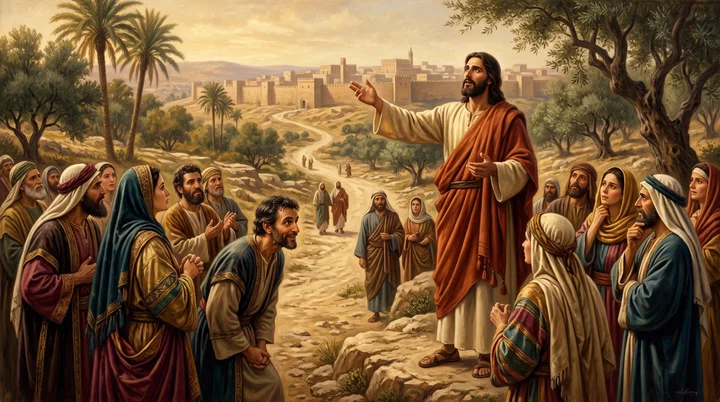
Cross-references 20 of 32
- Matthew 25:14-30
For the kingdom of heaven is as a man travelling into a far country, who called his own servants, and delivered unto them his goods.
Its parable of the talents is identified with the pounds in Luke 19.
- Daniel 7:13-14
I saw in the night visions, and, behold, one like the Son of man came with the clouds of heaven, and came to the Ancient of days, and they brought him near before him.
The Son of man receives dominion and a kingdom from the Ancient of Days.
- Acts 1:6
When they therefore were come together, they asked of him, saying, Lord, wilt thou at this time restore again the kingdom to Israel?
The disciples ask whether Christ will now restore the kingdom to Israel.
- 2 Timothy 4:1
I charge thee therefore before God, and the Lord Jesus Christ, who shall judge the quick and the dead at his appearing and his kingdom;
Christ’s appearing and kingdom are connected with judgment.
- Luke 19:15
And it came to pass, that when he was returned, having received the kingdom, then he commanded these servants to be called unto him, to whom he had given the money, that he might know how much every man had gained by trading.
The nobleman returns after receiving the kingdom.
- Luke 17:20-24
And when he was demanded of the Pharisees, when the kingdom of God should come, he answered them and said, The kingdom of God cometh not with observation:
The people expect the kingdom immediately, while Jesus describes its coming as unmistakable.
- Daniel 2:44
And in the days of these kings shall the God of heaven set up a kingdom, which shall never be destroyed: and the kingdom shall not be left to other people, but it shall break in pieces and consume all these kingdoms, and it shall stand for ever.
Both describe God establishing an everlasting kingdom that displaces human governments.
- Revelation 11:15
And the seventh angel sounded; and there were great voices in heaven, saying, The kingdoms of this world are become the kingdoms of our Lord, and of his Christ; and he shall reign for ever and ever.
The world’s kingdoms become Christ’s everlasting kingdom.
- John 18:36
Jesus answered, My kingdom is not of this world: if my kingdom were of this world, then would my servants fight, that I should not be delivered to the Jews: but now is my kingdom not from hence.
Christ’s kingdom was not to be set up as an earthly kingdom at his first advent.
- Luke 19:27
But those mine enemies, which would not that I should reign over them, bring hither, and slay them before me.
On his return, the ruler orders judgment on his enemies.
- Luke 23:42
And he said unto Jesus, Lord, remember me when thou comest into thy kingdom.
The thief asks to be remembered when Christ comes into his kingdom.
- Luke 22:29
And I appoint unto you a kingdom, as my Father hath appointed unto me;
Christ appoints the apostles to a kingdom before they reign in it.
- Matthew 3:2
And saying, Repent ye: for the kingdom of heaven is at hand.
John says the kingdom is at hand, while Jesus corrects the expectation that it would appear immediately.
- Daniel 7:27
And the kingdom and dominion, and the greatness of the kingdom under the whole heaven, shall be given to the people of the saints of the most High, whose kingdom is an everlasting kingdom, and all dominions shall serve and obey him.
The kingdom is given to the saints and is everlasting.
- Psalms 2:6-9
Yet have I set my king upon my holy hill of Zion.
The Son’s kingly rule follows judgment.
- Mark 1:14-15
Now after that John was put in prison, Jesus came into Galilee, preaching the gospel of the kingdom of God,
Jesus proclaims the approaching kingdom and calls people to repentance.
- Mark 13:34
For the Son of man is as a man taking a far journey, who left his house, and gave authority to his servants, and to every man his work, and commanded the porter to watch.
Both depict an absent lord entrusting work to his servants.
- Luke 19:17
And he said unto him, Well, thou good servant: because thou hast been faithful in a very little, have thou authority over ten cities.
The faithful servant is given authority over cities.
- Luke 9:27
But I tell you of a truth, there be some standing here, which shall not taste of death, till they see the kingdom of God.
Both speak of expectations about the kingdom of God appearing soon.
- Matthew 4:17
From that time Jesus began to preach, and to say, Repent: for the kingdom of heaven is at hand.
Jesus preached repentance as the kingdom drew near.
Commentary
Each commentary is drawn from primary sources: the writings of Ellen G. White and Adventist pioneers and periodicals. Each commentary is separate. Its own words are not a quotation; follow the references to read the source passages.
Ellen G. White
16 sources
As He drew near to Jerusalem, Jesus added a parable because His hearers thought the kingdom of God should immediately appear.Ms 76, 1900, par. 42T 667.3–668.2Lt 44, 1900, par. 6 They expected Him to take David's throne at Jerusalem and reign as a temporal prince to deliver them from Roman power and exalt them to immediate honor.Ms 76, 1900, par. 4Lt 44, 1900, par. 6 That expectation was mistaken, for He must first go away, suffer rejection and crucifixion, and pass through conflict before His triumph, so His servants have faithful work to do with entrusted truth before its victory.Lt 44, 1900, par. 6Ms 26, 1896, par. 27–28 God gives every person his work and entrusts His own goods according to ability, from one pound to five, including spiritual advantages, truth, talents, means, money, houses, lands, and tithes and offerings, to be used in co-partnership with Him.Ms 57, 1901, par. 152T 667.3–668.2Ms 10, 1892, par. 18 His servants must not remain slothful but occupy till He comes, diligently trading and improving in grace and knowledge to win souls at home and in regions beyond, knowing the Master will examine each personal account to reward faithful improvement with more and to punish abuse and squandering with loss.2T 667.3–668.2Ms 76, 1900, par. 9Ms 10, 1892, par. 18Ms 9, 1898, par. 9–10Ms 26, 1896, par. 27–28
Why Jesus Spoke Parable
As He neared Jerusalem, He added and spoke a parable because those who heard Him thought that the kingdom of God should immediately appear.Ms 76, 1900, par. 42T 667.3–668.2Lt 44, 1900, par. 6Lt 43, 1899, par. 34–36Ms 150, 1898, par. 19 They expected Him to take David's throne at Jerusalem and reign as a temporal prince who would deliver them from Roman power and glorify His people, giving them immediate honor as conquerors.Ms 76, 1900, par. 4Lt 44, 1900, par. 6 Because this false expectation was continually in their minds, He could not unfold many things He longed to tell them, so He put the truth in a parable to make correct impressions on their minds.Ms 76, 1900, par. 4
The expectation was mistaken, for He had first to go away, suffer rejection and crucifixion, and pass through conflict before His triumph was complete.Lt 44, 1900, par. 6 So the kingdom would not immediately appear, and His servants had work to do faithfully with the entrusted truth before its victory rather than expecting immediate honor.Lt 44, 1900, par. 6Ms 26, 1896, par. 27–28
Faithful Stewardship Until Return
God gives to every person his work and entrusts to His servants gifts that remain His own goods, to be used in co-partnership with Him.2T 667.3–668.2Ms 26, 1896, par. 27–28Lt 43, 1899, par. 34–36 The trust is given to each according to ability and varies from one pound to five, encompassing spiritual advantages, truth, talents, means, money, houses, lands, tithes and offerings.Ms 10, 1892, par. 18Ms 9, 1898, par. 9–10Ms 26, 1896, par. 27–28Ms 150, 1898, par. 19 Each person is to manage his own stewardship rather than hand it to another, and all means belong to God and are to be used to meet the needs of His work.Ms 26, 1896, par. 27–28Lt 43, 1899, par. 34–36 Those who fail to develop what is entrusted squander their gifts and will answer to God for them.Ms 10, 1892, par. 18Ms 9, 1898, par. 9–10
Christ's servants must occupy till He comes and must not remain slothful, but diligently trade upon what is entrusted, developing it and improving mentally and morally in grace and in knowledge.2T 667.3–668.2Ms 76, 1900, par. 9Ms 26, 1896, par. 27–28 They are to watch for opportunity to represent the truth to others, to win souls to Christ, and to give the message of truth not only in their own neighborhood but in regions beyond.Ms 76, 1900, par. 9Ms 26, 1896, par. 27–28 A faithful steward does all he possibly can in God's service with that one object, exercising frugality and self-denial.2T 667.3–668.2Ms 26, 1896, par. 27–28 No opportunity for serving God in little things is to be neglected, for nothing in God's work is insignificant, and faithfulness in doing the work decides each one's reward, so that the work of the one who has but one talent is as valuable in His sight as the work of the one who has five.Ms 25, 1899, par. 20Ms 150, 1898, par. 19 Having little is no reason to think one can do nothing, but every gift calls for faithful use and prayer for wisdom, and the minister's wife likewise is responsible to use her God-given ability earnestly and sacrificially to help save souls.GW 202.1Ms 150, 1898, par. 19
What is imparted is increased, for the more talents are exercised the greater the increase of capability, and as they impart what they have received they receive more richly.Ms 76, 1900, par. 9Ms 9, 1898, par. 9–10Lt 47, 1895, par. 14–15 Its wise use blesses the user, serves in saving souls, is shown in souls brought to the knowledge of the truth, and brings glory to God.Ms 9, 1898, par. 9–10Lt 49, 1895, par. 13–15 The servant's pound was first given by the Lord, so pound and gain come from His provision and belong to Him, the faithful servant takes no credit, and all praise and glory go to the Lord.Ms 57, 1901, par. 15 Each servant must give a personal account, for the Master examines how the trust was used, rewards faithful improvement with more, and punishes abuse and squandering.2T 667.3–668.2Ms 10, 1892, par. 18 Though no one is compelled to present tithe, gifts and offerings, God will surely require His own with usury at the hand of every human being, and refusing to use what is entrusted causes loss, forfeiture of blessing, and eternal separation from God.Ms 9, 1898, par. 9–10Ms 26, 1896, par. 27–28
Slothfulness in trading with the Lord's goods and selfishly withholding what belongs to God retards His work.Ms 57, 1901, par. 7Ms 26, 1896, par. 27–28 Money, houses, lands and other gifts are to be used to advance His work and build His kingdom, not to glorify self or indulge impulse.Ms 26, 1896, par. 27–28Ms 150, 1898, par. 19 When men cherish love of the truth and sanctification through the truth, it will banish avarice, overreaching and every species of dishonesty.Ms 26, 1896, par. 27–28 The command to occupy means the present is the opportunity for service, but probation may end and the account be fixed.2T 667.3–668.2 The verse stands in the account of His mission teaching that humanity can overcome evil by living faith in His divinity, for grasping divine power through faith helps overcome tempers, dispositions and unbelief in the battle of the Christian life.Ms 123, 1909, par. 19–20
Sources
Pioneers and periodicals
75 sources
As he drew near to Jerusalem on his last journey, at Jericho shortly before his death, Jesus spoke this parable because his hearers expected him to set up a temporal kingdom at once on entering the city and free them from Rome.RH Oct 3, 1854ST Nov 10, 1881GSAM 67.2–68.1ST Nov 20, 1884 He spoke to correct that expectation, showing he must first suffer and be crucified before the kingdom should come.RH Oct 3, 1854ST Dec 11, 1879ST Sep 10, 1894ST Nov 20, 1884 The nobleman going to a far country to receive a kingdom is himself, departing at his ascension to heaven to receive the kingdom from the Father in Daniel 7:9-10, 13-14 before returning at his second advent.ST Nov 10, 1881GSAM 67.2–68.1ST Dec 11, 1879ST Oct 13, 1898ST Aug 19, 1880 The kingdom therefore was still future when he spoke, a literal universal rule over the earth to be set up when he comes again already crowned, when he will reward the faithful, destroy those who rejected his reign, and give the saints to reign with him.RH May 30, 1854ST Jun 11, 1896ST Jun 4, 1894RH Oct 30, 1855RH Jun 7, 1915 In the meantime his servants through the whole gospel age are entrusted with pounds, the gifts of the Spirit and every temporal and spiritual blessing, and are commanded to put them to faithful use until he returns to reckon with them.ST Sep 14, 1882ST Dec 19, 1900ST Aug 19, 1889ST Sep 13, 1899RH Sep 28, 1869
Wording and Historical Setting
The word added means he spoke this parable in addition to what had been said before, not as part of the earlier words.ST Jun 1, 1882 He spoke it because he was nigh to Jerusalem on his last journey there, and because they thought the kingdom of God should immediately appear.RH Oct 3, 1854ST Nov 10, 1881GSAM 67.2–68.1 That journey was made a few days to about a week before his crucifixion, likely at Zacchaeus's house in Jericho, as he traveled from Jericho toward Jerusalem by way of Bethany.ST Apr 30, 1896
In Luke's order the parable comes after the foretelling of his death, the healing of the blind man, and the call of Zacchaeus.ST Apr 21, 1909 It comes before the riding into Jerusalem, the weeping over the city, the parable of the husbandman, the questions of the Pharisees and Sadducees, and the discourse on the destruction of Jerusalem and the second coming.ST Apr 21, 1909 The whole stands within Luke 18:24 through Luke 21.ST Apr 21, 1909 It belongs among events and teachings found only in Luke.ST Sep 20, 1905
The hearers, including the disciples, thought the kingdom of God should immediately appear.RH Oct 3, 1854ST Nov 20, 1884ST Sep 16, 1889ST Nov 20, 1884 They expected a temporal and political kingdom in which Jesus would begin reigning as king on entering Jerusalem.RH Oct 3, 1854 They looked for him to free the Jews from Roman rule, give them world sovereignty, and advance them to prominence.RH Oct 3, 1854ST Sep 16, 1889
Correction of Immediate Expectation
Jesus spoke the parable to correct the mistaken expectation that the kingdom of God would appear at once because he was near Jerusalem.ST Dec 11, 1879ST Sep 10, 1894RH May 30, 1854ST Mar 13, 1884ST Aug 19, 1880 The hearers thought the kingdom would be set up immediately, so the parable showed that the nobleman must first go away to receive the kingdom, leave his servants to care for his property while he was gone, and return later to reward the faithful, reject the unfaithful, and destroy his enemies.RH May 30, 1854ST Mar 13, 1884RH Oct 31, 1854 The kingdom therefore would not be established until Christ returned from heaven, after going to receive it and coming again.RH May 30, 1854ST Aug 19, 1880RH Oct 31, 1854 That future reception takes place in the presence of the Father, not during the earthly ministry, and is distinguished from the present priestly reign on the Father's throne, coming under the seventh trumpet near the close of the present age.ST Dec 11, 1879ST Mar 13, 1884
The correction showed that his mission in Jerusalem had to pass through suffering before the kingdom came.RH Oct 3, 1854ST Nov 20, 1884 Many thought he would begin his reign as king when he entered Jerusalem, and the parable warned them against the disappointment they would face at his crucifixion and would have prepared them for the collapse of their hopes at his death.RH Jul 30, 1857 Only after their disappointment did they learn that Christ had to suffer before coming in his kingdom, though even in their mistaken expectation they fulfilled prophecy by praising their king as he entered Jerusalem.ST Nov 20, 1884RH Jul 30, 1857 After his resurrection the same order points to delay, for Christ goes to heaven to receive his kingdom from the Father and returns with the New Jerusalem.
Even after hearing the parable the disciples did not fully grasp its order of events.ST Sep 16, 1889ST Nov 27, 1879 This was proved by their conduct on entering Jerusalem, when they hailed him as the Son of David and rejoiced before him as a king in triumph with palm branches and shouts, instead of realizing he was going to be condemned and crucified as a malefactor.ST Sep 16, 1889ST Nov 27, 1879RH Jul 30, 1857 That failure proves the disciples could mistake the chronological relation of coming events, so their supposed joining of the overthrow of the city with the coming of Christ and the end of the world does not prove those events must be fulfilled at the same time.ST Sep 16, 1889
Being mistaken about the time and what would happen did not make their timely proclamation a shocking error.ST Nov 20, 1884RH Jul 25, 1865 Their expectation of the event was mistaken even though they proclaimed at the right time and witnessed the fulfillment of prophecy in Jesus' entry into Jerusalem.ST Nov 20, 1884 The disappointment that followed at his death does not prove the doctrine false, for the first-advent disappointment was part of God's plan, just as the disappointment of those expecting the second advent in 1844 could accompany fulfilled prophecy.RH Jul 25, 1865
The verse concerns the timing of the kingdom's appearing, not the conditions for entering it taught to Nicodemus.ST Jun 21, 1883RH Jul 11, 1854RH Sep 20, 1864 It teaches that the kingdom was not to come at once in that day but approacheth as an event connected with and depending on Christ's coming, appearing, and judgment.ST Jun 21, 1883RH Jan 10, 1854RH Jul 11, 1854 The word for immediate nearness or imminence was never used for the proximity of the kingdom in that day, and the kingdom cannot be inherited during the gospel dispensation except as an embryo in the hearts of his people until after the resurrection or a change equal to it.ST Jun 21, 1883RH Jan 10, 1854 In this way the teaching helped people look forward to the time when his kingdom would come on earth.
Going Away to Receive Kingdom
The nobleman who goes to a far country to receive a kingdom and then returns is Jesus, and the far country is heaven where the Father dwells.ST Nov 10, 1881GSAM 67.2–68.1ST Dec 11, 1879RH Dec 11, 1866RH May 11, 1869 His going away is his ascension to heaven after his resurrection, and his coming back is his second advent, so the parable spans the whole Christian dispensation from his departure to his return.ST Nov 10, 1881GSAM 67.2–68.1RH Dec 11, 1866RH May 11, 1869ST Aug 19, 1889 He receives the kingdom in the presence of the Father and not during his earthly ministry, correcting the expectation that it should appear immediately because he was near Jerusalem.ST Nov 10, 1881GSAM 67.2–68.1ST Dec 11, 1879RH Dec 11, 1866RH May 11, 1869
He did not receive his kingdom during his earthly life, when he was not king and refused to be made king, but receives it while absent in heaven from the Father before he returns.ST Sep 10, 1894RH May 11, 1869ST Dec 13, 1905ST Oct 6, 1914RH Sep 8, 1874 He waits in heaven until his enemies are subdued, first going away to do a work and receiving the kingdom when that work is complete, then coming again.RH May 11, 1869ST Dec 13, 1905ST Oct 6, 1914 He therefore receives the kingdom before he comes and returns already invested with kingly authority as King to sit on his own throne and restore it, with the kingdom already established when he returns.ST Oct 6, 1914RH Sep 8, 1874ST Feb 21, 1878
Receiving the kingdom is his coming to the Ancient of Days in the heavenly temple described in Daniel 7:9-10, 13-14, not his second advent to earth.ST Dec 11, 1879ST Oct 13, 1898ST May 4, 1876ST Oct 6, 1881 It is his transition from priestly office on his Father's throne, where he now sits while his church occupies till he comes, to kingly office on his own throne when his priesthood is over.ST Dec 11, 1879ST Oct 13, 1898ST Aug 19, 1880ST May 4, 1876ST Oct 6, 1881 At the close of his priestly work in the sanctuary and at the time of the judgment, when probation closes and subjects are gathered and sealed, dominion and glory and a kingdom are given him from the Father after his priestly work and the judgment are completed.ST Oct 13, 1898ST Aug 19, 1880ST May 4, 1876ST Oct 6, 1881 That giving occurs under the sounding of the seventh trumpet near the close of the present age, which his people in 1844 followed him into by faith, and at his return with accompanying judgments the judgment takes place and those who refused his reign are destroyed, but not till then.ST Dec 11, 1879ST Oct 13, 1898ST Aug 19, 1880
His long absence is a period of moral probation in which the present condition continues without essential change until he returns, receives the kingdom, and judges the servants.RH Sep 23, 1862RH Oct 3, 1854 That reckoning brings judgment and accountability for both friends and enemies, for faithful servants and for enemies who refused his reign.ST Oct 13, 1898ST Aug 19, 1880RH Sep 23, 1862RH Oct 3, 1854 The parable gives no indication of an intervening millennium of holiness before that return and judgment.RH Sep 23, 1862
Kingdom Timing and Nature
The kingdom was still future when Jesus spoke and was not established at his first advent, for the parable was given to correct the expectation that it should appear at once.RH May 30, 1854ST Jun 11, 1896ST Jul 13, 1904 It will be set up and come when he returns and appears, after he has gone away, received it, and come again.RH May 30, 1854ST Jun 4, 1894ST Jul 23, 1874 Christ receives his kingdom before returning to earth, and its coming is connected with his appearing.ST Jun 4, 1894ST Jul 23, 1874ST Mar 10, 1887 His return, the reward of his servants, and the destruction of his enemies had not yet occurred, so his servants are to work diligently with what is entrusted to them until he returns.RH May 30, 1854ST Jun 11, 1896 In the sequence of great events it was near as the fifth kingdom to follow the Roman kingdom, yet many years and intervening changes would come first.RH Apr 25, 1865
When he returns as king he reckons with his servants, rewards the faithful, brings judgment on enemies who refused his reign, and destroys them.RH May 30, 1854ST Mar 13, 1884RH Oct 31, 1854RH Apr 9, 1857RH Dec 23, 1852 The nobleman's return represents the second advent to earth, when judgment falls on those who rejected his rule.ST Mar 13, 1884RH Apr 15, 1858 The kingdom is received near the close of the present age, not at its beginning.ST Mar 13, 1884 The saints inherit the kingdom at the resurrection of the just, receiving different privileges of reigning, one over ten cities and another over five.RH May 30, 1854RH Oct 31, 1854
The kingdom is not an indirect spiritual rule in individual hearts leaving human government untouched, but a direct and definite rule manifested in the person of Christ that destroys and displaces human governments.RH Jun 7, 1915 It is literal and universal, with its territory the earth and its capital paradise, the New Jerusalem above, with which he returns to offer the righteous an inheritance in the dominion of the earth.RH Oct 30, 1855ST Mar 10, 1887 It follows the Roman kingdom as the fifth kingdom, is not prepared by human effort, and was not of this world at his first advent.RH Jun 7, 1915RH Apr 25, 1865ST Jul 13, 1904
His physical kingship is given by the Father, not by earthly authority.ST Oct 4, 1905 The promised inheritance is the world, received with all who belong to him when he comes at his second coming to take the kingdom.RH Sep 25, 1913 Christ comes into possession of it later rather than immediately, and the penitent thief will be remembered and admitted when Christ has come into possession of it.RH Sep 25, 1913
The kingdom cannot be inherited in the present mortal state of flesh and blood except as an embryo in the hearts of his people during the gospel dispensation.RH Jan 10, 1854RH Jul 12, 1864 Inheritance waits for the resurrection from the dead or a change to immortality described as being born again, which baptism prefigures.RH Jan 10, 1854RH Jul 12, 1864 The reward of the servants is at the resurrection of the just, so the events of the parable do not take place after the thousand years. The dying thief's request to be remembered when Christ comes into his kingdom therefore looks to that future exaltation above his enemies when the kingdom is established.RH Oct 30, 1855ST Apr 25, 1900RH Sep 25, 1913
Stewardship Until Return
Luke 19:11 opens the parable of the pounds, or ten pieces of money, which parallels the parable of the talents in Matthew 25.ST Dec 19, 1900ST Aug 19, 1889ST Sep 13, 1899 It was spoken because nearness to Jerusalem stirred expectation that God's kingdom would appear immediately, and it teaches that the kingdom would not be established at once but that the nobleman goes away to receive a kingdom and later returns while his servants are entrusted with work during his absence.ST Jun 11, 1896RH Sep 22, 1863 The nobleman is Jesus, his departure to a far country is the ascension to heaven after the resurrection, and his return is the second advent.ST Aug 19, 1889 Its application spans the whole Christian dispensation and gospel age, depicting a period of waiting in which the Lord expects his servants to work diligently and faithfully with what has been entrusted to them until he returns and calls them to account, with special urgency as his return draws near.ST Aug 19, 1889ST Jun 11, 1896
The nobleman's goods represent every temporal and spiritual blessing entrusted to people, including health, ability, influence, property, money, time, and opportunities for doing good.ST Sep 14, 1882RH Sep 28, 1869 The servants' equal share can represent God's truth, given to all.ST Sep 14, 1882 All blessings and possessions come from God, men are accountable to Him for them, and must use them so as to meet His approval, with stewardship including the employment of time as well as the use of acquisitions of property.RH Sep 28, 1869ST Nov 20, 1884 Jesus is thus seen as doing a trading business which He left in the hands of His servants during His absence, and when He returns He will demand a strict account from every one.ST Nov 20, 1884 People are only stewards or servants and have no right to waste their Lord's goods or to pay His money for that which is a curse.RH May 20, 1858
The pounds and minas are the precious gifts of the Spirit bestowed by Christ on His church when He went away to fit believers for work and service.ST Sep 13, 1899ST Jul 8, 1889ST Oct 13, 1898 The pound in Roman money, like the talent in Jewish money, is the highest denomination, showing their inestimable value.ST Sep 13, 1899 Even the humblest gift is supernatural from heaven and should be valued and used, and using one gift of the Spirit may lead to receiving further gifts, just as the pound could have gained ten pounds.ST Aug 19, 1889 As founded by Christ His church possessed every gift, His body every needed member, and each member every needed talent, and the church must retain in use all gifts and powers and members and functions in order to do acceptable service for God, just as a normal human body needs every organ and function to serve the head effectually.ST Oct 13, 1898
The pounds, talents, and spiritual gifts were given at the same time, by the same Lord, to the same people, for the same purpose and period until Christ returns, so they are the same thing.ST Sep 13, 1899ST Oct 13, 1898ST Sep 13, 1899 They are not the servants' natural abilities which they already had before the pounds were entrusted to them.ST Jul 1, 1889 They are God's to assign rather than of human choice, not gifts people choose for themselves.ST Nov 3, 1909
Every servant receives at least one pound or gift to put to use for God's glory.ST Sep 14, 1882ST Aug 19, 1889ST Mar 15, 1910 In the teaching of those who stressed the equal share, each receives an equal portion of God's truth and blessing to trade with.ST Sep 14, 1882 What a person has is a trust lent by God, intended to be used wisely, and each person must answer to God for it before the time of reckoning.ST Oct 16, 1893 The one talent must not be hidden or hoarded but put to work for God, for faithful servants increase what they have received while the unprofitable servant faces grief and shame for failing to act.ST Oct 16, 1893ST Apr 10, 1884 The gifts are given to fit the church completely for her militant career, to rule and regulate the abundant life, to profit the individual, for the perfecting of the saints, for the work of the ministry, for the building up of the body of Christ, and for heralding abroad God's message of life to others, till all come in the unity of the faith and of the knowledge of the Son of God unto a perfect man.ST Mar 15, 1910
Another teaching holds that Christ gives to every servant when He goes away according to each one's ability to use it, bestowed variously according to ability, precious and valued, varied and effective, to be used for profit until the Master comes again.ST Jul 1, 1889ST Mar 15, 1910 The Lord requires faithfulness according to what has been given and does not expect as much from those with lesser abilities as from those with greater abilities.RH Mar 26, 1861 Smallness of gift does not excuse from service, and a person must diligently use even one small talent.ST Feb 19, 1902RH Mar 26, 1861
God rewards each person according to his work without respect of persons: those who faithfully use what they have been given receive more, while what was entrusted to the person who did not use it is taken away. Faithful trading and use increase what was given from one to five or ten pounds, bringing more trust, greater privileges, different privileges of reigning such as rule over ten cities and over five, and entrance into the joy of the lord.RH Jun 12, 1860ST Feb 19, 1902ST Aug 19, 1889 Neglecting a gift is like burying it, for earthly concerns hide it and it yields no increase.ST Aug 19, 1889 The servant who brings back the pound without profit is condemned, and the wicked and slothful servant who hides his gift has his talent taken away and is cast out.ST Feb 19, 1902ST Oct 16, 1893ST Apr 10, 1884
The command to occupy till I come means to use what He entrusts in a right manner as clearly indicated with warnings and directions in the word of God.RH Sep 28, 1869 It does not mean accumulating farms, stocks, or other worldly wealth, and the parable does not teach that serving mammon brings exaltation or rule in God's kingdom.ST Jul 19, 1883 It calls Christians to awake from sloth and inactivity to a practical sense of duty, exercising their powers in present work, because activity causes new spiritual life while inactivity causes decline.RH Sep 3, 1872 Small duties faithfully done prepare the way for a more extended field of labor, and work in the vineyard of the Lord revives the soul.RH Sep 3, 1872 This includes distributing truth such as message-filled leaflets, spreading the gospel, and doing business faithfully as stewards who must give an account.ST Aug 19, 1889ST Nov 20, 1884RH Mar 26, 1861
Charging interest for the use of money is not wrong in itself, since the parable's servant says his lord could have required the money with interest.RH Dec 31, 1861 Whether interest is right depends on the circumstances, for a borrower in hardship should be helped rather than oppressed, while reasonable payment for the use of money can be just.RH Dec 31, 1861 Money and every gift of God is received in trust, with God as the one original and inalienable owner of all and man not an owner but a trustee managing another's goods, required to be faithful and wise by converting them into as large gains as possible.RH Oct 25, 1906 Perversion of entrustments to self-indulgence brings awful reckoning not only to wasters but to hoarders, because the servant who brought back the pound without profit was condemned for not having used it so as to increase the entrusted goods.RH Oct 25, 1906
Sources