Luke 2:4
And Joseph also went up from Galilee, out of the city of Nazareth, into Judæa, unto the city of David, which is called Bethlehem; ( because he was of the house and lineage of David:)
Translations
And Joseph also went up from Galilee, out of the city of Nazareth, into Judaea, to the city of David, which is called Bethlehem; (because he was of the house and lineage of David:)
And Joseph also went up from Galilee, out of the city of Nazareth, into Judæa, unto the city of David, which is called Bethlehem; ( because he was of the house and lineage of David:)
And Joseph also went up from Galilee, out of the city of Nazareth, into Judea, unto the city of David, which is called Bethlehem; (because he was of the house and lineage of David:)
And Joseph also went up from Galilee, out of the city of Nazareth, into Judea, to the city of David, which is called Bethlehem; (because he was of the house and lineage of David)
And Joseph also went up from Galilee, out of the city of Nazareth, into Judaea, to the city of David, which is called Bethlehem, because he was of the house and family of David;
And Joseph also went up from Galilee, out of the city of Nazareth, into Judæa, to the city of David, which is called Bethlehem, because he was of the house and family of David;
and Joseph also went up from Galilee, out of the city of Nazareth, to Judea, to the city of David, that is called Bethlehem, because of his being of the house and family of David,
and Joseph also went up from Galilee out of the city Nazareth to Judaea, to David's city, the which is called Bethlehem, because he was of the house and family of David,
And Joseph also went up from Galilee, out of a city Nazareth, into Judaea, into the city of David which is called Bethlehem; because he was of the house and family of David:
Berean Standard Bible, Majority Standard Bible
So Joseph also went up from Nazareth in Galilee to Judea, to the city of David called Bethlehem, since he was from the house and line of David.
Joseph also went up from Galilee, out of the city of Nazareth, into Judea, to David’s city, which is called Bethlehem, because he was of the house and family of David,
And Joseph went up from Galilee, out of the town of Nazareth, into Judaea, to Beth-lehem, the town of David, because he was of the house and family of David,
And Ioseph also went vp from Galile out of a citie called Nazareth, into Iudea, vnto the citie of Dauid, which is called Beth-leem (because he was of the house and linage of Dauid,)
Douay-Rheims (Challoner revision)
And Joseph also went up from Galilee, out of the city of Nazareth into Judea, to the city of David, which is called Bethlehem: because he was of the house and family of David,
Pictures
Cross-references 20 of 22
- Micah 5:2
But thou, Beth-lehem Ephratah, though thou be little among the thousands of Judah, yet out of thee shall he come forth unto me that is to be ruler in Israel; whose goings forth have been from of old, from everlasting.
Bethlehem is foretold as the birthplace of the promised ruler.
- Matthew 2:1-6
Now when Jesus was born in Bethlehem of Judaea in the days of Herod the king, behold, there came wise men from the east to Jerusalem,
Both identify Bethlehem as Jesus’ birthplace, with Matthew naming it as the Messiah’s prophesied birthplace.
- Luke 1:27
To a virgin espoused to a man whose name was Joseph, of the house of David; and the virgin’s name was Mary.
Identifies Joseph as being of David’s house.
- Luke 2:11
For unto you is born this day in the city of David a Saviour, which is Christ the Lord.
The angel announces Jesus, the Saviour and Christ the Lord, born in the city of David.
- John 7:42
Hath not the scripture said, That Christ cometh of the seed of David, and out of the town of Bethlehem, where David was?
Both identify the Messiah as David’s descendant from Bethlehem.
- 1 Samuel 16:4-13
And Samuel did that which the LORD spake, and came to Beth-lehem. And the elders of the town trembled at his coming, and said, Comest thou peaceably?
Bethlehem is David’s city, where Samuel anointed him.
- Matthew 1:1
The book of the generation of Jesus Christ, the son of David, the son of Abraham.
Identifies Jesus as descended from David.
- Matthew 2:8-9
And he sent them to Bethlehem, and said, Go and search diligently for the young child; and when ye have found him, bring me word again, that I may come and worship him also.
Both texts place Jesus and his family in Bethlehem.
- Matthew 1:18-25
Now the birth of Jesus Christ was on this wise: When as his mother Mary was espoused to Joseph, before they came together, she was found with child of the Holy Ghost.
listed together as birth lesson
- 1 Samuel 17:12
Now David was the son of that Ephrathite of Beth-lehem-judah, whose name was Jesse; and he had eight sons: and the man went among men for an old man in the days of Saul.
David’s family and home were in Bethlehem.
- 1 Samuel 16:1
And the LORD said unto Samuel, How long wilt thou mourn for Saul, seeing I have rejected him from reigning over Israel? fill thine horn with oil, and go, I will send thee to Jesse the Beth-lehemite: for I have provided me a king among his sons.
Bethlehem is identified as David’s town.
- 2 Samuel 7:12-16
And when thy days be fulfilled, and thou shalt sleep with thy fathers, I will set up thy seed after thee, which shall proceed out of thy bowels, and I will establish his kingdom.
God’s promise establishes the royal line of David.
- Romans 1:3
Concerning his Son Jesus Christ our Lord, which was made of the seed of David according to the flesh;
Jesus is descended from David according to the flesh.
- Luke 1:32-33
He shall be great, and shall be called the Son of the Highest: and the Lord God shall give unto him the throne of his father David:
The expected child is to reign on David’s throne.
- Matthew 2:16
Then Herod, when he saw that he was mocked of the wise men, was exceeding wroth, and sent forth, and slew all the children that were in Bethlehem, and in all the coasts thereof, from two years old and under, according to the time which he had diligently enquired of the wise men.
Recounts Herod’s attempt to kill the child born in Bethlehem.
- Matthew 2:2
Saying, Where is he that is born King of the Jews? for we have seen his star in the east, and are come to worship him.
star shines over the birth in Bethlehem
- Luke 2:16
And they came with haste, and found Mary, and Joseph, and the babe lying in a manger.
shepherds' haste in same narrative
- Genesis 49:10
The sceptre shall not depart from Judah, nor a lawgiver from between his feet, until Shiloh come; and unto him shall the gathering of the people be.
Joseph’s Davidic lineage places Jesus’ birth before Judah’s dominion ended.
- John 1:46
And Nathanael said unto him, Can there any good thing come out of Nazareth? Philip saith unto him, Come and see.
Nazareth’s poor reputation is contrasted with Bethlehem.
- Genesis 22:18
And in thy seed shall all the nations of the earth be blessed; because thou hast obeyed my voice.
Renews the promise concerning the coming Deliverer.
Commentary
Each commentary is drawn from primary sources: the writings of Ellen G. White and Adventist pioneers and periodicals. Each commentary is separate. Its own words are not a quotation; follow the references to read the source passages.
Ellen G. White
20 sources
Joseph, who belonged to the house and lineage of David, went up from his home in Nazareth in Galilee to Bethlehem in Judea, the city of David, to have his name enrolled under the Roman decree.DA 43.2–44.1COS 9.2–10.1ST Sep 13, 1877 The enrollment ordered by Caesar Augustus reached even to the hills of Galilee and required registration for the census.DA 44.2–32SP 17.1–3 God in His providence brought Joseph and Mary to Bethlehem at the appointed time, making Caesar His agent to place the mother of Jesus there so the prophecy that the Messiah would be born in Bethlehem of David's line would be fulfilled.ST Sep 13, 18772SP 15.1–16.3DA 44.2–32SP 17.1–3 It is the account of Christ coming in humble earthly circumstances, with His divine glory veiled in a frail infant laid in a manger, without worldly display, rank, or outward grandeur.DA 43.12SP 15.1–16.3FE 401.1 Born in poverty to lowly parents, He laid aside His kingly crown in heaven to clothe His divinity with humanity, and so knows the hardship of poverty and is accessible to people of every station.9T 185.2FE 401.1Ms 74, 1894, par. 1Ms 109, 1902, par. 8–10
Journey to Bethlehem
Joseph, who was of the house and lineage of David, went up from his home in Nazareth in Galilee to Bethlehem in Judea, the city of David, to have his name enrolled under the Roman decree for the census.DA 43.2–44.1COS 9.2–10.1ST Sep 13, 1877RH Dec 17, 1872ST Dec 9, 1913 That imperial enrolment decree of Caesar Augustus extended even to the hills of Galilee and required the registration.DA 44.2–32SP 17.1–3
Mary accompanied Joseph on the difficult journey, and she became weary climbing the hill to Bethlehem, and because the inns were full they had to rest in a crude shelter used for cattle.COS 9.2–10.1 As they journeyed from Nazareth to Bethlehem they were attended by angels.DA 44.2–3
Nazareth was a despised, obscure village where Jesus lived for many years with His divine mission hidden from the world.9T 185.2Lt 1, 1880, par. 5–6 There He worked as a carpenter in ordinary, unhonored life.Lt 1, 1880, par. 5–6
Prophecy Fulfilled Through Providence
Bethlehem was the birthplace foretold by prophecy for the Messiah, and Joseph and Mary arrived there when the appointed time came for Christ to be born.ST Sep 13, 18772SP 15.1–16.32SP 17.1–3RH Dec 17, 1872 God's providence brought them to that place to register under the decree, so that what had been foretold concerning Bethlehem would be fulfilled.ST Sep 13, 18772SP 15.1–16.32SP 17.1–3RH Dec 17, 1872
In that providence Caesar Augustus was made God's agent to bring the mother of Jesus to Bethlehem, just as Cyrus was once called to the throne to set free the captives of the Lord.ST Sep 13, 1877DA 44.2–32SP 17.1–3RH Dec 17, 1872ST Dec 9, 1913 The imperial enrolment reached even to Nazareth in Galilee, and by it God directed their steps from the north to Judea, to the city of David.DA 44.2–32SP 17.1–3RH Dec 17, 1872ST Dec 9, 1913 Their coming there fulfilled the witness that the Messiah would come from David's line, for Joseph was of David's house and family, Mary also was of the lineage of David, and the Son of David must be born in David's city.DA 43.2–44.1DA 44.2–3ST Dec 9, 1913 Bethlehem was thus appointed in God's providence as the birthplace of the Prince of life, whose glory will fill the whole earth and whose dominion will last through all generations, coming with mercy to uplift the fallen and bring gladness to desolate places.Ms 27, 1898, par. 10
Humble Coming and Application
Luke 2:4 belongs to the account of Christ coming in humble earthly circumstances, with His divine glory veiled in a frail infant laid in a manger, without worldly display, rank, splendor, luxury, or outward grandeur, so that people would be drawn to Him by heavenly truth and the testimony of prophecy.DA 43.12SP 15.1–16.3FE 401.1Ms 109, 1902, par. 8–10 He was born in poverty to lowly parents in Bethlehem and lived in the despised village of Nazareth, though God was His Father.9T 185.2FE 401.1 He left the royal courts of glory in heaven, laying aside His kingly crown and royal robe to clothe His divinity with humanity and become a simple man on earth to redeem the world.Ms 74, 1894, par. 12SP 87.2 His lowly birth and life show that He knew the hardship of poverty and make Him accessible to people of every station, so that even the humblest believer can approach Him and hear the truth, for God thus introduced the gospel through humility rather than status.FE 401.1Ms 109, 1902, par. 8–10
His coming as a babe in Bethlehem set up a standard against Satan and began His conflict with the powers of darkness that continues as long as time lasts.Ms 56, 1890, par. 4–5 From that birth Satan never lost sight of Him and set on foot various plans to destroy Him, but every plan failed because the Son of God was upheld by His Father's strong arm.2SP 87.2 Satan knew Christ's position in heaven and was filled with apprehension, fearing he would fail in his cherished purpose of reigning supreme over the whole earth and that the power he already possessed would be wrested from him, so he later went out into the wilderness to beset Christ with temptations, bringing every force and artifice at his command to allure Him from His allegiance.2SP 87.2 His humble, unhonored life in obscure Nazareth, where His divine mission was hidden from the world and He worked as a carpenter, shows that people can walk closely with God in daily work and that greatness in God's sight comes through humble goodness and faithfulness, not by seeking eminence.Lt 1, 1880, par. 5–6 The account does not reveal the day on which He was born; December 25 is only a supposed date, and the actual date is unknown.Ms 8, 1880, par. 7–11
The verse begins the sweet story of Bethlehem to be repeated to children on the Sabbath to make the day a delight and the best day of the seven.Ms 57, 1897, par. 21–224MR 105.2–3 It presents Christ as a babe who was a child like themselves, obedient to His father and mother and afterward an industrious youth helping to support the family.Ms 57, 1897, par. 21–224MR 105.2–3 He thus knows the trials and perplexities, temptations, weariness, joys and happiness of youth.Ms 57, 1897, par. 21–22
Sources
Pioneers and periodicals
60 sources
Joseph also went up from Nazareth in Galilee to Bethlehem in Judea, the city of David, because he was of the house and lineage of David, to enroll himself with Mary his betrothed who was great with child under the decree of Caesar Augustus that all the world should be enrolled.ST Nov 1, 1899ST Jul 10, 1901ST Dec 15, 1898ST Jun 18, 1894 The journey was not less than seventy miles, at least three or four days, undertaken late in poverty and hardship with a crowded road, and arriving late they found no room in the inn but a stable with a manger among the beasts.ST Nov 1, 1899RH Jan 4, 1912RH Dec 15, 1859 By that human decree God brought them to Bethlehem where Jesus was born, fulfilling Micah's prophecy that the ruler of Israel would come from Bethlehem, with Augustus serving unknowingly as agent of God's foreknown purpose.ST Nov 1, 1899ST Jan 23, 1912ST Jul 10, 1901ST Dec 15, 1898 This identifies Jesus as heir of David's throne, Son of David born in David's city, with both Joseph and Mary of David's line of the tribe of Judah.ST May 27, 1908ST Apr 23, 1894ST Aug 17, 1904ST Aug 17, 1904ST Dec 15, 1898 His birth there as a real human babe laid in a manger in lowly circumstances marks His coming in flesh to share human trial and begins His work of salvation completed through His life, death, resurrection and return.RH Nov 14, 1854ST Dec 3, 1885ST Dec 30, 1889ST Dec 15, 1909ST Dec 19, 1892
Journey Geography and Setting
Joseph also went up from Galilee, out of the city of Nazareth, into Judea, unto the city of David called Bethlehem, because he was of the house and lineage of David.ST Nov 1, 1899ST Jul 10, 1901ST May 8, 1907ST Jun 18, 1894 He went to enroll himself with Mary who was betrothed to him and great with child, under the decree of Caesar Augustus that all should be enrolled every one to his own city.ST Nov 1, 1899ST Jul 10, 1901ST May 8, 1907ST Dec 15, 1898 That enrollment was probably carried out according to Jewish families and tribes, so both were required to register in their ancestral and tribal city even though they were poor.ST Jul 10, 1901ST May 8, 1907ST Dec 15, 1898ST Jun 18, 1894
Bethlehem is the city of David because David was born there and his family records were kept there.ST Jun 18, 1894RH Jul 20, 1905 It lies about five or six miles south of Jerusalem, and its name means house of bread for the fertile fields nearby.ST Jun 18, 1894 As David's ancestral city it was the place of registration for his descendants, which placed Joseph and Mary in Bethlehem at the time of Jesus' birth.ST Jun 18, 1894
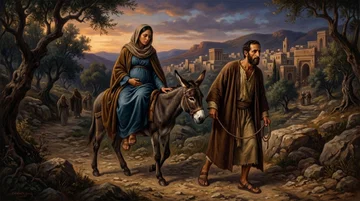
The journey was not less than seventy or seventy-five miles, at least three or four days at the rate they must travel, undertaken late under delicate circumstances.ST Nov 1, 1899 It was made in hardship and poverty along a crowded road, for multitudes had come for the enrollment.ST Nov 1, 1899RH Jan 4, 1912RH Dec 15, 1859 Officials making the census, rich people, rulers, rabbis, ladies and lords with servants, and travelers from farthest Galilee filled the inn like a hive at swarming-time.RH Jan 4, 1912 Joseph came among them as a humble workman with no servants and no standing, leading a donkey carrying his pale and drooping wife.RH Jan 4, 1912 Arriving late they found no ordinary accommodation or shelter for travelers except a stable, a manger in a stall among beasts, a place used for cattle, sharing straw with oxen.ST Nov 1, 1899RH Jan 4, 1912ST Dec 3, 1885RH May 1, 1913ST Dec 19, 1892
The verse belongs to the account of the marriage and birth of Jesus in the days of Caesar Augustus, in the events at Nazareth and Bethlehem in B.C. 5.ST Dec 15, 1898ST Sep 17, 1894 The Bible margin gives the birth as 5 B.C., though that marginal chronology is not definite.ST Nov 2, 1915
Bethlehem is an actual and identifiable sacred place of the Holy Land.RH Aug 29, 1871 Tradition associates it with a grotto supposed to be the birthplace, and in 1852 possession of that church door's key and the right to place a silver star in the grotto became the chief dispute between the Greek and Latin churches beneath their political rivalry for influence.RH Mar 9, 1911 After the Saviour was born, Bethlehem had no special importance as a place for keeping a genealogical record.ST Jul 10, 1901
Roman Enrollment Context
When Caesar Augustus decreed that all the world should be enrolled, in the first enrolment when Quirinius was governor of Syria, all went to enrol themselves every one to his own city, and Joseph went up from Galilee out of the city of Nazareth into Judea to the city of David which is called Bethlehem, because he was of the house and family of David, to enrol himself with Mary who was betrothed to him being great with child.ST Dec 15, 1898ST Dec 15, 1898 The enrollment was probably carried out according to Jewish families and tribes, which explains his journey to Bethlehem as his tribal city and the place associated with David's family.ST Dec 15, 1898ST Jun 18, 1894 That journey from Nazareth to Bethlehem belonged to the Jews' going to be enrolled or taxed under the Roman census ordered under Augustus.ST Mar 2, 1904ST Feb 20, 1912
The enrollment required registration and taxation under Roman rule, to answer to names on the tax roll in their own tribal and ancestral city under Caesar's decree.ST May 8, 1907ST May 8, 1907 Joseph and Mary were subject to that decree and required to pay taxes even though they were poor, and they went there to be registered and lodged in Bethlehem.ST May 8, 1907ST Mar 15, 1910ST May 8, 1907 Christ's birth at the time of the taxing is an instance of His recognition of Roman rule.ST Mar 2, 1904
Jesus was born in the very year Augustus imposed a tax upon the Jewish nation as a token of their subjection to the Roman government, proving Messiah came before the dominion of the Jews was taken away.RH Nov 18, 1862 His birth in Bethlehem, the city of David, took place during Augustus's rule and Rome's dominion, when the Roman world was subject to him and peace reigned over the nations.RH Dec 10, 1857ST Feb 19, 1880 That peace was marked by the closing of the temple of Janus after Rome's expansion, when Rome had vanquished all rivals and universal peace had settled upon a formerly war-devastated world.ST Feb 19, 1880ST Jan 13, 1914 This was in the midst of the reign of Augustus Caesar from 31 B.C. to 14 A.D., an age of general peace and prosperity when wars had nearly ceased and profound rest from turmoil prevailed throughout the civilized world longer than ever before.ST Jan 13, 1914
Traveling to ancestral cities for the taxation at Christ's birth could be more convenient in autumn than in midwinter, supporting the view that Jesus was born in autumn rather than winter. The setting of His birth at Bethlehem includes shepherds and flocks outdoors at night, which is used to argue that a December date for the nativity is unlikely.ST Oct 16, 1884
Prophecy Fulfilled at Bethlehem
The journey took Joseph up from Nazareth in Galilee to Bethlehem in Judea, the city of David, to enroll himself with Mary who was betrothed to him and great with child, and so brought Mary to Bethlehem where Jesus was born.ST Nov 1, 1899ST Jan 23, 1912ST Jul 10, 1901RH Dec 2, 1909 That birth in Bethlehem fulfilled the Scriptures, and Micah's prophecy that the ruler of Israel, the Messiah, would come from Bethlehem.ST Jan 23, 1912ST Jul 10, 1901RH Aug 17, 1876RH Dec 2, 1909 The information that the Child must be born in Bethlehem had not been given by the angel.ST Nov 1, 1899 Left to themselves the Child would have been born in Nazareth, and a birth in Nazareth would have contradicted Scripture.ST Nov 1, 1899ST Jul 20, 1882
God's foreknowledge and prophetic purpose worked through a ruler who did not know God.ST Jan 23, 1912 Caesar Augustus served as agent of God's purpose, and God used the imperial enrollment decree requiring registration to bring Joseph and Mary from Nazareth to Bethlehem and to keep them there for the birth in David's city.ST May 27, 1908ST Dec 9, 1913ST Dec 15, 1898ST Jul 20, 1882 Though God did not cause rulers to issue such decrees nor command the decree, He knew beforehand what its outcome would be and used it within the course of events foretold by prophecy.ST Dec 15, 1898
Joseph and Mary had neglected to search the Scriptures for every detail concerning the Child entrusted to them.ST Nov 1, 1899 From stupor through adhering to traditions instead of the Scriptures they would have left the Child to be born in Nazareth.ST Nov 1, 1899 God therefore brought them there under pressure of human decree when they might have gone more comfortably earlier through faith.ST Nov 1, 1899
Davidic Lineage and Identity
Joseph belonged to the house, family and lineage of David, and for that reason went up to Bethlehem, the ancestral town of that line, to be enrolled.ST May 27, 1908ST Dec 9, 1913ST Apr 23, 1894ST Dec 15, 1898 Mary was also of David's line, so both as descendants of David had to go to their ancestral town for the enrollment.ST May 27, 1908ST Dec 15, 1898 Together with the genealogies in Matthew 1 and Luke 2-3, this identifies Jesus' parents as Jews of the tribe of Judah.ST Apr 23, 1894
This establishes Davidic descent as the family line into which the Messiah was to be born.GSAM 58.4 Jesus as heir of David's throne, Son of David and second David, was therefore born in David's city, linking His humble birth to David's royal line.ST May 27, 1908ST Dec 9, 1913ST Aug 17, 1904ST Aug 17, 1904RH Jan 4, 1912 Though He lived many years in Nazareth and was associated with Nazareth despite its low standing, His birth in Bethlehem accords with His identity as Messiah and King of the Jews and with the expectation that the promised King would be born in Bethlehem.ST May 27, 1908ST Dec 9, 1913RH Jan 4, 1912 The child born there in weakness and humble surroundings is the King of angels who dispels humanity's darkness, who heals the injured with a touch and feeds multitudes with bread, and who will come again with retinue and power to ransom His people.RH Jan 4, 1912RH Dec 22, 1904
Bethlehem is presented as a fitting place for the Heir to be brought up, with access to the temple, religious instruction and good schools, though the verse itself does not explain why Joseph and Mary later moved there.ST Aug 17, 1904 The verse identifies Joseph as Jesus' father going to Bethlehem because he belonged to David's family.ST Jan 25, 1905 It places Jesus' birth in Bethlehem of Judea, not Galilee, and supports the record of His birth and His descent from David.ST Jan 25, 1905ST Sep 29, 1909 By identifying Mary as betrothed to Joseph, it supports reading Joseph as her husband rather than changing husband in Matthew 1:16 to father.
Human Birth of Christ
Luke 2:4 belongs to the account showing that Jesus was born as a real human being, Mary giving birth to him in Bethlehem of Judea during the reign of Augustus Caesar.RH Nov 14, 1854 It places the journey of Joseph and Mary from Nazareth to Bethlehem, the city of David, where Jesus was born, the foretold birthplace of the Messiah.ST Dec 3, 1885ST Dec 19, 1892ST Feb 3, 1881 His arrival there links his humble birth to David's royal line and sets the scene for the manger, for the inn was crowded and had no room for them.ST Dec 3, 1885ST Dec 19, 1892RH Nov 12, 1872 He was born there as a babe in lowly, humble circumstances, laid in a manger with angels attending.ST Dec 19, 1892RH Apr 20, 1916ST Feb 3, 1881 The travelers found no shelter except a place used for cattle, while the shepherds watching at night and longing for the promised Redeemer were ready to receive the angel's announcement, though the people showed no expectation or preparation for his coming.ST Dec 3, 1885
The Babe in Bethlehem stands in striking contrast to the glory he had with the Father before the world existed, marking his coming in human form to share human trials and sympathize with the afflicted.RH Nov 14, 1854 He is the same person, changing nature and manner of existence but not personal identity.RH Nov 14, 1854 His birth in Bethlehem is the beginning of his work of salvation, which he completed through his life, death, resurrection, and return to heaven.RH Feb 19, 1857 The story of Bethlehem tells who Jesus is and why he came, to save people from suffering and sin.ST Jun 18, 1885
The going up to Bethlehem brings about the birth in the manger where a virgin mother brings forth a baby boy who is King, Lord of the earth, and Saviour.ST Dec 30, 1889ST Dec 15, 1909 His birth joins a mother's prayer and a baby's cry with a star in the sky and a song from the heavenly throng, bringing tumult of joy whose light holds the ages and sweeps over the world, so that every home is aflame rejoicing and echoing the angels' gospel and greeting him in his cradle as Saviour and King.ST Dec 30, 1889ST Dec 15, 1909 The Babe brought to Bethlehem is the King of glory sung in prophecy, the same as the Man of Calvary, now crowned with everlasting glory instead of thorns and soon to rise descending from the skies.ST May 20, 1908
The first coming when he was manifest in the flesh and born at Bethlehem was personal, and therefore the second coming will also be a personal return.ST Aug 21, 1879 The historical account of his birth cannot simply be disregarded, for it reports that Joseph as his father went to Bethlehem because he belonged to David's family.ST Jan 25, 1905 It places his birth in Bethlehem of Judea, not Galilee, Joseph having traveled there from Nazareth because he was of the house and lineage of David, and so supports the record of his birth and his descent from David.ST Sep 29, 1909 Rejecting this account as unreliable challenges the credibility of the Gospel writers and makes it inconsistent to dismiss their testimony about the manner of his birth while accepting the rest of their records as trustworthy.RH Jan 1, 1914
Spiritual Lessons and Application
Luke 2:4 belongs to the second chapter of Luke whose general subject is the grace of the Lord in becoming man, voiced in the lofty strain of the angels' jubilee song.ST Jan 5, 1882 It is not to be taken as a sentence standing alone for an explanatory remark and a passing moral reflection but to be taught as part of that whole to give a true conception of that grace and to awaken the heart to that song.ST Jan 5, 1882 It tells how Jesus came to be born in Bethlehem.ST Jan 22, 1894 It places Joseph's journey from Nazareth in Galilee to Bethlehem in Judea, the city of David, because he belonged to David's family line, within the events remembered at Christmas where the child is found in the manger.ST Dec 24, 1912ST Dec 16, 1897 It places the journey to Bethlehem in the story of the Babe's birth there and recalls that birth and the family's later flight from Herod to Egypt.
Luke 2:4 belongs to the account of Jesus' birth, the event through which God gave Christ to the world.ST Dec 24, 1896 Jesus' birth and his identification with humanity are to be remembered continually, moving people to express gratitude to him in word and deed and to serve others.ST Dec 24, 1896 The verse is part of this account, not a command to commemorate the event on a particular day.ST Dec 24, 1896 Bethlehem is not merely a term in Eastern geography but expresses the place Christ occupies in the heart as Child, and Boy, and Man, and Saviour.ST May 28, 1902 The Bible is a new book and Christ is as much present now as in the days of His flesh, so Bethlehem must be read as a present inward reality rather than a distant old place.ST May 28, 1902
Luke 2:4 places Joseph and Mary's journey from Nazareth to Bethlehem, the city of David, where Jesus was born.ST Dec 3, 1885 Bethlehem was the foretold birthplace of the Messiah, yet the people showed no expectation or preparation for his coming, and the travelers found no shelter except a place used for cattle.ST Dec 3, 1885 The shepherds, watching at night and longing for the promised Redeemer, were ready to receive the angel's announcement of his birth.ST Dec 3, 1885 Luke 2:4 shows a band of humble, weary travelers on their way to Judea's city near two thousand years ago, arriving at nightfall to seek rest and shelter at a wayside inn. They are of humble mien and lowly garb, and there is no admittance for them because the couch of luxury and sumptuous feast were not prepared for such as these. Heart-sick they turn to a poor stable and share a bed of straw with patient, toil-worn oxen, finding there the repose the world refused to give. Their rejection shows how in this world's journeyings the lowly ones are overlooked while the goal is reached and the prize secured by the lofty and the proud, yet God holds the balances weighing not pomp and show but moral worth, not strength of sinew but the power of living faith, and will not leave his chosen to reproach.
Luke 2:4 shows Joseph traveling from Nazareth to Bethlehem, the city of David, and identifies Bethlehem as the place where Jesus' earthly life began.RH Dec 15, 1859 Bethlehem is the starting point of Jesus' path to Calvary, where he suffered and died to make the dying heirs of heaven.RH Dec 15, 1859 Bethlehem's humble surroundings are contrasted with the greatness of the King associated with it. Luke 2:4 shows the Babe brought to Bethlehem is the King of glory sung in prophecy, the same as the Man of Calvary, now crowned with everlasting glory instead of thorns and soon to rise on earth descending from the skies.ST May 20, 1908 Bethlehem is lowly yet honored because the world's light comes from it.
Sources