Luke 2:7
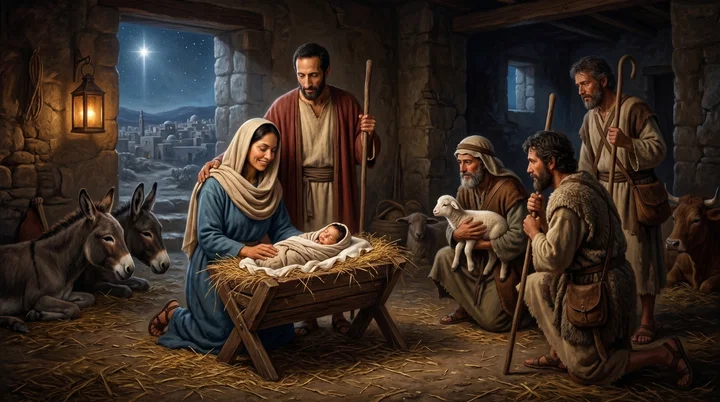
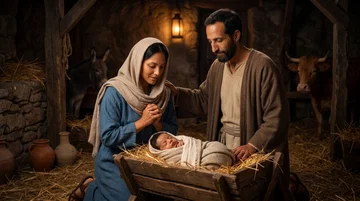
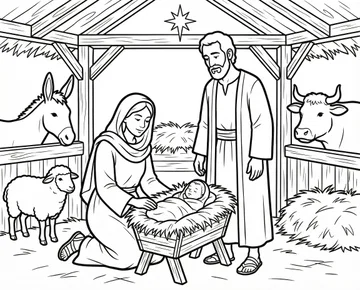
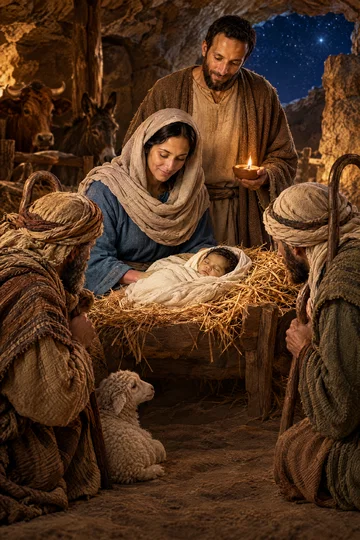
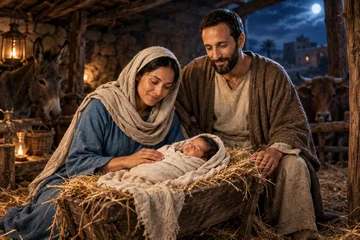
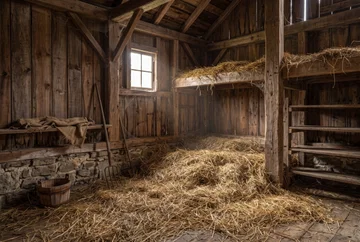
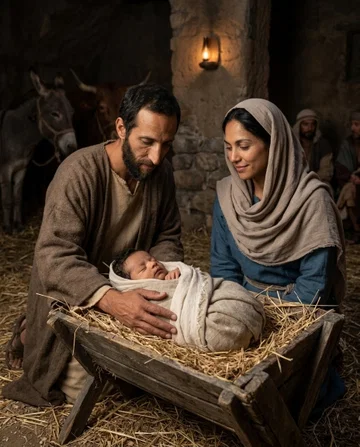
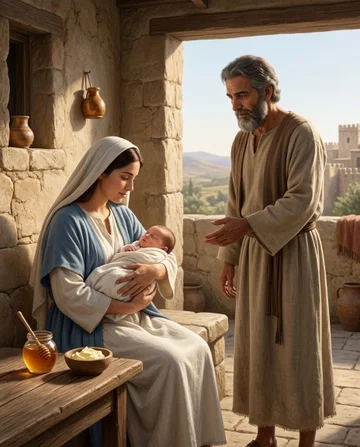
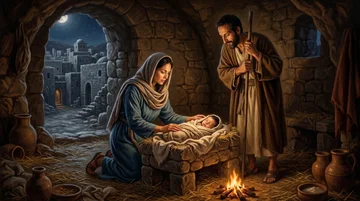
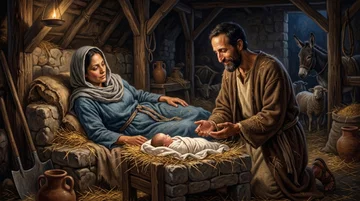
And she brought forth her firstborn son, and wrapped him in swaddling clothes, and laid him in a manger; because there was no room for them in the inn.
Translations
American King James Version, King James Version, KJV Cambridge Paragraph Bible
And she brought forth her firstborn son, and wrapped him in swaddling clothes, and laid him in a manger; because there was no room for them in the inn.
And she brought forth her first-born son, and wrapped him in swaddling-clothes, and laid him in a manger; because there was no room for them in the inn.
Revised Version, American Standard Version
And she brought forth her firstborn son; and she wrapped him in swaddling clothes, and laid him in a manger, because there was no room for them in the inn.
and she brought forth her son — the first-born, and wrapped him up, and laid him down in the manger, because there was not for them a place in the guest-chamber.
and she brought forth her first-born son, and wrapped him up in swaddling-clothes and laid him in the manger, because there was no room for them in the inn.
and she gave birth to her firstborn son, and wrapped him in swaddling clothes, and laid him in a manger, because there was no room for them in the inn.
And she gave birth to her firstborn, a Son. She wrapped Him in swaddling cloths and laid Him in a manger, because there was no room for them in the inn.
And she gave birth to her firstborn, a Son. She wrapped Him in swaddling cloths and laid Him in the manger, because there was no room for them in the inn.
She gave birth to her firstborn son. She wrapped him in bands of cloth and laid him in a feeding trough, because there was no room for them in the inn.
And she had her first son; and folding him in linen, she put him to rest in the place where the cattle had their food, because there was no room for them in the house.
And she brought foorth her first begotten sonne, and wrapped him in swadling clothes, and laide him in a cratch, because there was no roome for them in the ynne.
Douay-Rheims (Challoner revision)
And she brought forth her firstborn son, and wrapped him up in swaddling clothes, and laid him in a manger; because there was no room for them in the inn.
Pictures
Cross-references 20 of 34
- Micah 5:2
But thou, Beth-lehem Ephratah, though thou be little among the thousands of Judah, yet out of thee shall he come forth unto me that is to be ruler in Israel; whose goings forth have been from of old, from everlasting.
Foretells Bethlehem as the Messiah’s birthplace.
- Matthew 2:1
Now when Jesus was born in Bethlehem of Judaea in the days of Herod the king, behold, there came wise men from the east to Jerusalem,
Both texts place Jesus’ birth in Bethlehem of Judea.
- Philippians 2:7
But made himself of no reputation, and took upon him the form of a servant, and was made in the likeness of men:
Christ’s humble birth accords with his taking human form.
- John 1:14
And the Word was made flesh, and dwelt among us, ( and we beheld his glory, the glory as of the only begotten of the Father,) full of grace and truth.
Christ’s birth reveals the divine Word taking human flesh and dwelling among us.
- Matthew 1:18-25
Now the birth of Jesus Christ was on this wise: When as his mother Mary was espoused to Joseph, before they came together, she was found with child of the Holy Ghost.
Both recount Jesus’ birth, and Matthew identifies his saving purpose.
- Luke 2:13-14
And suddenly there was with the angel a multitude of the heavenly host praising God, and saying,
Describes the heavenly host praising God at Jesus’ birth.
- Luke 1:32
He shall be great, and shall be called the Son of the Highest: and the Lord God shall give unto him the throne of his father David:
Identifies the manger child as the Son of the Highest and heir to David’s throne.
- Luke 2:25-32
And, behold, there was a man in Jerusalem, whose name was Simeon; and the same man was just and devout, waiting for the consolation of Israel: and the Holy Ghost was upon him.
Simeon recognizes the child as God’s promised salvation and the light for all people.
- Luke 2:11
For unto you is born this day in the city of David a Saviour, which is Christ the Lord.
Identifies the newborn in the city of David as Savior and Christ the Lord.
- Isaiah 9:6
For unto us a child is born, unto us a son is given: and the government shall be upon his shoulder: and his name shall be called Wonderful, Counsellor, The mighty God, The everlasting Father, The Prince of Peace.
The child born in Bethlehem is the promised Son and Prince of Peace.
- Matthew 2:2
Saying, Where is he that is born King of the Jews? for we have seen his star in the east, and are come to worship him.
The wise men follow the star to worship the newborn King in Bethlehem.
- Matthew 2:11
And when they were come into the house, they saw the young child with Mary his mother, and fell down, and worshipped him: and when they had opened their treasures, they presented unto him gifts; gold, and frankincense, and myrrh.
The wise men worship the child and offer gifts despite his lowly setting.
- Luke 2:1
And it came to pass in those days, that there went out a decree from Cæsar Augustus, that all the world should be taxed.
Augustus’s decree brought Mary and Joseph to Bethlehem.
- Isaiah 7:14
Therefore the Lord himself shall give you a sign; Behold, a virgin shall conceive, and bear a son, and shall call his name Immanuel.
Foretells the virgin-born son, identified as Jesus.
- Luke 2:12
And this shall be a sign unto you; Ye shall find the babe wrapped in swaddling clothes, lying in a manger.
The manger and swaddling clothes identify the sign given to the shepherds.
- Matthew 2:6
And thou Bethlehem, in the land of Juda, art not the least among the princes of Juda: for out of thee shall come a Governor, that shall rule my people Israel.
Names Bethlehem as the ruler’s birthplace.
- Hebrews 2:14
Forasmuch then as the children are partakers of flesh and blood, he also himself likewise took part of the same; that through death he might destroy him that had the power of death, that is, the devil;
Christ took flesh to redeem humanity through death.
- John 1:1-3
In the beginning was the Word, and the Word was with God, and the Word was God.
The divine, pre-existent Word is identified as the child born in Bethlehem.
- Luke 2:16
And they came with haste, and found Mary, and Joseph, and the babe lying in a manger.
The shepherds find the Babe lying in a manger.
- Luke 2:21
And when eight days were accomplished for the circumcising of the child, his name was called JESUS, which was so named of the angel before he was conceived in the womb.
Jesus was circumcised eight days after his birth.
Commentary part 1 of 2
Each commentary is drawn from primary sources: the writings of Ellen G. White and Adventist pioneers and periodicals. Each commentary is separate. Its own words are not a quotation; follow the references to read the source passages.
Ellen G. White
54 sources
God used the decree of Caesar to bring Mary to Bethlehem, where, with no room in the crowded inn, she bore her firstborn son, wrapped him in swaddling clothes, and laid him in a manger in a rude stable for animals.ST Sep 13, 1877DA 44.2–32SP 17.1–3ST Dec 9, 1913 Though outwardly a frail, helpless infant dependent on his mother, he was the divine Son of God, the Majesty of heaven, whose glory was veiled by humanity.COS 10.2–3LC1 15.1–16.1ST Sep 13, 1877 His birth in David's city fulfilled the prophecy that from Bethlehem would come the ruler in Israel whose goings forth are from eternity.DA 44.2–32SP 17.1–3RH Dec 17, 1872 God honored his birth above all others by angels who watched over his parents, announced him to shepherds, and worshiped him, while the great and learned who expected an earthly prince did not know of him and the world he made had no room for him.DA 43.2–44.1COS 10.2–31RED 35.3LC1 15.1–16.1LC1 35.3 It was the plan of redemption for him to lay aside royal glory and enter the lowest poverty and temptation, thereby sanctifying every stage of human life, revealing God's sympathy for the lowliest, and beginning a meek, self-denying life that calls his followers to the same humility.EW 88.2–3Lt 17, 1883, par. 13–17Lt 150, 1899, par. 7Lt 48, 1907, par. 14–17Ms 161, 1903, par. 4–5
Birth Setting and Details
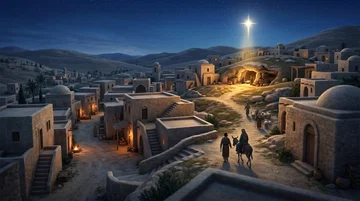
God worked through the enrollment decree of Caesar Augustus to bring Mary from Nazareth to Bethlehem, David's city, because she was of David's lineage and the Son of David had to be born there, even as Cyrus had once been used to free the captives.DA 44.2–32SP 17.1–3RH Dec 17, 1872 The journey was for the census ordered by Augustus, placing the birth in Bethlehem as prophecy had foretold.2SP 17.1–3RH Dec 17, 1872
In the city of their own royal line Joseph and Mary were unrecognized and unhonored, and weary and homeless they vainly sought a resting place for the night.DA 44.2–3ST Dec 9, 1913 They walked the whole narrow street from the city gate to the eastern end, yet the crowded inn and lodging had no space for them.DA 44.2–3HSFM 183.2 The wealthy and honored found welcome and comfort while the weary travelers were turned away.2SP 17.1–3
With no room in the inn they took refuge in a rude shelter, stable, and coarse building used for animals and cattle.ST Sep 13, 1877DA 44.2–32SP 17.1–3COS 9.2–10.1RH Dec 17, 1872 There Mary wrapped the child in swaddling clothes and laid him in a manger.ST Sep 13, 18772SP 17.1–3RH Dec 17, 1872 He was cradled with only his parents as guardians, with no royal guard or honored attendants, his parents being uneducated peasants.ST Sep 13, 1877COS 9.2–10.1ST Dec 5, 1916
The birth is discussed in connection with Christmas, but the date of the birth is not known.Ms 8, 1880, par. 7–11
Veiled Glory in Humility
The King of glory entered human life in deep humiliation and uninviting surroundings, born in a lowly shed and stable and laid in a manger for a bed with beasts surrounding him.DA 43.1COS 10.2–31RED 35.31RED 16.1 He came in poverty and obscurity to humble parents, with no earthly display, riches, or honor, and with no trace of luxury, ease, selfish gratification or indulgence.DA 43.19T 185.2RH Feb 15, 1912FE 401.1 His glory was veiled, and he did not rely on earthly attractions to draw followers, but people were to be drawn by heavenly truth and accept the Messiah on the testimony of God's word which had long foretold his character.DA 43.1
In outward appearance he was a frail, helpless infant like other infants and other children, dependent for a time on his mother's care.COS 10.2–3LC1 15.1–16.1ST Sep 13, 18772SP 15.1–16.31RED 15.1 Yet he was the divine Son of God, the Son of the Highest, the Majesty of heaven and the angels' Commander, whose presence had filled the courts of heaven with glory.COS 10.2–3ST Sep 13, 18771RED 16.1 His divine glory and majesty and heavenly presence were veiled and hidden by humanity, clothed with humanity so that his humble birth did not match the expectation of a mighty earthly prince.LC1 15.1–16.1ST Sep 13, 18772SP 15.1–16.31RED 15.1Ms 74, 1894, par. 1
This lowliness was deliberately chosen, for though he had left high command and infinite height he laid aside royal glory and took humanity upon himself.9T 185.2Lt 8, 1901, par. 24FE 401.1 He left his kingly crown and royal robe and clothed his divinity with humanity, stepping down from the high command of the angels in heaven to come as a lowly babe born and laid in a manger in Bethlehem.Lt 8, 1901, par. 24Lt 48, 1907, par. 14–17Ms 74, 1894, par. 1 Though he could have taken any condition he wanted and might have brought legions of angels with him, he chose instead to fill the humblest position and walk the lowest walk of continual self-denial and self-sacrifice.FE 401.1Lt 48, 1907, par. 14–17
His childhood followed a real, gradual development as any infant in its mother's arms, acting as a child and doing only the works of an obedient child.ED 106.3Ms 12, 1898, par. 12–14 He honored his parents, obeyed their will and wishes, and helped them, and through that right course in home life his wisdom and ability constantly increased.ED 106.3Ms 12, 1898, par. 12–14 He grew in grace and knowledge of truth, and in grace, knowledge, wisdom, and ability.ED 106.3Ms 12, 1898, par. 12–14
Prophecy Fulfilled in Bethlehem
Jesus was born in Bethlehem because the enrollment decree of Caesar Augustus brought Mary there from Nazareth, as Cyrus had once been used to free the captives, since Mary was of David's lineage and the Son of David had to be born in David's city in fulfillment of the prophecy that from Bethlehem would come the ruler in Israel whose goings forth are from eternity.DA 44.2–32SP 17.1–3RH Dec 17, 1872ST Dec 9, 1913 In the city of their royal line Joseph and Mary were unrecognized and unhonored, and weary and homeless they walked the whole narrow street from the city gate to the eastern end vainly seeking a resting place for the night, but the crowded inn and lodging had no space for them while the wealthy and honored found welcome and comfort.DA 44.2–32SP 17.1–3ST Dec 9, 1913 So they took refuge in a rude shelter, a coarse building for animals and cattle, and there the Redeemer of the world was born, unknown to men, wrapped and laid in a manger while heaven was filled with rejoicing, the world was made brighter by his presence, and an innumerable throng of angels gathered above the hills of Bethlehem waiting to declare the news.DA 44.2–32SP 17.1–3RH Dec 17, 1872
The temple sacrifices already pointed to him as the Lamb of God, but the people called to prepare for him failed to recognize or welcome him because their leaders were absorbed in worldly honor and riches rather than ready for his arrival.DA 43.2–44.1 His humble coming as a babe of poor parentage, without worldly honor or outward display, fulfilled what the prophets had testified, yet the people especially favored by God refused to receive him as Messiah because he did not meet their expectations of a king in power and glory.Ms 56, 1902, par. 2 He came as the Prince of life with a message of mercy to uplift the fallen and bring gladness to the desolate places of the earth, whose glory is to fill the whole earth and whose dominion will endure through every generation.Ms 27, 1898, par. 10
His humble first advent as a helpless babe, born in a stable and cradled in a manger, contrasts with his second coming in the clouds of heaven with power and great glory.STE 9.1Ms 8, 1896, par. 4–6Ms 56, 1902, par. 2 The scriptural record of his history and birth must be studied and searched alongside other Scripture to learn the terms of salvation.STE 9.1Ms 8, 1896, par. 4–6 His coming as a babe in Bethlehem set up a standard against Satan and began his conflict with the powers of darkness, as the Prince of light left the royal courts of glory in heaven to become man.Ms 56, 1890, par. 4–52SP 87.2 From that birth Satan never lost sight of him, knew well his heavenly position, feared the loss of his cherished supremacy and power over the earth, and set on foot various plans to destroy him, all unsuccessful because the Son of God was upheld by his Father's strong arm.2SP 87.2
Heaven Honors, Earth Rejects
Though lacking earthly honor, the birth in the lowly shed where the child lay in a manger in a rude cradle was honored by God above the births of other people.COS 10.2–31RED 35.3LC1 35.3 Angels watched over Mary and Joseph on their journey and remained with them when night came so they were not left alone at rest, for the child was the Son of the Highest whose presence had filled the courts of heaven with glory.COS 10.2–3 Angels announced the coming to the shepherds with heavenly light and glory and worshiped him, and an innumerable throng gathered above the hills of Bethlehem glorified God because the Son of God had come to redeem fallen humanity.1RED 35.3LC1 35.3EW 123.4 Heaven was filled with rejoicing that a Saviour had come, the whole world was made brighter by his presence, though he was unknown to men.DA 44.2–3
Though his outward circumstances were lowly, with a manger for a bed and beasts surrounding him, he was the angels' divine Commander.1RED 16.1 They could bow before him without ceasing to be loyal to Jehovah.1RED 16.1
The great and learned on earth, including the Pharisees and scribes, did not know of it, for learning and outward religious devotion could not prepare them when they expected a mighty ruler and temporal prince instead.LC1 15.1–16.11RED 15.1Ms 32, 1896, par. 22–24 Absorbed in worldly honor and riches, the leaders called to prepare for the Messiah failed to recognize or welcome him, though the temple sacrifices already pointed to him as the Lamb of God.DA 43.2–44.1 His nation made no preparation to receive him while heaven watched with intense interest, and the world he had made had no room for him, beginning a life of rejection and humiliation.Ms 52, 1890, par. 10–13 His divine glory and majesty were veiled and hidden by humanity, appearing as a frail, helpless infant like other infants, so his humble birth did not match the expectation.LC1 15.1–16.12SP 15.1–16.31RED 15.1
Humble shepherds on the heavenly announcement believed, received, and worshiped him.Ms 32, 1896, par. 22–24 No royal guard was stationed to protect the newborn King and none of the world's honored men were in attendance, for he was guarded only by his parents, uneducated peasants.DA 63.1 Wise men guided by a star came to worship him, and his glory was manifested there to them in the humble manger.Lt 150, 1899, par. 7 They proved his exalted position by bringing precious, costly gifts to the Saviour and bending before him in homage while he was still a babe in lowly surroundings, more definitely understanding his true position and the honor due him than his own later followers who had his instruction and beheld his mighty miracles.2SP 378.3Ms 52, 1890, par. 10–13 Yet his lowly estate had been made known to the shepherds but not to the wise men, so that after their long journey and disappointment at the indifference of the Jewish leaders in Jerusalem they arrived less confident than when they entered the city and questioned how this child could be he of whom it was written that he should raise up the tribes of Jacob and restore the preserved of Israel and be a light to the Gentiles and salvation unto the end of the earth.DA 63.1
Redemption Through Self Humiliation
He was born without worldly grandeur, in a stable and laid in a manger, yet though his birth lacked earthly honor God honored his coming above other births.1RED 35.3LC1 35.3EW 123.4 Angels announced him to the shepherds with heavenly light and glory and worshiped him, and the heavenly host glorified God because the Son of God had come.1RED 35.3LC1 35.3EW 123.4 His coming was the advent to a fallen, sinful world to accomplish redemption and, through his death, to bring peace, happiness, and everlasting life to fallen humanity.1RED 35.3LC1 35.3EW 123.4
It was according to the plan of redemption for him to be born in this humble place, laying off his royal robe and stepping down from high command over the angels in heaven to come as a lowly, helpless human babe in Bethlehem.Lt 150, 1899, par. 7Lt 48, 1907, par. 14–17Ms 161, 1903, par. 4–5 His glory was manifested there to the wise men of the east who were guided by a star to come and worship him.Lt 150, 1899, par. 7 Though divine he took human nature and lived a human life, and though he might have brought legions of angels with him he chose instead to fill the humblest position.Lt 48, 1907, par. 14–17Ms 161, 1903, par. 4–5 He would pass step by step through every stage of the temptations and necessities of human life, being tempted just as strongly as any member of the human family can be tempted.Lt 150, 1899, par. 7Lt 48, 1907, par. 14–17 By this he sanctified every department through which the fallen family must pass and showed that man need not continue in sin.Lt 150, 1899, par. 7Lt 48, 1907, par. 14–17 He became fully able to accomplish humanity's complete redemption, to restore people to the privileges of the higher life, and through his ministration to make it possible for human beings to become partakers of the divine nature.Lt 48, 1907, par. 14–17Ms 161, 1903, par. 4–5 His life gave the world an example of what humanity is to become and may live through receiving God's gift of his Son.Lt 48, 1907, par. 14–17Ms 161, 1903, par. 4–5
By sharing the needs and lowly conditions of human life the story of Bethlehem reveals the depth of God's sympathy for the humblest and lowliest.Lt 17, 1883, par. 13–17 He so entered human life in humble circumstances that every kind of work and station could be sanctified and lived for God.Lt 17, 1883, par. 13–17 His humility teaches rejection of pride and vanity and honor for humble, useful work.Lt 17, 1883, par. 13–17
His lowly birth in poverty and obscurity began the gospel age with the lesson that God introduced the gospel in a way unlike worldly displays of status, splendor, rank, grandeur, and outward appearance.CH 228.1Lt 8, 1901, par. 24Lt 128, 1902, par. 7–8Ms 109, 1902, par. 8–10 Though the Majesty of heaven and Commander of the angels, he laid aside his royal glory, took humanity, and was born as a helpless babe in a stable, and his upbringing in obscurity at Nazareth and the beginning of his work in poverty and without worldly rank carry the same witness.CH 228.1Lt 8, 1901, par. 24 Though he had left high command and infinite height and could have taken any condition he wanted, he deliberately chose the lowest and most humble walk of human life.FE 401.1 Born in Bethlehem with poor parentage on one side while God, the Owner of the world, was his Father, he lived with no trace of luxury, ease, selfish gratification or indulgence, in a continual round of self-denial and self-sacrifice with no apparent greatness or riches.FE 401.1 He chose this lowly condition of the far greater number of people so that it would be accessible to all, so the humblest believer need never say Christ never knew the stress of pinching poverty, and so the poorest class would not shun his society.FE 401.1 His theme was truth of heavenly origin to sow the earth with truth, so that faith and obedience and heavenly truth alone might make an impression upon human hearts, teaching his church not to rely on worldly rank, grandeur, outward appearance, display, recognition, or splendor, but on the Lord God of Israel.Lt 8, 1901, par. 24FE 401.1Lt 128, 1902, par. 7–8Ms 109, 1902, par. 8–10
Example and Practical Application
The manger birth begins a spotless, meek, lowly and self-denying life, for the Prince of heaven was born as a babe in Bethlehem in a stable because no room except there could be found, and that humble beginning fits the life that followed as a man of sorrow acquainted with grief, with plain dress in a seamless coat and nowhere to lay his head.EW 88.2–3RH Jun 10, 1852Ms 147, 1906, par. 9–10SCEV 26.5–27.3 His lowliness reflects the humility that marked his whole life, and it stands as the pattern of meekness and self-denial his followers are called to follow.EW 88.2–3Ms 147, 1906, par. 9–10SCEV 26.5–27.3 That lowliness condemns worldly dress, talk, lightness, vain laughter and covetousness in those professing to look for him, while his holy solemnity and unvarnished cutting truth restrain and check such conduct and manifest real character.RH Jun 10, 1852 Worldly professors would be ashamed of such a Saviour, and if he appeared among them as at his first advent they would oppose him, try to catch him in his words, and join the cry to crucify him.RH Jun 10, 1852
Worldly greatness cannot save anyone from death, and he did not rely on earthly attractions to draw followers, for with his glory veiled and his birth without earthly display, riches or honor, people were to be drawn by heavenly truth and to accept the Messiah on the testimony of God's word, which had long foretold his character.DA 43.1 His poor birth in humble circumstances, rather than among the rich, shows that poverty is no reason to despise people and removes the church's excuse to exalt itself because of wealth or social standing.9T 185.2Ms 151, 1904, par. 21–23 His entering human life in this lowly way and sharing its needs reveals the depth of divine sympathy for the humblest and lowliest, so that every kind of work and station can be sanctified and lived for God, teaching closeness to God and faithful service do not depend on honor, status or outward importance, but honor humble, useful work and reject pride and vanity; he became poor so that others might be made rich through his self-giving, though the date of his birth is not known.9T 185.2Lt 17, 1883, par. 13–17Lt 1, 1880, par. 5–6Ms 8, 1880, par. 7–11 As he was shut out from lodging at his birth and laid outside, self-sacrificing missionaries and preaching brethren returning worn out and sick from their fields must not in the same way be shut out from healing institutions, left to feel as paupers with debt hanging over them and forced to seek a place outside, but must find a freely open home where they are cared for without charge.Lt 68, 1898, par. 1–6
People should not provide comfort and attractive surroundings for themselves while leaving the place dedicated to God shamefully unsuitable, with his first earthly home a stable and a manger as the measure against such neglect.5T 268.3–269.1 Yet lack of a suitable place for worship need not prevent the truth from being presented, for there was no room in the inn and the Saviour was born in a stable, and the gospel never depended on imposing churches or grand settings but was proclaimed from a fisherman's boat, on mountains and plains, and by the highway.HSFM 183.2ST Jun 7, 1883 The sweet story of the babe in Bethlehem should be repeated to children on the Sabbath to make the day a delight and the best day of the seven, with interesting stories in Bible history presenting him first as a babe and then as a child like themselves, obedient to father and mother and later industrious as a youth helping to support the family.4MR 105.2–3Ms 57, 1897, par. 21–22 He knows the trials and perplexities, temptations, weariness, joys and happiness of youth, and being subject to his parents and doing simply the works of an obedient child according to a child's ability was his missionary work in the home life, and all children can do the same to be a blessing in the home, for through that right course his wisdom and ability constantly increased.Ms 57, 1897, par. 21–22Ms 12, 1898, par. 12–14 The gifts brought to Jesus by the wise men, when his nation had made no preparation to receive him though heaven watched with intense interest and angels proclaimed his arrival, show that offerings should honor God and support his work rather than be diverted to selfish gratification.Ms 52, 1890, par. 10–13
Sources
Pioneers and periodicals
216 sources
While Joseph and Mary were in Bethlehem for the enrollment, Mary delivered her firstborn son, wrapped him in swaddling clothes and laid him in a feeding trough in a stable because the inn was full.ST Jun 18, 1894ST Dec 15, 1898
The child so born was the eternal Son and Creator who became a helpless infant in poverty, entering human life without home or honor.RH Nov 18, 1862ST Nov 17, 1898RH Apr 10, 1913ST Jun 18, 1894ST May 17, 1899
His birth in Bethlehem fulfilled the prophecy that Israel's ruler would come from there, after long waiting for the promised Messiah.ST Jan 23, 1912ST Jul 10, 1901RH Aug 17, 1876
Having no room pictures his rejection from birth to death and the crowded human heart that makes space for business, pleasure and self while leaving Christ outside.RH Sep 9, 1862ST Feb 17, 1904RH Dec 19, 1871RH Apr 1, 1909RH Apr 11, 1907
He came first in lowliness as a babe in a manger, but he will return in glory as King of kings with angels and light above the sun.STRH Oct 28, 1909ST Dec 30, 1889RH May 10, 1915
Wording and Birth Details
While Joseph and Mary were in Bethlehem of Judea for the enrollment under the decree from Caesar Augustus, having gone up from Nazareth to the city of David, the days were fulfilled that Mary, who was betrothed to Joseph and great with child, should be delivered, and she brought forth her firstborn son and wrapped him in swaddling clothes and laid him in a manger because there was no room for them in the inn.ST Jun 18, 1894ST Dec 15, 1898ST Nov 4, 1897 The birth took place in autumn of B.C. 5 at Bethlehem, a village five or six miles south of Jerusalem whose name means house of bread from the fruitful corn fields nearby, the town of Ruth and Boaz from which sprang the family of David, called the house of David as David's birthplace where his family records were kept, under Augustus Caesar emperor of Rome and Herod the Great king of Judea when most of the known world was subject to Rome.ST Jun 18, 1894 The circumstances were simple and lowly, a helpless infant laid in a manger because there was no room for his family in the inn, yet he had a rightful claim to greatness. The birth is the promised Child born and Son given fulfilling Isaiah's prophecy, and the scene in the stable with his mother reclining on straw and cattle nearby is a true account planned and told by God of the heavenly Stranger, born at night while shepherds were nearby with their flocks when the angel announced the Saviour's birth and the heavenly host praised God, after which the child was taken to Egypt at night under angelic guard to escape Herod's attempt to kill him.ST Dec 24, 1912ST Nov 4, 1897
Firstborn renders the Greek prototokos, meaning firstborn, not firstbegotten.RH Aug 10, 1876 Jesus was Mary's first child, born when she was a virgin, and the verse does not by itself establish whether she later had other children.ST Sep 13, 1910
The manger was a feeding trough and a humble resting place in a stable, fitting his poverty and humility as one who though rich became poor and during life had no settled place to lay his head.ST Dec 15, 1898ST Jun 18, 1894 The exact spot does not matter, whether a cave or grotto for beasts or a rude shelter from sun and rain in the courtyard of the inn, and its lowliness means God came in closest touch with the very lowliest, even with the brute creation.ST Dec 24, 1902 The inn or khan was already full because multitudes had come to answer to their names on the tax roll and the hospitality of the town was already taxed, so the only accommodation left was a manger in a stall in humble quarters surrounded by animals where Jesus the Saviour of the world was born.ST Dec 5, 1895 The inn was an Eastern khan, a free shelter for travelers and their animals and not a hotel providing meals or beds, where travelers brought their own provisions and bedding and late arrivals who found the shelter full had to sleep in the manger with the animals, the Bethlehem shelter perhaps a rough enclosure or a cave used as a stable.ST Mar 27, 1884
The manger and swaddling clothes served as the sign by which the shepherds would recognize the babe announced to them. These details were the sign the angel gave the shepherds, and they found the child at night just as they had been told, with shepherds nearby in the fields when the angel announced the Saviour's birth.ST Nov 4, 1897ST Mar 1, 1910
The verse belongs to Luke's account of Jesus' birth in the setting of the whole second chapter, which also gives the story of angels announcing his birth to shepherds and the shepherds seeing the child, a story Matthew and Mark do not record.ST May 8, 1907ST Jan 5, 1882 His birth is part of the story that also includes the guiding star, the angels' message to the shepherds, the threat to the infants, Simeon's prophecy, and the family's flight into Egypt. Together Matthew and Luke, with the worship of the humble shepherds, the circumcision at eight days of age, the presentation in the temple, the prophecies of the aged Simeon and Anna, the adoration of the Magi, the flight into Egypt, and the return to Nazareth of Galilee to the home of Joseph, give the combined account of his birth as a Jew among a preeminently religious people possessed of the books of God's revelation and a wealth of tradition of His providential dealings with them, to simple hard-working parents.ST Aug 13, 1912
The account should be taught as revealing the grace of the Lord in becoming man, not as an isolated detail followed only by a passing moral reflection.ST Jan 5, 1882 It gives testimony about the manner of his birth and belongs to the Gospel record whose credibility is at issue when that birth account is rejected.RH Jan 1, 1914 The history of the birth cannot be set aside, for Jesus was not simply the son of Joseph.ST Jan 25, 1905 Together with Matthew's account and other scriptures it supports that Jesus was of the seed of David according to the flesh, and the claim that he was born in Galilee would set aside this birth record.ST Sep 29, 1909
The birth is a prominent landmark in the fulfillment of the Old Testament gospel promises. Its details of stable, swaddling clothes, and manger were worthy of special revelation from heaven, which confirmed the Old Testament Scriptures' testimony that Christ would come.RH Dec 11, 1866 The swathing bands wrapped around the Babe of Bethlehem picture both Testaments wrapped around Christ, for he is both the substance and object and the author and matter of the Scriptures.ST Aug 13, 1902
Time Journey and Lodging
The birth stands in B.C. 5, in autumn of B.C. 5, in the latter part of the Jewish year 5 B.C., a little more than four years before the era later marked by his name.ST Dec 15, 1898ST Jun 18, 1894ST Dec 16, 1897 The Bible margin dates it to 5 B.C., and that marginal chronology is only a fairly good working basis rather than a fully definite date.ST Nov 2, 1915 One account places it in autumn of B.C. 4, with the shepherds out in the fields with their flocks at night indicating the birth was before the November rains began.ST Aug 17, 1904
The verse gives no date for the birth.RH Dec 2, 1909ST May 9, 1906 The birth was certainly not in midwinter, and December 25 was not the night the shepherds greeted him.ST Dec 24, 1902ST Dec 20, 1910 Shepherds outdoors at night near Bethlehem argues December unlikely, and the time of the baptism and crucifixion points to September or October.ST Dec 24, 1902ST Oct 16, 1884 The December observance was taken from the heathen Saturnalia by a backslidden church, and the day set apart to celebrate his birth is not the actual day on which he was born.ST Dec 24, 1902ST May 9, 1906
The day of his birth is memorable, honored by an angel's announcement and the heavenly host's praise to God.RH Feb 13, 1872 That day is memorable in his history, but it is not the Lord's day because he never claimed it as his own.ST Apr 6, 1882 The verse records the birth without establishing its weekday, so the claim of a Sunday birth may be questioned.RH Oct 3, 1871 Even if his birth, his resurrection, and the outpouring of the Spirit all occurred on Sunday, those events without a syllable of inspired instruction give Sunday no authority to clothe itself with the fourth commandment and displace the original Sabbath as old as creation.RH Oct 3, 1871
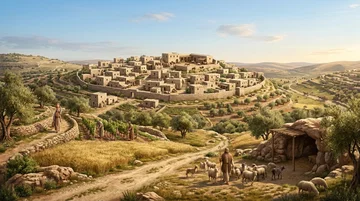
Bethlehem, whose name Beth-le-hem means house of bread from the fruitful corn fields nearby, was a village five or six miles south of Jerusalem.ST Jun 18, 1894 It was the town of Ruth and Boaz from which sprang the family of David, called the house of David as David's birthplace, where his family records were kept.ST Jun 18, 1894 It is a town perched on a lofty hill and surrounded by olive orchards.ST Aug 25, 1881 It is a real place in the Holy Land fitting the Gospel account and identified as the Saviour's birthplace.ST Feb 4, 1889RH Aug 29, 1871
Tradition holds the rocky chamber beneath the church of the Nativity to be the place of his birth, and it may have been part of an ancient khan belonging to Jesse's and King David's family.ST Aug 25, 1881 The birth cave is identified as the spot where he was born, with a nearby cavern linked with Jerome's later life and work, and the site's authenticity is supported by unbroken tradition and by Bethlehem's survival through sieges.ST Aug 25, 1881 A grotto in Bethlehem is connected with the birth, with a silver star claimed as its marker, and the manger is recalled as claimed to be at the very spot where he was born.ST Oct 13, 1898RH Mar 9, 1911 After his birth no real importance attached to a genealogical record in the city, and traditional practices connected with the nativity had become idolatrous.ST Jul 10, 1901 The exact spot does not matter, whether cave or grotto for beasts or rude shelter from sun and rain in the courtyard of the inn.ST Dec 24, 1902
The birth happened under Augustus Caesar emperor of Rome and Herod the Great king of Judea, when most of the known world was subject to Rome.ST Jun 18, 1894 Rome then held the nations in peace and subjection, and the Saviour, Christ the Lord, was born in the city of David during the reign of Augustus.RH Dec 10, 1857ST Feb 19, 1880 He was born in Bethlehem of Judea in the Augustan Age from 31 B.C. to 14 A.D., when after long and devastating wars for world supremacy the victorious arms of Rome had overcome all rivals and universal peace, tranquillity and prosperity settled upon the civilized world, the longest period of general rest from war known up to that time.ST Jan 13, 1914 He was born in the very year Augustus taxed the Jewish nation as a token of subjection to Rome, proving Messiah came before Jewish dominion was taken away.RH Nov 18, 1862
Joseph and Mary went up from Nazareth to the city of David to enroll under the decree from Caesar Augustus, and while they were in Bethlehem the days were fulfilled that Mary, who was betrothed to Joseph and great with child, should be delivered.ST Dec 15, 1898 Joseph and Mary were both lineal descendants of David and, as subjects of the Roman emperor, had to go to the city of David to be enrolled under his decree, and their presence there for the enrollment became the step by which the prophecy of birth in Bethlehem was fulfilled.ST Jan 23, 1912ST Dec 15, 1898 They made the seventy or seventy-five mile journey of three or four days from Nazareth only under pressure of the enrollment decree, when Mary was great with child.ST Nov 1, 1899 Faith in the Scripture that he must be born in Bethlehem should have brought them there and settled them before the decree went forth, but delay came from stupor through holding to the traditions of teachers instead of searching the Scriptures, so God used a heathen decree to still bring about the birth in Bethlehem but through embarrassment and hardship.ST Nov 1, 1899 God did not have to cause the decree, but seeing the end from the beginning He could state beforehand the results of such mandates, as with other decrees of nations or kings that become steps to fulfillment, and Joseph and Mary were detained there by the birth.ST Dec 15, 1898ST Jul 7, 1887
Joseph and Mary arrived to find the inn or khan already full because multitudes had come to answer to their names on the tax roll and the hospitality of the town was already taxed.ST Dec 5, 1895 The inn was full at enrollment time with Roman officers making the census, travelers from Galilee, rich people, rabbis, high ladies and lords with servants, packed like a hive at swarming time.RH Jan 4, 1912 Mary and Joseph arrived late as only two, poor and unimportant with no servants, Joseph a workman leading a donkey and Mary pale and drooping upon it, and they were driven to the stable by servants without being seen.RH Jan 4, 1912 They arrived too late to secure even ordinary lodging, so the only accommodation left was a manger in a stall, and there in humble quarters surrounded by animals was born Jesus, the Saviour of the world.ST Dec 5, 1895ST Nov 1, 1899 One report has them lodging with Cleopas the merchant, plainly dressed though possessing valuable ornaments, with the little Babe later seen in his mother's arms.ST Mar 15, 1910
The inn was crowded and its keeper turned the poor travelers away, so Mary and Joseph went to a stable and rested on the cold ground among the cattle.RH Dec 15, 1859 Two humble, weary travelers of lowly appearance and dress arrived at nightfall seeking rest and shelter and were refused admittance because the couch of luxury and sumptuous feast were not prepared for such as they, so heart-sick they turned to a poor stable and shared a bed of straw with patient, toil-worn oxen and found there the repose the world refused to give. This shows how in this world's journeyings the lowly are overlooked while the lofty and proud reach the goal and secure the prize, yet God holds the balances and weighs not pomp and show but moral worth and not strength of sinew but the power of living faith. The inn was full and Mary was turned out with her newborn into the night's inclemency, which exposed the child to danger and served Satan's purpose of destroying him, but the child was preserved for his appointed work.ST Oct 15, 1896
Sources