Luke 23:29
For, behold, the days are coming, in the which they shall say, Blessed are the barren, and the wombs that never bare, and the paps which never gave suck.
Translations
For, behold, the days are coming, in the which they shall say, Blessed are the barren, and the wombs that never bore, and the breasts which never gave suck.
For, behold, the days are coming, in the which they shall say, Blessed are the barren, and the wombs that never bare, and the paps which never gave suck.
For behold, the days are coming, in the which they shall say, Blessed are the barren, and the wombs that never bare, and the paps which never gave suck.
For behold, the days are coming, in which they shall say, Blessed are the barren, and the wombs that never bore, and the breasts which never nourished infants.
Revised Version, American Standard Version
For behold, the days are coming, in which they shall say, Blessed are the barren, and the wombs that never bare, and the breasts that never gave suck.
for, lo, days do come, in which they shall say, Happy the barren, and wombs that did not bare, and paps that did not give suck;
for behold, days are coming in which they will say, Blessed [ are] the barren, and wombs that have not borne, and breasts that have not given suck.
For lo! days are coming, in which they will say—Happy the barren! even the wombs that never bare, and the breasts that never gave suck.
Berean Standard Bible, Majority Standard Bible
Look, the days are coming when people will say, ‘ Blessed are the barren women, the wombs that never bore, and breasts that never nursed!’
For behold, the days are coming in which they will say, ‘ Blessed are the barren, the wombs that never bore, and the breasts that never nursed.’
For the days are coming in which they will say, Happy are those who have had no children, whose bodies have never given birth, whose breasts have never given milk.
For behold, the dayes wil come, when men shall say, Blessed are the barren, and the wombes that neuer bare, and the pappes which neuer gaue sucke.
Douay-Rheims (Challoner revision)
For behold, the days shall come, wherein they will say: Blessed are the barren, and the wombs that have not borne, and the paps that have not given suck.
Pictures
Cross-references
- Matthew 24:19
And woe unto them that are with child, and to them that give suck in those days!
Both describe the distress of pregnant and nursing women in coming days.
- Luke 19:41-44
And when he was come near, he beheld the city, and wept over it,
Jesus weeps over Jerusalem’s coming destruction.
Commentary
Each commentary is drawn from primary sources: the writings of Ellen G. White and Adventist pioneers and periodicals. Each commentary is separate. Its own words are not a quotation; follow the references to read the source passages.
Ellen G. White
9 sources
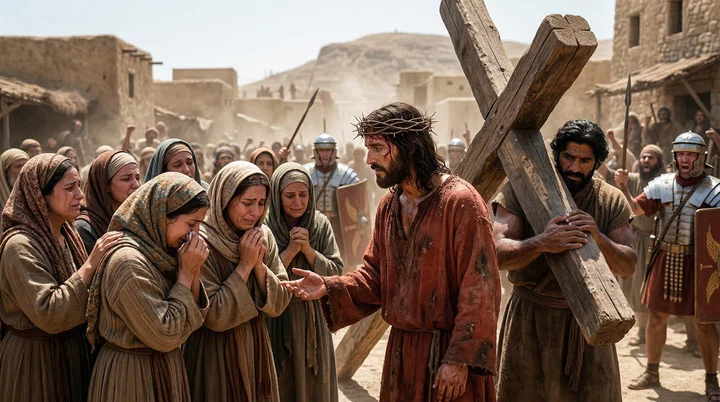
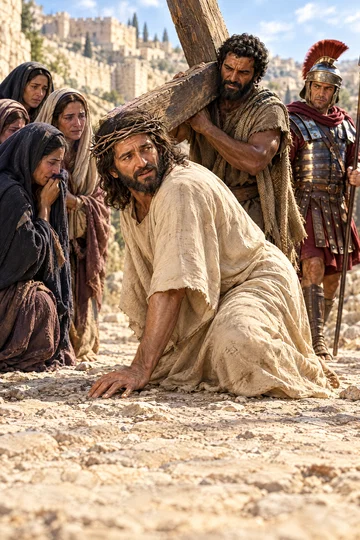
The words were spoken on the way from Pilate's court, the judgment-hall, to Calvary, as Jesus bore the cross after His scourging and fell beneath its burden.DA 741.4–742.1Ms 95, 1897, par. 14 They belong to the account of His crucifixion in which He faced the Jewish priests and rulers who pressed the Roman governor to do their will.RH Dec 24, 1908 They were uttered after news of His condemnation had spread through Jerusalem, when people of all classes and ranks flocked toward the place of crucifixion and disciples and believers from the city and the surrounding region joined the vast multitude following Him, because the priests and rulers were bound by promise not to molest His followers if He Himself were delivered to them.DA 741.3
They were addressed to women of Jerusalem following Him to His death who wept for Him from common human pity rather than from faith in Him as sent from God, some having seen Him before or been healed by Him or having brought the sick to Him.ST Jul 18, 1878DA 742.4–743.1 Though bearing the sins of the world under suffering, He was not indifferent to their grief but looked on them with tender compassion without despising their tears and sympathy, felt a deeper sympathy for them, forgot His own suffering, and warned them to weep for themselves and their children because He looked forward from His own suffering to the destruction of Jerusalem.ST Jul 18, 1878DA 742.4–743.1 The saying foretells days of such terrible suffering, trial and distress that people will call childless women blessed and count childlessness a mercy, because they will be spared the suffering faced by mothers and children.DA 741Ms 205, 1899, par. 4
The days foretold came in the siege of Jerusalem with its famine and horrors of war, when its inhabitants including children died.ST Jul 18, 1878DA 742.4–743.1Ms 205, 1899, par. 4 Many of those same women who were then wailing over Him as He fell fainting beneath the cross perished with their children, realizing the doom the people had blindly invoked when they cried for His blood to be on them and their children.ST Jul 18, 1878DA 742.4–743.1 The warning refers not only to the destruction of Jerusalem but to the end of the world, to the wider judgment when all the impenitent will suffer condemnation for their sins.ST Jul 18, 1878
It also describes the days when the Bridegroom is taken away and the disciples mourn and fast, the time of trial and temptation when the presence of the Comforter is not clearly discerned as Christ approaches the cross and descends into humiliation.ST Jul 7, 1898 It is when they witness Him in whom their hopes of eternal life are centered in the hands of wicked men, and hear His own nation clamoring for His blood.ST Jul 7, 1898 It is when they see Herod and his soldiers plaiting the crown of thorns, clothing Him in the purple robe while bowing and striking Him with the reed, and see Him scourged as the worst of criminals while the murderous Barabbas is chosen in His place though they thought He would take His place on David's throne.ST Jul 7, 1898 It is when they see Him lifted on the cross dying as a malefactor, so that they have cause to mourn and fast while their faith is tried and their hope and courage fail.ST Jul 7, 1898
Sources
Pioneers and periodicals
10 sources
The saying belongs to the crucifixion account, spoken on the way to Calvary when Jesus stood before the Jewish priests and rulers as they pressed the Roman governor to do their will.RH Dec 24, 1908ST Apr 30, 1902ST Mar 27, 1901 It was addressed to women weeping for Him from common human pity at His visible suffering, not from faith that He was a teacher sent from God, and He looked on them with tender compassion and did not despise their tears.ST Jul 18, 1878ST Apr 4, 1906 He told them to weep for themselves and their children rather than for Him, because far worse suffering from the coming consequences of the nation's deeds lay ahead for them.ST Nov 19, 1894ST Nov 19, 1894ST Apr 4, 1906
The calling of the barren and childless blessed means days of severe calamity, trouble and distress were coming upon Jerusalem and its people, so painful that childlessness would be counted a blessing and envied.ST Nov 19, 1894ST May 17, 1905ST Nov 19, 1894ST Apr 4, 1906ST Mar 27, 1901 Mothers and children would face terrible distress, and those without children would have none to suffer through it, so people would call the barren blessed because they had no children to suffer in those days.ST Nov 19, 1894ST Apr 4, 1906ST Apr 8, 1903 That coming doom was the fate of His people who rejected His offers of mercy, the doom they blindly invoked when they cried for His blood to be on them and their children.ST Jul 18, 1878ST Apr 4, 1906ST Apr 30, 1902 Forgetting His own suffering to warn them, He showed that grief over their fate caused Him greater agony than the prospect of suffering on the cross.ST Jul 18, 1878ST Apr 30, 1902
What He foretold came in the siege of Jerusalem, when many of those very weeping women perished with their children.ST Jul 18, 1878 The warning refers not only to the destruction of Jerusalem but to the end of the world, to the wider judgment when all the impenitent will suffer condemnation for their sins.ST Jul 18, 1878 It also means the time when the Bridegroom is taken away and the disciples mourn and fast, a time of trial and temptation when the presence of the Comforter is not clearly discerned as Christ approaches the cross and descends into humiliation.ST Jul 7, 1898 This was witnessed in His betrayal into wicked hands, His own nation clamoring for His blood, Herod and his soldiers crowning Him with thorns, clothing Him in purple and striking Him with the reed, scourging Him as a criminal while Barabbas was chosen instead, and lifting Him on the cross to die as a malefactor, so that faith is tried and hope and courage fail.ST Jul 7, 1898
Sources