Luke 23:28
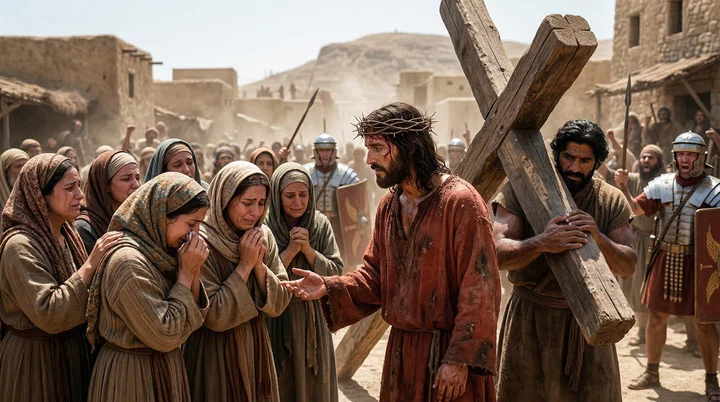
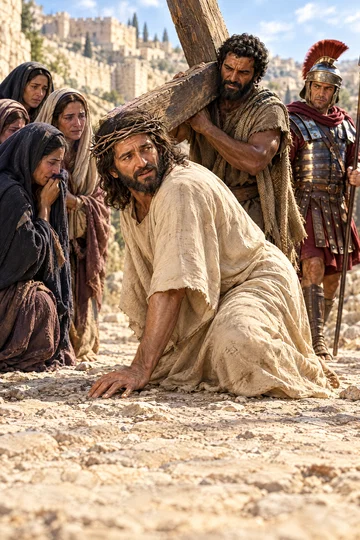
But Jesus turning unto them said, Daughters of Jerusalem, weep not for me, but weep for yourselves, and for your children.
Translations
But Jesus turning to them said, Daughters of Jerusalem, weep not for me, but weep for yourselves, and for your children.
King James Version, Revised Version, American Standard Version
But Jesus turning unto them said, Daughters of Jerusalem, weep not for me, but weep for yourselves, and for your children.
But Jesus turning unto them, said, Daughters of Jerusalem, weep not for me, but weep for yourselves, and for your children.
But Jesus turning to them, said, Daughters of Jerusalem, weep not for me, but weep for yourselves, and for your children.
and Jesus having turned unto them, said, 'Daughters of Jerusalem, weep not for me, but for yourselves weep ye, and for your children;
And Jesus turning round to them said, Daughters of Jerusalem, do not weep over me, but weep over yourselves and over your children;
But, turning towards them, Jesus said—Daughters of Jerusalem! Do not weep for me; but, for yourselves, be weeping, and for your children.
Berean Standard Bible, Majority Standard Bible
But Jesus turned to them and said, “ Daughters of Jerusalem, do not weep for Me, but weep for yourselves and for your children.
But Jesus, turning to them, said, “ Daughters of Jerusalem, don’ t weep for me, but weep for yourselves and for your children.
But Jesus, turning to them, said, Daughters of Jerusalem, let not your weeping be for me, but for yourselves and for your children.
But Iesus turned backe vnto them, and said, Daughters of Hierusalem, weepe not for me, but weepe for your selues, and for your children.
Douay-Rheims (Challoner revision)
But Jesus turning to them, said: Daughters of Jerusalem, weep not over me; but weep for yourselves, and for your children.
Pictures
Cross-references
- Matthew 27:25
Then answered all the people, and said, His blood be on us, and on our children.
The people call Jesus’ blood upon themselves and their children, invoking the doom they would face.
- John 19:16-30
Then delivered he him therefore unto them to be crucified. And they took Jesus, and led him away.
Both recount Jesus’ march to Calvary and crucifixion.
- Mark 15:20-38
And when they had mocked him, they took off the purple from him, and put his own clothes on him, and led him out to crucify him.
A parallel account of Jesus’ crucifixion and the march to Calvary.
- Luke 23:33-46
And when they were come to the place, which is called Calvary, there they crucified him, and the malefactors, one on the right hand, and the other on the left.
Continues with Jesus’ crucifixion and death.
- Matthew 27:31-53
And after that they had mocked him, they took the robe off from him, and put his own raiment on him, and led him away to crucify him.
A parallel account of Jesus’ march to Calvary and crucifixion.
- Lamentations 3:51
Mine eye affecteth mine heart because of all the daughters of my city.
Also refers to Jerusalem’s daughters.
- Luke 23:21
But they cried, saying, Crucify him, crucify him.
same crowd now cries Crucify him
- Isaiah 53:3
He is despised and rejected of men; a man of sorrows, and acquainted with grief: and we hid as it were our faces from him; he was despised, and we esteemed him not.
both present Jesus as Man of sorrows not sorrowing for self
- Matthew 23:37
O Jerusalem, Jerusalem, thou that killest the prophets, and stonest them which are sent unto thee, how often would I have gathered thy children together, even as a hen gathereth her chickens under her wings, and ye would not!
Both express Christ’s compassion and lament for Jerusalem.
Commentary
Each commentary is drawn from primary sources: the writings of Ellen G. White and Adventist pioneers and periodicals. Each commentary is separate. Its own words are not a quotation; follow the references to read the source passages.
Ellen G. White
26 sources
On the road from Pilate's judgment hall to Calvary outside Jerusalem, as he bears the heavy cross in weakness and suffering with two thieves led out to die beside him, Jesus turns to the wailing women in the vast multitude flocking toward the crucifixion.DA 741.4–742.1DA 741.3DA 741.1–2ST Nov 30, 1882COS 155.1 Those daughters of Jerusalem lament him from ordinary human pity rather than faith in him as sent from God, and among them are women he had healed and raised from the dead whose cries turn him when nothing else can.3SP 151.1–3Ms 205, 1899, par. 4ST Nov 16, 1882 Forgetting his own grief while bearing the sins of the world, he looks on them with tender compassion and tells them not to weep for his suffering but to grieve for themselves and their children because coming suffering will fall on Jerusalem.3SP 151.1–3ST Nov 16, 18825RED 71.1–33SP 159.25RED 79.1 He sees the city besieged and its people dying amid the horrors of war, foretelling that many of those very women will perish with their children in its destruction, fulfilling the blind cry for his blood to be upon them and their children through impenitence and stubborn rejection of truth.3SP 151.1–3Ms 103, 1897, par. 4–6Ms 205, 1899, par. 4ST Nov 16, 18825RED 71.1–3 That warning reaches beyond Jerusalem to the end of the world, teaching that as the innocent Christ suffered for the world's sins, all the impenitent who slight the mercies purchased by his death will suffer condemnation for their own sins when the Son of man comes with the mighty hosts of God.3SP 151.1–35RED 71.1–3ST Jul 18, 1878
Journey to Calvary
The saying is uttered on the road from Pilate's judgment hall to Calvary outside Jerusalem, as Jesus bears the heavy and cruel cross upon bruised and bleeding shoulders in weakness and suffering.DA 741.4–742.1DA 741.1–2COS 155.1Ms 6, 1889, par. 45–46 Two thieves are being led out at the same time to die with Him.COS 155.1
He comes to that road after being seized at midnight in Gethsemane, dragged from palace to judgment hall, arraigned twice before the priests, twice before the Sanhedrim, twice before Pilate and once before Herod, then mocked, scourged, condemned, and hurried toward crucifixion amid shouts and jeers.COS 155.1ST Aug 8, 1878 A second scourging is followed by a crown of cruel thorns piercing His temples until blood covers His face, and when the cross is laid upon Him human nature can bear no more so that He falls fainting beneath the burden.Ms 95, 1897, par. 14 He revives from that fall to speak to the women who wail for Him.5RED 71.1–3
News of His condemnation spreads throughout Jerusalem, and a vast multitude of people of all classes and all ranks flocks toward the place of crucifixion and follows Him.DA 741.3ST Oct 7, 1886 Disciples and believers from the city and the surrounding region join that throng, because the priests and rulers are bound by a promise not to molest His followers if He Himself is delivered to them.DA 741.3 Many in the crowd mock and deride, shout and jeer, while others wail and weep, telling His praise, declaring His marvelous works with earnest voice, and asking what He has done to be treated as a criminal.ST Nov 30, 18823SP 184.1–185.2ST Oct 7, 1886DA 759.5–760.2 The weeping ones include those He had healed of infirmities and those He had raised from the dead, and the fickleness of the crowd is exposed, for many who only days before had attended Him with joyful hosannas and waving of palm branches as He rode triumphantly to Jerusalem, because it was popular to praise Him, now swell the cry of Crucify Him, Crucify Him.ST Oct 7, 1886
In this setting Christ suffers as humanity's substitute, made a curse to redeem from the curse of the law.DA 741.1–2 He bears Himself as one making a voluntary sacrifice, standing firm against priests and rulers who pressure the Roman governor to carry out their evil will.Ms 95, 1897, par. 14RH Dec 24, 1908 The cost of His suffering and death gives His followers the measure for their own self-denial.Lt 1a, 1861, par. 2–5 It belongs to the days when the Bridegroom is taken away and the children of the bridechamber have cause to mourn and fast, when the disciples see Him in whom their hopes of eternal life are centered in the hands of wicked men, hear His own nation clamoring for His blood, see Herod and his soldiers plaiting the crown of thorns for His brow, see Him clad in the purple robe with persecutors bowing before Him and striking Him with the reed placed in His hand, see Him who they thought would take His place on David's throne scourged as the worst of criminals with the murderous Barabbas chosen in place of their Teacher, and see Him lifted up on the cross dying as a malefactor, so that faith is tried and hope and courage fail.ST Jul 7, 1898
Compassionate Prophetic Warning
The women wailing for Jesus on the road were moved by ordinary human pity, not by faith in Him as a teacher sent from God.3SP 151.1–3ST Nov 16, 18825RED 71.1–3ST Jul 18, 1878DA 742.4–743.1 Among them, undesignedly caught in the procession, were women He had healed of infirmities and raised from the dead.Ms 205, 1899, par. 4 Their lamentation was what turned Him when nothing else in the jeering throng could attract His attention.Ms 205, 1899, par. 4DA 742.4–743.1
Though He was full of suffering while bearing the sins of the world on the way to His cruel death, He was not indifferent to their grief but looked upon them with tender compassion.3SP 151.1–3DA 742.4–743.1 He did not despise their tears or their sympathy, but received it, and their sympathy awakened a deeper sympathy in Him.ST Nov 16, 18825RED 71.1–3ST Jul 18, 1878DA 742.4–743.1 He forgot His own grief while contemplating their future fate, and grieved more for them than for Himself.ST Nov 16, 18825RED 71.1–3ST Jul 18, 1878
He told them in comfort and warning not to weep for His suffering but to weep and grieve for themselves and their children, because coming suffering would fall upon Jerusalem and its people.3SP 159.2DA 684DA 751.3–4Ms 103, 1897, par. 17–18 Even in humiliation and the most intense, excruciating agony of mind and body, while pouring out His life in death, He acted as a prophet thinking only of others.3SP 159.25RED 79.1DA 751.3–4 That addressing of the daughters of Jerusalem displays infinite love for man stronger than death, and stands alongside His work as priest and advocate pleading for His murderers and as loving Saviour forgiving the penitent thief.5RED 79.1DA 751.3–4
He saw Jerusalem besieged and its people dying amid the horrors of war.Ms 205, 1899, par. 4 He foretold that many of those very same women then weeping for Him would perish with their children in the siege and destruction of Jerusalem.3SP 151.1–3ST Nov 16, 18825RED 71.1–3ST Jul 18, 1878DA 742.4–743.1
That doom was the blind fulfillment of the cry for His blood to be upon them and their children, a fearful doom soon to be realized.ST Nov 16, 18825RED 71.1–3ST Jul 18, 1878 The priests and rulers brought it upon themselves through impenitence and stubborn rejection of the light of truth.Ms 103, 1897, par. 4–6 Their determined opposition to God was climaxed after the final evidence of His Messiahship when He raised Lazarus.Ms 103, 1897, par. 4–6
The warning referred not only to the destruction of Jerusalem but to the end of the world and a wider judgment.3SP 151.1–35RED 71.1–3ST Jul 18, 1878 As the innocent Christ suffered for the world's sins, all the impenitent and unbelieving who slight the mercies purchased by the death of the Son of God and reject God's mercy will suffer condemnation for their sins.3SP 151.1–35RED 71.1–3ST Jul 18, 1878 That will be when the Son of man comes attended not by a murderous mob but by the mighty hosts of God.5RED 71.1–3ST Jul 18, 1878
Sources
Pioneers and periodicals
36 sources
On the way to be crucified, bearing the cross toward Calvary amid a jeering crowd, Jesus turned to the women mourning for him and told them to weep not for him but for themselves and their children because of the suffering to come upon them.ST Nov 30, 1882ST Aug 8, 1878ST Nov 19, 1894ST May 17, 1905ST Mar 27, 1901 Even while hungry and weary almost unto death and in extreme agony, he showed no self-pity or seeking of sympathy but forgot his own suffering in deeper, unselfish sympathy and care for their welfare.ST Jul 18, 1878ST Jun 12, 1884STST Jan 13, 1898 He looked forward to terrible judgment soon to fall on the Jewish nation, fulfilled thirty-six years later in the siege and destruction of Jerusalem in which many of those same women and their children would perish.ST Nov 16, 1882ST Jul 18, 1878ST Jan 13, 1898 That ruin came because they rejected light and healing and killed God's Messenger, blindly fulfilling their own cry for his blood to be upon them and their children.ST Nov 16, 1882ST Dec 7, 1904ST Apr 4, 1906 The warning reaches beyond Jerusalem to the final reckoning when the impenitent will face condemnation, and it calls parents who see their children following worldly ways to their destruction to make a zealous, urgent effort in time to save them.ST Jul 18, 1878RH Nov 11, 1858RH Sep 10, 1857RH Mar 22, 1860
Journey to the Cross
On the way to be crucified, bearing the heavy burden of the cross toward Calvary amid a jeering and mocking crowd, Jesus turned to the women who were mourning and wailing as he was led away.ST Nov 30, 1882ST Aug 8, 1878ST Nov 19, 1894RH Mar 9, 1905 He had been seized at midnight in Gethsemane as a murderer, dragged from palace to judgment hall, arraigned twice before the priests, twice before the Sanhedrim, twice before Pilate, and once before Herod, then mocked, scourged, and condemned.ST Aug 8, 1878 It was a fearful scene of mockery and violence driven by Satan's power over the hearts of men, which heaven beheld with grief and amazement.ST Aug 8, 1878 In turning to them he warned them not to grieve for him but for themselves and their children, pointing to the coming days of suffering described in the following verses.ST Nov 19, 1894RH Mar 9, 1905
A great multitude followed him to Calvary, with many mocking and deriding and some weeping while telling his praise.ST Oct 7, 1886 The weeping ones included those he had healed of infirmities and those he had raised from the dead, who declared his marvelous works with earnest voice and demanded to know what he had done to be treated as a criminal.ST Oct 7, 1886 Many in the crowd were fickle, for only days before they had attended him with joyful hosannas and waving of palm branches as he rode triumphantly to Jerusalem, because it was popular to praise him, and now they swelled the cry of Crucify him, Crucify him.ST Oct 7, 1886
Their tears came from common human pity over his visible physical suffering rather than from faith in him as a teacher sent from God, and they did not see the greater trouble his suffering foretold for the nation.ST Nov 16, 1882ST Jul 18, 1878ST Apr 4, 1906 Yet he answered their wailing with tender compassion, received their sympathy without despising their tears, and felt a deeper sympathy for them than for himself.ST Nov 16, 1882ST Jul 18, 1878 Their loving concern and fearless devotion were not useless, for he saw them and spoke to them as he went on the Way of Sorrows, and they pushed through the hostile crowd even to the foot of the cross.RH Dec 14, 1911 Their sorrow should have been for the sin of rejecting and killing God's Messenger and for the coming calamity upon Jerusalem, and repentance then could have spared them later grief.ST Apr 4, 1906
The account belongs to the saddest tragedy in history, carried out by a bloodthirsty, sin-hardened mob. The mourning continued after the death, with women still in tears with Joseph of Arimathea, who obtained permission from Pilate to bury Jesus of Nazareth, while soldiers were ordered to superintend the burial lest it be profaned.RH Jul 16, 1861 The sepulcher was found empty a few days afterward, and the disciples published everywhere that he had risen from the dead as he had foretold.RH Jul 16, 1861
Selfless Sorrow for Others
Even while toiling under the weight of the cross up toward Calvary, hungry and weary almost unto death and in extreme suffering and agony, He was forgetful of self, showed no self-pity and sought no sympathy.ST Jun 12, 1884ST Jan 13, 1898RH May 4, 1911 He silently and submissively bore the cross and the crowd's cruel taunts without calling attention to His own suffering, and left Himself to the care of God while caring for the welfare of others.ST Jun 12, 1884RH May 4, 1911RH Jun 28, 1870 His continued self-denial put the welfare of the women and their children before His own, warning them to grieve for the suffering facing them rather than for Him.ST Jun 12, 1884ST Jan 13, 1898
He turned lament for Himself away and directed it back upon those who were lamenting Him and upon their children.RH Sep 10, 1857RH Sep 19, 1854ST Apr 30, 1902RH Jul 1, 1902 Weeping for Him and His cause is misplaced and unneeded, for He and His cause need no pity.RH Sep 10, 1857RH Jul 1, 1902 Pity belongs upon those who offer it, since a coming time of reckoning will leave them needing sympathy for themselves.RH Sep 10, 1857ST Apr 30, 1902
His sorrow was unselfish and for others, for He felt a deeper sympathy for the women than for Himself, forgot His own suffering to care for their welfare, and His tears and concern were not for Himself.ST Jul 18, 1878STST Jan 13, 1898 His greater sorrow was over Jerusalem's rejection and coming desolation and over Palestine, and His counsel reflected anguish over the coming doom of those who rejected mercy.STST Apr 30, 1902RH Dec 30, 1862 Concern for them and for the sins He bore caused Him greater anguish than the physical suffering of the cross, while the weeping women remained beside Him when others fled.ST Apr 30, 1902RH Dec 30, 1862
He spoke as a prophet even in humiliation on the way to the cross, addressing the daughters of Jerusalem with tender compassion while suffering in extreme agony.ST Jul 18, 1878ST Jul 25, 1878RH Jan 16, 1908 His agony came from a heart of love burdened for souls, showing the deep concern and sympathy that suffering can teach.ST Jul 25, 1878RH Jan 16, 1908 Even in that hour His selfless care in turning from His own suffering to warn of judgment revealed His kingship.ST Jul 25, 1878RH Jul 1, 1902
Judgment Foretold for Jerusalem
On the way to Calvary Jesus turned to the women mourning as he was led away and told them not to grieve for him but for themselves and for their children.ST Nov 19, 1894ST May 17, 1905ST Mar 27, 1901RH Mar 9, 1905 The warning pointed to the days of suffering described in the verses that follow, a terrible fate and calamity awaiting them and their children.ST Nov 19, 1894ST May 17, 1905ST Mar 27, 1901RH Mar 9, 1905
He looked forward to terrible judgments soon to be poured out upon the Jewish nation, fulfilled in the siege and destruction of Jerusalem which came thirty-six years later.ST Nov 16, 1882ST Jul 18, 1878ST Jan 13, 1898 Many of those same women and their children would perish in that siege.ST Nov 16, 1882ST Jul 18, 1878 The Jewish people's later dispersion and persecution were also continuing evidence of that suffering.
The ruin came because they rejected light, and when the Healer and his healing message were rejected there was no remedy.ST Dec 7, 1904 Their sorrow should have been for the sin of rejecting and killing God's Messenger and for the coming calamity upon Jerusalem.ST Apr 4, 1906 It was the blind fulfillment of their own cry for his blood to be upon them and their children, connecting the consequences of the people's rejection of God with their children despite his repeated care and admonitions concerning them.ST Nov 16, 1882ST Jul 18, 1878RH Jun 23, 1853
He saw among them some who would be in the siege without God or a ray of hope.ST Dec 7, 1904 Their coming suffering was a greater cause for grief than his own abuse. Repentance then could have spared them later grief.ST Apr 4, 1906
The warning reaches beyond the destruction of Jerusalem to the end of the world and the wider judgment.ST Jul 18, 1878 Pity belongs on those who offered it, because a coming time of reckoning will leave them needing sympathy for themselves, when the hopes of scoffers are destroyed and they face the wrath of the Lamb.RH Sep 10, 1857 Then the impenitent will suffer condemnation at the coming of the Son of man with the mighty hosts of God, and the lost will seek shelter from that day of judgment near at hand.ST Jul 18, 1878RH Sep 10, 1857RH Mar 22, 1860
History and Sabbath Witness
The words to the daughters of Jerusalem stand in the preparation-day, or Friday, account of the death and burial in which the Sabbath is shown to come before the first day of the week.RH Dec 8, 1874 After he was laid in the tomb the women who had seen where he lay started for home, stopping in the city to buy sweet spices to anoint him at a future time. They then rested the Sabbath day and came to the sepulcher early the first day of the week expecting to anoint the body, but the stone was rolled away and he had risen.
The naming of the seventh day and the first day in immediate connection at the crucifixion and resurrection proves the identity of the days.ST Feb 1, 1905 Christ, the Author of the Sabbath institution who led Israel from Creation, was present in the flesh at that time and regularly kept with the Jews in their synagogues the same day he had taught them to keep from Creation, and he would have corrected them if they were keeping the wrong day.ST Feb 1, 1905 His keeping proves the Jews then were keeping the true seventh day in unbroken succession from the beginning.ST Feb 1, 1905 Jews, Christians, and others have kept their reckonings without break from that time to the present and all agree, with the first day and the seventh traveling side by side ever since, so if Sunday is kept in true succession from the cross the seventh day is also certain, and no loss of the day's identity between the crucifixion and now is possible.ST Feb 1, 1905
The history of the trial, execution, and burial is told with minute accuracy in its allusions to the customs, opinions, political events, and institutions of that time.RH Feb 11, 1862 It includes being brought to Pontius Pilate as governor of Judea whose sentence with power of life and death was necessary, derision before and during execution, scourging before crucifixion, the accusation affixed to the cross in three languages, bearing the cross, and giving the body to friends for burial.RH Feb 11, 1862 This circumstantial manner and consistency with other authors and sources concerning manners and institutions affords evidence in favor of the truth of the narrative.RH Feb 11, 1862
The account shows Jesus on the cross standing against the Jewish priests and rulers who pressured the Roman governor to carry out their will.RH Dec 24, 1908 His example shows God's word and righteousness standing firm against human power and plans for evil.RH Dec 24, 1908 The verse belongs to the days when the Bridegroom is taken away and the children of the bride-chamber have cause to mourn and fast.ST Jul 7, 1898 It is the time of approaching the cross and descending into humiliation, when the disciples see him in whom their hopes of eternal life are centered in the hands of wicked men, hear his own nation clamoring for his blood, see Herod and his soldiers plaiting the crown of thorns for his brow, see him clad in the purple robe with persecutors bowing before him and striking him with the reed placed in his hand, see him who they thought would take his place on David's throne scourged as the worst of criminals with the murderous Barabbas chosen in place of their Teacher, and see him lifted up on the cross dying as a malefactor.ST Jul 7, 1898 Then faith is tried and hope and courage fail.ST Jul 7, 1898
Call to Weep and Act
On the way to death under extreme suffering Jesus turned attention away from sympathy for himself to concern for the welfare of others and left himself to the care of God, giving the pattern of the true missionary heart that under any and all circumstances is concerned for others.ST Jun 12, 1884 His agony came from a heart of love burdened for souls, and that sorrow for others shows the deep concern and sympathy that suffering can teach.RH Jan 16, 1908 Silently and submissively bearing the cross and cruel taunts without calling attention to his own suffering, his example teaches submission and taking burdens to God for help in bearing them.RH Jun 28, 1870 The warning not to grieve for him but for self and children presses parents who remain calm while their children follow worldly ways and face destruction to recognize the danger and make a zealous effort in time to save their families.RH Nov 11, 1858 That grief and urgent labor for children's salvation is urged because a day of judgment is near when the lost will seek shelter from it, and such tears and efforts are acts of faith for the deliverance of children.RH Mar 22, 1860
The words assure burdened mothers and fathers that Jesus sees and pities their sorrows over their children.RH Apr 9, 1901 He knows the burden carried in training the family, the pain and deep love of motherhood, and the sore and aching question over wayward, disobedient children and whose fault it is.RH Apr 9, 1901 Burdened mothers are comforted that he sees their grief, that God pities them, and that nothing is too hard for God, and parents are encouraged to plead with God for their own children and their neighbors' children.RH Apr 9, 1901 A mother with bowed head and tear-laden eyes should weep not over the grave of her innocent dead child but over her living child.ST Aug 22, 1911 The innocent dead are safe from all trouble and care and secure in Jesus, while the living who have left innocent babyhood days behind and strayed far from the side and hand of home into sin in the dark and cold with no desire for the dawning day or to come into the fold are farther off than the children who died and are the ones to sorrow for.ST Aug 22, 1911 The same call is echoed in Sister Goodale's final words urging those around her not to weep for her but to consider their own need to prepare to meet God.RH Mar 22, 1860
Sources