Luke 23:43
And Jesus said unto him, Verily I say unto thee, To day shalt thou be with me in paradise.
Translations
And Jesus said to him, Truly I say to you, To day shall you be with me in paradise.
King James Version, KJV Cambridge Paragraph Bible
And Jesus said unto him, Verily I say unto thee, To day shalt thou be with me in paradise.
And Jesus said to him, Verily I say to thee, This day shalt thou be with me in paradise.
And he said unto him, Verily I say unto thee, Today shalt thou be with me in Paradise.
And he said unto him, Verily I say unto thee, To-day shalt thou be with me in Paradise.
and Jesus said to him, 'Verily I say to thee, To-day with me thou shalt be in the paradise.'
And Jesus said to him, Verily I say to thee, To-day shalt thou be with me in paradise.
And he said unto him—Verily, I say unto thee this day: With me, shalt thou be in Paradise.
Berean Standard Bible, Majority Standard Bible
And Jesus said to him, “ Truly I tell you, today you will be with Me in Paradise.”
Jesus said to him, “Assuredly I tell you, today you will be with me in Paradise.”
And he said to him, Truly I say to you, Today you will be with me in Paradise.
Then Iesus said vnto him, Verely I say vnto thee, to day shalt thou be with me in Paradise.
Douay-Rheims (Challoner revision)
And Jesus said to him: Amen I say to thee, this day thou shalt be with me in paradise.
Pictures
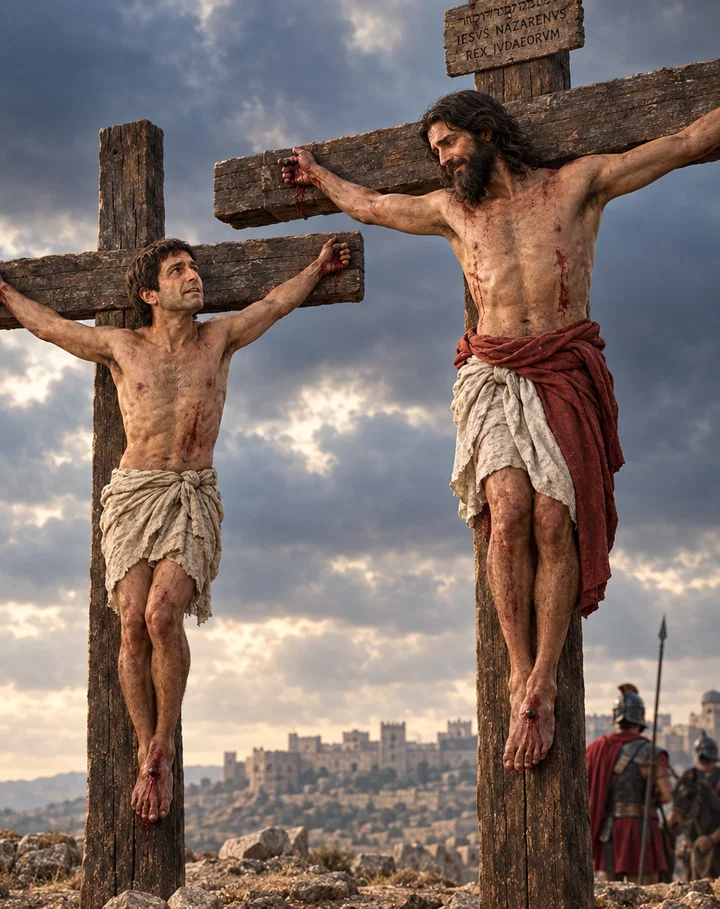
Cross-references 20 of 39
- Revelation 2:7
He that hath an ear, let him hear what the Spirit saith unto the churches; To him that overcometh will I give to eat of the tree of life, which is in the midst of the paradise of God.
Both connect Paradise with the tree of life promised to the overcomer.
- 2 Corinthians 12:4
How that he was caught up into paradise, and heard unspeakable words, which it is not lawful for a man to utter.
Paul identifies Paradise with the third heaven.
- Revelation 22:1-2
And he shewed me a pure river of water of life, clear as crystal, proceeding out of the throne of God and of the Lamb.
The river and tree of life portray Paradise in God’s presence.
- John 20:17
Jesus saith unto her, Touch me not; for I am not yet ascended to my Father: but go to my brethren, and say unto them, I ascend unto my Father, and your Father; and to my God, and your God.
Jesus says he had not yet ascended to the Father after his death.
- John 19:30
When Jesus therefore had received the vinegar, he said, It is finished: and he bowed his head, and gave up the ghost.
Jesus’ final cry, “It is finished,” accompanies his death on the cross.
- Philippians 1:23
For I am in a strait betwixt two, having a desire to depart, and to be with Christ; which is far better:
Paul desires to depart and be with Christ, as Jesus promises the thief.
- Matthew 27:38-44
Then were there two thieves crucified with him, one on the right hand, and another on the left.
The crucified thief turns to Jesus amid the mockery at the cross.
- 2 Corinthians 12:2
I knew a man in Christ above fourteen years ago, ( whether in the body, I cannot tell; or whether out of the body, I cannot tell: God knoweth;) such an one caught up to the third heaven.
Paradise is identified with the third heaven, the place of God’s presence.
- 2 Corinthians 5:8
We are confident, I say, and willing rather to be absent from the body, and to be present with the Lord.
Both describe being with the Lord after death.
- Mark 15:27-32
And with him they crucify two thieves; the one on his right hand, and the other on his left.
Jesus is crucified between two thieves amid mockery.
- Luke 16:25-26
But Abraham said, Son, remember that thou in thy lifetime receivedst thy good things, and likewise Lazarus evil things: but now he is comforted, and thou art tormented.
The rich man’s torment and the fixed gulf contrast with Christ’s promise of paradise to the thief.
- John 11:25
Jesus said unto her, I am the resurrection, and the life: he that believeth in me, though he were dead, yet shall he live:
Jesus promises the believer life beyond death and entry into paradise.
- Acts 2:31
He seeing this before spake of the resurrection of Christ, that his soul was not left in hell, neither his flesh did see corruption.
Peter’s account of Christ’s resurrection bears on whether Christ was in paradise between death and resurrection.
- Psalms 16:10
For thou wilt not leave my soul in hell; neither wilt thou suffer thine Holy One to see corruption.
Christ’s soul was not left in Hades.
- Revelation 1:18
I am he that liveth, and was dead; and, behold, I am alive for evermore, Amen; and have the keys of hell and of death.
The risen Christ lives forever and holds the keys of death and Hades.
- Genesis 2:8
And the LORD God planted a garden eastward in Eden; and there he put the man whom he had formed.
The Greek Old Testament calls Eden Paradise.
- John 19:32
Then came the soldiers, and brake the legs of the first, and of the other which was crucified with him.
The thieves’ legs are broken while they are still alive, unlike Jesus, who is already dead.
- Hebrews 3:7
Wherefore ( as the Holy Ghost saith, To day if ye will hear his voice,
“Today” can denote more than the strict calendar day.
- Revelation 21:1-4
And I saw a new heaven and a new earth: for the first heaven and the first earth were passed away; and there was no more sea.
Paradise is pictured as a new creation where God wipes away every tear.
- Matthew 22:32
I am the God of Abraham, and the God of Isaac, and the God of Jacob? God is not the God of the dead, but of the living.
God of living not dead
Commentary part 1 of 2
Each commentary is drawn from primary sources: the writings of Ellen G. White and Adventist pioneers and periodicals. Each commentary is separate. Its own words are not a quotation; follow the references to read the source passages.
Ellen G. White
72 sources
Spoken while both hung dying on the cross in answer to the plea to be remembered when the kingdom came, the assurance given that day was that the dying man would be with his Saviour in paradise in the future, not on that day.DA 842.1Ms 94, 1897, par. 36–37Ms 96, 1904, par. 11–13Ms 78, 1910, par. 29Ms 9, 1910, par. 16–18 He could not have gone there that day, for his Saviour Himself did not go to Paradise or to the Father that day but died and lay in the tomb until the third day.DA 842.1Ms 94, 1897, par. 36–37Ms 190, 1903, par. 41 On one reading it is taught that the man would be with Him in paradise that very day.Ms 83, 1910, par. 29–32 Even nailed to the cross in shame and agony, He revealed Himself as the sin-pardoning Saviour with royal right and divine power to forgive and to save to the uttermost all who come to Him.Ms 105, 1897, par. 1–6RH Aug 26, 1909Ms 52, 1897, par. 28–32 Because the penitent acknowledged Him in humiliation by faith in His coming kingdom, He at once pardoned him and assured him a place with Him in the paradise of God when he rises from the dead.Ms 94, 1897, par. 36–37Ms 96, 1904, par. 11–13Ms 105, 1897, par. 1–6Ms 81, 1910, par. 24Ms 142, 1906, par. 55–56
Setting at Calvary
The saying belongs to the road to Calvary after taking neither food nor drink since the Passover supper with the disciples, agonizing in Gethsemane in conflict with satanic agencies, enduring betrayal and the forsaking by the disciples, and being taken to Annas then to Caiaphas then to Pilate then to Herod then again to Pilate.DA 741.4–742.1 Through insult upon insult, mockery upon mockery, and torture by the scourge twice in scenes trying the soul to the uttermost, there was no failure and no word but what tended to glorify God, borne with firmness and dignity.DA 741.4–742.1 Human nature could bear no more, so He fell fainting beneath the cross prepared for Barabbas, followed by a crowd showing no compassion but taunting Him because He could not carry the heavy cross.DA 741.4–742.1 He was to suffer death at the same time with two companions of Barabbas upon whom also crosses were placed.DA 741.4–742.1
He was crucified at the place called Calvary outside the gate and outside the boundaries of Jerusalem where felons and murderers were executed.DA 741.1–2 He was led from the judgment-hall to Calvary after news of His condemnation spread throughout Jerusalem, when people of all classes and all ranks flocked toward the place of crucifixion.DA 741.3 The priests and rulers left His followers unharmed, so that disciples and believers from the city and the surrounding region joined the throng that followed Him.DA 741.3
By direction of the priests and rulers He was crucified in the midst between the two thieves to indicate He was the greatest criminal of the three, which fulfilled that He was numbered with the transgressors.DA 751.3–4 In truth His central cross stood in the midst of a world lying in sin.DA 751.3–4 The saying shows the cost at which salvation was secured, bought with the infinite price of the Son of God suffering on the cross of Calvary with nails in His hands and feet and with mockery and abuse from those He came to save.Ms 11, 1911, par. 11–13Lt 1a, 1861, par. 2–5 It belongs to the account of His suffering and self-sacrifice when lifted up and dying as a malefactor.Lt 1a, 1861, par. 2–5ST Jul 7, 1898
He was seen in the hands of wicked men with His own nation clamoring for His blood, crowned with thorns, clad in the purple robe, bowed before and struck with the reed, and scourged as the worst of criminals with the murderous Barabbas chosen in His place.Ms 11, 1911, par. 11–13ST Jul 7, 1898 This descent into the depths of humiliation came when the hopes the disciples had centered in Him for eternal life seemed destroyed.ST Jul 7, 1898 The promise was spoken that day on the cross while He was suffering and dying and while both He and the thief were hanging in execution.Ms 78, 1910, par. 29Ms 9, 1910, par. 16–18 It answered the thief's appeal to be remembered when He comes into His kingdom.Ms 78, 1910, par. 29Ms 11, 1911, par. 11–13
Sense of Today
The word today belongs with the speaking, so the sense is I tell you today, you will be with me in paradise.DA 842.1Ms 94, 1897, par. 36–37Ms 96, 1904, par. 11–13Ms 122, 1909, par. 29Ms 190, 1903, par. 41 It marks the day Jesus gave the assurance on the cross, not the day the thief would enter paradise, but a present promise of a future home with Him in paradise when His kingdom comes.Ms 94, 1897, par. 36–37Ms 96, 1904, par. 11–13Ms 122, 1909, par. 29Ms 190, 1903, par. 41Ms 52, 1897, par. 28–32 In answer to the dying man's plea to be remembered when He came into His kingdom, Jesus told him that day, while giving His life for the world and still suffering on the cross, that he would have a place in His kingdom.Ms 96, 1904, par. 11–13Ms 122, 1909, par. 29Ms 190, 1903, par. 41Ms 52, 1897, par. 28–32Ms 37, 1908, par. 33 The promise was made to a dying sinner who acknowledged his guilt, confessed Jesus had done nothing amiss, recognized His innocence, and entrusted himself to the Saviour, and it showed that even in death Jesus had right and power to forgive and save.Ms 96, 1904, par. 11–13Ms 52, 1897, par. 28–32Lt 102, 1905, par. 12–17
Jesus Himself did not go to paradise or to His Father that day.Ms 94, 1897, par. 36–37Ms 190, 1903, par. 41Ms 52, 1897, par. 28–32Ms 37, 1908, par. 33Lt 102, 1905, par. 12–17 He died, lay alone in the grave like a grain of wheat, and remained in the tomb.Ms 52, 1897, par. 28–32 After His resurrection on the third day He told Mary He had not yet ascended to the Father, which harmonizes with this reading and shows the thief could not have gone there with Him that day.DA 842.1Ms 94, 1897, par. 36–37Ms 190, 1903, par. 41Ms 52, 1897, par. 28–32Lt 102, 1905, par. 12–17 He did not enter His kingdom that day, so today cannot mean entry that same day.Ms 37, 1908, par. 33Lt 102, 1905, par. 12–17
On one reading held in a single instance, the verse promises the condemned man who asked to be remembered would be with Jesus in paradise that very day, while He was suffering on the cross.Ms 83, 1910, par. 29–32
Christ Revealed in Humiliation
Even while nailed to the cross and regarded by all around as a deceiver suffering justly, helpless in agony and shame and cruelty, Jesus revealed Himself as the sin-pardoning Saviour with royal right and divine authority and power to forgive transgression and sin and to save to the uttermost all who receive Him and come to God by Him.Ms 105, 1897, par. 1–6RH Aug 26, 1909Ms 52, 1897, par. 28–32Lt 102, 1905, par. 12–17ST Oct 25, 1905 Though dying an ignominious death, He had endured the test without losing divine power, for His hand was not shortened that He could not save and His ear was not heavy that He could not hear.Ms 105, 1897, par. 1–6Ms 52, 1897, par. 28–32 Even in the agonies of death and in humiliation and apparent defeat He asserted His right and power to forgive sin, and the thief's faith grasped that truth and found perfect peace in acceptance with God.RH Aug 26, 1909Lt 102, 1905, par. 12–17Ms 142, 1906, par. 55–56ST Oct 25, 1905 Spoken that day from pale and quivering lips amid darkness, the promise pierced the gloom around the cross and bore final testimony to His dignity and the Father's glory that His ear still hears and His arm still saves.Ms 105, 1897, par. 1–6Ms 52, 1897, par. 28–32 It gave evidence of His divine attributes, Godhead, kingly power and redeeming power, showing divinity flashing through suffering humanity and divinity at work while His humanity suffered hatred and revenge for acknowledging Himself the Son of God.Ms 105, 1897, par. 1–6ST Dec 8, 189811MR 345.1Ms 84a, 1897, par. 8 His divinity was not exercised by coming down from the cross to prove Sonship, but by speaking life-giving words of pardon in death, displaying kingly power through the life-giving power of His death for all who believe on Him in His humiliation.Ms 105, 1897, par. 1–6Ms 52, 1897, par. 28–32ST Dec 8, 1898
As humanity's Advocate with the Father and propitiation for the sins of the whole world, He was bound by plan and covenant agreement to remain on the cross as substitute and surety for a guilty world and unable to come down, yet He alone was free to undertake suretyship for the guilty criminal and speak forgiveness in a clear distinct voice reaching far and near.Ms 84a, 1897, par. 5–75RED 77.1–211MR 345.1Ms 84a, 1897, par. 8 Even while suffering humiliation and persecution He had divine authority and divine right to make this promise to a repentant believer, counting the thief far less guilty than the priests, scribes, rulers and condemners who took active part in demanding His death.5RED 77.1–23SP 157.2ST Jul 25, 1878Ms 84a, 1897, par. 8 In dying agony He acted as Conqueror though to all other eyes He appeared conquered, with Satan and the chief priests triumphing and His own disciples broken-hearted and failing to speak faith in Him as Messiah.ST Apr 26, 1905Ms 52, 1897, par. 23–25 The verse reveals opposites met in His person, Son of Man yet infinitely higher than angels, equal with the Father yet with divinity clothed with humanity to stand at the head of the fallen race, and the faith of a dying sinner laying hold upon a dying Saviour shone with distinct brightness amid moral darkness at deepest midnight.ST Apr 26, 1905Ms 52, 1897, par. 23–25
While suffering the most intense and excruciating agony of mind and body and pouring out His life in death, Jesus thought only of others and bore the insult and reproach of the cross for humanity.Ms 180, 1907, par. 23DA 751.3–4ST Jul 25, 1878 He entered into sympathy with people in temptation, and even in agony and persecution He offered salvation, encouraging the penitent soul to believe.Ms 47, 1908, par. 5–6DA 751.3–4ST Jul 25, 1878 His love for man was stronger than death, a love that amazed the angels, and as loving Saviour He mercifully answered the dying thief while Himself suffering under mockery.Ms 180, 1907, par. 233SP 159.25RED 79.1ST Jul 25, 1878 That compassion pressed evidence of His divine identity upon condemners, and many who witnessed those scenes on Calvary were afterward established by them in faith.DA 751.3–4ST Jul 25, 1878 The pardoning of the dying thief shows that Christ bore our sins in His own body on the tree and bore our griefs and sorrows, taking the sinner's guilt upon Himself to bring life and immortality to light with a divine-human heart exercised for the relief of men, so that pardon flows from the Father through Him even in His humiliation and all who come to Him will find life.Ms 94, 1897, par. 36–37Ms 52, 1897, par. 28–32
Thief's Faith and Forgiveness
The two men crucified with Jesus endured the same physical torture, yet their hearts were opposite.5RED 76.2–3 One was hardened by pain into desperation and defiance and joined the priests in mocking.5RED 76.2–3 The other was not a hardened criminal, though his morals had been corrupted by base association, and his crimes were not so great as those of many who stood beneath the cross reviling the Saviour.5RED 76.2–3 In common with the Jews he had believed that Messiah was soon to come, and he had heard Jesus and been convicted by His teachings, but through the influence of priests and rulers he had turned away and sought to drown conviction in pleasure until corrupt associations led him farther into wickedness, arrest for open crime, and condemnation to die.5RED 76.2–3 During the day of trial he had been with Jesus in the judgment hall and on the way to Calvary, had heard Pilate declare Him a just man, had marked His Godlike deportment and pitying forgiveness of His tormentors, and in his heart acknowledged Jesus to be the Son of God.5RED 76.2–3
At the brink of eternity, at the close of his probation and suffering justly for his deeds, the penitent thief was convicted by the fear of God and of a future to tremble at.5RED 77.3–78.23SP 158.1–2ST Dec 14, 1904 He confessed that he suffered justly and that Jesus had done nothing amiss.ST Jul 25, 1878ST Dec 14, 1904 He remembered all he had heard of Jesus healing the sick and pardoning sin, the words of weeping believers, and the title above the cross.ST Dec 14, 1904 As the Holy Spirit illuminated his mind he joined the evidence together link after link until he discerned in the bruised, mocked victim hanging beside him the Messiah, the Son of God, the Lamb of God that takes away sin, a King with a coming kingdom, and his Lord.5RED 77.3–78.23SP 158.1–2ST Jul 25, 1878ST Dec 14, 1904ST Jul 25, 1878 He called Jesus Lord when no one else would call Him Lord dying on the cross, though leading Jews denied Him and even disciples doubted His divinity.5RED 77.3–78.23SP 158.1–2ST Jul 25, 1878
In anguish mingled with hope he reached out by faith to grasp Christ's hand, believing in Him as his only hope of salvation who could pardon.Ms 84a, 1897, par. 5–7ST Jul 25, 1878ST Dec 14, 1904 He cast his helpless dying soul and body on Christ in consciousness of his own sinfulness and entire dependence on the mercy of a dying Saviour, knowing he would be eternally lost without Him.ST Dec 14, 1904Ms 52, 1897, par. 26–27 He asked to be remembered when Christ came into His kingdom, and his prayer offered in faith, patience, contrition, earnestness, hope, trust and love was heard at once.ST Jul 25, 1878ST Dec 14, 1904Ms 52, 1897, par. 26–27 Jesus answered in a clear distinct voice reaching far and near, so that watching spectators and the taunting throng heard every word.Ms 84a, 1897, par. 5–7
Jesus answered at once with love, compassion and power, granting the plea and promising a place with Him in Paradise.Ms 81, 1910, par. 24Ms 142, 1906, par. 55–56DA 750.2ST Oct 25, 1905ST Dec 14, 1904 He honored the thief's faith and received his intelligent faith because the man asked for mercy and acknowledged Christ.Ms 81, 1910, par. 24Ms 142, 1906, par. 55–56DA 750.2 He gave peace, comfort and perfect assurance of acceptance with God and salvation through the merits and blood of Christ, encouraging him to believe.ST Oct 25, 1905ST Jul 25, 1878Ms 45, 1897, par. 20–22 The thief's faith grasped a sin-pardoning Saviour and Friend and Redeemer even while both suffered on the cross, and it was not forgotten, for Christ would do as He said.ST Jul 25, 1878Ms 45, 1897, par. 20–22 The promise displayed that though Jesus appeared defeated He had authority to forgive sins and save, revealing His divinity.ST Oct 25, 1905
His conversion was genuine under peculiar circumstances for a special purpose.5RED 77.3–78.2ST Jul 25, 18783SP 159.1 It testified to all beholders that Jesus was no impostor but sustained His character and carried out His mission to the closing scene of His earthly life.5RED 77.3–78.2ST Jul 25, 18783SP 159.1 No words in His whole ministry were more grateful to Him than that utterance of faith amid blasphemy and taunts, and it gave Christ a gleam of comfort in bitter loneliness while suffering justly-deserved punishment was confessed beside Him.5RED 77.3–78.2Ms 45, 1897, par. 20–22 He was saved at the eleventh hour like the laborers rewarded equally though coming last, proving that even the vilest dying sinner may find pardon and favor with Christ when enlightenment is accepted with intelligent faith.5RED 77.3–78.23SP 158.1–2ST Jul 25, 1878
Witnesses and Satan Defeated
The assurance spoken from the cross was a rebuke to Satan and his synagogue united with priests, rulers, crucifiers and the mocking mob, who in deceived zeal closed the door of hope and paradise to themselves while it was opened to the thief.Ms 105, 1897, par. 1–6 Satan heard the promise as his death-knell, for the vindication of Christ would place the thief beyond his power to overcome him.Ms 164, 1907, par. 16–18 It showed him that he had failed to overcome the Son of God and that his case was lost.Ms 99a, 1908, par. 9–11 Spoken that day amid suffering and mockery while Christ bore insult and reproach for humanity, it marked his defeat.Ms 180, 1907, par. 23 It struck down his hope of overcoming Christ while it comforted the man who acknowledged Jesus as Saviour.Lt 230, 1907, par. 17–20 It proved that Satan had failed to make Him sin and had lost the contest for victory.RH Jan 14, 1909
The promise forgave the iniquity of one who had been ensnared by Satan.ST Jul 25, 1878Ms 93, 1899, par. 20–21 Even in humiliation and suffering it displayed meekness and lowliness.Ms 119, 1909, par. 25–27 As the words of a loving Saviour it forgave sin and kindled a light that will shine to the earth's remotest bounds.DA 751.3–4 Heard by those reviling Him, the words made them tremble.Lt 232, 1908, par. 10–14 Those who mocked were moved by this evidence toward belief that He was the Son of God.Ms 119, 1909, par. 25–27 While pouring out His life in death He thought only of others with a love stronger than death, and many who witnessed those scenes on Calvary were afterward established by them in faith in Christ.ST Jul 25, 1878
That answer to the dying thief, with the prayer for His murderers, the last conquering cry that it is finished, the reeling earth, the darkened heavens, the rent veil and the shivered rocks, spoke with powerful distinctness to the heart of Nicodemus and forever settled his faith.ST Aug 8, 1878 It made no longer mysterious the words spoken to him in the night interview in the mountains that the Son of man must be lifted up as the serpent was lifted up in the wilderness, and convicted him of loss in not openly connecting himself with Jesus while He lived.ST Aug 8, 1878 Recalled on the Sabbath while Christ lay in the grave, that answer with the other events of Calvary forever established his faith.DA 775.2 At the very time the hopes of the disciples were destroyed, it convinced him and Joseph of the divinity of Jesus.DA 775.2 This help to settle his faith came while Jesus Himself was enduring the excruciating tortures of death on the cross.ST Aug 8, 18783SP 188.2
The thief who died beside Jesus was one of three widely different men who declared faith in Christ on the very day of His death, together with the Roman centurion who commanded the guard and the man who bore His cross.DA 770.1–2 His confession gives fresh evidence of fulfilled prophecy and new witness to Christ's divinity.DA 770.1–2 It gives evidence that the Redeemer would see the fruit of the travail of His soul even on the day He died.DA 770.1–2
Future Paradise and Application
The assurance given on the cross is a present promise of a future home, made that day to a dying sinner who acknowledged guilt, recognized innocence, and entrusted himself to the Saviour for remembrance when the kingdom should come.Ms 96, 1904, par. 11–13Ms 164, 1907, par. 16–18Ms 99a, 1908, par. 9–11 Because he acknowledged Jesus in humiliation, he was pardoned and assured he would have a place in the kingdom and be with Christ in the paradise of God when the kingdom comes.Ms 122, 1909, par. 29Ms 164, 1907, par. 16–18Ms 99a, 1908, par. 9–11 He need not wait until coronation is received, for the door is opened and the most precious gift bestowed at once, with certainty that he shall have life with Christ in the paradise of God when he shall arise from the dead with those who believe in Him who is the resurrection and the life.Ms 105, 1897, par. 1–6 That paradise is the place from which Satan was cast out because of rebellion, now opened to the thief through this pardon.Ms 94, 1897, par. 36–37 The pardoning itself shows One bearing sins in His own body on the tree and bearing griefs and sorrows with a divine-human heart exercised for the relief of men, so that all who come will find life.Ms 94, 1897, par. 36–37
Salvation comes through Christ alone, proved by the fact that the thief prayed directly to Christ.COL 263.4 As those who looked on the brazen serpent uplifted in the wilderness lived, so those who now look in faith to the lifted Saviour are pardoned, for without shedding of blood no one can be saved.Ms 45, 1897, par. 20–22 The penitent looking to and believing in Jesus as lifted up represents all who believe in Christ and receive eternal life, and the gospel preached even to the dying thief is accepted for all who receive and believe.3SP 159.3Lt 146, 1903, par. 21 Christ looks on sinners not as they are in themselves but as they may become if they surrender themselves to Him in sincerity as the thief did.RH Sep 9, 1909 Those who sincerely surrender, repent of sins, accept mercy, and trust saving power may be uplifted and ennobled, proving the Son of God gave His life for this.Lt 366, 1908, par. 8RH Sep 9, 1909 Even a poor trembling sinner may thus grasp by faith the salvation offered through God’s gift of His Son, laying hold of it though weak and sinful to finally receive everlasting life in the kingdom of glory.Ms 153, 1907, par. 10
The eleventh-hour salvation was genuine under peculiar circumstances for a special purpose, granting peace and comfort of acceptance with God through the merits of blood even at the brink of eternity at the close of probation, proving the vilest sinner may find pardon.5RED 77.3–78.2 Yet it warns against neglecting present opportunities and delaying repentance in presumption upon a death-bed repentance, because every ray of light neglected leaves the sinner in greater darkness until deception takes possession of the mind and the case becomes hopeless.5RED 77.3–78.2ST Jul 25, 18783SP 159.1 Unlike the thief who waited until the last moment when he had no light, those shown their duty in God’s Word should not delay serving God and preparing for the home being prepared.Ms 16, 1895, par. 23 Judas too could have been forgiven and saved if he had yielded and confessed his betrayal as the thief turned and was freely forgiven.Ms 149, 1904, par. 13–15 Still it is never too late for Christ to hear words of repentance and speak words of sympathy, answering at once with love, compassion and power.ST Dec 14, 1904ST Dec 14, 1904 The quick tender promise pledges pardon and eternal life to all who repent and turn and place confidence in the merits of the Lamb of God, and those in distress and facing death may likewise call upon Him and be heard as the thief called and was heard.ST Dec 14, 1904Lt 22, 1900, par. 1–5
That mercy, spoken amid the cruelty of the cross while both were dying and Jesus was condemned and abused as a criminal, reveals compassion even in dying agony.Ms 119, 1906, par. 46–47ST Dec 14, 1904 It gives a lesson in showing His love and mercy to others, calling Christians to deal with the tempted and tried with the same sympathy and compassion.Ms 119, 1906, par. 46–47ST Dec 14, 1904 His mercy toward a guilty person unable to save himself, while Himself dying for the sins of the world, displays the self-giving mind His followers are called to have.Lt 71, 1901, par. 4
Sources
Pioneers and periodicals
199 sources
To-day marks when the promise was spoken, with the pause falling after to-day so that the thief is assured that day of a future place with Christ in paradise.ST Jan 16, 1879ST Aug 18, 1887ST Mar 27, 1879ST Aug 29, 1878RH Oct 30, 1855 He had asked to be remembered when Christ comes into His kingdom, and the answer pledges that he will be with Christ when that kingdom comes in glory at the resurrection of the just.ST Mar 27, 1879RH Mar 4, 1862ST Jan 16, 1879ST Jan 20, 1887ST Aug 23, 1877 Christ Himself did not enter paradise that day, for He died and lay in the tomb and three days later said He had not yet ascended to His Father.ST Aug 18, 1887ST Mar 27, 1879RH Sep 15, 1859ST Jan 16, 1879ST Jan 20, 1887 Paradise is in heaven where God dwells, where the tree of life stands by the river of life in the holy city that will fill the renewed earth.ST Mar 27, 1879RH Sep 25, 1913ST Aug 7, 1893ST Nov 13, 1884ST May 25, 1915 The dead sleep unconscious in the grave with no knowledge until Christ returns to raise them immortal, so the verse gives no proof of a conscious soul passing at death into immediate reward.ST Dec 16, 1913RH Dec 12, 1854RH Oct 30, 1855ST Aug 23, 1877ST Feb 20, 1901
Wording and Punctuation
The Greek text was first written without stops, punctuation, or divisions of words and sentences, with commas invented much later and added by translators without inspiration, so the comma expresses only the punctuator's understanding and cannot settle meaning by textual authority but must be judged by harmony with Scripture, context, and evident meaning.ST Jan 16, 1879ST Aug 29, 1878RH Oct 30, 1855ST Jun 16, 1909ST Jul 8, 1930 Because punctuation changes the construction of the sentence and bears on whether the dead receive reward immediately, the right placement must be decided by agreement with other scriptures rather than by the English pointing alone.ST Jan 16, 1879ST Aug 26, 1889ST Jul 8, 1930 With the comma before to-day the verse contradicts John 20:17, while placing it after to-day makes everything clear and brings harmony.ST Aug 29, 1878ST Jun 16, 1909ST Aug 26, 1889
The comma belongs after to-day, so the sense is Verily I say unto thee to-day, thou shalt be with me in paradise, with to-day marking when Jesus spoke the promise rather than when the thief would enter paradise.ST Jan 16, 1879ST Aug 18, 1887ST Mar 27, 1879RH Sep 25, 1913RH Mar 4, 1862 The thief had asked to be remembered when Jesus comes into His kingdom, which did not happen that day, and the answer assures him on that very day of a future place with Christ when that kingdom comes.ST Aug 18, 1887ST Mar 27, 1879RH Sep 25, 1913RH Mar 4, 1862ST Jan 16, 1879 That emphasis made the promise especially powerful because it was spoken while Jesus was dying, rejected, and apparently unable to fulfill His promises, yet it did not require entry into paradise that day.ST Aug 18, 1887ST Mar 27, 1879 This agrees with the facts that Jesus had not yet ascended to the Father three days later, that Paradise is in heaven where God dwells, that the dead know nothing and cannot move, and that Peter testifies Christ had been in neither soul nor flesh in paradise between death and resurrection.ST Aug 18, 1887ST Mar 27, 1879RH Sep 25, 1913RH Mar 4, 1862ST Jan 16, 1879
Some Greek manuscripts place the comma after to-day, showing the pointing is not fixed.ST Aug 29, 1878RH Oct 1, 1872 The second-century Curetonian Syriac rendering supports this punctuation, and the Syriac wording joins to-day with the assurance, I say unto thee to-day, while giving the promise itself as future, thou shalt be, showing how an early translator understood the promise as spoken that day for future fulfillment.ST Aug 29, 1878RH Oct 1, 1872ST Apr 13, 1915
The Greek word semeron means to-day or this day, never that day, and refers to present time rather than to the future day of Christ's coming.ST Apr 18, 1911RH Jun 27, 1878RH Oct 1, 1872 Its position after the words it qualifies does not settle its construction, since Greek use allows to-day to stand first even when it belongs with what goes before.ST Apr 18, 1911ST Jan 30, 1912 Zechariah 9:12 shows that to-day can emphasize the time of a declaration rather than the time of its fulfillment, as does Deuteronomy 9:1.ST Apr 18, 1911ST Jan 30, 1912RH May 26, 1874
The wording shalt thou be with me is an old English form of affirmation meaning thou shalt be with me, not a question, and it gives a declarative promise of future presence with Christ.ST Feb 7, 1911ST Jun 22, 1915RH Dec 15, 1859 The Greek verb means you shall be, and changing the order of subject and verb does not change the sense.RH Dec 15, 1859 The question form, where it is discussed, is presented as an especially strong affirmation of assurance even on the day when prospects appeared ruined by the cross.RH Dec 13, 1864
On one alternative reading the verse is taken as a solemn question, To-day, shalt thou be with me, with the implied answer no, referring instead to the day when Jesus comes into His kingdom.RH Apr 8, 1858 On another form of that alternative the thief's words are treated as mockery of Jesus' title as King, and Jesus' reply as a solemn question challenging whether the thief could think he would be with Him in paradise.RH Sep 15, 1859 On that reading to-day must still modify say, with the comma placed after it.RH Apr 8, 1858RH Sep 15, 1859
To-day can function as an emphatic expression accompanying a solemn statement, as in the Old Testament, stressing the certainty of the promise and the authority of the saying itself rather than adding unnecessary words, and today means now, this day, used only to give force to the promise.RH Sep 25, 1913RH Nov 16, 1911RH Oct 30, 1855ST Sep 20, 1905 So punctuated, the verse places the promised event at the close rather than the beginning of the dispensation, moving fulfillment from the day of crucifixion to the close of the dispensation.ST Jan 20, 1887ST Jan 16, 1879 The punctuation is entirely modern and carries no authority, and has been and is still changed as knowledge of the Scriptures increases.RH Nov 16, 1911ST Jan 20, 1887ST Jan 16, 1879
Setting on the Cross
The promise was spoken on Friday, the preparation and crucifixion day, when Christ was taken down from the cross and laid in Joseph's new tomb as the Sabbath drew on. After that the women rested the Sabbath day according to the commandment and came to the sepulcher very early on the first day of the week with spices to anoint the body, only to find the stone rolled away and Jesus risen. The Sabbath according to the commandment, that the seventh day is the Sabbath of the Lord thy God, thus stands wedged between Friday the crucifixion day and Sunday the resurrection day, identifying it as Saturday the seventh day of the week.RH Dec 8, 1874 This sequence supports the continuity of the weekly cycle from the time of the crucifixion and resurrection and shows the law of God still binding.ST Jun 3, 1908RH Dec 8, 1874 The crucifixion, resurrection and ascension occurred in A.D. 31.ST Sep 22, 1909
Jesus truly died that same day on the cross, contrary to the claim that he did not die until later, as the Gospel accounts of the crucifixion and burial establish.RH Mar 10, 1859RH Jul 16, 1861 After his death Joseph of Arimathea asked Pilate for permission to bury him and received it, with soldiers sent to superintend the burial, and a few days afterward the sepulcher was found empty while the disciples published everywhere that he had risen as he foretold.RH Jul 16, 1861ST Dec 18, 1901 The detailed history of trial, execution and burial is told with minute accuracy about customs, opinions, political events and institutions of that time.RH Feb 11, 1862 Its small and even incidental details agree with what is known about the Roman governor of Judea, the need for his sentence of death, the mocking of condemned criminals, scourging before crucifixion, the crime written and fixed to the instrument of punishment in several languages, the criminal bearing his cross, and the giving of the body to friends for burial, a full natural and undesigned consistency of subordinate circumstances showing true fact rather than fabricated story with truth artfully blended with falsehood.RH Feb 11, 1862
The thieves' legs were broken near the end of the crucifixion day while they were still alive and lingering at sundown before sunset, Jesus having already died.RH Sep 25, 1913ST Nov 30, 1915 Since crucified men commonly lingered for hours and even days after their legs were broken, the thief probably or possibly did not die that day and could not have entered glory that day.RH Sep 25, 1913ST Dec 13, 1905ST Apr 26, 1905ST Jul 8, 1930ST Feb 20, 1901 This lingering is cited as further evidence against taking today as the time of fulfillment, with today instead emphasizing the certainty of the promise made on the day Christ seemed powerless to fulfill it.RH Sep 25, 1913ST Dec 13, 1905 The promise therefore answers the request to be remembered when Christ comes in his kingdom, an event still future and inspired by the Holy Spirit, to be fulfilled at the second coming when the believing thief will be with Jesus among the redeemed.ST Nov 30, 1915ST Jul 8, 1930ST Feb 20, 1901
The setting includes the mocking rulers and soldiers, the casting of lots for his raiment, and the superscription THIS IS THE KING OF THE JEWS, followed by darkness over the earth, the rending of the temple veil, and Jesus commending his spirit to the Father.RH Jul 4, 1865ST Jul 28, 1914 The sun withdrew and darkest night covered Calvary, rocks were rent in two, graves gave up their trust with sleeping saints rising immortal, creation groaned, and angels wept and kept vigil over his lonely tomb as he yielded his breath as spotless victim and priceless sacrifice among cruel foes.ST Jul 25, 1878 Amid this, while the heathen captain with limited understanding could only say Jesus was the Son of God and the faithless disciples were silent, the fellow prisoner hanging beside Jesus alone made full confession of the stricken Saviour who trod the winepress alone with none of the people with him.ST Jun 1, 1904RH Jul 4, 1865 He rebuked the mocking malefactor, confessed they were justly condemned while Jesus had done nothing amiss, and asked to be remembered when he comes into his kingdom, and his confession with the other events surrounding Jesus' death moved the witnesses to remorse as they returned from Calvary.RH Jul 4, 1865RH Jun 25, 1867 Only one penitent thief gave him homage that day amid mockery, darkness and jeers of thieves at Calvary where he was lifted up and died, showing how quickly response can change, before three thousand acknowledged him less than sixty days later.ST Jul 28, 1914ST Dec 17, 1896
The verse is one of seven sayings Jesus spoke from the cross where he hung seven hours.RH Sep 15, 1874
Promise for the Future
The thief asked to be remembered when Jesus comes into his kingdom, meaning a future coming in power and glory and not that same day, and Jesus answered that request by promising a future place with him in paradise when that kingdom comes.ST Mar 27, 1879RH Mar 4, 1862ST Jan 16, 1879RH Jan 5, 1860RH May 26, 1874 The word to-day belongs with the speaking, marking the day Jesus made the promise rather than the day the thief would enter paradise, so paradise in heaven where God dwells was promised on crucifixion day for fulfillment when Christ returns in glory to receive believers to himself.ST Mar 27, 1879RH Mar 4, 1862ST Jan 16, 1879ST Nov 13, 1884ST Aug 23, 1877 The thief will enter the kingdom as other followers do, through death and the grave, then resurrection and ascension to heaven, concerning the person himself and not an immortal soul living apart from the body.RH Jan 5, 1860RH May 26, 1874ST Nov 13, 1884 Since Christ has not yet come into his kingdom the promise remains future and unfulfilled, to be fulfilled when the dead are raised and judged and the saints receive their reward.RH Mar 4, 1862ST Jan 16, 1879ST Apr 15, 1897
Jesus did not go to paradise on the day he died, for three days later on resurrection morning he told Mary he had not yet ascended to his Father, and his body lay in Joseph's tomb in the interval.ST Aug 18, 1887ST Mar 27, 1879RH Sep 15, 1859RH Sep 25, 1913RH Mar 4, 1862 The emphasis on to-day makes the promise especially powerful because it was spoken while dying, rejected and apparently unable to fulfill promises, yet with certainty rather than fixing the time of fulfillment.ST Aug 18, 1887RH Sep 25, 1913 The comma therefore belongs after to-day, since punctuation is human and not inspired and must not override the plain teaching of other scriptures, and the dead know nothing and cannot move.ST Aug 18, 1887RH Sep 25, 1913RH Oct 30, 1855 Christ had to be raised from the dead before passing from hades to paradise, so the thief could not enter paradise before Christ did, and the breaking of the thieves' legs near the end of crucifixion day is cited as further evidence against the claim that they died that day.RH Sep 25, 1913RH May 26, 1874
Between death and resurrection Christ was not in paradise in soul or flesh but his soul was in hell, hades, sheol, or the grave, having descended to the lower parts of the earth before ascending.ST Jan 16, 1879ST Jan 20, 1887RH May 19, 1874RH Aug 3, 1869 Peter testifies that his soul was not left in hell and his flesh did not see corruption, placing Christ's soul in hades from death until resurrection, and Paul says he descended before ascending to heaven.ST Jan 16, 1879RH Aug 3, 1869 Paradise is the heavenly Jerusalem in the third heaven reached through the gates of God's city, not a place in hades, and the same Jesus descended and later ascended rather than his soul going to paradise while his body went to hades.RH May 19, 1874 There in hades, the grave, the dead know not anything, have no more reward, and their love, hatred and envy have perished, with no work, device, knowledge or wisdom, so no part of Christ or the thief was conscious there.RH Oct 2, 1866
The promise will be fulfilled when Christ returns in glory with the holy angels to sit on the throne of his glory, when the righteous dead are raised immortal, the living righteous are gathered, and all receive their reward together.ST Jan 16, 1879ST Jan 20, 1887ST Aug 23, 1877ST Apr 15, 1897 The saints do not receive their reward at death but at the coming of Christ and the resurrection of the dead, at the resurrection of the just, at his appearing and kingdom, under the sounding of the seventh trumpet when comes the time of the dead to be judged and God gives reward to his servants the prophets and to the saints.ST Jan 16, 1879ST Jan 20, 1887ST Aug 23, 1877ST Jan 16, 1879 Then the thief will be with him in paradise, which is the Eden of God restored as at the first, as immortal subjects of his kingdom, fulfilled together with the disciples' promise to be received by Christ and not at a separate time.ST Aug 23, 1877ST Apr 15, 1897 At his appearing Jesus will raise the thief from death and give him the promised reward, when the Son of man comes in the glory of his Father with his angels to reward every man according to his works and Paul and all the faithful receive the crown.ST Aug 23, 1877ST Jan 16, 1879
Christ comes into his kingdom only at his second coming after going to the Father to receive it like the nobleman in the parable who goes into a far country to receive a kingdom and to return.RH Oct 30, 1855ST Oct 6, 1914ST Mar 10, 1914 That coming is future when the kingdom is established at the end of the fourth universal kingdom of Daniel 7, and Christ receives his kingdom after the investigative judgment and before his return, while in mediation occupying the throne of his Father in heaven and not his own throne or the throne of David which is given him under the seventh trumpet.ST Jan 20, 1887RH Oct 30, 1855ST Aug 23, 1877 His people inherit it after the judgment, so the request's fulfillment belongs to that future time and not to the day it was made, when Christ comes in glory with the holy angels to sit on the throne of his glory.ST Aug 23, 1877ST Oct 6, 1914ST Mar 10, 1914 For the three days his body was in the tomb he rested unconscious under the penalty of death, having laid down his life with power to take it again, and Christ actually died on Calvary and did not leave his body as a spirit to meet in paradise.ST Mar 10, 1914
The thief's choice that day made his future with Christ certain in a short time, like Israel's crossing of Jordan being certain when Moses said they would pass over this day.RH May 26, 1874 The wording is the same, for the Greek word semeron translated to-day in the promise is the same word the Septuagint uses for this day in Moses' statement in Deuteronomy 9:1, and in both cases the promise became certain that day and would be fulfilled in a short time.RH May 26, 1874 His humble confession and recognition of Jesus while Jesus was in humiliation marked the day his future with Christ became assured, and he may have been numbered among the saints who arose when Christ left the grave on the third day and ascended with him as part of that throng.RH May 26, 1874
One explanation suggests Jesus may have ascended soon after speaking with Mary to present himself to the Father as the first fruits of the resurrection, fulfilling the first-fruits offering, though it does not state where the thief went or directly resolve the timing.RH Jul 6, 1916 A minority reading takes the verse to promise that Jesus and the thief would both be conscious and together in paradise that very day, with this day meaning that literal day and not tomorrow nor the period until the resurrection.RH Oct 1, 1872RH May 19, 1874ST Nov 20, 1884ST Jan 24, 1911RH Jun 8, 1911 On that reading both died, went to paradise that day, and remained conscious and intelligent there, spoken at the crucifixion amid mocking rulers and soldiers, casting lots, the superscription THIS IS THE KING OF THE JEWS, darkness, rending of the veil, and Jesus commending his spirit to the Father.RH Oct 1, 1872RH Jul 4, 1865 That use is rejected by the teaching that Christ did not go to paradise that day, and it cannot be reconciled with the claim that he went to where the dead were gathered in hades to preach to them, since if one destination is true the other cannot be.RH Oct 1, 1872ST Nov 20, 1884
Another minority reading takes paradise in this verse to mean hades, sheol, the grave, or an intermediate state for the good where the dead are unconscious, so that Christ and the thief went together into hades that day rather than to heaven.RH Oct 2, 1866RH Apr 20, 1869RH Apr 20, 1869RH Oct 2, 1866ST Aug 23, 1877 On this view paradise sometimes means heaven, sometimes hades, and sometimes the garden of Eden, and here it means hades, since Jesus remained in hades until his resurrection and the thief shared the common human lot of death and resurrection.RH Oct 2, 1866RH Apr 20, 1869 If both entered paradise when they died, paradise would be within hades or another name for it, placing paradise in hades and not as a separate place beyond it.RH Apr 20, 1869RH Apr 20, 1869 If Jesus' soul went to paradise at death, paradise would be the state of death represented by sheol and hades of darkness and silence with no knowledge, from which resurrection delivers the dead, and one late use makes it a halfway place where departed souls remain until the resurrection akin to purgatory except without purification and prayer for release.ST Aug 23, 1877RH Apr 18, 1865
Sources