Luke 5:29
And Levi made him a great feast in his own house: and there was a great company of publicans and of others that sat down with them.
Translations
American King James Version, King James Version, KJV Cambridge Paragraph Bible
And Levi made him a great feast in his own house: and there was a great company of publicans and of others that sat down with them.
And Levi made him a great feast in his own house; and there was a great company of publicans, and of others that sat down with them.
Revised Version, American Standard Version
And Levi made him a great feast in his house: and there was a great multitude of publicans and of others that were sitting at meat with them.
And Levi made a great entertainment to him in his house, and there was a great multitude of tax-gatherers and others who were with them reclining (at meat),
And Levi made a great entertainment for him in his house, and there was a great crowd of tax-gatherers and others who were at table with them.
And Levi made a great reception for him, in his house, and there was a great multitude of tax-collectors, and others,—who were with them reclining.
Berean Standard Bible, Majority Standard Bible
Then Levi hosted a great banquet for Jesus at his house. A large crowd of tax collectors was there, along with others who were eating with them.
Levi made a great feast for him in his house. There was a great crowd of tax collectors and others who were reclining with them.
And Levi made a great feast for him in his house: and a great number of tax-farmers and others were seated at table with them.
Then Leui made him a great feast in his owne house, where there was a great company of Publicanes, and of other that sate at table with them.
Douay-Rheims (Challoner revision)
And Levi made him a great feast in his own house; and there was a great company of publicans, and of others, that were at table with them.
Pictures

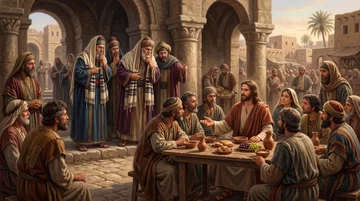
Cross-references
- Matthew 9:10
And it came to pass, as Jesus sat at meat in the house, behold, many publicans and sinners came and sat down with him and his disciples.
Parallel account of Jesus dining with Levi and many publicans and sinners.
- Mark 2:15-17
And it came to pass, that, as Jesus sat at meat in his house, many publicans and sinners sat also together with Jesus and his disciples: for there were many, and they followed him.
Jesus eats with publicans and sinners and explains his mission to call sinners.
- Mark 2:17
When Jesus heard it, he saith unto them, They that are whole have no need of the physician, but they that are sick: I came not to call the righteous, but sinners to repentance.
Jesus says he came to call sinners to repentance.
- Hosea 6:6
For I desired mercy, and not sacrifice; and the knowledge of God more than burnt offerings.
Jesus shows mercy toward sinners rather than prioritizing sacrifice.
Commentary
Each commentary is drawn from primary sources: the writings of Ellen G. White and Adventist pioneers and periodicals. Each commentary is separate. Its own words are not a quotation; follow the references to read the source passages.
Ellen G. White
21 sources
After His call Levi, also called Matthew, a despised publican left his tax work at once to follow Him, and in honor of that call made a great open feast in his own house for Jesus as the honored guest, inviting his former associates, relatives and friends to meet Jesus and hear Him, so that a great company of publicans and other rejected sinners sat down with Jesus and His disciples, who accepted and attended despite the offense it caused.Ms 72, 1895, par. 7–10DA 272.1–273.2Ms 36, 1898, par. 15–17DA 273.6–274.3
At that table He set aside social distinctions with sympathy, courtesy and respect that affirmed the dignity of outcasts and made them long to become worthy of His trust.DA 273.6–274.3GW 47.2ST Jun 9, 1914
He did not share in luxury, dissipation or worldly levity, but welcomed innocent social happiness in order to break down separation and turn thoughts from common concerns to spiritual and eternal things.3RED 11.2–12.1GW92 319.2–320.1GW 334.4–335.1
He was there on purpose to meet sin-sick souls where they were, asking and answering questions, speaking words of encouragement and searching truth that called sinners to repentance and satisfied the inmost longings priests and rulers left untouched.Ms 72, 1895, par. 7–10Ms 36, 1898, par. 15–172SP 189.1–3
His words awakened thirst for new life and, though not always answered at once, remained as seed that later bore fruit in converts who became messengers and helpers under the apostles after His resurrection, while exposing Pharisaic exclusiveness and leaving a lasting pattern for gospel and medical missionary workers to use friendly social occasions to recommend Christ to the erring.Ms 72, 1895, par. 7–10Lt 30, 1911, par. 11–13Ms 36, 1898, par. 15–17DA 273.6–274.32SP 188.3
Feast Setting and Guests
The feast comes directly after the call of Levi, also called Matthew, who belonged to the publicans, a class despised as traitorous and corrupt, yet when Jesus called him he followed without hesitation.DA 272.1–273.2 Feeling highly honored by that call, Levi made a great feast in his own house in honor of Jesus as the honored guest.Ms 72, 1895, par. 7–10Ms 36, 1898, par. 15–17DA 273.6–274.32SP 188.1–2 It was an open feast held as he was leaving his tax-collecting business and openly ending his business association with his former companions, without shame.Ms 72, 1895, par. 7–10Ms 36, 1898, par. 15–17 He invited his former associates, relatives and friends so they could see that he had chosen to follow Christ and could meet Jesus and hear His teaching, hoping His words would lead them to follow Him too.Ms 72, 1895, par. 7–10DA 273.6–274.32SP 188.1–2
There was a great company of publicans and of others present, described as sinners.Ms 72, 1895, par. 7–10Ms 36, 1898, par. 15–172SP 189.1–3 They were people from different social groups whom their more scrupulous neighbors rejected as outcasts.DA 273.6–274.33RED 11.2–12.1 They sat down with Jesus and His disciples, since Jesus and His disciples were invited to the feast.Ms 36, 1898, par. 15–172SP 188.1–22SP 189.1–3 Jesus accepted and attended despite the offense it caused, and He never refused invitations of this kind.Ms 36, 1898, par. 15–17DA 273.6–274.32SP 188.1–2
Jesus Ministry at Feast
At the publican's table Jesus set aside social distinctions as of no account and met the outcasts with sympathy, social kindness, courtesy and respect that upheld their human dignity.DA 273.6–274.3GW 47.2ST Jun 9, 1914ST Jul 16, 1902Ms 69, 1902, par. 6 His sympathetic presence did not merely comfort them but made them long to become worthy of His confidence and trust.DA 273.6–274.3GW 47.2ST Jun 9, 1914ST Jul 16, 1902Ms 69, 1902, par. 6 His words fell upon their thirsty souls with blessed, life-giving power.GW 47.2ST Jun 9, 1914ST Jul 16, 1902
His willingness to sit and eat with people from different social groups helped break down religious and social separation and opened opportunity to reach them with truth and do them good.3RED 11.2–12.1GW92 319.2–320.1 His presence at such a feast was not worldly conformity but a means of bringing heavenly benefit and letting hosts and guests know Him.GW92 319.2–320.1GW 334.4–335.1 He welcomed innocent happiness and used social occasions with people of every class to turn thoughts from ordinary concerns to spiritual and eternal things, without approving dissipation, luxuries, amusements, feasting or worldly levity.GW92 319.2–320.1GW 334.4–335.1MYP 384.110MR 273.1–2
He was there with deliberate purpose to meet people where they were, even at a guest table, and to sow the seeds of truth in human hearts and bring hope to souls sick with sin.Ms 72, 1895, par. 7–10Ms 36, 1898, par. 15–17Ms 128a, 1903, par. 14–15 He asked and answered questions that spread light, and He joined publicans and sinners to reach those who needed forgiveness in order to call sinners to repentance.Ms 36, 1898, par. 15–172SP 189.1–3 His words on such occasions were always spoken with wisdom and always exalted the truth, presenting principles that searched the recesses of hearts, reached the diseased imagination, and drew the mind out after eternal realities.15MR 168.3–4Ms 187, 1905, par. 23–27 He spoke words of encouragement to erring, sore-troubled men who needed guidance, words the priests and rulers were unwilling to speak, to satisfy the inmost longings of the soul.15MR 168.3–4
His life-giving words awakened new impulses, stirred desire for a new life, and opened its possibility to the outcasts of society.DA 273.6–274.3GW 47.2ST Jun 9, 1914ST Jul 16, 1902Ms 69, 1902, par. 6 Though hearts did not always respond at once, the seeds of truth remained in them and His influence continued to draw them until they finally yielded.Ms 36, 1898, par. 15–1710MR 273.1–2 Some who heard Him at the feast later accepted the truth under the apostles' teaching after His resurrection and ascension, and became gospel messengers and helpers in bringing its light to others.Ms 72, 1895, par. 7–10Ms 36, 1898, par. 15–17DA 273.6–274.32SP 189.1–3Ms 128a, 1903, par. 14–15 The feast itself was a lasting lesson to Matthew, who became a devoted evangelist.DA 273.6–274.3
His willingness to associate with publicans challenged the prejudices and traditions of the Pharisees and exposed the contrast between His life and teaching and their exclusiveness.2SP 188.3GW92 319.2–320.1GW 334.4–335.1 They accused His disciples of eating with publicans and sinners, while priests and rulers criticized His action and made all possible capital out of it.2SP 188.315MR 168.3–4
Pattern for Ministry Today
Luke 5:29 belongs to the record of Christ's works for the spiritual and physical needs of those who sought His help, revealing Him as the great Medical Missionary and the great Restorer.Lt 30, 1911, par. 11–13 Its study gives precious lessons for the ministry of healing, calling all engaged in gospel ministry and medical missionaries everywhere to do the work He did while on earth.Lt 30, 1911, par. 11–13 They are to learn His meekness and lowliness of heart, to testify to His power, and to stand firmly at the post of duty to reveal righteousness and the principles of righteousness to needy souls.Lt 30, 1911, par. 11–13
His acceptance of invitations to meals with publicans and others shows how to use friendly social occasions to teach lessons suited to the hearers.MYP 406.2GW92 319.2–320.1 At Levi's feast in his home, where publicans and others ate with them, He treated hosts and guests generously and let them know Him through godly character and conduct, giving them a chance to see how His life and teaching differed from the Pharisees' exclusiveness.GW92 319.2–320.1GW 334.4–335.1 His presence at such a meal was not worldly conformity but a way to bring heavenly benefits and let the light of truth reach them.GW92 319.2–320.1GW 334.4–335.1Ms 128a, 1903, par. 14–15 His example in this taught His disciples how to conduct themselves among both religious and nonreligious people.MYP 406.2 He met people where they were, even at a guest table, to sow seeds of truth among those willing to admit they were sinners, seeds that bore fruit under the apostles' teaching after His resurrection and ascension.Ms 128a, 1903, par. 14–15
His deliberate eating with publicans and sinners gives the tender, forgiving pattern to be practiced in helping the erring.15MR 168.3–4 He ate with them on purpose that He might speak words of encouragement to erring men that priests and rulers were unwilling to speak, to satisfy the inmost longings of the soul and to help sore-troubled ones who needed guidance and encouragement.15MR 168.3–4 The verse thus provides the example for speaking among unconverted people in a way that recommends Christ and lets the light of truth reach those willing to admit they are sinners.Ms 128a, 1903, par. 14–15Ms 187, 1905, par. 23–27 Though priests and rulers criticized His action and made all possible capital out of it, His words on such occasions were always spoken with wisdom and always exalted the truth, presenting principles that searched the recesses of listeners' hearts, reaching the diseased imagination and drawing the mind out after eternal realities.15MR 168.3–4
Sources
Pioneers and periodicals
17 sources
After his call to follow Jesus, Levi forsook all and honored Jesus with a great reception in his own house, inviting a great company of tax collectors and others of his own circle to meet the One who had welcomed him.ST Jul 23, 1894ST Jan 27, 1898ST Mar 5, 1894RH Aug 26, 1902 Jesus was there as the honored guest, sharing the meal with them and living as a true human being who ate and drank.ST Jun 9, 1914ST Apr 11, 1878 He accepted the invitation with the one unswerving purpose of saving sinners, remaining in the world but not of it and using ordinary social fellowship not to indulge appetite but to lift thoughts toward spiritual and eternal things.ST Jun 28, 1905ST Jun 28, 1905RH Nov 26, 1901ST Apr 2, 1912 By His sympathy, courtesy, and life-giving words He awakened in these outcasts who felt their need a longing for confidence and the possibility of a new life.ST Jun 9, 1914ST Jul 16, 1902ST Jun 28, 1905 His sharing of social life to instruct and save permits His followers to associate with people of any class to do good to souls and bodies without sharing in sin, rejecting social exclusiveness toward the poor and disfavored.ST Jun 3, 1886STRH Aug 26, 1902
Feast and Setting
In Luke's account the word rendered feast denotes a reception, a term found only in his Gospel.ST Jul 23, 1894 After the command to follow, Levi abandoned everything to follow Jesus and then honored him by preparing a great feast in his own house, where a great multitude of publicans and others sat at meat with them.ST Mar 5, 1894 The feast took place in Levi's own house, where a great company of publicans and others sat down with Jesus and his disciples, which shows Matthew reaching out to his own circle and inviting them to meet Jesus because Jesus had welcomed him.ST Jan 27, 1898 It was a meal in his home to which Levi invited Jesus, where many tax collectors and others ate with him, and his presence there shows meeting people in ordinary social settings as an opportunity to reach them.ST Jan 27, 1898RH Aug 26, 1902
The call of Levi and the feast he made for Jesus in his own house form the fourth division of Luke 5.ST Mar 12, 1894 This division follows the teaching from the boat with the miraculous draught of fishes, the cleansing of the leper, and the healing of the palsied man.ST Mar 12, 1894 It comes before the Sabbath controversies, the choosing of the twelve, the healing of the multitudes, and the pronouncing of blessings in Luke 6.ST Mar 12, 1894
Christ's Saving Presence
Jesus attended the great feast at Levi's house and shared a meal with others there as an honored guest, and his sitting at that entertainment shows he lived as a human being who ate and drank.ST Jun 9, 1914ST Apr 11, 1878 He accepted the publican's invitation to dine with one unswerving object, to save sinners.ST Jun 28, 1905ST Apr 2, 1912 That saving purpose gave meaning to his coming into the world, and it governed this meal just as it governed his teaching and praying and suffering and dying.ST Jun 28, 1905 At the feast, where publicans and all the lower classes mingled, he was in the world but not of the world, still in the bosom of his Father as the ladder reaching from earth to heaven with support from the heaven end.ST Jun 28, 1905 He was in harmony with neither the world's principles nor its customs nor its fashions nor its follies, and learned nothing from those present except their great need.ST Jun 28, 1905
He came close to people in an ordinary social setting not to indulge appetite or lower his standards but to lift their thoughts toward spiritual and eternal things.RH Nov 26, 1901 His presence among them showed that social fellowship could be innocent and could be used to influence people for good, without licensing dissipation or worldly conduct.RH Nov 26, 1901 By sitting at the publicans' table with sympathy and social kindness and courtesy that recognized human dignity, his presence made men long to become worthy of his confidence.ST Jun 9, 1914ST Jul 16, 1902 His words fell on their thirsty souls with life-giving power, awakening new impulses and opening to these outcasts of society the possibility of a new life.ST Jun 9, 1914ST Jul 16, 1902
Those present, or at least most of them, felt their need and believed he could supply it, and came where he was for the one purpose of hearing him, hearing him gladly, with no thought of seducing him to go with them.ST Jun 28, 1905 His choice to eat with publicans and sinners drew malice and accusation from those who condemned him for associating with evil people.ST Apr 2, 1896ST Aug 16, 1910
Pattern for Christian Fellowship
Jesus sharing social life with publicans and sinners in order to instruct and save them permits Christians to associate with people of any class when they go in his name and spirit to do good to souls and bodies.ST Jun 3, 1886RH Aug 26, 1902 Meeting people in an ordinary social setting such as a home meal is an opportunity to reach them.RH Aug 26, 1902 Christians need not exclude themselves from society with worldly people, but can associate with them while honoring and glorifying God, provided such contact does not share in sin but faithfully seeks to turn people from it.ST Jun 3, 1886
His eating with publicans and sinners whom the Pharisees condemned for his associating with them rejects social exclusiveness and treating people as inferior because they are poor or socially disfavored.ST The publicans he welcomed were lowly, and his welcome stands in contrast to welcoming brewers and distillers.ST Aug 10, 1882
Sources