Matthew 9:10
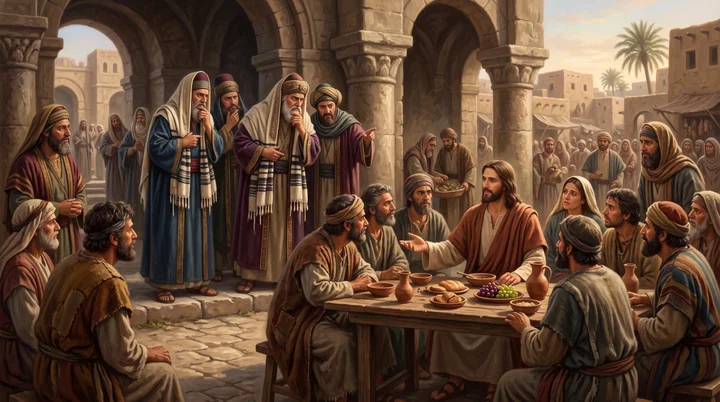
And it came to pass, as Jesus sat at meat in the house, behold, many publicans and sinners came and sat down with him and his disciples.
Translations
American King James Version, King James Version, KJV Cambridge Paragraph Bible
And it came to pass, as Jesus sat at meat in the house, behold, many publicans and sinners came and sat down with him and his disciples.
And it came to pass, as Jesus sat at table in the house, behold, many publicans and sinners came and sat down with him and his disciples.
Revised Version, American Standard Version
And it came to pass, as he sat at meat in the house, behold, many publicans and sinners came and sat down with Jesus and his disciples.
And it came to pass, he reclining (at meat) in the house, that lo, many tax-gatherers and sinners having come, were lying (at meat) with Jesus and his disciples,
And it came to pass, as he lay at table in the house, that behold, many tax-gatherers and sinners came and lay at table with Jesus and his disciples.
And it came to pass, as he was reclining in the house, that lo! many tax-collectors and sinners, came, and were reclining together with Jesus and his disciples.
Berean Standard Bible, Majority Standard Bible
Later, as Jesus was dining at Matthew’s house, many tax collectors and sinners came and ate with Him and His disciples.
As he sat in the house, behold, many tax collectors and sinners came and sat down with Jesus and his disciples.
And it came about, when he was in the house taking food, that a number of tax-farmers and sinners came and took their places with Jesus and his disciples.
And it came to passe, as Iesus sate at meate in his house, beholde, many Publicanes and sinners, that came thither, sate downe at the table with Iesus and his disciples.
Douay-Rheims (Challoner revision)
And it came to pass as he was sitting at meat in the house, behold many publicans and sinners came, and sat down with Jesus and his disciples.
Pictures
Cross-references 20 of 22
- Luke 5:29-32
And Levi made him a great feast in his own house: and there was a great company of publicans and of others that sat down with them.
Jesus eats with tax collectors and sinners and explains his mission to call sinners to repentance.
- Mark 2:15-17
And it came to pass, that, as Jesus sat at meat in his house, many publicans and sinners sat also together with Jesus and his disciples: for there were many, and they followed him.
Jesus shares a meal with sinners and explains that he came to call them to repentance.
- Hosea 6:6
For I desired mercy, and not sacrifice; and the knowledge of God more than burnt offerings.
God desires mercy rather than sacrifice, answering criticism of Jesus eating with sinners.
- Matthew 11:19
The Son of man came eating and drinking, and they say, Behold a man gluttonous, and a winebibber, a friend of publicans and sinners. But wisdom is justified of her children.
Jesus eats with publicans and sinners and is called their friend.
- Luke 7:36-50
And one of the Pharisees desired him that he would eat with him. And he went into the Pharisee’s house, and sat down to meat.
Jesus receives a sinful woman and forgives her.
- Luke 19:5-7
And when Jesus came to the place, he looked up, and saw him, and said unto him, Zacchæus, make haste, and come down; for to day I must abide at thy house.
Jesus chooses to stay in the home of a sinner.
- Matthew 21:31
Whether of them twain did the will of his father? They say unto him, The first. Jesus saith unto them, Verily I say unto you, That the publicans and the harlots go into the kingdom of God before you.
Jesus says publicans enter the kingdom before the religious leaders.
- 1 Timothy 1:15
This is a faithful saying, and worthy of all acceptation, that Christ Jesus came into the world to save sinners; of whom I am chief.
Christ came into the world to save sinners.
- Matthew 9:15
And Jesus said unto them, Can the children of the bridechamber mourn, as long as the bridegroom is with them? but the days will come, when the bridegroom shall be taken from them, and then shall they fast.
Jesus explains that his disciples feast while the bridegroom is with them.
- Luke 5:29
And Levi made him a great feast in his own house: and there was a great company of publicans and of others that sat down with them.
Both describe a feast where publicans and sinners gathered with Jesus.
- Luke 7:34
The Son of man is come eating and drinking; and ye say, Behold a gluttonous man, and a winebibber, a friend of publicans and sinners!
Both texts describe Jesus eating with publicans and sinners.
- Luke 5:27-28
And after these things he went forth, and saw a publican, named Levi, sitting at the receipt of custom: and he said unto him, Follow me.
The feast grew from Christ’s personal call to Levi.
- Luke 15:2
And the Pharisees and scribes murmured, saying, This man receiveth sinners, and eateth with them.
Records the leaders’ complaint that Jesus welcomed sinners and ate with them.
- Mark 2:18-20
And the disciples of John and of the Pharisees used to fast: and they come and say unto him, Why do the disciples of John and of the Pharisees fast, but thy disciples fast not?
The disciples’ fasting is questioned while Jesus is with them.
- Luke 5:33-35
And they said unto him, Why do the disciples of John fast often, and make prayers, and likewise the disciples of the Pharisees; but thine eat and drink?
Jesus’ presence with his disciples prompts the question of fasting.
- Luke 5:21-24
And the scribes and the Pharisees began to reason, saying, Who is this which speaketh blasphemies? Who can forgive sins, but God alone?
Scribes question Jesus’ authority to forgive sins despite his miraculous evidence.
- Matthew 5:46
For if ye love them which love you, what reward have ye? do not even the publicans the same?
Jesus eats with publicans and sinners, illustrating love beyond those who love you.
- Matthew 26:20
Now when the even was come, he sat down with the twelve.
Jesus shared a meal with his disciples, including the unfaithful Judas.
- Luke 18:13-14
And the publican, standing afar off, would not lift up so much as his eyes unto heaven, but smote upon his breast, saying, God be merciful to me a sinner.
The humble publican seeks mercy and is justified, unlike the self-righteous man.
- Revelation 3:20
Behold, I stand at the door, and knock: if any man hear my voice, and open the door, I will come in to him, and will sup with him, and he with me.
Christ enters and shares a meal with those who welcome him.
Commentary
Each commentary is drawn from primary sources: the writings of Ellen G. White and Adventist pioneers and periodicals. Each commentary is separate. Its own words are not a quotation; follow the references to read the source passages.
Ellen G. White
52 sources
Jesus sat at meat in Matthew's house, also called Levi, at the feast he made to honor Christ's call, where many publicans and sinners came and sat down with him and his disciples who were present with him at the table.Ms 61, 1899, par. 9Lt 112, 1909, par. 26Ms 36, 1898, par. 15–172SP 188.1–2ST Dec 28, 1876 The publicans were tax collectors hated as agents of Roman rule and despised as extortioners and traitors, a rejected class to which Matthew himself had belonged.DA 272.1–273.2 His sharing the meal was mercy toward sinners to call them to repentance, the work of a physician among the sick who came not to call the righteous but sinners, requiring mercy and not sacrifice.Ms 61, 1899, par. 9Lt 199, 1905, par. 7–8Ms 115, 1906, par. 12–1516MR 90.1–91.22SP 189.1–3 Sitting as an honored guest he showed sympathy and social kindness that affirmed their dignity and awakened longing for new life, and his words fell with life-giving power, yet he mingled and ate without adopting their low habits or being tainted in the least.GW 47.2DA 273.6–274.3STA 150.2MH 197.2–3MH 26.2 Eating with them offended the scribes and Pharisees, who accused him by asking why he eats with publicans and sinners, misinterpreting the holy feast as evil association.16MR 90.1–91.2RH Apr 30, 19014RED 45.2–32SP 188.3ST Dec 28, 1876 His example teaches believers not to shun others or withdraw from social contact but to mingle and meet them where they are in homes and at tables to reach souls, without joining in conduct that identifies them with unbelievers, and many at that table felt their need of pardon and accepted him as Redeemer.4RED 45.2–3GW92 319.2–320.1MYP 403.1FE 482.220MR 289.2
Setting and Company
The meal was a feast in the house of Matthew, also called Levi, which he made to honor Christ's call.Ms 36, 1898, par. 15–172SP 188.1–2ST Dec 28, 18764RED 40.2–3Ms 3, 1898 As soon as his heart was opened he opened his house to take Jesus home, arranging the gathering so that his friends, relatives and neighbors could meet Jesus and hear His teaching.Ms 36, 1898, par. 15–172SP 188.1–2ST Dec 28, 18764RED 40.2–3Ms 2, 1888, par. 39–41 Invitations of this kind were never refused, because there questions could be asked and answered to diffuse light, seeds of truth could be sown in human hearts that would respond in time, and the work of a physician seeking the sick could be done by going into busy places to find souls needing a Saviour and to show sinners their true condition.Ms 36, 1898, par. 15–172SP 188.1–2ST Dec 28, 1876 The same occasion gave the scribes and Pharisees opportunity to seek grounds for condemnation, yet the invitation was honored despite religious prejudice against associating with such company.2SP 188.1–2ST Dec 28, 1876
Many publicans and sinners came and sat down with Jesus at meat, and His disciples were present with Him at the table.Ms 61, 1899, par. 9Lt 112, 1909, par. 26ST Dec 28, 1876ST Jul 7, 1898DA 360.4–361.2 His willing fellowship with those regarded as sinners expressed mercy toward them and His purpose of calling them to repentance.Ms 61, 1899, par. 9Lt 112, 1909, par. 26 His presence at the meal was no failure to take spiritual matters seriously, though mourners misunderstood His purpose and condemned His practice because He did not follow their pattern of fasting.ST Jul 7, 1898DA 360.4–361.2
The publicans were tax collectors, hated as agents of Roman rule and often despised as extortioners and traitors to their nation.DA 272.1–273.2 They formed a rejected class to which Matthew himself had belonged before Jesus called him to follow.DA 272.1–273.2
The eating took place while John's disciples were mourning and fasting because John was in prison.Ms 3, 1898, par. 13–15 It belonged to the time when the bridegroom was present with His disciples, when mourning and fasting were not appropriate.Ms 3, 1898, par. 13–15 That hour was for catching light from Jesus and learning the spiritual nature of His kingdom and the grace of His character, to prepare them to work when He would be taken away.Ms 3, 1898, par. 13–15 The contrast led John's disciples to think He needed to reform His practice to do as John did, and by misinterpreting His purpose in eating with sinners they united with the Pharisees in condemning Him and sided with them in criticism.DA 360.4–361.2Ms 3, 1898, par. 13–15
Mission to Sinners
Sitting at meat with many tax collectors and sinners who came and sat with Him and His disciples expresses mercy toward sinners and the purpose of calling them to repentance.Ms 61, 1899, par. 9Lt 199, 1905, par. 7–8Ms 115, 1906, par. 12–15Lt 112, 1909, par. 26 His welcome shows He did not exclude them on account of their sinful or social standing, but reached those who needed spiritual healing and was willing to be with them in order to call them.Ms 61, 1899, par. 9Lt 199, 1905, par. 7–8Ms 115, 1906, par. 12–15Lt 112, 1909, par. 26 His presence among them was the work of a physician among the sick, for those who are whole do not need a physician but those who are sick do.16MR 90.1–91.22SP 189.1–3RH Apr 30, 19017MR 310.1–311.1 God requires mercy and not sacrifice, and He came not to call the righteous but sinners to repentance, to seek and heal those needing forgiveness and pardon.16MR 90.1–91.22SP 189.1–3RH Apr 30, 19017MR 310.1–311.1
The feast shows a turning from His own nation to those who would hear, because His own nation refused His healing for the wounds of sin and trampled His teachings and mighty works.ST Dec 28, 1876 Like His fasting in the wilderness, His eating with publicans was a giving of His life for their salvation and for redemption of the lost.DA 278.1–2 True devotion is therefore not mere fasting, bodily hardship, or outward religious forms, but surrender of self in willing service to God and others.DA 278.1–2
Manner Among Outcasts
Sitting as an honored guest at the table He showed sympathy and social kindness, treating the outcasts themselves as honored guests, recognizing the dignity of humanity in them, and awakening in them a longing to become worthy of His confidence.GW 47.2DA 273.6–274.3MH 26.22MR 109.1Ms 69, 1902, par. 6 His words fell upon their thirsty souls with blessed, life-giving power, stirring new impulses in their hearts.GW 47.2DA 273.6–274.3MH 26.22MR 109.1Ms 69, 1902, par. 6 For people cast out by society this opened the possibility of a new life, and for some it was their first hearing of the truth.GW 47.2DA 273.6–274.3MH 26.22MR 109.1
He mingled with them and ate with them without adopting their low habits, earthly ways, character or spirit, and without being tainted or corrupted in the least by their society or conversation.STA 150.2MH 197.2–320MR 289.2SW 2.2Ms 6, 1891, par. 4 His purpose was not to become low and earthly with them nor to share in their luxuries, amusement or feasting, but to present right principles by precept and example and to lift them up from low habits, earthliness, degradation and harmful manners.STA 150.2MH 197.2–3SW 2.2Ms 6, 1891, par. 4Ms 9, 1891, par. 24–26 He welcomed people from every class and mingled with ordinary people, ignoring society's distinctions of birth, wealth, learning and rank.Ms 138, 1908, par. 15MH 197.2–3Lt 2, 1878, par. 6–8 This loving-kindness that drew the despised to Him stands in contrast to approving those who in self-esteem keep apart and look down on others, and His generous mercy in meeting people where they were was not worldly conformity but stood opposed to self-righteous judgment.MH 164.2Lt 2, 1878, par. 6–8
He came to sow the seeds of truth in human hearts and to let the light of truth shine through His godly character, scattering precious gems of truth while sitting at their table.Ms 36, 1898, par. 15–17Ms 128a, 1903, par. 14–15Ms 128, 1903, par. 18–19Ms 9, 1891, par. 24–26 The jewels of truth that fell from His lips remained in their hearts, and though they might not yield at once to the influence of the Spirit they were affected and kept drawn until they would finally yield.Ms 36, 1898, par. 15–17Ms 9, 1891, par. 24–26 That seed sprang up after His resurrection and ascension under the teaching of the apostles, when five thousand were converted in one day.Ms 128a, 1903, par. 14–15Ms 128, 1903, par. 18–19
Opposition and Accusation
Sharing the table with tax collectors and outcasts struck directly against the prejudices and traditions of the scribes and Pharisees, and they seized upon that fellowship to accuse Him by demanding of His disciples why their Master eats with publicans and sinners.16MR 90.1–91.2RH Apr 30, 19012SP 188.3 On that occasion John's disciples sided with the Pharisees in the criticism.DA 360.4–361.2 Though the critics rejected His teachings, they recognized His influence and directed their complaint against His disciples for sharing the meal with such people.2SP 188.3
The charge was scandal, reproach, and falsehood, coming from watching spies whose hearts were not open to conviction but were filled with hatred, bitter prejudice, and wrath.16MR 90.1–91.2 It is the same accusation that men today bring against God's commandment-keeping people.16MR 90.1–91.2
The jealous, self-righteous critics misinterpreted the holy feast and charged Him with immorality, impiety, and evil association.4RED 45.2–3ST Dec 28, 18762SP 192.3–193.1 Not daring to complain to Him after His rebukes, they carried their complaints to His disciples in order to create prejudice and unbelief.ST Dec 28, 1876 The disciples rightly ignored them.ST Dec 28, 1876
John's disciples and other mourners misunderstood His purpose and condemned His practice because He did not follow their pattern of fasting.ST Jul 7, 1898Ms 3, 1898, par. 13–15 Because they misinterpreted His purpose in eating with sinners they united with the Pharisees in condemning Him, thinking He needed to reform His practice to do as John did.Ms 3, 1898, par. 13–15 His presence at the meal was not a failure to take spiritual matters seriously.ST Jul 7, 1898
Those despised sinners who received Him will be gathered into His kingdom when He comes in His glory.4RED 45.2–3ST Dec 28, 18762SP 192.3–193.1 The fasting, hypocritical, and unbelieving Pharisees who scorned them will share the portion of hypocrites and unbelievers and face judgment.4RED 45.2–3ST Dec 28, 18762SP 192.3–193.1
Fruit of the Feast
At the table he spoke words of life to those gathered, and many accepted him as their Redeemer.4RED 45.2–3ST Dec 28, 18762SP 192.3–193.1 The guests felt their need of repentance and pardon and were receptive to his teaching.2SP 189.1–34RED 40.4–42.1 Those who felt their need of pardon proved more ready to receive truth than the religious leaders who scorned them.2SP 189.1–3
Some who attended and listened became instruments of enlightenment to others.DA 273.6–274.34RED 40.4–42.1 Some thus received their first hearing of the truth at the feast and later became gospel messengers.DA 273.6–274.3 Matthew himself was changed from a despised publican into a devoted evangelist with an unselfish heart drawn out for souls needing light.ST Dec 28, 1876 He did not repulse sinners by magnifying his own piety against their sinfulness, but linked them to himself through kindly sympathy while presenting the gospel, and his labors had marked success.ST Dec 28, 1876
His fellowship offered tender, forgiving encouragement and wise guidance to people in error whom religious leaders would not encourage.15MR 168.3–4 In that fellowship he met the soul's deepest needs, upheld truth with wise words, and turned minds toward eternal realities.15MR 168.3–4 Those who are troubled and in need of guidance are therefore to be met with such love and not pushed away.15MR 168.3–4
Pattern for Believers
Christ's sitting at meat with publicans and sinners shows that his followers are not to shun their fellow people or withdraw from social contact, but to seek their company in order to share the spiritual blessings received.GW92 319.2–320.1MYP 403.1GW 394.1–2 Reaching people means meeting them where they are, in homes and at hospitable tables, mingling with them so as to turn their thoughts to matters of eternal importance rather than refusing their company.MYP 403.1FE 482.2GW 394.1–2Lt 95, 1899, par. 24 His sympathies were identified with suffering humanity, reaching the sinful, helpless and needy where they were and making their necessities his own.Ms 6, 1875, par. 4 Those whose unpopular faith separates them from the world must therefore not place themselves in sympathies and views so far from the world that they cannot reach souls, nor close the door of access to souls by judging other men's consciences and binding exacting burdens that God does not bind.Ms 6, 1875, par. 4
Doing good among unbelievers is to be done without joining them in plans or conduct that would identify believers with them.FE 482.220MR 289.2 He associated with publicans and sinners without adopting their character or spirit, so that through his words he could sow truth, lead them to become one with him, and bring them toward the light.20MR 289.2 He did not eat with them to share in their luxuries, amusement or feasting, but to diffuse precious gems of truth and scatter them while sitting at their table, jewels that remained in their hearts and, though not yielding at once, would finally yield as he keeps drawing them.Ms 9, 1891, par. 24–26 His followers are thus to go among the needy and sinful to diffuse light, speak words of kindness, and show his love, tenderness and compassion rather than joining the practices of the world.Ms 9, 1891, par. 24–26
Friendly social gatherings and meals with people who are not religious are opportunities to speak in a way different from the usual conversation there, bringing life and teaching lessons suited to the hearers.6T 173.2 His example is to continually sow the seed of life in words that take root in the soil of the heart, with speech that recommends Christ.Ms 10, 1891, par. 17–19Ms 187, 1905, par. 23–27 At the dining table words are to be kept clean and pure rather than common, low, cheap chit-chat, jesting and joking, so that the Holy Spirit and angels can be present, good things come forth from the treasure house of the heart, light is reflected, and impressions are made on minds.Ms 10, 1891, par. 17–19
His eating with publicans and sinners and mingling with ordinary people was not to adopt their low habits or become low and earthly with them, but to teach right principles by word and example and by precept and example, and to lift them from earthliness, degradation, low habits and manners and harmful habits.STA 150.2MH 197.2–3SW 2.2Ms 6, 1891, par. 4 In that fellowship he ignored society's distinctions of birth, wealth, learning and rank, welcoming people from every class.Ms 138, 1908, par. 15MH 197.2–3 That welcome of all classes supports receiving all classes into sanitariums and laboring for the poor and suffering.Ms 138, 1908, par. 15 As soon as he opened Matthew's heart, Matthew dropped his former occupation, entered his service, and opened his house as a home for Jesus.Ms 2, 1888, par. 39–41 This opening of heart and house is the proof of God's good work to be manifested by all who are converted, taking Jesus home into hearts and houses and presenting him to neighbors, letting families and children see the sweet grace of Christ at work in the heart and exemplified in the character, letting the efficacy of his blood avail and his righteousness become personal righteousness, and bearing a living testimony of what he has done for the soul.Ms 2, 1888, par. 39–41
His presence among them, welcoming them into his company so they could receive his blessings and learn his character, was generous mercy and not worldly conformity.16MR 318.2–319.1Lt 2, 1878, par. 6–8 He mingled with people of every class and entered homes when invited, using such occasions to reveal the contrast between his generous mercy and life and the Pharisees' bigotry, self-righteous judgment and ways.GW92 319.2–320.116MR 318.2–319.1Lt 2, 1878, par. 6–8 His example shows that religious service must not become self-righteous withdrawal from others, and that helping people requires meeting them where they are so they may have opportunity to know him.16MR 318.2–319.1Lt 2, 1878, par. 6–8
Sources
Pioneers and periodicals
44 sources
As Jesus sat at meat in Matthew's own house in Capernaum, many publicans and sinners came and sat down with him and his disciples, for the feast was arranged so his former associates and friends could meet Jesus as honored and willing guest.ST Dec 28, 1876ST Jan 27, 1898ST Oct 11, 1899ST Mar 10, 1898ST Apr 23, 1896 He welcomed those despised as outcasts because he came to call sinners to repentance as a physician goes to the sick, seeking and saving the perishing who felt their need and believed he could meet it.RH Apr 30, 1901ST Jan 27, 1898RH Aug 26, 1862RH Nov 3, 1863ST Jun 28, 1905 By sympathy and kindness at the table he affirmed their dignity, drew them toward spiritual and eternal things, and spoke words of life and hope that many accepted and then carried to others.ST Dec 28, 1876ST Dec 28, 1876ST Oct 30, 1907RH Nov 26, 1901 His willingness to receive them and share their company drew the criticism of the Pharisees, who misinterpreted the holy feast and charged him with evil association because he did not follow their pattern.RH Apr 30, 1901ST Dec 28, 1876ST Jul 7, 1898ST Oct 11, 1899ST Mar 10, 1898 His mingling proves it is safe and right for Christians to associate socially with any class to instruct them and seek their salvation, reaching those in need rather than avoiding them, yet without joining in sin, lowering principle, or sympathizing with sin.RH Jan 8, 1914ST Jun 3, 1886RH Nov 26, 1901ST Jun 28, 1905
Meal Setting and Guests
The meal took place in the house of Matthew, also called Levi, in Capernaum.ST Dec 28, 1876ST Jan 27, 1898ST Jun 2, 1898ST Dec 3, 1894 It was arranged so that Matthew's friends and relatives and former associates among the publicans could meet Jesus and hear his instruction.ST Dec 28, 1876ST Dec 28, 1876ST Jan 27, 1898ST Mar 10, 1898 Many tax collectors and sinners from Matthew's former circle came to that gathering.ST Jan 27, 1898ST Mar 10, 1898
Matthew was a Galilean Jew from Capernaum who worked as a tax gatherer and collector of customs under Roman rule.RH Sep 28, 1916ST Jun 2, 1898 His work was collecting dues and customs from travelers and cargoes crossing the Sea of Galilee or passing through Capernaum on the Damascus road.RH Sep 28, 1916 He left that profitable calling to cast in his lot with Jesus and follow him.RH Sep 28, 1916ST Jun 2, 1898
Many publicans and sinners came and sat down with him and his disciples, and such people gladly received him into their homes.ST Oct 11, 1899ST Apr 23, 1896ST Mar 24, 1898 Jesus was present there together with his disciples, sitting at meat in the house as honored and willing guest.ST Oct 30, 1907ST Oct 11, 1899RH Sep 25, 1913ST Jul 21, 1898 He brought his disciples with him into that company.ST Oct 11, 1899RH Sep 25, 1913
The verse should not be treated as an isolated unit, since the chapter division cuts sharply across the flow of the narrative.ST Oct 13, 1898 It belongs to the account of the feast at Levi's house, an event that took place between Jesus' teaching of the parables and the sending out of the twelve disciples.ST Dec 3, 1894
Savior's Mission to Sinners
Jesus did not confine his company to the socially respectable but welcomed and ate with tax collectors and sinners who were treated as outcasts, showing that need rather than standing should guide efforts to help them.ST Jan 27, 1898RH Dec 11, 1856RH May 28, 1861 He mingled with sinners of every kind and did not exclude the despised and socially disfavored from his company or the gospel.RH Dec 11, 1856RH May 28, 1861 His willingness to receive them at the table illustrates that their need, not social standing or respectability, is the rule for reaching them.ST Jan 27, 1898
He explained that welcome by saying he came to call sinners to repentance and not those who consider themselves righteous, just as a physician goes to the sick.RH Apr 30, 1901RH Aug 26, 1862 Sinners should therefore come to him as they are rather than wait until they feel worthy, for he receives them.RH Aug 26, 1862 That reception means he takes people despite their sin and supplies what they lack, cleansing by his blood alone to give forgiveness, peace, and perfect righteousness.RH Aug 26, 1862RH Dec 14, 1916
His presence among publicans and sinners was practical and personal, reflecting his purpose to seek and save the perishing and lost.RH Nov 3, 1863RH May 9, 1871ST Apr 2, 1912RH Sep 25, 1913ST Oct 2, 1893 They came to hear him because they felt their need and believed he could meet it, and he went among them to save them without sharing the world's spirit or customs.ST Jun 28, 1905ST Apr 2, 1912 He met them with love and hope, showing himself a loving and tender Saviour who healed those he sought.RH May 9, 1871ST Oct 2, 1893 He brought his disciples with him so they could see him reach sinners and learn by example how to continue that work.RH Sep 25, 1913
At the table his sympathy and kindness affirmed their dignity and inspired them to want to become worthy of his confidence, while his words brought life-giving hope to their hearts.ST Oct 30, 1907 His ease among people of different classes drew them toward spiritual and eternal things, and there he spoke the words of life that many accepted as from their Redeemer.ST Dec 28, 1876RH Nov 26, 1901 That holy feast made the meal a place of instruction and acceptance rather than exclusion.ST Dec 28, 1876
His willingness to sit at such a table shows his presence in a home is not limited by poverty, trouble, or the moral standing of its guests.RH Apr 8, 1902 Matthew himself illustrates the result, changed from a despised publican into a devoted evangelist with an unselfish heart drawn out for souls needing light, who linked sinners to himself through kindly sympathy while presenting the gospel instead of repulsing them by magnifying his own piety against their sinfulness.ST Dec 28, 1876 His labors had marked success, and many who sat at that feast listening to Jesus became instruments of enlightenment to others.ST Dec 28, 1876ST Dec 28, 1876 The despised ones who received him will be gathered into his kingdom when Christ comes in his glory, while the fasting, jealous, self-righteous Pharisees who scorned those sinners will have their portion with hypocrites and unbelievers.ST Dec 28, 1876
Opposition and Misjudgment
The meal drew many tax collectors and sinners, including people from Matthew's former circle, to sit with Jesus and his disciples in Matthew's house.RH Apr 30, 1901ST Oct 11, 1899ST Mar 10, 1898 Their presence drew the criticism of the Pharisees and Jewish religious leaders, who condemned his willingness to receive such people and share their company.RH Apr 30, 1901ST Oct 11, 1899ST Mar 10, 1898 That willingness was a defining feature of his ministry, and his welcome explained that he came to call sinners to repentance, as a physician goes to the sick.RH Apr 30, 1901ST Oct 11, 1899 Pharisaic rules did not determine who could come to him, for publicans and sinners coming to eat with him and his disciples shows they were not barred from his company.ST Apr 23, 1896ST Apr 2, 1896 His opponents used his eating with publicans and sinners as grounds to malign him, yet associating with people regarded as sinners was not a reason to condemn him.ST Apr 23, 1896ST Apr 2, 1896
The gathering was a holy feast where he spoke to them words of life and many accepted him as Redeemer, but the jealous, self-righteous Pharisees misinterpreted the meal.ST Dec 28, 1876 They charged him with immorality, impiety, and evil association.ST Dec 28, 1876 Not daring to complain to him after his rebukes, they carried their complaints to his disciples to create prejudice and unbelief, but the disciples rightly ignored them.ST Dec 28, 1876 His presence at the meal with his disciples was not a failure to take spiritual matters seriously.ST Jul 7, 1898 Those mourning his practice misunderstood his purpose and condemned it because he did not follow their pattern of fasting.ST Jul 7, 1898
He lived in close contact with people regarded as poor, low, and unclean, and showed no repulsion toward them.ST Jan 27, 1904RH Sep 9, 1909 His repulsion was directed toward hypocrites and formalists.ST Jan 27, 1904 His sitting at a meal with publicans and sinners stands as conduct opposed to cruelty toward others.RH Sep 9, 1909ST Sep 22, 1909 That conduct is contrasted with the cruelty of one who pursued people for their Sabbath observance.ST Sep 22, 1909
Pattern for Christian Fellowship
Though the Son of God, Jesus mingled with the people and sat at meat with publicans and sinners together with his disciples, and his course proves it is safe and right to follow his example in matters of eating and association.RH Jan 8, 1914 His disciples were commissioned to follow that example of welcoming the company of sinners of every kind and even receiving one among the twelve, as he ultimately died for sinners. People in need of spiritual help are precisely those to be sought and reached rather than avoided as beneath notice, for his sitting with publicans and sinners shows his concern for people regarded as sinners and the work of bringing them to him.ST Jan 22, 1885ST May 17, 1899 A mission that serves people in need in this way shows its work is done for Christ.ST May 17, 1899
Christians may associate socially with any class of people in order to instruct them, do them good, and seek their salvation.ST Jun 3, 1886ST Dec 21, 1915ST Mar 1, 1899 That means loving and associating with people who sin rather than limiting fellowship to the righteous, and seeking opportunities to do them good as he did.ST Dec 21, 1915ST Mar 1, 1899 Christians should eat at the same table even with one judged to be a sinner, and must not turn a cold shoulder, shun a brother in the church, or refuse to eat with him because of an evil report about him or because he spoke disparagingly.RH Jan 8, 1914RH Jan 8, 1914 Refusing to eat with such a person is like the caste customs of India that forbid eating with or taking food from one of lower caste, and like the pride and religious bigotry that led the Jews to refuse to eat with Gentiles.RH Jan 8, 1914
Love and care for people who are marginalized or regarded as sinful must not be blocked by social rank, wealth, education, attainments, or respectability.STRH Apr 20, 1916 Drawing near to him obliterates distinctions of wealth, education, and attainments, for he did not separate himself into cliques or a favored set but freely associated with rich and poor, learned and ignorant, giving kindness to all who needed help rather than only to a few.RH Apr 20, 1916 Christians must do the same and not use distinctions of class or status to keep others at a distance, but choose friends and associates for real worth and character rather than for position, wealth, education, fine clothes, fluent speech, or agreement in oddities, hobbies, and opinions.STRH Apr 20, 1916
His creed and Spirit is to seek the poor, humble, sinful, and common people rather than the rich and fashionable.ST Jul 21, 1898 His method of helping the poor and unfortunate is to go to them, lodge in lowly places as in the manger, enter the homes of outcasts such as Zacchaeus, and preach to the common people who hear him gladly.ST Jul 21, 1898 His followers should likewise welcome the poor, abandoned, and distressed rather than make them feel unwelcome in the place of worship.RH Nov 3, 1863ST Jul 21, 1898 A church that shuts out the poor man in rough clothing to keep the rich man's pew pleasant has drifted from Christ and has little of Christ or his Spirit, while the true church follows his example of receiving sinners.ST Jul 21, 1898
By joining the hardened and outcast in the ordinary setting of a home he made personal contact with them and opened the way for God's kingdom.ST Dec 4, 1901 His example calls his followers to serve others through humble, direct involvement.ST Dec 4, 1901 He brought his disciples with him so they could see him reach sinners and learn by example how to continue that work of seeking and saving the lost.RH Sep 25, 1913 His example teaches that people may adapt to social customs and cross social customs to reach and help others considered fallen, so long as no principle is sacrificed.
Mingling ever so freely with all men, including old companionships and close natural ties such as husband and wife, brother and sister, and friends of former days, is right when done as he did.ST Nov 4, 1886 It must be done with the single purpose and settled determination of gaining them back to God and winning them over to the Lord's side while being true to God and the soul.ST Nov 4, 1886 God will show how to walk with him and with companions until they are either won or themselves break the fellowship.ST Nov 4, 1886
Associating Without Sharing Sin
He was at ease among publicans and sinners and shared their meal without joining in sin or lowering his principles.ST Jun 3, 1886RH Nov 26, 1901 He dined among them without sharing the world's spirit or customs and without sharing in or sympathizing with their sins.ST Jun 3, 1886ST Jun 28, 1905 He associated socially with them so that he could instruct them and save them, and his presence among people of different classes was a way to draw them toward spiritual and eternal things.ST Jun 3, 1886RH Nov 26, 1901ST Jun 28, 1905 They came to hear him because they felt their need and believed he could meet it.ST Jun 28, 1905 Contact with worldly people does not itself corrupt a Christian, for he could eat with publicans and sinners without acting like them.RH Dec 12, 1865
Mingling ever so freely with all men is right when done as he did, with the single purpose and settled determination of gaining them back to God and winning them over to the Lord's side while being true to God and the soul.ST Nov 4, 1886 This gives the pattern for dealing with old companionships and close natural ties such as husband and wife, brother and sister, and friends of former days.ST Nov 4, 1886 The danger is preserving friendship at the expense of Christian testimony and being lured back onto the devil's ground, and God will show how to walk with him and with companions until they are either won or themselves break the fellowship.ST Nov 4, 1886
Sources