Luke 6:16
And Judas the brother of James, and Judas Iscariot, which also was the traitor.
Translations
American King James Version, King James Version
And Judas the brother of James, and Judas Iscariot, which also was the traitor.
and Judas the brother of James, and Judas Iscariot, which also was the traitor.
And Judas the brother of James, and Judas Iscariot, who also was the traitor.
and Judas the son of James, and Judas Iscariot, which was the traitor;
and Judas the son of James, and Judas Iscariot, who became a traitor;
Judas of James, and Judas Iscariot, who also became betrayer;)
[ and] Judas [brother] of James, and Judas Iscariote, who was also [ his] betrayer;
and Judas Iscariot, who became betrayer;—
Berean Standard Bible, Majority Standard Bible
Judas son of James, and Judas Iscariot, who became a traitor.
Judas the son of James; and Judas Iscariot, who also became a traitor.
And Judas, the son of James, and Judas Iscariot, he who was false to him.
Iudas Iames brother, and Iudas Iscariot, which also was the traitour.)
Douay-Rheims (Challoner revision)
And Jude, the brother of James, and Judas Iscariot, who was the traitor.
Pictures
Cross-references
- Mark 3:13-19
And he goeth up into a mountain, and calleth unto him whom he would: and they came unto him.
parallel account of calling the twelve
- John 6:71
He spake of Judas Iscariot the son of Simon: for he it was that should betray him, being one of the twelve.
Jesus identifies Judas Iscariot as the one who would betray him.
- Matthew 10:4
Simon the Canaanite, and Judas Iscariot, who also betrayed him.
Names Judas Iscariot among the apostles and identifies him as the betrayer.
- Acts 1:17
For he was numbered with us, and had obtained part of this ministry.
Judas was numbered among the apostles.
- Matthew 26:14-16
Then one of the twelve, called Judas Iscariot, went unto the chief priests,
Judas agrees to betray Jesus for silver.
- Luke 22:47-48
And while he yet spake, behold a multitude, and he that was called Judas, one of the twelve, went before them, and drew near unto Jesus to kiss him.
Jesus is betrayed with Judas’s kiss.
- Matthew 26:47-49
And while he yet spake, lo, Judas, one of the twelve, came, and with him a great multitude with swords and staves, from the chief priests and elders of the people.
Judas identifies Jesus with a kiss in Gethsemane.
- Luke 6:12
And it came to pass in those days, that he went out into a mountain to pray, and continued all night in prayer to God.
Jesus prayed all night before choosing the twelve apostles.
Commentary
Each commentary is drawn from primary sources: the writings of Ellen G. White and Adventist pioneers and periodicals. Each commentary is separate. Its own words are not a quotation; follow the references to read the source passages.
Ellen G. White
8 sources
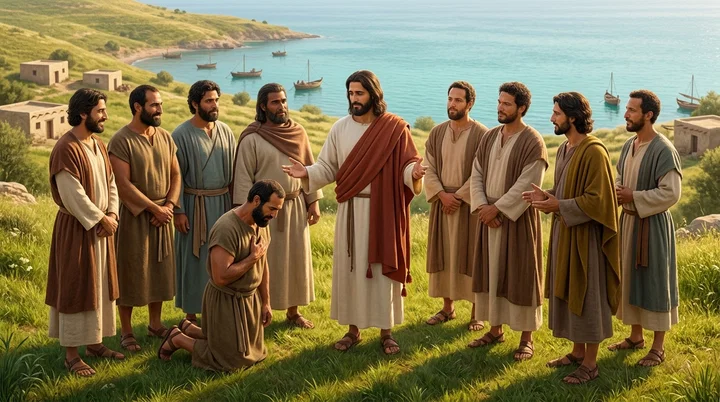
Luke 6:16 supplies the final two names in the calling and ordination of the twelve to the apostolate.DA 290.2–291.2DA 290.1ST Dec 19, 1916 The calling took place beneath the sheltering trees on a mountainside a little distance from the Sea of Galilee, where the Sermon on the Mount was given.DA 290.2–291.2DA 290.1ST Dec 19, 1916 Jesus prepared for the ordination by resorting to the solitude of the mountains and spending the night in prayer to His Father before the ordination and the Sermon on the Mount, as He did when preparing for some great trial or important work. The calling was the first step in the organization of the church that after His departure was to be His representative on earth.DA 290.2–291.2
With no costly sanctuary at command, He led the disciples to a retreat He loved, and the sacred experiences of that day were forever linked in their minds with the beauty of mountain and vale and sea, having withdrawn from the confusion of the city to the quiet of fields and hills as more in harmony with the lessons of self-abnegation He desired to teach.DA 290.2–291.2 Fields and hills were His favorite resorts, and much of His teaching was given under the open sky rather than in the temple or synagogues, not only because no synagogue could have received the throngs that followed Him but because He loved the scenes of nature, to whom each quiet retreat was a sacred temple.DA 290.1 The call offered no flattering prospects in this life and no promise of gain or worldly honor, and those called made no stipulation about what they should receive, but left all at once without question or hesitation, without demanding pay equal to former work or asking how to live and sustain family, content to be with Christ to hear His words and unite with Him in His work, and could afterward testify they lacked nothing.SSP 3.1–3
The same call still requires making God's service supreme with clear conceptions of duty and unselfish aspirations, rejoicing to be co-workers with Christ and trusting His care rather than putting compensation first.SSP 3.1–3 Judas was included among those Jesus chose because the other disciples wanted him to join them and recommended him for his commanding appearance, keen discernment, and executive ability, thinking he could greatly help the work.Ms 106, 1903, par. 41 The verse identifies Judas Iscariot as numbered among the twelve apostles although imperfect in character, even as the traitor who betrayed Jesus.GC88 43.2ST Feb 9, 19158MR 107.2–108.3
His place among the disciples did not mean his character was approved, but he was accepted despite his faults so he could learn from teaching and example, recognize his errors, repent, and be changed by divine grace, yet he rejected that opportunity, cherished sin, resisted correction, and ultimately betrayed his Master.GC88 43.2 His place among the apostles and Christ's experience with him show long patience with perverse human nature and teach followers to bear patiently with false brethren in the church.ST Feb 9, 1915
Sources
Pioneers and periodicals
12 sources
Luke 6:16 closes the list of the twelve whom Jesus chose and ordained as apostles after spending the whole night in prayer alone on the mountainside and calling his disciples to him at daybreak.RH Aug 17, 1916RH Apr 15, 1909RH Nov 14, 1912ST Mar 12, 1894 It names two different men to keep them distinct, Judas the brother of James, who is also Lebbaeus or Thaddaeus called Jude, and Judas Iscariot last as the one who would become the traitor.RH Apr 15, 1909RH Nov 14, 1912RH Apr 7, 1868RH Dec 7, 1916RH Sep 18, 1900 This choosing was the first step in organizing the church to represent Christ on earth, with the apostolic office serving the whole church.RH Aug 17, 1916RH Apr 15, 1909 Though ordained among the twelve, Judas Iscariot did not follow Christ in heart, but clung to greed until he stole from the money entrusted to him and betrayed his Lord with a kiss in Gethsemane for thirty pieces of silver.RH Dec 7, 1916RH Sep 18, 1900 His place among the apostles shows that ordination alone does not prevent apostasy, and teaches Christ's long patience with perverse nature and forbearance toward false brethren in the church while warning against greed.ST Feb 9, 1915RH Sep 18, 1900RH May 12, 1863ST Dec 2, 1897
Choosing and Naming Apostles
Jesus showed His dependence on God by resorting to the solitude of the mountains and continuing all night in prayer to His Father, beneath the trees on the mountainside near the Sea of Galilee, and as soon as it was day calling His disciples to Him and choosing the twelve.ST Dec 19, 1916RH Nov 14, 1912ST Mar 12, 1894 He prayed in this way when preparing for some great trial or some important work, and this night of prayer came before the ordination and the Sermon on the Mount. The choosing was the ordination and naming of the twelve as apostles, the first step in organizing the church that would represent Him on earth after His departure.RH Aug 17, 1916RH Apr 15, 1909
After choosing the apostles, He came down to a level place where a large crowd had gathered to hear Him and be healed, and He taught them, pronouncing blessings upon them before they left.ST Mar 12, 1894ST May 5, 1881 This work of Sabbath mercy, healing the multitudes on the plain, and preaching the Sermon on the Mount came next, standing together with the choosing of the twelve as the work Jesus did next.ST Mar 12, 1894
The verse names two different men, Judas the brother of James and Judas Iscariot, distinguishing them from each other.RH Apr 15, 1909 Judas the brother of James is the same person as Lebbaeus and Thaddaeus, also called Jude, not Iscariot.RH Apr 7, 1868 Judas Iscariot is named as the last of the twelve and is identified as the traitor who would betray Jesus.RH Apr 15, 1909RH Nov 14, 1912RH Sep 18, 1900
The twelve were representatives of the gospel church, and their apostolic office served the whole church, not just one locality.RH Aug 17, 1916
Traitor's Course and Lessons
Luke 6:16 names Judas Iscariot among the disciples as the one who would be the traitor and betray Jesus, distinguishing him from Judas the brother of James.RH Apr 15, 1909RH Nov 14, 1912RH Dec 7, 1916 He was one of the twelve apostles Christ chose as the first step in organizing the church, in the account of Jesus praying through the night before choosing his disciples.RH Apr 15, 1909RH Nov 14, 1912 His clinging to sin made him a failure and a betrayer.RH Dec 7, 1916
He heard the same teaching and witnessed the same works as John, yet resisted Christ's pleading, hardened his heart, and strayed from him. Though he accepted that high calling and professed to follow Christ, he did not follow in heart or truth. His greed led him to steal money entrusted to him and finally to sell his Lord, betraying him to death for pieces of silver, for thirty pieces of silver, identifying him with a kiss in Gethsemane.RH Sep 18, 1900 He is called a son of perdition, fell from his high calling and position as apostle, became a failure and betrayer, and came to a terrible end.RH Dec 7, 1916
Jesus ordained Judas as one of the twelve apostles, yet Judas became a traitor, so ordination and succession alone do not prevent apostasy.ST Dec 2, 1897 Judas Iscariot was numbered among the apostles despite being the traitor, and even among the twelve chosen by Jesus there was a Judas and a rash Peter.ST Feb 9, 1915RH May 12, 1863 His place among them and Jesus' experience with him show Christ's long patience with perverse human nature and teach his followers to bear patiently with false brethren in the church, and one such person may be expected among every twelve.ST Feb 9, 1915RH May 12, 1863 His example in betraying Jesus for pieces of silver as the last of the twelve warns against greed.RH Sep 18, 1900
Sources