Matthew 26:47
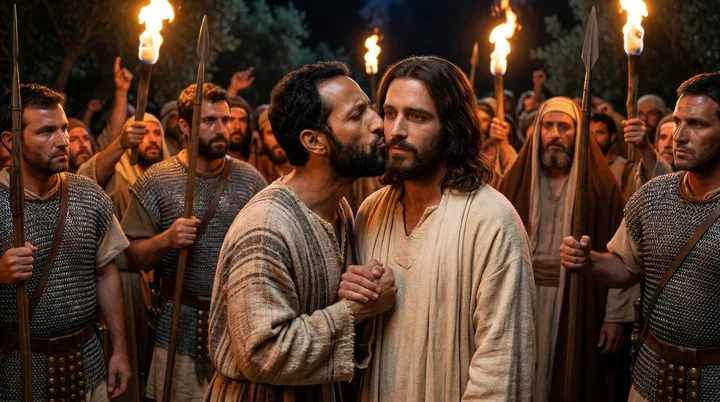
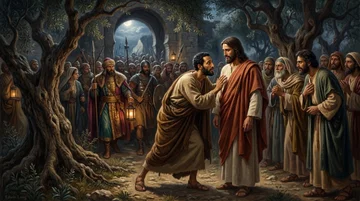
And while he yet spake, lo, Judas, one of the twelve, came, and with him a great multitude with swords and staves, from the chief priests and elders of the people.
Translations
And while he yet spoke, see, Judas, one of the twelve, came, and with him a great multitude with swords and staves, from the chief priests and elders of the people.
King James Version, KJV Cambridge Paragraph Bible, Revised Version, American Standard Version
And while he yet spake, lo, Judas, one of the twelve, came, and with him a great multitude with swords and staves, from the chief priests and elders of the people.
And while he was yet speaking, lo, Judas, one of the twelve, came, and with him a great multitude with swords and staffs, from the chief priests and elders of the people.
And while he is yet speaking, lo, Judas, one of the twelve did come, and with him a great multitude, with swords and sticks, from the chief priests and elders of the people.
And while he was yet speaking, behold, Judas, one of the twelve, came, and with him a great crowd with swords and sticks from the chief priests and elders of the people.
And, while, yet, he was speaking, lo! Judas, one of the twelve, came, and, with him, a large multitude, with swords and clubs, from the High-priests and Elders of the people.
Berean Standard Bible, Majority Standard Bible
While Jesus was still speaking, Judas, one of the Twelve, arrived, accompanied by a large crowd armed with swords and clubs, sent from the chief priests and elders of the people.
While he was still speaking, behold, Judas, one of the twelve, came, and with him a great multitude with swords and clubs, from the chief priests and elders of the people.
And while he was still talking, Judas, one of the twelve, came, and with him a band armed with swords and sticks, from the chief priests and those in authority over the people.
And while hee yet spake, loe Iudas, one of the twelue, came, and with him a great multitude with swordes and staues, from the high Priests and Elders of the people.
Douay-Rheims (Challoner revision)
As he yet spoke, behold Judas, one of the twelve, came, and with him a great multitude with swords and clubs, sent from the chief priests and the ancients of the people.
Pictures
Cross-references 20 of 35
- Luke 22:47-48
And while he yet spake, behold a multitude, and he that was called Judas, one of the twelve, went before them, and drew near unto Jesus to kiss him.
Judas leads the crowd to Jesus and betrays him with a kiss.
- Mark 14:43-46
And immediately, while he yet spake, cometh Judas, one of the twelve, and with him a great multitude with swords and staves, from the chief priests and the scribes and the elders.
Judas arrives with an armed crowd, identifies Jesus with a kiss, and they seize him.
- John 18:2-12
And Judas also, which betrayed him, knew the place: for Jesus ofttimes resorted thither with his disciples.
Judas leads the armed party to Jesus in the garden, where they arrest him.
- Matthew 27:3-5
Then Judas, which had betrayed him, when he saw that he was condemned, repented himself, and brought again the thirty pieces of silver to the chief priests and elders,
Judas’s remorse and suicide follow his betrayal of Jesus.
- Matthew 26:14-16
Then one of the twelve, called Judas Iscariot, went unto the chief priests,
Judas agrees to betray Jesus for thirty pieces of silver.
- Matthew 26:57
And they that had laid hold on Jesus led him away to Caiaphas the high priest, where the scribes and the elders were assembled.
Jesus is taken to the high priest after the armed arrest.
- John 13:27
And after the sop Satan entered into him. Then said Jesus unto him, That thou doest, do quickly.
Satan enters Judas before he betrays Jesus.
- Matthew 27:1-2
When the morning was come, all the chief priests and elders of the people took counsel against Jesus to put him to death:
After Jesus’ arrest, the leaders take counsel and deliver him to Pilate.
- Matthew 26:3-5
Then assembled together the chief priests, and the scribes, and the elders of the people, unto the palace of the high priest, who was called Caiaphas,
The chief priests and elders plot secretly to seize and kill Jesus.
- Matthew 26:56
But all this was done, that the scriptures of the prophets might be fulfilled. Then all the disciples forsook him, and fled.
The disciples forsake Jesus and flee after his arrest.
- Matthew 26:53
Thinkest thou that I can not now pray to my Father, and he shall presently give me more than twelve legions of angels?
Jesus could ask his Father for angelic help but does not.
- John 13:1-17
Now before the feast of the passover, when Jesus knew that his hour was come that he should depart out of this world unto the Father, having loved his own which were in the world, he loved them unto the end.
Jesus serves his disciples and teaches them during the events of that night.
- Matthew 27:26
Then released he Barabbas unto them: and when he had scourged Jesus, he delivered him to be crucified.
The arrest leads to Jesus being handed over for crucifixion.
- John 18:3
Judas then, having received a band of men and officers from the chief priests and Pharisees, cometh thither with lanterns and torches and weapons.
An armed band accompanied Judas to arrest Jesus in Gethsemane.
- Luke 22:52
Then Jesus said unto the chief priests, and captains of the temple, and the elders, which were come to him, Be ye come out, as against a thief, with swords and staves?
Jesus addresses the elders who come to arrest him.
- Luke 22:3-6
Then entered Satan into Judas surnamed Iscariot, being of the number of the twelve.
Satan enters Judas and prompts his betrayal of Jesus.
- Zechariah 11:12
And I said unto them, If ye think good, give me my price; and if not, forbear. So they weighed for my price thirty pieces of silver.
Foretold thirty pieces of silver as the price of betrayal.
- Matthew 26:52
Then said Jesus unto him, Put up again thy sword into his place: for all they that take the sword shall perish with the sword.
Jesus forbids sword defense at his arrest.
- Luke 22:39-46
And he came out, and went, as he was wont, to the mount of Olives; and his disciples also followed him.
Jesus prays at the place where Judas finds him.
- Matthew 26:24
The Son of man goeth as it is written of him: but woe unto that man by whom the Son of man is betrayed! it had been good for that man if he had not been born.
Jesus warns of judgment for the man who betrays Him.
Commentary
Each commentary is drawn from primary sources: the writings of Ellen G. White and Adventist pioneers and periodicals. Each commentary is separate. Its own words are not a quotation; follow the references to read the source passages.
Ellen G. White
33 sources
While He is yet speaking His warning about betrayal comes true at once, for Judas, one of the twelve, arrives leading those searching for Jesus with a great multitude, a large armed crowd carrying swords and staves, sent by the chief priests and elders of the people to seize Him.Ms 29, 1909, par. 2–4Ms 40, 1897, par. 11–155RED 22.1–3 It takes place on Passover night under a broad full moon while the city lies hushed, as Jesus in company with His disciples makes His way to the garden of Gethsemane, a spot He had often visited for prayer but now enters with a heart full of sorrow in His last agony.DA 685.2DA 685.1 He carries out his agreed part by coming close to Jesus as a familiar friend and identifying Him with the traitor's kiss, betraying Him with expressions of love, and Jesus answers with a voice trembling with sorrow, calling him Friend and asking why he has come, an appeal meant to rouse conscience that He meets without anger to the last moment.5RED 23.2–24.1ST May 30, 1911Ms 107, 1893, par. 2Ms 149, 1904, par. 11–12 At His betrayal and arrest all His disciples forsake Him and flee, leaving Him alone to be taken to Annas, then to Caiaphas, then to Pilate, and the arrest begins the suffering that leads to His being treated as a criminal, crowned with thorns, and nailed to the cross with two thieves.ST Nov 30, 18828MR 241.2–242.3Ms 95, 1897, par. 10–12 Judas, though one of the twelve, illustrates how people who profess righteousness can betray their Lord into the hands of His enemies, and his course warns that those among God's professed followers who follow the same path of unchecked temptation and love of worldly gain may become open enemies of God's work.4SP 44.1–45.15T 557.1COS 133.25T 690.1Lt 332, 1908, par. 5–8
Arrest in Gethsemane
It is Passover night under a broad full moon shining from a cloudless sky while the city of pilgrims' tents lies hushed into silence, and Jesus in company with His disciples slowly makes His way to the garden of Gethsemane.DA 685.2DA 685.1 That garden is a spot He had often visited for meditation and prayer, but now He enters it with a heart full of sorrow in His last agony after earnest conversation with His disciples gives way to strange silence.DA 685.2DA 685.1
As He approaches Gethsemane He is visibly changed before His disciples, utterly sad and silent as they had never seen Him, with a strange sadness that deepened as He proceeded yet left them daring not to question its cause.DA 685.2DA 685.3 His form sways as if about to fall, every step is taken with labored effort while He groans aloud under the pressure of a terrible burden, and He must twice be supported by His companions or He would have fallen to the earth.DA 685.2DA 685.3 The disciples anxiously look for His usual place of retirement that He might rest.DA 685.3
Throughout His earthly life He had walked in the light of God's presence, doing always what pleased the Father and never left alone, but now He seems shut out from the light of God's sustaining presence.DA 685.2 He is numbered with the transgressors and bears the guilt of fallen humanity, for the One who knew no sin has laid upon Him the iniquity of all.DA 685.2 Sin appears so dreadful and the weight of guilt so great that He is tempted to fear being shut out forever from His Father's love, feeling the terrible wrath of God against transgression and exclaiming that His soul is exceeding sorrowful even unto death.DA 685.2 After the Passover supper with His disciples He spends a night with neither food nor drink agonizing in the garden in conflict with satanic agencies striving to divorce Him from God, a conflict so terrible that great drops of blood come from the pores of His skin and moisten the ground, yet He will not yield.Ms 95, 1897, par. 10–12
While He is yet speaking His warning about betrayal comes true at once, for Judas, one of the twelve, arrives leading those searching for Jesus.Ms 29, 1909, par. 2–4Ms 40, 1897, par. 11–155RED 22.1–3Ms 107, 1893, par. 2Lt 40, 1901, par. 7–9 The high priest follows closely behind him, and with him comes a great multitude, a large armed crowd and band of men and soldiers carrying swords and staves and spears, sent by the chief priests and elders of the people to seize Him.Ms 29, 1909, par. 2–4Ms 40, 1897, par. 11–155RED 22.1–3Ms 107, 1893, par. 2Lt 40, 1901, par. 7–9 The leaders use secrecy and force because they fear the people would protect Him, and their role in the betrayal and death is driven by envy and jealousy, bearing responsibility for rejecting and putting to death an innocent man.Ms 40, 1897, par. 11–15 He is seized at midnight and at night in Gethsemane and betrayed into the hands of His persecutors.ST Nov 30, 18828MR 241.2–242.3 As His enemies approach He tells His disciples to rise and go because His betrayer is near, and He steps forward to meet His betrayer with calm dignity, with no trace of His recent agony visible.5RED 22.1–3
At His betrayal and arrest all His disciples forsake Him and flee, leaving Him alone to be taken to Annas, then to Caiaphas, then to Pilate.Ms 95, 1897, par. 10–12 The arrest begins the suffering that leads to His being hurried from one tribunal to another amid mockery and violence and treated as a criminal, while the people and leaders reject the one who came to save them.ST Nov 30, 18828MR 241.2–242.3 That betrayal leads directly to Christ being taken, abused in His person, crowned with thorns pressed into His temples, caused all possible suffering, and nailed through His hands and feet to hang on the cross in company with two thieves.ST Nov 30, 18828MR 241.2–242.3Ms 95, 1897, par. 10–12Ms 78, 1910, par. 29
Betrayer and Redeemer
Judas was one of the twelve disciples, close to Jesus, yet he came with the crowd sent by the chief priests and elders and the priests and rulers to seize and betray Him.GC88 43.24SP 44.1–45.1Ms 149, 1904, par. 11–12 He had been accepted among the disciples despite his faults so that Christ's teaching and example might help him recognize and correct them.GC88 43.24SP 44.1–45.1 Instead he cherished sin and resisted correction, yielded to temptation, and grew angry when reproved, betraying the One who had sought his good.GC88 43.24SP 44.1–45.1 His love of money grew into the ruling motive of his life, leading him to sell Jesus for thirty pieces of silver, the price of a slave.COS 133.2
His betrayal grew from divided loyalty, love of worldly praise and gain, and a shallow religion.Lt 40, 1901, par. 7–9 It grew also from an unchecked spirit of superiority and failure to overcome temptation, which he carried out with a treacherous kiss.Lt 332, 1908, par. 5–8 Though he worked with Jesus and had the same opportunity as the other disciples to learn, he failed to value and practice the lessons.5T 557.1Lt 34, 1886, par. 39–42Lt 34a, 1886, par. 41 He heard without doing, was a hearer but not a doer, and did not let his character be shaped by Christ's example.Lt 34, 1886, par. 39–42Lt 34a, 1886, par. 41
He carried out his agreed part by coming close to Jesus, taking His hand as a familiar friend, and giving the traitor's kiss by which he had arranged to identify Him.5RED 23.2–24.1Ms 149, 1904, par. 11–12 He betrayed Him with expressions of love, with a kiss, adding to the insult, reproach, and humiliation He willingly bore that He was betrayed by one of His own followers and professed disciples.ST May 30, 1911Ms 107, 1893, par. 2Ms 95, 1897, par. 10–12 Jesus answered with a voice trembling with sorrow, calling him Friend and asking why he had come and whether he would betray the Son of man with a kiss, an appeal meant to rouse conscience and touch the heart.5RED 23.2–24.1 He met him without anger and continued to seek his salvation to the last moment, and did not reject the kiss, giving an example of forbearance, love, and pity without parallel.5RED 23.2–24.1Ms 149, 1904, par. 11–12
Judas had given himself to Satan's control, so honor, fidelity, and human tenderness had utterly left him, leaving him bold and defiant with no desire to relent and no power to resist.5RED 23.2–24.1 His boldness in touching Jesus restored the courage of the awed mob, so they then laid violent hands on Jesus and bound the hands that had always been used in doing good.5RED 23.2–24.1 He had sold his Master to the priests and rulers expecting Jesus to escape capture by displaying divine power and not allow Himself to be taken.5RED 45.2–46.1Lt 40, 1901, par. 7–9 He eagerly expected Him to surprise His enemies by appearing as the Son of God and setting at naught all their plots and power.3SP 125.3
When Jesus instead meekly submitted to abuse and trial and let Himself be tried and condemned to death, Judas understood the full weight of his betrayal and was smitten in heart.5RED 45.2–46.13SP 125.3 He kept Jesus in sight and realized the full extent of his crime in selling his divine Master to shame and death.3SP 125.3 He remembered how kind and considerate Jesus had always been to him, and in remorse and anguish despised the covetousness Jesus had reproved that had tempted him to sell the Saviour for a few pieces of silver.3SP 125.3
Warning to Followers
Matthew 26:47 belongs to the future scenes Jesus opened before His disciples, showing Judas, one of the twelve, arriving while Jesus is still speaking, accompanied by a large armed crowd sent by the chief priests and elders to seize Him.Ms 29, 1909, par. 2–4DA 394.2–34RED 102.2–103.1 Jesus foresaw His agony, betrayal, and crucifixion as a great trial that would test His disciples severely, and He prepared His true and faithful followers for that ordeal of humiliation, condemnation, and the hostility of a fickle crowd.DA 394.2–34RED 102.2–103.1 Because He had so prepared them, they would not be wholly surprised when people who had followed Him turned against Him, and they could withstand the test.DA 394.2–34RED 102.2–103.1
He is seized at midnight in Gethsemane and betrayed into the hands of His persecutors, treated like a criminal and hurried from one tribunal to another amid mockery and violence.ST Nov 30, 1882 During these events one of His best-loved disciples denies Him with cursing and swearing, revealing Satan's power over human hearts.ST Nov 30, 1882 The example of Judas as betrayer stands contrasted with Peter's denial and with the faithful, selfless work of following Christ.ST Apr 8, 1913
Judas, though one of the twelve, coming with a crowd sent by the chief priests and elders to seize Jesus, illustrates how people who profess righteousness can betray their Lord into the hands of His enemies.5T 690.1Lt 332, 1908, par. 5–8 His unchecked spirit of superiority and failure to overcome temptation opened the way to betrayal carried out with a treacherous kiss, warning that people among God's professed followers who follow the same path may become open enemies of God's work.Lt 332, 1908, par. 5–8 His betraying Christ shows that those who accuse fellow believers serve Satan in the same way, even if they do so unknowingly, for Satan remains active and those who do his work show his spirit.IRCUP 35.1 The betrayal, trial, and crucifixion reveal the pattern in which giving doubt and bitterness room lets a satanic spirit stir wrath and hatred into a mob spirit.Lt 14, 1889, par. 2–912MR 14.1–2 A slight difference of opinion creates a frenzy of feeling, a tiny seed of doubt and questioning finds fruitful soil in hearts with no living connection with God that are hard and unimpressionable, base passions are stirred and a mob spirit is shown, the same way reformers were treated.12MR 14.1–2
Christ being delivered into the hands of Caiaphas and Pilate is likened to evangelical Christians' loss of protection and the threat to their religious liberty.GC 198.2 Judas's apparently friendly approach concealing deadly intent presents the image of the Judas hand, applied to the hand that shot President McKinley.Ms 191, 1901, par. 1–3
Sources
Pioneers and periodicals
50 sources
The verse tells of the arrest of Jesus in Gethsemane at night, when Judas, one of the twelve disciples He had chosen, came with a great multitude with swords and staves sent from the chief priests and elders of the people.RH Feb 5, 1914RH Feb 13, 1872ST Jun 11, 1896ST Nov 4, 1897 Judas knew the retired place where Jesus often went, and having arranged it beforehand, his hired work was to lead the armed band there and identify Jesus with a greeting and kiss so they would not take the wrong man.STST Jan 31, 1911ST May 11, 1915 His betrayal was the outcome of a gradual decline in covetousness and greed until he yielded wholly to Satan's control, selling his Master for thirty pieces of silver.RH Dec 7, 1916ST Jan 10, 1911RH Aug 2, 1906RH Jun 10, 1875 Jesus met the mob with calm bearing and gave Himself up voluntarily, though He could have called for more than twelve legions of angels, submitting so that Scripture would be fulfilled in the time permitted by God.RH Aug 2, 1906ST Feb 20, 1879 Even as He was betrayed by one disciple, forsaken by the rest and denied by another, He loved His own to the end, making His faithfulness against Judas's treachery both the Saviour's example and a warning that some sleep or betray Christ while a few remain watchful with Him.ST Nov 30, 1882STST Jan 8, 1902
Words and Setting
The arrest took place in Gethsemane, the place where Jesus often went with His disciples and where He was praying when Judas arrived to hand Him over to those who would put Him to death.RH Mar 14, 1865ST Jun 11, 1896RH Jun 20, 1912ST Mar 8, 1899ST Oct 21, 1897 Judas knew the place because Jesus often resorted there with His disciples, and he led officers and a great mob there to apprehend Jesus, an event later night arrests by officers and a mob were compared to.ST Jun 11, 1896ST Mar 8, 1899 Jesus had gone everywhere among the people and spoken openly, knowing the rulers were plotting against His life and that His life would be sacrificed on the cross the next day, so that if He ever needed protection it was then, yet He had no army of men to guard Him.ST Oct 21, 1897
It was night, at midnight, in a quiet, retired place, and the nighttime setting makes the betrayal a deed of darkness.ST Nov 30, 1882ST Nov 4, 1897RH Feb 27, 1872 Seized at midnight and betrayed into the hands of His persecutors, He was treated like a criminal.ST Nov 30, 1882
The words while he yet spake mean Judas came while Jesus was still speaking to His disciples in Gethsemane, immediately after He said Rise, let us be going.RH Jan 8, 1861 This is the same event in the same connection as in Luke, where Jesus found the disciples sleeping for sorrow and said Rise and pray, with Judas coming while He yet spake.RH Jan 8, 1861 Because Judas arrives while Jesus is speaking, the words just before in Matthew, Sleep on now and take your rest, must be the question Do ye now sleep and take your rest, not a command to sleep that would contradict the immediate commands to rise and go.RH Jan 8, 1861
Judas is identified as one of the twelve, one of the disciples Jesus had chosen, fulfilling the prediction that the Messiah would be betrayed by an intimate friend.RH Nov 18, 1862ST Jun 11, 1896RH Jun 20, 1912RH Jun 10, 1875RH Mar 17, 1853 He came with the crowd sent by the religious leaders to arrest Jesus, carrying swords and clubs, and though he had been among the apostles and had worked miracles, his coming illustrates the opposition Jesus endured from one who had been close to Him.RH Feb 13, 1872RH Jun 10, 1875RH Mar 17, 1853 With him came a great multitude with swords and staves, with clubs and torches, including officers, sent by the chief priests and elders of the people.RH Feb 5, 1914RH Feb 13, 1872ST Jun 12, 1901ST Jun 11, 1896ST Jan 8, 1902 The word translated elders is presbuteros.RH Jan 9, 1855 Together with the next verse, the account identifies the religious leaders' party as bringing Jesus before the high priest, paralleling the bringing of the red heifer to the priest before it was slain.ST Jun 12, 1901
The leaders delayed the arrest until night because they feared an uproar among the people on the feast day, and they moved immediately from arrest to trial.RH Feb 5, 1914 The betrayal and apprehension occurred on the day that also included the trial and crucifixion, for after being taken from Gethsemane by the mob Judas brought and mistreated by the priests, Pharisees, and soldiers, Jesus was crucified that same day, Friday, the fifteenth day of the month.RH Feb 13, 1872ST Mar 11, 1886 From the arrest He was hurried from one tribunal to another amid mockery and violence, beginning His trial before the Sanhedrin and Pilate at the hands of His enemies as religious prosecutors and persecutors.ST Nov 30, 1882ST Feb 3, 1909ST Jan 28, 1903 Chosen to die for the nation, He was led to the cross, led out of the city and away from the sanctuary to suffer for the people, within the readings that also cover His trials before the Sanhedrin and the chief priests and present Him as the Saviour of the world and show His example.ST Feb 3, 1909ST Jun 12, 1901 Persecutors regard their course as just and as doing God service, so their own records would not report the arrest and proceedings as illegal or irregular, while the true history of the persecution is recorded only on high.ST Jan 28, 1903
How the Betrayal Happened
Judas knew Gethsemane as one of Jesus' favored places where He often went with His disciples, and he himself arranged the arrest beforehand by promising to watch Jesus and lead an armed band to Him when He came to Jerusalem for the Passover with His disciples, telling the high priest where Christ could be found.STST Jun 11, 1896ST May 11, 1915ST Jan 10, 1911 He was supplied with a band by the priests to seize Him, and his hired work was to identify Jesus with a greeting and kiss so the mob sent by the religious authorities would not take the wrong man.STST Jun 11, 1896ST Jan 31, 1911RH Aug 2, 1906 Judas led that large armed company with swords and clubs and torches while Jesus was still speaking, arriving at the head of the mob come to arrest Him.ST Jun 11, 1896ST Jan 31, 1911RH Aug 2, 1906
He betrayed Jesus with a kiss and salutation while still professing to be one of His disciples and one of the twelve.ST May 10, 1905ST Oct 14, 1880ST May 11, 1915RH Jun 10, 1875RH Sep 18, 1900 That deceitful kiss in a quiet, retired place expressed the antichristian spirit already working before Christ's death.ST May 10, 1905RH Feb 27, 1872 It pictures those who call Christ the pearl of great price and fountain of joys yet feed on folly and vice and cleave to the world and its toys.ST Oct 14, 1880
When the mob came, Jesus met them with calm bearing and gave Himself up voluntarily instead of fighting, asking protection for the eleven standing with Him.RH Aug 2, 1906 When He said I am, divine power through the angel that had just strengthened Him struck the mob with Judas to the ground as dead men, making his hired identification unnecessary and foolish.RH Aug 2, 1906 After they rose Jesus again asked whom they sought, then laid bare Judas's heart by asking if he betrayed the Son of man with a kiss before the kiss was given, and then Jesus was seized.RH Aug 2, 1906
The rabble's harsh cries as they seized Him show the violence of the arrest, treating Him like a criminal and betraying Him into the hands of His persecutors.ST Nov 30, 1882ST Sep 9, 1930 He was seized at midnight in Gethsemane and hurried from one tribunal to another amid mockery and violence.ST Nov 30, 1882
Fall and Motives of Judas
Judas's betrayal was the outcome of a gradual decline in which he cherished selfish, ambitious and carnal desires, covetousness and greed, until temptation brought him to act.RH Jan 20, 1916ST May 11, 1915RH Sep 18, 1900 He had earlier quietly decided not to unite his interests fully with Christ, and that cherished covetousness led him to sell Jesus for money and to tell the high priest where Christ could be found.ST May 11, 1915RH Aug 2, 1906 His hired work was to identify Jesus so the mob would not take the wrong man.RH Aug 2, 1906 He acted from anger after being rebuked for protesting the pouring of spikenard valued at three hundred denarii, and from greed, first demanding three hundred denarii and then two hundred, finally accepting thirty shekels or pieces of silver to be paid on delivery, fulfilling the prophecy, So they weighed for My price thirty pieces of silver.ST Jan 10, 1911
Though he had been among the apostles and had worked miracles, he sold his Master for thirty pieces of silver, a paltry sum for pieces of silver.RH Jun 10, 1875RH Oct 26, 1905RH Sep 18, 1900 His betrayal warns against greed.RH Sep 18, 1900 He surrendered himself wholly to Satan's control when he received the sop; before that Satan had hovered over him and at times brought him beneath his power, but then he yielded completely.RH Dec 7, 1916 The coming with the multitude and the traitor's kiss followed that full surrender, and despair and suicide followed later, while in betraying Christ he was serving Satan.ST Dec 2, 1886RH Dec 7, 1916
He may not at first have imagined he would become the betrayer or that his actions would lead to condemnation.RH Feb 27, 1872 He expected Jesus to let Himself be taken only to reveal divine power and miraculously escape His enemies, but Jesus submitted meekly to abuse and trial.RH Feb 27, 1872RH Nov 20, 1913 His later remorse was not genuine repentance, and he recognized the consequence and repented only when it was too late.ST May 11, 1915RH Feb 27, 1872 Outwardly he appeared so good that the other apostles did not suspect he was the betrayer, showing that a person can profess loyalty while living in denial of that profession.RH Oct 26, 1905ST Oct 28, 1889
What the Verse Shows About Jesus
The arrest presents Jesus as the Saviour of the world and holds up His example, with the treachery of Judas set against the faithfulness of Jesus as He allowed Himself to be taken and accepted suffering for humanity.ST Feb 3, 1909ST He was betrayed into the hands of His enemies by one of His own followers, by Judas, one of the disciples He had chosen, fulfilling the prediction that the Messiah would be betrayed by an intimate friend.ST May 30, 1911RH Nov 18, 1862 That betrayal added to the insult, reproach, and humiliation He willingly bore.ST May 30, 1911
He was betrayed by one disciple while the others forsook Him and fled, and one of His best-loved disciples denied Him with cursing and swearing, so that He knew the pain of fickle friends and was touched by human sorrow.ST Nov 30, 1882RH May 10, 1860ST Apr 3, 1928RH Sep 2, 1873 He was seized at midnight in Gethsemane and treated like a criminal, hurried from one tribunal to another amid mockery and violence, revealing Satan's power over human hearts.ST Nov 30, 1882 Even in that failure of friends before Calvary, Peter was afterward converted and restored to favor by a merciful Saviour.RH Sep 2, 1873
He had gone everywhere among the people and spoken openly, knowing the rulers of the Jews were plotting against His life and knowing His life would be sacrificed on the cross the next day, yet when He most needed protection He had no army of men to guard Him.ST Oct 21, 1897 Although He could have called on His Father to send more than twelve legions of angels, He gave Himself into the hands of the armed crowd sent by the chief priests and submitted so that Scripture would be fulfilled.ST Feb 20, 1879 That submission shows that fulfilling Scripture could require Christ to act visibly rather than take possession of His dominion without appearing.ST Feb 20, 1879 He was taken at the time permitted by God in fulfillment of God's eternal purpose in the conflict between good and evil, the powers of evil having been restrained until then, though the disciples failed to understand that the experience was included in the Father's plan.
Even as Judas betrayed Him into the hands of a mob, Jesus loved him and had loved His own to the end.ST Aug 17, 1915 He was the sinless One whose heart throbbed with pity for sinners, and He bore this shame for the sinner, which a careless heart must not forget.ST Aug 17, 1915 When Peter used a sword to defend Him, Christ rebuked him, teaching that His servants must not use worldly force to advance or defend His spiritual kingdom.ST Sep 13, 1905
Prophecy and Scripture Connections
The arrest shows one of the disciples Jesus had chosen delivering him into the hands of his enemies, fulfilling the prediction that the Messiah would be betrayed by an intimate friend.RH Nov 18, 1862 Judas himself had arranged the seizure beforehand, promising to watch Jesus and to lead an armed band to him in the Garden of Gethsemane when he came to Jerusalem for the Passover with his disciples.ST Jan 10, 1911 He acted from anger after being rebuked for protesting the pouring of spikenard valued at three hundred denarii, and from greed, first demanding three hundred denarii and then two hundred, finally accepting thirty shekels or pieces of silver to be paid on delivery.ST Jan 10, 1911 That price fulfilled the prophecy, So they weighed for My price thirty pieces of silver.ST Jan 10, 1911
Judas arrived with a large armed crowd sent by the chief priests and elders to seize Jesus, and together with what follows it identifies the religious leaders' party as bringing Jesus before the high priest.ST Jun 12, 1901 That bringing parallels the bringing of the red heifer to the priest before it was slain.ST Jun 12, 1901 The same account is how Jesus, chosen to die for the nation, was led to the cross, led out of the city and away from the sanctuary to suffer for the people.ST Jun 12, 1901
In his vileness Judas is a counterpart to Absalom.RH Aug 2, 1864 The betrayal came while Jesus was still speaking, with Judas, one of the twelve, accompanied by an armed crowd sent by the chief priests and elders.RH Mar 25, 1862 The day of that betrayal was remembered by some as a voluntary memorial day.RH Mar 25, 1862 While still professing to be one of Jesus' disciples, Judas came with a crowd sent by the chief priests and elders to seize Jesus, and his betrayal with a kiss expresses the antichristian spirit already working before Christ's death.ST May 10, 1905
Warnings and Applications
Gethsemane recurs in the world, with some sleeping, some betraying Christ, and only a few remaining watchful with Him.ST Jan 8, 1902 Judas had stood among the apostles and worked miracles, yet he sold his Master for thirty pieces of silver, and his fall shows the danger of beginning in faith and then giving up.RH Jun 10, 1875 Trials, offenses and apostasies must therefore be expected in the church and should not discourage as though some strange thing had happened, since even the primitive church was not free from them.RH Sep 2, 1873 Peter denied with cursing and swearing that he knew Jesus when the disciples forsook Him and fled, yet Peter was afterward converted and restored to favor by a merciful Saviour.RH Sep 2, 1873
The kiss with its salutation pictures those who style Christ the pearl of great price and the fountain of joys, yet feed upon folly and vice and cleave to the world and its toys.ST Oct 14, 1880 Such profession is a betrayal like that of Judas, and it will avail nothing in His terrible day.ST Oct 14, 1880 Those who lend themselves to do Satan's work by acting as accusers of the brethren serve him just as truly as Judas did when he betrayed Christ, even when they do it ignorantly, and they represent his spirit.ST Dec 2, 1886 As spies were on Christ's track in His day, so they are on the track of His followers now, for Satan is no less active now than then.ST Dec 2, 1886 The same malicious spirit that treated the Saviour thus leaves His followers exposed, so that the time has come when it is not safe to put confidence in a friend or a brother.ST Dec 2, 1886
Judas stands as the betrayer, in contrast both to Peter's denial and to the faithful, selfless work of following Christ.ST Apr 8, 1913 His wrongdoing does not make all Christ's followers responsible for his actions.ST May 15, 1879 Nor does his betrayal justify condemning the faithful eleven or their Master, for it is one failure set against the many whose lives show Christianity's power to inspire godliness. His betrayal of Jesus was a grave betrayal of Christ, yet defending papal infallibility despite the alleged sins and errors of popes would betray Christ even more.RH Jun 27, 1871
The use of an armed force by the religious authorities to seize Jesus parallels the priests' use of armed policemen and swords to persecute believers and force them to renounce their faith.RH Jul 23, 1914 The arrest with a multitude with swords and staves, together with His condemnation, was simply an outbreak of lawlessness, men taking the law into their own hands, of the same kind as putting Stephen to death on a false charge of blasphemy.ST Aug 13, 1902 Beginning with the armed multitude from the chief priests and elders, His trial before the Sanhedrin and Pilate came at the hands of His enemies as religious prosecutors and persecutors.ST Jan 28, 1903 Their own records would not report the arrest and proceedings as illegal or irregular, because persecutors regard their course as just and as doing God service, while the true history of the persecution is recorded only on high.ST Jan 28, 1903 So too a later night arrest by officers accompanied by a great mob is like Jesus being apprehended in Gethsemane by officers with a great mob.ST Mar 8, 1899
Sources