Luke 6:41
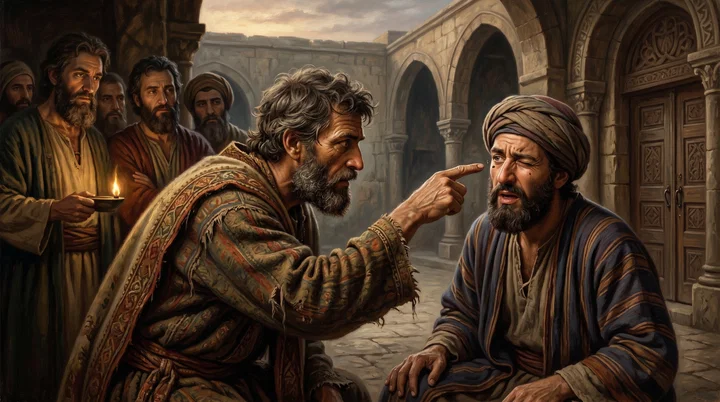
And why beholdest thou the mote that is in thy brother’s eye, but perceivest not the beam that is in thine own eye?
Translations
And why behold you the mote that is in your brother’s eye, but perceive not the beam that is in your own eye?
King James Version, KJV Cambridge Paragraph Bible
And why beholdest thou the mote that is in thy brother’s eye, but perceivest not the beam that is in thine own eye?
And why beholdest thou the mote that is in thy brother's eye, but perceivest not the beam that is in thy own eye?
Revised Version, American Standard Version
And why beholdest thou the mote that is in thy brother’s eye, but considerest not the beam that is in thine own eye?
'And why dost thou behold the mote that is in thy brother's eye, and the beam that [is] in thine own eye dost not consider?
But why lookest thou on the mote which is in the eye of thy brother, but perceivest not the beam which is in thine own eye?
But why beholdest thou the mote that is in the eye of thy brother, while, the beam that is in thine own eye, thou dost not consider?
Why do you look at the speck in your brother’s eye, but fail to notice the beam in your own eye?
Why do you look at the speck in your brother’s eye but fail to notice the beam in your own eye?
Why do you see the speck of chaff that is in your brother’s eye, but don’ t consider the beam that is in your own eye?
And why do you take note of the grain of dust in your brother's eye, but take no note of the bit of wood which is in your eye?
And why seest thou a mote in thy brothers eye, and considerest not the beame that is in thine owne eye?
Douay-Rheims (Challoner revision)
And why seest thou the mote in thy brother’s eye: but the beam that is in thy own eye thou considerest not?
Pictures
Cross-references
- Matthew 7:3-5
And why beholdest thou the mote that is in thy brother’s eye, but considerest not the beam that is in thine own eye?
Jesus teaches self-correction before correcting another through the mote-and-beam image.
- Romans 2:1
Therefore thou art inexcusable, O man, whosoever thou art that judgest: for wherein thou judgest another, thou condemnest thyself; for thou that judgest doest the same things.
Judging another while guilty oneself exposes the judge’s hypocrisy.
- Luke 6:37
Judge not, and ye shall not be judged: condemn not, and ye shall not be condemned: forgive, and ye shall be forgiven:
criticizing and condemning others without knowledge
- James 4:11-12
Speak not evil one of another, brethren. He that speaketh evil of his brother, and judgeth his brother, speaketh evil of the law, and judgeth the law: but if thou judge the law, thou art not a doer of the law, but a judge.
Warns against speaking evil of and judging a fellow believer.
- John 8:15
Ye judge after the flesh; I judge no man.
The passage says Jesus judged no man.
- Matthew 5:1-7
And seeing the multitudes, he went up into a mountain: and when he was set, his disciples came unto him:
Both passages belong to Jesus’ teachings in the Sermon on the Mount and the sermon on the plain.
Commentary
Each commentary is drawn from primary sources: the writings of Ellen G. White and Adventist pioneers and periodicals. Each commentary is separate. Its own words are not a quotation; follow the references to read the source passages.
Ellen G. White
1 source
The question lays bare hypocrisy, watching closely for a tiny defect in a brother while failing to perceive a far greater defect in oneself.Ms 59, 1902, par. 35–37 It condemns a mischievous disposition and an unsanctified tongue given to criticism and talebearing.Ms 59, 1902, par. 35–37 Such indulgence is living in darkness under Satan's power, and its influence spreads that darkness to others.Ms 59, 1902, par. 35–37 The faultfinder is spiritually blind and unfit to lead or help others.Ms 59, 1902, par. 35–37 He must first cast the beam from his own eye, and only then will he see clearly to take the mote from his brother's eye.Ms 59, 1902, par. 35–37
Critical, corrupt speech proves a corrupt heart.Ms 59, 1902, par. 35–37 A good tree does not bring forth corrupt fruit, nor does a corrupt tree bring forth good fruit, but every tree is known by its own fruit.Ms 59, 1902, par. 35–37 A good person brings forth good from the good treasure of the heart, while an evil person brings forth evil, because the mouth speaks from the abundance of the heart.Ms 59, 1902, par. 35–37 This rebuke comes from One who cannot err.Ms 59, 1902, par. 35–37 It applies to every follower and must be heeded rather than resented.Ms 59, 1902, par. 35–37
Sources
Pioneers and periodicals
32 sources
The small particle set against the large timber shows that the fault overlooked in oneself may be far greater than the small fault criticized in another.ST Jan 23, 1896ST Jan 23, 1896ST Aug 25, 1887 The saying belongs to Jesus' instruction on the plain on the folly of trying to correct another while blind to oneself, and the next saying completes it: the fault must first be removed from oneself, and only then is sight clear enough to help a brother.ST Jan 23, 1896ST Mar 19, 1894ST Aug 25, 1887ST Mar 19, 1894ST Mar 9, 1888 People are strangely blind to their own faults while sharp-eyed toward the small faults of others, overlooking greater faults in themselves.ST Jun 15, 1882ST Sep 13, 1899ST Aug 4, 1881 The timber means obstructed spiritual vision and unreliable judgment, so condemning without knowledge, picking at others, and drawing harmful inferences come from the critic's own defective sight, and constant faultfinding is a sign that something is seriously wrong with the critic.RH Mar 14, 1907ST Jan 23, 1896RH Apr 2, 1867ST Jan 23, 1896ST Aug 25, 1887 The command is therefore to stop judging the brother and start judging oneself, examining and correcting one's own faults first, since humility, self-examination, and love heal faultfinding and make sight clear.RH Oct 16, 1860RH Apr 2, 1867ST Sep 12, 1916RH Apr 21, 1863RH May 26, 1868
Words and Setting
The mote is a small splinter or particle, even a speck of straw or dust, while the beam is a log or stick of timber.ST Jan 23, 1896ST Jan 23, 1896ST Aug 25, 1887 The contrast pictures how much greater one's own fault may be than the fault criticized in another, so that noticing a small fault in another while missing a far greater fault in oneself shows impaired judgment.ST Jan 23, 1896ST Jan 23, 1896 The mote is the petty fault detected in another, and the beam is the greater fault the self-righteous person fails to see in himself.ST Aug 25, 1887 Faultfinding criticism of that kind borders on judging and is a sign that something is seriously wrong with the critic.ST Jan 23, 1896ST Jan 23, 1896
The saying uses a proverbial expression familiar to Jesus' hearers.ST May 19, 1881 It runs as telling another to take the small piece of wood out of his teeth and being answered to take the beam out of his own eyes.ST May 19, 1881 It was spoken to check those who are always censuring and condemning others for small matters when they themselves are guilty of things much more to be reprehended.ST May 19, 1881
The verse belongs to Jesus' instruction on the plain, Luke's great discourse.ST Mar 9, 1888 There it teaches the folly of trying to correct another person's faults while remaining blind to one's own, even failing to recognize the same fault in oneself.ST Mar 19, 1894ST Mar 19, 1894 The next verse applies the lesson: first correct one's own fault, then one can see clearly to help one's brother.ST Jan 23, 1896ST Aug 25, 1887 A person must therefore examine and correct his own spiritual faults before trying to judge or reform another, for the self-blinded hypocrite cannot see clearly until his own fault is removed.ST Aug 25, 1887
Judge Yourself First
People are astonishingly blind to their own faults while sharp-eyed to see the faults of others, readily noticing small faults in a brother while overlooking greater faults in themselves, so that consistency between profession and life becomes rare.ST Jun 15, 1882ST Sep 13, 1899ST Aug 4, 1881ST Jul 29, 1897 It is folly and danger to judge others and find fault with their actions, to try to correct another's faults while failing to recognize the same or greater fault in oneself, sharply noticing another's small fault while scrutinizing wrongdoing yet neglecting self-examination.ST Mar 12, 1896ST Mar 19, 1894RH Oct 9, 1856 Christ is the only standard, and those who look fully to him for guidance leave no place for the ambitions of the human heart.ST Mar 12, 1896
The beam is obstructed spiritual vision and dim, unreliable judgment, for the one who notices a small fault in another while failing to recognize a far greater fault in himself cannot judge clearly.RH Mar 14, 1907ST Jan 23, 1896RH Apr 2, 1867 Criticizing another, condemning a course of action without knowledge of it, drawing inferences harmful to the person, picking at others, and slurring and hinting at fault all come from this defect in the critic's own sight, which all share in different thickness and needing harder rubbing to get it off in some than in others.ST Jan 23, 1896RH Apr 2, 1867ST Mar 10, 1881 Faultfinding criticism borders on judging and is a sign that something is seriously wrong with the critic, marking a self-blinded hypocrite, and constant faultfinding points to a selfish nature.ST Jan 23, 1896ST Jan 23, 1896ST Aug 25, 1887
No one should require perfection in a brother until nearly perfect himself, for outward appearance deceives and no one can know hearts or who has sinned more, since those who look spotless may be foul within and those thought impure may be pure and near to God, with secret penitence winning mercy.ST Nov 11, 1880RH Jul 21, 1904 To judge a brother is self-righteousness and hypocrisy, for under the hell of his untold temptations the judge might walk less upright than he, and it is hypocrisy to be enraged at faults cherished in oneself, calling them sins in others and peculiarities in oneself, frowning upon frowns, being harsh with harshness, exaggerating exaggerations, and insincerely reprimanding falsehoods.ST Nov 11, 1880RH Jul 21, 1904 The verse commands a person to stop judging his brother and start judging himself, to attend to, examine, and correct his own faults before harshly judging or pointing out another's, to close the eyes to a brother's grievous errors until opening them upon one's own sins, and while the beam remains never to play surgeon for motes.ST Sep 12, 1916RH Apr 21, 1863RH May 26, 1868RH Jul 21, 1904RH May 8, 1913 Seeing a fault in another should prompt self-examination, not hasty judgment, with each person considering his own faults and avoiding adding the fault of rash judgment.RH May 8, 1913
Humility, self-examination, and love and charity heal faultfinding and give clearer sight, so that when the beam is considered the mote seems small.RH Oct 16, 1860RH Apr 2, 1867 Since all have imperfections, people should seek the Lord's help to recognize and correct their own faults, leaving room for charity toward others, and the Lord can remove even a selfish nature.ST Jan 23, 1896 The verse does not mean reproof should be rejected whenever it comes from one who has faults, for reproof given kindly can be accepted as a help, the beam brings unhappy results to the one who has it, and a fault should cause sadness because it needs correction, not merely because someone pointed it out.RH Mar 14, 1907 Keeping one's own sight clear is the remedy, and the one who keeps it clear will not know whether others need it or not.ST Mar 10, 1881
How It Applies
Putting the worst construction on what brethren have done instead of the best is keeping the beam in one's own eye, and searching for the mote in that state makes any real fault look very distinct and even makes faults appear where nothing is really there, which is wrong and calls for hearty sorrow.RH Oct 9, 1856 Exaggeration and careless judgment can make another person's flaw seem greater than it is while one's own fault goes unrecognized.ST Jun 3, 1889 Looking chiefly at others' failings can encourage sin, while dwelling on one's own strengths can lead to pride, whereas considering others' good qualities and one's own faults instead encourages emulation, humility, and modesty.RH Sep 9, 1862
Those who do wrong have small strength and many trials and face a tide of wrong difficult to stem, so they need help and pity rather than condemnation.ST Nov 11, 1880 Those given clearer knowledge of good and true owe them more help, since all are human with small power, none can walk the perfect way alone, all are allured and fall, none may boast, and all need God to help and lead them day by day.ST Nov 11, 1880 Outward appearance deceives, for those who look spotless may be foul within and those thought impure may be pure and near to God, and secret penitence may win mercy, so no one can know hearts or who has sinned more, and to judge a brother in that ignorance is self-righteousness, since under the hell of his untold temptations the judge might walk less upright than he.ST Nov 11, 1880
In a church dispute, some demanded that others confess wrongdoing without recognizing that they had given the first offense and helped cause the conflict, and attending to one's own case brought confession, reconciliation, and Christian love.RH Apr 21, 1863 The same image exposes people who make extraordinary claims while acting deceptively, failing to recognize their own fault as they expose or criticize another's, which is inappropriate for those claiming advanced light and special purification.RH Jun 18, 1908 It also exposes Roman Catholics criticizing Methodists over church-state relations, since given their own history they are especially ill-placed to criticize others.RH Dec 10, 1908
Ruling power strains to remove a small evil in others while keeping a far greater evil in itself.ST Nov 10, 1881 The mote is the Fenian dynamite plot built at Peoria to blow up British steamers in Liverpool harbor, the murderous work of microscopic offenders against thousands.ST Nov 10, 1881 The beam in the eye of power is the government license system that authorizes the making and selling of intoxicating drinks and divides the profits with manufacturer and retailer, flooding the land with liquid dynamite that robs and then kills whether the fuse runs six hours or six years and does more harm to life in a single year.ST Nov 10, 1881 England and America seek together to take the mote from the national eye by hunting down the dynamite makers, but both governments must cast the beam from their own eye by ending the gigantic murders planned by licensed liquor traffic in order to see clearly.ST Nov 10, 1881
The beam in one's own eye applies to complaints about another person and calls for Christian charity and forbearance.RH Oct 9, 1856ST Apr 3, 1879 It pictures the folly of sharply noticing another person's small fault while failing to see one's own greater fault, scrutinizing others' wrongdoing but neglecting self-examination.RH Oct 9, 1856 It warns against making others' failings the chief subject of conversation.RH Oct 9, 1856 The warning also applies to being quick to criticize or express opinions about matters one knows little about, since people readily notice flaws in others while failing to see their own.ST Apr 7, 1914
Sources