Luke 7:12
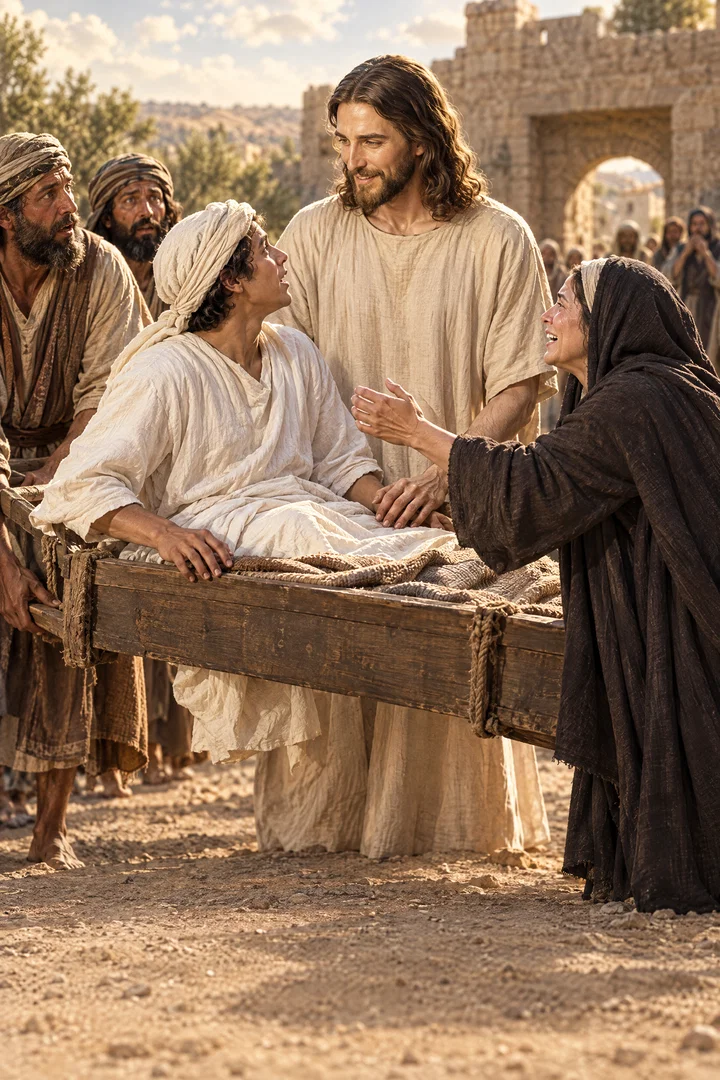
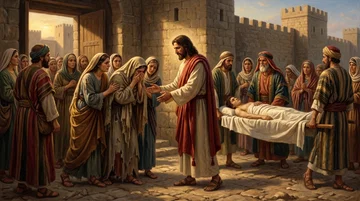
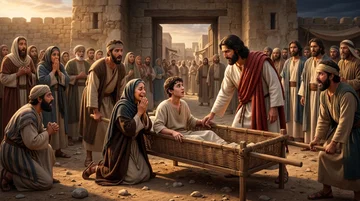
Now when he came nigh to the gate of the city, behold, there was a dead man carried out, the only son of his mother, and she was a widow: and much people of the city was with her.
Translations
Now when he came near to the gate of the city, behold, there was a dead man carried out, the only son of his mother, and she was a widow: and much people of the city was with her.
King James Version, KJV Cambridge Paragraph Bible
Now when he came nigh to the gate of the city, behold, there was a dead man carried out, the only son of his mother, and she was a widow: and much people of the city was with her.
Now when he came nigh to the gate of the city, behold, there was a dead man carried out, the only son of his mother, and she was a widow: and many people of the city were with her.
Revised Version, American Standard Version
Now when he drew near to the gate of the city, behold, there was carried out one that was dead, the only son of his mother, and she was a widow: and much people of the city was with her.
and as he came nigh to the gate of the city, then, lo, one dead was being carried forth, an only son of his mother, and she a widow, and a great multitude of the city was with her.
And as he drew near to the gate of the city, behold, a dead man was carried out, the only son of his mother, and she a widow, and a very considerable crowd of the city [ was] with her.
Now, as he drew near unto the gate of the city, then lo! there was being brought forth, one dead, the only-begotten son of his mother,—and, she, was a widow; and, a considerable multitude of the city, was with her.
Berean Standard Bible, Majority Standard Bible
As He approached the town gate, He saw a dead man being carried out, the only son of his mother, and she was a widow. And a large crowd from the town was with her.
Now when he came near to the gate of the city, behold, one who was dead was carried out, the only born son of his mother, and she was a widow. Many people of the city were with her.
Now when he came near the door of the town, a dead man was being taken out, the only son of his mother, who was a widow: and a great number of people from the town were with her.
Nowe when hee came neere to the gate of the citie, behold, there was a dead man caried out, who was the onely begotten sonne of his mother, which was a widowe, and much people of the citie was with her.
Douay-Rheims (Challoner revision)
And when he came nigh to the gate of the city, behold a dead man was carried out, the only son of his mother; and she was a widow: and a great multitude of the city was with her.
Pictures
Cross-references 20 of 28
- John 11:43-44
And when he thus had spoken, he cried with a loud voice, Lazarus, come forth.
Jesus raises Lazarus from the dead, as he later raises the widow’s son.
- 1 Kings 17:21-22
And he stretched himself upon the child three times, and cried unto the LORD, and said, O LORD my God, I pray thee, let this child’s soul come into him again.
Elijah’s prayer restores a widow’s dead son to life.
- 2 Kings 4:18-37
And when the child was grown, it fell on a day, that he went out to his father to the reapers.
Elisha raises the only son of the woman at Shunem.
- Luke 8:54-55
And he put them all out, and took her by the hand, and called, saying, Maid, arise.
Christ raises Jairus’s daughter, another person he raised from the dead.
- Mark 5:41-42
And he took the damsel by the hand, and said unto her, Talitha cumi; which is, being interpreted, Damsel, I say unto thee, arise.
Jesus raised Jairus’s daughter to life.
- 2 Kings 13:21
And it came to pass, as they were burying a man, that, behold, they spied a band of men; and they cast the man into the sepulchre of Elisha: and when the man was let down, and touched the bones of Elisha, he revived, and stood up on his feet.
A dead man revives after touching Elisha’s bones.
- John 5:25
Verily, verily, I say unto you, The hour is coming, and now is, when the dead shall hear the voice of the Son of God: and they that hear shall live.
The widow’s son hears Christ’s voice and lives, illustrating the dead hearing and living.
- 1 Corinthians 15:20
But now is Christ risen from the dead, and become the firstfruits of them that slept.
Christ’s resurrection is the firstfruits of those who have died.
- John 5:28-29
Marvel not at this: for the hour is coming, in the which all that are in the graves shall hear his voice,
Jesus’ raising of the dead displays his power to raise the dead.
- Acts 9:36-41
Now there was at Joppa a certain disciple named Tabitha, which by interpretation is called Dorcas: this woman was full of good works and almsdeeds which she did.
Dorcas is named as another person literally raised from the dead.
- John 11:25
Jesus said unto her, I am the resurrection, and the life: he that believeth in me, though he were dead, yet shall he live:
Jesus declares himself the resurrection and the life.
- Revelation 1:18
I am he that liveth, and was dead; and, behold, I am alive for evermore, Amen; and have the keys of hell and of death.
Christ was dead and lives forever, holding the keys of death.
- Luke 7:16
And there came a fear on all: and they glorified God, saying, That a great prophet is risen up among us; and, That God hath visited his people.
The miracle prompts hope in God’s final saving work.
- Luke 7:22
Then Jesus answering said unto them, Go your way, and tell John what things ye have seen and heard; how that the blind see, the lame walk, the lepers are cleansed, the deaf hear, the dead are raised, to the poor the gospel is preached.
Jesus names the raising of the dead among the signs reported to John.
- John 11:39-40
Jesus said, Take ye away the stone. Martha, the sister of him that was dead, saith unto him, Lord, by this time he stinketh: for he hath been dead four days.
Lazarus’s raising is cited alongside the widow’s son.
- John 11:11
These things said he: and after that he saith unto them, Our friend Lazarus sleepeth; but I go, that I may awake him out of sleep.
Nain leads on to Bethany awakening.
- John 11:14
Then said Jesus unto them plainly, Lazarus is dead.
both call deceased man dead
- John 12:1
Then Jesus six days before the passover came to Bethany, where Lazarus was which had been dead, whom he raised from the dead.
Both describe a dead person who needs raising.
- Hebrews 2:14-15
Forasmuch then as the children are partakers of flesh and blood, he also himself likewise took part of the same; that through death he might destroy him that had the power of death, that is, the devil;
Christ defeats the devil’s power of death and frees those held by fear.
- Isaiah 26:19
Thy dead men shall live, together with my dead body shall they arise. Awake and sing, ye that dwell in dust: for thy dew is as the dew of herbs, and the earth shall cast out the dead.
It speaks of the dead living again.
Commentary
Each commentary is drawn from primary sources: the writings of Ellen G. White and Adventist pioneers and periodicals. Each commentary is separate. Its own words are not a quotation; follow the references to read the source passages.
Ellen G. White
14 sources
At the gate of Nain Jesus met a funeral procession carrying out for burial a dead young man who was his widowed mother's only son and sole support, while many townspeople went with her in sympathy for her deep loss.DA 318.3–5DA 318.1–2STDA 512.2DA 319.1–320.1 Seeing her sorrow He felt compassion, came beside her, told her not to weep, and by His word alone raised her son and gave him back to her.DA 318.3–5STDA 512.2 This shows He is touched with unchanging tenderness by the sorrow of mourners, especially a bereaved mother's woe, and still remains compassionate toward mothers in sorrow and need.DA 319.1–320.1ST Mar 23, 1882MH 41.4–42.4 The son was called back only to mortal earthly life with its hardships, still subject to decay and death, and not clothed with immortality as were those raised to everlasting life at Christ's own resurrection nevermore to see death or sorrow.DA 319.1–320.1ST Feb 3, 1914Ms 115, 1897, par. 17–20 His life-giving word still comforts those who mourn and gives hope because He has conquered death and can do more than can be asked or imagined, leaving His followers an example of compassionate work in sympathizing with, hearing, comforting, aiding, and helping every trusting mother and all in need.STDA 319.1–320.1ST Mar 23, 1882Ms 169, 1903, par. 5–7Ms 1, 1867, par. 44–47
Funeral Procession at Nain
As He came near to the gate of Nain He met a funeral procession just as it was leaving the city, bearing a dead man out for burial.DA 318.1–2DA 512.2DA 319.1–320.1ST Mar 23, 1882Ms 169, 1903, par. 5–7 The dead man was a young man being carried to his burial.DA 512.2DA 319.1–320.1ST Mar 23, 1882Ms 169, 1903, par. 5–7COS 86.2–87.2 He was the only son of his mother, and she was a widow.DA 318.3–5DA 318.1–2DA 512.2Ms 1, 1867, par. 44–47COS 86.2–87.2 He had been her sole earthly support and comfort, which made her grief and loss especially deep as she followed his bier.DA 318.3–5DA 512.2Ms 1, 1867, par. 44–47
Much people of the city, many townspeople, were with her and accompanied her out.DA 318.3–5DA 318.1–2STDA 512.2ST Mar 23, 1882 Their presence showed their sympathy for her in her loss.DA 318.1–2STST Mar 23, 1882COS 86.2–87.2
Compassion, Power, and Hope
Jesus saw the widow's sorrow, felt compassion, came beside her, told her not to weep, and then raised her son and gave him back to her.DA 318.3–5STDA 512.2ST Mar 23, 1882COS 86.2–87.2 It was by His word alone that the son was brought back to life, without a long process of treatment.DA 318.3–5Ms 1, 1867, par. 44–47 This compassion shows He is touched by mourners' sorrow with unchanging tenderness, and especially by a bereaved mother's woe.DA 319.1–320.1MH 41.4–42.4ST Aug 20, 1902 He remains compassionate toward mothers in sorrow and need, touched by a mother's sorrow and ready to help those who trust in Him.ST Mar 23, 1882MH 41.4–42.4
The son thus restored was brought back only to mortal earthly life with its hardships, still subject to death and decay, and he would die again.DA 319.1–320.1ST Feb 3, 1914Ms 115, 1897, par. 17–20 This was not a clothing with immortality.ST Feb 3, 1914Ms 115, 1897, par. 17–20DA 786.1–3 Those who came forth at Christ's own resurrection were different, for they were raised to everlasting life nevermore to see death or sorrow or experience decay.ST Feb 3, 1914Ms 115, 1897, par. 17–20DA 786.1–3 His word that called the young man back to life remains powerful, still comforts those who mourn, and gives believers hope because He has conquered death.DA 319.1–320.1Ms 1, 1867, par. 44–47 It assures that He can do more than people can ask or imagine, offering the greater hope of deliverance from death.DA 319.1–320.1Ms 1, 1867, par. 44–47
The act stands as an example of compassionate medical missionary work for His followers to study and imitate.STMs 169, 1903, par. 5–7 It proves He sympathizes with every mother in her work and hears her earnest prayers.MH 41.4–42.4ST Aug 20, 1902 He remains woman's best friend, ready to aid every mother in need who trusts in Him, and ready to comfort, aid, and help all in need.STST Mar 23, 1882MH 41.4–42.4ST Aug 20, 1902
Sources
Pioneers and periodicals
77 sources
Jesus coming near the gate of Nain met a funeral procession carrying a dead young man out of the city on an open bier, and he stopped the bearers there.ST Jun 2, 1881ST Oct 30, 1907ST Jan 30, 1896 The dead man was the only son of a widowed mother, leaving her alone and desolate without husband or child to lean upon, while much people of the city went with her in sympathy that could not comfort her grief.ST Jun 2, 1881ST May 24, 1905ST May 24, 1905 Moved with tender compassion, he touched the bier and by his word called the dead to life, who sat up and spoke, and he delivered him to his mother and turned her sorrow into joy.ST Jun 2, 1881STST May 24, 1905 The lifeless body carried out was truly a dead man, knowing nothing and reporting nothing of an afterlife, whom Jesus awakened from the sleep of death and brought back to mortal life still subject to death.STST Jan 30, 1879ST Oct 7, 1913 This literal raising, wrought by virtue of his promised sacrifice and his power to have life in himself, is an earnest of the coming hour when all in the graves shall hear his voice unto the resurrection of life or the resurrection of judgment.ST Oct 12, 1876ST Nov 29, 1883RH Oct 19, 1869
Funeral at Nain Gate
Jesus came nigh to the gate of the city and met a funeral procession as it was being carried out of Nain, stopping the bearers near the gate.ST Jun 2, 1881ST Oct 30, 1907ST Jan 30, 1896ST Oct 4, 1899ST Jun 2, 1881 The dead man carried out was the only son of his mother, and she was a widow, accompanied by much people of the city with her in sympathy for her loneliness and deep grief.ST Jun 2, 1881ST Oct 30, 1907ST Jan 30, 1896ST Oct 4, 1899ST Jun 2, 1881 Jesus was moved with tender pity at her sorrow, touched the bier and stopped the procession while those carrying him to his grave stood still in amazement.ST Jun 2, 1881ST Jan 30, 1896RH Nov 25, 1902 The scene with its loud piercing cries and wails of professional mourners sets up the display of his life-giving power, for his word raised the dead son and returned him to her, illustrating that his word can also bring to life hearts dead in sin.ST Jun 2, 1881ST Oct 30, 1907ST Jan 30, 1896RH Nov 25, 1902
Nain stood on the northwest slope of Little Hermon, with Tabor and the heights of Zebulon in view. The dead were carried out without a coffin upon an open bier amid loud wails of professional mourners, death songs of minstrels, and lamentations of mourning women.ST Jan 30, 1896RH Aug 29, 1871 This domestic custom of Eastern funerals vividly depicted in the verse has remained substantially unchanged for forty centuries and so bears testimony to Bible truth.RH Aug 29, 1871
The account of raising the widow's son belongs to Luke's account and is not recorded in the other Gospels.ST Sep 20, 1905 The dead man was a young man, named Reuben, who had been sick unto death with a fever and died with no breath left in him by sunrise that morning.ST Nov 29, 1910ST Sep 20, 1910 He was carried out on a bier with a concourse of people and much people of the city with his widowed mother, and Jesus of Nazareth gave him life again and raised him from the dead.ST Nov 29, 1910ST Sep 20, 1910
Widow's Loss and Mourners
The one carried out was the only son of his mother, and she was a widow whose husband had already died.ST May 24, 1905ST Sep 13, 1899RH Nov 20, 1860RH Nov 20, 1860ST Oct 4, 1899 His funeral procession was leaving the city, and many people of the city were with her.ST May 24, 1905ST Sep 13, 1899RH Nov 20, 1860ST Oct 4, 1899RH Mar 22, 1906 Her loss left her desolate and without hope, with both husband and only child gone.ST May 24, 1905RH Mar 22, 1906
His death left her alone, facing the loneliness of a bereaved mother and widow without the husband and only child on whom she had depended and hoped to lean.ST Jun 2, 1881ST May 24, 1905ST May 24, 1905 Her last source of love and hope had died.RH Dec 15, 1859 Among the Jews dying without children was considered a terrible calamity, and having offspring entirely cut off was regarded as punishment for sin, which made her loss especially grievous and severe.ST May 24, 1905
Much people of the city was with her, and the large crowd and the whole town's presence showed sympathy for her.ST Jun 2, 1881ST Jun 2, 1881ST Sep 20, 1910 She remained in deep sorrow and grief, bereft and grieving as she followed the bier.ST Jun 2, 1881ST Sep 20, 1910ST Oct 28, 1880ST Jan 16, 1896 The crowd's presence brought her no comfort.ST Sep 20, 1910ST Oct 28, 1880
The detail that he was an only son whose mother was a widow is used to compare him with another gravely ill young man who was also an only son of a widow.ST Apr 7, 1914
Jesus' Compassion and Miracle
At the gate of Nain Jesus met a funeral carrying out a widow's only son, with a large crowd of the town about her in sympathy, leaving her lonely and bereaved of husband and child on whom she had depended and hoped to lean, her last source of love and hope dead.ST Jun 2, 1881ST May 24, 1905RH Dec 15, 1859ST Mar 26, 1894 Seeing her grief He was moved with tender pity and compassion, stopped the procession and touched the bier, while the bearers stood still in amazement.ST Jun 2, 1881ST May 24, 1905RH Dec 15, 1859ST Sep 20, 1910ST Mar 26, 1894 The scene leads on to His restoring the youth to earthly life, to the astonishment and awe of the people.ST Sep 20, 1910ST Sep 20, 1910ST Mar 26, 1894
By His word and call the dead man heard His voice and lived again, sat up and spoke, and Jesus delivered him to his mother, giving her back her support and turning her sorrow to joy.ST Jun 2, 1881STST May 24, 1905ST Sep 20, 1910RH Jun 13, 1854 His touch restored the youth, so that the enemy lost a victim amid great rejoicing, astonishment and awe.RH Dec 15, 1859ST Sep 20, 1910 The hour in which the dead heard His voice and lived shows the dead can literally be restored to life, and that hour need not mean one literal hour or a single time.RH Jun 13, 1854
He did this without her first asking Him, unlike the Canaanite woman who came asking for her living daughter and at first received no answer.RH May 21, 1857
The act reveals the goodness and mercy of God and His sympathy for a bereaved mother and readiness to help those in need, to hear prayer and render help in every emergency.STST Mar 23, 1882ST Apr 4, 1911ST Mar 24, 1909ST Sep 9, 1886 He lighted her pale sad face with a smile when He commanded death itself and gave the boy back to his mother's gaze once more.RH Jun 13, 1871 The same sympathy that moved Him then touches Him still, for He remains touched by a mother's sorrow, knows every mother's burdens, sympathizes with every mother in her work, and with everlasting arms still supports the God-fearing faithful mother, proving Himself woman's best friend and helper in all the relations of life, a heart He retains even after His exaltation.ST Mar 23, 1882ST Apr 4, 1911ST Sep 9, 1886
His care for her sorrow is benevolence and self-renunciation in perfect obedience to God's law and care for the sorrowful, part of His labor of love going about doing good.RH Jun 13, 1871ST Aug 28, 1884ST Sep 11, 1884 It is also God's presence working through the Spirit to give life to the dead.
The later scene recalls that her son was restored to life and is now with her.ST Feb 14, 1911
Death and Unconscious Dead
The lifeless body being carried out for burial is called a dead man, which proves that death is the literal death of the whole man and not the mere separation of an immortal part from the body.ST Jan 30, 1879ST Jun 15, 1904 The man was formed out of the dust of the ground, and when the breath of life leaves him the body lying there is still the man.ST Jan 30, 1879 The man is not the breath that has left him behind, wherever it goes and whatever it is, and the abandoned body is he, so there is no immortal part in man.ST Jan 30, 1879 Yet the word man can still refer to one whose body is dead, for the physical person is the real man dead or alive.RH Dec 23, 1862RH Aug 12, 1873
Nothing is recorded about the young man's thoughts or experience while he was dead, and after he was raised he made no report of experiences in an afterlife.STST Nov 4, 1880 No record says he was in heaven while dead, and no record says he saw or heard anything during that time.ST Nov 4, 1880ST Jan 4, 1877 His return to life does not mean he was called back from heaven or from punishment to another life on earth, supporting that the dead are unconscious, know nothing, and are not already experiencing reward or torment.RH Jan 23, 1913ST Nov 4, 1880ST Jan 4, 1877 His raising stands as one of the exceptions to the general rule that the dead await resurrection.ST Oct 7, 1913ST Jan 28, 1889
The scene at the gate shows the reality of death and the widow's bereavement before Jesus raises her son.ST Sep 13, 1899ST Aug 20, 1896 Death is here presented as a foe of humanity.ST Sep 13, 1899 It is the king of terrors, the slayer and destroyer of homes.ST Jan 26, 1915
Jesus awakened him from the sleep of death at his call and brought him back to life.ST Sep 27, 1910 When Jesus came to Nain he brought life to the widow's only son who was being carried out dead.ST May 10, 1910 His coming was not a messenger of death but an act of life-giving.ST May 10, 1910
Resurrection Doctrine and Promise
The return to life at the gate was a literal resurrection of one who had truly died, a factual account and not myth or allegory.RH Mar 7, 1865RH Mar 8, 1864RH Jun 5, 1866 The dead son literally heard the voice of the Son of God and lived, proving that the dead can be restored to life.RH Mar 8, 1864RH Jun 13, 1854RH Oct 19, 1869 That hearing shows the hour of resurrection does not have to mean one literal hour or a single time.RH Jun 13, 1854
Bringing one who was dead back to life is a resurrection even when the person is not raised to immortality and may die again.RH Nov 20, 1860 The raising at Nain was back to mortal life, not a clothing with immortality, and after being raised the son was still subject to death.ST Feb 3, 1914ST Aug 12, 1889 Yet it broke the power of death just as truly as a resurrection to eternal life.ST Aug 12, 1889 Those who came forth at Christ's own resurrection were different, raised to everlasting life nevermore to see death or experience sorrow.ST Feb 3, 1914
It was one of three cases in which Christ raised the dead during His earthly ministry, a public miracle not done in secret.RH Jan 6, 1916ST May 8, 1907 It took place before He raised Lazarus the brother of Martha and Mary and before His own resurrection.RH Nov 20, 1860ST Mar 24, 1909ST Dec 21, 1882 It stands among many raisings even hundreds of years before He came, as one of the exceptions to the general rule that the dead await resurrection.ST Jan 28, 1889ST Dec 21, 1882ST Jun 5, 1884
This earlier raising does not contradict that Christ is first by the resurrection, the firstfruits and firstborn from the dead.ST Dec 30, 1903 Those terms do not always denote priority of time save in God's purpose but denote pre-eminence, as Israel and Ephraim are called firstborn.ST Dec 30, 1903 Christ in His own resurrection demonstrated in Himself the power over death to proclaim light to people and Gentiles, being the One through whom all are raised and before all in God's purpose as the Lamb slain from the foundation of the world who also called Moses back to life.ST Dec 30, 1903 Whether the widow's son was raised to immortality is not told, but nothing forbids that he could have been made immortal by the same power that made Enoch and Elijah immortal without death, since immortality is brought to light only through the gospel.ST Jun 5, 1884
The raising was possible only by virtue of the sacrifice of the Son of God and His promised death and resurrection.ST Oct 12, 1876ST Nov 29, 1883 Although not then accomplished, it was already established in God's purpose and promise made before any man died, as good as accomplished and as sure as if fulfilled, giving Christ victory with the keys of death and the grave.ST Oct 12, 1876ST Nov 29, 1883ST Jun 5, 1884 In itself it gave no pledge that anyone else would be raised.ST Jun 5, 1884
These present raisings occurred because the Father has life in Himself and has given the Son to have life in Himself, giving Him power to bestow life on those who hear His voice and authority to execute judgment on the ungodly.RH Oct 19, 1869 They foreshadow the greater coming hour when all in the graves will hear His voice and come forth.ST Jan 26, 1915RH Oct 19, 1869 The good come forth unto the resurrection of life which is the beginning of eternal life, and the evil unto the resurrection of judgment ending in the second death in the lake of fire.RH Oct 19, 1869
The mighty works He did are only earnest of the completer work of final salvation when He will raise all the dead and heal all the sick.ST Mar 12, 1896 In the meantime they help faith, proving true that everyone who sees the Son and believes may have everlasting life and He will raise him at the last day.ST Mar 12, 1896ST Jan 26, 1915 The same life-giving power that conquered disease and death still makes whole physically today.ST Jan 26, 1915 Yet the miracle was exceptional and does not mean all who have died since should be raised in the same way before the resurrection at the appointed time, for Jesus did not raise all the dead nor heal all the sick.ST Mar 12, 1896RH Jun 22, 1916
The miracle shows the Giver of Life and the creative, life-giving power of God's word and of God's presence through the Spirit, which brings life where there is death.ST Oct 30, 1907ST Oct 30, 1907 His word that raised the dead son illustrates that His word can also bring to life hearts dead in sin.ST Oct 30, 1907 By it He makes spiritually dead sinners alive to God and restores them as children of Jerusalem above, their mother city.
The raising was like the raising of Jairus's twelve-year-old daughter and stands with the ruler's daughter, Lazarus of Bethany, the little maid, the multitude raised later, and the saints who arose after the Lord's resurrection.ST Nov 22, 1910ST Jan 26, 1915RH Oct 19, 1869 It was known in Bethany alongside the healing of Martha's sister, the cleansing of Simon the leper, and the restoration of Jairus's daughter, giving Martha reason to believe Jesus can still act for Lazarus though dead.ST Nov 29, 1910 It could have strengthened Jairus's faith when his daughter was dying, though he apparently had not yet heard of it.ST Feb 6, 1896 The disciples' greater privilege was not simply to walk where Jesus walked or visit Nain to trace His roads, but to accompany Him and witness His works.ST Feb 16, 1915
The event shows that the returning Jesus is the same personal Jesus who stopped the procession, restored the widow's only son, raised the dead, and showed compassion to the bereaved.ST Apr 15, 1897
Witness Opposition and Comfort
The raising at the gate was seen by eyewitnesses before many onlookers, standing together with causing the lame to walk and the dumb to shout and the leper to be cleansed, with restoring palsied hands and limbs, opening blind eyes, unstopping deaf ears, and checking deadly malady by the touch of faith.ST Sep 20, 1910ST Sep 27, 1910ST Jan 26, 1915 So witnessed, it proves him to be the Son of the Highest, the Anointed of Israel who should come, the Messiah, and the conqueror of all manner of disease and death, the king of terrors and slayer and destroyer of homes.ST Sep 20, 1910ST Sep 27, 1910ST Jan 26, 1915 As a literal New Testament miracle it shows the mighty miraculous power of God in Jesus Christ, part of an infallible Bible that regenerates, brings hope to souls, and lights the dark valley of death for trusting saints.ST Jan 26, 1915 To deny it as myth or allegory or fancy or incredible is to deny the infallibility of the Bible and at last its every essential saving truth.
The miracle divided its witnesses, with the Pharisees contending for the resurrection from the dead while its deniers insisted the dead rise not at all.ST Sep 20, 1910ST Sep 20, 1910 Annas challenged whether the young man was truly dead and alleged that Jesus had arranged an apparent miracle to mislead the people.ST Sep 20, 1910 The deniers claimed he had only been sleeping, that he was in league with Jesus, and that the entire circumstance from beginning to ending had been prearranged and contrived by Jesus and his friends to make good his claim to Messiahship, so that the miracle was made of none effect before the people.ST Sep 20, 1910ST Sep 20, 1910 The priests used that view to explain the miracle away. Even this God-given power to raise dead friends and gladden hearts did not keep those he loved and came to save from seeking opportunity to put him away from their midst.ST Feb 1, 1899
The account is used as words of comfort for a bereaved family, placing loss in the setting of Jesus' power to raise the dead. It shows Jesus meeting the funeral procession at the gate, near to the grieving mother whose only son is carried out with much people of the city with her, in readiness to show compassion and help.RH Jul 23, 1901ST Oct 28, 1880ST Jan 16, 1896 He brings comfort to mourners in bereavement and has comfort for every kind of grief, healing grief and the brokenhearted and making the widow's heart rejoice.ST Oct 28, 1880ST Jan 16, 1896
The verse shows the goodness and mercy of God, standing in mighty contrast to the low condition of Israel in the time of the judges.ST Mar 24, 1909 It gives wonderfully interesting and touching and uplifting and pathetic material for meditation and spiritual growth.ST Mar 24, 1909 The widow of Nain is one of many unnamed women on whom Jesus bestowed signal favor, proving that woman occupies a conspicuous place in the primitive church and in the four Gospels. Her son's raising was an instance when the circumstances called for a miracle, and one of the recent miracles welcomed with wonder and joy and gratitude.ST Sep 13, 1905 Faith touching the funeral bier can still revive withered hopes and bring joy even amid death and grief.
Having met this need he passes on to find others' needs and bids those he has helped follow him, for hands he has touched are set free for other deeds.RH Jun 18, 1908 He leaves Nain behind on the stony path toward Judah and Bethany where the cup has yet to brim, for Lazarus still sleeps awaiting awakening.RH Jun 18, 1908 The coming visitation on Olivet is ahead, when captives shall burst through the gates of death.RH Jun 18, 1908 He questions eyes that remain dim and voices of bitter sorrow after he has come, calling for lifted heads in hope.RH Jun 18, 1908
Sources