Luke 8:13
They on the rock are they, which, when they hear, receive the word with joy; and these have no root, which for a while believe, and in time of temptation fall away.
Translations
American King James Version, King James Version, KJV Cambridge Paragraph Bible
They on the rock are they, which, when they hear, receive the word with joy; and these have no root, which for a while believe, and in time of temptation fall away.
They on the rock are they, who, when they hear, receive the word with joy; and these have no root, who for a while believe, and in time of temptation fall away.
And those on the rock are they which, when they have heard, receive the word with joy; and these have no root, which for a while believe, and in time of temptation fall away.
And those on the rock are they who, when they have heard, receive the word with joy; and these have no root, who for a while believe, and in time of temptation fall away.
'And those upon the rock: They who, when they may hear, with joy do receive the word, and these have no root, who for a time believe, and in time of temptation fall away.
But those upon the rock, those who when they hear receive the word with joy; and these have no root, who believe for a time, and in time of trial fall away.
And, those upon the rock, are they who, as soon as they hear, with joy, welcome the word; and, these, not having, root, are they who, for a season, believe,—and, in a season of testing, draw back.
Berean Standard Bible, Majority Standard Bible
The seeds on rocky ground are those who hear the word and receive it with joy, but they have no root. They believe for a season, but in the time of testing, they fall away.
Those on the rock are they who, when they hear, receive the word with joy; but these have no root. They believe for a while, then fall away in time of temptation.
And those on the rock are those who with joy give hearing to the word; but having no root, they have faith for a time, and when the test comes they give up.
But they that are on the stones, are they which when they haue heard, receiue ye word with ioy: but they haue no rootes: which for a while beleeue, but in the time of tentation goe away.
Douay-Rheims (Challoner revision)
Now they upon the rock, are they who when they hear, receive the word with joy: and these have no roots; for they believe for a while, and in time of temptation, they fall away.
Pictures

Cross-references
- Matthew 13:20-21
But he that received the seed into stony places, the same is he that heareth the word, and anon with joy receiveth it;
Joyful reception on rocky ground lacks root and falls away under trouble.
- Mark 4:16-17
And these are they likewise which are sown on stony ground; who, when they have heard the word, immediately receive it with gladness;
Rocky-ground hearers receive the word gladly but lack roots and fall away under trouble.
- Matthew 13:5-6
Some fell upon stony places, where they had not much earth: and forthwith they sprung up, because they had no deepness of earth:
Seed on stony ground springs up briefly, then withers for lack of root.
- Mark 4:5-6
And some fell on stony ground, where it had not much earth; and immediately it sprang up, because it had no depth of earth:
Seed on rocky ground springs up but withers because it has no root.
- Luke 8:6
And some fell upon a rock; and as soon as it was sprung up, it withered away, because it lacked moisture.
Seed on rock withers for lack of moisture.
- John 6:66
From that time many of his disciples went back, and walked no more with him.
Many disciples turn back and no longer follow Jesus.
- Matthew 13:22
He also that received seed among the thorns is he that heareth the word; and the care of this world, and the deceitfulness of riches, choke the word, and he becometh unfruitful.
Worldly cares and riches choke the word and prevent fruitfulness.
- Matthew 13:1-2
The same day went Jesus out of the house, and sat by the sea side.
Gives the setting by the sea for Jesus’ teaching.
- Luke 6:48
He is like a man which built an house, and digged deep, and laid the foundation on a rock: and when the flood arose, the stream beat vehemently upon that house, and could not shake it: for it was founded upon a rock.
Listed as another use of petra.
- Luke 8:7
And some fell among thorns; and the thorns sprang up with it, and choked it.
Introduces the seed choked by thorns, another response to the word in the parable.
- Matthew 7:24-25
Therefore whosoever heareth these sayings of mine, and doeth them, I will liken him unto a wise man, which built his house upon a rock:
Listed as another use of petra.
- 2 Peter 2:21
For it had been better for them not to have known the way of righteousness, than, after they have known it, to turn from the holy commandment delivered unto them.
Both describe turning away after receiving or knowing the truth.
- Hebrews 6:7-8
For the earth which drinketh in the rain that cometh oft upon it, and bringeth forth herbs meet for them by whom it is dressed, receiveth blessing from God:
Stony ground receives rain but bears no fruit.
- James 1:23-25
For if any be a hearer of the word, and not a doer, he is like unto a man beholding his natural face in a glass:
word as mirror profits only if remembered and done
- Ezekiel 33:31-32
And they come unto thee as the people cometh, and they sit before thee as my people, and they hear thy words, but they will not do them: for with their mouth they shew much love, but their heart goeth after their covetousness.
People hear the words gladly but do not put them into practice.
- James 1:22
But be ye doers of the word, and not hearers only, deceiving your own selves.
Both require being doers as well as hearers.
- Romans 9:33
As it is written, Behold, I lay in Sion a stumblingstone and rock of offence: and whosoever believeth on him shall not be ashamed.
Listed as another use of petra.
- 1 Corinthians 10:4
And did all drink the same spiritual drink: for they drank of that spiritual Rock that followed them: and that Rock was Christ.
Listed as another use of petra.
Commentary
Each commentary is drawn from primary sources: the writings of Ellen G. White and Adventist pioneers and periodicals. Each commentary is separate. Its own words are not a quotation; follow the references to read the source passages.
Ellen G. White
25 sources
They on the rock are those who hear the word and at once take it up with gladness and believe for a time, but having no depth of root they last only briefly and fall away when temptation, trial and persecution come.ST Jun 30, 1881Lt 57, 1895, par. 4–714MR 114.3–116.1 Their failure is not in the sower or the seed, which are the same in every case, but in themselves, for their faith rests on feeling and excitement rather than settled principle reaching the springs of action, and the heart has not been renewed and transformed by the Spirit.3T 111.2–112.1COL 56.1–2TCBMP 140.1–142.1 They do not count the cost or yield habit and life fully to the control of the word, attempting to serve both self and Christ, so when plain truth calls for self-denial, sacrifice, reproach and radical change they choose present ease and abandon the truth.3T 111.2–112.1COL 49.3–50.1ST Jan 26, 1915 A stony hearer need not remain such, for by choice and cooperation with God the soil of the heart can be broken up by deep repentance and earnest effort in the strength of Jesus, and by diligent preparing, sowing and cultivating until Christ's life and character take root and bear lasting fruit.COL 56.1–2CTBH 67.3ED 111.1–2
Parable Setting and Purpose
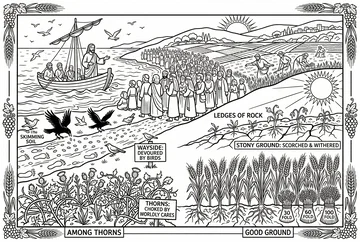
Luke 8:13 was spoken to an eager, expectant throng gathered to see and hear by the Sea of Galilee.COL 33.2–34.1 There the sick lay on mats waiting to present their cases, and disease was rebuked while life and health and peace were diffused.COL 33.2–34.1 As the crowd increased and pressed close until there was no room, a fishing boat was entered and pushed off a little from the land, and the multitude upon the shore was addressed from it.COL 33.2–34.1
The verse belongs to the parable of the sower illustrating the things of the kingdom of heaven and the work of the great Husbandman for His people.COL 33.1 Like a sower in the field, Christ came to scatter the heavenly grain of truth, and the parable-teaching itself was the seed with which the most precious truths of grace were sown.COL 33.1 The natural seed cast into the soil points to the gospel seed whose sowing brings man back to loyalty to God.COL 33.1 He who gave the parable is the Sovereign of heaven, and the same laws that govern earthly seed-sowing govern the sowing of the seeds of truth.COL 33.1
The parable presents the different tendencies and kinds of the human heart.2SP 241.1–24RED 86.2–3 It explains why the ministry had meager and limited immediate results.2SP 241.1–24RED 86.2–3 People were free to accept or reject, to receive or refuse, rather than being forced or compelled to believe and obey.2SP 241.1–24RED 86.2–3
Meaning of Rocky Ground
The rock is people who hear the word and receive it at once with joy and believe for a while, but have no root and no deep root to sustain them, so they endure only briefly and fall away in time of temptation and testing and trial and persecution.ST Jun 30, 1881Lt 57, 1895, par. 4–714MR 114.3–116.1COL 49.3–50.1GW 185.1 Their profession does not endure when tested, and this is seen in those who deny Christ's soon coming in word and action, live for the world, mistreat fellow servants, and outgrow Advent faith through worldliness and unbelief.Lt 57, 1895, par. 4–714MR 114.3–116.1Lt 15, 1862, par. 25–27 Thorough grounding helps fortify those brought into the truth to remain faithful when later instruction or correction might otherwise offend them and Satan use that offense to lead them away.Lt 15, 1862, par. 25–27
Their faith is guided by feeling rather than settled principle, with no depth and stability of character, and principle does not reach the springs of action.3T 111.2–112.1TCBMP 140.1–142.1 The heart and character have not been renewed and transformed by the Spirit of God, so they speak with zeal and exalt the truth in word but are not doers of the word.3T 111.2–112.1TCBMP 140.1–142.1 They take up anything new and exciting with ardor, talk earnestly of faith and hope, and even reprove those of long experience for lack of enthusiasm.TCBMP 140.1–142.1 Yet their knowledge remains theoretical in the mind and is not brought into heart and conscience to convert the heart and transform the character, leaving unsanctified self alive and strengthening evil instead of restraining it, and producing no lasting Christian fruit.TCBMP 140.1–142.1Ms 130, 1897, par. 26Ms 74, 1897, par. 33–35 Genuine conversion bears the peaceable fruits of righteousness and brings a person closer to Christ in character, while apparent conversion is exposed by trial as unable to endure unless truth does that work.Ms 130, 1897, par. 26
Their joy and quick acceptance are not themselves the cause of failure.ST Jan 26, 1915 The problem is they do not count the cost, consider what the word requires, or yield habits and life fully to its control, and trying to serve both self and Christ leaves them unable to endure when the test comes.COL 49.3–50.1ST Jan 26, 1915 They may appear faithful while life is easy, or welcome religion as a way to escape suffering, but they cannot bear reproach for Christ.ST Jan 26, 1915 When tested by the heat of trial and temptation, by sacrifice and persecution because of the word, and when plain pointed truth and the pruning-knife of God are applied that they may bring forth fruit unto perfection and expose faults and deformity of character and cherished sin, calling for self-denial and sacrifice and radical change and sanctification, their zeal dies and their voice is silent.3T 111.2–112.1TCBMP 140.1–142.1ST Jan 26, 1915 When the truth calls for workers they are elsewhere, and they choose present ease over eternal realities, abandoning and yielding the truth rather than submitting to be sanctified through it, while flattering themselves that heaven can be reached by an easier way.3T 111.2–112.1TCBMP 140.1–142.1ST Jan 26, 1915
In falling away they return to worldly surroundings where cares and temptation fade first impressions, take up sins again, and sink back into indifference.2SP 234.1–2 The seed imagery also shows the broader law that what is sown in the heart bears fruit, so that teachings in books can grow into infidelity.CT 186.3–187.2
Cultivating Enduring Faith
The failure of the rocky-ground hearers lies in themselves and not in the sower or the seed, for in every case the sower and the seed are the same and the different result depends on the soil.COL 56.1–2 The hardness of heart that keeps the good seed from taking root comes by resisting the Spirit who seeks to break the spell of worldly infatuation and awaken desire for imperishable treasure, and people are themselves responsible for that inattention and neglect of the word.COL 56.1–2 A stony-ground hearer need not remain such, for the outcome is not beyond control; though no one can change himself, the power of choice remains and it rests with each one to determine what he will become by cooperating with what God desires to accomplish in him.COL 56.1–2 The garden of the heart must be cultivated, the soil broken up by deep repentance for sin, and the evil tendencies of the natural heart overcome by earnest effort in the name and strength of Jesus.COL 56.1–2
Lasting belief requires diligent, persevering labor in preparation of the soil, sowing of the seed, and culture of the crop, for the heart is a garden and soil that must be prepared beforehand just as ground is prepared for natural seed, since a raw, uncultivated heart cannot at once yield a harvest.ED 111.1–2 This is to be taught practically by having children prepare soil and sow seed while explaining the garden of the heart with good or bad seed, and by instructing youth from tilling the soil.ED 111.1–2 Parents must do this preparing in early childhood by not sending little ones away to school too early nor trusting the molding of the infant mind to other hands, but being the best teachers of their children till eight or ten years of age.CTBH 67.3 Their schoolroom should be the open air amid flowers and birds and their textbook the treasures of nature, opening before them God's great book of nature as fast as their minds can comprehend it, so the lessons will not soon be forgotten.CTBH 67.3 Great pains must be taken in this cultivation of children's minds and formation of correct habits, using half the time and labor now worse than wasted in following the fashions of the world, for what is planted in an impressionable young mind on good soil can bear fruit unto eternal life.CTBH 67.34T 499.2
Believers need to be taught from the beginning to make Christ's life and character their own, to deny natural inclination, bear burdens, serve and endure hardship, trust Christ, and work for others.COL 57.1–2 Ministers must keep refreshed and cheerful in order to drop words of cheer and courage as seed into honest hearts, and must teach people how to come to the Lord and how to lead others to Him, how to be purified from iniquity and elevated by adherence to pure and holy principles, so that belief takes root and springs up to bear precious fruit.COL 57.1–26T 45.1–2 The seed can take root even in a hard heart when Christ's love is shown through personal ministry that softens stony hearts, and working for the lost weakens the attraction of worldly pleasures and helps truth remove harmful growth at its roots.COL 57.1–2GW 185.1 The seed may also lie dormant for a time before God's grace awakens it to life so that it springs up and bears fruit.TBC1872 111.1
The seed can wither if left without care, so continued work after people hear the message protects and nurtures what was sown.Lt 18, 1898, par. 2–3 Thorough teaching and firm grounding before a minister leaves fortifies those brought into the truth to remain faithful when later instruction or correction might otherwise offend them and Satan use that offense to lead them away.Lt 15, 1862, par. 25–27 Those who oppose the truth act like birds that take the seed, using false claims to make the truth appear false and destroy its effect on those who are convicted.Lt 18, 1898, par. 2–3
Sources
Pioneers and periodicals
42 sources
Those on the rock hear the word and at once receive it with joy and believe for a while, but having no root or depth they wither and fall away when temptation, trial, and persecution come.ST Jun 30, 1881ST Nov 26, 1894RH Oct 18, 1870ST Nov 26, 1894 They are the second unfruitful class in the parable of the sower, where the seed is the word of God and the soils are the hearers, and mere hearing and profession without root give no lasting conversion or harvest.RH May 11, 1869ST Feb 6, 1896RH May 11, 1869RH Dec 21, 1905RH May 11, 1869 They fall because they do not count the cost and yield life fully to the word's control, choosing present ease over reproach for Christ when it calls for self-denial, sacrifice, and radical change.ST Jan 26, 1915ST Nov 26, 1894RH Jun 18, 1867 They have no root in themselves because they have no individual experience with God, but depend on another's experience, though endurance requires personal knowledge of Him and standing alone with Him.RH May 19, 1904RH Jul 8, 1902 Hearing gives no profit unless the word is obeyed and practiced until it springs up and bears fruit, with the heart kept soft and free from weeds of worldly care and vanity under the sunlight and showers of the Holy Spirit.RH Jul 10, 1856RH Oct 22, 1914RH Aug 6, 1861RH Feb 16, 1864ST Dec 4, 1884
Words and Parable Setting
The word for rock denotes a rock mass, ledge, cliff, or shelf of rock, not a small movable stone.ST Aug 26, 1880 The saying belongs to the parable of the sower, in which the seed is the word of God and sowing is the preaching of the gospel, while the different soils are the hearers and the fruit sought is people obeying the truth and bringing forth a harvest.ST Feb 6, 1896RH Dec 21, 1905RH Sep 20, 1906 Human lives themselves are soil for God's word, so that even small and seemingly insignificant lives offered to God can become ground from which He brings good and much fruit.ST Aug 5, 1913 The same sowing bears an abundant harvest when the gospel as good seed is sown in young minds as in good ground, with lasting impressions from sermons leading to salvation, and it brings forth fruit among mission peoples able to understand and receive salvation through the Saviour's merits.ST Mar 18, 1889RH Dec 24, 1908 Good ground shows the possibilities when the word takes root, and despite threats and opposition the word keeps being sown, with companies and churches springing up wherever it reaches honest and good hearts.ST Feb 6, 1896RH Sep 20, 1906
Those on the rock are the second class in the parable, standing alongside wayside hearers and hearers choked among thorns as unfruitful responses where the seed falls on unprepared soil.RH May 11, 1869RH May 11, 1869RH Dec 10, 1872 Their ground offers no sound basis for lasting results, like sowing seed where no harvest can be expected, since merely hearing the word and making a profession do not by themselves produce lasting conversion or fruit.RH May 11, 1869RH May 11, 1869 They welcome the word with joy and believe for a time, but having no root they do not endure and fall away when temptation and testing come.RH May 11, 1869RH May 11, 1869 Such fruitless profession risks grave disappointment at the final judgment, yet whenever the seed falls into good soil it will bring forth fruit, not by any virtue in the sowers but because the seed is the word of God and the heart is in a condition to receive it.RH May 11, 1869RH Dec 10, 1872
Good soil contrasts with the rock by taking deep root and bringing forth a rich harvest. Holland at the Reformation showed such good soil, prepared by liberty under city charters and privileges, by advancing education, and by freedom of thought and argument. There the doctrines of Luther spread rapidly and yielded a rich harvest.
Joyful Yet Rootless Belief
Those on the rock hear the word and receive it at once with joy, welcoming it gladly because they are charmed by its beauty and want the salvation it promises.ST Jun 30, 1881ST Nov 26, 1894RH Oct 18, 1870ST Nov 26, 1894 Even brief listening can let the seed begin to germinate.RH May 19, 1904 They believe for a while, including some who rejoiced in the truth about the Sabbath and Christ's coming and some who accepted faith during a tent effort.ST Jun 30, 1881RH Oct 18, 1870RH Jun 18, 1867RH May 19, 1904ST Oct 6, 1887 Their joy and quick acceptance are not themselves the cause of failure.ST Jan 26, 1915 An initial joyful response is not lasting faith unless it takes root.RH Feb 16, 1864ST May 5, 1881
They have no root or depth of earth and no deep root in the heart.ST Jun 30, 1881ST Apr 16, 1894RH Oct 18, 1870RH Aug 6, 1861RH May 19, 1904 Like hard stony ground they do not drink in the rain God sends, and the seed withers for lack of moisture.ST Apr 16, 1894RH Oct 18, 1870 The rain needed for growth unto eternal life and much fruit is His righteousness, received with heavenly light and moisture.ST Apr 16, 1894 Apart from that the word can be taken from the conscience and left unfruitful.ST Jun 16, 1887
In time of temptation, testing, trial, trouble, tribulation, persecution, or opposition they fall away, turn away, wither, become discouraged, and give up belief.ST Nov 26, 1894RH Oct 18, 1870ST Nov 26, 1894RH Jul 30, 1861 The most enthusiastic converts are often the least stable.ST Nov 26, 1894ST Nov 26, 1894
Reasons They Fall Away
Those on the rock fall away because they do not count the cost, consider what God's word requires, or yield their habits and life fully to its control.ST Jan 26, 1915 They may appear faithful while life is easy, or welcome religion as a way to escape suffering, but when tribulation or persecution comes because of the word they fall away.ST Jan 26, 1915 They cannot bear reproach for Christ or accept the word when it exposes a cherished sin and calls for self-denial, sacrifice, and radical change, choosing present ease over eternal realities.ST Jan 26, 1915 Their joy and immediate acceptance are not themselves the cause of failure; the lack of deep root to sustain them is.ST Jan 26, 1915
They believe for a time, charmed by the beauty of the word and wanting the salvation it promises, yet fall away when temptation brings trials they are unwilling to endure to win the crown.ST Nov 26, 1894ST Nov 26, 1894 The most enthusiastic converts are often the least stable.ST Nov 26, 1894ST Nov 26, 1894 Among those who hear the truth about the Sabbath and Christ's coming, few bring forth fruit to maturity or accept fellowship in Christ's sufferings as the way to share His glory.RH Jun 18, 1867
They have no root in themselves because they have no individual Christian experience but depend on another's experience, though no one can confess sin, accept forgiveness, or believe for another and the Christian life cannot be lived by proxy.RH Jul 8, 1902 In the time of peril and test this lack is revealed as some fall out by the way and others show signs of weakness.RH Jul 8, 1902 To keep from falling away in temptation each one must stand alone with God and for His truth, individually knowing whom is believed and being persuaded He is able to keep what has been committed against that day, for personal knowledge of God and trust in Him are needed to endure coming trials rather than fall away.RH May 19, 1904RH Jul 8, 1902
The rocky soil represents a heart that does not sustain the truth because the truth is not the ruling principle but a secondary concern competing with worldly cares and desires, so lasting religious life requires the truth to rule rather than compete.RH Aug 6, 1861 Joyful reception does not by itself ensure lasting faith, and worldly entanglements choke the word so it bears no fruit; a good conversion experience is therefore not enough without continuing faithfulness and daily growth.RH Feb 16, 1864 Without root a person can believe for a time and fall away when trial or persecution comes.RH Aug 6, 1861RH Feb 16, 1864
Hearing gives no profit or advantage unless obeyed and reduced to practice.ST Dec 4, 1884 The word must become seed in the heart that springs up and bears fruit in life rather than being stored away in memory, for looking into it as a mirror that reveals character is useless unless what is seen is remembered and done.ST Dec 4, 1884 Growth requires the rich soil of the human heart together with the warm sunlight and awakening showers of the gracious work of the Holy Spirit, which are found in honest effort to obey the truth as made known by practicing its principles and doing its duties, and only doers as well as hearers will give account of hearing with joy and not with grief.ST Dec 4, 1884
The heart as soil must be made ready so the word can take root and grow instead of failing.RH Jul 10, 1856 Every evil weed naturally takes root and spreads there, including thorns of worldly care, thistles of worldly vanity, and roots of bitterness with other unprofitable weeds, which must be searched out, examined, and cast off as a husbandman watches his land.RH Jul 10, 1856 When this work is rightly done the soil is ready for the good seed to spring up and prosper under divine grace as corn grows by rain and sunshine from heaven.RH Jul 10, 1856 The soil of life must also be kept soft, with tender sympathy and free imagination, to keep the elementary quality of receptiveness, for without that softness all divine influences are scattered over a person in vain.RH Oct 22, 1914
The fault for lack of growth is not with the seed, for God's words are living seeds of truth and spiritual power planted in mind and heart with unseen life like wheat or corn that grows surely and wonderfully under right conditions.ST Apr 11, 1900 Faith serves as heat and moisture for the seed.ST Apr 11, 1900 When the Word is received only as mere words without faith, it does not grow but lies dormant showing no signs of life, even if the soil is good and the planting is careful.ST Apr 11, 1900 Hearts hard at first can still be broken up and softened so the seed takes root and springs up to everlasting life, with the gospel carried by song as well as preaching.RH Oct 23, 1913
Warning and Faithful Living
Joyful hearing and temporary belief warn that testing reveals whether there is root, and faithfulness means continuing with Christ through His trials as the disciples continued with Him. The parable is verified in experience, where some who receive the truth later grow weary and are overcome by the pressures and pleasures of life, while others remain faithful and bear fruit.RH Jul 10, 1860
When persecution and reproach arise, those without depth wither and separate, and their separation is necessary for the spiritual health of those who remain and is no cause for discouragement.RH Jul 6, 1869 They stand with wayside hearers and thorn-choked hearers as unfruitful responses, yet good soil also exists, and whenever seed falls into good soil it brings forth fruit by the power of the word and a receptive heart, not by any virtue in the sowers, so visiting neighbors and friends to share truth remains worthwhile.RH Dec 10, 1872RH Jul 6, 1869 The scattering of tracts is sowing seeds of truth in hope they will find a place in hearts.ST Sep 7, 1904 The small, seemingly insignificant lives offered to God can become ground from which He brings good and much fruit, for human lives are soil for His word.ST Aug 5, 1913
Religious teaching must give truth room to grow rather than bury it under needless scolding, repetition, or explanation.ST Oct 19, 1882 Children's glad reception of a lesson can fail to take root when attention is easily diverted, so the lesson's gentle influence needs room to settle and grow.ST Jun 18, 1885 Even a ready heart can lose the seed when critical talk at home acts like wind carrying the good seed away and hindering growth.ST Dec 2, 1897 The same danger applies to children who may carry a harmful home example into life and succumb to appetite for intoxicating drink when temptation comes.ST May 16, 1878 Bible readers likewise must let the message find receptive hearts and grow deeply rather than rest on joyful hearing and temporary belief that falls away in testing for lack of root.ST Jun 27, 1911
In Peru some who received the word with joy left off their vices and thereby gained strength to free themselves from servitude.ST Jun 20, 1911 In China even brief listening let the seed begin to germinate and led a hearer to investigate further.ST The teaching becomes a prayer for the young, that Bible teaching sown in young minds as in good ground will take root, bear an abundant harvest, and lead through lasting impressions from sermons to salvation.ST Mar 18, 1889RH Oct 7, 1915
Sources