Luke 9:37
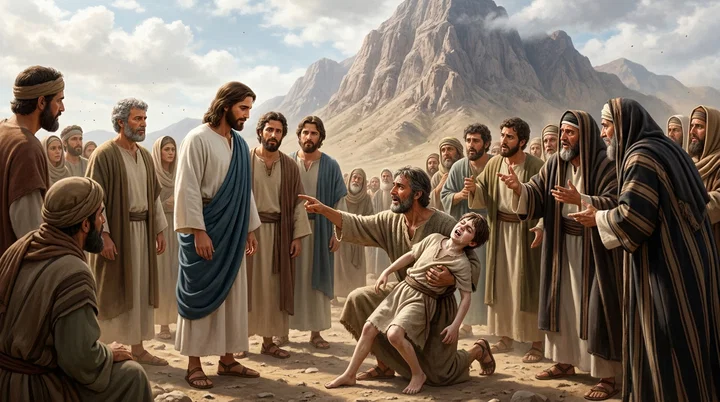
And it came to pass, that on the next day, when they were come down from the hill, much people met him.
Translations
American King James Version, King James Version, KJV Cambridge Paragraph Bible
And it came to pass, that on the next day, when they were come down from the hill, much people met him.
And it came to pass, that on the next day, when they had come down from the hill, many people met him.
Revised Version, American Standard Version
And it came to pass, on the next day, when they were come down from the mountain, a great multitude met him.
And it came to pass on the next day, they having come down from the mount, there met him a great multitude,
And it came to pass on the following day, when they came down from the mountain, a great crowd met him.
And it came to pass, on the next day, when they came down from the mountain, that there met him a great multitude.
Berean Standard Bible, Majority Standard Bible
The next day, when they came down from the mountain, Jesus was met by a large crowd.
On the next day, when they had come down from the mountain, a great multitude met him.
And on the day after, when they came down from the mountain, a great band of people came to him.
And it came to passe on the next day, as they came downe from the mountaine, much people met him.
Douay-Rheims (Challoner revision)
And it came to pass the day following, when they came down from the mountain, there met him a great multitude.
Pictures
Cross-references
- Mark 9:14-27
And when he came to his disciples, he saw a great multitude about them, and the scribes questioning with them.
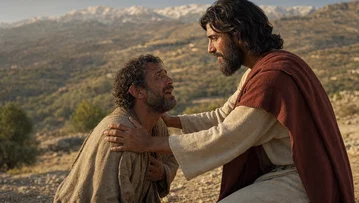
Parallel account of Jesus’ descent and the boy’s healing.
- Matthew 17:14-18
And when they were come to the multitude, there came to him a certain man, kneeling down to him, and saying,
Jesus descends the mountain, meets the crowd, and heals the afflicted boy.
- Matthew 17:1-9
And after six days Jesus taketh Peter, James, and John his brother, and bringeth them up into an high mountain apart,
Parallel account of the transfiguration and descent from the mountain.
- 2 Peter 1:16-18
For we have not followed cunningly devised fables, when we made known unto you the power and coming of our Lord Jesus Christ, but were eyewitnesses of his majesty.
Peter refers directly to the transfiguration.
- Luke 9:33
And it came to pass, as they departed from him, Peter said unto Jesus, Master, it is good for us to be here: and let us make three tabernacles; one for thee, and one for Moses, and one for Elias: not knowing what he said.
Peter wanted to remain on the mount.
- Matthew 16:28
Verily I say unto you, There be some standing here, which shall not taste of death, till they see the Son of man coming in his kingdom.
The transfiguration fulfills the promise of seeing the Son of man coming in his kingdom.
- Luke 9:1-2
Then he called his twelve disciples together, and gave them power and authority over all devils, and to cure diseases.
Jesus had given the disciples authority over demons and diseases.
Commentary
Each commentary is drawn from primary sources: the writings of Ellen G. White and Adventist pioneers and periodicals. Each commentary is separate. Its own words are not a quotation; follow the references to read the source passages.
Ellen G. White
5 sources
The verse records the next day after the night of the transfiguration, when Jesus came down from the hill with the three who had been with Him above.DA 426.1–2DA 426.3–427.2DA 429.2–430.1 He moved from the mount of transfiguration down to its foot in the plain below, returning to the work waiting for Him among the people.DA 426.1–2DA 429.2–430.1ST Jan 22, 1902 A large crowd had gathered at the foot while the disciples who had stayed behind were seeking Him, and they came to meet Him as He returned.DA 426.1–2DA 426.3–427.2ST Jan 22, 1902 They ran to Him with reverence and joy as people waiting for His help and deliverance from Satan's power.DA 426.3–427.2ST Jan 22, 1902
The crowd and the disciples were troubled because the disciples had failed to cast out a demon, and the scribes were using that failure to discredit them.DA 426.3–427.2 The descent from heavenly glory to save an afflicted boy enslaved by Satan is a lesson in redemption.DA 429.2–430.1 It shows that His servants must both seek spiritual insight with Him and work among suffering people.DA 429.2–430.1
The verse belongs to His words and work while shedding light upon the people when the time was nearly come for Him to be taken from them, when He wanted them to remember all He had said to them.Ms 72, 1911, par. 1–5 Its meaning is to be studied and grasped now so that hearts are in full harmony with Christ and understand His work and what He will do for those who follow on to know the Lord.Ms 72, 1911, par. 1–5 That following on is with ever-increasing light like the dawn, whose going forth is prepared as the morning, in preparation for a coming time when there will be trials and persecutions everywhere.Ms 72, 1911, par. 1–5
Sources
Pioneers and periodicals
16 sources
On the next day after the transfiguration Jesus and his disciples came down from the hill, identified as Mount Hermon, and a large crowd met him.ST Oct 14, 1913ST Aug 16, 1905ST Jul 12, 1899 Among them was a man appealing for his epileptic son, a child tormented by an unclean spirit whom the disciples could not cure and whom Jesus healed by his power, wisdom and love.ST Sep 27, 1910ST Oct 14, 1913ST Jul 12, 1899ST May 14, 1894ST Dec 17, 1896 The vision of God's triumphant kingdom had not removed suffering and sorrow on earth, for at the foot of the mountain the sick and demon-possessed were still waiting for deliverance from Satan's power.ST Jan 22, 1902RH Jan 4, 1912 His descent from midnight prayer communion with his Father to work for men in the valley shows that nearness to God's heart brings nearness to men and their need, and that only those who have been with Christ on the mount receive power to serve and to cast out evil spirits at its foot, so disciples must leave quiet communion to labor amid suffering.ST Jun 13, 1900RH Nov 24, 1910 The disciples' failure came from little faith, lack of courage and trust, neglect of prayer, and selfish ambition and jealousy, for that kind required prayer and fasting, and the whole scene stands as the abrupt contrast between the glory on the mountaintop and the distressing work below, where mountain triumph is followed by travail for sick bodies and dying souls.RH Nov 30, 1911ST May 8, 1901ST Oct 5, 1904
Setting and Immediate Events
The descent took place on the next day after the transfiguration and the events on the mountain, when Jesus with his disciples came down from the hill and a large crowd met him.ST Oct 14, 1913ST Jul 12, 1899ST Mar 31, 1898ST May 14, 1894ST May 14, 1894 It was the day after the mountain experience, with Jesus coming down to find a multitude waiting to meet him.ST Oct 14, 1913ST Aug 16, 1905ST Mar 31, 1898ST May 14, 1894ST May 14, 1894 This movement belongs within his travels of miracle-working and teaching.ST Oct 14, 1913
The hill is the Mount of Transfiguration, near which the healing episode occurred, and which some identify as Mount Hermon.ST Aug 16, 1905ST Jul 12, 1899 The descent is connected with the father's appeal for his epileptic son, whom the disciples had been unable to cure and whom Jesus healed.ST Jul 12, 1899 The crowd included a man who asked Jesus to heal his son, leading to the healing of the child possessed by an unclean spirit.ST May 14, 1894 A demon-tormented sufferer waited below, a demon-possessed boy met in the distressing scene below the mountain.ST Dec 17, 1896ST Oct 5, 1904
The healing of the epileptic boy in this chapter shows Christ's power, wisdom, and love.ST Sep 27, 1910 The verse is also cited as part of the account of feeding the multitude, in which after withdrawing with his disciples Jesus was followed by a great crowd.ST Jul 26, 1905 He taught them and met their need for food by miraculously multiplying the loaves and fishes.ST Jul 26, 1905
Service After the Mount
The day after the transfiguration Jesus and the disciples came down from the mountain and met a crowd at its foot.ST Jan 22, 1902RH Jan 4, 1912 The vision of God's triumphant kingdom had not removed suffering and sorrow on earth, for sick and demon-possessed people still needed relief and there was work to do among them.RH Jan 4, 1912 On the plain below people were waiting for Christ's help and deliverance from Satan's power.ST Jan 22, 1902 The descent was a coming down from midnight prayer communion with the Father on the mountain to work for men in the valley where much people met Him.ST Jun 13, 1900 Nearness to God's heart brings nearness to men and their need and cures indifference in service, and only those who have been with Christ on the mount receive power to cast out evil spirits at the foot of the mount.ST Jun 13, 1900 Peter's wish to remain on the mount shows the appeal of quiet communion with God, but disciples must leave such stillness to serve people amid suffering and sorrow where human needs await them at the mountain's base.RH Nov 24, 1910
The failure of the disciples to cast out the demon after the descent came from little faith, lack of courage and trust in Christ's power, neglect of prayer, and selfish ambition and jealousy.RH Nov 30, 1911 That kind of demon required prayer and fasting, showing that spiritual success depends on the disciples' condition before God.RH Nov 30, 1911 After the glory of the transfiguration Jesus came down to give the glory of His life to the needy, demon-haunted multitude in the valley below.ST May 8, 1901 As beyond His resurrection and ascension lay the great field of the world where His body the church was to labor to minister His life, to witness to the power of His resurrection and to carry on the struggle begun by its self-sacrificing Head, so mountain triumph is followed by labor, travail and pain for sick bodies and dying souls, ending in the triumph of saving souls by the baptizing power of the Spirit.ST May 8, 1901 The coming down marks the abrupt change from the glory of the transfiguration to the distressing scene below where Jesus meets a crowd and a demon-possessed boy.ST Oct 5, 1904 It is the contrast between a mountaintop spiritual experience and the difficult work that follows.ST Oct 5, 1904
Sources