Mark 12:42
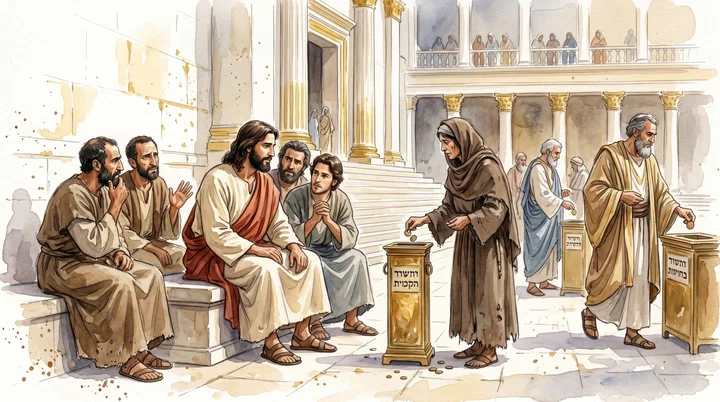
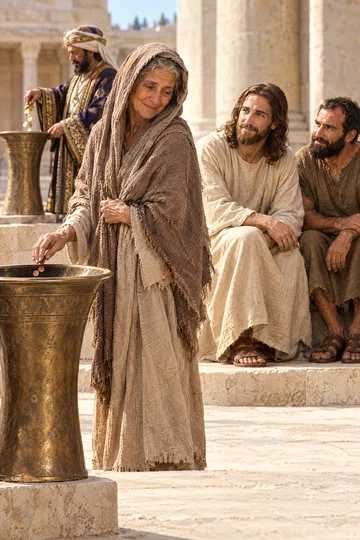
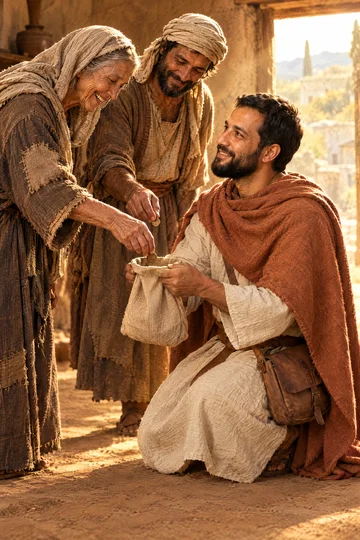
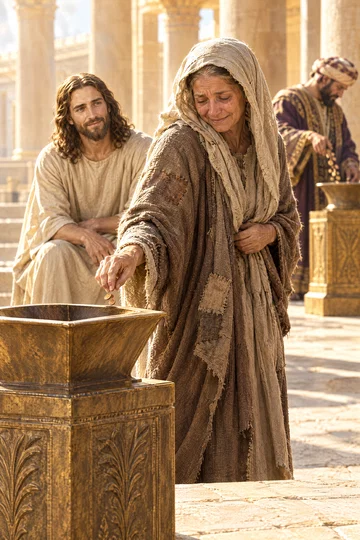
And there came a certain poor widow, and she threw in two mites, which make a farthing.
Translations
American King James Version, King James Version, KJV Cambridge Paragraph Bible, Webster Bible
And there came a certain poor widow, and she threw in two mites, which make a farthing.
Revised Version, American Standard Version
And there came a poor widow, and she cast in two mites, which make a farthing.
and having come, a poor widow did put in two mites, which are a farthing.
And a poor widow came and cast in two mites, which is a farthing.
And there came, one destitute, widow, and cast in two mites, which are, a farthing.
Berean Standard Bible, Majority Standard Bible
Then one poor widow came and put in two small copper coins, which amounted to a small fraction of a denarius.
A poor widow came and she cast in two small brass coins, which equal a quadrans coin.
And there came a poor widow, and she put in two little bits of money, which make a farthing.
And there came a certaine poore widowe, and she threw in two mites, which make a quadrin.
Douay-Rheims (Challoner revision)
And there came a certain poor widow, and she cast in two mites, which make a farthing.
Pictures
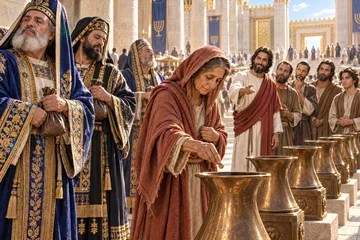
Cross-references
- Luke 21:1-4
And he looked up, and saw the rich men casting their gifts into the treasury.
Luke recounts the widow’s small offering and her gift of all she had.
- 2 Corinthians 8:12
For if there be first a willing mind, it is accepted according to that a man hath, and not according to that he hath not.
A gift is accepted according to what a person has and gives willingly.
- 2 Corinthians 8:2-3
How that in a great trial of affliction the abundance of their joy and their deep poverty abounded unto the riches of their liberality.
The Macedonians’ deep poverty abounded in generous giving, like the widow’s offering.
- 2 Corinthians 9:7
Every man according as he purposeth in his heart, so let him give; not grudgingly, or of necessity: for God loveth a cheerful giver.
Both teach giving with a willing, cheerful heart.
- Matthew 6:20-21
But lay up for yourselves treasures in heaven, where neither moth nor rust doth corrupt, and where thieves do not break through nor steal:
Sacrificial giving lays up treasure in heaven and reveals the heart.
- Luke 21:3
And he said, Of a truth I say unto you, that this poor widow hath cast in more than they all:
Jesus says the widow gave more than all the others.
- 1 Kings 17:12-16
And she said, As the LORD thy God liveth, I have not a cake, but an handful of meal in a barrel, and a little oil in a cruse: and, behold, I am gathering two sticks, that I may go in and dress it for me and my son, that we may eat it, and die.
The widow gives from her last provisions and receives an unfailing supply.
- Proverbs 19:17
He that hath pity upon the poor lendeth unto the LORD; and that which he hath given will he pay him again.
Both describe giving to the poor as lending to the Lord, who repays the giver.
- Matthew 19:23-24
Then said Jesus unto his disciples, Verily I say unto you, That a rich man shall hardly enter into the kingdom of heaven.
Both passages concern riches and entry into the kingdom of God.
- Proverbs 11:24-25
There is that scattereth, and yet increaseth; and there is that withholdeth more than is meet, but it tendeth to poverty.
A small gift is scattered generously, with increase following.
- 2 Corinthians 9:10
Now he that ministereth seed to the sower both minister bread for your food, and multiply your seed sown, and increase the fruits of your righteousness;)
God multiplies the seed of those who give sacrificially.
Commentary part 1 of 2
Each commentary is drawn from primary sources: the writings of Ellen G. White and Adventist pioneers and periodicals. Each commentary is separate. Its own words are not a quotation; follow the references to read the source passages.
Ellen G. White
60 sources
A poor widow put two very small coins, worth only a farthing together, into the offering for the service of the temple.Ms 101, 1906, par. 44ED 109.2–3ST May 9, 1878 Those two coins were all she had to live on, given out of her poverty at the cost of food and comfort for the cause she loved.DA 615.1–616.13SP 72.22T 666.1–2 Her gift is reckoned not by its small amount but by its proportion to all she possessed, the sacrifice it required, and the unselfish love, faith and purity of motive behind it.ST May 9, 1878DA 615.1–616.12T 666.1–2ST Nov 15, 19109T 224.3 Because it was wholly given at real self-denial, it was counted greater than the large gifts of the rich from their abundance, indeed the greatest offering given that day.3SP 73.2RH Jul 11, 1907ST Nov 15, 1910 Her deed stands as a lasting example that even the poorest may give what they can, and such willing mites have moved countless others to generosity and helped sustain the work of missions and mercy through the ages.ED 109.2–3GW 467.19T 224.36T 310.1–29T 54.3
The Widow's Small Offering
The verse records a poor widow throwing two mites, which make a farthing, into the treasury for the temple service, a very small sum of money.Ms 101, 1906, par. 44ED 109.2–3ST May 9, 1878RH Jul 11, 19075T 733.4 Her two small coins became an example that prompted countless gifts to the Saviour's cause over the centuries, and Christ counted her gift as greater than the larger gifts of the rich because they gave from abundance while she gave all she had to live on.Ms 101, 1906, par. 44ED 109.2–3ST May 9, 18785T 733.4RH Dec 25, 1900
Her two small coins were all she had to live on, for she gave from her living and poverty rather than from abundance.DA 615.1–616.13SP 72.22T 666.1–2Ms 53, 1906, par. 1Ms 98, 1904, par. 1–8 She surrendered even what she needed for food and comfort, depriving herself of food and going without to support the cause she loved.DA 615.1–616.1RH Jul 11, 19073SP 72.22T 666.1–2Ms 98, 1904, par. 1–8 The wealthy gave without feeling want, while her small gift was costly because its worth depended not chiefly on amount but on proportion to what she had, on consecration and sacrifice, and on fidelity that was rewarded.DA 615.1–616.12T 666.1–2Ms 53, 1906, par. 1Ms 98, 1904, par. 1–8Ms 40, 1905, par. 11–12 Christ measures a gift by whether it is all the giver has rather than by its size, the mites being as dear to her as the riches of the wealthy are to the rich.Ms 53, 1906, par. 1Ms 40, 1905, par. 11–12
She gave eagerly but discreetly, willingly and with loving concern for God's work and for the temple service she believed God had appointed.DA 614.3–43SP 71.2–72.1Lt 155, 1899, par. 1–3 Her gift was precious because giving it required sacrifice, yet she gave with gratitude and joy and with a willing heart.Lt 155, 1899, par. 1–3STPW 11.2–12.12T 571.1 It was consecrated with prayer and joy even when obtained through hardship and economy.STPW 11.2–12.12T 571.1
Her gift was noticed by God, valued above larger offerings, commended by Christ, and recorded as done to Christ.DA 614.1–2EW 100.1DA 396.4–397.2Lt 29, 1897, par. 19–22 Even a small deed has weight in the judgment when truth and holiness shape it, and even a small amount given by giving up some personal gratification matters when put into the Lord's treasury.EW 100.1Lt 29, 1897, par. 19–22 The misuse of a gift by those who receive it does not take away God's blessing from the giver, and giving offerings to God remains a duty even though religious leaders could misuse apparent devotion to cover self-interest.DA 614.1–2DA 396.4–397.2
How God Measures Giving
In the sanctuary's reckoning a gift is not measured by its amount in money but by its proportion to what the giver has and by the consecration and sacrifice behind it.2T 666.1–29T 224.3RH Oct 10, 19073T 398.2–3Ms 53, 1906, par. 1 God values an offering by the purity of the motive and the spirit of love that prompts it, and by the self-denial it costs, rather than by its monetary size.2T 666.1–2ST Nov 15, 19109T 224.3RH Oct 10, 19073T 398.2–3 The widow's two mites were therefore a costly gift and the greatest offering given that day, because she gave from her poverty all she had to live on while the wealthy gave from their abundance without feeling want.2T 666.1–2ST Nov 15, 19103T 398.2–3Ms 53, 1906, par. 1 A small willing offering given from love is as acceptable as a rich person's large donation, and wholehearted interest in saving souls is of great value to God.9T 224.3RH Oct 10, 19073T 398.2–3Ms 53, 1906, par. 1
Its worth lay in unselfish love and benevolence toward God and the service she believed He had appointed, and in unwavering, childlike faith.ST May 9, 1878DA 615.1–616.13SP 72.23SP 71.2–72.1RH Dec 15, 1874 She surrendered even what she needed for food and deprived herself to give to the cause she loved, trusting that her Heavenly Father would not overlook her great need and would care for her and supply her needs in an uncertain future.ST May 9, 1878DA 615.1–616.1RH Jul 11, 19073SP 72.23SP 71.2–72.1 The rich men's larger offerings cost them no comforts, but her humble gift given with unselfish love and genuine faith was precious to God and won Christ's commendation above theirs.ST May 9, 1878RH Jul 11, 19073SP 72.23SP 71.2–72.1 Little gifts and duties done cheerfully from love can thus have greater moral worth than costly gifts, and a willing gift from a heart of love may involve real self-denial.DA 615.1–616.13SP 72.2RH Dec 15, 1874
Its worth lay also in willingness and wholehearted cheerfulness, in gratitude, sincerity and faithfulness, in giving her best with her whole heart.7T 294.2–295.1Ms 20, 1896, par. 1ST Jul 15, 1880Ms 26, 1891, par. 33–35 Her gift expressed a heart set on following God's way and faithfully doing His will to the best of ability and to the utmost, so that even what people consider insignificant and small in ability is weighed by its principle and is noticed in heaven rather than despised.Ms 20, 1896, par. 1Lt 52, 1891, par. 42–45 A humble offering is accepted when it is all the giver can bring, and a poor giver may sacrifice more than one who gives from abundance.7T 294.2–295.1ST Jul 15, 1880Ms 26, 1891, par. 33–35 Cheerful, freely given gifts are more acceptable than great wealth given grudgingly, and God blesses a gift's work of love and mercy so that it bears fruit in keeping with the wholehearted cheerfulness with which it is given.7T 294.2–295.1ST Jul 15, 1880Ms 26, 1891, par. 33–35
Faithfully rendering to the Lord His portion and His just dues without robbing Him even in little things brings His recognition and favor, for it is heart service, willingness, love and faith in doing one's best that makes a gift valuable, acceptable and commended by Him.ST Oct 21, 1889 No one is rejected because of the smallness of the gift, and even the humblest sincere offering a person can present is accepted and valued by the Lord.ST Oct 21, 18892T 256.3–258.3Lt 175, 1904, par. 10Lt 377, 1904, par. 14 Lowly service close to Christ is therefore not to be despised.Lt 377, 1904, par. 14
Greater Than Rich Gifts
The rich put in from their abundance without feeling want, giving up no comforts or luxuries, and giving partly to be seen and recognized by others.3SP 73.2ST May 9, 18782T 666.1–23T 398.2–3RH Dec 15, 1874 The widow by contrast gave from her poverty at real cost, with true self-denial, surrendering even what she needed for comfort and to live on.Ms 101, 1906, par. 443SP 73.22T 666.1–23T 398.2–3RH Dec 15, 1874 Her two mites were a very small amount in money, yet they were all she had.Ms 101, 1906, par. 44ST May 9, 18782T 666.1–2
Because it was a sacrifice, her mite was counted greater in true value than the larger gifts, indeed worth more than the rich men's offerings and the greatest offering given that day.3SP 73.2RH Jul 11, 1907ST Nov 15, 1910Lt 155, 1899, par. 1–32T 198.1 It surpassed their donations in motive and in moral worth, and in lasting effect, showing a generosity and unselfish spirit their offerings did not possess.3SP 73.2RH Jul 11, 1907ST Nov 15, 1910 Its preciousness lay in the sacrifice and trust it expressed, in love and faith and benevolence toward God and His work.RH Jul 11, 1907ST Nov 15, 19102T 198.1
Christ measures a gift not by its size but by whether it is all the giver has.Ms 40, 1905, par. 11–12 The two mites were as dear to her as the riches of the wealthy are to the rich, and for that reason they were accepted.Ms 40, 1905, par. 11–12 In the same way He did not reproach His disciples for forsaking only a few fishing boats and nets to follow Him, but accepted their sacrifice because it was their all.Ms 40, 1905, par. 11–12
Lasting Influence For Good
Her two small coins became an act of love whose influence reached far beyond its size and far beyond what she knew.DA 614.3–46T 310.1–2ST Nov 30, 1915 Across the centuries her self-sacrifice has stood as an example that has prompted countless gifts to the Saviour's cause.ED 109.2–36T 310.1–2ST Nov 30, 1915 That example has inspired and encouraged generosity in people of every class and every age and station.GW 467.1DA 615.1–616.16T 310.1–2 It especially encourages those who have little to give what they can, since every gift however small helps in the Lord's work.GW 467.1Ms 138, 1903, par. 3–4
Its influence has proved far greater than the larger contributions of the rich.GW 467.1DA 614.3–4 It has helped sustain missions and missionary work, establish hospitals, feed the hungry, provide for the needy and sick, relieve the poor, extend truth, preach the gospel to the poor, and bring souls to faith.GW 467.1DA 614.3–4DA 615.1–616.1ST Nov 15, 19106T 310.1–2 This shows that a gift given sincerely for God's glory can produce good that no one can measure.GW 467.1DA 614.3–4DA 615.1–616.1 A very small gift in Christ's hands is multiplied for His work, and small regular offerings given through self-denial can support the gospel ministry.DA 614.3–4DA 615.1–616.19T 55.1 Even children's saved pennies can help save souls.Lt 48, 1901, par. 109T 55.1
Such gifts, when offered with sincere purpose and love, are made effective in doing good.6T 103.1–2Lt 48, 1901, par. 109T 55.1 They will be rewarded hereafter.6T 310.1–26T 103.1–2 She will see the results of these far-reaching blessings in the day of God, and children who save their pennies for the Lord will see in heaven what their gifts accomplished.6T 310.1–26T 103.1–2Lt 48, 1901, par. 10
Call For All To Give
Even the poorest can take part in giving, for the two mites show that poverty does not excuse neglecting the duty to give.GW 222.1SG2 154.2–156.1GW92 269.3–270.1 The poor, children, and the ignorant and humble who do duty to the best of ability from love are not despised but are noticed in heaven. God values effort according to what a person has, not what he does not have, accepting every sincere gift and counting a small willing offering given from love as acceptable as a rich person's large donation.9T 224.39T 54.3
Those who cannot give much should still give what they can, forgoing something they could do without.SG2 249.21T 176.3–177.1RH Nov 26, 1857 This means giving up money once spent on personal gratification and putting it into God's work, denying useless spending on dress and needless gratification.SCEV 42.2–3Ms 98, 1904, par. 1–8 Parents are to teach children this self-denial, laying aside in the home from parents to children, saving pennies by economy, using self-denial boxes for mission work, with children putting in candy money or earning by making and selling simple useful household articles for the needy southern missionary field.Ms 98, 1904, par. 1–8 Even a small amount given by giving up some personal gratification matters when put into the Lord's treasury, bringing the joy of generosity and laying up treasure in heaven.SG2 249.2EW 100.1
Humble offerings should be cherished, welcomed, and not judged inferior, dismissed as too meager, despised, or withheld because of size.7T 294.2–295.13SP 73.17T 295.2Ms 57, 1901, par. 6Ms 24, 1897, par. 1–3 When given willingly, with understanding and in love they become priceless, and God smiles upon, receives, blesses and multiplies them so their work of mercy bears fruit in keeping with wholehearted cheerfulness.7T 294.2–295.13SP 73.1Ms 26, 1891, par. 33–35 Faithful use of little lays up treasure in heaven and brings the joy of generosity.SG2 249.2GW 222.1GW92 269.3–270.1
Her example calls everyone entrusted with means to follow her self-denial in giving to support God's work, including churches, gospel ministry, missionaries, missionary work for the destitute and needy, and gifts that comfort widows and fatherless children and satisfy hunger.Ms 98, 1904, par. 1–8MYP 312.2–3 A simple offering from the heart with Heaven's blessing is more acceptable than money raised by lavish feasts indulging appetite.HLT1 53.3–5 Lowly service close to Christ can appeal to one out of Christ and should be put out to usury like larger talents, for God does not make light of small ability. When the poor embrace truth and labor to the extent of their ability, God brings in other talents to carry forward the wonderful work, for which His people are to act like living soldiers of the cross.Ms 6, 1878, par. 31Ms 14, 1887, par. 18
Sources
Pioneers and periodicals
290 sources
A poor widow put two tiny coins worth a farthing into the temple treasury, and they were all she had to live on while the rich gave from their surplus without sacrifice.RH Jun 9, 1859ST Dec 18, 1893 Jesus sat watching the treasury and discerning each motive, and He counted and declared her offering greater than all the larger gifts put in that day.RH Jun 9, 1859ST May 18, 1882ST Dec 18, 1893 God measures an offering not by its monetary amount but by its cost to the giver, its proportion to what He has entrusted, and its motive of love, faith, devotion and willingness.RH Jun 9, 1859ST Dec 18, 1893RH Jul 28, 1874 Poverty does not excuse withholding, for even the very poor share the duty and privilege of giving what they can rather than coming empty.RH Jun 9, 1859RH Sep 12, 1865RH Dec 27, 1853 Her small gift given in cheerful self-denial and trust was remembered and blessed by God to accomplish far more good through the ages than the abundance of the rich.ST May 9, 1878RH Jul 11, 1907RH Jul 29, 1909ST Mar 30, 1882RH Mar 28, 1854
Coins and Their Value
The account records a poor widow throwing two mites, which make a farthing, into the treasury, a very small sum given from poverty as all she had to live on while the rich gave from surplus.ST Dec 18, 1893RH Jul 29, 1909ST Nov 8, 1899 Her two small coins together were worth a farthing, and her small gift from want was counted greater than larger gifts because its worth lay in love, sacrifice and giving all rather than in amount.ST Dec 18, 1893 Diligent labor could earn even this small amount, and its value is measured not only by amount but by cost to the giver and what remains after giving.RH Jul 29, 1909RH Apr 28, 1904
The two mites were worth about three cents, counting for more than larger gifts through greater sacrifice and showing the poor can lay up heavenly treasure as fully as the rich.RH Jun 9, 1859 They were worth about one fourth or a quarter of a cent in the currency described, given from extreme need rather than surplus.RH Jul 29, 1909RH Apr 28, 1904 They were worth less than half a cent, yet given as all she had rather than merely a tenth, an example of giving in extreme poverty that was not condemned.ST Aug 30, 1883 Financially the whole offering counted for but a farthing, a quadrant equal to four mills or two fifths of a cent or three fourths of an English farthing, most insignificant in itself yet her whole means of subsistence and last trusted resource.RH Oct 25, 1906 The two mites amounted to about half a cent, especially commended and carried in fame through succeeding generations as a small gift blessed by God when given with humble faith.ST Jul 25, 1878
Her two small brass coins were worth about two-thirds of a cent in contrast to large sums, showing judgment does not depend on outward amount but weighs thoughts and feelings and the giving of all to live on.ST Apr 1, 1897 She gave only two mites, with eight mites equaling a penny and nothing left for food or clothing, measured by what remains to show the value of self-denial.RH Nov 11, 1915 Two mites make one farthing, with about one cent for a mite and three cents for a farthing, describing real small Temple coins placed into the Temple Treasury.RH Aug 29, 1871ST Mar 13, 1893 A mite is a small sum cast in as payment or contribution, for a poor afflicted person the last money and last means to live on.RH Jun 13, 1865 The presence of such small coins still dug from the ruins of once opulent and popular cities in the Holy Land confirms the truth of the Bible account.RH Aug 29, 1871
A mite means a small monetary gift or modest contribution, not necessarily a literal coin, and her mites are the smallest gifts of money, so that consecrated giving of silver and gold means withholding not even a mite.ST Feb 6, 1893RH Dec 12, 1854RH Nov 25, 1852 Even one who is poor can give such a mite as often as able to carry forward Christ's cause, and even a little offering toward supporting the truth can be called a mite.RH Dec 12, 1854RH Nov 25, 1852 Even a small monetary gift from those made poor by stopped income can be called a mite, and such a little mite may be given to help brothers and sisters in mission fields.ST Aug 27, 1894RH Dec 23, 1909 Putting a small monetary gift in with what others give toward a shared work is casting in a mite, which one with limited means may be unable to do.RH May 21, 1857
Temple Setting and Background
Long before Christ the Jews had taken up bringing an offering every Sabbath into the house of God and placing it in the treasury, and the two small coins were cast into that temple treasury in the presence of a multitude, where Jesus watched those depositing gifts and spoke directly to his disciples, lifting the poor widow above all the rich of Jerusalem.RH May 2, 1907ST Aug 5, 1886RH Oct 22, 1872 That treasury received offerings collected for priests and the poor, and though she was poorer than some who might receive the money, she answered duty in loving zeal without knowing how the priests would use it and left the outcome to God who knows all things.ST Nov 8, 1899 She came as a shy and shrinking widow in widow's clothes, knowing want and sorrow and lack of daily food and grieving that her offering was so small, into the courts of the splendid marble and gold and gemmed temple where rich nobles, stately Pharisees and priests displayed costly gifts and tithes of all their store.ST May 18, 1882 Jesus sat overlooking all in gentle lowly appearance as the Nazarene, ignored by priest and Pharisee, yet with searching sight trying hearts and knowing what prompted every offering, seeing her want and hunger and grief and care and sorrow and that her paltry farthing cost a sacrifice.ST May 18, 1882
What she gave came from poverty and from diligent labor, even the small amount earned through hard toil, and its worth lay in its being honestly gotten by honest effort.ST Dec 23, 1903RH Mar 26, 1901 After passing through the devouring hands of men who devoured widows' houses and for pretense made long prayers, she had only a pittance left, and every particle of it was honest and therefore measured according to righteousness in God's sight.RH Mar 26, 1901 Whatever is not acquired by honest dealing cannot be counted as the giver's gift, however much is given to the cause, but with all its fruits is counted in righteousness to the widows and the poor and the laborers whose wages were ground down to get it, for money gained by robbing or underpaying still belongs to those wronged.ST Dec 23, 1903RH Mar 26, 1901 By that measure the wealthy gifts counted for nothing, because gotten by Mammon worship in crowding sellers down when they sold and crowding buyers up when they bought so as to increase gains at both ends.RH Mar 26, 1901 It was the spirit of priests and temple officials at Passover gatherings, who bought cattle, sheep and doves cheap from country owners under claim they were for sacrifice to God, then resold them in the temple at exorbitant prices to those wishing to sacrifice, doubly robbing both those from whom they purchased and those to whom they sold.RH Mar 26, 1901
That act belonged to his three and a half years of teaching and humble service before his disciples, relieving wants and seeking the poor, the sick, the obscure and the unpopular to be their friend and helper, distinct from his later washing of the disciples' feet.ST Aug 5, 1886 She gave both of her small coins and not merely one, the smallest coins saved for a long time, and the giving of both is what matters, for she gave all she had including what she needed for food.RH Nov 23, 1916RH Nov 23, 1916RH Feb 21, 1907 Her gift therefore expressed prayerful devotion and surrender to God, valued for love and devotion rather than size.RH Nov 23, 1916RH Nov 23, 1916 The mite was her last money and last means to live on, so small an offering that a person may have no money even for that, while salvation cannot be bought with wealth.ST Jul 1, 1880RH Jun 13, 1865
Like the widow of Zarephath, whose need prompted sacrifice of her last food for Elijah, she gave all and withheld nothing.RH Jun 24, 1902 The giver is not named, which exposes the weakness of appealing to her to justify publicizing contributors, though sharing details of Christian service to help and encourage others is proper and does not warrant publicity for its own sake or reliance on public sympathy.RH Dec 2, 1873 Even the smallest sum given at sacrifice, consecrated through prayer and tears, is regarded by God, and those entrusted with such sacred gifts bear responsibility to use them properly.RH Oct 15, 1872
Her Total Sacrifice
The two small coins together worth a farthing were all she had to live on, her whole means of subsistence and entire earthly possession, given from poverty and want while the rich gave from abundance and surplus without sacrifice of comfort.ST Dec 18, 1893RH Jul 29, 1909ST Nov 8, 1899 The offering was tiny in amount yet judged greater than the larger gifts because its worth lay not in the sum but in love for God, interest in His work, and sacrifice, so gifts that seem small when given from a heart filled with love are precious, accepted and blessed.RH Jun 9, 1859ST Dec 18, 1893RH Jul 29, 1909 Her example has inspired generous giving to the cause, showing that value is not measured only by amount and that the poor can lay up treasure in heaven as fully as the rich.RH Jun 9, 1859ST Dec 18, 1893RH Jul 29, 1909 A poor person could earn even this small amount through diligent labor, and the lesson illustrates that offerings are measured not only by amount but by the sacrifice they represent.ST Dec 18, 1893
Its spiritual power depends on giving what one cannot spare, the last two rather than money left over from abundance, for the important measure is what the giver keeps back because cost reveals sacrifice.ST Sep 28, 1915 Such a small offering from poverty can represent real self-denial even when the giver needs what is given for life's necessities, and gifts of that kind are especially precious in the Lord's sight.RH Dec 5, 1907 A contribution sent despite lack of basic necessities is fittingly described as such a mite given at real personal cost.RH Jul 13, 1905 Her small gift earned through daily toil could cost her as much as a much larger donation from wealth, since the giving system was intended to make rich and poor support the cause in proportion to means so none would be distressed.
Jesus counted, commended and declared her offering greater than all the larger gifts put in that day, counting as more than all the rest and outweighing rich treasures and accomplishing more good than millions.RH Jun 9, 1859RH Jul 29, 1909ST Nov 8, 1899 She gave in love, faith, benevolence and cheerful self-denial, giving all she had and trusting God to care for her uncertain future, and a small sum so given is worth more than gifts of thousands from those who feel no lack because value is measured not by the coin but by purity of motive behind the sacrifice.ST May 9, 1878RH Jul 11, 1907ST Nov 7, 1878ST Nov 15, 1910ST Mar 30, 1882 She went without food to support the cause she loved, and her faith that God would care for her need with unselfish spirit made the gift precious, surpassing larger donations in motive and lasting effect.RH Jul 11, 1907ST Nov 7, 1878ST Nov 15, 1910 She left with assurance that God would care for her and did not starve to death, with joyful heart and peace met with abundant provision like manna and promised future care.RH Jul 11, 1907ST Mar 30, 1882ST Jan 18, 1916
God blessed that sincere offering and made it the source of great results, like a tiny stream flowing down through the ages, widening and deepening and contributing in a thousand directions to spreading truth and relieving the needy.RH Jul 11, 1907ST Nov 7, 1878ST Nov 15, 1910ST Mar 30, 1882 Its influence acted upon thousands of hearts in every age and country, leading many liberal self-denying poor to give and stirring ease-loving and doubting ones to good works whose gifts swell the value of her offering, helping meet the needs of the poor and extend saving truth.RH Jul 11, 1907ST Nov 7, 1878ST Nov 15, 1910ST Mar 30, 1882 Her example rebukes those who selfishly withhold what they could give and encourages rich and poor alike to serve God and suffering humanity as His stewards.ST Nov 7, 1878
Giving for the cause may involve such personal sacrifice as a child going without butter to contribute a few pennies, with hope of the promised rest for those who give what they can.RH Sep 1, 1863 Giving to God may mean setting aside food the giver and family would otherwise have eaten, as a real sacrifice sharing in the work for others.ST Apr 22, 1897 Poor widows likewise placed their food on the altar though doing so meant going hungry for days, and their sacrifice was accepted.RH Dec 4, 1913 Her two mites, being her earthly all, were the greatest offering of earthly substance that can be made, a standard of giving that rich men almost never reach, perhaps not one in a hundred years on average since Christ, so those who have abundance must give abundantly and must not excuse a trifling gift by calling it the widow's mite.RH May 2, 1871
How God Measures Giving
The two small coins worth a farthing count greater than the larger gifts because they were given from poverty as all the giver had to live on, and their worth lies not in amount but in sacrifice, self-denial, cost to the giver, proportion to what was entrusted, and motive, devotion, love, faith and willingness.RH Jun 9, 1859ST Dec 18, 1893RH Apr 21, 1903 What seems small is precious and accepted and blessed when the heart is filled with love for God and interest in His work, while giving from abundance without giving up comfort costs nothing.RH Mar 2, 1876 A gift's worth is measured by the giver's sacrifice and spirit, not merely by its amount, so even the very poor can lay up treasure in heaven as fully as the rich.RH Jun 9, 1859RH Apr 21, 1903
Generosity is measured not by the amount given but by what remains after giving.RH Mar 15, 1906RH Dec 30, 1909RH May 21, 1872 The two coins matter because both were given, not just one, and genuine giving is measured by sacrifice and by what is left to the giver.RH Feb 21, 1907RH Dec 30, 1909 God estimates money gifts not by what is given but by what is kept, not by the amount contributed but by the cost in self-denial.RH Oct 25, 1906 Giving from abundant wealth can leave what remains as evidence that love is centered on self rather than on God and eternity, while an offering that costs everything is blessed because it costs everything. The offering tests the heart, and its true worth is measured by what is given together with what the giver keeps, with the giver's spirit discerned.RH May 21, 1872
The value is measured not by the worth of the coin but by purity of motive, and God looks at thoughts and feelings so that character and fidelity outweigh riches.ST May 9, 1878RH Jul 11, 1907ST Mar 30, 1882 Love, faith, willingness to sacrifice, and trust amid an uncertain future make a small sum given cheerfully from self-denial worth more than thousands from those who feel no lack.ST May 9, 1878RH Jul 11, 1907ST Mar 30, 1882 The devoted, unselfish motive is what is counted greatest, and even the smallest act of charity is acceptable when given with holy love.ST Nov 7, 1878RH Jul 28, 1874 Humble gifts given with unselfish love and faith are precious, and what is blessed can become the source of great results through the ages in spreading truth, relieving the needy, stirring thousands of hearts, and leading the liberal self-denying poor to give and the ease-loving and doubting to good works.ST Nov 7, 1878ST Mar 30, 1882
Given with an eye single to God's glory, the small gift amounts to more than gifts given for human praise or admiration, which earn only the worthless reward sought, and more than abundant gifts that cost no sacrifice.ST Jan 21, 1886ST Aug 22, 1878RH Jan 10, 1871 The smallest sum given cheerfully from self-denial is of more value than thousands given by those who feel no lack, fragrant before God and pronounced greatest that day.ST Jan 21, 1886
Giving is blessed when it comes from right motives and supports a cause God approves, and the small gift to the treasury is regarded as favorably as rich men's gold, for amount alone does not determine worth.ST Apr 13, 1882 Even a poor person's gift can show love for God and should be given willingly rather than stingily or grudgingly, its value measured by sacrifice made and not by amount.ST Jan 22, 1880 God loves a cheerful giver and regards the will with which a person gives more than the amount given, so the small gift willingly given is great in His sight.RH Jan 23, 1900
Loving sacrifice is always blessed and honored, and in the judgment of Him who knows the heart it is more than all gifts of wealth or pride, while giving to be seen receives only the reward of unrighteousness.RH Mar 27, 1900ST Jan 7, 1889 What is given according to ability in love for Jesus and for souls, with sympathy and prayer, brings blessing on both gift and giver, and Christ notices and values the whole offering, measuring each person's part not merely by size.RH Mar 27, 1900ST Aug 20, 1902ST Oct 5, 1904 Cheerful humble service is worthier than pride's most costly rites, truly owned and accepted as much as exalted service, requiring faithful use to its utmost, and even what is little or contemptible among men has full value before God when pure love moves it.RH Nov 7, 1865ST Jan 7, 1889
A gift may be small yet worthy when offered from love, which the Master knows and counts as service.RH Dec 12, 1907 Worth lies in sincerity, gratitude and love rather than size, so a small offering presented with cheerful gratitude and duty done to the best of ability from love is noticed in heaven and not despised, and small ability is expected to be put to use just as larger talents are.
Love to God is revealed by sacrifice, not by size of gift, for two mites gave more than gold bestowed from wealth.ST Dec 26, 1892 Building great churches, schools and institutions out of millions reaped from the people does not show love to God or prove advancement in spiritual life, since increase in wealth, numbers, great institutions, and worldly and political influence are not evidence of knowing more of Christ or having more of His power.ST Dec 26, 1892
Christ's Notice and Reward
Jesus sat overlooking the treasury watching how offerings were cast in, searching and trying hearts and discerning the spirit and motive that prompted every gift, and he still invisibly sits as overseer of the treasury watching with deep interest how people give, not to gain human approval but unto the Lord.ST May 18, 1882ST Dec 18, 1893RH Oct 25, 1906RH Sep 23, 1873RH May 21, 1872 The true worth of an offering is measured not only by what is given but also by what the giver keeps, and a gift can be paltry when offered with mixed motives or when what is due is withheld while means are spent on what is preferred.RH Oct 25, 1906RH Sep 23, 1873RH May 21, 1872 Christ saw and valued the widow's offering and judged it greater than larger gifts from abundance because she gave from her need all she had to live on.ST May 18, 1882ST Dec 18, 1893RH Mar 30, 1869
Heaven's record gives the widow's mite greater weight than rich gifts publicly displayed, for her deep poverty abounded to riches of liberality given willingly to her power and beyond her power, and her small gift counted as more than all cast in out of abundance.RH Jun 9, 1859RH Sep 12, 1865RH Jul 27, 1876RH Jun 18, 1872 Her two mites, worth about three cents, counted for more than larger gifts of the rich because they represented greater sacrifice, not greater sum, teaching that the poor can lay up treasure in heaven as fully as the rich.RH Jun 9, 1859RH Sep 12, 1865RH Oct 25, 1906 By casting her whole living into the sacred treasury she became rich in good works and in the praise of God, whereas had she kept the coins she would have remained only the same poor widow, for wealth is measured not by what is possessed but by what is given in love to God who purifies, accepts, acknowledges and recompenses every accepted gift and will have it reappear as treasure in heaven.RH Oct 25, 1906RH Jun 18, 1872RH Jun 2, 1904 Her humble generosity was seen and honored by Christ and became an enduring example that encourages giving, showing humble offerings for Christ are noticed and appreciated by him and can have lasting influence.RH Jul 27, 1876RH Jun 18, 1872RH Jun 2, 1904
Her little gift received reward and commendation as great charity though given while still poor instead of waiting until rich, meaning perfection depends on making the best use of the present condition and doing at once all one is able for his glory.RH Jun 11, 1857ST May 20, 1880RH Jul 7, 1863 Even those able to give little may receive the greatest reward when they give what they have, and the smallest act performed or sacrifice made in Christ's name with unselfish motive and loving spirit cannot fail to accomplish good and will receive its reward.ST May 20, 1880ST Mar 20, 1884ST Feb 8, 1892 Her gift of two mites made her a large stockholder in heaven, with her giving recorded both there and here, and her generous gift has continued to prompt others to give to the Lord.RH Jun 25, 1872ST Mar 20, 1884RH Jul 7, 1863 She offered it with trembling heart as though it might not be worthy of the Master's acceptance, yet Jesus knew her heart and gave deserved encouragement, illustrating that giving to God's cause lays up treasure in heaven.RH Jun 11, 1857RH Jun 25, 1872RH Jul 7, 1863
God regarded the motives of her heart, joined his blessing to the gift, and made it accomplish more than the rich people's abundance.ST Nov 30, 1915RH Mar 28, 1854ST Jul 25, 1878 Her small gift of about half a cent was especially commended by Jesus, and its record in Scripture has carried its fame through succeeding generations, with a small gift given with humble faith likewise able to receive his blessing.ST Nov 30, 1915RH Mar 28, 1854ST Jul 25, 1878 Across the centuries her example of love has prompted countless gifts to the Saviour's cause.ST Nov 30, 1915RH Mar 28, 1854ST Jul 25, 1878
God blessed that sincere offering of love, faith and benevolence, given as all she had while trusting God to care for her uncertain future, and made it the source of great results like a tiny stream flowing down through the ages, widening and deepening and contributing in a thousand directions to spreading truth and relieving the needy.RH Jul 11, 1907ST Nov 7, 1878ST Nov 15, 1910RH Jul 29, 1909ST Mar 30, 1882 A small sum given cheerfully from self-denial is worth more in God's sight than gifts of thousands from those who feel no lack, and Christ declared her gift the greatest put into the treasury that day because its value is measured not by worth of coin but by purity of motive behind the sacrifice.ST Nov 7, 1878ST Nov 15, 1910ST Mar 30, 1882 Its influence acting upon thousands of hearts in every age and country led many liberal self-denying poor to give and stirred ease-loving and doubting ones to good works whose gifts swell the value of her offering, helping meet needs of the poor, extend saving truth, relieve the poor and spread the gospel.RH Jul 11, 1907ST Nov 7, 1878ST Nov 15, 1910ST Mar 30, 1882RH Jun 18, 1872 Her two mites, worth a farthing or about one fourth of a cent, mattered because she gave from extreme poverty all she had unlike those who gave from abundance, and Jesus noticed and commended her showing a gift's value is not measured only by amount and her example has inspired generous giving.RH Jul 11, 1907ST Nov 15, 1910RH Jul 29, 1909
God's blessing on a small amount makes it feed many hungry souls with the bread of life, just as the few loaves and fishes fed the hungry thousands who followed Jesus, so people who cannot serve as active laborers can still give of means even when they have but little, and even children giving pennies are encouraged in missionary work by giving.RH Nov 1, 1906 Though people might dismiss her gift as insignificant, Jesus sees the sacrifice and values wholehearted giving, and her reward is not earthly praise but assurance of his loving regard.ST Oct 23, 1893ST Jan 24, 1911RH Nov 9, 1911 She gave quietly out of gratitude trusting he would continue to provide, though fearing the Pharisees' scorn, and Jesus saw her gift and read her heart and said she had given more than those who gave from abundance because she gave all she had to live on.ST Oct 23, 1893ST Jan 24, 1911RH Nov 9, 1911 Her tiny offering held a great store of sacrificial love whose full worth was known to Christ, its significance unfolding through the ages to be displayed in the final day when Christ reveals the value of loving service people could not see.ST Oct 23, 1893ST Jan 24, 1911RH Nov 9, 1911
The widow's two mites, though worth only a farthing by earthly reckoning, were worth more in heaven than all the rich people's gifts, illustrating Christian service cannot be measured by totals or outward results because heaven values a gift differently from earthly arithmetic.ST Apr 27, 1882ST Apr 5, 1883RH Jun 24, 1902 The angels recorded them as greater than much cast in by rich men, showing value is not measured by outward size and God gives success in proportion to love, not amount done.ST Apr 27, 1882RH Mar 2, 1876ST Apr 5, 1883 Even a poor person's giving matters as a test of sincere love, not merely as a way to fill the treasury, for the widow's mites were valued not by small amount but by great sacrifice as she gave from poverty while the rich gave from abundance.RH Aug 6, 1872RH Mar 2, 1876RH Jun 24, 1902 By heaven's standard every member of God's family can give as much as another, since value is measured by spirit of giving not market value, and even a poor person's unnoticed gifts are recorded with great worth.RH Mar 2, 1876ST Apr 5, 1883RH Jun 24, 1902
God rewards what is done in secret faith rather than what is done to be seen and praised by men, for her humble gift was made in love for God not to be seen by people and would bring richer returns, with giving measured by what it costs the giver and love shown, the same small amount being no sacrifice for the wealthy.RH Aug 6, 1872RH Sep 18, 1855RH May 19, 1904 Pride resists this measure, wanting large gifts trumpeted and thought much of while hiding a small all-giving and forgetting self-pleasing spending, yet her gift counts by faith and self-sacrifice not amount.RH Aug 6, 1872RH Sep 18, 1855 Christ rewards those who make a covenant with him by sacrifice and blessed her gift, teaching sacrifice not size measures value.RH Aug 6, 1872RH Sep 18, 1855RH May 19, 1904 Her two mites were worth more in God's sight than a miser's millions given to ease a guilty conscience or win public favor, for her act was done in unboastful unselfish love commended by Jesus as service prompted by Christian motive, and treating it as a bid for praise would strip it of merit as a good work.
The gift does not buy salvation, does not purchase a home in the New Jerusalem, and does not secure a right to the tree of life, because what is given already belongs wholly to God, and dividing surplus by placing in his treasury what can be spared without being missed is no test of faith.RH Jul 8, 1902RH Sep 8, 1859 The test is not giving what costs no sacrifice after fully providing for present needs and laying up for the future, but placing needs of God's work ahead of personal needs, and that spirit of self-sacrifice is itself God's gift bringing the giver into relationship where he supplies every need according to his riches in glory by Christ Jesus and ministers bread for food, multiplies sown seed and increases fruits of righteousness.RH Jul 8, 1902 The mite she gave, precious to the Lord, will be returned to her a thousandfold in the resurrection as overflowing treasure, for nothing good or cherished by a saint is too small to be remembered or restored.RH Jul 8, 1902RH Sep 8, 1859 Faithfulness in casting in the mite to support God's work and help a worthy cause even when poor has promised reward and blessing, and God will bless those who contribute what they can.RH Jun 23, 1859RH Jun 4, 1867ST Dec 22, 1898ST Aug 14, 1893 A poor widow's small offering brought rare and sweet blessing and is presented as more valuable than a rich person's wealth, and though such givers receive no newspaper notice for great generosity the Lord has it all recorded in his book, with great reward awaiting willing hands that gather for the Lord while sunshine lasts.RH Jun 23, 1859RH Jun 4, 1867ST Dec 22, 1898ST Aug 14, 1893 Jesus approved the poor widow's gift of two mites, and his approval commands his followers to give their part to those in trouble when hearts are touched by suffering, even out of poverty and imprisonment, to have the gift used as best judged and to send prayers and best wishes with it.RH Jun 4, 1867ST May 13, 1913
Sources