Mark 6:21
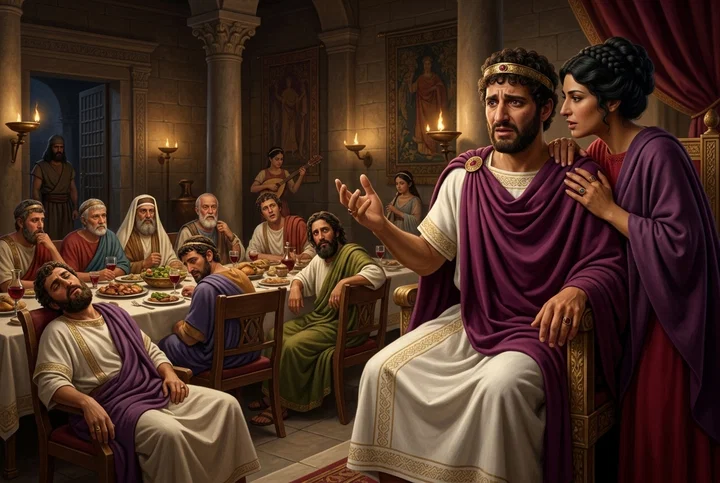
And when a convenient day was come, that Herod on his birthday made a supper to his lords, high captains, and chief estates of Galilee;
Translations
American King James Version, King James Version, KJV Cambridge Paragraph Bible
And when a convenient day was come, that Herod on his birthday made a supper to his lords, high captains, and chief estates of Galilee;
And when a convenient day had come, that Herod on his birth-day made a supper to his lords, high captains, and chief men of Galilee;
Revised Version, American Standard Version
And when a convenient day was come, that Herod on his birthday made a supper to his lords, and the high captains, and the chief men of Galilee;
And a seasonable day having come, when Herod on his birthday was making a supper to his great men, and to the chiefs of thousands, and to the first men of Galilee,
And a holiday being come, when Herod, on his birthday, made a supper to his grandees, and to the chiliarchs, and the chief [ men] of Galilee;
And, an opportune day arriving, when Herod on his birthday made a feast for his nobles, and for the rulers of thousands and for the first men of Galilee,
Berean Standard Bible, Majority Standard Bible
On Herod’s birthday, her opportunity arose. Herod held a banquet for his nobles and military commanders and the leading men of Galilee.
Then a convenient day came when Herod on his birthday made a supper for his nobles, the high officers, and the chief men of Galilee.
And the chance came when Herod on his birthday gave a feast to his lords, and the high captains, and the chief men of Galilee;
But the time being conuenient, when Herod on his birth day made a banket to his princes and captaines, and chiefe estates of Galile:
Douay-Rheims (Challoner revision)
And when a convenient day was come, Herod made a supper for his birthday, for the princes, and tribunes, and chief men of Galilee.
Pictures
Cross-references
- Matthew 14:6-11
But when Herod’s birthday was kept, the daughter of Herodias danced before them, and pleased Herod.
Parallel account of the birthday feast and John’s execution.
- Luke 3:19-20
But Herod the tetrarch, being reproved by him for Herodias his brother Philip’s wife, and for all the evils which Herod had done,
John rebukes Herod, who then imprisons him.
- Luke 9:7-9
Now Herod the tetrarch heard of all that was done by him: and he was perplexed, because that it was said of some, that John was risen from the dead;
Herod recalls beheading John and is perplexed by reports that he has risen.
- Mark 6:14-16
And king Herod heard of him; ( for his name was spread abroad:) and he said, That John the Baptist was risen from the dead, and therefore mighty works do shew forth themselves in him.
Herod fears that Jesus is John risen from the dead.
- Mark 6:27-28
And immediately the king sent an executioner, and commanded his head to be brought: and he went and beheaded him in the prison,
Describes John’s execution and the delivery of his head.
- Acts 12:1-11
Now about that time Herod the king stretched forth his hands to vex certain of the church.
Herod persecutes the church, killing James and seeking to execute Peter.
Commentary
Each commentary is drawn from primary sources: the writings of Ellen G. White and Adventist pioneers and periodicals. Each commentary is separate. Its own words are not a quotation; follow the references to read the source passages.
Ellen G. White
24 sources
Herod on his birthday made a supper in his royal banqueting-room for his lords, high captains and chief estates of Galilee, his officials and military commanders and leading men.STRH Mar 11, 1873RH Apr 8, 1873
It was a planned entertainment for the officers of state and nobles that Herodias deliberately used as the convenient day, sending her daughter to dance before the king when he was feasting and drinking amid revelry until he promised her whatever she asked.DA 220.6–221.3RH Mar 11, 1873Ms 107, 1893, par. 1
Feasting and drunkenness weakened reason, judgment, self-control and the sense of justice and mercy, so Herod in that intoxicated state made a rash oath and, from concern for reputation before his guests, treated keeping it as more binding than God's commandment not to kill.RH Mar 11, 1873RH Apr 8, 1873ST Mar 15, 18832SP 76.1–77.1ST Mar 15, 1883
The revel ended with John's beheading in prison to please Herodias and gratify her revenge for his faithful denunciation of Herod's unlawful marriage to his brother's wife, and his head was brought in before the horrified guests.DA 214.1COS 144.2–3Ms 107, 1893, par. 1EW 124.3–125.15RED 55.1
The supper therefore warns against self-indulgence and intemperance in eating and drinking, which can cloud the mind and lead to unjust and destructive decisions, while showing that faithful reproof will not be softened to save life even to the point of death.ST Mar 15, 1883ST Mar 15, 1883RH Apr 8, 1873STB 55.4Ms 16, 1895, par. 18
The Feast's Setting
The birthday supper took place in the royal banqueting-room of Herod's Galilean court, where Herod entertained his lords, high captains, and chief estates of Galilee, that is his officials and military commanders and leading men of Galilee.STRH Mar 11, 1873RH Apr 8, 1873STST It was a scene of wicked dissipation whose guilt afterward tormented him, an occasion of indulgence and display where drinking and entertainment weakened judgment and prepared the way for a rash promise and for execution.STRH Mar 11, 1873 In intoxication and concern for reputation Herod and his guests were left unable to act with sound judgment, so Herod ordered the execution rather than appear to break his rash oath, and the guests failed to object.RH Apr 8, 1873ST The rash oath gave opportunity to demand death, for keeping an oath made amid revelry was wrongly treated as more binding than refusing an inhuman demand, and murder was chosen over what was feared would be called perjury.RH Apr 8, 1873ST The late notice taken of Jesus' preaching and miracles reflects the general religious indifference and ignorance of people in high rank, who often remain unaware of religious movements even where they live.ST
The feast belongs to the imprisonment of John the Baptist by Herod Antipas after John faithfully denounced as unlawful Herod's marriage to his brother's wife.DA 214.1EW 124.3–125.1SG1 29.2–30.1 Herodias sought revenge for the reproof and induced Herod to imprison and punish him, and through her influence John was later beheaded.DA 214.1EW 124.3–125.1SG1 29.2–30.13SP 136.1–2 Herod had married his brother's wife despite warning that the marriage was unlawful, and had punished the prophet for reproving him.EW 124.3–125.1SG1 29.2–30.13SP 136.1–2
At this time John was shut in prison after active labor, with gloom, inaction, and week after week with no change weighing heavily and bringing despondency and doubt.DA 214.2–215.2 His disciples still had access to him and brought tidings of the works of Jesus and the crowds flocking to Him, while questioning why Jesus did nothing to effect his release.DA 214.2–215.2 John did not understand the nature of Christ's kingdom and expected Jesus to take the throne of David, and he was perplexed and troubled because the Saviour made no claim to kingly authority.DA 214.2–215.2
The convenient day was a planned entertainment for the officers of state and nobles of the court, which Herodias deliberately used by stratagem to gain consent to John's death that she could never win by direct measures.DA 220.6–221.3RH Mar 11, 1873 She used the feast to indulge appetite with feasting and drinking and with gluttony and intoxication in order to throw Herod off his guard, weaken his judgment, and influence him according to her will in pursuit of revenge.DA 220.6–221.3RH Mar 11, 1873 When the day arrived the king was feasting and drinking with his lords amid revelry, and in that condition Herodias sent her daughter into the banqueting hall to dance for the guests.DA 220.6–221.3Ms 107, 1893, par. 1 Herod after drinking promised her whatever she asked, and the promise resulted in the order to kill John, whose head when brought before the guests horrified them, a sight Herod could not bear.DA 220.6–221.3Ms 107, 1893, par. 1
How John Was Killed
Herodias could never have won Herod's consent to John's death by direct measures, so she used this birthday banquet by stratagem to gain it and to pursue her revenge.DA 220.6–221.32SP 76.1–77.1RH Mar 11, 1873 The convenient day was a planned entertainment for the officers of state and nobles of the court, for his officials and military commanders and leading men of Galilee.DA 220.6–221.32SP 76.1–77.1RH Mar 11, 1873 She deliberately used the feast to indulge appetite with feasting and drinking in order to throw Herod off his guard, weaken his judgment and self-control, and make him able to be influenced according to her will.DA 220.6–221.32SP 76.1–77.1RH Mar 11, 1873 When the day arrived the king was feasting and drinking with his lords, and in that condition Herodias sent her daughter into the banqueting hall to dance for the guests.RH Mar 11, 1873DA 220.6–221.3
The luxurious food, gluttony, drinking, and drunken revelry weakened the reason, judgment, self-control, and sense of justice and mercy of Herod and his guests.RH Mar 11, 1873ST Mar 15, 18832SP 76.1–77.1ST Mar 15, 1883RH Apr 8, 1873 They became intoxicated and ruled by passion and sensual appetites rather than sound judgment, driven by sensual passions and unable to judge justly or mercifully.ST Mar 15, 1883ST Mar 15, 1883RH Apr 8, 1873 That indulgence and display prepared the way for Herod's rash promise and left them vulnerable to Herodias's influence, leading to a decision that cost a prophet his life.RH Mar 11, 1873ST Mar 15, 18832SP 76.1–77.1ST Mar 15, 1883
In that intoxicated state Herod made a rash oath after drinking and promising whatever was asked, and concern for reputation before his guests left him unable to act with sound judgment.RH Apr 8, 1873ST Mar 15, 1883Ms 107, 1893, par. 1 He wrongly treated keeping the oath made amid feasting and revelry as more binding than God's commandment not to kill and than refusing an inhuman demand, choosing murder over what he feared would be called perjury.ST Mar 15, 1883STRH Apr 8, 1873 The men of high authority present had their judgment and sense of right and wrong impaired by intemperance, and their failure to object helped bring about the death.RH Apr 8, 18732SP 80.1 Calm, sound reason would have recoiled from killing an innocent prophet, but eating and drinking to excess had clouded the mind and weakened moral judgment unto grave sin.RH Apr 8, 1873
The birthday revel ended with Herod's command to kill and behead John in prison to please the wicked Herodias and to gratify her revenge, which she clung to until she had destroyed him.STCOS 144.2–3Ms 107, 1893, par. 15RED 55.1 He had been deeply impressed by John's teaching, knew him as a true prophet, and nearly became his disciple, but he did not turn from intemperance and sin.COS 144.2–35RED 55.1 Turning from the truth he had received, his heart grew harder and his conscience grew less sensitive, so that his sins came to seem trivial until he ordered John's death.COS 144.2–35RED 55.1 When John's head was brought before the guests they were horrified, and Herod could not bear the sight.Ms 107, 1893, par. 1
Warning and Aftermath
Herod's birthday supper stands as a warning against self-indulgence, pleasure-seeking, and intemperance in eating and drinking.ST Mar 15, 1883RH Apr 8, 18732SP 80.1 Luxurious food, gluttony, overeating, and drunkenness at the feast weakened reason and judgment, clouded the mind, and left Herod and his high guests intoxicated and ruled by passion and sensual appetite rather than sound judgment.ST Mar 15, 1883ST Mar 15, 1883RH Apr 8, 1873 In that state their sense of justice and mercy and of right and wrong was distorted and impaired, they were driven by sensual passions and unable to judge justly or mercifully, they became vulnerable to Herodias's influence, and their failure to object helped bring about death.ST Mar 15, 1883RH Apr 8, 18732SP 80.1 Herod made a rash oath amid feasting, drinking, and revelry and wrongly treated keeping it as more binding than God's commandment not to kill and than refusing an inhuman demand, so a decision that cost a prophet his life was made and John's life was condemned.ST Mar 15, 1883RH Apr 8, 1873 The event teaches that excess can weaken moral judgment and lead to grave, unjust, destructive sin, it warns those who love pleasure and calls them to Christian temperance, for calm, sound reason would have recoiled from killing an innocent prophet.ST Mar 15, 1883RH Apr 8, 18732SP 80.1
Herod had been deeply impressed by John's teaching, knew him as a true prophet, nearly became his disciple, and felt remorse, but he did not turn from intemperance and sin and turned from the truth he had received.COS 144.2–33SP 135.15RED 55.1 After choosing against the truth his heart grew harder until he ordered John's death to please the wicked Herodias and gratify her revenge, he became morally hardened, his conscience grew less sensitive, and his sins came to seem trivial.COS 144.2–33SP 135.15RED 55.1 The birthday revel ended with his command to kill and behead John in prison, and when John's head was brought before the guests they were horrified and Herod could not bear the sight.COS 144.2–3Ms 107, 1893, par. 1 The feast is remembered as a royal banqueting-room scene of wicked dissipation, and Herod's guilt over what he did there later tormented him.ST
Herod later remembered that he had beheaded John and feared that Jesus was John risen from the dead.3SP 135.1 His late attention to Jesus' preaching and miracles is explained by the general religious indifference and ignorance of people in high rank, who often remain unaware of what is happening in religion even when they live where it occurs.ST
John's death at Herod's hand in prison, which Jesus left him to die there, was reported to Jesus and the disciples just after the disciples returned filled with joy from their first missionary tour as heralds of the Gospel.ST It brought bitter sorrow and disappointment and severely tested the faith of the disciples.ST Jesus felt the sorrow with them with tears in His own eyes and voice and with pitying tenderness called them apart into a desert place to rest awhile.ST
The birthday supper provided the convenient occasion for John's death because he gave a pointed message and would not soften reproof to save himself.STB 55.4 Faithful warning grows more and more pointed under opposition even to the point of death so that the people are not deceived.STB 55.4 Though his witness for reproving Herod for sin led to imprisonment and execution, his enemies could not destroy his hope or take away eternal life.Ms 16, 1895, par. 18
Sources
Pioneers and periodicals
46 sources
The verse describes Herod's birthday supper for his nobles, military commanders and leading men of Galilee, gathered in his palace banqueting-room at the fortress of Machaerus where John was imprisoned.STST Dec 24, 1894ST Dec 24, 1894ST Mar 3, 1898 The convenient day was the long-waited opportunity suited to Herodias's revenge, who used the indulgence of the feast to weaken Herod's judgment and self-control.RH Mar 11, 1873ST Jun 7, 1899ST Dec 15, 1887ST Sep 6, 1910ST Sep 6, 1910 Merry with wine and ruled by passion, Herod was pleased by the dancing of Herodias's daughter and rashly promised her whatever she asked up to half his kingdom with an oath, then at her mother's prompting ordered John's beheading and had his head brought on a platter into the hall.ST Jun 7, 1899ST Feb 7, 1911ST Dec 15, 1887ST Jun 19, 1907ST Sep 13, 1910 He treated keeping that rash oath as more binding than refusing murder or obeying God's commandment not to kill, choosing execution to preserve his dignity before guests who remained silent rather than appear weak.RH Apr 8, 1873ST Mar 15, 1883ST Dec 24, 1894ST Sep 13, 1910ST Sep 13, 1910 The feast thus warns lovers of pleasure and those in authority that luxurious food, drunkenness and revelry cloud reason and conscience and lead to grave injustice, and it sets John the brave prophet who feared God rather than man against Herod the weak king who feared man more than God and Herodias the ambitious woman whose revenge destroyed him.ST Mar 15, 1883ST Mar 15, 1883ST Mar 3, 1898ST Mar 8, 1899ST Apr 20, 1882
Words and Setting
Herod's birthday supper was for his lords, high captains and chief estates of Galilee, that is his nobles, military commanders, officials and leading men of Galilee gathered together for the feast.STST Dec 24, 1894ST Dec 24, 1894RH Aug 29, 1865 The gathering was in his palace, in the royal banqueting-room, where the feast was held and the order for John's execution was given.STRH Aug 29, 1865 The feast was held at Machaerus, the fortress where John was imprisoned and beheaded.ST Dec 24, 1894ST Dec 24, 1894ST Mar 3, 1898 That fortress stood on the borders of Arabia in southern Perea near Arabia, about nine miles east of the northern end of the Dead Sea.ST Dec 24, 1894ST Mar 3, 1898
Those who place the celebration at Herod Antipas's palace at Tiberias set it in the afternoon, with John imprisoned near the palace while a grand feast for the guests was underway.ST Sep 6, 1910 The events belong to about A.D. 29, a year after a probable starting date of spring A.D. 28.ST Dec 24, 1894 They fall in the third year of Jesus' ministry, when John had been imprisoned for a year and was martyred at about age 33.ST Mar 3, 1898
The word translated chief estates means first in dignity and importance, that is chief, principal and most important in rank, dignity and station, not first in time, place or order.RH May 28, 1861 The convenient day was a day suited to Herodias's plan and long waited for to have John killed.ST Jun 7, 1899ST Sep 6, 1910ST Sep 6, 1910
Feast and Execution
The birthday banquet provides the setting for John's death, a day closed by feasting, revelry, drinking, royal display and dancing that ended in the prophet's tragic murder.ST Sep 13, 1910ST Sep 13, 1910ST Sep 6, 1910ST Sep 6, 1910 The feast gathered his lords, military commanders and leading men of Galilee, who reclined at the table partly drunk while Herod watched in a scene of indulgence.ST Sep 13, 1910ST Sep 6, 1910ST Sep 6, 1910 At that supper in his palace and royal banqueting-room, Herod's prosperity and grandeur were on full display even as the revelry became the setting for the fatal promise and murder.RH Aug 29, 1865ST Sep 13, 1910ST Sep 6, 1910
At the feast Herodias's daughter, his stepdaughter Salome, danced before the king and his guests and pleased them, receiving their applause.ST Jun 7, 1899ST Jun 7, 1899ST Sep 6, 1910ST Jun 19, 1907 The dance took place after Herodias had prepared her daughter to perform while Herod was merry with wine, and Salome continued dancing during the feast.ST Sep 6, 1910ST Sep 13, 1910ST Sep 6, 1910 The banquet for Galilee's leading men, military commanders and officials thus became the occasion Herodias planned to use to secure John's death.ST Jun 7, 1899ST Jun 7, 1899ST Sep 6, 1910ST Feb 7, 1911
Pleased and confused, merry with wine and ruled by passion rather than judgment, Herod rashly promised the dancer whatever she asked, even up to half his kingdom, and confirmed it with an oath.STST Jun 7, 1899ST Feb 7, 1911ST Dec 15, 1887 That rash oath gave Herodias the opportunity to demand John's death, and the vow whose keeping cost John his head was made amid indulgence and revelry.STST Dec 15, 1887RH Sep 11, 1860 Prompted by her mother, the girl demanded John's head, and Herod gave the oath-bound order to give her John's head.ST Feb 7, 1911ST Jun 19, 1907ST Sep 13, 1910 John was killed while still in prison, and the order was carried out before the guests who were gathered for the birthday celebration.ST Jun 19, 1907ST Sep 13, 1910ST Sep 13, 1910ST Sep 13, 1910
John's head was then brought on a platter or tray into the banquet hall to Herod and the girl, and the guests witnessed the command and its fulfillment, with some appearing horrified.RH Aug 29, 1865ST Sep 13, 1910 The bringing in of the head into the hall belongs to the same palace supper for lords, high captains and leading men of Galilee.RH Aug 29, 1865ST Sep 13, 1910 Herod had imprisoned John after John faithfully rebuked him and Herodias for the illicit marriage, a rebuke that cost John his life.RH Nov 11, 1858ST Jun 19, 1907 Herod had feared John and protected him from Herodias's hostility and hatred, recognizing him as a just and holy man, and had gladly listened to his preaching of God's truth even as a licentious ruler.ST Jun 19, 1907ST Sep 13, 1910ST May 8, 1907
Causes of the Crime
Herodias deliberately planned the birthday supper and used its indulgence of appetite to weaken Herod's judgment and self-control and to create the opportunity for revenge against John, a revenge to which she clung until she destroyed him.RH Mar 11, 1873STST Dec 15, 1887 The occasion of luxurious food and wine was chosen because the king's indulgence would leave him more vulnerable to vanity, reckless promises, and the passions that led to John's death.RH Mar 11, 1873ST Dec 15, 1887 Her rash oath at the feast gave Herodias the opening to demand John's death.ST
Luxurious food, gluttony, drunkenness, and intoxicating wine weakened the reason, judgment, and sense of justice and mercy of Herod and his guests, leaving them driven by sensual passion, vanity, and pride rather than sound judgment.RH Mar 11, 1873ST Mar 15, 1883ST Mar 15, 1883ST Mar 8, 1883RH Apr 8, 1873 Drinking and entertainment with pride, vanity, indulgence, and display prepared the way for Herod's rash promise and John's death.RH Mar 11, 1873ST Mar 8, 1883 Intoxication and concern for reputation left Herod and his guests unable to act with sound judgment, and in that revelry Herod made the rash oath that led to the execution.RH Apr 8, 1873ST Mar 15, 1883 Overeating and drinking until reason was clouded left them unable to judge justly or mercifully, so that calm, sound reason which would have recoiled from killing an innocent prophet was lost and grave sin followed.RH Apr 8, 1873
Rejecting God's reproof had left Herod vulnerable to temptation, so that drunkenness and pride led him step by step into an act he had not intended while sober.ST Dec 24, 1894 Merry with wine and ruled by passion, he made the rash promise while drunk and, rather than go back on it, carried it out to preserve his sense of dignity.ST Dec 24, 1894 He wrongly treated keeping his rash oath as more binding than refusing an inhuman demand or obeying God's commandment not to kill, choosing murder over what he feared would be called perjury or promise-breaking.RH Apr 8, 1873ST Mar 15, 1883STRH Apr 8, 1873 In that intoxicated state he treated an oath made amid feasting and revelry as binding even above God's commandment, ordering the execution rather than appear to break his oath before his guests.RH Apr 8, 1873ST Mar 15, 1883RH Apr 8, 1873
The guests helped seal John's fate, for when the king appealed for counsel about his oath and the prophet's life they remained silent and no one defended the prophet.ST Sep 13, 1910ST Sep 13, 1910 Seeing their sneering expressions, Herod chose to order John's execution rather than appear weak.ST Sep 13, 1910 The feast thus reveals three contrasting characters meeting around the illicit marriage and John's rebuke and arrest.ST Apr 20, 1882 John was the brave prophet who feared God but not man, whom the king could not silence, as quick to rebuke iniquity in high places as among the lowly; Herod was the weak and wicked king, wicked chiefly because weak, a man with a conscience but without courage who feared God but feared man still more and his wife most of all, who desired to do right but dared not be laughed at and, inveigled into a foolish promise, preferred to be called murderer rather than promise-breaker; and Herodias was the ambitious, designing, unprincipled woman in whom ambition dethroned love.ST Apr 20, 1882 Herod's loss of his own head to a woman cost John his head to the sword, with infatuation leading directly to the beheading.ST Mar 8, 1899 He was halting between two opinions and unstable in spiritual things, one day listening joyfully to John's instruction and the next listening at his birthday supper to the horrid proposal of Herodias's daughter, convinced but not converted nor changed in heart, without decision of character, floating loosely upon the tide like a leaf tossed upon the winds.RH Apr 28, 1863
Warnings and Applications
The birthday feast stands as a warning to lovers of pleasure and to people in authority against self-indulgence, feasting, and intemperance, for luxurious food, overeating, and drunkenness weakened the reason, judgment, and sense of justice and mercy in Herod and his guests until they were driven by sensual passion rather than sound judgment.ST Mar 15, 1883ST Mar 15, 1883RH Apr 8, 1873ST Dec 15, 1887 Eating and drinking to excess clouded the mind, impaired conscience, left them vulnerable to Herodias's influence, and led to grave injustice and sin in condemning a prophet to death, whereas calm, sound reason would have recoiled from killing an innocent man.ST Mar 15, 1883ST Mar 15, 1883RH Apr 8, 1873 Intemperance among rulers in particular impairs judgment and contributes to such wrongdoing, teaching all who love pleasure the need for Christian temperance.ST Mar 3, 1898ST Dec 15, 1887
It is also a lesson against rash promises and oaths made amid indulgence and revelry, and against treating such an oath as more binding than God's commandment not to kill.ST Mar 15, 1883STRH Apr 8, 1873ST Mar 3, 1898 Confused, merry with wine, and ruled by passion rather than judgment, Herod rashly promised whatever was asked and confirmed it with an oath, then wrongly chose murder over what he feared would be called perjury and promise-breaking.ST Mar 15, 1883STST Dec 15, 1887 The supper itself was a drunken court and the dance before it indecent, showing that lust and strong drink always go hand in hand.ST Dec 12, 1906 Intemperance is warned against in the Bible more than any other sin, with its punishment positively affirmed, because it inspires and causes almost every other crime.ST Dec 12, 1906
John remains in this setting a model for the modern preacher to dare to do right cost what it would, as quick to rebuke iniquity in high places as among the lowly, whom the king could not silence.ST Apr 20, 1882 Herod's brief authority to have John killed illustrates that power over others does not necessarily make a ruler wiser or better.ST Jul 13, 1904 His late attention to what was happening in religion is explained by the general indifference and ignorance of people in high rank, who often remain unaware of religious events even where they occur.ST
John's mission as Christ's forerunner was rejected by the authorities, and he was put out of the way, dying for his Master as a hero.ST Oct 11, 1899 His head was brought into the banquet hall on a tray, but the graphic details of that beheading can frighten very young children and may not suit their needs. The news of his death in prison, where he was left to die, reached Jesus and the disciples just after they returned filled with joy from their first missionary tour as heralds of the Gospel.ST It brought bitter sorrow and disappointment and severely tested their faith, and Jesus felt the sorrow with them, with tears in His own eyes and voice, and with pitying tenderness called them apart into a desert place to rest awhile.ST
The feast in the royal banqueting-room where the execution was commanded is remembered as a scene of wicked dissipation, and Herod's guilt over what he did there later tormented him.ST He feared that John, whom he recognized as a just man, would rise from the dead to condemn him.ST Sep 13, 1910 His royal grandeur and prosperity at the supper for his lords, high captains, and leading men of Galilee, with its dancing, oath-bound promise, and bringing in of John's head, stand in contrast with the ruin of his palace and the fading of his power.RH Aug 29, 1865
Sources