Mark 6:22
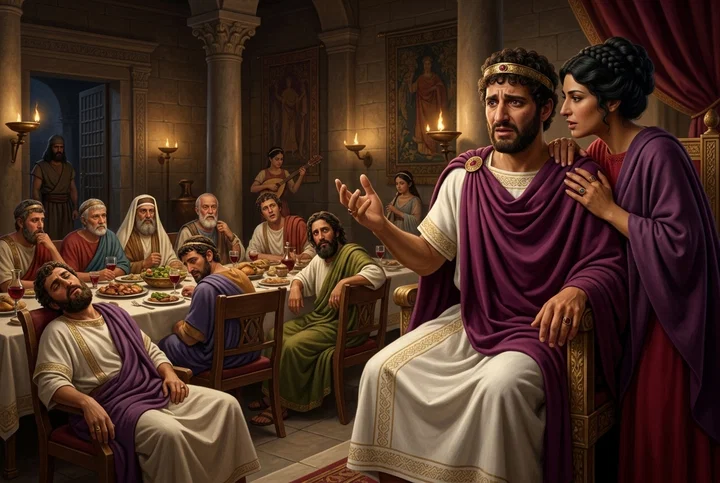
And when the daughter of the said Herodias came in, and danced, and pleased Herod and them that sat with him, the king said unto the damsel, Ask of me whatsoever thou wilt, and I will give it thee.
Translations
And when the daughter of the said Herodias came in, and danced, and pleased Herod and them that sat with him, the king said to the damsel, Ask of me whatever you will, and I will give it you.
And when the daughter of the said Herodias came in, and danced, and pleased Herod and them that sat with him, the king said unto the damsel, Ask of me whatsoever thou wilt, and I will give it thee.
and when the daughter of the said Herodias came in, and danced, and pleased Herod and them that sat with him, the king said unto the damsel, Ask of me whatsoever thou wilt, and I will give it thee.
And when the daughter of the said Herodias came in, and danced, and pleased Herod, and them that sat with him, the king said to the damsel, Ask of me whatever thou wilt, and I will give it thee.
Revised Version, American Standard Version
and when the daughter of Herodias herself came in and danced, she pleased Herod and them that sat at meat with him; and the king said unto the damsel, Ask of me whatsoever thou wilt, and I will give it thee.
and the daughter of that Herodias having come in, and having danced, and having pleased Herod and those reclining (at meat) with him, the king said to the damsel, 'Ask of me whatever thou wilt, and I will give to thee,'
and the daughter of the same Herodias having come in, and danced, pleased Herod and those that were with [ him] at table; and the king said to the damsel, Ask of me whatsoever thou wilt and I will give it thee.
when the daughter of this very Herodias came in and danced, she pleased Herod and those reclining together, and, the king, said unto the damsel—Ask me what thou wilt, and I will give it thee;
Berean Standard Bible, Majority Standard Bible
When the daughter of Herodias came and danced, she pleased Herod and his guests, and the king said to the girl, “ Ask me for whatever you wish, and I will give it to you.”
When the daughter of Herodias herself came in and danced, she pleased Herod and those sitting with him. The king said to the young lady, “ Ask me whatever you want, and I will give it to you.”
And when the daughter of Herodias herself came in and did a dance, Herod and those who were at table with him were pleased with her; and the king said to the girl, Make a request for anything and I will give it you.
And the daughter of the same Herodias came in, and daunced, and pleased Herod, and them that sate at table together, the King sayd vnto the mayde, Aske of me what thou wilt, and I will giue it thee.
Douay-Rheims (Challoner revision)
And when the daughter of the same Herodias had come in, and had danced, and pleased Herod, and them that were at table with him, the king said to the damsel: Ask of me what thou wilt, and I will give it thee.
Pictures
Cross-references
- Matthew 14:6-7
But when Herod’s birthday was kept, the daughter of Herodias danced before them, and pleased Herod.
The daughter’s dance pleased Herod, who promised to grant her request.
- Luke 3:19-20
But Herod the tetrarch, being reproved by him for Herodias his brother Philip’s wife, and for all the evils which Herod had done,
Herod imprisoned John after John rebuked him over Herodias.
- Mark 6:27-28
And immediately the king sent an executioner, and commanded his head to be brought: and he went and beheaded him in the prison,
Herod sends the executioner after granting the girl’s request, and John’s head is brought to her.
- Mark 6:26
And the king was exceeding sorry; yet for his oath’s sake, and for their sakes which sat with him, he would not reject her.
Herod keeps his oath because he fears rejecting the request before his guests.
- Matthew 14:5
And when he would have put him to death, he feared the multitude, because they counted him as a prophet.
Herod feared the multitude because they held John as a prophet.
- Esther 5:3
Then said the king unto her, What wilt thou, queen Esther? and what is thy request? it shall be even given thee to the half of the kingdom.
Both kings promise to grant a woman's request, even up to half the kingdom.
- Luke 9:7-9
Now Herod the tetrarch heard of all that was done by him: and he was perplexed, because that it was said of some, that John was risen from the dead;
Herod recalls beheading John and wonders about Jesus.
- Mark 6:14-16
And king Herod heard of him; ( for his name was spread abroad:) and he said, That John the Baptist was risen from the dead, and therefore mighty works do shew forth themselves in him.
Herod identified Jesus as John, whom he had beheaded.
Commentary
Each commentary is drawn from primary sources: the writings of Ellen G. White and Adventist pioneers and periodicals. Each commentary is separate. Its own words are not a quotation; follow the references to read the source passages.
Ellen G. White
27 sources
Mark 6:22 records Herod Antipas's royal birthday banquet, where Herodias's daughter Salome came in and danced and pleased Herod and those sitting with him.STRH Mar 11, 1873ST Mar 15, 1883 Pleased and weakened by wine, feasting, and desire to impress his guests, Herod rashly promised her whatever she asked, even to half his kingdom, sealing it with an oath.RH Mar 11, 1873DA 220.6–221.32SP 76.1–77.1 The dance was Herodias's stratagem to exploit his intoxication and weakened judgment in order to secure the promise she needed for revenge against John, whom Herod had imprisoned for faithfully denouncing his sinful marriage to his living brother's wife.DA 214.1DA 214.2–215.2DA 220.6–221.32SP 76.1–77.12SP 77.2–78.2 That rash promise became the pretext for beheading John in prison, which Herod carried out to protect his reputation before his guests, wrongly treating his oath as binding even when it required murder in violation of God's commandment.RH Apr 8, 1873ST Mar 15, 1883COS 144.2–3STMs 107, 1893, par. 1 The feast thus warns that sensual pleasure, drinking, dancing, and revelry cloud judgment and reverence for God and leave even rulers vulnerable to reckless choices and ruin, calling lovers of pleasure to Christian temperance.RH Mar 11, 1873ST Mar 15, 1883ST Mar 15, 1883
Feast, Dance, and Promise
The verse records Herod Antipas's royal birthday banquet, where Herodias's daughter, his stepdaughter Salome, came in and danced before Herod and his guests and pleased them.STRH Mar 11, 1873ST Mar 15, 1883DA 220.6–221.32SP 76.1–77.1 The dancing took place amid food, wine, amusement, sensual pleasure and revelry that excited the mind, clouded judgment and reverence for God, weakened reason and the sense of right and justice, and turned the occasion into the setting for an unjust decision leading to John the Baptist's death.RH Mar 11, 1873ST Mar 15, 1883ST Mar 15, 1883RH Mar 11, 1873RH Apr 8, 1873 Under the influence of the feast and the approval of the company, indulgence and display left Herod vulnerable to a reckless act.RH Mar 11, 1873ST Mar 15, 1883RH Mar 11, 1873
Pleased and weakened by wine, feasting and revelry, and driven by desire to impress and exalt himself before the company, Herod rashly promised the girl whatever she would ask, even up to half his kingdom.RH Mar 11, 1873DA 220.6–221.32SP 76.1–77.1RH Mar 11, 18732SP 77.2–78.2 He sealed the promise with an oath, making it in the excitement of eating, drinking, dancing and revelry when sound judgment was lost.ST Mar 15, 1883RH Apr 8, 18732SP 77.2–78.2 That rash oath later became the pretext for ordering John's death and a test between honoring God's command not to kill an innocent person and preserving standing before guests, for keeping such an oath could not justify breaking God's commandment.ST Mar 15, 1883RH Apr 8, 1873
The dance was Herodias's stratagem to secure the promise needed for her revenge against John.DA 220.6–221.32SP 76.1–77.12SP 77.2–78.2 She used the occasion and her daughter's performance to exploit Herod's intoxication, weakened judgment and desire to impress the guests.DA 220.6–221.32SP 76.1–77.12SP 77.2–78.2 By pleasing the king and those sitting with him, the girl obtained the open-ended pledge that opened the way for Herodias to demand John's death.STDA 220.6–221.32SP 76.1–77.1
Herod, John, and Judgment
John had been shut up in prison by Herod Antipas in revenge for faithfully denouncing Herod's sin in taking his living brother's wife, after Herodias turned Herod against him.DA 214.1DA 214.2–215.23SP 135.1EW 124.3–125.13SP 136.1–2 Herod feared John as a just and holy man and a true prophet, listened to him and was deeply impressed by his teaching, at times tried to repent, and nearly became his disciple, yet at the point of decision turned from the truth.DA 214.1COS 144.2–33SP 135.1 He is remembered as a proud, cruel ruler who boasted of punishing John for that reproof.3SP 136.1–2
Cut off from active labor and shut in the dungeon week after week with no change, John grew gloomy, despondent, and doubtful.DA 214.2–215.2 He did not understand the nature of Christ's kingdom, expecting Jesus to take David's throne and to reveal Himself in judgment and deliverance.DA 214.2–215.2
Herod's rash promise to the dancing girl became the pretext for ordering John's beheading while imprisoned, to satisfy Herodias's revenge and to please her.ST Mar 15, 1883COS 144.2–33SP 135.1EW 124.3–125.15RED 55.1 Infatuated by the dance and impaired by drink and revel at a drunken revel, with judgment weakened by drinking, Satan gained control of his mind and he sacrificed the life of one of the greatest prophets.ST Mar 15, 1883COS 144.2–3Ms 107, 1893, par. 1 Herod later felt remorse for this terrible act.3SP 135.15RED 55.1
He carried out the oath to protect his reputation before his guests who were present at the offer, believing that keeping it would preserve his standing, though a protest from them could have helped him spare John's life.RH Apr 8, 1873RH Apr 8, 1873 His oath, made in the excitement of eating, drinking, dancing, and revelry that weakened judgment and the sense of justice, became a test of whether he would honor God's command not to kill or preserve his standing before his guests.ST Mar 15, 1883RH Apr 8, 1873 He wrongly treated the oath as binding even when fulfilling it meant ordering John's murder, choosing actual guilt over the false charge of breaking his word, though keeping such an oath could not justify breaking God's commandment against killing an innocent person.ST Mar 15, 1883ST
Afterward Herod felt remorse and later regret for John's death, but by continuing in intemperance and sin his heart grew harder and his conscience, moral sense, and judgment grew duller.COS 144.2–3RH Apr 8, 18733SP 135.15RED 55.1 John's violent death was later recalled by the disciples when they questioned why Jesus had not saved him.DA 380.1–2
The episode frames John's faithful witness under persecution: his message became more and more pointed even at the cost of his life, so the people would not be deceived.STB 55.4STB 377.2 His outspoken reproof of Herod's sin, followed by imprisonment and death, shows the danger surrounding such faithful testimony.STB 377.2Ms 16, 1895, par. 18
Temperance, Influence, and Faithfulness
The birthday banquet shows a stepdaughter dancing before the king and his seated guests and winning their pleasure, and in the excitement of that approval the king rashly pledged her anything she asked, even to half his kingdom.RH Mar 11, 1873ST Mar 15, 1883RH Mar 11, 1873 Food and wine, dancing and amusement, feasting and revelry excited the mind, clouded judgment, removed reverence for God, and dulled the sense of right and justice, leaving reason weakened and the will open to reckless choice and sinful influence.ST Mar 15, 1883ST Mar 15, 1883RH Mar 11, 1873RH Apr 8, 1873 In that intoxicated and indulgent atmosphere sound judgment was lost, the occasion was turned into the setting for an unjust decision, and the rash pledge became the pretext for ordering the death of John the Baptist.ST Mar 15, 1883ST Mar 15, 1883RH Apr 8, 1873
Keeping such an oath could not justify breaking God's commandment against killing an innocent person, so the pledge became a test between honoring God's command not to kill and preserving standing before guests.ST Mar 15, 1883RH Apr 8, 1873 The outcome warns that intemperance is especially deadly when indulged by those in authority, because weakened judgment over right and wrong can carry lethal consequences for others, a result the king himself later regretted.RH Apr 8, 18732SP 80.1 Lovers of pleasure are therefore called to Christian temperance rather than sensual indulgence and display.RH Mar 11, 18732SP 80.1
The impression made by the dance illustrates the wider power of entertainment and flattery that arouses pleasure to draw people toward evil, and a like impression can be made by flattering, foolish, and joking talk.STB 845.2CT 340.2 Alluring and deceptive influences work in the same way, pleasing ruler and guests for a moment while leading toward a rash promise and toward ruin.CT 340.214MR 122.1
Sources
Pioneers and periodicals
53 sources
The daughter of Herodias, Herod's stepdaughter Salome, came into Herod's birthday feast for his lords and captains and danced before the king and his guests, pleasing them so that he promised her whatever she would ask, even to half his kingdom with an oath.STRH Mar 11, 1873ST Jun 7, 1899ST Jun 7, 1899ST Dec 24, 1894 He made that extravagant, rash promise when flushed and merry with wine, with his senses and moral judgment clouded by feasting, revelry and sensual indulgence.RH Mar 11, 1873ST Mar 15, 1883ST Mar 8, 1883ST Mar 3, 1898ST Dec 15, 1887 Herodias had arranged the dance to exploit his weakened judgment and, at her direction after consultation, the girl demanded the head of John the Baptist, whom Herod had imprisoned for faithfully rebuking his unlawful marriage.ST Apr 20, 1882ST Sep 6, 1910ST Feb 7, 1911ST Dec 15, 1887ST Sep 6, 1910 Herod was a weak king with conscience but without courage, fearing God and knowing John was holy yet fearing his guests, his wife and public opinion more, so he wrongly treated his oath as binding and ordered the murder rather than break a vow that required killing an innocent man.ST Mar 15, 1883ST Dec 24, 1894ST Apr 20, 1882ST Apr 20, 1882ST Sep 6, 1910 The feast stands as a temperance warning that lust and strong drink go together and cloud reason unto crime, and the dance that pleased Herod and prompted the fatal promise is like modern dancing for pleasure and is held up as an example Christians should not imitate.ST Mar 15, 1883ST Mar 3, 1898ST Feb 18, 1886ST Jun 3, 1880ST Dec 15, 1887
Feast and Its Setting
The occasion was Herod's birthday feast, a supper he made in his palace for his lords and high captains and chief estates of Galilee.RH Aug 29, 1865 That palace is described as standing on table land on the summit overlooking Galilee, probably at Macherus, while it is also identified as his palace in Tiberias and the feast as held about the month of Nisan.ST Dec 24, 1894RH Aug 29, 1865ST Sep 6, 1910 At that feast Herodias's daughter danced and pleased Herod and them that sat with him, and Herod promised her whatsoever she would ask, repeating and enlarging the pledge with an oath even to half his kingdom, which set in motion the request for John the Baptist's death.ST Jun 7, 1899ST Dec 24, 1894RH Aug 29, 1865 He had sat day after day looking on the surrounding beauty until his heart was hardened with prosperity, and in his pride he made that oath-bound offer.RH Aug 29, 1865
John the Baptist was imprisoned nearby when the feast occurred.ST Sep 6, 1910 His beheading connected with the feast took place at Machaerus, and while the feast was still going on his head was brought in on a platter and given to the girl.RH Aug 29, 1865 She had demanded the Baptizer's head that day, and Herod later remembered the exchange with guilt.ST Feb 7, 1911
The dancing girl was the daughter of Herodias, Herod's brother's wife, hence Herod's stepdaughter, named as Salome.ST Mar 15, 1883ST Sep 6, 1910RH Aug 29, 1865ST Apr 20, 1882 Herod's offer to her was made before the king's guests who sat with him and looked on, and their presence bore on what followed.RH Apr 8, 1873RH Aug 29, 1865
Dance and Rash Promise
Herodias's daughter came in and danced before Herod and his guests at the birthday feast, entertaining them with her beauty and performance and pleasing the king and those who sat with him.STST Jun 7, 1899ST Jun 7, 1899ST Sep 13, 1910ST Sep 13, 1910 Her dancing took place while they were merry with wine, and her beauty influenced and inflamed Herod.ST Jan 31, 1906 The revelry ended in the killing of the prophet John, a ghastly tragedy that made the king's household a house of blood, and the scene continues with her dancing until John was killed in prison.ST Sep 13, 1910ST Sep 13, 1910
The dance was a lewd and indecent performance before a drunken and shamelessly licentious court, gratifying depraved taste.ST Sep 15, 1909ST Dec 12, 1906 It pleased the wine-reddened king and fed his vanity and sensual desire amid applause and drunken laughter.ST Jan 31, 1906ST Sep 6, 1910 It proves that lust and strong drink have always gone hand in hand, and that intemperance is the inspiration and fruitful cause of almost every other crime, against which the Bible gives more warnings than against any other sin and affirms its punishment more positively.ST Dec 12, 1906
Pleased by the dance and under the influence of the feast and his guests' approval, Herod promised the girl whatever she asked, repeating and reinforcing the offer with an oath even to half his kingdom.RH Mar 11, 1873ST Mar 8, 1883ST Jun 7, 1899ST Jun 7, 1899ST Sep 6, 1910 It was an extravagant, foolish and rash promise, made when flushed and merry with wine and drunk after the dance, which he would not have made sober.RH Mar 11, 1873ST Mar 8, 1883ST Dec 24, 1894ST Apr 20, 1882 Indulgence, display, intoxication and sensual excitement clouded reason, weakened moral judgment and self-control, and removed reverence for God, leaving him vulnerable to a reckless pledge that set in motion the request for John's death.RH Mar 11, 1873ST Mar 8, 1883ST Jun 7, 1899 He was a weak and wicked king, wicked chiefly because weak, a man with a conscience but without courage and decision who feared God but feared men still more and his wife most of all, who desired to do right but dared not be laughed at, so that pride and concern for dignity and desire to impress his guests led him to carry it out rather than be called promise-breaker.ST Mar 8, 1883ST Dec 24, 1894ST Apr 20, 1882 Rejecting God's reproof had left him vulnerable to step-by-step temptation, and the safe course is to heed the Lord's reproof when it comes.ST Dec 24, 1894
Plot to Kill John
Herodias had arranged the birthday feast and the dance to exploit Herod's appetite and pleasure and to catch his judgment weakened.ST Dec 15, 1887ST Sep 6, 1910 She had been waiting for a chance to bring about John's death, with John imprisoned nearby, and she used the festivities, dancing, and wine to cloud his senses and weaken his power to govern his passions and decide soundly.ST Dec 15, 1887ST Sep 6, 1910 She expected that Herod, flushed with wine, would offer the dancing girl whatever she asked, as King Ahasuerus had offered to Esther, and she meant to turn that promise into the means of killing John the Baptizer.ST Sep 6, 1910 The dance of Salome before Herod and his guests, pleasing the king, was therefore her set preparation for demanding John's death.ST Sep 6, 1910ST Sep 6, 1910
At the mother's direction and persuasion the girl demanded John the Baptizer's head that day after Herod's offer to give whatever she asked.ST Feb 7, 1911ST Jun 19, 1907ST Sep 13, 1910 She made the request after consulting her mother, who had persuaded her to seek John's death by promising her jewels and an advantageous marriage.ST Sep 13, 1910ST Sep 6, 1910 Herod, intoxicated and captivated by vanity and pleasure, stood ready to grant it, and John, then imprisoned, was executed.ST Jun 19, 1907ST Sep 6, 1910 The revelry at the king's festival thus ended in the killing of the prophet, a ghastly tragedy that made the household a house of blood.ST Sep 13, 1910
John's death grew from his faithful rebuke of Herod's cherished sin in the illicit marriage, for which he had been arrested.ST Apr 20, 1882RH Nov 11, 1858RH Nov 25, 1858 He was brave in fearing God and not man, quick to rebuke iniquity in high places as among the lowly, and his courage in proclaiming God's truth in the king's house before a licentious ruler and a hating adulterous woman led to his death.ST Apr 20, 1882 His work was open and not done in a corner, known to the rulers as the heaven-born mission of Christ's forerunner announcing the Messiah, whom Herod himself heard gladly.ST May 8, 1907ST Oct 11, 1899 His course in rebuking Herod made it certain that Herod would put him out of the way and kill him.ST Oct 11, 1899
The dancing of Herodias's daughter before Herod and his guests to his pleasure marks the occasion of Herod's wrongdoing in beheading John.RH Jul 22, 1873 The chief priests, scribes, and elders counted on that outcome, and therefore never openly condemned John's heaven-sent mission themselves but let it be understood that they shared the popular regard for him.ST Oct 11, 1899 They refused to acknowledge John as sent from heaven because he was Christ's forerunner, since to acknowledge him would leave them no excuse for rejecting Christ.ST Oct 11, 1899
Drink Clouding Judgment
Herod and his guests had been partaking freely of intoxicating wine and were merry with wine at the birthday feast.ST Mar 8, 1883ST Mar 3, 1898ST Jan 31, 1906 They were excited by feasting, dancing, and revelry in sensual pleasure and indulgence.ST Mar 15, 1883ST Mar 8, 1883ST Mar 15, 1883 Her beauty influenced and inflamed Herod as she danced before him and his guests, and pleased by her he promised to grant whatever she asked, a promise extended as far as half his kingdom.ST Mar 15, 1883ST Mar 8, 1883ST Mar 15, 1883ST Mar 3, 1898ST Jan 31, 1906
The food, wine, dancing, amusement, and display clouded their senses and reason.RH Mar 11, 1873ST Mar 15, 1883RH Mar 11, 1873ST Dec 15, 1887ST Dec 15, 1887 Intoxication and sensual excitement weakened moral judgment and self-control, removed reverence for God and the sense of justice, and left Herod vulnerable to a reckless promise and an unjust decision that led to John's death.ST Mar 15, 1883ST Mar 8, 1883ST Mar 15, 1883RH Mar 11, 1873 Under the influence of the feast and the guests' approval he rashly promised her whatever she asked, even up to half his kingdom, confirming it with an oath, with pride and desire to impress his guests helping to draw out the offer.RH Mar 11, 1873ST Mar 8, 1883ST Mar 15, 1883 The festivities had been arranged to exploit his appetite and weakened judgment, so that with his ability to govern his passions and make a sound decision impaired, the opportunity was created for revenge against John.ST Dec 15, 1887ST Dec 15, 1887
The feast stands as a temperance lesson warning against intemperance, especially among men entrusted with great responsibility.ST Mar 3, 1898ST Dec 15, 1887 Those in authority, impaired by excess and pleasure-seeking, failed to exercise sound judgment, and John's death resulted.ST Mar 15, 1883ST Dec 15, 1887 It proves that lust and strong drink have always gone hand in hand, and that intemperance is the inspiration and fruitful cause of almost every other crime.ST Dec 12, 1906 The Bible gives more warnings against the sin of intemperance than against any other sin and affirms its punishment more positively.ST Dec 12, 1906 Sensual pleasures and intoxication pervert judgment and make people vulnerable to sinful influence, turning indulgence into the setting for unjust decisions.ST Mar 15, 1883
Weakness Fear and Warning
Herod was a weak and wicked king, wicked chiefly because weak, wine-reddened and unstable, a man with a conscience but without courage and decision of character.ST Apr 20, 1882ST Sep 6, 1910 He halted between two opinions, turning one day from listening joyfully to John's instruction to listening the next to the horrid proposal that followed the dance, convinced but not converted nor changed in heart, floating loosely like one tossed by wind and tide.ST Apr 20, 1882RH Apr 28, 1863 He feared God and knew John was a holy prophet, heard him often and gladly, and guarded him from Herodias because he feared the multitude who counted John as a prophet.ST Apr 20, 1882ST May 8, 1907 Yet he feared men still more and his wife most of all, desiring to do right but daring not to be laughed at.ST Apr 20, 1882ST Apr 20, 1882 Against him stands John the Baptist, the brave prophet who feared God but not man, whom the king could not silence, as quick to rebuke iniquity in high places as among the lowly after rebuking the illicit marriage for which he was arrested, a model who dared to do right cost what it would, and Herodias the ambitious, designing, unprincipled woman, a picture of what any woman may become when ambition dethrones love.ST Apr 20, 1882
The dancing and the foolish promise inveigled Herod at his feast, and pride and concern for dignity and reputation then led him to carry the rash promise out to John's death.ST Dec 24, 1894ST Apr 20, 1882 He believed keeping his vow before the guests who were present at the offer and looked on would protect his reputation, though a protest from a guest could have helped him spare John's life.RH Apr 8, 1873ST Sep 13, 1910 Fear of public opinion overcame fear of God, for the cowardly king, overcome by the cunning woman, feared the jeers of his companions and their mocking looks more than the rebuke of his own conscience and the judgment of God.ST Apr 20, 1882ST Sep 13, 1910 He appealed for someone to release him from the oath and spare the righteous prophet, yet chose to act before them rather than defend him, and the guests remained silent while some looked on horrified.ST Sep 13, 1910ST Sep 13, 1910ST Sep 13, 1910 Chuza alone eventually spoke in John's defense, and the soldier hesitated before carrying out the command.ST Sep 13, 1910ST Sep 13, 1910
Rejecting God's reproof left Herod vulnerable to step-by-step temptation, and the safe course is to heed the Lord's reproof when it comes.ST Dec 24, 1894 His loss of judgment through a woman led to death by the sword.ST Mar 8, 1899 Respect for human opinion may prop up tottering virtue for a time like a wire holding a tree till it roots, but it is no root to give life and strength against temptation.ST Apr 20, 1882 The supper he made in his palace on the table land on the summit overlooking Galilee for his lords and high captains and chief estates of Galilee, where he had sat day after day looking on the surrounding beauty until his heart was hardened with prosperity, ended while the feast was still going on in the beheading of John, whose head was brought in on a platter and given to the girl after the oath even to half the kingdom.RH Aug 29, 1865 That splendor ending in murder and ruin, with Herod and Herodias and his great men gone and only the ruins of the palace left, proves the vanity of worldly greatness, and his use of power to put to death the one sent to announce the Messiah shows that holding authority does not make a person wise or good.RH Aug 29, 1865ST Jul 13, 1904
Oaths and Responsibility
The dancing that pleased Herod and his guests drew him into a foolish promise, and keeping that rash oath then became the pretext for ordering John's death.ST Mar 15, 1883STST Apr 20, 1882ST Sep 13, 1910 He wrongly treated the oath as binding even when fulfilling it meant murder, choosing actual guilt over the false charge of breaking his word.STST Apr 20, 1882 He preferred to be called murderer rather than promise-breaker.ST Apr 20, 1882
The oath put him to the test whether he would honor God's command not to kill an innocent person or preserve his standing before his guests.ST Mar 15, 1883RH Apr 8, 1873 Keeping an oath could not justify breaking God's commandment against killing the innocent.ST Mar 15, 1883 Some promises are better broken than kept, and a vow that requires murder must not be kept.ST Jun 9, 1898ST Oct 9, 1884 If the girl had asked for Herod's own head he would not have kept the promise, which shows the promise did not oblige him to behead John.ST Oct 9, 1884
The rash promise led to John's death, and the gift of John's head cost Herod his peace.RH Apr 8, 1873ST Sep 13, 1910 He afterward remembered the exchange with guilt and regretted the consequence.RH Apr 8, 1873ST Feb 7, 1911 He feared that John would rise from the dead to condemn him.ST Sep 13, 1910
Example About Dancing
The daughter of Herodias danced before Herod and his guests and pleased them, prompting his offer to give her whatever she asked.ST Jun 19, 1907ST Feb 18, 1886ST Jun 3, 1880ST Sep 13, 1910ST Apr 28, 1909 That dancing was an amusement in a worldly setting with no tendency to promote piety, and was like the dancing practiced for pleasure in modern times.ST Feb 18, 1886ST Jun 3, 1880 With Salome and Herodias it stands as an example Christians should not imitate.ST Apr 28, 1909
At Herod's birthday feast the king, intoxicated, made the promise in response to the dance.ST Jun 19, 1907 At Herodias's direction the dancer then demanded the head of John the Baptist, leading to his execution while he was imprisoned.ST Jun 19, 1907 The performance that pleased Herod thus prompted the fatal promise, and the episode is associated with the beheading of John and ended in his death, continuing until he was killed in prison.ST Feb 18, 1886ST Sep 13, 1910ST Aug 17, 1904
Sources