Matthew 14:6
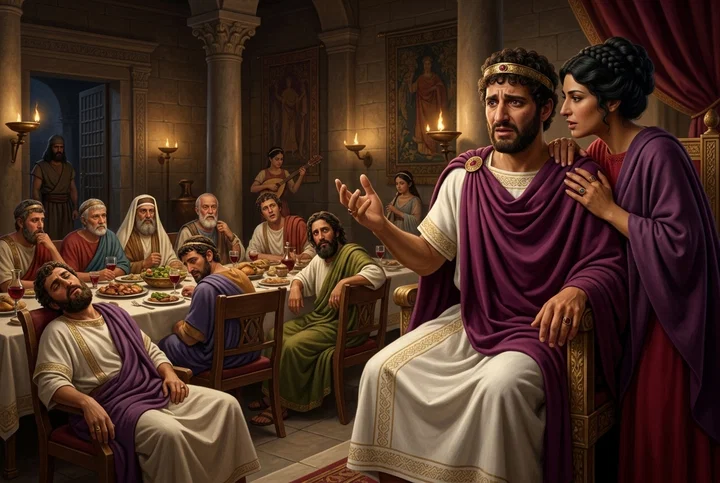
But when Herod’s birthday was kept, the daughter of Herodias danced before them, and pleased Herod.
Translations
American King James Version, King James Version, KJV Cambridge Paragraph Bible
But when Herod’s birthday was kept, the daughter of Herodias danced before them, and pleased Herod.
But when Herod's birth-day was kept, the daughter of Herodias danced before them, and pleased Herod.
Revised Version, American Standard Version
But when Herod’s birthday came, the daughter of Herodias danced in the midst, and pleased Herod.
But the birthday of Herod being kept, the daughter of Herodias danced in the midst, and did please Herod,
But when Herod's birthday was celebrated, the daughter of Herodias danced before them, and pleased Herod;
But, a birthday feast of Herod taking place, the daughter of Herodias danced in the midst, and pleased Herod;
On Herod’s birthday, however, the daughter of Herodias danced before them and pleased Herod
When Herod’s birthday was being celebrated, however, the daughter of Herodias danced before them and pleased Herod
But when Herod’s birthday came, the daughter of Herodias danced among them and pleased Herod.
But when Herod's birthday came, the daughter of Herodias was dancing before them, and Herod was pleased with her.
But when Herods birth day was kept, the daughter of Herodias daunced before them, and pleased Herod.
Douay-Rheims (Challoner revision)
But on Herod’s birthday, the daughter of Herodias danced before them: and pleased Herod.
Pictures
Cross-references
- Mark 6:21-22
And when a convenient day was come, that Herod on his birthday made a supper to his lords, high captains, and chief estates of Galilee;
Describes the birthday celebration and the dance before Herod.
- Luke 3:19-20
But Herod the tetrarch, being reproved by him for Herodias his brother Philip’s wife, and for all the evils which Herod had done,
Herod imprisoned John after John rebuked him over Herodias.
- Matthew 14:10-11
And he sent, and beheaded John in the prison.
Birthday revelry ended in John’s beheading, and his head was brought on a platter.
- Matthew 14:11
And his head was brought in a charger, and given to the damsel: and she brought it to her mother.
bleeding head brought before guests
- Mark 6:20
For Herod feared John, knowing that he was a just man and an holy, and observed him; and when he heard him, he did many things, and heard him gladly.
Herod feared and respected John, yet was overpowered by the birthday episode.
- Luke 23:11
And Herod with his men of war set him at nought, and mocked him, and arrayed him in a gorgeous robe, and sent him again to Pilate.
Herod Antipas mocked Jesus during his sufferings.
- Matthew 14:1-2
At that time Herod the tetrarch heard of the fame of Jesus,
Herod thinks Jesus is John risen from the dead.
- Matthew 2:16
Then Herod, when he saw that he was mocked of the wise men, was exceeding wroth, and sent forth, and slew all the children that were in Bethlehem, and in all the coasts thereof, from two years old and under, according to the time which he had diligently enquired of the wise men.
Herod’s massacre of Bethlehem’s children recalls an earlier family crime.
- Luke 23:8
And when Herod saw Jesus, he was exceeding glad: for he was desirous to see him of a long season, because he had heard many things of him; and he hoped to have seen some miracle done by him.
same Herod inquisitive without loving truth
- Acts 13:1
Now there were in the church that was at Antioch certain prophets and teachers; as Barnabas, and Simeon that was called Niger, and Lucius of Cyrene, and Manaen, which had been brought up with Herod the tetrarch, and Saul.
identifies the Herod the tetrarch named there
- Mark 6:16
But when Herod heard thereof, he said, It is John, whom I beheaded: he is risen from the dead.
same Herod superstitious about John
- Luke 3:1
Now in the fifteenth year of the reign of Tiberius Cæsar, Pontius Pilate being governor of Judæa, and Herod being tetrarch of Galilee, and his brother Philip tetrarch of Ituraea and of the region of Trachonitis, and Lysanias the tetrarch of Abilene,
cited together to identify Herod the tetrarch
- Acts 12:2
And he killed James the brother of John with the sword.
Agrippa I killed the apostle James.
Commentary
Each commentary is drawn from primary sources: the writings of Ellen G. White and Adventist pioneers and periodicals. Each commentary is separate. Its own words are not a quotation; follow the references to read the source passages.
Ellen G. White
36 sources
Herod Antipas held his birthday feast in the royal banqueting room, where the daughter of Herodias danced before him and his guests and pleased him, setting the scene for his rash oath and the demand that led to John's murder.DA 214STST John was in prison because he had faithfully rebuked Herod for unlawfully taking his brother's wife Herodias while her husband was still living.DA 214.1SG1 29.2–30.1SLP 255.2 Herodias, who hated the reproof and waited for this opportunity, had looked to the birthday as an occasion of gluttony and intoxication, using costly feasting, stimulating drink, and her daughter's captivating dance to throw Herod off guard and weaken his judgment.DA 220.6–221.32SP 76.1–77.1RH Mar 11, 1873 Dulled by wine and eager to preserve his honor before his guests, Herod exalted his oath above God's commandment, Thou shalt not kill, and commanded the beheading of the prophet to gratify revenge, an act he thought maintained his honor but that branded him forever with dishonor.STRH Apr 8, 1873RH Apr 8, 1873 The feast therefore stands as a warning that revelry, dance, and free use of wine becloud the senses and destroy clear moral decision, and that rulers and all men must be temperate and self-governed lest intemperance pervert justice and mercy.RH Apr 8, 1873RH Apr 8, 1873ST Mar 15, 18832SP 80.1
Feast and Its Context
Herod's birthday was kept in the royal banqueting room, where Herodias's daughter danced before Herod and his guests and pleased him.DA 214STSTMWISDAP 34.2Lt 399, 1904, par. 14–15 That dance and pleasure set the scene for his rash oath and the demand that led to John's murder, and the feast became part of the crime that later tormented Herod's conscience.DA 214STSTSTB 55.4Lt 399, 1904, par. 14–15 The celebration forms the setting in which John's bold, fearless and pointed message against wrongdoing could cost him his life.STB 377.2STB 55.4MWISDAP 34.2MOPP 14.3–4Lt 399, 1904, par. 14–15
The verse belongs to the imprisonment and death of John the Baptist under Herod Antipas, after John faithfully rebuked Herod for unlawfully marrying his brother's wife Herodias while her husband was still living.DA 214.1SG1 29.2–30.1SLP 255.2EW 124.3–125.1 It is part of the history of Herod's family crimes against God's servants, in which Herodias's influence led Herod to imprison John and ultimately to have him beheaded.SG1 29.2–30.1SLP 255.2EW 124.3–125.1 It belongs also to the account of Herod punishing John the prophet for reproving him, without further explanation of the celebration and dance.ST Nov 2, 18823SP 136.1–2
Herod knew John was a true prophet and had nearly become his disciple, but at the decisive moment he gave in to evil and Satan's snare and had John slain to gratify Herodias's revenge.3SP 135.1ST Jul 11, 18785RED 55.1 He felt remorse for the killing for a time, but as he continued in sin and licentious life his conscience grew less sensitive and degraded his moral judgment until his sins seemed trivial to him.3SP 135.1ST Jul 11, 18785RED 55.1
John's death grieved the disciples and seemed an inglorious end amid hostility from scribes and Pharisees.4RED 103.2–104.12SP 182.3 It led some who had accepted Christ to doubt John's mission and whether Jesus was the expected Messiah, and made them fear Jesus might suffer the same fate.4RED 103.2–104.12SP 182.3 It was the approaching crisis Jesus sought to avoid stirring up prematurely by withdrawing to Galilee.2SP 139.1–2
Intemperance and Murderous Plot
Herod had kept John in prison because John's truthful rebuke of his unlawful life with Herodias laid open the secrets of his heart, yet Herod honored and feared John as a true prophet, was convicted and terrified in conscience by the reproof, had reformed in many things, and purposed to release him.RH Mar 11, 1873 Herodias hated that reproof and could not rest until John's head was brought to her, so she waited for the birthday as her planned opportunity.Lt 107, 1897, par. 4–5RH Mar 11, 1873 She knew Herod's character and weak points and knew she could not obtain John's death while his intelligence controlled him, and therefore planned to accomplish her revenge by strategy through gratification of intemperate appetite.2SP 76.1–77.1RH Mar 11, 1873
She looked forward to the birthday as an occasion of gluttony and intoxication and made costly preparations for feasting and voluptuous dissipation.RH Mar 11, 1873 She counted on the king's love of luxurious food and stimulating drink and of pleasure and amusement to throw him off guard, excite the lower passions, and weaken his judgment, using her daughter's captivating dance, unusual for a woman of the court, with the guests' reaction helping to put him off guard.DA 220.6–221.32SP 76.1–77.1RH Mar 11, 1873 The banquet became feasting and drinking in which wine benumbed reason, debased the senses, paralyzed moral principle, and made all slaves to brute appetite.RH Apr 8, 1873Ms 107, 1893, par. 1 Overeating and drunkenness enervated mental powers, deadened moral and physical powers, lowered mental and moral tone, perverted ideas of justice and mercy, beclouded the senses, removed the fear of God, warred against the earnest appeals of the Spirit, and left minds in animal excitement unable to see facts clearly and make right decisions.RH Apr 8, 1873RH Apr 8, 1873ST Mar 15, 1883RH Mar 11, 1873
Off his guard and impaired by wine, pleasure, and desire to impress his lordly guests, Herod was entrapped by the dance into promising the daughter anything she asked, making a reckless oath on account of the guests when nothing was too sacred to profane.DA 220.6–221.3RH Apr 8, 1873RH Apr 8, 1873Ms 107, 1893, par. 1 He was tested whether he would exalt his oath above God's commandment, Thou shalt not kill, to preserve his honor and dignity as king by violating God's law and sacrificing an innocent man, or humble himself to ask his guests to release him from his rash oath.RH Apr 8, 1873RH Apr 8, 1873 He gave them opportunity to speak for John, but their tongues were paralyzed and no voice remonstrated, and under delusion he thought he must keep an oath made under intoxication and excitement to save his reputation and not appear fickle, rash, or dishonored.RH Apr 8, 1873RH Apr 8, 1873 If he and his guests had preserved vigor of intellect, their minds would have been awake to the noble demands of justice and duty and calm reason would have recoiled with horror at beheading an innocent man and an exalted prophet.RH Apr 8, 1873
If told at the start of the revelry that he would take John's life, Herod would have denied it, saying in effect is thy servant a dog that he should do this, yet the rash vow led to results he would regret as long as he lived.RH Apr 8, 1873 Herod's drunken revel and desire to please Herodias led him to command the executioner to behead John to gratify a licentious woman's revenge, and the head of the honored prophet whose lips had faithfully called Herod to reform and whose preaching Herod had heard was brought in before Herod and his guests.RH Apr 8, 1873COS 144.2–3Ms 107, 1893, par. 1 Herodias received it with fiendish satisfaction and exulted that his conscience would no more be disturbed, while the guests looked on with horror and the sight was more than Herod could endure.RH Apr 8, 1873Ms 107, 1893, par. 1 The very act Herod thought maintained his honor and dignity branded him forever with dishonor and made his name detestable, made Herodias notorious and abhorred and infamous, enshrined John in the hearts of disciples and many convinced hearers, left John's reproofs to extend through every generation to the close of time, and made the feast part of the crime that later tormented Herod's conscience.STRH Apr 8, 1873
Herod felt remorse for the killing for a time, but as he continued in sin and licentious life his conscience grew less sensitive and degraded his moral judgment until his sins seemed trivial to him.3SP 135.1ST Jul 11, 18785RED 55.1 The feast proves that rulers and guardians of the people must be temperate law-keepers and men of self-government with unclouded intellect, lest intemperance pervert justice and mercy.RH Apr 8, 1873 It stands as a warning to pleasure-seekers and an exhortation to temperance because intemperance among men in authority helped bring about John's death.RH Apr 8, 18732SP 80.1
Warning Against Alluring Pleasure
The birthday feast stands as a warning against self-indulgence and popular pleasure, bidding lovers of pleasure to beware.RH Apr 8, 1873ST Mar 15, 1883 Festivities and amusements, dances and free use of wine becloud the senses, lower sensibility to moral improvement, remove the fear of God, and make it impossible for holy impulses to govern the passions.RH Apr 8, 1873RH Mar 11, 1873 Overeating and drunkenness enervated Herod and his guests, perverting their ideas of justice and mercy, so that minds in animal excitement pronounced a decision costing the life of one of God's prophets.RH Apr 8, 1873ST Mar 15, 1883 Herodias had waited for this occasion of gluttony and intoxication, making costly preparations for feasting and voluptuous dissipation because she knew Herod's character and weak points and knew she could not obtain John's death while his intelligence controlled him.RH Apr 8, 1873RH Mar 11, 1873 Herod's love of luxurious food and stimulating drink, pleasure and amusement threw him off guard, excited the lower passions, deadened moral and physical powers, warred against the appeals of the Spirit, and left his deadened sensibilities unable to see facts clearly and make right decisions.RH Apr 8, 1873RH Mar 11, 1873 Under the delusion of feasting, dancing, and revelry, when nothing was too sacred to profane, he treated an oath made in excitement as binding though the life of one of the greatest prophets hung in the balance, and would regret the rash vow as long as life should last.RH Apr 8, 1873ST Mar 15, 1883
Herod's being pleased and moved by the dancing shows that those who hear or watch can be influenced and impressed by such an act.RP 14.1STB 845.2SPBC 147.3CT 340.2Lt 57, 1895, par. 25 The same kind of impression is made on hearers by cheap common talk, alluring talk and entertainment, flattering words, and foolish joking spoken to create a laugh.STB 845.2SPBC 147.3CT 340.2Lt 57, 1895, par. 25 Such alluring and deceptive conduct leaves a lasting impression on those who witness it, just as the scene before Herod did.STB 845.214MR 122.1
Such foolish, flattering, or joking talk and alluring, deceptive conduct are Satan's merchandise and the alluring, deceptive working of the devil to entice and deceive toward ruin and the broad road and wide gate that opens to ruin.STB 845.2SPBC 147.3CT 340.2Lt 57, 1895, par. 2514MR 122.1 The tenor of conversation reveals the treasure of the heart.Lt 57, 1895, par. 25 All such words, actions, and their influence are recorded in the books of heaven and will appear in their true light before the guilty at the judgment and last great day.STB 845.2SPBC 147.3Lt 57, 1895, par. 2514MR 122.1
John's life was imperiled by his straight and proving testimony to Herod because of his sins, especially the unlawful marriage to Herodias.Lt 107, 1897, par. 4–5 Those who reprove in the gate are hated, because plain God-given testimony cuts the fleshly heart to joints and marrow as a savor of life unto life or of death unto death.Lt 107, 1897, par. 4–5 Such testimony must be given whether men will hear or refuse to hear, for the work of God will go forward and the third angel's message will triumph with all who voice it with heart and soul.Lt 107, 1897, par. 4–5
Sources
Pioneers and periodicals
67 sources
Herod Antipas kept his birthday with his lords and leading men in his palace, and in the midst of the feast the daughter of Herodias, Princess Salome, danced before them and greatly pleased him.ST Dec 15, 1887ST Mar 2, 1904ST Mar 3, 1898RH Nov 12, 1861ST May 7, 1902 Herodias seized that long-watched occasion to avenge herself on John the Baptist for faithfully rebuking Herod's unlawful marriage, using costly preparation, wine, and her daughter's beauty to throw Herod off guard.RH Mar 11, 1873ST Mar 16, 1904ST Mar 2, 1904ST Dec 15, 1887RH Nov 11, 1858 Merry and inflamed with wine, Herod rashly swore to give the girl whatever she asked even to half his kingdom, and when prompted by her mother she demanded John's head in a charger, which he had beheaded in prison and brought in before his guests.ST Mar 3, 1898ST Mar 3, 1898ST Feb 7, 1911ST Sep 13, 1910ST Dec 15, 1887 The feast shows how drunkenness and sensual pleasure benumb reason, pervert justice and mercy, and lead rulers to make rash vows they think they must keep for honor, though no oath obliges the breaking of God's commandment, Thou shalt not kill.RH Apr 8, 1873RH Apr 8, 1873ST Dec 15, 1887ST Mar 2, 1904ST Oct 9, 1884 John's death was the violent end of faithful witness that would not conform to the world, yet it was victory in God's measure and high honor, while the act Herod thought saved his honor branded him with lasting dishonor and left his conscience tormented by the dancer's step and the fear of John's rising.STRH Apr 8, 1873ST Mar 2, 1904ST Mar 16, 1904RH Sep 15, 1904
Place, Time, and Persons
The birthday feast was kept by Herod the tetrarch, Herod Antipas, son of Herod the Great who tried to kill Jesus in infancy, and a different man from his nephew Herod Agrippa who killed James.RH Nov 12, 1861ST May 7, 1902 He was the Herod who imprisoned John the Baptist and put him to death.RH Nov 12, 1861ST May 7, 1902 He was inquisitive about truth without loving it, crafty, incestuous, superstitious, the murderer of John the Baptist, and the mocker of Jesus in His last sufferings.RH Nov 12, 1861
The celebration took place in the royal banqueting room of his palace, identified as his palace at Tiberias.STST Sep 6, 1910 It was held before his lords, high captains, and leading men of Galilee, his lordly guests, with guards in attendance and a laden table.RH Apr 8, 1873ST Sep 13, 1910RH Aug 29, 1865ST Sep 6, 1910 The revelry there formed the setting for John the Baptist's death and later tormented Herod's conscience.STRH Apr 8, 1873
The place is described as a desert meaning an uninhabited region, not necessarily a dry, barren place.ST May 20, 1880 It was in Galilee, at the fortress of Machaerus on the borders of Arabia toward the Dead Sea, where John was imprisoned, near the palace.ST Dec 24, 1894ST May 20, 1880ST Sep 6, 1910ST Mar 3, 1898 Machaerus was a fortress on a very high rocky hill surrounded by very deep valleys running toward the Dead Sea. It was first built by Alexander Janneus and then enlarged and strongly fortified by Herod the Great with walls, beautiful palaces, stores of weapons, reservoirs of water, and natural fountains hot and cold, bitter, sweet, and medicinal.
The time was probably in the spring of A.D. 28.ST Dec 24, 1894 It was in the third year of the ministry of Jesus while He was in Galilee with His disciples, after John had been imprisoned one year, when John was 33 years old.ST Dec 24, 1894ST Mar 3, 1898
Dance, Oath, and Execution
The dancer was the daughter of Herodias, Princess Salome, a young woman of royal descent, who danced in the midst before Herod and his guests at his birthday feast and pleased Herod.ST Dec 15, 1887ST Mar 2, 1904ST Mar 3, 1898ST Mar 3, 1898ST Mar 16, 1904 Her performance was the most pleasing feature of the feast to him, and it supplied the occasion used to bring about the beheading of John the Baptist.ST Mar 2, 1904ST Mar 3, 1898ST Mar 16, 1904 She pleased him and his guests with her dancing in that setting of feasting, drinking, dancing, and indulgence.ST Dec 15, 1887ST Dec 15, 1887
The dance was lewd and indecent, gratifying the depraved taste of a shamelessly licentious, drunken court.ST Sep 15, 1909ST Dec 12, 1906 She exhibited her beauty with reckless abandon before a crowd of gross, drunken men in a way no true woman would submit to, as lust and strong drink went hand in hand and could lead to crime.ST Dec 12, 1906ST Sep 13, 1910ST Jan 31, 1906 She kept dancing without pausing while the soldier left to behead John, until he returned with blood-spattered garments and dripping hands bearing the head on a charger to deliver it to the king.ST Sep 13, 1910
Being pleased and captivated, and influenced and inflamed by her beauty when his heart was merry with wine, Herod rashly promised with an oath to give her whatever she asked.ST Mar 3, 1898ST Mar 3, 1898ST Dec 15, 1887ST Jan 31, 1906 He commanded that any request she made would be given her, even to the half of the kingdom, and swore to fulfill the promise.ST Sep 6, 1910ST Jan 31, 1906 That vow following the dancing cost John his head.RH Sep 11, 1860
Prompted by her mother, she that same day demanded the head of John the Baptist in a charger.ST Mar 3, 1898ST Feb 7, 1911 Herod commanded and carried out John's beheading in prison, and the head was brought in before Herod and his guests and given to the girl to carry to her mother as a costly gift now her enemy had fallen.ST Mar 3, 1898ST Sep 13, 1910 It was brought upon a large charger seized from the banquet table.ST Sep 13, 1910 With careless and reckless bravado Herod commanded Rufas, the son of Varro, to go to John's cell and bring the head, repeating the command with haste when the soldier hesitated in astonishment.ST Sep 13, 1910 John was alone in the cell except that Matthias his disciple had just entered to tell him concerning Jesus of Nazareth who did mighty miracles.ST Sep 13, 1910 The girl trembled and hesitated to take the platter, while Herod himself was livid, hesitating, dazed and bewildered as he handed it to her.ST Sep 13, 1910
Herodias's Plot and Herod's Weakness
The birthday feast supplied Herodias with the long-awaited occasion to advance her wicked design and take revenge against John, who had faithfully carried the Gospel warning to Herod about his unlawful marriage and laid open the secrets of his heart.RH Mar 11, 1873ST Mar 16, 1904ST Mar 2, 1904RH Nov 11, 1858RH Mar 3, 1904 John had directly rebuked Herod for setting aside his lawful spouse, the daughter of Aretas, to take Herodias, after faithfully preaching in the wilderness of Judea which Herod had heard reverently while pricked in conscience.ST Feb 7, 1911 Herodias knew Herod's character and weak points and knew she could not obtain John's death while his intelligence controlled him, so she made costly preparations and planned to accomplish it by strategy through gratification of intemperate appetite, looking to gluttony, intoxication, feasting, and voluptuous dissipation to throw him off guard.RH Mar 11, 1873
She planned to exploit his appetite for luxurious food and wine, urging her daughter to dance while he was flushed with wine and entertaining his guests, expecting her beauty to please him and prompt a lavish offer, using jewels, a rich marriage, a palace, and the prospect of reward to draw her in.ST Dec 15, 1887ST Sep 6, 1910ST Sep 6, 1910ST Sep 6, 1910 Salome at first hoped to ask for gold jewelry and objected that dancing before drunken lords would dishonor her father Philip, but Herodias presented John as a threat and intended to have him killed.ST Sep 6, 1910ST Sep 6, 1910 The festivities, dancing, and free use of wine were meant to flatter his pride, indulge his passions, cloud his senses, weaken judgment and self-control, enervate moral and physical powers, remove the fear of God, and make him vulnerable to her scheme.RH Mar 11, 1873ST Dec 15, 1887ST Dec 15, 1887ST Dec 15, 1887
Although Herod recognized John as righteous, just and holy, honored and feared him as a true prophet, was convicted and terrified by his reproofs, had reformed in many things, wanted to spare him and purposed to release him, no voice among those present spoke to prevent the execution when he appealed to his guests to release him from the oath.RH Mar 11, 1873ST Jul 11, 1878ST Sep 13, 1910ST Sep 13, 1910 In contrast, Herod lost his judgment through a woman, while John lost his life by the sword.ST Mar 8, 1899 John had gone to Herod's court to proclaim God's truth to a licentious ruler, and Herodias in hatred caused his death and even dishonored his dead tongue after his head was severed.
Intemperance and Rash Vows
The birthday feast was an occasion of feasting, drinking, dancing, and indulgence, a setting of drunkenness in which Herodias had arranged the dance to make the king more ready to grant her request against John.ST Mar 15, 1883ST Dec 15, 1887ST Mar 2, 1904 In that company wine benumbed reason and paralyzed moral principle and made all slaves to brute appetite.RH Apr 8, 1873RH Apr 8, 1873 Reason was made servant to baser passions, and minds were in animal excitement.RH Apr 8, 1873RH Apr 8, 1873 Herod and his guests were partly intoxicated, and Herod had been partaking freely of intoxicating wine when he was pleased.RH Apr 8, 1873ST Mar 3, 1898
Gorging like beasts on luxurious food and adding drunkenness to surfeiting, they had their mental powers enervated by sensual pleasure and their ideas of justice and mercy perverted.RH Apr 8, 1873ST Mar 15, 1883 Overeating and drunkenness weakened judgment and distorted the sense of justice and mercy, and in that state Herodias exploited the occasion to bring about a decision that cost John his life.RH Apr 8, 1873ST Mar 15, 1883 If vigor of intellect had been preserved, minds would have been awake to the noble demands of justice and duty, and calm reason would have recoiled with horror at beheading an innocent man and an exalted prophet of God.RH Apr 8, 1873 Festivities and amusements, dances and free use of wine becloud the senses, lower sensibility to moral improvement, war against the earnest appeals of the Spirit, make it impossible for holy impulses to govern the passions, and remove the fear of God.RH Mar 11, 1873
The account is therefore a warning about temperance and self-indulgence and the folly of rash vows, teaching lovers of pleasure to beware self-indulgence and popular pleasure.RH Apr 8, 1873ST Mar 15, 1883ST Mar 10, 1898 It proves that rulers and guardians of the people must be temperate law-keepers and men of self-government with unclouded intellect, lest intemperance pervert justice and mercy.RH Apr 8, 1873ST Dec 15, 1887 Those in authority, impaired by excess, failed to exercise sound judgment and justice, and John was killed as a result.ST Dec 15, 1887ST Mar 3, 1898
Under the excitement of wine, feasting, dancing, and revelry Herod made a rash vow he would not have imagined when sober, a vow made when nothing was too sacred to profane and when intellect and manhood were sacrificed to sensual indulgence.RH Apr 8, 1873RH Apr 8, 1873 When he began the feast of revelry, if told he would take John's life he would have answered, Is thy servant a dog that he should do this, but under the excitement of wine his rash vow was made, leading to results he would not cease to regret as long as life should last.RH Apr 8, 1873 Under delusion he thought he must keep an oath made under intoxication and under the excitement of feasting, dancing, and revelry, to save his reputation and not appear fickle, rash, or dishonored before his guests.RH Apr 8, 1873RH Apr 8, 1873 His oath was made on account of the guests, and his fear of losing face before them overcame his hesitation to spare John.RH Apr 8, 1873ST Sep 13, 1910
He was tested whether he would lift himself against the Lord of Heaven and exalt his oath above the commandment of God, Thou shalt not kill, preserving his honor and dignity as king by violating God's law and sacrificing an innocent man, or humble himself to ask his guests to release him from his rash oath.RH Apr 8, 1873 He gave them opportunity to speak for John and release him, but no voice remonstrated while the life of one of the greatest prophets God sent as a messenger hung in the balance.RH Apr 8, 1873RH Apr 8, 1873 He was not obliged to keep a vow when keeping it would lead to John's death.RH Apr 8, 1873ST Oct 9, 1884
Dancing and Christian Conduct
Herodias's daughter dancing before Herod at his birthday is the New Testament's only example of dancing for pleasure.ST Feb 18, 1886 It is one of the Bible's few examples of dancing for amusement, reckoned by some as one of three such examples, set in a worldly setting with no tendency to promote piety.ST Feb 18, 1886ST Jun 3, 1880RH Sep 5, 1912 It resembled the dancing for pleasure, ball-room dancing, and dancing parties of later times.ST Feb 18, 1886 It belonged to miscellaneous parties and the ball-room with promiscuous contact of the sexes.ST Apr 14, 1881
The dancing that pleased Herod caused John the Baptist, the first Baptist minister, to have his head danced off, so that dancing is a pastime for one off his head.ST Aug 17, 1904 The dancer herself was shameless, the child of a more shameless mother, exhibiting her beauty when his heart was merry with wine in a way no true woman would submit to before a crowd of gross, drunken men.ST Jan 31, 1906 She is the pattern of the promiscuous dance that Christian daughters must not copy, standing opposite to the example of Dorcas and Lydia, and learning her part means leaving the school of Christ.ST Jan 31, 1906ST Apr 14, 1881 Joining Salome and Herodias in dancing is a shameful example and a warning, for a Christian may dance, but dancing does not identify someone as a Christian or make that person better.ST Apr 28, 1909
The whole trend of that dancing is against moral purity and spirituality, inflaming passion, kindling salacious thoughts, breeding extravagance in dress, late hours, envy and other lusts which war against the soul, and promoting self-indulgence.ST Apr 14, 1881 Its usual associations are of such a character that Christians should not take pleasure in ball-rooms and dancing parties.ST Aug 17, 1904ST Apr 14, 1881 By contrast the instance makes clear why Vashti did a noble thing honored by the world in refusing to come and exhibit herself before Ahasuerus and his drunken guests.ST Jan 31, 1906
Faithfulness, Memory, and Aftermath
The dance furnished the occasion that was used to bring about the beheading, and the birthday celebration with its feasting, revelry and dancing ended in ghastly tragedy.ST Mar 2, 1904ST Apr 20, 1882ST Sep 13, 1910 The setting was Herod's birthday feast, where Herodias's daughter danced before the king and his guests and pleased him, leading to his rash promise and oath and then to the demand that brought John's murder.STST Apr 20, 1882ST Sep 27, 1910 The account belongs to John's imprisonment and beheading after his long imprisonment by Herod Antipas, and his life and death were victories of faith rather than defeat.RH Sep 15, 1904ST Sep 27, 1910 John was killed because he had faithfully carried the Gospel warning to Herod about his unlawful marriage and would not conform to the world.ST Mar 16, 1904 His God-appointed work met a violent end though it had divine approval, for he was cut off because he preached the gospel's saving truth which could have saved Herod if received.ST Apr 28, 1898
His death illustrates being faithful unto death, and those who suffer or lose things for Christ's sake gain a triumph that outweighs the loss and endures throughout eternity.ST Mar 2, 1904RH Sep 15, 1904 His life was a success in God's measure even though he was imprisoned and beheaded, since faithfulness to duty and to what is pure, good and true matters more than apparent earthly triumph or defeat.ST Dec 2, 1889ST Feb 4, 1913 The cost of his faithful work included imprisonment and the loss of his head.ST Feb 1, 1905 Suffering and death for Christ can be a high honor, and John was not less great or honored than Enoch or Elijah who were taken to heaven.ST He stands as a hero who gave his life for his Master, though the frightening details of the banquet, beheading and presentation of the head make the story unsuitable for children under six.
The very act by which Herod thought to maintain his honor and dignity branded him forever with dishonor and made his name detestable.RH Apr 8, 1873 It made Herodias notorious and abhorred and infamous, while it enshrined John in the hearts of his disciples and many convinced hearers and left his reproofs to extend through every generation to the close of time.RH Apr 8, 1873 The frivolity of that night brought lasting remorse to Herod and infamy to Herodias, while John's murder strengthened his influence and moved some who had been secretly convinced by his teaching to become open disciples.ST Dec 15, 1887 Herod had been close to becoming John's disciple, but at the decisive moment he gave in to the snare and executed a prophet he knew was true, and his remorse faded as licentious life degraded his moral judgment until his sins seemed trivial to him.ST Jul 11, 1878
The feast became part of the crime that later tormented Herod's conscience, with its music and the light step of the dancer's feet living on in his guilty memory.STST Feb 7, 1911 His act cost him a peace that would never again rest in his bosom, leaving him trembling lest the Pharisee doctrine of resurrection from the dead be true and John, a just man, rise to condemn him.ST Sep 13, 1910 The tidings of John's death were brought to Jesus by messengers while He was teaching, and on receiving the news He took His weary disciples away toward some quiet retreat for meditation, rest and better instruction concerning the nature of His kingdom and work.ST Feb 15, 1905 His death closes the period from Christ's baptism in Jordan to the parable of the tares and the wheat, after a work that prepared the way for Christ and continued until the work of Jesus was well established.ST Mar 10, 1898
John's death at Herod's hand presaged Jesus' own suffering and death. His violent death means his career ended in eclipse, not gloriously, for Elijah was translated and did not see death but John was slain.ST Aug 7, 1901 Thus John and his times did not meet all the requirements of the type in Elijah, nor did Elijah and his times meet all of the antitype in John.ST Aug 7, 1901 The days of John together with the days of Elijah typify the last days and the work and character of God's servants then.ST Aug 7, 1901 That apostasy differed in form from Elijah's Baal or sun-worship but was not less evil, appearing as cold self-righteous ceremonial hypocritical formalism in Pharisaism, infidel critical loose liberalism in Sadduceeism, low business morals, and gross commercialism invading even the temple precincts, while the Lord's coming was impending, indicated by prophecy and heralded with mighty power by a call to repent, turn to obedience and prepare for Christ's coming; and if His own people had received Him with all the heart the destruction of people and city would have been averted.ST Aug 7, 1901
The account of John beheaded is grouped together with the feeding of the five thousand in Matthew 14:1-21.ST Jan 20, 1909 His death after long imprisonment was news to be carried to Bethsaida and Capernaum so that his disciples could go bury him, for he was known through all Galilee and Judea as the prophet of the wilderness.ST Sep 27, 1910 The birthday celebration stands within Herod's conflict with John the prophet, whom Herod punished for reproving him.ST Nov 2, 1882
Sources