Mark 7:26
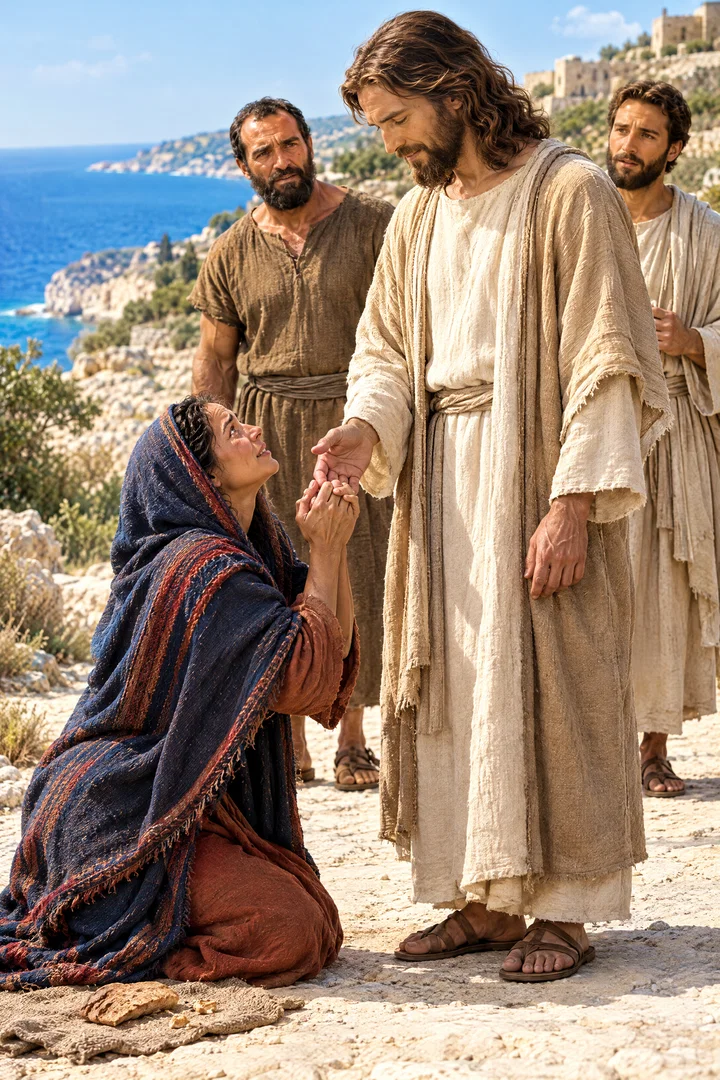
The woman was a Greek, a Syrophenician by nation; and she besought him that he would cast forth the devil out of her daughter.
Translations
The woman was a Greek, a Syrophenician by nation; and she sought him that he would cast forth the devil out of her daughter.
The woman was a Greek, a Syrophenician by nation; and she besought him that he would cast forth the devil out of her daughter.
the woman was a Greek, a Syrophenician by nation; and she besought him that he would cast forth the devil out of her daughter.
(The woman was a Greek, a Syrophenician by nation,) and she besought him that he would cast forth the demon out of her daughter.
Now the woman was a Greek, a Syrophoenician by race. And she besought him that he would cast forth the devil out of her daughter.
Now the woman was a Greek, a Syrophoenician by race. And she besought him that he would cast forth the demon out of her daughter.
and the woman was a Greek, a Syro-Phenician by nation — and was asking him, that the demon he may cast forth out of her daughter.
( and the woman was a Greek, Syrophenician by race), and asked him that he would cast the demon out of her daughter.
Now, the woman, was a Grecian, a Syrophoenician by race,—and she was requesting him that, the demon, he would cast forth out of her daughter.
Berean Standard Bible, Majority Standard Bible
Now she was a Greek woman of Syrophoenician origin, and she kept asking Jesus to drive the demon out of her daughter.
Now the woman was a Greek, a Syrophoenician by race. She begged him that he would cast the demon out of her daughter.
Now the woman was a Greek, a Syro-phoenician by birth: and she made a request to him that he would send the evil spirit out of her daughter.
(And the woman was a Greeke, a Syrophenissian by nation) and she besought him that he would cast out the deuill out of her daughter.
Douay-Rheims (Challoner revision)
For the woman was a Gentile, a Syrophenician born. And she besought him that he would cast forth the devil out of her daughter.
Pictures

Cross-references
- Matthew 15:21-28
Then Jesus went thence, and departed into the coasts of Tyre and Sidon.
Parallel account of the woman’s plea and Jesus healing her daughter.
- Matthew 8:5-13
And when Jesus was entered into Capernaum, there came unto him a centurion, beseeching him,
Jesus responds to Gentile faith, showing his work beyond Israel.
- Matthew 15:28
Then Jesus answered and said unto her, O woman, great is thy faith: be it unto thee even as thou wilt. And her daughter was made whole from that very hour.
Jesus commends her great faith and heals her daughter as requested.
- Matthew 15:24
But he answered and said, I am not sent but unto the lost sheep of the house of Israel.
Jesus says he is sent to Israel’s lost sheep.
- Matthew 15:22
And, behold, a woman of Canaan came out of the same coasts, and cried unto him, saying, Have mercy on me, O Lord, thou Son of David; my daughter is grievously vexed with a devil.
Both accounts describe the woman pleading with Jesus for her demon-possessed daughter.
- John 12:20-23
And there were certain Greeks among them that came up to worship at the feast:
Greeks seek Jesus, signaling the gospel’s reach to Gentiles.
- Acts 10:34-35
Then Peter opened his mouth, and said, Of a truth I perceive that God is no respecter of persons:
God shows no partiality, welcoming Gentiles as well as Jews.
Commentary
Each commentary is drawn from primary sources: the writings of Ellen G. White and Adventist pioneers and periodicals. Each commentary is separate. Its own words are not a quotation; follow the references to read the source passages.
Ellen G. White
25 sources
A heathen Greek mother of the old Canaanite race from the borders of Tyre and Sidon, shut out from the light and advantages the Jews enjoyed, begged Jesus as Lord to cast the devil that grievously vexed her daughter out of her.DA 399DA 399.22SP 304.22SP 301.1 Jesus had withdrawn from Capernaum to that heathen hill country seeking retirement and to prepare His disciples, and this plea was the only miracle of that journey, made for the very purpose of answering it.DA 399.13RED 80.1DA 402.1 He first appeared indifferent and answered that He was sent only to the lost sheep of Israel, testing her sincerity, then, satisfied with her confidence, turned in pity, commended her great faith and by His word made her daughter whole from that hour.4SP 334.12SP 302.13RED 79.2COL 175.2–3ST May 28, 1896 In contrast with the scribes and Pharisees who murmured in unbelief, she yielded at once with implicit, persistent faith, unoffended by cold reception and willing to be as a dog to receive the crumbs from the Master's table.2SP 302.13RED 79.22SP 304.1DA 401.13RED 78.1 Her healing was a deliberate example to lead the disciples from Jewish exclusiveness to compassionate work for all nations, showing Christ reaching Gentiles beyond Israel as with the centurion and foreshadowing their gathering into God's church.2SP 304.23RED 80.1ST Jun 12, 1879AA 19.2–20.1
Setting and Request
After withdrawing from Capernaum following the encounter with the Pharisees, Jesus crossed Galilee to the hill country on the borders of Phenicia overlooking Tyre and Sidon with their heathen temples, palaces, marts, harbors, and beyond them the Mediterranean over which messengers of the gospel would later carry glad tidings to the centers of the world's great empire, though the time for that was not yet.DA 399.1 He came to this region hoping to find the retirement He had failed to secure at Bethsaida and to prepare His disciples for their mission, and retirement was not His only purpose in making the journey.DA 399.1 The meeting took place just after He had left Jerusalem because the scribes and Pharisees were seeking His life.3RED 79.22SP 304.1
This plea for the daughter was the only miracle He wrought on that journey to the coast of Tyre and Sidon, and He made the journey for the very purpose of answering it and relieving the afflicted woman.3RED 80.1DA 402.1 The woman was a Greek, a Syrophenician by nation, a heathen mother of the old Canaanite race living in the borders of Tyre and Sidon, an idolater from a despised people hated by the Jews, shut out from advantages Jews enjoyed daily and not favored with the light of God's word.DA 399DA 399.22SP 304.22SP 301.1ST Jan 6, 1888 In this encounter as she reaches toward Him barriers are broken down.DA 399
Her daughter was grievously vexed with a devil, and after seeking help from heathen gods without relief, the mother heard reports that Jesus heals all manner of diseases for rich or poor alike.DA 399.2 Though she knew Jews rejected contact with Canaanites, moved by a mother's love and hope in His power she formed the resolute purpose that Jesus must heal her child, believed He alone could help, and came crying for mercy as Lord, Son of David, begging Him to cast the devil out.DA 399.22SP 301.1 Jesus cast the devil out by His word, and from that hour the daughter was made whole and the demon troubled her no more, showing His compassionate power and mercy toward those tormented.4SP 334.1GC88 515.2GC 515.23RED 79.22SP 304.1
The healing stands with His other healings of the demon-possessed as proof of His power and mercy and of the number, power, and malignity of evil spirits.GC88 515.2 For demons are intelligent entities whom He addressed as such, commanding them to come out of the victim and torment him no more, and they obeyed His authority.4SP 334.1GC88 515.2
Faith Beyond Israel
In contrast to the scribes and Pharisees who murmured and complained, manifested unbelief and bitterness, sought His life, and refused the salvation freely offered them, she yielded at once to His divine influence with implicit faith in His ability to grant what she asked.3RED 79.22SP 304.1DA 401.1 She had no national or religious prejudice or pride to shape or influence her course, but unconditionally acknowledged Jesus as Redeemer able to do all that she asked of Him.3RED 79.22SP 304.1DA 401.1 She begged for the crumbs that fall from the Master's table and was willing to be regarded as a dog if she might have a dog's privilege.DA 401.1
She followed Him and continued her supplications with persistent faith that He would relieve her distress, and did not become offended and leave even when He passed on as if not hearing and appeared indifferent to her cries.2SP 302.13RED 78.12SP 302.2 In this encounter, as this foreign Greek woman from Syrophoenicia came to Him and reached toward Him, barriers are broken down.DA 399 The disciples, seeing His indifference, supposed that Jewish prejudice against Canaanites pleased Him, felt no sympathy and had their sympathies not aroused by her distress, were annoyed at her importunity, and asked Him to send her away.3RED 78.12SP 302.2
His initially cold reception and apparent delay and rejection, and His answer that He is sent only to the lost sheep of the house of Israel, tested her faith and sincerity and tested and taught His disciples.2SP 302.1COL 175.2–3ST May 28, 18963RED 78.12SP 302.2 That teaching was not to treat people of a despised race as the Jews did, but to respond compassionately to distress.2SP 302.1 Though spoken in accord and accordance with Jewish prejudice, His answer was an implied rebuke to the disciples, afterward understood by them, reminding them that He came to save all in the world who will accept Him and that everyone who seeks Him ready to believe on Him when He is manifested to them is one of the lost sheep He came to gather into His fold.3RED 78.12SP 302.2
He knew her sorrow and persistent faith, her grief and persistent prayer revealed her faith, He tested her confidence in Him and was satisfied with it, and He turned to her with pity and love, commended her great faith, and granted her request and desire that it should be as she willed.3RED 79.22SP 304.1COL 175.2–3ST May 28, 1896 She did not leave discouraged but departed acknowledging her Saviour and happy in the granting of her prayer, and from that hour her daughter was made whole.3RED 79.22SP 304.1ST May 28, 1896 Her case shows that persevering prayer is rewarded and that those who persistently ask Christ in faith can receive His help.COL 175.2–3ST May 28, 1896
He made the journey to the region and borders of Tyre and Sidon for the very purpose of answering this afflicted Greek woman's plea, and this casting of the demon out of her daughter was the only miracle He wrought on that journey.3RED 80.1DA 402.1 In showing mercy to one of a despised people He both relieved her suffering and left a deliberate example for His disciples for after He should be no longer with them.3RED 80.1DA 402.1 He meant to lead them from Jewish exclusiveness to interest in working for others besides their own people, to teach them to work beyond their own nation and prepared them for gospel work and a gospel mission among the Gentiles, unrestricted by custom or nationality.2SP 304.23RED 80.1ST Jan 6, 1888 That lesson gained force when His death broke down the barrier and partition wall between Jews and Gentiles, and it opened their minds more fully to the labor that lay before them and exerted a powerful influence in directing their labors when the Jews turned still more persistently from them because they declared Jesus to be the Saviour of the world.2SP 304.23RED 80.1
Her appeal and healing are an instance of His work directly beyond and outside the acknowledged people of Israel, showing that His ministry reached Gentiles.ST Jun 12, 18793SP 356.2–3ST Apr 23, 1885ST Jun 12, 1879 Her case stands with the centurion's case and conversion as evidence that Gentiles too were welcomed as children of God.ST Jun 12, 1879 The healing of her daughter revealed that even Gentiles, including people regarded as unworthy of salvation, could receive the light of truth and share in God's saving promise.AA 19.2–20.1 Her conversion foreshadowed and prepared for continued gospel work among them and for the later active and sustained gathering of Gentile communities into God's church, which Jewish unbelief did not thwart.3SP 356.2–3ST Apr 23, 1885ST Jun 12, 1879
Her situation gives His disciples a lesson in the needs of people around them who lack knowledge of the truth, since Jewish people had been blessed so they could bless others, but pride and self-sufficiency had led them to shut out other nations and neglect those in need. His great love for suffering humanity in healing the daughter in answer to the earnest, humble supplication of her afflicted mother rebukes selfishness toward the unfortunate, the blind, the lame and afflicted, the widow and the fatherless.Ms 7, 1873, par. 9 It calls for greater missionary effort right at home in families and neighborhoods in caring for the afflicted, the suffering, and the discouraged.Ms 7, 1873, par. 9
Sources
Pioneers and periodicals
44 sources
The woman was a Greek-speaking Gentile of Syrian Phoenicia on the coast near Tyre and Sidon, who fell at Jesus' feet and pleaded with him to free her grievously demon-possessed daughter.ST Jul 4, 1900ST Jun 21, 1899ST Oct 14, 1913 Jesus made a long journey to those borders to meet her distress, though he at first kept himself hidden and spoke beyond his usual speech.RH Nov 28, 1912ST May 12, 1914ST Mar 10, 1881 He tested her trust by seeming indifference, silence and the word about children's food and dogs, and she answered with humility and perseverance without taking offense or withdrawing.ST Jun 7, 1905ST Jan 6, 1888ST Nov 21, 1911 Her great faith was rewarded with her daughter's healing, showing that God's mercy and salvation are not limited to the Jews but reach people of every nation who seek him.ST Jun 15, 1904ST Nov 21, 1911ST Nov 21, 1911 Her pleading remains the pattern of persevering prayer that keeps crying day and night without fainting when the answer is delayed, especially for mothers praying for afflicted children.ST Dec 4, 1901ST Jun 7, 1905ST Mar 23, 1888
Woman's Identity and Background
The woman was a Greek, meaning a Greek-speaking Gentile distinct from the Hebrew people, shaped by Greek customs and culture.ST Jul 4, 1900ST Jul 29, 1908ST Oct 14, 1913ST Jul 27, 1915 That sense of Greek as Gentile clarifies the meaning of Greek elsewhere, as in Galatians 3:28.ST Jul 27, 1915
She was a Syrophoenician by nation, that is a Syrian Phoenician rather than a Carthaginian Phoenician.ST Jul 4, 1900ST Jun 21, 1899ST Jul 4, 1900 The Syrophoenicians were a mixed coastal people of Phoenicia attached to the Roman province of Syria.ST Jun 21, 1899ST Jul 4, 1900ST Jun 21, 1899
Her descent is associated with Shem and Ham, while her language and civilization are associated with Japheth.ST Jul 4, 1900 She lived on the Mediterranean coast near Tyre and Sidon, about a hundred miles north of Jerusalem, and had heard of Jesus' healing miracles.ST Nov 21, 1911 That coastal region where Jesus and the Twelve traveled had long been half heathen and half Jewish, settled by Jews drawn there through commerce.ST Jun 21, 1899
She belonged to a despised non-Jewish people, Canaanites, toward whom Jews showed cold treatment and prejudice.ST Jan 6, 1888ST Dec 18, 1907ST Jan 6, 1888 The Jewish use of dog for Gentiles appears in the exchange that follows her plea.ST Oct 14, 1913
She besought Jesus to cast the devil out of her daughter, coming in grief, falling at His feet and worshiping Him.ST Jul 4, 1900ST Jun 21, 1899ST Jun 7, 1905ST Nov 21, 1911 Her daughter was grievously afflicted and possessed by an evil spirit, a demon.ST Mar 26, 1885RH May 21, 1857ST Nov 21, 1911 She trusted her child would be helped, believed in His goodness and power despite few opportunities to learn of Him, and He freed the girl by His word.ST Mar 26, 1885ST Jun 21, 1899ST Jun 7, 1905RH May 21, 1857ST Nov 21, 1911
Journey to Tyre and Sidon
Jesus took a long journey to the borders and coasts of Tyre and Sidon to meet one Greek Syrophoenician woman, to answer her plea, relieve her distress and grief over a daughter possessed by an evil spirit, and bring the mother comfort and salvation.ST Apr 4, 1911RH Nov 28, 1912ST May 12, 1914ST Sep 9, 1886ST Oct 1, 1896 She was a Gentile from Syrophoenicia who sought his help for her daughter, and though she could not travel to seek him earlier she went to him when she learned he was nearby.ST Nov 21, 1911ST May 12, 1914 His journey to that region to relieve the anxious heart of one woman shows his personal care for an individual in need, his sympathy for a mother's anxious care, and his readiness to hear mothers' prayers and bless their children.ST Apr 4, 1911ST Sep 9, 1886ST Oct 1, 1896
He had come to meet her, though he initially kept himself hidden, and her faith would not give up seeking his help.ST Nov 21, 1911 She lived on the Mediterranean coast near Tyre and Sidon, about a hundred miles north of Jerusalem, and had heard of his healing miracles.ST Nov 21, 1911 His conversation with her there in the region of Tyre and Sidon went beyond his usual speech, Syriac or west-Aramaic, showing he was also acquainted with Greek and Hebrew and may have known other languages.ST Mar 10, 1881 The healing of the daughter took place in the neighborhood of Tyre and Sidon immediately before he left those parts to travel northeastward toward the country east of Jordan and Decapolis instead of returning at once to Capernaum.ST Sep 22, 1881
Comforting and saving this mother and healing her daughter was the only work he did in that region so far as the record shows.RH Nov 28, 1912 That earnest personal effort to secure the salvation of even one soul proves that personal work is the chief factor in successful ministry, and his cordial receiving of everyone who came for light or healing and his long journey to the coasts of Canaan to bring relief to one poor woman shows that true ministry reaches people by personal contact with each soul alone rather than only by preaching to crowds.RH Nov 28, 1912ST Jun 8, 1904 In going up to Sidon to heal the daughter of a poor Syrophoenician woman he put one suffering person above national tradition and prejudice and above every holy thing, utterly disregarding the corporate tradition by which Jews regarded the Gentile nations as accursed.ST Apr 13, 1904ST Oct 29, 1896 One poor, suffering soul outweighed national traditions, prejudices, and distinctions, proving each man as an individual is of eternal worth in the sight of God, and that the Sabbath was made for man and not man for the Sabbath, with man ever exalted above the thing.ST Apr 13, 1904ST Oct 29, 1896
Faith Tested and Rewarded
The woman showed real faith that trusted her child would be helped when she fell at his feet in grief to plead for deliverance.ST Jun 15, 1904ST Jun 7, 1905 Though she had few opportunities to learn of him, she believed in his goodness and power, and her trust contrasts with rejection by others.RH May 21, 1857 She persisted though he seemed indifferent and kept her at a distance for a time to test her faith, and her faith prevailed.ST Jun 15, 1904RH Dec 3, 1867
Jesus tested her faith and sincerity by seeming indifference, silence, rebuff, and scorn, including speaking of the children's food being given to dogs.ST Jun 7, 1905ST Jan 6, 1888ST Nov 21, 1911 His seeming refusal drew her to seek him more earnestly until her faith was richly rewarded with her daughter's healing and her own comforting.ST Jun 7, 1905ST Nov 21, 1911 He received her request in the cold manner Jews would have given such a despised petitioner in order to test her and to teach his disciples to show mercy to people in distress.ST Jan 6, 1888 His apparent rejection also tested and taught his disciples while he knew her sorrow and persistent faith, and he granted her request and commended her great faith.ST May 28, 1896
She did not take offense, faint, or withdraw in anger at the humiliating comparison, but answered with humility and kept from losing the blessing.ST Jun 15, 1904RH Aug 28, 1860 True faith accepts any position assigned by the Master and knows its own unworthiness.ST Jun 15, 1904 Her response showed profound humility through which heaven's mystery is grasped, bowing low without losing sight of heaven while recognizing human corruption yet respecting humanity as made for immortality.RH Feb 18, 1858 Had she withdrawn in anger, her daughter might have died still afflicted.RH Aug 28, 1860
Her persistent appeal showed faith and courage that endure apparent silence, rebuff, scorn, and refusal, still worshiping and asking for help.ST Nov 21, 1911ST Nov 21, 1911 Her perseverance also showed unselfishness and tender mother love that keeps seeking Jesus for her daughter despite delay.ST Nov 21, 1911 Jesus knew her sorrow, granted her request, healed her daughter and comforted her mother, and commended her great faith to show that those who persistently ask in faith can receive his help.ST May 28, 1896ST Jun 7, 1905 He found such great faith in her during his visit to Tyre.
Her humility and ready answer left a lasting example associated with her daughter's healing.RH Aug 28, 1860 That example teaches that humble, persevering faith is not limited to the Jews but reaches people of every class.ST Jun 7, 1905 It shows a faith that turns obstacles and seeming rebuff and denial into steps toward the Master.ST Mar 23, 1888
Salvation Open to Gentiles
The verse presents Jesus as a compassionate and powerful deliverer who is willing to relieve suffering and lift burdens when a Greek Syrophoenician mother pleads for the demon to be cast out of her daughter.RH Oct 30, 1860ST Jul 29, 1908 His recorded miracles and care were not limited to the Hebrew people but offered comfort to people of every nation who seek God.RH Oct 30, 1860ST Jul 29, 1908 Her foreign nationality and her plea show that God's blessings reach beyond the chosen people to people of every class and nationality.ST Jun 15, 1904ST Jul 4, 1900ST Jun 7, 1905 Salvation is not limited by any national or social lines, faith can cross the barriers between Jews and Gentiles, and whosoever will may come and receive eternal life.ST Jun 15, 1904ST Jul 4, 1900ST Jun 7, 1905 Humble, persevering faith is not limited to the Jews, for though Jesus tested her by seeming indifference he healed her daughter and comforted her mother.ST Jun 15, 1904ST Jun 7, 1905
A person of any nationality can be counted with true Israel by humbly accepting the low position assigned and persisting in seeking the blessing for the daughter.ST Jun 15, 1904ST Jun 15, 1904 Her appeal is an instance of Christ's direct work beyond the acknowledged people of Israel.ST Jun 12, 1879ST Apr 23, 1885ST Jun 12, 1879 With the centurion's conversion, her case is evidence that Gentiles too were welcomed as children of God.ST Jun 12, 1879
She represented the many pagans of her time and the pagan nations generally.ST Jul 4, 1900ST Jul 4, 1900 She represents one of the few people in any land who truly long for God and seek salvation.ST Jul 4, 1900ST Aug 26, 1897 Though she had few opportunities to learn of him, she believed in his goodness and power to heal her grievously afflicted daughter, and her faith contrasts with rejection by the Jews.RH May 21, 1857ST Aug 26, 1897 Her story gives Gentiles reason to hope in God's mercy and encourages persistent prayer.RH May 21, 1857
Her conversion shows that his ministry reached Gentiles and prepared for continued gospel work among them.ST Jan 6, 1888ST Apr 23, 1885ST Jun 12, 1879 Jesus went to the region of Tyre and Sidon to heal her, showing mercy to someone from a despised people, and his act taught the disciples to work beyond their own nation unrestricted by custom or nationality.ST Jan 6, 1888 Jewish people had been blessed so they could bless others, but pride and self-sufficiency had led them to shut out other nations and neglect those in need, and her situation gives the disciples a lesson in the needs of people around them who lack knowledge of the truth.ST Jan 6, 1888 Her case is an example of his ministry to Gentiles and anticipates the later sustained gathering of Gentile communities into God's church.ST Jan 6, 1888ST Apr 23, 1885ST Jun 12, 1879
Pattern for Persistent Prayer
Her besetting Christ to cast the devil out of her daughter is persevering prayer that does not faint when the answer is delayed.ST Dec 4, 1901ST Mar 23, 1888 It gives encouragement to keep crying to God day and night, with assurance that persistent faith will be heard and avenged.ST Dec 4, 1901 Even when she seemed to meet rebuff and denial she continued to seek Jesus for her daughter, showing a faith that turns obstacles into steps toward the Master.ST Mar 23, 1888
Earnest prayer may face delay while faith is tested or strengthened.ST Nov 21, 1911RH Dec 3, 1867 Jesus kept her at a distance for a time to test her faith, but her faith prevailed.RH Dec 3, 1867 His apparent withdrawal can lead seekers to seek Him more persistently, and delays or unsatisfying answers and silence can test their faith.ST Nov 21, 1911 Those who cling to Him and do not give up will be heard, and when the trial has done its work He will turn toward them in reconciliation and love.ST Nov 21, 1911
Her experience is an example of courage and faith for people whose prayers seem unanswered.ST Nov 21, 1911 It is likewise an example for seekers after the Saviour who do not gain immediate assurance of pardon and peace, who must not be discouraged, give up, or despair.ST Nov 21, 1911RH Feb 26, 1861 A hope gained too easily would be valued too lightly, for despair never saved a sinner and discouragement and retreat lose everything, while pressing on in hope saves.RH Feb 26, 1861 They must press on and keep seeking, coming with boldness to the throne of grace to ask what they want and all they want, as those who are not strangers, with the King's Son Himself ready to take in the petition and intercede with the Almighty Father.RH Feb 26, 1861 The last decisive step of surrendering the whole soul to Christ unlocks the eternal glories of the heavenly inheritance.RH Feb 26, 1861
Her plea is applied as an example for mothers to pray humbly, earnestly, and persistently for children bound by destructive powers, even when obstacles arise or Jesus seems indifferent.ST Jun 7, 1905 He took a long journey to relieve the distress of a woman whose daughter was possessed by an evil spirit and to relieve the woman's anxious heart.ST Apr 4, 1911ST Sep 9, 1886 His action reveals His sympathy for a mother's anxious care and His readiness to hear her prayers and bless her children.ST Apr 4, 1911ST Sep 9, 1886 He hears, loves, sympathizes, and delivers, and His care for her anxious heart shows that He is a helper to mothers in their troubles and blesses their children.ST Apr 4, 1911ST Dec 18, 1907ST Jun 7, 1905
Jesus journeying to the region of Tyre to relieve the grief of one Syrophoenician woman shows His personal care for an individual in need.ST Oct 1, 1896 His help to her as an outcast expresses tender solicitude for the afflicted and tempted, continual ministry of love to physical need, and generous, loving compassion joined with lofty, Godlike dignity.RH Mar 24, 1910 In reaching her as well as the Samaritan woman, the learned Pharisee, and the proud nobleman, He witnessed human prejudices, jealousies, and animosities without partaking of them and without being moved by the spirit of the world.RH Mar 24, 1910 His kindness to her is the pattern for members of His body to feel for one another, pass over weakness, and live in loving, charitable relationship different from the world.RH Mar 24, 1910
Sources