Mark 7:27
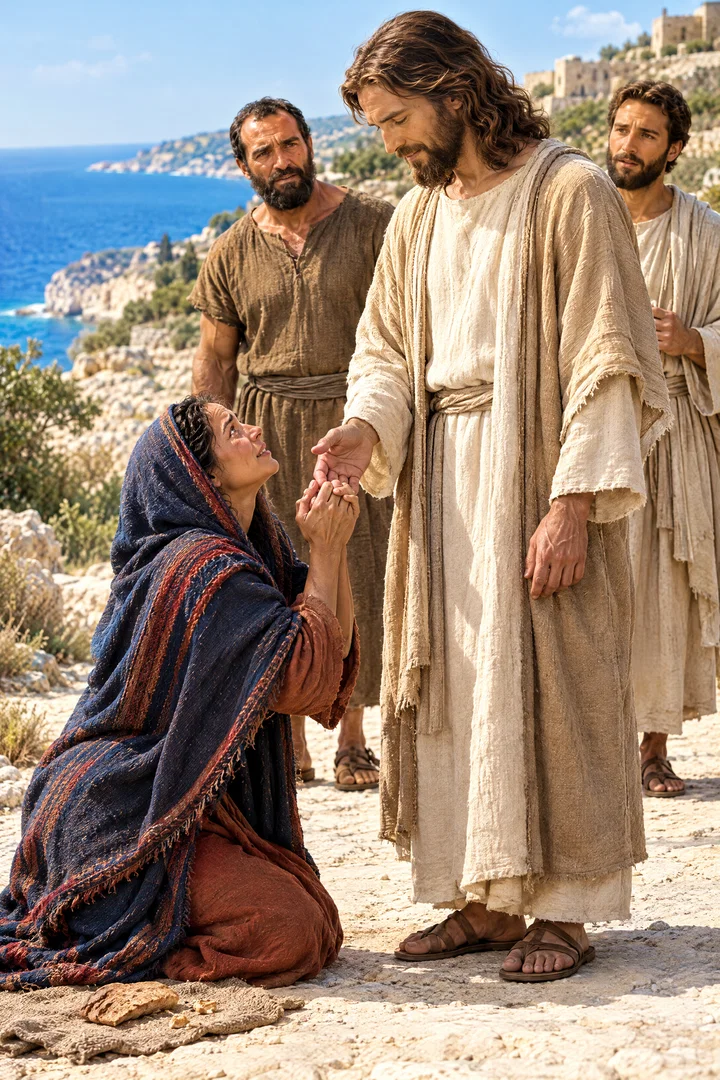
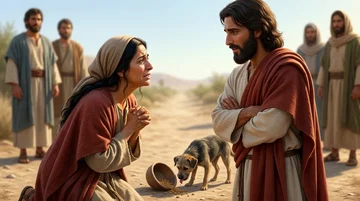
But Jesus said unto her, Let the children first be filled: for it is not meet to take the children’s bread, and to cast it unto the dogs.
Translations
But Jesus said to her, Let the children first be filled: for it is not meet to take the children’s bread, and to cast it to the dogs.
King James Version, KJV Cambridge Paragraph Bible
But Jesus said unto her, Let the children first be filled: for it is not meet to take the children’s bread, and to cast it unto the dogs.
But Jesus said to her, Let the children first be satisfied: for it is not meet to take the children's bread, and to cast it to the dogs.
Revised Version, American Standard Version
And he said unto her, Let the children first be filled: for it is not meet to take the children’s bread and cast it to the dogs.
And Jesus said to her, 'Suffer first the children to be filled, for it is not good to take the children's bread, and to cast [it] to the little dogs.'
But [ Jesus] said to her, Suffer the children to be first filled; for it is not right to take the children's bread and cast it to the dogs.
And he was saying to her—Suffer, the children, first, to be fed; for it is not seemly to take the bread of the children, and, unto the little dogs, to cast it;
“ First let the children have their fill,” He said. “ For it is not right to take the children’s bread and toss it to the dogs.”
“ First let the children have their fill,” Jesus said. “ For it is not right to take the children’s bread and toss it to the dogs.”
But Jesus said to her, “ Let the children be filled first, for it is not appropriate to take the children’s bread and throw it to the dogs.”
And he said to her, Let the children first have their food: for it is not right to take the children's bread and give it to the dogs.
But Iesus saide vnto her, Let the children first be fedde: for it is not good to take the childrens bread, and to cast it vnto whelpes.
Douay-Rheims (Challoner revision)
Who said to her: Suffer first the children to be filled: for it is not good to take the bread of the children, and cast it to the dogs.
Pictures
Cross-references
- Matthew 15:21-28
Then Jesus went thence, and departed into the coasts of Tyre and Sidon.
Parallel account of the Gentile woman’s plea and Jesus healing her daughter.
- Matthew 15:22
And, behold, a woman of Canaan came out of the same coasts, and cried unto him, saying, Have mercy on me, O Lord, thou Son of David; my daughter is grievously vexed with a devil.
The Canaanite woman pleads for mercy for her demon-afflicted daughter.
- Matthew 15:26-27
But he answered and said, It is not meet to take the children’s bread, and to cast it to dogs.
Parallel account of Jesus testing the Syrophoenician woman’s faith as she asks for crumbs.
- Matthew 15:28
Then Jesus answered and said unto her, O woman, great is thy faith: be it unto thee even as thou wilt. And her daughter was made whole from that very hour.
Jesus commends her faith and heals her daughter.
- Matthew 15:27
And she said, Truth, Lord: yet the dogs eat of the crumbs which fall from their masters’ table.
She humbly accepts the dogs’ place while trusting Jesus for crumbs.
- Matthew 15:23
But he answered her not a word. And his disciples came and besought him, saying, Send her away; for she crieth after us.
The disciples ask Jesus to send the persistent woman away.
- Matthew 15:25
Then came she and worshipped him, saying, Lord, help me.
The woman worships Jesus and pleads for his help.
- Acts 10:34-35
Then Peter opened his mouth, and said, Of a truth I perceive that God is no respecter of persons:
Peter learns that God accepts people from every nation.
- Matthew 8:10-12
When Jesus heard it, he marvelled, and said to them that followed, Verily I say unto you, I have not found so great faith, no, not in Israel.
Jesus commends a Gentile’s faith and says many will enter the kingdom while some children of the kingdom are cast out.
- Acts 13:46-48
Then Paul and Barnabas waxed bold, and said, It was necessary that the word of God should first have been spoken to you: but seeing ye put it from you, and judge yourselves unworthy of everlasting life, lo, we turn to the Gentiles.
After Jews reject the message, Paul turns to Gentiles, who receive it.
Commentary
Each commentary is drawn from primary sources: the writings of Ellen G. White and Adventist pioneers and periodicals. Each commentary is separate. Its own words are not a quotation; follow the references to read the source passages.
Ellen G. White
30 sources
Jesus told the Syrophoenician mother that Israel as God's favored family must first be filled with its blessings, picturing Gentile outsiders as dogs under the table who eat the fallen crumbs.DA 399.23RED 78.22SP 301.12SP 304.1DA 400.4 His cold, rejecting manner echoed Jewish prejudice but hid a pitying heart, and was meant to prove her faith, sincerity and perseverance.3RED 78.22SP 302.12SP 301.12SP 304.1 He also allowed her plea to wait in order to rebuke the disciples' lack of sympathy and to teach them the compassionate way they must treat such distress after He was gone.2SP 304.23RED 80.12SP 302.12SP 301.1COL 175.2–3 She yielded without pride, accepted a dog's place for a dog's crumb, and showed unexampled faith in His power and goodness, so He commended her, ended the test, and by His word freed her demon-vexed daughter from that hour.4SP 334.1COL 175.2–33RED 79.2DA 400.4ST May 28, 1896 The encounter thus breaks Jewish exclusiveness and shows the gospel reaching beyond Israel to Gentiles hungering for truth who are welcomed as God's children.3RED 80.1AA 19.2–20.13SP 356.2–3ST Jun 12, 1879 In the teaching held by a few, the children's bread is the third angel's message to be given to the children first and not softened and spent upon the churches as dogs.Lt 8, 1851, par. 14–183MR 401.2–402.2
Encounter and Wording
The saying belongs to the meeting with a foreign woman in a Phoenician town on the borders of Tyre and Sidon, where barriers are broken down.DA 399DA 399.1 Jesus had withdrawn there to seek retirement and to prepare His disciples for their mission, turning from scribes and Pharisees who sought His life with murmuring and complaint, unbelief and bitterness, and who refused the salvation freely offered them.DA 399.1DA 401.1 It was the only miracle on that journey, undertaken for the very purpose of relieving the afflicted woman.3RED 80.1DA 402.1 Though He sought privacy, He could not be hidden, but heard the mother's appeal for her sick daughter and healed her.Lt 227, 1905, par. 9–10
It was spoken to a Canaanitish, Syrophoenician woman of the old Canaanite race of that district, idolaters despised and hated by the Jews.DA 399.22SP 301.1 As a heathen she was excluded from the advantages the Jews daily enjoyed and was not favored with the light of God's word, and she knew that Jews rejected contact with Canaanites.DA 399.22SP 301.1DA 401.1 She came out from those borders crying for mercy, calling Him Lord, Thou Son of David, for her daughter grievously vexed with a devil and sick.DA 399.22SP 301.1 She had heard of the prophet who heals all manner of diseases whether rich or poor, and though she had sought help from heathen gods and obtained no relief and was tempted to think what a Jewish teacher could do for her, hope sprang up in her heart.DA 399.2 Inspired by a mother's love she determined with resolute purpose to present her case and not lose her only hope.DA 399.2
The encounter ended with Jesus freeing the grievously afflicted daughter by His word.4SP 334.1GC88 515.2 This gives another instance like the Gadara demoniacs of cruel satanic affliction met by the compassionate Saviour's power and mercy to heal and release captives.4SP 334.1GC88 515.2 As in nearly every such healing, He addressed the demon as an intelligent entity, commanding him to come out of his victim and torment him no more, exercising authority and power over unclean spirits so that they come out.GC88 515.2
The children are Israel, the favored people of God, and their bread is the blessings given to Israel.3RED 78.2DA 400.42SP 302.2 The dogs are strangers and aliens from Israel, Gentiles and Canaanites as members of a despised people not favored with the light of God's word.3RED 78.22SP 304.1DA 400.42SP 303.1–22SP 302.2 Let the children first be filled means Israel should first receive the bread.2SP 304.1ST May 28, 18962SP 302.2 The saying pictures the abundance on which the rightful family feasts while dogs under the table eat the crumbs that fall to the floor.2SP 303.1–2 That priority does not deny that a believing outsider may receive help.2SP 304.12SP 302.2
Jesus spoke in apparent rejection, according to the unfeeling, cold and heartless prejudice of the Jews that treated those outside Israel as unworthy of Israel's blessings.3RED 78.22SP 302.12SP 301.13RED 78.12SP 303.1–2 His apparent indifference hid a pitying heart.3RED 78.1 His noticing her case enough to remark upon it encouraged her, though His words gave her no definite hope.3RED 78.22SP 303.1–2 The repulse was so severe that it would have utterly discouraged a less earnest seeker and sent many away humiliated and abused.3RED 78.22SP 303.1–2
Testing Faith for Mercy
Jesus spoke in this way to prove and test the confidence, faith, sincerity and perseverance of the woman as a representative of a despised race not favored with the light of God's word, after He had left Jerusalem where the scribes and Pharisees were seeking His life.2SP 302.12SP 301.12SP 304.13RED 79.22SP 302.2 He answered her in the same cold and heartless manner in which the Jews treated Canaanites, setting forth Israel as children to receive the bread first and her people as dogs to whom the children's bread must not be given, reflecting the Jewish prejudice that God's blessings belonged first to Israel.2SP 302.12SP 301.12SP 304.12SP 302.2 His exclusive words, spoken with apparent indifference hiding a pitying heart, tested her confidence in Him as she followed and pleaded without taking offense.2SP 304.13RED 79.23RED 78.1
He allowed her plea to go unanswered for a time and spoke and acted as He did to teach His disciples and to leave an example of mercy toward one of a despised people for them to follow in similar cases when He would no longer be with them.2SP 302.1COL 175.2–33RED 78.1DA 402.1 The harsh reception was designed to impress them with the contrast between heartless Jewish treatment of such distress and the compassionate manner in which they should deal with it, as shown when He granted her petition and healed her daughter.2SP 302.12SP 301.1DA 402.1 It exposed the disciples, who were annoyed at her importunity, felt no sympathy for her distress, and wrongly supposed that Jewish prejudice against Canaanites pleased Him.3RED 78.1 Like His word about being sent only to the lost sheep of the house of Israel, the saying sounded like Jewish prejudice but was an implied rebuke reminding them that He came to save all who will accept Him, so that everyone who seeks Him ready to believe when He is manifested belongs to the lost sheep He came to gather into His fold.3RED 78.1
Her answer showed immediate yielding to divine influence, implicit faith in His ability to grant what she asked, and unconditional acknowledgment of Jesus as Redeemer able to do all she asked, with no national or religious prejudice or pride.3RED 79.2DA 401.1 Though His words gave her no definite hope, His noticing her case enough to remark upon it pictured the abundance on which the rightful family feasts while dogs watching under the table devour the crumbs that fall to the floor.DA 400.42SP 303.1–2 The repulse was so severe it would have utterly discouraged a less earnest seeker and sent many away humiliated and abused.2SP 303.1–2 Yet she accepted a dog's place and was willing to be regarded as a dog if she might have a dog's privilege of crumbs from the Master's table, thankfully taking whatever falls from the Master's hand with no claim on His favor yet pleading for one crumb from His bounty while He favored His people with rich and bountiful gifts.DA 400.42SP 303.1–2DA 401.1 This revealed faith and perseverance unexampled and a higher appreciation of His benevolence and power than few of the favored people of God possessed.2SP 303.1–2DA 401.1
Satisfied by her faith, Jesus ended His testing, finished His lesson to the disciples, and with pity and love commended her and granted her request, so that from that hour her daughter was made whole and the demon troubled her no more.COL 175.2–33RED 79.2 The episode shows the result of persevering prayer and that Christ rewards the persistence and confidence He inspires.COL 175.2–3 It teaches that persevering, faith-filled prayer finds His help and that even the weakest and most troubled soul may find hope and sufficiency in God, for she was not sent away empty but received what she asked.COL 175.2–3ST May 28, 1896
Gospel Beyond Israel
The encounter stands as a lesson and example of mercy toward a despised people, given to lead the disciples away from Jewish exclusiveness toward interest in working for others besides their own people and to open their minds more fully to the labor before them among the Gentiles.2SP 304.23RED 80.1ST Jan 6, 1888 It exposes the barrier created by Jewish pride and prejudice toward Gentiles and the failure of those entrusted with Scripture to understand that their privileges were meant to make them a blessing to other nations in spiritual darkness. After Christ's death broke down the partition wall between Jew and Gentile, when the Jews turned more persistently from the disciples for declaring Jesus to be the Saviour of the world, this lesson directed the labors of His representatives toward a gospel work unrestricted by custom or nationality.2SP 304.23RED 80.1ST Jan 6, 1888 Gentiles too were thus recognized as children of God welcomed to receive the gospel.ST Jun 12, 1879
It belongs to Jesus' direct work among Gentiles and to conversion beyond Israel's acknowledged people, an early sign of His purpose to lead the Jews beyond exclusiveness toward the Gentiles.3SP 356.2–3ST Apr 23, 1885ST Jun 12, 1879 While acknowledging Israel's prior place in receiving the bread and the gospel, the encounter shows this priority did not exclude Gentiles from receiving Christ's help.3SP 356.2–3ST Jun 12, 1879 It helped show that people among the Gentiles, though often regarded as unworthy of salvation, were hungering for the light of truth and that God's saving message was to reach all nations, not only Israel.AA 19.2–20.1 The time was coming for continued work among the Gentiles, to whom the gospel welcome was extended.ST Jun 12, 1879ST Jun 12, 1879
It also shows Christ's great love for suffering humanity in answering the earnest, humble supplication of the afflicted mother.Ms 7, 1873, par. 9 That love rebukes selfishness and neglect of the unfortunate, the blind, the lame and afflicted, the widow and the fatherless.Ms 7, 1873, par. 9 It calls for greater missionary effort right at home in families and neighborhoods, caring for the afflicted, the suffering, and the discouraged.Ms 7, 1873, par. 9
The children's bread is the third angel's message belonging first to the children, and the dogs are the churches.Lt 8, 1851, par. 14–18 Taking the children's bread and giving it to dogs means taking that message to the churches and softening, taming it down and changing it to gain entrance there, as Brother Baker had done.Lt 8, 1851, par. 14–183MR 401.2–402.2 That course withholds its proper spiritual food from those it was meant to serve and spends it on outsiders, which is all wrong.Lt 8, 1851, par. 14–183MR 401.2–402.2 The bread must be given to the children first and the message preserved and faithfully proclaimed rather than diluted.Lt 8, 1851, par. 14–183MR 401.2–402.2
Sources
Pioneers and periodicals
52 sources
Jesus told the Greek Syrophoenician mother who fell at His feet for her demon-possessed daughter that the children of Israel must first be filled before taking their bread of God's favor and gospel to give to Gentile dogs.ST Mar 23, 1904ST Jul 4, 1900ST Jun 21, 1899ST Mar 29, 1905ST Mar 23, 1904 He was voicing the Jews' own claim of exclusive right, who counted themselves children of Abraham and despised Gentiles as unclean dogs, not to insult her or from indifference.ST May 23, 1911ST Mar 29, 1905ST Mar 23, 1904ST Jul 4, 1900ST Jul 4, 1900 The hard, delaying answer tested the sincerity of her faith to draw her to seek Him more earnestly, and she was not offended but humbly accepted the lowly place and trusted His bounty was abundant for her daughter's deliverance.ST May 23, 1911ST Jun 15, 1904RH Aug 28, 1860ST Nov 21, 1911ST Nov 21, 1911 He spoke this way to teach His disciples to carry the blessings beyond the chosen people to all, exposing Jewish pride and prejudice and showing that humble persevering faith is not the heritage of the Jews alone.ST Jun 15, 1904ST Jun 15, 1904ST Mar 23, 1904ST Jan 6, 1888ST Jun 7, 1905 Her experience encourages persevering prayer that keeps crying to Jesus without fainting despite seeming rebuff and delay until the answer comes, trusting that He hears and loves even the weakest troubled soul.ST May 28, 1896ST Dec 4, 1901ST Jun 7, 1905ST Nov 21, 1911ST Sep 9, 1886
Historical Setting
Jesus spoke these words in the borders of Tyre and Sidon to a Greek woman, a Syrophoenician by race, whose little daughter had an unclean spirit.ST Mar 23, 1904ST Mar 23, 1904ST Jul 4, 1900 He had entered a house wanting no one to know He was there, but she had heard of Him and came and fell down at His feet and besought Him to cast the demon out of her daughter.ST Mar 23, 1904 His answer that the children must first be filled and that it was not right to take the children's bread and cast it to the dogs was the reply that prompted her further plea.ST Mar 23, 1904ST Mar 23, 1904ST Jul 4, 1900
He spoke it after a forty to sixty mile journey from Galilee, where He sought secrecy but could not be hid, in a house near Tyre and Sidon.ST Jun 7, 1905 She had followed crying for mercy as Son of David for her grievously afflicted child, and He spoke after answering her not a word.ST Jun 7, 1905 He spoke after the disciples urged Him to send her away for crying after them, and after declaring He was sent only to the lost sheep of the house of Israel.ST Jun 7, 1905
The saying stands in the account told also in Matthew 15:1-29, after Jesus rebuked the Pharisees for hypocrisy.ST Sep 8, 1881 The confrontation came when deputies from Jerusalem accused Him because His disciples sat down to eat without ceremonially washing their hands and because they had plucked and rubbed ears of barley on the Sabbath.ST Sep 8, 1881 The Pharisees held that food could not be taken with a good conscience without every precaution against ceremonial defilement, teaching that impurity from person or vessel passed to food and through food to body and soul, so that hands and even dishes, couches, and tables had to be scrupulously washed before every meal.ST Sep 8, 1881
The encounter took place in a coastal region whose population had long been partly Jewish and partly heathen.ST Jun 21, 1899 It shows He could converse with the Syro-Phoenician woman in the region of Tyre and Sidon, and it belongs to His visit to Tyre where He met a woman of great faith.ST Mar 10, 1881 It belongs to the healing of the daughter of the Canaanite woman in the neighborhood of Tyre and Sidon, immediately before He left that region on a wide circuit through Sidon and the country east of Jordan toward Decapolis.ST Sep 22, 1881
It belongs to His leaving the crowds and traveling to the region of Tyre and to Syrophoenicia to help one woman in her distress.ST May 12, 1914ST Oct 1, 1896ST Jun 8, 1904 She was poor and not of His faith, yet He made a long journey to the coasts of Canaan to bring her relief.ST May 12, 1914ST Jun 8, 1904 He met her cordially, as He met everyone who came for light or healing, giving personal attention to a single soul in need rather than reaching people only by preaching to a crowd.ST Oct 1, 1896ST Jun 8, 1904
Meaning of the Image
The children are the Jews, the people of Israel, to whom the ministry was first directed and who must first be filled, while the dogs are the Gentiles and the bread is favor from God, the gospel and the abundant gifts given, including the bread of life entrusted to Israel for the world.ST Jun 21, 1899ST Mar 23, 1904ST Oct 14, 1913ST Jun 7, 1905RH May 21, 1857 The image describes a first mission to Israel in which the children receive bread before it is given to dogs, and the woman humbly accepts that order and asks even for the crumbs, persisting in asking for help for her daughter until her faith is praised and her daughter is healed.ST Jun 21, 1899ST Jun 7, 1905RH May 21, 1857 The children first to be filled are the Jews, and the dogs are the Gentiles held in contempt through Jewish national pride and exclusiveness, with Jesus voicing the Jewish claim of exclusive right to favor from God.ST Mar 29, 1905ST Mar 23, 1904ST Oct 14, 1913 The gospel was to be offered first to the Jews, while the Gentiles' later reception of the gospel fulfills the hope that this bread would reach them, showing mercy reaching Gentiles and teaching that God's blessings reach beyond Israel to people of every class.ST Oct 14, 1913ST Jun 7, 1905RH May 21, 1857
Dogs was a term Jews often applied to Gentiles, but it is used here not to insult or reproach the woman but to test and prove her faith, and her faith shows that she is one of the children in fact, so that after proving her faith the request is granted.ST Jul 4, 1900ST Jul 4, 1900 Dogs were deeply disliked, and Jews called uncircumcised people dogs, against the background of a coastal region long partly Jewish and partly heathen.ST Jun 21, 1899 Gentile dog was a common term of reproach, associated with the surrounding nations' uncleanness, ferocity, and opposition to God, reflecting the Jews' general view of those nations.ST Mar 17, 1898 The woman was not turned aside by the insult or by false pride, for her whole concern was her daughter's salvation.ST Mar 17, 1898
The saying places the children's needs before the dogs' and is the reply to the woman's request, explaining that giving the children's bread to the dogs would be improper.ST Jul 4, 1900ST Jul 4, 1900 It presents the response to a Greek, Syrophoenician woman asking for her daughter to be freed from an unclean spirit: the children must be fed first, and it is not proper to take their bread and give it to the dogs.ST Jul 4, 1900ST Jul 4, 1900
The image of children receiving bread before dogs expresses the Jewish view that Jews were God's children and Gentiles were dogs, using on this occasion the Jews' own view in which they counted themselves as children of Abraham and counted the Gentiles as dogs.ST May 23, 1911ST Mar 29, 1905 Jesus voiced the Jewish claim of exclusive right to favor from God, speaking in the manner a Jew might treat someone of her despised race and as a Jew expressing Jewish exclusiveness.ST Mar 23, 1904ST Jan 6, 1888 He said this not from indifference and not to insult or reproach the woman, but to test the Gentile woman's faith and sincerity and to teach the disciples.ST Mar 23, 1904ST Jul 4, 1900ST Jan 6, 1888ST Jul 4, 1900 She did not let racial pride or prejudice keep her from seeking help, but humbly accepted even the crumbs of God's blessing, and her faith was honored.ST May 23, 1911
Testing Faith Purposefully
The hard reply with its seeming indifference, delay, and humiliating comparison held the woman at arm's length in order to test the sincerity of her faith.ST Jun 15, 1904ST Nov 21, 1911ST Nov 21, 1911RH Dec 3, 1867RH Feb 26, 1861 He knew she would endure the trial without complaint, and the rebuff drew her to seek Him more earnestly rather than turning her away.ST Jun 15, 1904ST Nov 21, 1911 Real faith is not driven off by such testing but keeps asking, accepts any place assigned to it, and owns its unworthiness.ST Jun 15, 1904ST Nov 21, 1911 Assurance of pardon and peace does not always come at once, because a hope gained too easily would be valued too lightly.RH Feb 26, 1861
The saying tried her persistent, loving maternal pleading that bears rebuffs and descends into depths of humility while hope still holds out fruition.ST Jun 7, 1905ST Jun 7, 1905 She clung on despite what looked like refusal and denial, turning obstacles into stepping-stones to draw nearer to Him.ST Jun 7, 1905ST Mar 23, 1888 She pressed on in prayer with firm, expectant faith until the answer came.ST Mar 23, 1888
She took no offense and let neither racial pride nor prejudice stop her from seeking help.ST May 23, 1911RH Aug 28, 1860 She humbly accepted even crumbs of blessing and the lowly place of dogs beneath the table, confessing she had no claim yet trusting His bounty was so abundant that even a crumb would suffice.ST May 23, 1911ST Jan 6, 1888ST Jun 7, 1905ST Nov 21, 1911RH May 21, 1857 Her whole concern was her daughter's deliverance, and she was willing to be counted among the dogs if only her child might be healed.ST Jun 7, 1905 The children are those to whom His ministry was first directed, receiving abundant gifts, while she took the outsider's lowly position and appealed for mercy.ST Jan 6, 1888ST Jun 7, 1905RH May 21, 1857
Her humble, persevering answer with its ready wit proved her to be one of the children in fact.ST Jul 4, 1900RH Aug 28, 1860 He honored, proved, commended, and praised her great faith and richly rewarded it.ST May 23, 1911ST Jul 4, 1900ST Nov 21, 1911 He healed her daughter's body, comforted the mother's heart, and snatched the lamb from the demon wolf.ST Jun 7, 1905 To have taken offense and left in anger would have meant missing that outcome and losing the lasting record of humility and faith.RH Aug 28, 1860
He spoke in this way not from indifference but to teach His disciples, preparing them as missionaries to carry the gospel to the world after His departure.ST Mar 23, 1904ST Jan 6, 1888 His later healing reveals the compassion with which they should meet people in distress rather than the coldness shown by the Jews.ST Jan 6, 1888 The hard answer shows the ministry of blessing reaches outside the chosen people to all of every class, and that humble persevering faith is not the heritage of the Jews alone.ST Jun 7, 1905ST Jun 7, 1905 The encounter exposes the barrier raised by Jewish pride and prejudice and the failure of those entrusted with Scripture to understand their duty to bless other nations and help those in spiritual darkness, pointing to a gospel unrestricted by custom or nationality and to the breaking down of the wall between Jew and Gentile through His death.ST Jan 6, 1888
Gospel Beyond Israel
The saying describes a first mission to Israel, with the children to be filled first before the bread is given to dogs, yet the woman's humble acceptance of even crumbs and the healing of her daughter show work already reaching beyond Israel.ST Jun 12, 1879ST Apr 23, 1885ST Jun 12, 1879ST Jun 21, 1899 That direct work beyond Israel was an early sign of the purpose to lead the Jews out of exclusiveness toward the Gentiles, with the time coming for continued work among them.ST Jun 12, 1879ST Apr 23, 1885ST Jun 12, 1879 The bread of life entrusted to Israel for the world was to reach the Gentiles, and their later reception of the gospel fulfills that hope.ST Oct 14, 1913
Salvation is not limited by national or social lines, but whosoever will may come and receive eternal life.ST Jun 15, 1904 A person of another nation, though treated as an outsider and assigned the low place of a dog, could humble herself and persist like Jacob in seeking God's blessing and be counted among true Israel.ST Jun 15, 1904ST Jun 15, 1904 Gentiles too are recognized as children of God and welcomed to receive the gospel.ST Jun 12, 1879
The encounter shows mercy reaching a Gentile woman whose daughter was afflicted, with her persistent prayer and faith rewarded.RH May 21, 1857 It presents a perfect King, powerful yet loving, just yet humble, respectful of the least as well as the greatest and marked by selfless benevolence.RH Oct 30, 1860 That mercy to the outsider also serves as evidence of Messiahship.RH May 21, 1857
The saying belongs to the challenge to making ceremonial rules about food and washings the basis of righteousness, teaching that the heart must first be right before God and that outward observances cannot make a person righteous.ST Aug 13, 1912 It also stands as an example of severe response to a seemingly pious excuse for violating God's commandment, as when support due to parents was withheld by declaring it Corban, showing that religious claims do not excuse breaking the law.
Human need was set above corporate tradition and national prejudice, exalting man above thing however holy the thing.ST Apr 13, 1904ST Oct 29, 1896 Though the Gentile nations were regarded as accursed, the long journey to Sidon to heal the daughter of a poor Syrophoenician woman showed one poor suffering soul to be worth more than national traditions, prejudices, and rules.ST Apr 13, 1904ST Oct 29, 1896 That ministry to the outcast was carried out with tender, generous compassion not governed by prejudice.RH Mar 24, 1910
The language of children and dogs voiced the Jews' own view in which they counted themselves as children of Abraham and counted the Gentiles as dogs held in contempt through national pride and exclusiveness.ST Mar 29, 1905 Brought to explain the rich man and Lazarus, it rebukes both pride of wealth with contempt of the poor and national pride with contempt of the Gentiles.ST Mar 29, 1905 The principle that children should be fed first raises whether work at home comes before missionary work elsewhere, but local needs do not exhaust the duty to serve, since Paul went out to seek and save people beyond the Christian community.ST Apr 10, 1884
Call to Persevering Faith
The Syrophoenician woman's encounter stands as encouragement to persevering prayer when the answer is delayed, for faith keeps crying to Jesus and does not faint.ST May 28, 1896ST Dec 4, 1901 She held on despite what seemed rebuff and denial, making obstacles stepping-stones to draw nearer to Him, pressing on in prayer with firm, expectant faith.ST May 28, 1896ST Nov 21, 1911ST Mar 23, 1888 The delay in assurance of pardon and peace does not always come at once, because a hope gained too easily would be valued too lightly, so seekers are to press on in full surrender until pardon is found and not be discouraged and give up.RH Feb 26, 1861 Her humble, persistent faith, tested by an apparent rebuff, became an example of courage that was rewarded and not sent away empty, showing that persevering, faith-filled prayer finds help and that even the weakest and most troubled soul may find hope and sufficiency in God.ST May 28, 1896ST Nov 21, 1911
Jesus' apparent indifference did not mean He failed to hear or love her, for He ultimately delivered her daughter.ST Jun 7, 1905 Mothers are therefore encouraged to pray humbly, earnestly, and persistently for children bound by destructive influences, trusting Christ to hear, sympathize, and deliver despite apparent obstacles or delay.ST Jun 7, 1905 He took a long journey to relieve an anxious mother whose daughter was possessed by an evil spirit, responding with compassion to her anxious heart.ST Apr 4, 1911ST Dec 18, 1907ST Sep 9, 1886 That care assures that He hears mothers' prayers and is ready to bless their children today.ST Apr 4, 1911ST Sep 9, 1886
Her deep humility led her to grasp the blessed mystery of heaven.RH Feb 18, 1858 Her self-abasement did not erase her sense of human worth, since true humility recognizes human corruption while respecting humanity's immortal calling.RH Feb 18, 1858
The long journey to the borders of Tyre and Sidon to give the gospel to a Greek Syrophoenician woman shows earnest personal effort to secure the salvation of even one soul.RH Nov 28, 1912 That effort proves that personal work is the chief factor in successful Christian ministry.RH Nov 28, 1912 The healing of the woman's daughter connected with these words was the only work done in that region, bringing comfort and salvation to the mother.RH Nov 28, 1912
Sources