Matthew 15:21
Then Jesus went thence, and departed into the coasts of Tyre and Sidon.
Translations
Then Jesus went there, and departed into the coasts of Tyre and Sidon.
King James Version, KJV Cambridge Paragraph Bible
Then Jesus went thence, and departed into the coasts of Tyre and Sidon.
Then Jesus went thence, and departed into the territories of Tyre and Sidon.
Revised Version, American Standard Version
And Jesus went out thence, and withdrew into the parts of Tyre and Sidon.
And Jesus having come forth thence, withdrew to the parts of Tyre and Sidon,
And Jesus, going forth from thence, went away into the parts of Tyre and Sidon;
And, going forth from thence, Jesus retired into the parts of Tyre and Zidon.
Berean Standard Bible, Majority Standard Bible
Leaving that place, Jesus withdrew to the district of Tyre and Sidon.
Jesus went out from there and withdrew into the region of Tyre and Sidon.
And Jesus went away from there into the country of Tyre and Sidon.
And Iesus went thence, and departed into the coastes of Tyrus and Sidon.
Douay-Rheims (Challoner revision)
And Jesus went from thence, and retired into the coasts of Tyre and Sidon.
Pictures
Cross-references
- Mark 7:24-30
And from thence he arose, and went into the borders of Tyre and Sidon, and entered into an house, and would have no man know it: but he could not be hid.
Parallel account of Jesus’ encounter with the woman from Tyre and healing of her daughter.
- Mark 7:31
And again, departing from the coasts of Tyre and Sidon, he came unto the sea of Galilee, through the midst of the coasts of Decapolis.
Jesus travels from the region of Tyre and Sidon toward the Sea of Galilee.
- 1 Kings 17:8-9
And the word of the LORD came unto him, saying,
Elijah was sent to Zarephath, near Tyre and Sidon.
- Matthew 15:28
Then Jesus answered and said unto her, O woman, great is thy faith: be it unto thee even as thou wilt. And her daughter was made whole from that very hour.
Jesus grants the woman’s plea by healing her daughter.
- Acts 21:3-6
Now when we had discovered Cyprus, we left it on the left hand, and sailed into Syria, and landed at Tyre: for there the ship was to unlade her burden.
Records Paul’s visit to Tyre, where disciples were present.
- Isaiah 23:18
And her merchandise and her hire shall be holiness to the LORD: it shall not be treasured nor laid up; for her merchandise shall be for them that dwell before the LORD, to eat sufficiently, and for durable clothing.
Tyre’s wealth is prophesied to be devoted to the Lord.
Commentary
Each commentary is drawn from primary sources: the writings of Ellen G. White and Adventist pioneers and periodicals. Each commentary is separate. Its own words are not a quotation; follow the references to read the source passages.
Ellen G. White
24 sources
After open conflict with the scribes and Pharisees who were offended by His rebuke and sought His life, Jesus withdrew from Galilee toward the hill country on the borders of Phoenicia to avoid open strife.DA 399.12SP 304.13RED 79.2 That district was heathen ground of the old Canaanite race, despised by the Jews and without the light of God's word, where He hoped to find the retirement and rest He had failed to secure at Bethsaida.DA 399.1DA 399.23RED 79.2DA 401.1 He went there deliberately to relieve an afflicted Gentile mother by healing her demon-possessed daughter, traveling a long distance for that purpose, and it was the only miracle He performed on that journey.2SP 304.13RED 80.1ST Jan 6, 1888 He first met her pleading with apparent indifference and silence, acting out the exclusiveness of His followers in order to test and reveal her persistent faith, then with divine compassion commended her great faith and healed her daughter from that hour.Lt 28, 1909, par. 13–153RED 79.2ST May 28, 18962SP 302.1COL 175.2–3 By this mercy to one of a despised people He taught His disciples to leave Jewish exclusiveness and prepared them to carry His love without limit of nationality or custom to all nations after the partition between Jew and Gentile was broken down.DA 3993RED 80.1ST Jan 6, 18882SP 304.22SP 302.1
Withdrawal to Gentile Borders
Then Jesus withdrew from Capernaum and from Jerusalem and Galilee after His clash with the Pharisees and scribes, who were offended by His laying bare the hollowness of their piety and the unscripturalness of their teachings and sought His life.DA 399.12SP 304.13RED 79.22SP 301.1Lt 227, 1905, par. 9–10 He departed to avoid an outbreak of hostility, and in so doing fulfilled that He would not strive nor cry nor cause His voice to be heard in the streets, for He did not proclaim His own merits or enter into controversy or strife.Lt 227, 1905, par. 9–10 He left His field of labor because they sought His life and crossed Galilee to the hill country on the borders of Phoenicia.DA 399.1DA 401.1
Looking westward He could see the ancient cities of Tyre and Sidon spread on the plain below with their heathen temples, magnificent palaces and marts of trade and harbors filled with shipping.DA 399.1 Beyond lay the blue expanse of the Mediterranean, over which the messengers of the gospel were afterward to bear its glad tidings to the centers of the world's great empire, though the time for that was not yet and the work before Him then was to prepare His disciples for their mission.DA 399.1 The departure into that region set the scene for barriers being broken down.DA 399
The district was heathen ground inhabited by the old Canaanite race, who were idolaters despised and hated by the Jews and excluded from the advantages the Jews daily enjoyed.DA 399.2 They were an unfortunate and despised people, not favored with the light of God's word.DA 399.23RED 79.2DA 401.1 Even there tidings of His work as a prophet who heals all manner of diseases, whether rich or poor, had penetrated through Jews living among the Phoenicians, some of whom had listened to His words and witnessed His wonderful works.DA 399.2
He came to this region hoping to find the retirement He had failed to secure at Bethsaida.DA 399.1 He hoped there to find the rest and quiet His human nature needed, because His work was less widely known there than in Jerusalem or Galilee.DA 399.1 Yet retirement and rest were not His only purpose in taking this journey.DA 399.1 Even in retirement He could not be hid, for He entered into a house and would have no man know it, yet His Godlike character, wise and gracious words, and deeds of mercy revealing a power far above priests and rulers made Him the observed of all observers and spoke to hearts and minds.Lt 227, 1905, par. 9–10
Mercy Beyond Israel's Bounds
He went into the coasts of Tyre and Sidon deliberately to relieve an afflicted Gentile mother by healing her devil-vexed daughter, traveling a long distance for that purpose.2SP 304.13RED 80.1ST Jan 6, 18882SP 304.2DA 402.1 That healing was the only miracle He performed on that journey.2SP 304.2DA 402.1 Tidings of His work as a healer of rich and poor had already penetrated there through Jews living among the Phoenicians, and people from other nations were coming to Him for help for relatives and friends.DA 399.2Ms 50, 1897, par. 2
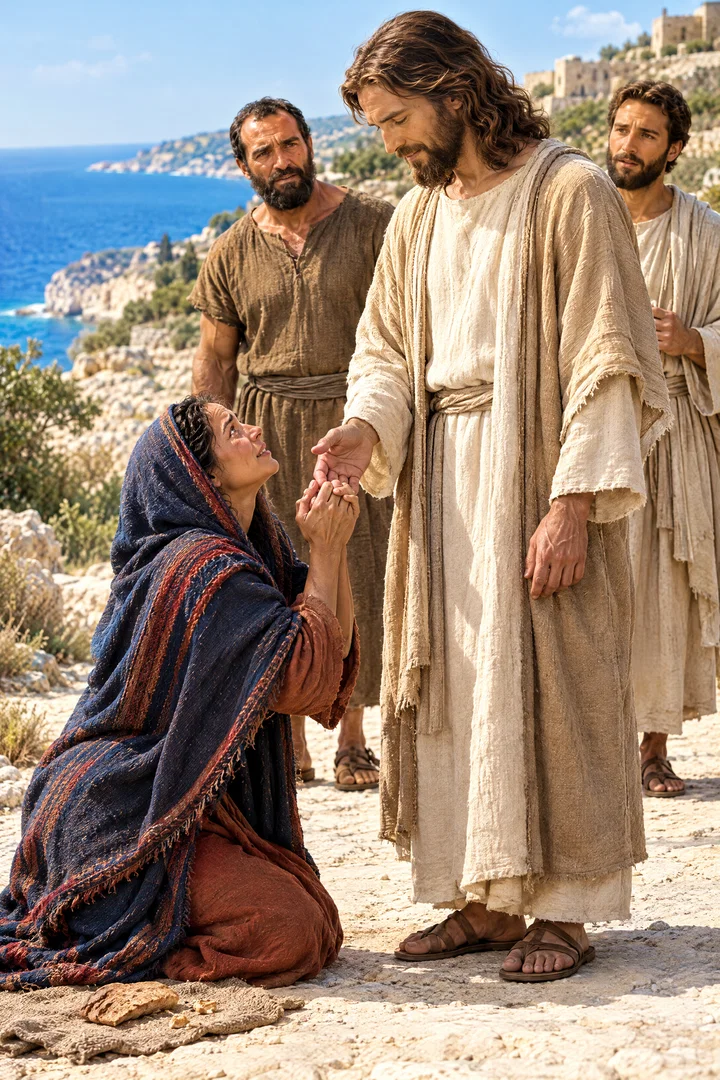
The woman who met Him was a Canaanite of a despised race, knowing the Jews had no dealings with Canaanites and would not even speak to them.DA 399.23RED 79.22SP 301.13RED 77.1 She had sought help from heathen gods without relief and was tempted to doubt what a Jewish teacher could do, yet moved by a mother's love and having heard of His miracles of mercy she resolutely determined to appeal to Him as her only hope.DA 399.22SP 301.13RED 77.1 She came without national or religious prejudice or pride, yielding to His influence, acknowledging Him as Redeemer able to do all she asked, accepting even the lowly place of one seeking crumbs, with implicit and perfect faith.3RED 79.23RED 77.1DA 401.1
For a time He acted out the exclusive ideas of His followers and the Pharisees toward the heathen, meeting her with apparent indifference, repulse and silence while she followed and continued pleading.Lt 28, 1909, par. 13–15ST May 28, 18963RED 78.1 The disciples thought He shared their prejudice and asked Him to send her away.3RED 78.1 His answer about being sent to the lost sheep of Israel outwardly matched that prejudice but implicitly rebuked them, since He had taught He came to save all who would accept Him.3RED 78.1 This delay exposed the cold treatment she would have received from the Jews and tested and displayed her faith, sincerity and persistent determination not to be driven away.ST May 28, 18962SP 302.1COL 175.2–3
Knowing her heart and sorrow, He looked on her woe with divine compassion and pitying tenderness.ST May 28, 1896 He commended her great faith as greater than He had found in Israel, and in pity and love granted her request and healed her daughter from that hour so the demon troubled her no more.3RED 79.2ST May 28, 1896COL 175.2–3 She departed acknowledging Him as Saviour and happy in answered prayer, and her trust refreshed His spirit.3RED 79.2DA 404.1–405.2 His great love for suffering people was shown in answering her earnest, humble supplication.Ms 7, 1873, par. 9
By this act of mercy toward one of a despised people He taught the disciples to leave Jewish exclusiveness, to treat people in distress with mercy, and to see that Gentiles also bore deep sorrows and hungered for truth and the light.3RED 80.12SP 304.22SP 302.1DA 402.1 He taught that Israel's privileges and promises were meant to make them a blessing to other nations rather than a reason for pride and separation.
The encounter broke down barriers and prepared them to work for others besides their own people and to act without His personal counsel after He left them.DA 3992SP 304.22SP 302.1DA 402.1 It led them beyond exclusiveness to direct ministry among the Gentiles without limits of custom, nationality, territory or social division.3RED 80.12SP 304.2AA 19.2–20.1 After His death broke down the partition between Jew and Gentile this lesson guided His representatives in carrying the message of His love to all nations as salvation also for Gentiles.3RED 80.1ST Jan 6, 1888AA 19.2–20.1
The account shows Him as moved by a mother's sorrow, compassionate toward mothers and suffering people, a great Medical Missionary whose whole life represented God and set an example of compassionate service to the whole world.DA 512.2Lt 227, 1905, par. 9–10MH 41.4–42.4Ms 50, 1897, par. 2 It teaches persevering prayer: He inspires persistent faith and rewards it.COL 175.2–3 No soul who asks in faith will be left to perish and even the weakest struggling soul may live, for when He comes into storm and darkness midnight becomes as bright as noonday, and faith recognizing Him rests implicitly on the promises because God is behind them, bringing peace, quietude, rest and grace to the needy soul.ST May 28, 1896
Sources
Pioneers and periodicals
53 sources
Then Jesus withdrew from confrontation with the Pharisees and left the vicinity of Galilee for the region of Tyre and Sidon in Phenicia toward the seacoast, the only time he went outside the land of the Jews, where he entered a house wanting to remain unknown.ST Jun 21, 1899ST Jun 21, 1899ST Jan 6, 1888ST Jun 7, 1905ST Jun 9, 1898 He sought rest where his work was less known and avoided needlessly provoking hostile opposition, yet his Spirit-led journey had the deliberate object of answering from afar the cry of a Gentile Syrophoenician mother grieving over a daughter vexed by an unclean spirit.ST Jan 6, 1888ST Jun 9, 1898RH May 4, 1911ST Jun 7, 1905 His crossing Jewish prejudice to help one despised as a Canaanite showed that human suffering mattered more than national barriers, that Israel's privileges were meant to bless other nations, and that the disciples must leave exclusiveness behind to carry mercy and the gospel to the Gentiles.ST Jan 6, 1888ST Jan 6, 1888ST Oct 29, 1896 He was at first silent to test her sincerity and call her faith into action, and when she persisted in worship without offense, owning she asked only for crumbs, he commended her great faith as greater than any he had found in Israel and healed her daughter from that hour.RH Dec 9, 1852RH Feb 25, 1873ST Nov 29, 1883RH Apr 10, 1866RH Aug 28, 1860 Her prevailing prayer shows that no soul who asks in faith will be left to perish, that delay is not denial but strengthens faith and makes the blessing more valued, and that anxious mothers today may pray humbly and persistently for demon-oppressed sons and daughters knowing he hears, sympathizes and will deliver.ST May 28, 1896ST Sep 2, 1875RH Aug 26, 1875ST Apr 4, 1900ST Jun 7, 1905
Journey Setting and Geography
Then Jesus withdrew from where he had confronted the Pharisees, leaving the vicinity of Galilee and Jerusalem and going into the coasts of Tyre and Sidon where he met the Syro-Phoenician or Canaanite woman who came to seek healing for her daughter.ST Jun 21, 1899ST Jun 21, 1899ST Jan 6, 1888RH Sep 28, 1916ST Jun 21, 1899 The departure marks the beginning of the account of the woman of Canaan, and its setting points to the geography of the country around Galilee and beyond.RH Sep 28, 1916
The destination lies north and west toward the seacoast near Tyre and Sidon, called the coasts of Canaan and identified as Phenicia.ST Jun 28, 1899ST Jun 21, 1899ST Jun 8, 1904 It had long been inhabited by a population partly heathen and partly Jewish, including Jews drawn there by commerce, and it is the parallel setting for the Gentile woman's encounter with Jesus.ST Jul 4, 1900ST Jun 21, 1899 After that encounter in Phenicia he left for the region toward the Sea of Galilee, where he met a heathen woman.ST Jun 28, 1899
In sequence this withdrawal came after about two months of continued work in Galilee following the death of John the Baptist, while opposition to his work kept increasing toward its culmination at the cross, and it is dated to A.D. 30.ST Jun 28, 1899ST Mar 17, 1898 From there the Canaanitish woman came out crying for mercy for her daughter grievously vexed with a devil, and her worship and persistence were met with testing and then with healing from that hour because of great faith.ST Mar 17, 1898 The same setting then leads to healings in Galilee and the feeding of the four thousand, after which he departed toward the Sea of Galilee where great multitudes brought the lame, blind, dumb, and maimed to be healed to the glory of the God of Israel.ST Mar 17, 1898ST Sep 12, 1911 The region is the same where Elijah did the work recorded in 1 Kings 17:8-24, giving occasion to dwell upon the object and mission of miracles.ST Mar 17, 1898
After nights and days full of praying, teaching, and many mighty works of healing in Galilee, he called his disciples and traveled forty to sixty miles with them toward the old cities of Tyre and Sidon with a deliberate object in mind.ST Jun 7, 1905ST Jun 7, 1905 On arriving he entered into a house wanting no man to know it, which perplexed the wondering disciples who questioned why he had brought them so far only to secrete himself.ST Jun 7, 1905ST Jun 7, 1905 Yet he could not be hid, for people sought him out for healing even while he was in hiding, since the fullness of God in him flowed out and reached hearts that were drawn to him.ST Jun 7, 1905RH May 11, 1911 The region offered a welcome and room for teaching, healing, and saving, in contrast with the opposition he had faced in Judea and the danger of going to Jerusalem.RH May 11, 1911
The journey is also described as a long, weary and tiring journey of many miles over the hills, reckoned at roughly 150 to 200 miles, which brought the healer she had heard about within reach of the home of the Syrophoenician woman who lived nearby with her afflicted daughter.ST Nov 21, 1911ST May 12, 1914RH Feb 26, 1914ST Apr 15, 1897 How long he stayed there is unknown, and that incident forced him to leave sooner than he had purposed.ST Sep 22, 1881 He did not return at once to Capernaum but set out northeastward through the territory of Sidon, across Lebanon and down the valley of the Upper Jordan by Caesarea Philippi to the country east of Jordan.ST Sep 22, 1881 His purpose in this wide circuit was to reach his old haunts without passing through Galilee, and this brought him to the territory of Decapolis.ST Sep 22, 1881
This marks the only time he went outside the land of the Jews.ST Jun 9, 1898 His Spirit-led journey had a purpose, for a Gentile woman there was ready to answer the gospel call and someone there was suffering and needed physical and spiritual help, showing that God knows every heart and can bring the good news to anyone even in the remotest place.ST Jun 9, 1898
Reasons for Withdrawing There
He withdrew after speaking plainly to opponents whose resentment could move them to act against him, refusing to meet opposition with a defiant spirit and choosing instead to avoid needlessly provoking hostility so as to preserve his opportunities to serve.RH May 4, 1911 He also sought the rest and quiet his human nature needed in a place where his work was less widely known than in Jerusalem or Galilee, though rest was not his only purpose in going there.
His Spirit-led journey had a deliberate object, for from afar he had heard the cry of a Gentile Syrophoenician mother bowed in grief over a daughter vexed by an unclean spirit, his heart felt her pain, and he came to answer her prayer, heal the child, and relieve the anxious heart of a woman from a people the Jews despised.ST Jun 7, 1905ST Sep 9, 1886 This was the only time he went outside the land of the Jews, and the only miracle he performed on that journey, undertaken because a Gentile woman there was ready to answer the gospel call and because someone there was suffering and needed physical and spiritual help.ST Jun 9, 1898 God knows every heart and can bring the good news to anyone in need, even in the remotest place.ST Jun 9, 1898
He came after days and nights full of praying, teaching, and healing, taking his disciples with him on a forty to sixty mile journey from Galilee, and on arriving he entered into a house and would have no man know it, yet he could not be hid, for the fullness of God in him flowed out and reached the mother's heart and drew her to him.ST Jun 7, 1905 His visit brought the healer she had heard about within reach of her home and afflicted daughter, having deliberately hidden himself from her even though he knew of her need and of the steadfast faith that would be revealed through their encounter.ST Nov 21, 1911 His work there both relieved a suffering woman and taught the disciples through an act of mercy to leave behind Jewish exclusiveness and serve beyond their own people, showing them that Gentiles also bore deep sorrows and longed for help and the light of truth, and thus preparing them to work for people beyond their Jewish community after his death broke down the barrier between Jews and Gentiles.ST Jan 6, 1888 The compassionate Redeemer watches mothers with love and sympathy, knows the burdens of every mother's heart, and is her best friend in every emergency, ready to hear prayers and render needed assistance, with his everlasting arms supporting the God-fearing, faithful mother; he sympathizes with every Christian mother in her cares and anxieties because when upon earth he had a mother who struggled with poverty with many anxious cares and perplexities, and as he heard and answered that anxious mother he will hear a mother's prayers and bless her children.ST Sep 9, 1886
Mercy Beyond Israel
Then Jesus went into the coasts of Tyre and Sidon to meet need among a despised people, receiving the plea of a poor Syrophoenician mother for her afflicted child in a way that set his compassion against the cold treatment she might have expected from the Jews.ST Jan 6, 1888ST Oct 29, 1896 His journey and help crossed Jewish prejudice against Gentiles, showing that human suffering mattered more than national traditions and barriers.ST Jan 6, 1888ST Oct 29, 1896 The encounter tested the woman's faith and sincerity and taught the disciples to show mercy to people in distress, even for the time when they could no longer seek his personal counsel.ST Jan 6, 1888
He went there to help the afflicted Gentile woman and by that act of mercy to teach his disciples to leave behind Jewish exclusiveness and serve others beyond their own people.ST Jan 6, 1888 It was the only miracle he performed on that journey, relieving a suffering woman from a people the Jews despised, and it prepared them to work for people beyond their own Jewish community and to carry the gospel without limits imposed by custom or nationality.ST Jan 6, 1888 After his death broke down the barrier and division between Jews and Gentiles, that lesson helped guide and direct their work among the Gentiles and mission to all peoples.ST Jan 6, 1888 Her conversion stands as an instance of his direct work among the Gentiles and of his effort to lead the Jews beyond their exclusiveness toward the coming work among the Gentiles.ST Apr 23, 1885ST Jun 12, 1879
The setting shows that Israel's privileges and God's promises were meant to make the Jews a blessing to other nations, not a reason for pride or separation. He brought his disciples there so they could see spiritual need among nearby people outside Judea, exposing how religious leaders with abundant opportunity to know Scripture could still fail to understand its purpose and neglect the people around them. The encounter showed them that Gentiles also bore deep sorrows and longed for help and the light of truth.
The woman from the region of Tyre was a pious Gentile who sought God and prayed before him, numbered among the women who received special favor from the Lord.ST Jun 21, 1883 Her faith and persistence in seeking mercy for her afflicted daughter, even with limited knowledge, provide evidence of his Messiahship and show God's purpose to extend mercy to the Gentiles, encouraging prayer and trust in his mercy.RH May 21, 1857 The journey was long and weary to Sidon to heal the demoniac daughter of a mother who was a stranger to Israel, and that journey and healing belong to the account of the same Jesus who is coming again.ST Apr 15, 1897 The region is the same where Elijah did the work recorded in 1 Kings 17:8-24, and the setting gives occasion to dwell upon the object and mission of miracles.ST Mar 17, 1898 His speaking with the Syro-Phoenician woman there shows he could converse with her, but it does not establish that he spoke Phoenician, and the claim that Irish might be a dialect of his language because of a supposed Phoenician connection is rejected.ST Mar 10, 1881
Faith Tested and Rewarded
At first he was silent and delayed answering in order to test faith and sincerity.RH Feb 25, 1873ST Nov 21, 1911ST Nov 21, 1911 That silence allowed perseverance and earnestness to become clear, while his apparent withdrawal drew her to seek him more earnestly.ST Nov 29, 1883ST Nov 21, 1911 The delay was not denial, for he knew what she could bear and used it to call faith into action, to strengthen his young disciples, and to avoid stirring Jewish prejudice.RH May 21, 1857 It also revealed that the disciples lacked his deep compassion for the suffering, and his apparent indifference tested a deep, unselfish faith that endured rebuff without complaint and was richly rewarded.ST Nov 29, 1883ST Nov 21, 1911ST Nov 21, 1911
Though a Gentile with no merit to claim, the Canaanite woman persisted in asking mercy for a daughter grievously afflicted by a devil, worshipping and enduring rebuff without complaint.RH Apr 10, 1866ST Nov 21, 1911 To his saying it is not meet to take the children's bread and cast it to dogs she answered with humility and quick fitness that dogs eat the crumbs from the master's table and that crumbs are all she asks.ST May 28, 1896RH Aug 28, 1860 She did not take offense or leave in anger, but held on in utter self-abasement that hates self as corrupt yet respects self as made to be immortal, kneeling in the dust while gazing on the skies.RH Aug 28, 1860RH Feb 18, 1858
He commended her great faith, declaring he had not found so great faith, no, not in Israel, and granted her request with healing from that hour.ST May 28, 1896RH Dec 9, 1852 The account shows he hears those who come in faith even when they feel unworthy and even with limited knowledge.RH Apr 10, 1866RH May 21, 1857 Her humility and faith led to her daughter's healing and earned her a lasting record, and the account warns against pride and taking offense when slighted.RH Aug 28, 1860 The visit to the region of Tyre thus marks a meeting with a woman of great faith.
Her case illustrates persevering, prevailing faith that holds to hope and continues in prayer despite apparent reasons to expect rejection or delay.ST Sep 2, 1875RH Aug 26, 1875ST Jan 21, 1913 Earnest pleading can keep him near and bring a response, and her courage and persistent faith when he seemed to hide his face was richly rewarded.ST Apr 4, 1900ST Nov 21, 1911 Delayed blessings can be more deeply valued, and affliction may be better borne for a time until its purpose is fulfilled.RH May 21, 1857 Believers are thereby encouraged to keep seeking and trusting through prolonged distress, confident that he hears and will answer.ST Nov 21, 1911
The story teaches how persistent, humble faith seeks help even when his response seems cold or delayed, as when seeking grace to overcome an evil temper.RH Jun 7, 1864 Prayer brings present help to resist it and assurance of further aid when needed, rather than a sudden, permanent removal of the struggle.RH Jun 7, 1864
The same need exists today with many sons and daughters demon-possessed in mind and body by unrestrained pleasure binding with cords soft as silk but strong as steel, by unreasoning temper and blind fitful passion, by ambition dethroning calm reason and best judgment and holding back from usefulness and God, and by the unclean demons of intemperance, profanity, obscenity and vice chaining myriads in the bonds of perdition.ST Jun 7, 1905 Anxious mothers must pray humbly, earnestly and persistently, minding neither the obstacles Satan interposes between them and the Master nor his seeming indifference, because he hears, loves, sympathizes and will deliver.ST Jun 7, 1905
The case is recorded to show the result of persevering in presenting needs to the Hearer of prayer: no soul who asks in faith for his help will be left to perish, and the weakest struggling soul may live and find hope and sufficiency in God.ST May 28, 1896 Faith recognizing him rests implicitly on the promises because God is behind them and brings peace, quietude and rest with grace imparted to the needy soul.ST May 28, 1896 When he comes into storm and darkness midnight is as bright as noonday.ST May 28, 1896
Pattern for Present Ministry
He went to the region of Tyre and Sidon to answer the spiritual longing and relieve the grief of one poor Syrophoenician woman outside his faith, leaving the crowds of Judea and Galilee for the coasts of Canaan to bring relief to one person seeking help.ST May 12, 1914ST Oct 1, 1896ST Jun 8, 1904 That journey of roughly 150 to 200 miles, long and tiring, shows personal care for an individual in need and gives individual ministry the same care as ministry to crowds.ST May 12, 1914ST Oct 1, 1896RH Feb 26, 1914 Ministry therefore includes making a long journey to go personally to people, not merely preaching sermons.RH Feb 26, 1914ST Jun 8, 1904
The departure into the coasts of Tyre and Sidon to relieve the anxious heart of a woman whose daughter was possessed by an evil spirit means the compassionate Redeemer watches mothers with love and sympathy, knows the burdens of every mother's heart, and is her best friend in every emergency.ST Dec 18, 1907ST Aug 20, 1902ST Sep 9, 1886 He is ready to hear prayers and render needed assistance, with his everlasting arms supporting the God-fearing, faithful mother.ST Sep 9, 1886 He sympathizes with every Christian mother in her cares and anxieties because when upon earth he had a mother who struggled with poverty with many anxious cares and perplexities.ST Sep 9, 1886 As he heard and answered that anxious Canaanite mother in distress, he will hear a mother's prayers and bless her children, and he remains the helper of mothers today.ST Dec 18, 1907ST Sep 9, 1886
His departing to the coasts of Tyre and Sidon to do good, traveling many miles away over the hills to a mother watching by the bedside of her dying child to comfort her heart by healing the sick one, means his stay on earth was not for pleasure and ease but was occupied in ministering freely and unselfishly of the things received from God. He hastened on from place to place to heal, refusing to stop to exalt self or to be praised and crowned, giving freely because he had freely received. He did his Father's will even foot-sore and weary with the cross and death before him, leaving an example to follow in his steps.
Her place among those he loved, as an outcast Canaanite and Syrophoenician woman met in the region of Tyre and Sidon, shows he looked for what was good in people across social and religious boundaries rather than focusing only on their faults.RH Jun 2, 1904RH Mar 24, 1910 His kindness displayed tender compassion across social and religious prejudice, without sharing the prejudices and hostilities around him.RH Jun 2, 1904RH Mar 24, 1910
Sources