Translations
American King James Version, King James Version, KJV Cambridge Paragraph Bible
And he looked up, and said, I see men as trees, walking.
And he looked up, and said, I see men as trees walking.
Revised Version, American Standard Version
And he looked up, and said, I see men; for I behold them as trees, walking.
and he, having looked up, said, 'I behold men, as I see trees, walking.'
And having looked up, he said, I behold men, for I see [ them], as trees, walking.
and, looking up, he was saying—I see men, because, like trees, I behold them walking
Berean Standard Bible, Majority Standard Bible
The man looked up and said, “ I can see the people, but they look like trees walking around.”
He looked up, and said, “ I see men, but I see them like walking trees.”
And looking up, he said, I see men; I see them like trees, walking.
And he looked vp, and said, I see men: for I see them walking like trees.
Douay-Rheims (Challoner revision)
And looking up, he said: I see men as it were trees, walking.
Pictures
Cross-references
- Luke 18:35-43
And it came to pass, that as he was come nigh unto Jericho, a certain blind man sat by the way side begging:
Jesus heals a blind man at Jericho, restoring his sight.
- Matthew 20:29-34
And as they departed from Jericho, a great multitude followed him.
Jesus heals blind men and restores their sight.
- John 9:6-7
When he had thus spoken, he spat on the ground, and made clay of the spittle, and he anointed the eyes of the blind man with the clay,
Both recount Jesus healing a blind man through physical means.
- Isaiah 42:7
To open the blind eyes, to bring out the prisoners from the prison, and them that sit in darkness out of the prison house.
Jesus’ healing of the blind man fulfills the words about opening blind eyes.
- Mark 8:18
Having eyes, see ye not? and having ears, hear ye not? and do ye not remember?
Physical sight contrasts with failure to perceive.
- Mark 7:32-35
And they bring unto him one that was deaf, and had an impediment in his speech; and they beseech him to put his hand upon him.
Another account of Jesus healing a man through a gradual, personal act.
- Acts 9:18
And immediately there fell from his eyes as it had been scales: and he received sight forthwith, and arose, and was baptized.
Scales fall as sight begins.
- 1 Corinthians 13:12
For now we see through a glass, darkly; but then face to face: now I know in part; but then shall I know even as also I am known.
The passage echoes its image of seeing dimly.
Commentary
Each commentary is drawn from primary sources: the writings of Ellen G. White and Adventist pioneers and periodicals. Each commentary is separate. Its own words are not a quotation; follow the references to read the source passages.
Ellen G. White
27 sources
The verse records the middle stage of a two-touch healing, when after the first touch the man saw people only indistinctly and after the second touch he saw clearly.Ms 29, 1896, par. 2 It means spiritual eyesight that can see but does not yet perceive clearly, too dim to discern spiritual things.STBk 119.1Ms 40, 1890, par. 107–108Ms 16, 1890, par. 45–46 So it was with the disciples, who saw only blurred shapes and could not comprehend that Christ must suffer humiliation and death rather than take an earthly throne.DA 417.3 Those in this condition need Christ's divine touch and the Holy Spirit's work so they can see as God sees and work as Christ worked.LSEGW 327.1STA 119.1Ms 61, 1890, par. 33 Because sight that has been blind does not return all at once, this partial, unfinished sight calls for wise, patient labor and very careful presentation of truth.RH Jun 13, 1912RH Feb 14, 1907
Partial Sight Restored Gradually
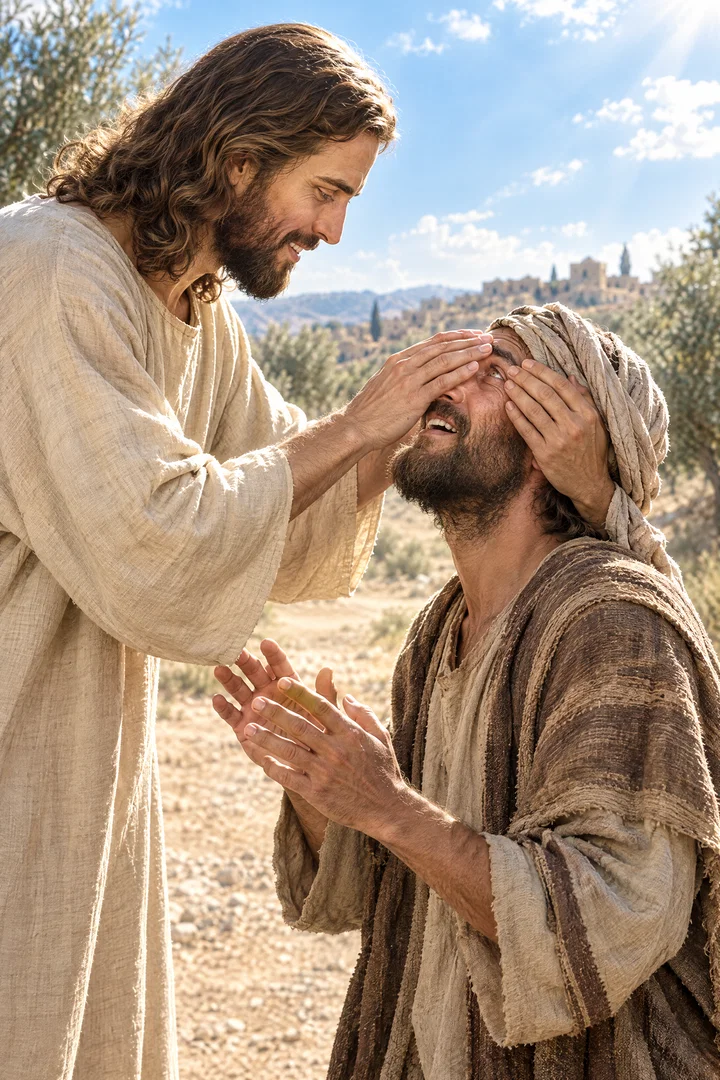
The healing unfolded in two touches, for after the first touch sight was only partly restored so that people appeared indistinctly, like trees walking, and only after Christ touched the eyes again did the man see clearly.Ms 29, 1896, par. 2 This pictures those shut in by unbelief who walk in spiritual darkness, stumbling without recognizing where they stumble, and who refuse the light because they fear it will reprove them.Ms 29, 1896, par. 2 Eyes that have been blind do not at once see everything clearly, so this indistinct seeing marks the point when scales are beginning to fall and truth is seen only dimly and in unfinished form, still needing further light.RH Jun 13, 1912RH Feb 14, 1907 Such partial sight calls for wise and patient labor, and for very careful work in presenting truth so as not to arouse prejudice and close the door of the heart.RH Jun 13, 1912RH Feb 14, 1907
The disciples themselves saw only dimly, as blurred shapes, and did not comprehend Christ.DA 417.3 With eyes fixed on the nearer view of earthly life in poverty, humiliation, and suffering, they clung to glowing expectations of an earthly kingdom with their Lord exalted to David's throne.DA 417.3 It seemed incomprehensible to them that the Son of God should live as a humble homeless wanderer, be despised and rejected, voluntarily go to Jerusalem to suffer cruel humiliation and be put to death, leaving them in greater darkness than that in which they groped before He revealed Himself to them, and sadness oppressed their loving hearts while doubt harassed their minds at how He could resign Himself to such a fate.DA 417.3 Beyond present poverty and humiliation He pointed them to His coming not with the splendor of an earthly throne but in the glory of God with the heavenly hosts to reward every person according to his works, promising that some standing there would not taste death till they see the Son of man coming in His kingdom, though that glory seemed far away.DA 417.3
The same blurred, indistinct sight describes the Jewish teachers and educated men who were thought to know more than all others yet erred, not knowing the Scriptures nor the power of God.Ms 5, 1889, par. 6–7 Human traditions teaching the commandments of men had placed in false settings the lessons Christ had given to the prophets, and because they were not connected with the God of all truth their view of truth was not distinct.Ms 5, 1889, par. 6–7 Christ, as origin and foundation of all truth and representative of the Father, came to strip off those traditions and set truth in its true setting.Ms 5, 1889, par. 6–7 Jesus wants people to see spiritual things clearly rather than with blurred or distorted sight, for failing to distinguish truth from error leaves diseased moral sight that mistakes error for light and realities for phantoms.Ms 16, 1890, par. 45–46
Dim Discernment Needing Divine Touch
The verse means spiritual eyesight that can see but does not yet perceive clearly, too dim to discern spiritual things.STBk 119.1Ms 40, 1890, par. 107–108 After much labor a person may begin to recover sight and perceive the wrong in his conduct, as Lawrence had begun to do.Lt 57, 1897, par. 6–10 He sees some things, as Brother Lawrence did, but needs to see many matters in a different light.Lt 112, 1897, par. 4
When a person no longer sees in this indistinct, confused way, he has become converted and can give a clear message.Lt 14a, 1889, par. 3–611MR 235.2–236.4 Before his eyes were opened he had not grasped clearly that he must rely on Christ's righteousness, and clear sight means recognizing that reliance or being lost.7MR 249.1–2Lt 1, 1889, par. 10–12 The same indistinct sight describes partial understanding in those who grasp and promote some truth while also presenting ideas that contradict it.4MR 148.1–2 Seeing in this confused or mistaken way includes misreading the relation between God's law and Christ's righteousness, which distorts the truth, for God's law can be rightly upheld only by taking hold of Christ's righteousness.Ms 5, 1889, par. 35–36
The verse describes a paralyzed state of spiritual sight in which a person at best sees only dimly and cannot sense how God regards his conduct.Lt 61, 1880, par. 11 Applied to stubborn rejection of a faithful mother's counsel through indifference, inattention and disrespect that caused her tears and heartbreaking prayers, it leaves the person needing earnest prayer to be shown his true past and present state.Lt 61, 1880, par. 11 The same confused spiritual vision marked those discussing the dress question, who had become so confused they could see people only indistinctly.1T 462.1–464.1 Spiritual eyesight becomes defective and clouded, failing to perceive people and matters clearly, especially when people are charmed by flattering and destructive theories.Lt 265, 1903, par. 6–711MR 248.3–4 Those captivated cannot recognize where the theories lead or that their vision is defective, and they need the Holy Spirit to see things as they are.Lt 265, 1903, par. 6–711MR 248.3–4
Those who see like this have incomplete discernment and need a deeper experience to recognize the deceiver's snares, as applied to members of the Adelaide church who lacked that deeper experience.Ms 185, 1897, par. 12Lt 1, 1897, par. 12 People in this condition need Christ's divine touch and the Holy Spirit's work so they can see as God sees and work as Christ worked.STBk 119.1LSEGW 327.1STA 119.1Ms 61, 1890, par. 33Lt 92, 1891, par. 8 With that sight God's people can recognize danger and warn others clearly.LSEGW 327.1 Without that discernment people frame plans after the order of the world through Satanic agency.ST2 10.2STA 119.1Ms 61, 1890, par. 33 When united in the unity for which Christ prayed the controversy ends, and with clear sight Zion's watchmen discern the coming sword and the people's danger and sound the trumpet in clearer, louder notes.ST2 10.2
Sources
Pioneers and periodicals
27 sources
After the first touch upon his eyes the blind man saw only partly, perceiving people indistinctly as trees walking, and after the second touch he saw clearly, his healing being completed in stages.ST Jun 28, 1899ST Sep 29, 1881ST Jun 28, 1899 Jesus led him apart from the crowd not from necessity, but to meet weak faith, varying His method with the individual rather than always giving instant and complete healing.ST Nov 29, 1910 It pictures sin-blinded souls who cry to Christ and are led toward light, yet who have only begun to receive help and still see truth dimly, needing His finishing touch for full salvation and complete sanctification.ST Apr 25, 1878RH Sep 22, 1868RH Nov 18, 1858ST Aug 19, 1875 One who has felt that first touch remains in partial darkness with partial knowledge and trust in works, but by waiting in faith for the Master's second touch he is made whole, set free from works, and given power to go in peace and sin no more.RH Jun 24, 1915
Healing and Setting
When Jesus first laid his hands upon the blind man's eyes his sight came back only in part, so that he could distinguish human figures but only indistinctly, as trees in motion.ST Jun 28, 1899ST Sep 29, 1881ST Jun 28, 1899RH Feb 24, 1916 A further laying on of hands was required, and after Jesus touched his eyes a second time the man saw distinctly and the cure was finished by successive stages.ST Jun 28, 1899ST Sep 29, 1881ST Jun 28, 1899RH Feb 24, 1916
The cure was wrought at Bethsaida, described also as near Bethsaida, and it stands as a miracle preserved by Mark alone.RH Nov 30, 1916ST Mar 8, 1905ST Mar 30, 1904 The man thus healed is reckoned as one of seven blind persons whose healings by Jesus receive special notice.ST Mar 8, 1905 He is not the man born blind who was healed at Jerusalem.ST Mar 8, 1905
The division of the chapters falls sharply and abruptly across this narrative, so reading is not to halt with the close of the chapter but to continue by the paragraph to the close of the incident and its line of thought.ST Oct 13, 1898
The verse falls within Mark 6 to 13, with Mark 8 to be read together with Ecclesiastes 8 and 9 and to be compared with the parallel accounts in the other Gospels.ST Jul 29, 1908 It brings a lesson of life from Christ to be taken home to the heart, that He is as ready now to pardon the sinful, to heal and restore the sick, and to comfort the troubled as He was toward those who came to Him in person.ST Jul 29, 1908 The miracles put on record are only a small portion of those He performed, and they were written to bring comfort to every class of people on earth, for although written by Hebrews the Bible is not for Hebrews only but for all beyond the Hebrew tribes, since God is the God of all who will seek Him.ST Jul 29, 1908
Jesus led this blind man out of the crowd and apart before healing him, not because separation was necessary to His power, for He had shown power to restore one sick unto death even from a distance.ST Nov 29, 1910 He did so to meet weakness of faith, for God never deals in precisely the same way with different persons.ST Nov 29, 1910 Though able and willing to grant instant and complete victory over every habit, He varies His method where full faith to lay hold of His healing power is wanting.ST Nov 29, 1910
Spiritual Sight Applied
The verse pictures the giving of sight to those blinded by sin, who are to cry out for help and be led onward toward the light of God until the blindness is fully removed.ST Apr 25, 1878 It describes an incomplete spiritual condition in which light and help have begun to be received but truth is still seen only dimly, and a finishing touch is needed for full salvation and complete sanctification.RH Sep 22, 1868RH Nov 18, 1858 Partial sight of this kind can leave a person bewildered by the light, since clear understanding requires more than seeing truth in part.ST Aug 19, 1875
It shows the state of one who has felt the healing touch once yet still sees dimly, with only partial knowledge of the gospel and partial experience of its power.RH Jun 24, 1915 Such a one remains in partial darkness, with despondency and the idea of overcoming and meriting grace by works and good deeds, but by waiting in faith for the second touch will be made whole, set free from trust in works, and given power to go in peace and sin no more.RH Jun 24, 1915 It is applied to the need for clearer vision to see others as Christ sees them rather than fastening on their faults, recognizing in every person one for whom Christ died.RH Jul 16, 1914 That vision leads to refusing to judge others and to placing no stumbling block in the way of even the weakest.RH Jul 16, 1914 The partial sight illustrates the difference between seeing outward appearances and seeing realities, for some with normal eyesight see without truly perceiving, and trees are a lower type of human life, lacking human will and the power to move about.RH Mar 18, 1902
It illustrates seeing the providences of God and the means used for the salvation of souls only partly clearly, so that further help from the Master is needed to see them as they are and to witness faithfully and effectively.RH Mar 28, 1907 It illustrates an early, incomplete perception of truth that sees indistinctly and could be misdirected, while as understanding advances the way becomes clearer and connected truths confirm what was first seen.RH Jul 16, 1872 It shows that the reformers who brought the light of the gospel in the Dark Ages at first saw truth only imperfectly and could make mistakes, gaining clearer understanding as their eyes were opened, though their conduct did not always withstand the test of greater light.ST May 24, 1899 The same is taught of those who received the light of the Reformation, who did not yet fully understand or escape the corrupting influences of the old order.ST Jul 18, 1900 As the blind man saw people indistinctly before full restoration, so leaders grasped only dimly the explanation of the disappointment and the organization needed for the work that followed.RH Feb 7, 1907
It illustrates unclear, incomplete perception in learning, where pupils who have not grasped a lesson clearly see its facts in confusion, with principal points not firmly understood and minor points not properly connected to them.RH Oct 3, 1907 It means prejudiced, blurred eyes that do not yet perceive things as they really are, applied to those who do not yet see the liquor curse that destroys homes, takes lives, and costs money.RH May 14, 1914 Such dim sight can be opened and made clear by pictures, cartoons, stories, and arrays of facts until the drink evil is beheld just as it is, and that education becomes the basis for legislation to abolish the liquor traffic.RH May 14, 1914 It describes believers whose eyes have been opened yet see dimly, defectively, nearsightedly and shortsightedly, unable to see afar off and needing further purging.RH Apr 14, 1874 God has no pleasure in dimness and the objects themselves are vivid, and the hindrance is the dimness of the eye in this present evil world.RH Apr 14, 1874
It means seeing only part of truth and realizing even that imperfectly, so that the gospel is but half a gospel, the cross is not full of peace and light, the way of life is only partially known, the coming glory has only feeble radiance, the advent has little value, and Christ has little excellence and is poorly appreciated.RH Apr 14, 1874 Those so afflicted lose much all their lifetime, for faith becomes only the shadow and not the substance of things hoped for, hope a vague expectation with little certainty or brightness, and life has more cloud than sunshine.RH Apr 14, 1874 It shows that sight may return gradually, since eyes that have been blind do not at once see everything clearly, marking the point when scales are beginning to fall and men see only dimly with partial, unfinished sight of truth.RH Jun 13, 1912RH Feb 14, 1907 It therefore illustrates the need to labor wisely and patiently with those learning truth and to work very carefully so that truth is not presented in a way that arouses prejudice and closes the heart.RH Jun 13, 1912RH Feb 14, 1907
Sources