Translations
And he asked the scribes, What question you with them?
King James Version, KJV Cambridge Paragraph Bible, Webster Bible
And he asked the scribes, What question ye with them?
Revised Version, American Standard Version
And he asked them, What question ye with them?
And he questioned the scribes, 'What dispute ye with them?'
And he asked them, What do ye question with them about?
And he questioned them—What are ye discussing with them?
“ What are you disputing with them?” He asked.
“ What are you disputing with them?” He asked the scribes.
He asked the scribes, “ What are you asking them?”
And he said, What are you questioning them about?
Then hee asked the Scribes, What dispute you among your selues?
Douay-Rheims (Challoner revision)
And he asked them: What do you question about among you?
Pictures
Cross-references
- Matthew 17:14-18
And when they were come to the multitude, there came to him a certain man, kneeling down to him, and saying,
Jesus heals the afflicted boy after the disciples fail to cure him.
- Luke 9:37-42
And it came to pass, that on the next day, when they were come down from the hill, much people met him.
Parallel account of the afflicted boy, the failed exorcism, and Jesus’ healing.
- Matthew 17:19-20
Then came the disciples to Jesus apart, and said, Why could not we cast him out?
The disciples ask about their failure, which Jesus attributes to unbelief.
- Matthew 17:1-9
And after six days Jesus taketh Peter, James, and John his brother, and bringeth them up into an high mountain apart,
parallel account of same event
- Mark 9:25-27
When Jesus saw that the people came running together, he rebuked the foul spirit, saying unto him, Thou dumb and deaf spirit, I charge thee, come out of him, and enter no more into him.
Jesus casts out the spirit and heals the boy.
Commentary
Each commentary is drawn from primary sources: the writings of Ellen G. White and Adventist pioneers and periodicals. Each commentary is separate. Its own words are not a quotation; follow the references to read the source passages.
Ellen G. White
8 sources
The setting is the morning after the night on the mount of transfiguration, as Jesus descends with His three companions to the plain where the people are already searching for Him.DA 426.1–2 Just before this He charges the three to tell the vision to no one until the Son of man is risen from the dead, because the revelation is to be pondered in their own hearts and not published where it would excite only ridicule or idle wonder, and even the nine apostles would not understand the scene until after the resurrection.DA 426.1–2 Even the three favored disciples are slow of comprehension, questioning among themselves what the rising from the dead should mean yet asking Jesus no explanation, because His words about the future have filled them with sorrow they do not want to face.DA 426.1–2
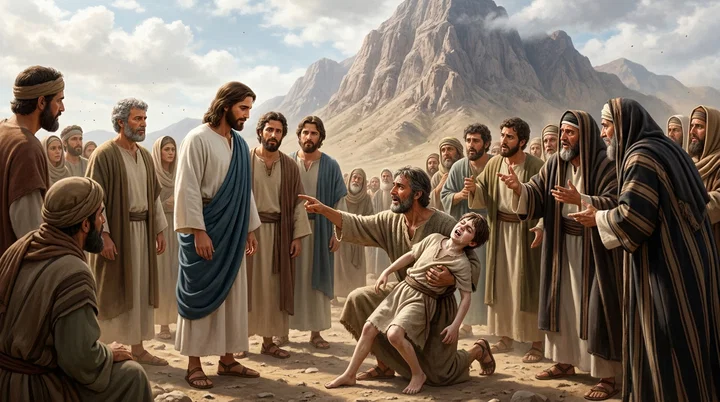
On arriving He finds the scene of the disciples' failed attempt to cast out the evil spirit or demon from the boy, with the scribes disputing and questioning with the disciples.DA 426.3–427.23RED 122.2–3DA 427.3–6 The scribes had been using that failure to humiliate the disciples and to challenge Jesus.DA 426.3–427.23RED 122.2–3 In the verse He asks the scribes what they were disputing with the disciples, thereby drawing attention to their challenge and bringing the dispute into the open.DA 426.3–427.23RED 124.23RED 122.2–3DA 427.3–6 When He arrives their bold voices fall silent.DA 427.3–6 The question comes before He addresses the father and the afflicted child.3RED 122.2–3
In this encounter after coming down from the mountain He meets the demon-afflicted boy or child and restores him to his father, freeing him from the demon's power.3RED 125.2DA 429.2–430.13RED 124.2 The boy's restoration is an object lesson of redemption, showing Christ stooping from glory to save the lost.DA 429.2–430.1 The movement from transfiguration on the mount to the plain shows people enslaved by Satan needing deliverance through faith and prayer.ST Jan 22, 1902 After Jesus delivers the boy, the scribes are crestfallen and defeated and turn away sullenly.3RED 124.2
Sources
Pioneers and periodicals
15 sources
Coming down from the mount of transfiguration with Peter, James and John, Jesus finds a great crowd gathered around the other disciples and asks the scribes what they are disputing with them.ST Aug 16, 1905ST Jul 21, 1914RH Jan 4, 1912 The dispute has arisen because the nine left below have failed to cast a demon out of an afflicted boy, and the scribes have seized on that failure to challenge their power while the crowd is left perplexed.ST Aug 16, 1905ST Jul 21, 1914ST Oct 6, 1881 The question stands at the contrast between rejoicing on the mountain in the Teacher's presence and the plain below, where a needy, suffering, demon-haunted multitude waits for those who come down to serve them.ST Jan 22, 1902ST Jun 13, 1900ST Dec 17, 1896RH Jan 4, 1912ST May 8, 1901 The failure came despite authority already given over demons and disease, and revealed divided hearts with eyes not on Jesus only, little faith and courage, neglect of prayer and watchfulness, and ambition and jealousy.RH Nov 30, 1911ST Apr 17, 1901 It warns that while the Master is away his followers are to bring light and relief to those in need but can fail in that work, and teaches them to examine the causes of spiritual failure and seek victory through faith and prayer, since deliverance comes that way and God gives success.ST Aug 16, 1905RH Nov 30, 1911RH Sep 25, 1913RH Apr 9, 1914
Setting After Transfiguration
Jesus put the question to the scribes as He came down from the mount of transfiguration with Peter, James and John and found the disciples surrounded by a great crowd.ST Aug 16, 1905ST Jul 21, 1914RH Jan 4, 1912 The vision of the kingdom of heaven on the mountain did not end earthly need, and He and the three met below suffering and demon possession with work awaiting them.RH Jan 4, 1912 The dispute He asked about had arisen because the nine left below had failed to cast a demon out of a boy.ST Aug 16, 1905ST Jul 21, 1914ST Apr 17, 1901 The scribes had seized on that failure to challenge the disciples' power to work miracles, leaving the crowd perplexed.ST Oct 6, 1881 His question led to the father's account of his son's severe affliction.ST Aug 16, 1905
The verse belongs to the section recording the transfiguration and the events immediately following it, parallel to Matthew 17:1-9 and Luke 9:28-42.ST Mar 31, 1898 That section comes six days after the promise that there be some standing there which shall not taste of death till they see the Son of man coming in His kingdom, and shows the fulfilment of that promise.ST Mar 31, 1898 Peter makes direct reference to the transfiguration part of this section in 2 Peter 1:16-18.ST Mar 31, 1898 The mountain of the transfiguration is thought by some to have been Mount Hermon, while tradition dating from before the fourth century places it on Mount Tabor in Galilee.ST Mar 31, 1898
The verse stands in Mark 6-13, to be compared with the parallel stories in the other Gospels and taken home to the heart as a lesson of life from Christ.ST Jul 29, 1908 It shows that He is just as willing to forgive the sinful, to heal and restore the sick, and to comfort the troubled as when people came directly to Him.ST Jul 29, 1908 The miracles recorded there are only a small part of those He wrought, and they are recorded to give comfort to every class of people on earth.ST Jul 29, 1908 Though the entire Bible was written by Hebrews it is not for the Hebrew people alone but for all outside the Hebrew tribes, and God is the God of all who will seek Him.ST Jul 29, 1908
Failure, Faith and Service
The question stands at the contrast between rejoicing on the mountain while listening to the Teacher's voice and even the accents of immortals, and the plain below in the valley where demon-tortured brothers wait for those who come down to serve them.ST Dec 17, 1896ST May 8, 1901 It belongs to the moment after the transfiguration when Jesus meets the needy, demon-haunted multitude in the valley.ST Dec 17, 1896ST May 8, 1901 There on the plain are people enslaved by Satan who need deliverance through faith and prayer.ST Jan 22, 1902
The vision of heaven's kingdom does not end earthly needs, and Christ and his disciples must come down to meet those needs and do the work awaiting them amid suffering and demon possession.RH Jan 4, 1912 Those who have been with Christ on the mount can cast out evil spirits below.ST Jun 13, 1900RH Jan 4, 1912
Jesus finds the disciples perplexed and humbled, with a multitude gathered around them and a father seeking healing for his son.ST Aug 16, 1905 Their inability to help warns the church that while its Master is away it is to represent him by bringing light and relief to those in need, but it can fail in that work.ST Aug 16, 1905
The failure came despite previous success and despite received authority over demons and diseases.RH Nov 30, 1911 It came from little faith, lack of courage and trust in Christ's power, neglect of prayer and watchfulness, and ambition and jealousy.RH Nov 30, 1911 It revealed a divided mind and heart whose eyes were not on Jesus only but divided or turned away.ST Apr 17, 1901 Peter, James, and John, though not perfect men, were taken up because they were the most earnest of the disciples, the nearest to God, and better prepared to appreciate what they would see.ST Apr 17, 1901
The disciples sometimes failed in their work, then went privately to Jesus to learn why they had failed and were instructed, and their next attempt succeeded.RH Nov 30, 1911RH Sep 25, 1913 The lesson is to examine the causes of spiritual failure and seek victory through faith, prayer, and a right spirit.RH Nov 30, 1911 Deliverance for those enslaved by Satan comes through faith and prayer.ST Jan 22, 1902 The rescue of the young man from the enemy's power shows that young people need earnest spiritual care, that some can be saved only through prayer and fasting, and that God gives success.ST Jan 22, 1902RH Apr 9, 1914
Sources