Mark 9:26
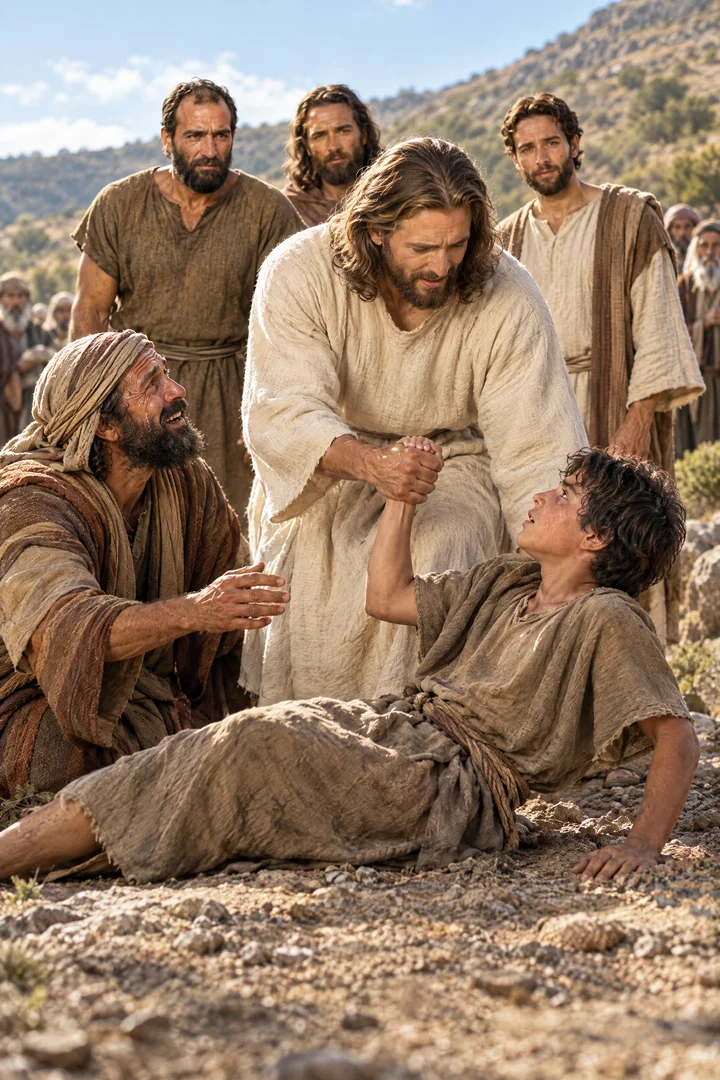
And the spirit cried, and rent him sore, and came out of him: and he was as one dead; insomuch that many said, He is dead.
Translations
And the spirit cried, and rent him sore, and came out of him: and he was as one dead; so that many said, He is dead.
King James Version, KJV Cambridge Paragraph Bible
And the spirit cried, and rent him sore, and came out of him: and he was as one dead; insomuch that many said, He is dead.
And the spirit cried, and rent him severely, and came out of him: and he was as one dead; so that many said, He is dead.
And having cried out, and torn him much, he came out: and the child became as one dead; insomuch that the more part said, He is dead.
And having cried out, and torn him much, he came out: and the boy became as one dead; insomuch that the more part said, He is dead.
and having cried, and rent him much, it came forth, and he became as dead, so that many said that he was dead,
And having cried out and torn [ him] much, he came out; and he became as if dead, so that the most said, He is dead.
And, crying out, and greatly mangling him, it came forth; and he became as if dead, so that, the more part, were saying—He is dead!
Berean Standard Bible, Majority Standard Bible
After shrieking and convulsing him violently, the spirit came out. The boy became like a corpse, so that many said, “ He is dead.”
After crying out and convulsing him greatly, it came out of him. The boy became like one dead, so much that most of them said, “ He is dead.”
And after crying out and shaking him violently, it came out: and the child became like one dead; so that most of them said, He is dead.
Then the spirit cried, and rent him sore, and came out, and he was as one dead, in so much that many said, He is dead.
Douay-Rheims (Challoner revision)
And crying out, and greatly tearing him, he went out of him, and he became as dead, so that many said: He is dead.
Pictures
Cross-references
- Matthew 17:14-18
And when they were come to the multitude, there came to him a certain man, kneeling down to him, and saying,
Jesus rebukes the spirit and heals the afflicted boy.
- Luke 9:37-42
And it came to pass, that on the next day, when they were come down from the hill, much people met him.
Jesus rebukes the spirit and heals the boy after the disciples fail to cast it out.
- Luke 4:35
And Jesus rebuked him, saying, Hold thy peace, and come out of him. And when the devil had thrown him in the midst, he came out of him, and hurt him not.
Jesus commands an unclean spirit to leave a man.
- Matthew 12:22
Then was brought unto him one possessed with a devil, blind, and dumb: and he healed him, insomuch that the blind and dumb both spake and saw.
Jesus heals a man who was demon-possessed, blind, and mute.
- Mark 1:26
And when the unclean spirit had torn him, and cried with a loud voice, he came out of him.
Both describe a demon leaving after crying out and violently tearing its victim.
- Matthew 17:19-20
Then came the disciples to Jesus apart, and said, Why could not we cast him out?
The disciples’ failure to cast out the spirit is linked to their unbelief.
Commentary
Each commentary is drawn from primary sources: the writings of Ellen G. White and Adventist pioneers and periodicals. Each commentary is separate. Its own words are not a quotation; follow the references to read the source passages.
Ellen G. White
14 sources
When commanded in Christ's name to leave, the torturing demon cries out and tears its victim with a violent final attack before coming out, leaving the boy motionless and unconscious as one dead so that many onlookers think he has died.4SP 334.1GC88 515.2GC 515.2DA 426.3–427.2ST Jan 20, 1904 Jesus then stoops to take him by the hand and lift him up, restoring him completely in mind and body and forever free and returning him to his father.ST Jan 20, 19043RED 123.1–124.1ST Jun 7, 1877 The scene lays bare both the destructive cruelty of evil spirits and Christ's supreme authority to command them and set the sufferer free.4SP 334.1GC88 515.2GC 515.2 It stands as an object lesson of redemption, the divine Son descending from glory to rescue one enslaved by Satan in terrible agony.2SP 336.1DA 429.2–430.1 It also pictures the work appointed to His followers in freeing others through faith and prayer, a deliverance that brings joy to the rescued and praise to their Deliverer while confounding unbelief.DA 429.2–430.13RED 124.2ST Jan 22, 1902
Setting and Violent Deliverance
The scene lies at the foot of the mountain while Jesus is above in night communion with heavenly glory with three companions, talking with messengers from heaven and proclaimed the Son of God by the Father's voice out of radiant glory.DA 426.3–427.22SP 336.1 The demon-possessed boy has been brought by his father to the disciples below, and Jesus descends in the morning light of glory to meet in sharp contrast grief and suffering no mortal could relieve.DA 426.3–427.22SP 336.1ST Jan 22, 1902 The boy is enslaved by Satan, pointing to those who need faith and prayer to be set free.ST Jan 22, 1902
The nine disciples attempt to command the spirit on the basis of authority over unclean spirits to cast them out conferred when Jesus sent out the twelve to preach through Galilee, an authority that had obeyed their word when they went forth strong in faith.DA 426.3–427.2 Their failure now mocks them and brings bitter disappointment and humiliation and dishonor upon the disciples and their Master.DA 426.3–427.2 It gives scribes occasion to press them with questions to prove them and Christ deceivers, triumphantly declaring an evil spirit that neither the disciples nor Christ Himself could conquer, inclining the people to contempt and scorn and leaving the multitude in great perplexity.DA 426.3–427.2
The possessing spirit is a dumb, unclean spirit, an intelligent evil being and torturing, cruel demon.4SP 334.1DA 426.3–427.23RED 124.2 The boy is Satan's victim, enslaved by Satan in terrible agony with distorted countenance and teeth gnashing in spasms of agony, wallowing on the ground.DA 426.3–427.22SP 336.13RED 125.2 The spirit tears its victim and displays fresh power when commanded in the name of Christ to leave.DA 426.3–427.2
As commanded to leave, the spirit cries out and convulses and rends the boy sore with violent final attack, then comes out.GC 515.2ST Jan 20, 19042SP 335.1 The departure leaves him motionless, powerless and unconscious, as one dead and apparently lifeless, so severely affected that many bystanders and the crowd think he has died.GC 515.2ST Jan 20, 19043RED 123.1–124.1ST Jun 7, 18772SP 335.1 The episode shows the demon's destructive power and the youth's severe condition.GC88 515.2GC 515.2
Jesus then stoops to lift the child from the ground, taking him by the hand and raising him up.ST Jan 20, 19043RED 123.1–124.1ST Jun 7, 18772SP 336.13RED 125.2 He restores him completely in mind and body, completely and forever freed from the demon's power, and restores him to his father.ST Jan 20, 1904DA 428.1–52SP 336.13RED 125.2
Power and Redemptive Meaning
The violent cry and tearing at the departure lay bare the destructive power of evil spirits and the severity of the youth's condition under a dumb spirit.GC88 515.2GC 515.2 That dumb spirit is an intelligent evil being, and the healing is accomplished when Jesus commands it to leave.4SP 334.1 His authoritative command frees the sufferer and casts the demon out, so the account stands as an instance of His power to heal the demon-afflicted.4SP 334.1GC 515.2
The deliverance is an object lesson of redemption, in which the divine Son stoops from glory to save one enslaved by Satan.DA 429.2–430.1 He has just come down from the glory of the transfiguration, where He talked with messengers from heaven and was proclaimed the Son of God by the Father's voice out of radiant glory, to meet in sharp contrast the grief below of a demon-possessed boy in suffering no mortal could relieve.2SP 336.1 There Satan's victim lies wallowing on the ground with distorted countenance and teeth gnashing in spasms of agony.2SP 336.1 After a violent final convulsion the spirit leaves him so still and apparently lifeless that many think he is dead, and then the mighty Redeemer stoops to lift the child from the ground by the hand, restoring him to his father completely in mind and body and forever freed from the demon's power.2SP 336.1DA 429.2–430.1 That same lifting represents the disciples' work of freeing people through faith and prayer, and the scene of the boy brought down from the mount points to those who still need faith and prayer to be set free.DA 429.2–430.1ST Jan 22, 1902
His freedom brings joy to him and his father, who praise their Deliverer, while the astonished people look on and the defeated scribes turn away.3RED 124.2
Sources
Pioneers and periodicals
29 sources
Mark 9:26 describes the deliverance of the epileptic boy possessed by an evil, dumb spirit, brought by his pleading father to Jesus at the base of the mountain after the transfiguration because the disciples had failed to cast it out.ST Aug 16, 1905ST Jul 12, 1899ST Jun 13, 1900 At the command of Jesus the spirit gave a loud cry and tore the boy with a severe convulsion in a last violent effort to destroy him, and then came out of him.ST Jan 20, 1904ST Jul 21, 1914ST Mar 29, 1899 The departure left him exhausted, powerless and motionless as one dead, so that many onlookers said he was dead, yet that seeming death followed his deliverance and not any victory of the spirit.ST Jul 21, 1914RH Oct 30, 1860ST Jul 12, 1899 Jesus then took him by the hand and lifted him up and restored him completely, showing the power of God to deliver from the enemy.ST Jan 20, 1904ST Jul 12, 1899ST Oct 6, 1881 The disciples had failed through unbelief and little faith, from lack of trust in the power of Christ and from neglecting watchfulness and genuine prayer and fasting, since this kind goes out only by prayer.ST Jul 18, 1900RH Nov 30, 1911RH Apr 9, 1914 Those who have been with Christ on the mount are therefore to come down to meet suffering and evil in the valley, and the enslaved boy points to souls who still need faith and prayer to be set free in the name of Jesus.ST Jan 22, 1902RH Nov 30, 1911ST Jun 13, 1900ST Dec 17, 1896RH Jan 4, 1912
Setting and Violent Deliverance
Mark 9:26 belongs to the healing of an epileptic boy possessed by an evil, unclean, dumb spirit at the base of the mountain after the transfiguration.ST Aug 16, 1905ST Jul 12, 1899ST Jun 13, 1900ST Dec 17, 1896RH Jan 4, 1912 The father pleaded for his afflicted son after the disciples had failed to cast the spirit out, and Jesus answered that plea in Mark 9:23-27.ST Aug 16, 1905ST Jul 12, 1899ST Jan 8, 1902 The boy had been left in abject slavery to the spirit, with his actions controlled by the spirit rather than himself.ST Aug 16, 1905ST Jan 28, 1875 Its seizure of him included violently overpowering him and throwing him into fire and water, illustrating the severe physical effects of demonic control.RH Sep 27, 1864ST Sep 4, 1879
The disciples had failed to heal him because of unbelief and little faith, lacking courage and trust in Christ's power.ST Jul 18, 1900RH Nov 30, 1911 They had neglected prayer and watchfulness, and their prayer and fasting had not been genuine, for this kind of spirit requires prayer, with such deliverance also connected to prayer and fasting.ST Jul 18, 1900RH Nov 30, 1911RH Apr 9, 1914ST Apr 1, 1897 Their failure was also linked to jealousy, ambition, and love of supremacy, which must be removed through prayer and fasting before they can serve as pure channels of God's healing power.RH Dec 16, 1902RH Nov 30, 1911 They were less earnest, less near God, and less prepared than Peter, James, and John, who alone were taken up into the mountain because they were most earnest and nearest God and better prepared to appreciate what they would see.ST Apr 17, 1901 This shows what happens when eyes are not on Jesus only, but on Jesus and someone else at the same time or off Him entirely, which is the origin of troubles, despondency, and fault-finding with co-workers.ST Apr 17, 1901 Jesus trained them through practice and let them learn from failure when they asked Him privately why they had failed.RH Sep 25, 1913
At Jesus' command the spirit cried out with a loud shout and rent the boy sore with severe convulsion before coming out of him.ST Jan 20, 1904ST Jun 7, 1877ST Jul 21, 1914ST Mar 29, 1899 It was a final violent effort to destroy him, leaving him powerless and unconscious.ST Jun 7, 1877ST Aug 16, 1905 The departure left him exhausted, motionless, and apparently lifeless as one dead, so that many witnesses said he was dead.ST Jan 20, 1904ST Jul 21, 1914RH Oct 30, 1860ST Jul 12, 1899ST Oct 6, 1881 That apparent death followed his deliverance, not the spirit's victory.ST Jul 21, 1914 Jesus then took him by the hand, lifted him up, raised him, and restored him completely, displaying God's power to deliver from the enemy and rescue from the enemy's power.ST Jan 20, 1904ST Jun 7, 1877ST Jul 12, 1899ST Oct 6, 1881ST Aug 16, 1905
Teaching Connections and Application
The boy was delivered from the evil spirit and healed in answer to his father's faith, while the disciples had failed to heal him because of their unbelief, since this kind of spirit requires prayer.ST Jul 18, 1900 He received immediate and permanent relief when his father discarded doubt and believed, after seeking help when the disciples could not cast out the spirit, with the spirit leaving and the boy appearing dead coming just before that relief.ST Jan 8, 1902
Those who have been with Christ on the mount are to come down to serve others by confronting evil in the valley, where the evil spirit left the child looking dead so that many thought he had died.ST Jun 13, 1900 The demon-tormented boy below the mountain, seen after the Teacher's voice had been heard above, shows the need awaiting those who come down.ST Dec 17, 1896 Suffering and the need for relief remained even after the transfiguration was seen, when Jesus and the disciples came down to find the suffering, demon-possessed boy among the crowd.RH Jan 4, 1912 The demon's final violence as it left the boy, after which he appeared dead, belongs to Jesus giving the glory of His life to a needy, demon-haunted multitude after the transfiguration.ST May 8, 1901
The spirit's seizure of the boy, including throwing him into fire and water, is an example of demoniacal possession and of the spirits' evil power.RH Sep 27, 1864 Demonic possession violently overpowers a person and leaves him apparently dead, illustrating the severe physical effects of demonic control, as with victims thrown down in public places.ST Sep 4, 1879 The demon violently tormented the boy as it came out of him and left him looking dead to those watching, showing the enemy's destructive power, yet the name of Jesus makes the enemy powerless.
The same pattern holds now, for the unclean spirit left the afflicted boy after a violent convulsion with the boy appearing dead before he revived, and so also an epileptic man, after prayer and a command in Jesus' name for the unclean spirit to leave, was thrown down, screamed, and appeared to be dying before he revived and was thereafter free from the attacks.RH Mar 7, 1912 The child delivered by Jesus after the disciples' failed attempt to cast out the demon shows their little faith, lacking courage and trust in Christ's power and neglecting prayer and watchfulness, with ambition and jealousy also leaving them spiritually unready, so that failure in God's work calls for honest self-examination before Jesus that its cause may be corrected and victory may come.RH Nov 30, 1911 The demon-possessed boy brought down from the mount of transfiguration was enslaved by Satan, pointing to people who need faith and prayer to be set free.ST Jan 22, 1902
The passage stands within Mark 9:2-29, the parallel to the transfiguration in Matthew 17:1-9 covering the transfiguration and the events immediately following, together showing the fulfilment of the promise that some standing there would not taste death till they see the Son of man coming in His kingdom.ST Mar 31, 1898 It is one of the miracles in Mark 6-13 to be read with its parallels in the other gospels as a lesson of life to take home to the heart, showing Christ's willingness to heal and restore the sick now as He gave health to the leper and hearing to the deaf.ST Jul 29, 1908 It is only a small part of the much larger number of miracles He wrought, recorded to give comfort to every class of people who may live on earth, for though the Bible was written by Hebrews it is for all outside the Hebrew tribes, because God is the God of all who will seek Him.ST Jul 29, 1908 The epileptic boy brought to Jesus, afflicted by fire and water, pictures the earth's condition, which like the boy suffers from fire and water with both extremes occurring at the same time.RH Dec 12, 1871
Sources