Matthew 16:13
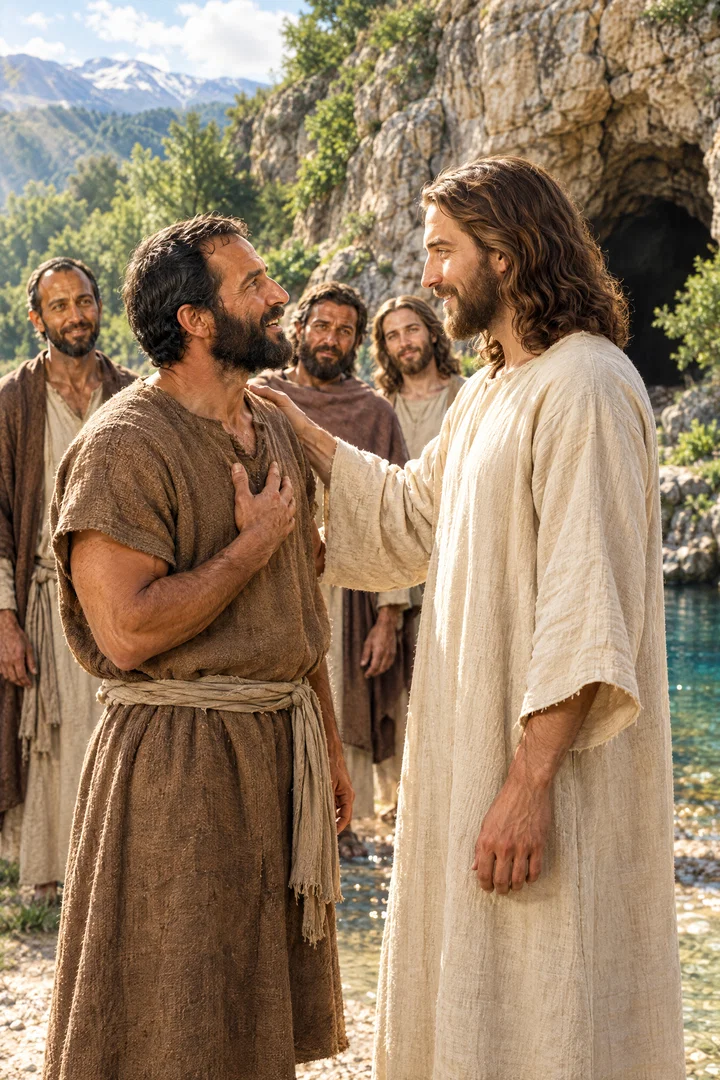
When Jesus came into the coasts of Caesarea Philippi, he asked his disciples, saying, Whom do men say that I the Son of man am?
Translations
American King James Version, King James Version
When Jesus came into the coasts of Caesarea Philippi, he asked his disciples, saying, Whom do men say that I the Son of man am?
When Jesus came into the coasts of Cesarea Philippi, he asked his disciples, saying, Whom do men say that I the Son of man am?
When Jesus came into the borders of Cesarea Phillippi, he asked his disciples, saying, Who do men say that I the Son of man am?
Now when Jesus came into the parts of Caesarea Philippi, he asked his disciples, saying, Who do men say that the Son of man is?
Now when Jesus came into the parts of Cæsarea Philippi, he asked his disciples, saying, Who do men say that the Son of man is?
And Jesus, having come to the parts of Caesarea Philippi, was asking his disciples, saying, 'Who do men say me to be — the Son of Man?'
But when Jesus was come into the parts of Caesarea-Philippi, he demanded of his disciples, saying, Who do men say that I the Son of man am?
And, Jesus coming into the parts of Caesarea of Philip, began questioning his disciples, saying—Who are men saying that, the Son of Man, is?
When Jesus came to the region of Caesarea Philippi, He questioned His disciples: “ Who do people say the Son of Man is?”
When Jesus came to the region of Caesarea Philippi, He questioned His disciples: “ Who do people pronounce Me, the Son of Man, to be?”
Now when Jesus came into the parts of Caesarea Philippi, he asked his disciples, saying, “ Who do men say that I, the Son of Man, am?”
Now when Jesus had come into the parts of Caesarea Philippi, he said, questioning his disciples, Who do men say that the Son of man is?
Nowe when Iesus came into the coastes of Cesarea Philippi, hee asked his disciples, saying, Whome doe men say that I, the sonne of man am?
Douay-Rheims (Challoner revision)
And Jesus came into the quarters of Cesarea Philippi: and he asked his disciples, saying: Whom do men say that the Son of man is?
Pictures
Cross-references
- Luke 9:18-20
And it came to pass, as he was alone praying, his disciples were with him: and he asked them, saying, Whom say the people that I am?
Records the same exchange about who Jesus is.
- Mark 8:27-30
And Jesus went out, and his disciples, into the towns of Cæsarea Philippi: and by the way he asked his disciples, saying unto them, Whom do men say that I am?
Records Jesus’ question about his identity and Peter’s confession.
- John 6:68-69
Then Simon Peter answered him, Lord, to whom shall we go? thou hast the words of eternal life.
Peter identifies Jesus as the Christ and affirms that he has the words of eternal life.
- Daniel 7:13-14
I saw in the night visions, and, behold, one like the Son of man came with the clouds of heaven, and came to the Ancient of days, and they brought him near before him.
Daniel’s vision depicts the Son of man receiving dominion and an everlasting kingdom.
- Matthew 16:17
And Jesus answered and said unto him, Blessed art thou, Simon Bar-jona: for flesh and blood hath not revealed it unto thee, but my Father which is in heaven.
True knowledge comes by divine revelation.
- Matthew 12:40
For as Jonas was three days and three nights in the whale’s belly; so shall the Son of man be three days and three nights in the heart of the earth.
Both texts call Jesus the Son of man.
- John 1:49
Nathanael answered and saith unto him, Rabbi, thou art the Son of God; thou art the King of Israel.
Nathanael confesses Jesus as the Son of God.
- Matthew 11:27
All things are delivered unto me of my Father: and no man knoweth the Son, but the Father; neither knoweth any man the Father, save the Son, and he to whom soever the Son will reveal him.
Identifies the Son in relation to the Father.
- Deuteronomy 18:18
I will raise them up a Prophet from among their brethren, like unto thee, and will put my words in his mouth; and he shall speak unto them all that I shall command him.
A prophecy about a coming prophet helped shape people’s expectations.
- Matthew 12:32
And whosoever speaketh a word against the Son of man, it shall be forgiven him: but who soever speaketh against the Holy Ghost, it shall not be forgiven him, neither in this world, neither in the world to come.
Names the Son of Man and the Son of God.
- Matthew 16:23
But he turned, and said unto Peter, Get thee behind me, Satan: thou art an offence unto me: for thou savourest not the things that be of God, but those that be of men.
Peter’s failure shows that no mortal can be the church’s foundation.
Commentary
Each commentary is drawn from primary sources: the writings of Ellen G. White and Adventist pioneers and periodicals. Each commentary is separate. Its own words are not a quotation; follow the references to read the source passages.
Ellen G. White
9 sources
Jesus was with His disciples when He came into the coasts of Caesarea Philippi, in a town near Caesarea Philippi beyond Galilee where idolatry and heathen worship were widespread.Ms 202, 1899, par. 1DA 411.2 He used the stay in that seclusion to devote Himself more fully to teaching them, instructing them on the true nature of His kingdom against their desire for a temporal reign of worldly honor.3RED 65.1–2DA 411.2 The surroundings were meant to help them recognize their responsibility toward the heathen.DA 411.2
Before asking, He had prayed alone for His disciples that their faith would stand steadfast through His coming suffering and death.3RED 65.1–2 In the question He calls Himself the Son of Man.3RED 65.1–2Ms 202, 1899, par. 1DA 410DA 411.3–5ST Oct 28, 1913 He asked His disciples whom men said that He was, drawing the report that some said John the Baptist, some Elijah, and others Jeremiah or one of the prophets.3RED 65.1–2Ms 202, 1899, par. 12SP 272.1–2ST Oct 28, 1913
Though people had seen His miracles and some called Him the Son of David or a prophet, they did not recognize Him as the Messiah.DA 411.3–5 He asked what the people thought though He already knew their thoughts, giving the disciples opportunity to state their faith openly before He told them of His coming suffering.3RED 65.1–2DA 411.3–5Ms 202, 1899, par. 9 The faith then expressed would strengthen them for the trial ahead and remain firm through His suffering, humiliation, abuse, and apparent degradation.DA 411.3–5Ms 202, 1899, par. 9
The question about public opinion prepared the way for the closer personal question of what the disciples themselves believed, leading Peter to confess that Jesus is the Christ, the Son of the living God.3RED 65.1–22SP 272.1–2ST Oct 28, 1913 That recognition came through the Father and the Holy Spirit, revealed by God and not discovered through human wisdom or insight.2SP 272.1–2 The confession expresses the living faith and living principle that will animate believers in every coming age through the mysterious working of God's Spirit on the heart, elevating even the humblest mind to knowledge above earthly wisdom and to knowledge of sacred truth.3RED 65.1–22SP 272.1–2
His words about Peter and the rock did not give Peter superiority over the other apostles: the rock on which He builds His church is Christ Himself, and the powers of evil will not overcome it. The question begins the events that foreshadow the cross, in which He sees that His mission will bring Him to the cross to give His life for humanity, bear the world's sins, and win the world back to loyalty to God, enduring suffering and shame for the joy of that result.DA 410.2DA 410 No human power could degrade Him, for His Godlikeness would appear in every scene of humiliation and flash conviction into the hearts of priests and rulers in a way they would never forget.Ms 202, 1899, par. 9 The question stands centuries after Isaiah wrote of the Lord's servant called from the womb, named from his mother's bowels, made with a mouth like a sharp sword and as a polished shaft hidden in the shadow of God's hand and in His quiver, and addressed as my servant, O Israel, in whom God will be glorified.Ms 202, 1899, par. 1
Sources
Pioneers and periodicals
25 sources
Near the close of his ministry at the northern limit of his journeying around Caesarea Philippi, Jesus asked his disciples whom men said that he the Son of man was, first asking what others reported and then leading to what they themselves believed.ST Sep 29, 1881ST Jul 4, 1899ST Jul 4, 1899ST Jun 26, 1901 The people said he was John the Baptist, Elijah, Jeremiah or one of the prophets, recognizing his miracles and teaching, but none of the answers was correct.ST Apr 4, 1911ST Nov 4, 1930ST Sep 29, 1881 In answer Peter declared that he is the Christ, the Son of the living God, a recognition revealed by the Father in heaven through the Holy Spirit and not reached by human wisdom or reasoning.ST Sep 29, 1881ST Jul 4, 1899ST Jun 23, 1914ST Oct 25, 1877 The rock on which he builds his church is Christ himself and Peter's confession of him, not Peter or any other mortal, for Peter's name means a stone while the rock is this confession of Christ.ST May 26, 1914ST Oct 25, 1877 That confession of Jesus as both Son of man and Son of God, divinity and humanity united in one person, is the foundation of sound doctrine and the church and the true key to the kingdom of heaven, by which the church triumphs over death and acceptance of him as the Son is essential to salvation.RH Dec 5, 1907ST Oct 25, 1877ST Sep 16, 1886ST May 2, 1916ST Oct 15, 1902
Place, Time and Question
When Jesus asked whom men said that he the Son of man was, he was in the coasts and country around Caesarea Philippi.ST Jan 13, 1888ST Jul 4, 1899 That place was the northernmost point and northern limit of his journeying, built on a broad terrace on the side of Mount Hermon overlooking the plain of Huleh, with rocky cliffs and deep ravines and temple-crowned snowy peaks in full view.ST Jun 26, 1901ST Feb 13, 1896 It stood at the eastern and principal source of the Jordan River, and the mount of transfiguration was probably somewhere in that region.ST Feb 13, 1896
The question came near the close of his ministry, shortly before his death.ST Sep 29, 1881ST Jun 26, 1901ST Feb 3, 1887 He knew the time was near when he would be offered up as the sacrifice for the sins of the world and as the sacrifice for sin.ST Sep 29, 1881ST Jun 26, 1901 He was anxious about his disciples and was preparing them for the trials ahead and for the trial soon to come.ST Sep 29, 1881ST Jun 26, 1901 Despite all his instruction they still did not understand that his kingdom was not of this world and still looked for him to establish an earthly kingdom.ST Jun 26, 1901
The sayings beginning with this question came just before the going up to the mount of transfiguration, about six days before it.STST Feb 3, 1887 The interval from the close of those sayings and happenings to the start for the mount is six clear days between the two days.ST It is about eight days when the day the sayings finished and the day of starting for the mount, the closing day and the starting day, are also counted.ST
In the question he calls himself the Son of man.ST Oct 28, 1913ST Jul 4, 1899ST Jun 25, 1902 He is the same Jesus who is also the Son of God and the only-begotten of the Father.ST Jun 25, 1902RH Dec 10, 1867 His human life did not make him less than God, for he was both man and the only-begotten of the Father.ST Jun 25, 1902
The question begins a distinction between reports of other people's opinions about him and the disciples' own belief about him.ST Jul 4, 1899ST Jul 4, 1899 It first asks whom men say he is and then leads them to their own confession by asking whom they themselves say he is.ST Oct 28, 1913ST Jul 4, 1899 In this way the report of what others believe leads directly to what the disciples themselves believe.ST Oct 28, 1913ST Jul 4, 1899
The people variously said he was John the Baptist, Elijah, Jeremiah, or another ancient prophet or one of the prophets.ST Apr 4, 1911ST Sep 29, 1881ST Jan 13, 1888ST Jul 4, 1899ST Mar 23, 1915 They recognized his miracles and teaching, yet thought he was Elijah, Jeremiah, or John the Baptist raised to life.ST Nov 4, 1930ST Jan 13, 1888 None of the answers was correct.ST Mar 23, 1915
Those opinions reflected expectations about the prophets and the Messiah.ST Jan 13, 1888 They were confusing prophecies of the Messiah's first and second advents and expecting him to come in glory.ST Jan 13, 1888 Some thought he might be a prophet raised from the dead as a sign of the coming resurrection.ST Jan 13, 1888 These were the limited judgments of people who saw his works from a distance and judged him from a distance by comparing him with earlier prophets, rather than the fuller knowledge of those who lived closely with him and witnessed God's life shining through him, whose closer experience of his life enabled the true confession.ST Jan 13, 1888ST Jun 23, 1914ST Jun 23, 1914
Answers and Confession
When asked whom men said he was, the disciples were led to their own answer, and Peter declared him to be the Christ, the Son of the living God, recognizing his true nature and mission as wholly different from the opinions among the people who called him John the Baptist, Elijah, Jeremiah or another prophet.ST Sep 29, 1881ST Jul 4, 1899ST Oct 25, 1877ST Sep 16, 1886RH Jul 8, 1902 That confession identifies him as the divine-human foundation of the church and as the one whose saving death has immeasurable value, and whose acceptance is essential to salvation.ST Sep 16, 1886RH Jul 8, 1902ST Feb 3, 1887
That recognition was revealed by the Father in heaven through the Holy Spirit, not reached by human wisdom, reasoning, insight or judgment.ST Sep 29, 1881ST Jun 23, 1914ST Oct 25, 1877ST Sep 16, 1886 Those who judged from a distance compared him with earlier prophets, while the disciples' closer experience of his life enabled Peter to confess who he was.ST Sep 29, 1881ST Jun 23, 1914
Jesus asked about others' opinions in order to draw out his disciples' own confession, leading them to consider who he truly is.ST Apr 4, 1911ST Nov 4, 1930ST Jun 26, 1901 The question also tested how their faith would stand the trial soon to come.ST Apr 4, 1911ST Jun 26, 1901 The central question therefore is not only what others believe but what Christ is to each person and the state of each person's heart toward him.ST Apr 4, 1911ST Nov 4, 1930 The verse teaches the need to recognize when God's appointed time has come and to attend to the truth due in one's day, as those rebuked for failing to discern the signs of their time had not done.ST Oct 21, 1880
Foundation, Church and Salvation
The rock on which Jesus builds his church is Christ himself and Peter's confession of him as the Christ, the Son of the living God, not Peter or any other mortal.ST May 26, 1914ST Oct 25, 1877ST Apr 4, 1911 Peter's name Petros means a stone, while the rock petra is this confession of Christ. Christ is the tried, precious cornerstone and sure foundation who alone withstood every temptation.ST May 26, 1914ST Apr 4, 1911 Peter and all other human beings have failed when tested, and Peter's later rebuke by Jesus shows why he could not be the church's foundation, giving him no superiority over the other apostles.ST May 26, 1914
That confession of Jesus as both Son of man and Son of God, the union of divinity and humanity in one person, is the foundation of sound doctrine, the church, and the true key to Scripture and the kingdom of heaven.ST Oct 25, 1877ST May 2, 1916ST Oct 15, 1902 It is Christ in the flesh, in the same flesh and blood all people have, through which righteousness is revealed in the flesh, and perversion of this truth is perversion of Christianity.ST Oct 15, 1902 His divine and human natures together enable him to conquer death and the grave.RH Dec 5, 1907RH Jul 8, 1902 His incarnation and endless life are the basis for everlasting life for all who are in him and belong to him.RH Dec 5, 1907RH Jul 8, 1902
Because it is founded on Christ and on heartfelt acknowledgment of him, the church triumphs over death and continues forever.RH Dec 5, 1907 It is safe from the powers of darkness and evil, which will not overcome it.ST Apr 4, 1911 Acceptance of Jesus as the Son is essential to salvation.ST Sep 16, 1886 This truth is foundational to Christian faith and the basis for the immeasurable value of his saving death.ST Feb 3, 1887
Sources