Matthew 25:33
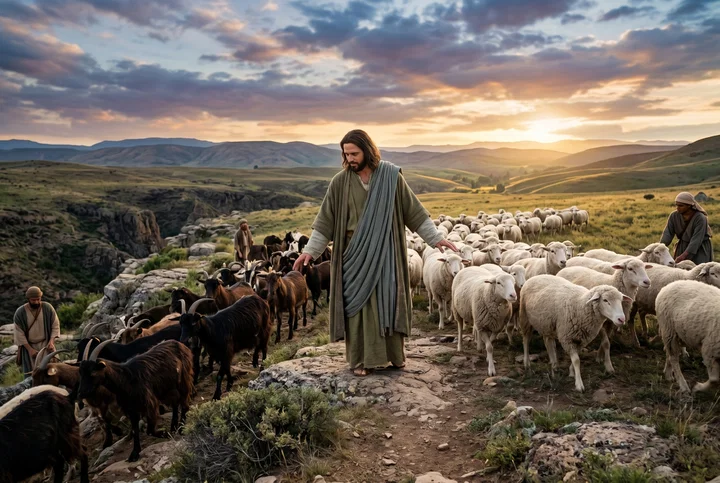
And he shall set the sheep on his right hand, but the goats on the left.
Translations
American King James Version, King James Version
And he shall set the sheep on his right hand, but the goats on the left.
KJV Cambridge Paragraph Bible, Revised Version, American Standard Version
and he shall set the sheep on his right hand, but the goats on the left.
And he will set the sheep on his right hand, but the goats on the left.
and he shall set the sheep indeed on his right hand, and the goats on the left.
and he will set the sheep on his right hand, and the goats on [ his] left.
And he will set, the sheep, indeed, on his right hand, but, the goats, on the left.
Berean Standard Bible, Majority Standard Bible
He will place the sheep on His right and the goats on His left.
He will set the sheep on his right hand, but the goats on the left.
And he will put the sheep on his right, but the goats on the left.
And he shall set the sheepe on his right hand, and the goates on the left.
Douay-Rheims (Challoner revision)
And he shall set the sheep on his right hand, but the goats on his left.
Pictures
Cross-references 20 of 33
- Matthew 25:41-46
Then shall he say also unto them on the left hand, Depart from me, ye cursed, into everlasting fire, prepared for the devil and his angels:
The King sentences the goats for neglecting the needy to everlasting punishment.
- Revelation 20:12
And I saw the dead, small and great, stand before God; and the books were opened: and another book was opened, which is the book of life: and the dead were judged out of those things which were written in the books, according to their works.
The dead stand before God and are judged from the books according to their works.
- 2 Timothy 4:1
I charge thee therefore before God, and the Lord Jesus Christ, who shall judge the quick and the dead at his appearing and his kingdom;
Christ judges the living and the dead at his appearing and kingdom.
- Matthew 25:40
And the King shall answer and say unto them, Verily I say unto you, Inasmuch as ye have done it unto one of the least of these my brethren, ye have done it unto me.
Christ counts acts of kindness to those in need as service to him.
- Matthew 16:27
For the Son of man shall come in the glory of his Father with his angels; and then he shall reward every man according to his works.
Christ comes in glory with angels and rewards each person according to their works.
- 2 Corinthians 5:10
For we must all appear before the judgment seat of Christ; that every one may receive the things done in his body, according to that he hath done, whether it be good or bad.
Both describe everyone appearing before Christ to receive according to their deeds.
- Matthew 13:40-43
As therefore the tares are gathered and burned in the fire; so shall it be in the end of this world.
At the end of the world, the wicked are separated for punishment and the righteous enter the kingdom.
- Matthew 25:45
Then shall he answer them, saying, Verily I say unto you, Inasmuch as ye did it not to one of the least of these, ye did it not to me.
Neglecting the least is counted as neglecting Christ and brings judgment.
- Matthew 25:46
And these shall go away into everlasting punishment: but the righteous into life eternal.
Contrasts the condemned’s eternal punishment with the righteous’ eternal life.
- Matthew 13:30
Let both grow together until the harvest: and in the time of harvest I will say to the reapers, Gather ye together first the tares, and bind them in bundles to burn them: but gather the wheat into my barn.
Wheat and tares are separated at harvest, as the righteous and wicked are divided.
- John 5:29
And shall come forth; they that have done good, unto the resurrection of life; and they that have done evil, unto the resurrection of damnation.
Both texts distinguish the righteous from the wicked and assign them different outcomes.
- Revelation 22:12
And, behold, I come quickly; and my reward is with me, to give every man according as his work shall be.
Christ comes to reward each person according to their works.
- Acts 17:31
Because he hath appointed a day, in the which he will judge the world in righteousness by that man whom he hath ordained; whereof he hath given assurance unto all men, in that he hath raised him from the dead.
Christ judges the world in righteousness on the appointed day.
- Matthew 13:49
So shall it be at the end of the world: the angels shall come forth, and sever the wicked from among the just,
At the end of the world, angels separate the wicked from the just.
- Romans 2:6-9
Who will render to every man according to his deeds:
God renders to each person according to their deeds.
- Romans 14:10
But why dost thou judge thy brother? or why dost thou set at nought thy brother? for we shall all stand before the judgment seat of Christ.
All stand before Christ’s judgment seat, including the righteous.
- Daniel 7:13-14
I saw in the night visions, and, behold, one like the Son of man came with the clouds of heaven, and came to the Ancient of days, and they brought him near before him.
The Son of man comes in the clouds and receives an everlasting kingdom.
- Ecclesiastes 12:14
For God shall bring every work into judgment, with every secret thing, whether it be good, or whether it be evil.
God brings every work, including secret things, into judgment.
- John 5:22
For the Father judgeth no man, but hath committed all judgment unto the Son:
The Father commits all judgment to the Son.
- Matthew 3:12
Whose fan is in his hand, and he will throughly purge his floor, and gather his wheat into the garner; but he will burn up the chaff with unquenchable fire.
The winnowing separates the righteous from the wicked for judgment.
Commentary part 1 of 2
Each commentary is drawn from primary sources: the writings of Ellen G. White and Adventist pioneers and periodicals. Each commentary is separate. Its own words are not a quotation; follow the references to read the source passages.
Ellen G. White
64 sources
When He comes in glory with all the holy angels to sit on the throne of His glory, He will gather all nations before Him and divide them as a shepherd divides sheep from goats, placing the sheep on His right hand and the goats on His left.Ms 9, 1898, par. 14–16Ms 131, 1899, par. 24–27GC88 322.2 The whole world is represented by two classes only, with no middle class.Lt 29, 1897, par. 26–2719MR 240.1–241.34MR 444.1 The right hand is the place of favor and blessing to inherit the kingdom prepared from the foundation of the world and enter life eternal, while the left hand is the place of rejection to depart into everlasting fire prepared for the devil and his angels.Ms 9, 1898, par. 14–16Ms 82, 1896, par. 10–12Ms 77, 1906, par. 15Lt 102, 1886, par. 9–10 That placing is decided by what was done or left undone to the hungry, thirsty, stranger, naked, sick, and imprisoned, for what was done to one of the least of His brethren was done to Him.DA 637.1–2Ms 82, 1896, par. 10–12Lt 52, 1891, par. 55–56ST Jun 25, 1894STMW10 32.3 The decision turns less on outbreaking crimes than on neglect of duty and failure to do the good that might and ought to have been done, measured day by day in the common incidents of life.Ms 82, 1896, par. 10–1218MR 140.2–4Lt 12, 1893, par. 4–74MR 20.4
Setting and Separation Scene
Matthew 25:33 belongs to the discourse recorded in Matthew 24-25, given shortly before entering Gethsemane.ST Nov 20, 1884 The Son of man comes in glory with all the holy angels, sits upon the throne of His glory with all nations gathered before Him, and divides them as a shepherd divides sheep from goats, setting the sheep on the right hand and the goats on the left.Ms 9, 1898, par. 14–16Ms 131, 1899, par. 24–27GC88 322.2Ms 82, 1896, par. 10–12Ms 77, 1906, par. 15 The separation is public and final, deciding eternal destiny with every case decided and sentence passed upon the whole world.Ms 9, 1898, par. 14–16Ms 131, 1899, par. 24–27Ms 137, 1897, par. 1–2 The whole world is represented by two classes only, the sheep being the just and righteous and obedient and the goats being the unjust and unrighteous and disobedient, with no middle class.Lt 29, 1897, par. 26–2719MR 240.1–241.34MR 444.1
The right hand is the position of favor and blessing and standing as children of God, and the left hand is the position of rejection for the disobedient, unthankful, and unholy.Lt 102, 1886, par. 9–10Ms 10, 1894, par. 20–23 The right-hand place belongs to those who obey God's commandments and receive His blessing as faithful children in harmony with the spirit and work of Jesus.Lt 102, 1886, par. 9–10Ms 10, 1894, par. 20–23 The judgment scene takes place in the presence of all worlds to vindicate the government of God so that His honor and His law stand forth as holy, just, and good.Ms 137, 1897, par. 1–2 There sin is seen in all its hideous magnitude rather than as attractive, the relation in which each person stands to God and to others is revealed, and the principles of eternal justice are revealed as the judgment sits and the books are opened.Ms 137, 1897, par. 1–2Lt 12, 1893, par. 4–7
The scene reverses Christ's trial, when He was surrounded and abused by a riotous mob.COS 129.6–7 He will then occupy the position of supreme Judge of heaven and earth, seated upon the Father's throne with no appeal from His decisions, coming in the clouds of heaven with power and great glory escorted by legions of angels to pronounce sentence upon His enemies, including the same accusing throng that condemned Him.COS 129.6–7 The Judge is God, who created the world through Jesus Christ and judges without mistake, with no compulsion, threats, harsh words, or condemnation.Ms 129, 1906, par. 10 His return follows the completion of His mediatorial work to establish His kingdom on earth, and the gathering of the resurrected saints into the kingdom, the judgment, and their establishment upon the new earth have not yet transpired but are carried forward in time to when they will happen.AA 228.3Ms 4, 1883, par. 35 The separation belongs to a judgment day lasting a thousand years, with the nations gathered before the King at its close, after the wicked dead are raised.WLF 23.4–24.1
Timing and Kingdom Inheritance
The kingdom is not received until the personal advent of Christ, for the universal reign of peace and the setting up of the kingdom of God on earth come after the second advent, not before.GC88 322.2GC 321.1–323.1GC88 323.1 When He comes in glory with all the holy angels and sits on the throne of His glory, all nations are separated as a shepherd separates sheep from goats, the righteous put on one side and the wicked on the other, the sheep at His right and the goats at His left.GC88 322.2GC 321.1–323.1GC88 323.1 That separation precedes the inheriting, for those approved on the right are then welcomed to inherit the kingdom prepared from the foundation of the world.GC88 322.2GC 321.1–323.1 At that coming the righteous dead are raised incorruptible and the righteous living are changed in a moment to put on incorruption and immortality, and being thus made immortal and incorruptible they are ready to inherit the enduring kingdom, since mortal flesh and blood cannot inherit the incorruptible, everlasting kingdom.GC88 322.2GC 321.1–323.1
Those on the right are called blessed of the Father to inherit the kingdom and enter life eternal to live forever with Christ, while those on the left are bidden to depart as cursed into everlasting fire prepared for the devil and his angels and go away into everlasting punishment and eternal death.Ms 9, 1898, par. 14–16Ms 82, 1896, par. 10–12Ms 77, 1906, par. 15RH Nov 22, 1906 The division at the coming of the Son of man in glory with all the holy angels, when all nations are gathered before Him seated on the throne of His glory, leads to these different destinies and distinguishes those who have done good from those who have done evil, each receiving according to works.Ms 9, 1898, par. 14–16Ms 82, 1896, par. 10–12Ms 77, 1906, par. 1521MR 350.4–351.3 The righteous inherit the kingdom prepared from the foundation of the world because what was done to one of the least of Christ's brethren in feeding the hungry, giving drink to the thirsty, taking in the stranger, clothing the naked, and visiting the sick and those in prison was counted as done to Him, though they are surprised at their own service.Ms 82, 1896, par. 10–12 The wicked are ordered to depart because what was not done to the least in giving no food or drink, taking in no stranger, clothing not the naked, and visiting not the sick and imprisoned was counted as withheld from Him, whether through disobedience, wasted opportunity and probationary time, refusal to come out and be separate and to come to the Redeemer, or unchanged disposition choosing other associates.Ms 82, 1896, par. 10–1221MR 350.4–351.3
The righteous are thus saved in the kingdom of God inside the city, while the wicked find themselves outside the gates of the city, a division fixed by their own choice that decides destiny forever.Lt 131, 1902, par. 22–23 When opportunity to repent and be converted was offered them, the wicked dishonored their Redeemer by scorning mercy, refusing to acknowledge the love of God, and choosing the service and side of Satan in the controversy, so that when they see the righteous saved and themselves lost they feel shame and with lamentation and woe acknowledge too late that they are lost, a sad spectacle to angels and to men.Lt 131, 1902, par. 22–23 The coming judgment makes present choices and conduct consequential, for character will not be changed after Christ comes and preparation must be made now.Ms 13, 1888, par. 64–67
Basis of the Division
The placing on the right or on the left is decided by what was done or left undone, especially feeding the hungry, giving drink to the thirsty, taking in the stranger, clothing the naked, and visiting the sick and those in prison.DA 637.1–2Ms 82, 1896, par. 10–12ST Jun 25, 18944T 620.1–3 What was done to one of the least of Christ's brethren was done to Him, and what was not done to them was not done to Him.Ms 82, 1896, par. 10–12 Those on the right are commended for such care even when done without recognizing Christ in the sufferers, for kindness to them is received as service to Him and is evidence of discipleship.DA 637.1–2 The separation marks differing destinies decided by whether need was cared for, with caring accepted as care for Him and neglecting or mistreating the poor as neglecting Him and bringing judgment.ST Jun 25, 18944T 620.1–3 The righteous inherit the kingdom prepared from the foundation of the world and enter life eternal though surprised at their own service, while the wicked who withheld that same care are ordered to depart into everlasting fire prepared for the devil and his angels and go away into everlasting punishment.Ms 82, 1896, par. 10–12
The decisions of that day turn on practical benevolence, with acts of beneficence counted as done to Christ.STMW10 32.3 Professions count for nothing before God; character and deeds determine the outcome.Lt 52, 1891, par. 55–56GC88 487.2–3 Only love shown in actions is counted as genuine, and even small acts done from love are accepted and rewarded.GC88 487.2–3 The record reveals how abilities, time, resources, influence, and entrusted spiritual truth were used, including whether Christ was served by caring for the poor, afflicted, orphaned, and widowed.GC88 487.2–3
The division does not turn especially on revolting crimes and outbreaking sins of actual transgression, but on neglect of duty, failing to do what might have been done and ought to have been done through the moral power Christ provided by clothing His divinity with humanity to bring fallen man power to become a laborer together with God.Lt 12, 1893, par. 4–7 People are held accountable for good they had opportunity and ability to do but neglected, including failing to use abilities and opportunities and failing those they could have helped.18MR 140.2–44MR 20.4 Professing Christians will answer for neglecting those they could have helped, and those left in degradation will bear witness against those who failed them.4MR 20.4 Those placed as sheep are transformed in character by looking to Jesus and beholding Him, changed into His likeness, working in Christ's lines and growing in knowledge of God, while those placed as goats lacked saving faith, living connection with God, and doing of Christ's words, like foolish virgins with lamps of truth but no oil of grace.Lt 12, 1893, par. 4–7
Placing right or left is decided day by day in the common incidents of life according to what was done or not done.Ms 82, 1896, par. 10–12 The whole life tendency, disposition, and actions are examined in the courts of heaven to see whether character in probationary time was formed after the pattern given in Christ Jesus or after the pattern of the enemy of all righteousness.Ms 82, 1896, par. 10–12 Those attentive to self and living to please and glorify self, disobedient to the commandments, wasting opportunity and probationary time, refusing to come out and be separate, refusing to come to the Redeemer and choosing other associates with unchanged disposition, have their portion with unbelievers and cannot be received into the kingdom.Ms 82, 1896, par. 10–12
The verse embraces stewardship of entrusted talents that include more than earthly goods and temporal employments and more than worldly goods committed to keeping, with eternity kept in reckoning because eternal interests are involved.19MR 389.2–4Lt 108, 1896, par. 13–15 Talents are trusts to be used for God's glory and not buried in worldly enterprises, and ability to accumulate worldly goods gives no satisfaction unless turned to account for Him who bestowed them.19MR 389.2–4Lt 108, 1896, par. 13–15 No person is an owner but only a trustee of means and talents, whether one or two or five, with not a farthing to be squandered on selfish indulgence, and must give account with fear and trembling, so faithful or selfish use decides the final separation.Lt 8, 1896, par. 21–22 Christ has paid with His own blood and sufferings to secure servitude and entire obedience, giving a loan from the Master to invest in work for Him to advance His glory, making each a steward of His grace with endowments for a sacred, higher trust, so that even the humblest service becomes a consecrated gift when exercised in doing the Master's bidding and promoting His glory.Lt 108, 1896, par. 13–15
Final placing for the kingdom is decided by faithful use of the present trading time.Ms 25, 1908, par. 16 The name in the church book does not put a person among the sheep.Ms 25, 1908, par. 16 Each must make close, critical examination of how opportunities and God-given capabilities and the Lord's talents have been used and put out to the exchangers for the Master.Ms 25, 1908, par. 16 Those who have not worked for Christ and have lived for themselves are placed with those who did evil and receive the same condemnation.COL 365.1 This includes those who withheld abilities and resources, served their own interests, bore no fruit for God, and neglected the work and responsibilities entrusted to them, with failure to do the good they had opportunity and ability to do leaving them among the condemned.4T 385.2–386.1 God rewards with entrance into the kingdom every servant who works with self-denying, self-sacrificing zeal for the salvation of souls, and everyone who has denied self and purified the soul through belief of the truth proves it by at once doing missionary work for those perishing in sins.Ms 25, 1908, par. 16
The sheep on the right are faithful servants who use entrusted property of means, tact, skill, and worldly treasure to relieve suffering, feed the hungry, clothe the naked, care for the widow and fatherless, advance the gospel, cooperate with Christ, and draw near in love to His family.21MR 351.4–352.1 The goats on the left rob Christ by withholding His money from the poor and accumulating riches for selfish luxury and reputation, receiving but not producing.21MR 351.4–352.1 No position in this life brings acceptance and no wealth gained by clever schemes or sharp dealing brings praise or justification.21MR 351.4–352.1 Every act of oppression, double dealing, and fraud is registered, and those who corrupted their senses and abused His gifts lose heavenly treasure and become poorest, for gaining the whole world profits nothing if the soul is lost.21MR 351.4–352.1
The separation reveals the side each chose, obedience to God or rebellion, and distinguishes those who have done good from those who have done evil according to works that reveal their class and their treatment of fellow men.Ms 77, 1906, par. 15Ms 10a, 1898, par. 17–19RH Jun 18, 1901 There is no middle class, and each person's destiny is decided.Lt 29, 1897, par. 26–27 The sheep obeyed God's law and did good, cooperating in faith with Jesus to restore God's moral image and sharing received light by grace through faith and repentance; the goats transgressed the law, did evil, and are stained by an ungodly life.Lt 29, 1897, par. 26–27RH Jun 18, 1901Lt 131, 1900, par. 22–23 Each receives reward or punishment according to obedience or violation, when character is tested by God's law as His standard of righteousness.RH Jun 18, 1901Lt 131, 1900, par. 22–23 Those on the right are welcomed to inherit the kingdom and live eternally with Christ, while the goats are among those condemned to eternal death, with obedience standing as a condemnation to the world and judgment committed to the Son of God.Lt 29, 1897, par. 26–27Ms 77, 1906, par. 1521MR 350.4–351.3
Ministers are included in the reckoning and will be asked what they have done for Christ.Ms 79, 1886, par. 14 They are held accountable for whether they sought to save souls perishing in sin and iniquity, brought them light and truth purchased by the blood of the Son of God, and opened their understanding to accept Jesus and the truth and Word He sends.Ms 79, 1886, par. 14 The final accounting covers how people treated others: harshness and oppression toward a poor stranger belong in the record faced at that judgment.Lt 34a, 1886, par. 32 Those who drive the weak into temptation and ruin will be held accountable for the souls harmed by their actions.Ms 41, 1899, par. 5–6 Those who use sharp, calculating, selfish methods in God's service will find they have no place in the kingdom.1MR 243.2 Those who cling to selfish, unjust conduct and refuse to reform will not see the King in His beauty, because experience in this life decides eternal destiny.1MR 272.1–273.1
Identity of the Sheep
Those on the right hand are Christ's commended, blessed family, all who have been born into the heavenly family and are in a special sense His brethren.DA 638.1–639.2 They are bound together by the love of Christ, and wherever that love is made manifest the divine relationship is revealed.DA 638.1–639.2 They may have known little of theology, but they cherished His principles and through the influence of the divine Spirit were a blessing to those about them.DA 638.1–639.2 Kindness to sufferers may be done without recognizing Christ in them, yet it is received as service to Him and is evidence of discipleship.DA 637.1–2DA 638.1–639.2
The right hand includes even among the heathen those who cherished the spirit of kindness.DA 638.1–639.2 Some befriended missionaries at peril of life before hearing words of life, some worshiped God ignorantly without light brought by human instrumentality yet will not perish, and some though ignorant of the written law heard His voice in nature and did the things the law required.DA 638.1–639.2 Their works are evidence the Holy Spirit touched their hearts so they are recognized as children of God.DA 638.1–639.2 They will be surprised and gladdened to hear approval from the Saviour for ministry they did not know they rendered to Him, to the joy of Infinite Love.DA 638.1–639.2 Angels are now passing throughout the earth seeking these unmanifested overcomers, comforting the sorrowing, protecting the imperiled, and winning hearts to Christ, for not one is neglected and God has equal care for all souls He created.DA 638.1–639.2
The judgment at Christ's glorious return recognizes faithful work done for Christ, with His triumph seen by the universe.ST Apr 21, 1898 It includes people among the heathen who without knowing God's law do what it requires because they heed the witness of nature.ST Apr 21, 1898 God's grace softens their hearts and leads them to act with mercy.ST Apr 21, 1898 The righteous are surprised at their own service of feeding the hungry, giving drink to the thirsty, welcoming strangers, clothing the naked, and visiting the sick and those in prison, which the King counts as done to Himself when done to the least of His brethren.
Small, humble acts of loving service — including a cup of cold water or a timely word — are precious to God even when the worker does not regard them as great deeds.17MR 69.3–70.2 Their value is measured by heaven, not by human estimation.17MR 69.3–70.2 Christ recognizes as His believing ones those who obey Him.RH Aug 2, 1906 The right-hand place is associated with those who obey God's commandments and receive His blessing as faithful children of God.RH Apr 24, 1913Lt 102, 1886, par. 9–10Ms 10, 1894, par. 20–23
Those in harmony with the spirit and work of Jesus do not neglect the needy, the oppressed and the afflicted but give them help, comfort and Christlike love.RH Apr 24, 1913 The separation gathers into His kingdom scorned sinners who accepted Him.2SP 192.3–193.1 Every person may be saved by believing in Christ as a personal Saviour, though not all will be saved.Ms 83, 1891, par. 5 This is not because Christ does not want them saved, for He draws every person to Himself.Ms 83, 1891, par. 5
Identity of the Goats
Those set on the left are those who neglected Christ in the person of the poor and suffering, self-absorbed and careless of others' needs yet unconscious of guilt because Satan has blinded them so they do not perceive what they owe their brethren.DA 639.3–640.1 This includes especially the rich, to whom God gave wealth to relieve and comfort His suffering children, but who too often feel superior to their poor brethren, do not put themselves in the poor man's place, do not understand the poor's temptations and struggles, and let mercy die out of the heart.DA 639.3–640.1 They shut themselves away in costly dwellings and splendid churches and spend on pride and selfishness the means given to bless the needy, thereby robbing the poor of comfort and of education in the tender mercies of God and treating them contemptuously as paupers.DA 639.3–640.1
Christ counts Himself as the hungry and thirsty, the stranger, the sick, and the prisoner, famishing while others feast, homeless while others are at ease, destitute while others multiply apparel, and languishing in prison while others pursue pleasure, being near in the person of the afflicted all the days of life.DA 639.3–640.1 Even a pittance of bread or flimsy garments given to the starving and freezing was giving to the Lord of Glory, but those on the left did not seek Him and would not enter into fellowship with Him, so He answers, I know you not.DA 639.3–640.1 The poor will rise in judgment against those who squander wealth on pride and extravagance while neglecting the hungry, naked, and distressed, for such neglect and selfishness dishonor God and show a heart turned from Him.ST Jun 25, 1894
Those on the left claim to keep God's commandments yet lift up their souls unto vanity and think themselves exalted in His favor, while neglecting the needy, turning a deaf ear to the oppressed, and speaking sharp, cutting words to those needing different treatment, offending God daily by hardness of heart.RH Apr 24, 1913 Every neglect of God's suffering ones is written in the books of heaven as if shown to Christ Himself, and it decides whether a person receives the welcome to inherit the kingdom prepared from the foundation of the world.RH Apr 24, 1913 The condemned wear religion as a mask, follow the imaginations of their own evil hearts, have no regard for human brotherhood, suppose God honors the rich and those in high positions, neglect the poor, ignorant, and afflicted, and give no encouragement to virtue nor sanction to means by which the poor might receive consolation and substantial help.Ms 90, 1894, par. 2–3 They place little restraint on themselves in business and social relations and do not retain God in their knowledge.Ms 90, 1894, par. 2–3
Christ stoops from His throne to catch every sound from His purchased possession and approves or condemns every action by its nature, while His angels go through the earth to witness every struggle against evil, lend divine aid, record neglect, work for blessing, raise the fallen and oppressed, and even visit the wicked, who if they do not repent and reform will receive according to evil works.Ms 90, 1894, par. 2–3 The portion apart from the kingdom receives the self-righteous Pharisees with hypocrites and unbelievers, those stained by transgression and marked by ungodly life.Lt 131, 1900, par. 22–232SP 192.3–193.1 When opportunity to repent was offered they dishonored their Redeemer by scorning mercy, refusing to acknowledge God's love, and choosing Satan's service and side of the controversy.Lt 131, 1902, par. 22–23
When they see the righteous saved and themselves lost they will feel shame, and with lamentation and woe acknowledge too late that they are lost, a sad spectacle to angels and to men.Lt 131, 1902, par. 22–23 Bringing children into the world and then forsaking a rightful wife, withholding support, robbing her of means rightfully hers, and leaving her to bear the labor of rearing the children while rearing a second family is held against a man and proclaimed in the ears of the assembled universe, barring him from the right hand and from entering the kingdom of heaven.Lt 35, 1896, par. 15–17 There is not a semblance of a chance to stand with the sheep unless he is thoroughly converted, confesses his sins, and pays his honest debts for the support of his wife and children.Lt 35, 1896, par. 15–17
Call to Self-Examination
The instruction running from Matthew 25:14 through 46 is to be studied and compared with the life record.Lt 214, 1906, par. 13RH Aug 2, 1906Ms 166, 1905, par. 9–10 Every person is called to put away boasting, self-sufficiency, and self-trust.Lt 214, 1906, par. 13RH Aug 2, 1906Ms 166, 1905, par. 9–10 Self-sufficiency is fearfully dangerous because it leads people to make the words of Christ of no effect.Lt 214, 1906, par. 13RH Aug 2, 1906Ms 166, 1905, par. 9–10 Instead of boasting or self-trust there is to be honest self-examination, putting away self-trust and walking in the footsteps of Christ in all the humility of true faith, committing to the Saviour day by day and hour by hour, for Christ recognizes as His believing ones those who obey Him.RH Aug 2, 1906Ms 166, 1905, par. 9–10
The division of sheep and goats represents the character God accepts.Ms 131, 1899, par. 24–2715MR 112.1–3 It is given to educate men and women for the work that must be done for the soul.Ms 131, 1899, par. 24–2715MR 112.1–3 The words then spoken to the two classes decide forever their eternal destiny.Ms 131, 1899, par. 24–2715MR 112.1–3 They must be heard by all who have ears to hear and intellect to comprehend.15MR 112.1–3
Each person must closely examine heart, life, and course of action by God's Word to see if they agree with Christ, rather than criticize others.RH Apr 24, 1913Lt 102, 1886, par. 9–10 He must cease to do evil and learn to do well by seeking judgment, relieving the oppressed, judging the fatherless, and pleading for the widow.RH Apr 24, 1913 He is to seek Christ's riches and honor from God.RH Apr 24, 1913Lt 102, 1886, par. 9–10 Such faithfulness is tied to receiving more of the outpouring of the Holy Spirit.RH Apr 24, 1913
Each person should now ask on which side he will stand at Christ's speedy appearing in the clouds of heaven with power and great glory.18MR 60.1–2Ms 32a, 1896, par. 9 No one is given light to delay that day, and eternal destiny is being decided now, so each must live in holy conduct and godliness, prepare for His coming, and serve faithfully each day rather than presume His coming is delayed.18MR 60.1–2Ms 32a, 1896, par. 9 At His return even family members and close associates may be separated forever.RH Mar 18, 1902 Lack of mercy, patience, and Christlike character can help make religion distasteful to others.RH Mar 18, 1902
Sources
Pioneers and periodicals
315 sources
He shall divide all people into only two classes with no middle ground, the sheep who are the righteous, faithful and accepted set on his right hand, and the goats who are the wicked, lost and rejected set on his left.RH Jun 23, 1910ST Jul 22, 1886ST Feb 5, 1885ST Sep 9, 1886RH Jul 18, 1865 The separation takes place when the Son of man comes in glory with all the holy angels and sits on the throne of his glory with all nations gathered before him.RH Jun 23, 1910ST Jul 22, 1886ST Feb 5, 1885 The test turns on how each treated Christ in the person of his least brethren, feeding the hungry, giving drink to the thirsty, welcoming the stranger, clothing the naked, and visiting the sick and imprisoned, with neglect counted as neglect of Christ himself.ST Jun 25, 1894ST Aug 21, 1884RH Nov 26, 1857RH May 26, 1868 Those on the right are then invited to inherit the kingdom prepared from the foundation of the world and enter eternal life, while those on the left are told to depart into everlasting fire prepared for the devil and his angels and go into everlasting punishment.ST Jul 22, 1886RH Mar 11, 1858ST Apr 26, 1910 That sentence only executes decisions already reached in a prior investigative judgment in the sanctuary, where each life has been examined in the books before Christ appears.ST Apr 20, 1888RH Apr 21, 1874
Words and Setting
The sheep are the righteous, faithful and accepted, and the goats are the wicked, lost and rejected.RH Jun 23, 1910ST Jul 22, 1886ST Feb 5, 1885ST Sep 9, 1886ST Jul 26, 1910 When the Son of man comes in glory with all the holy angels and sits on the throne of glory with all nations gathered before him, he divides them as a shepherd divides flock, setting sheep at the right and goats at the left.RH Jun 23, 1910ST Jul 22, 1886RH Mar 11, 1858 The sheep are those who have served the Lord with sanctified lives, and the goats are those who have lived for self from selfishness and love of praise.ST Feb 5, 1885 The sheep are invited to inherit the kingdom prepared from the foundation of the world and enter eternal life, while the goats are ordered to depart into everlasting fire prepared for the devil and his angels into everlasting punishment.ST Jul 22, 1886RH Mar 11, 1858
There are only these two classes at that time as now, with no third class distinct from them and no middle ground; if a person is not good he is bad.RH Jun 23, 1910ST Sep 9, 1886 At the day of judgment there are only two sides, the right and the left, with no third place, and all must appear to receive for things done in the body whether good or bad, hearing either Come ye blessed or Depart ye cursed.ST Apr 1, 1875 The right side is the way to heaven for those who love and trust Jesus and seek to obey him, and the left side is the way to darkness and despair for the careless, proud, angry, selfish, unkind and untrue, so the turn to Jesus should be made early since all begin life sinful.ST Aug 7, 1884 The solemn eternal division ends long mingling, dividing nations, churches, societies and households and sundering loved ones to meet no more, the righteous sheep to rest and peace and the wicked goats to the lake of fire and perdition.RH Jul 18, 1865 The resurrection then calls each forth to receive reward or punishment already determined, not to have cases decided after rising.RH Aug 24, 1869
The right-hand place is one of honor, favor, exaltation and presence with Christ for the accepted, and the left-hand place is rejection to shame, condemnation, ruin and being cast out.ST Oct 28, 1913ST Sep 26, 1878 The positions do not mean literal physical sides of his person but signify this exaltation and rejection.ST Sep 26, 1878 The separation is accomplished as an act of the angels when the saints are caught up to meet Christ in the air.ST Sep 26, 1878 The same symbolic meaning holds even if the separation is placed after the thousand years, with the righteous inside the city receiving the kingdom and the wicked outside surrounding it.ST Sep 26, 1878 The decision rests on character formed through obedience to God's law and the Spirit's seal, on the principles of Christ's kingdom including love, mercy, forgiveness, humility, faith and sympathy.RH Feb 5, 1914ST Apr 30, 1912 The scene is the decisive final account revealing where each will be found and whether there is refuge in the day of trouble, with plea to be counted among the sheep, spared the burning, and welcomed with the blessed.RH Sep 17, 1857RH Jun 22, 1869
Sheep and goats are figures for Christ's followers and people in their natural state, not fixed animal natures.ST Mar 29, 1883 People are naturally children of wrath and may be represented as goats, but through the gospel they can be changed into sheep, and they can also turn back, the change one way being no more impossible than the other.ST Mar 29, 1883 As with shepherds' flocks, sheep and goats can gather together and then separate, each following its own shepherd when called.RH Feb 18, 1858
The passage is part of Jesus' answer to the disciples' question about the end of the world in the fuller prophetic discourse of Matthew 24-25.ST Jul 22, 1886ST Apr 22, 1889 It belongs to the memorable discourse given shortly before entering Gethsemane, as his ministry closed under the shadow of the cross.ST Nov 20, 1884 The discourse covers the Christian age and moves beyond Jerusalem's destruction to events leading to the end, providing the key to its groups.ST Jun 11, 1874ST Apr 22, 1889 It concerns the future, visible, personal coming and general judgment, when all nations are gathered and the saints inherit the kingdom, which did not happen at Jerusalem's destruction.ST Jul 22, 1886ST Dec 11, 1879ST Oct 21, 1889 It fixes the time of his coming, showing Christ coming not then to die or to preach salvation but to sit as judge and decide character and destiny at the appointed day.ST Jul 22, 1886
By itself the continued discourse, given two days before the Passover at which he was betrayed and crucified, does not explain the sheep-and-goats imagery or its meaning.RH Jan 8, 1901 The right interpretation requires the setting of Matthew 23 with light to escape destruction, warnings about false teachers for all centuries, and signs by which the generation of his return can be known though not the day or hour.RH Jan 8, 1901ST Apr 22, 1889 The present age is a time when people are deceived about the second advent.ST Jun 11, 1874
In one view the setting is the result of the administration of the kingdom of Heaven in separating righteous from wicked with final destiny for each class.RH Sep 3, 1872 In that view the discourse of Matthew 24 and 25 prophetically describes the utter political destruction of the Jewish nation with its civil, political and religious polity, the end of that dispensation, and the establishing of the Christian dispensation, accomplished at the coming of the Son of man.RH Sep 3, 1872
The discourse traces the history of his people and the changes in their duties and trials as the second advent approaches. Its judgment scene places the people of God and those not truly his in distinct conditions, making faithful obedience to God's word decisive. Christ's appearing is the central hope toward which Christian belief, longing and conduct are directed, to be expected and longed for and lived with constant regard.ST Jan 29, 1880RH Jan 6, 1874
The teaching belongs with the parables of the ten virgins and the talents.RH Jun 4, 1867RH Feb 21, 1856 The tarrying time of the virgins ended with the bridegroom's coming, and the chapter teaches use of entrusted abilities in service to Christ and preparation of others for his kingdom.RH Jun 4, 1867 Those who improve talents and do faithful service enter into his joy and share his glory as fruit of his self-sacrifice and the outworking of his character and spirit, tasted on earth when hungering souls receive life and made full when the universe witnesses the presentation of the redeemed.RH Dec 17, 1914 The kingdom may be spoken of as a whole when only one part is intended, as the ten virgins illustrate the kingdom considered in its parts, and the church is not itself the kingdom but will ultimately constitute its subjects.RH Apr 5, 1860RH Jan 22, 1857
The setting converges with the cleansing of the sanctuary and the Son of man's coming to the Ancient of days, with the bridegroom's coming among events converging in 1843-1844 as the prophetic setting for the message preparing the way for the Lord.RH May 5, 1903 The parable's division between accepted and rejected connects with a shut door for the class that rejected the Advent message of 1843 and 1844, while an open door remained for those who had not rejected it.RH Jun 9, 1853 The exhortations to watch belong to the signs of the second coming and apply urgently to the waiting time after the 1844 disappointment, to remain awake, pray and be ready without setting a definite time.RH Oct 15, 1872 A message about the nearness of the judgment and Christ's coming will be proclaimed by the church living at the close of this dispensation, and at his glorious coming after going away he receives his own and sets up the kingdom with two classes separated.RH Aug 18, 1874
The verse presents Christ as the world's King and Judge with authority to separate, placing sheep at the right and goats at the left.ST Jun 6, 1878 The chapter presents the promise of his coming to reign gloriously in the world.RH Apr 24, 1913 The purpose of his coming is to give every man according as his work shall be, giving final reward then to those who look for him and love his appearing.ST Jul 22, 1913 It is connected with the time when Jesus is revealed from heaven with his angels and glorified in his saints, taking vengeance on the disobedient and giving rest to the troubled, having been given authority to execute judgment because he is the Son of man.ST Jan 15, 1885ST Feb 19, 1902
The sheep at the right and goats at the left are figurative details setting forth how people are distinguished under Christ's rule.RH Oct 22, 1872 They depict the administration of his government and its consequences, rewarding people according to whether faith is proved by works, rather than a single final day of judgment.RH Oct 22, 1872
Time and Manner of Separation
The separation happens when the Son of man comes in glory with all the holy angels, sits on the throne of his glory, and has all nations gathered before him, when as a shepherd he divides sheep from goats, setting the sheep on his right hand and the goats on the left for eternal life or everlasting punishment according to deeds.RH Jun 23, 1910ST Jul 22, 1886ST Feb 5, 1885RH Jun 9, 1859ST Sep 9, 1886 The sheep are the righteous and the goats are the wicked, with only these two classes and no third class or middle ground, and the scene gives no indication of a greater ingathering of sinners when Christ takes his kingdom.RH Jun 23, 1910ST Sep 9, 1886RH Mar 11, 1858 It applies not to the destruction of Jerusalem but only to the final and general judgment, showing Christ coming not to die or preach but to sit as judge and decide character and destiny at the appointed day, which fixes the time of his coming.ST Jul 22, 1886 The following invitation to inherit the kingdom prepared from the foundation of the world belongs to the sheep who served the Lord in sanctified love, while the departure into everlasting fire prepared for the devil and his angels belongs to the goats who lived for self.ST Jul 22, 1886ST Feb 5, 1885RH Mar 11, 1858
It is a real, literal judgment at Christ's personal coming in glory, not a spiritual manifestation or outpouring of the Holy Spirit, and not postponed until after a millennium.RH Feb 17, 1874RH Oct 22, 1872 It carries out decisions already made in the investigative judgment in the sanctuary, for a prior judgment has already determined destinies before Christ descends, the Father having decided each case and the Son executing its just decision.ST Apr 20, 1888RH Feb 8, 1870RH Jan 30, 1879ST Oct 17, 1878 Both classes are judged before receiving recompense and neither has entered final reward or punishment before appearing before the Judge, so final reward and punishment follow this judgment rather than being received immediately at death one by one.ST Sep 15, 1881ST Jun 7, 1877ST Feb 5, 1880RH Apr 21, 1874 It is not a second separation after assignment to heaven or hell at death, nor a separation completed at death to be repeated later, nor a summons from heaven and hell after ages of dwelling there.RH Jun 14, 1870ST Jan 1, 1885RH Apr 21, 1874RH Mar 13, 1856
The classification of the whole human family as sheep or goats must be completed before Christ comes through a preliminary investigative judgment of every life record in the books above, as taught in Revelation 14:7, because immortality is instantly conferred on all the righteous at the second coming and God leaves worthiness to investigation so an intelligent universe can understand its righteousness.RH Oct 16, 1900RH Aug 24, 1869RH Jan 13, 1874 The decision of who are sheep is made before the separation, as a shepherd knows which are sheep before dividing them, so the instant separation at his appearing announces destinies rather than deciding salvation then.RH Nov 19, 1857ST Sep 26, 1878RH Oct 16, 1900RH Aug 24, 1869 It divides living saints from living wicked and dead saints from wicked dead without requiring all in either group to be living at that time.RH Nov 19, 1857RH Aug 24, 1869 The separation is accomplished by the resurrection of the just rather than the trial in which cases are investigated and decided, when Christ saves the meek, raises them from the dust, gives them a share in the throne of his glory, and explains to each group why they were separated.ST Aug 15, 1878RH Feb 8, 1870ST Oct 17, 1878 The resurrection is when people are called forth to receive reward or punishment already determined, not when cases are judged, and Christ there executes judgment rather than conducting the trial.ST Aug 15, 1878RH Feb 8, 1870RH Jan 30, 1879RH Mar 1, 1870
The separation takes place in the investigative judgment before Christ comes, with cases already determined so the righteous are raised immortal and taken home while the wicked are assigned to punishment at the close of the thousand years.ST Jan 3, 1911 The placing on the right or left is not a brief sorting at Christ's coming but represents decisions reached through a searching judgment of each person's deeds, including secret things and idle words, after their cases have been judged.RH Dec 8, 1915RH Apr 22, 1915ST Sep 17, 1874 The division is based on character determined by a review of each life and the books, occurring at the close of the examination of the books recording every life and becoming evident when the sentence is carried out at the end of the thousand years.ST Jul 12, 1910RH Dec 8, 1915ST Sep 17, 1874 The separation begins a judgment day lasting a thousand years, introduced by Christ's coming raising the sleeping saints and changing the living saints.RH Jul 21, 1851
The initial judgment at the second coming gathers the living nations and raises the righteous dead and assigns one class to life and the other to death, while the placing of the sheep and goats represents a later work during the thousand years determining each person's reward or punishment, after which the final sentence gives the righteous the renewed earth and assigns the wicked to extinguishing fire.RH Nov 14, 1871 The separation occurs at the close of the examination of the books recording every life and becomes evident when the sentence is carried out at the end of the thousand years.ST Jul 12, 1910 The final separation occurs at the culmination of judgment after degrees of punishment are decided in heaven during the thousand years, when the assembled righteous and wicked stand together confronted by the records, see their choice, acknowledge God's justice, and feel remorse without true repentance.ST Sep 3, 1902 This proves there is no second probation, because this life alone tests character and even another lifetime would end the same way.ST Sep 3, 1902
The verse concerns the separation, not the judgment itself, and does not teach that all the dead are raised at once, since the righteous and wicked are raised at different times.RH Aug 24, 1869 Its broad all-men language must be taken in a limited sense in harmony with two resurrections, and vague ideas of judgment and the second coming have put wrong constructions on it.RH Aug 24, 1869 The separation and sentencing of the wicked occur after the second coming when decisions are announced before the assembled nations and the wicked are cast into the lake of fire.ST Dec 3, 1912 Christ's coming is the time when nations are gathered before his judgment seat and destinies officially announced.ST Dec 3, 1912ST Feb 22, 1883 The parable is fulfilled at Christ's coming when he gathers the nations, following the closing of probation and the outpouring of the seven last plagues, with the resurrection of the righteous dead and transformation of the righteous living.RH Mar 25, 1858 It occurs when Christ finishes his priestly work and probation closes, when the righteous are sealed and those who remain filthy continue so.RH Mar 25, 1858RH Mar 9, 1869
The judgment is carried out in fact at Christ's appearing in the clouds, though all cases are decided by that time, when the righteous dead are raised incorruptible and together with the righteous living are caught up to meet the Lord in the air.ST Nov 25, 1897 The faithful are placed at his right when he returns after being gathered to meet him in the air and before the sentence awarding everlasting life.RH Jan 6, 1853ST Nov 25, 1897 The separation belongs to the time when Christ's mediatorial and priestly work as Advocate is finished and he takes his own throne to reign and reward.ST Jun 14, 1905ST Mar 3, 1909 The gathering of all nations is the second link in the sequence of events and is identified with the nations assembled against Christ at his advent, connected with the nations' anger and God's wrath when rule is given to Christ.ST Sep 12, 1878ST Aug 19, 1886 The events connect with Christ's coming to introduce the millennium and give the saints the kingdom, having received his throne and capital before appearing and then sitting on his glorious throne after the Advent in connection with the thousand-year reign and judgment with the saints.RH Mar 13, 1856RH Dec 23, 1852
At the end of the world there will be a general judgment with Christ as judge seated on a cloudy throne, before whom all who have ever lived will be assembled in their material bodies, the angel-kept records of each life will be read, and then the multitude will be divided into two great divisions.ST Jul 8, 1886 The separation of the righteous to the right and the wicked to the left takes place in the judgment at his coming in glory as the opening scene of final reward and punishment, showing no one receives reward before his coming.RH Mar 27, 1856 The second coming divides the whole world into two classes for final reward: one class now believes the gospel, looks for him and loves his appearing with lives hid with Christ, and at his appearing understands, rejoices, claims him as saving God, appears in glory and receives a crown of righteousness; the other class rejected mercy and spurned his sacrifice, and at his appearing understands too late, cannot stand before his glory and wails.ST Sep 28, 1904 The second advent gathers his people to himself in separation, a cause of joy for those who trust him but of fear for those who reject him.ST May 25, 1904ST Jun 8, 1904RH Jun 2, 1904
The same meek Jesus condemned by Caiaphas will come in might as Judge to place the condemned on the left to hear Depart, distinct from the first advent when despised and slain.ST Jul 18, 1878RH Jan 30, 1908RH Nov 11, 1862 The judgment separates the wicked from the righteous when people from every land are gathered, where angels welcome and provide for the righteous at the Lord's feast while the wicked have no place there.RH Jan 30, 1879 The separation occurs in connection with Christ's coming in glory to establish his kingdom and everlasting reign, when he appears and his people are delivered.ST Feb 11, 1897ST Feb 20, 1893RH Feb 28, 1871 It is the hope bringing redemption from sin and everlasting joy, at his future visible return in glory when he gathers all nations before his judgment throne, an event not fulfilled at Jerusalem's destruction and still future.RH Aug 24, 1869ST Jan 11, 1883ST Feb 20, 1893 The resurrection there is when they are called forth to receive the judgment's reward or punishment, not when their cases are judged.RH Aug 24, 1869
In one application the separation occurs at the complete establishment of the kingdom on the new earth at the renewal of the earth at the end of the thousand years, the same kingdom foretold in Daniel 2 and Daniel 7.RH Oct 11, 1870 The calling of the saints to possess the earth itself as the kingdom prepared from the foundation of the world happens a thousand years after the second advent, after the resurrection and destruction of the wicked, because the wicked cannot be sent to the flames until then.RH Sep 11, 1856ST Jul 27, 1882RH Jun 9, 1859 In that application Christ and the saints are on earth and the resurrected wicked stand before him, the wicked gathered for battle around the holy city and destroyed.RH Sep 11, 1856 In another application the separation is literal and spatial at the final confrontation around the holy city when hostilities stop: the saved sheep are on Christ's right inside the camp of the saints and the wicked goats on his left outside the city, when every knee bows and every tongue confesses Jesus Christ as Lord and the wicked see Abraham, Isaac, Jacob and all the prophets in the kingdom while they themselves are thrust out with weeping and gnashing of teeth.ST Aug 20, 1902
The sheep on the right in the city and the goats on the left outside the city are fulfilled at the close of the thousand years after all have been raised, with the saints in the Holy City and those of the second resurrection outside it.RH Feb 6, 1900RH Mar 13, 1856RH Jul 21, 1851 The gathering takes place at the end of the thousand years after the wicked dead are raised, with the wicked rallying to attack the beloved city, when fire from God destroys them and a new heaven and earth appear for God's kings and priests to inherit.RH Jul 21, 1851RH Sep 18, 1856 The final separation precedes the King's invitation and locates the saints' inheritance of the earth after the wicked are finally judged following the resurrection of the wicked at the end of the thousand years.ST Dec 17, 1874 The inheritance is not given at the moment of separation but after all things that offend are gathered out, after Satan and the wicked surround the saints and the city and are devoured by fire, after which the righteous shine as the sun and inherit the kingdom.ST Dec 17, 1874
The scene belongs to the execution of judgment in which Christ gathers the nations, exposes the ungodly for evil deeds and hard speeches, and directs the execution of his unchanging verdict.RH Feb 22, 1870ST Sep 12, 1878RH Aug 19, 1909 The rest of the chapter moves to the execution of the wicked and full reward of the righteous at the end of the thousand years. Christ will come again to receive believing disciples to himself, with their salvation complete at his coming.ST Apr 5, 1899 The verse is part of his instruction about his second coming connected with the angels' definite description of how he will return.ST Apr 5, 1899ST May 15, 1901 The passage is cited as part of Jesus' teaching about his glorious coming with the gathering of the elect, the resurrection, and the saints receiving the promised kingdom, without explaining the sheep-and-goats distinction in the verse itself.RH Mar 17, 1853
Sources