Matthew 13:30
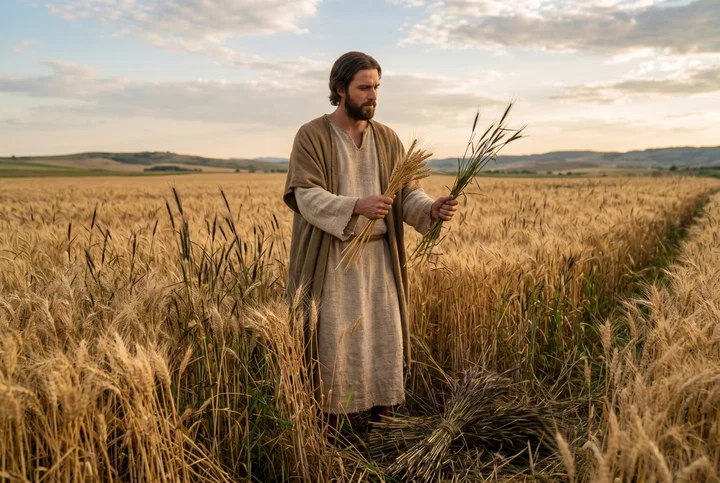
Let both grow together until the harvest: and in the time of harvest I will say to the reapers, Gather ye together first the tares, and bind them in bundles to burn them: but gather the wheat into my barn.
Translations
Let both grow together until the harvest: and in the time of harvest I will say to the reapers, Gather you together first the tares, and bind them in bundles to burn them: but gather the wheat into my barn.
King James Version, KJV Cambridge Paragraph Bible
Let both grow together until the harvest: and in the time of harvest I will say to the reapers, Gather ye together first the tares, and bind them in bundles to burn them: but gather the wheat into my barn.
Let both grow together until the harvest: and in the time of harvest I will say to the reapers, Gather ye first the tares, and bind them in bundles to burn them: but gather the wheat into my barn.
Let both grow together until the harvest: and in the time of the harvest I will say to the reapers, Gather up first the tares, and bind them in bundles to burn them: but gather the wheat into my barn.
Let both grow together until the harvest: and in the time of the harvest I will say to the reapers, Gather up first the tares, and bind them in bundles to burn them; but gather the wheat into my barn.
suffer both to grow together till the harvest, and in the time of the harvest I will say to the reapers, Gather up first the darnel, and bind it in bundles, to burn it, and the wheat gather up into my storehouse.'
Suffer both to grow together unto the harvest, and in time of the harvest I will say to the harvestmen, Gather first the darnel, and bind it into bundles to burn it; but the wheat bring together into my granary.
Suffer both to grow together until the harvest, and at, harvest time, I will say unto the reapers,—Collect ye first, the darnel, and bind it into bundles, with a view to the burning it up; but, the wheat, be gathering it into my barn.
Berean Standard Bible, Majority Standard Bible
Let both grow together until the harvest. At that time I will tell the harvesters: First collect the weeds and tie them in bundles to be burned; then gather the wheat into my barn.’”
Let both grow together until the harvest, and in the harvest time I will tell the reapers, “ First, gather up the darnel weeds, and bind them in bundles to burn them; but gather the wheat into my barn.”’”
Let them come up together till the getting in of the grain; and then I will say to the workers, Take up first the evil plants, and put them together for burning: but put the grain into my store-house.
Let both growe together vntill the haruest, and in time of haruest I will say to the reapers, Gather yee first the tares, and binde them in sheaues to burne them: but gather the wheate into my barne.
Douay-Rheims (Challoner revision)
Suffer both to grow until the harvest, and in the time of the harvest I will say to the reapers: Gather up first the cockle, and bind it into bundles to burn, but the wheat gather ye into my barn.
Pictures
Cross-references 20 of 41
- Matthew 13:36-43
Then Jesus sent the multitude away, and went into the house: and his disciples came unto him, saying, Declare unto us the parable of the tares of the field.
gives Christ's explanation defining the terms
- Matthew 13:40-43
As therefore the tares are gathered and burned in the fire; so shall it be in the end of this world.
Explains the harvest’s separation and the fate of the wicked and righteous.
- Revelation 14:14-16
And I looked, and behold a white cloud, and upon the cloud one sat like unto the Son of man, having on his head a golden crown, and in his hand a sharp sickle.
Christ reaps the earth’s harvest at his coming.
- Matthew 3:12
Whose fan is in his hand, and he will throughly purge his floor, and gather his wheat into the garner; but he will burn up the chaff with unquenchable fire.
Both depict wheat gathered and the chaff burned.
- Malachi 4:1
For, behold, the day cometh, that shall burn as an oven; and all the proud, yea, and all that do wickedly, shall be stubble: and the day that cometh shall burn them up, saith the LORD of hosts, that it shall leave them neither root nor branch.
Both describe the wicked burned up like stubble.
- Matthew 13:49-50
So shall it be at the end of the world: the angels shall come forth, and sever the wicked from among the just,
Angels separate the wicked from the just at the end of the age and cast them into fire.
- Matthew 13:25
But while men slept, his enemy came and sowed tares among the wheat, and went his way.
The enemy sows tares among the wheat while people sleep.
- Matthew 25:32-33
And before him shall be gathered all nations: and he shall separate them one from another, as a shepherd divideth his sheep from the goats:
At his coming, Christ separates the righteous from the wicked and assigns their destinies.
- Matthew 13:43
Then shall the righteous shine forth as the sun in the kingdom of their Father. Who hath ears to hear, let him hear.
The righteous shine in the Father’s kingdom after the tares are burned.
- Matthew 13:38
The field is the world; the good seed are the children of the kingdom; but the tares are the children of the wicked one;
Identifies the field as the world and the wheat and tares as two kinds of people.
- Hebrews 6:8
But that which beareth thorns and briers is rejected, and is nigh unto cursing; whose end is to be burned.
Both describe the wicked as burned for destruction.
- Matthew 13:40
As therefore the tares are gathered and burned in the fire; so shall it be in the end of this world.
The tares’ burning at the harvest depicts the wicked’s fate at the end of the age.
- Revelation 14:18-19
And another angel came out from the altar, which had power over fire; and cried with a loud cry to him that had the sharp sickle, saying, Thrust in thy sharp sickle, and gather the clusters of the vine of the earth; for her grapes are fully ripe.
The ripe wicked are gathered for God’s wrath, paralleling the tares gathered for burning.
- Matthew 9:37-38
Then saith he unto his disciples, The harvest truly is plenteous, but the labourers are few;
Both use harvest imagery for gathering people, with laborers sent into the field.
- John 4:35
Say not ye, There are yet four months, and then cometh harvest? behold, I say unto you, Lift up your eyes, and look on the fields; for they are white already to harvest.
Both describe fields ready for harvest and call for gathering.
- 2 Peter 2:9
The Lord knoweth how to deliver the godly out of temptations, and to reserve the unjust unto the day of judgment to be punished:
The unjust are reserved for punishment until the day of judgment.
- Matthew 13:3-8
And he spake many things unto them in parables, saying, Behold, a sower went forth to sow;
The sower’s seed, like the wheat and tares, shows good and evil growing side by side.
- Revelation 14:14
And I looked, and behold a white cloud, and upon the cloud one sat like unto the Son of man, having on his head a golden crown, and in his hand a sharp sickle.
Christ appears with a sickle to reap the earth’s harvest.
- 1 Corinthians 4:5
Therefore judge nothing before the time, until the Lord come, who both will bring to light the hidden things of darkness, and will make manifest the counsels of the hearts: and then shall every man have praise of God.
Both warn against judgment before the appointed time, when the Lord reveals what is hidden.
- Malachi 3:18
Then shall ye return, and discern between the righteous and the wicked, between him that serveth God and him that serveth him not.
The harvest reveals who serves God and who does not.
Commentary part 1 of 2
Each commentary is drawn from primary sources: the writings of Ellen G. White and Adventist pioneers and periodicals. Each commentary is separate. Its own words are not a quotation; follow the references to read the source passages.
Ellen G. White
421 sources
Christ sows the good seed as the children of the kingdom, Satan sows the tares as the children of the wicked one, the field is the world and the church in the world, the harvest is the end of the world, and the angels as reapers first gather what offends to burn in fire and then gather the wheat so the righteous shine in the Father's kingdom.Lt 102, 1901, par. 4–6MH 493.2COL 70.2ST Nov 24, 1887RH Apr 1, 1902
Good and evil, true and false believers, must remain together until the harvest at the end of probationary time, because their roots are entwined and human judgment of heart and motive is too imperfect to uproot the supposed tares without destroying wheat Christ is drawing.ST Feb 9, 1915Ms 82, 1900, par. 14Lt 11, 1893, par. 8–10Ms 96, 1900, par. 16–17COL 72.1
While green and growing the tares look like wheat and deceive many as mere professors mingle with true followers, but when ripe there is no likeness, for fruit reveals character and those joined to the church without being joined to Christ are made manifest.Lt 86, 1907, par. 10–13Lt 30, 1895, par. 47–48COL 74.2–3ST Jul 15, 1897ST Apr 9, 1912
The binding of the tares in bundles to burn and the sealing of the wheat for the garner is taking place now as every person reveals by spirit and course which bundle he is binding himself with, the tares uniting with Satan for destruction and the wheat united by truth under the Holy Spirit for heaven.Lt 201, 1902, par. 11–12EW 4.2–3SCEV 6.3–7.25T 384.1Lt 13, 1892, par. 8–10
Therefore no human is given the work of final condemning and uprooting, which belongs to Christ and His angels alone, and each must take heed to himself to be sanctified through truth, bear precious fruit, and be found gathered as wheat rather than bound as tares for the fire.Ms 52, 1899, par. 1–2Lt 98, 1896, par. 26–29Lt 317, 1905, par. 7–9COL 71.2–35T 540.3
Parable Story and Symbols
The verse belongs to a parable in which tares grow alongside wheat and resemble the grain while green and growing, with roots so entwined that pulling the tares would disturb the wheat and destroy its young blades.ST Nov 24, 1887MH 493.2ST Nov 24, 1887 When the servants asked from zeal for their master's honor to pull out the tares, the master refused because uprooting them would also uproot the wheat, and ordered both to remain side by side until the harvest.ST Nov 24, 1887MH 493.2 The wheat and tares are therefore to stay together until harvest because earlier removal could uproot the wheat, and at harvest they are separated with the tares gathered and burned while the wheat is brought into the barn.MH 493.2ST Nov 24, 1887RH Apr 1, 1902 Their presence represents evil seeds sown among the good, as troublesome weeds growing among and resembling the grain.ST Nov 24, 1887ST Nov 24, 1887
The field is the world, and the church of Christ in the world is the field where people are to grow and ripen for God's harvest and garner.Lt 102, 1901, par. 4–6COL 70.2ST Feb 9, 1915 The good seed are the children of the kingdom sown by the Son of man, the tares are the children of the wicked one sown by the devil, the harvest is the end of the world, and the reapers are the angels.Lt 102, 1901, par. 4–6RH Apr 1, 1902 At harvest time the angels first gather out all that offends and them which do iniquity and cast them into a furnace of fire with wailing and gnashing of teeth, and then gather the wheat so the righteous shine forth as the sun in the kingdom of their Father.Lt 102, 1901, par. 4–6RH Apr 1, 1902 The gospel calls together in church capacity those who come out from the world, and the kingdom of God must be kept free from the sinful practices of the world.Lt 102, 1901, par. 4–6ST Feb 9, 1915
The chapter is given as a warning and points to the final judgment, when people will face Christ's judgment seat and only those acquitted, with characters free from stain, will stand.Lt 317a, 1905, par. 6–8 The teaching shows two opposing forces and their work, with wheat and tares remaining together until separated at harvest, and its lessons are important for recognizing the enemy's deceptive ways and following Christ's teaching.Ms 115, 1906, par. 21–22 The parable applies to all kinds of people because familiar fields and the work of sowing and harvesting grain made its lesson accessible to everyone through an illustration familiar to ordinary listeners.2SP 253.2–3ST Dec 1, 1887ST May 17, 1877 The lessons of sowing and harvest teach that God works in nature and make plain the things of the kingdom of heaven, with the seed's growth depending on God's power working together with human care and skill.2SP 253.2–3Ms 170, 1899, par. 12–13
The picture illustrates the things of the kingdom of heaven and the work of the great Husbandman for His people to strengthen the wheat and put it in flourishing condition, that the tares sown among it may not assume the supremacy.Ms 34, 1898, par. 5–7 The kingdom of heaven has laws of government, else it would not be a kingdom.Ms 34, 1898, par. 5–7 The first great sower of evil drew away by deceptive power a part of the holy family of heaven under a lie, and those who apostatized fell because there could be no disloyal ones in the Lord's kingdom, so every disloyal subject was turned out of the blessed abode, the celestial city of God.Ms 34, 1898, par. 5–7 Christ is the sower of the seeds of truth, come to sow the world with truth in the garb of humanity as head of the human race to limit Satan's power and bring restoration by revealing truth adapted to the apostate race as the Word of God in contrast with Satan's falsehood, Himself the Truth minimizing error and magnifying truth, enabling the natural mind by His teaching to understand spiritual things and bring man back to loyalty to God.Ms 34, 1898, par. 5–7
The tare in nature represents the evil that blights and mars, growing alongside objects that reveal the love that restores, from singing bird and opening blossom to rain and sunshine, summer breeze and gentle dew, and from the oak of the forest to the violet at its root.ED 101.2–3 This mingling of evil with good in nature is read aright only in the light shining from Calvary, through Bethlehem and the cross, where good conquers evil and every blessing comes as a gift of redemption, so nature still speaks of God's goodness.ED 101.2–3 Nothing God made is useless, for His creation is a reservoir of means made ready for Him to employ instantly to do His pleasure, but tares were sown by the enemy through the curse bringing confusion and disorder into a world otherwise governed by God where the natural world obeys its Creator.Lt 131, 1897, par. 3–517MR 58.1–59.16MR 30.2 Rational beings alone cause confusion in the world when they resist God instead of living to Him, honoring Him, and revealing His perfection in themselves.17MR 58.1–59.16MR 30.2
When man fell by transgressing the law of God, man's disobedience gave Satan opportunity to sow seeds of evil in the human heart, and the earth was cursed so the ground that in the beginning produced only good began to produce tares.Lt 5, 1900, par. 4 The growth of the tares calls for continual warfare, and the cultivation of the soil enjoined on man becomes a mirror in which man may see reflected and learn spiritual lessons about the work of God upon the human soul.Lt 5, 1900, par. 4 The image of an enemy scattering harmful growth among precious wheat shows what is valuable opposed by briers and thorns that hinder good work, and the enemy ever seeks to scatter them so overcoming that scattering and bringing efforts to success requires earnest labor.Lt 106, 1908, par. 12–132MR 315.2–316.11MR 172.5–173.4 Even wise-looking plans carried out with the best motives still lose the good results sought when they result in friction.2MR 315.2–316.1 The field where Christ sowed the gospel was a world where the enemy had already sown error, with tares growing in the field, without here explaining its harvest and separation.ST Feb 24, 1898
Wheat Tares and Sowers
The wheat are the children of the kingdom born of God's word and truth sown by the Son of man, and the tares are the children of the wicked one embodying error and false principles sown by Satan and the devil, not by God or His angels.COL 70.3Lt 102, 1901, par. 4–6RH Apr 1, 1902 The field is the world, the harvest is the end of the world, and the reapers are the angels who first gather out all that offends and does iniquity to cast into a furnace of fire with wailing and gnashing of teeth, then bring in the wheat so the righteous shine as the sun in the kingdom of their Father.Lt 102, 1901, par. 4–6RH Apr 1, 1902 The gospel calls together in church capacity those who come out from the world, yet the kingdom must be kept free from sinful practices of the world.Lt 102, 1901, par. 4–6
Sinners making pretension of piety mingle for a time with true followers and deceive many while the blades are green, for tares closely resemble wheat at that stage.Lt 86, 1907, par. 10–13COL 74.2–3 In the harvest of the world there will be no likeness between good and evil, for when ripe the worthless weeds bear no likeness to wheat bowing under full ripe heads.Lt 86, 1907, par. 10–13COL 74.2–3 Those who joined the church without joining Christ will then be made manifest, judged by words and deeds and character rather than profession, receiving the same sun and rain until Christ separates them.Lt 86, 1907, par. 10–13COL 74.2–3
The tares are false counterfeit Christians always found among true disciples, bearing Christ's name while denying His character, whose conduct misrepresents Christ and the Saviour and dishonors God, putting souls in danger and dishonoring the work.Lt 30, 1895, par. 47–48COL 71.1Lt 19a, 1892, par. 16–18 Some listed as members are not joined to Christ or transformed into His likeness, and their profession and good deeds do not make them Christians, for temptation reveals a different spirit; they are uncircumcised by grace, hypocrites alongside genuine Christians who are genuine without pretense and true in heart and soul and action.Lt 30, 1895, par. 47–48Lt 19a, 1892, par. 16–18Lt 135, 1899, par. 22 They include the sensual, the proud, the careless in heart, and those opposed to truth who do not love it to be sanctified and refined, who grow with the faithful for a time but carry out the will of the great enemy; their present bundling in unbelief and darkness fits them for last-day fires when they will cry that harvest is past and they are not saved, and after a time the true Watcher who never mistakes character will separate false from true so no soul is excused by another's sin.Lt 135, 1899, par. 22Lt 124, 1899, par. 12–14Lt 366, 1907, par. 10
In the parable Christ sows good seed in the human heart while Satan secretly sows seeds of evil and error that can grow abundantly, crowd out and destroy what is good, and spread sin to others, and vice must not be mingled with virtue.ST Nov 24, 1887Lt 189, 1900, par. 7–9 Satan is a living persevering power working to keep Christ's kingdom from coming and God's will from being done by sowing his tares while the church sleeps.Ms 10, 1892, par. 13 Those tares are the selfish self-centered idle spirit he manifests in professed Christians, with selfishness, pride and self-indulgence showing his seed sown in hearts among God's people, so that with many refusing to shine and do their given work the world is left unenlightened and spiritual growth and power are needed to resist him.Ms 10, 1892, par. 13Lt 209, 1899, par. 15–16
The righteous and the wicked remain mixed through the ages and as long as time lasts, and their fruit reveals which is which so they can be recognized by the lives they produce.ST Jul 15, 1897ST Apr 9, 1912Ms 25, 1897, par. 25 Tares among wheat are error mingled with truth and guarded by Satan who seeks to make error grow until it overshadows truth, but Christ sows no error.Ms 30, 1898, par. 5–6 His truth must be clearly set against error so people can recognize and discard the false, and truth planted and cherished in the heart uproots errors cherished as truth.Ms 30, 1898, par. 5–6
The corn is sound teaching grounded in God's word, while cockle and darnel are Satan's corrupting work diligently spread while good doctrine is neglected, including replacing the Bible and gospel with human traditions and religious practices.GC 248.3 Wheat is present truth and pure provender thoroughly winnowed from chaff, meat in due season for the flock, and when truth is taught in its purity no tares are mingled with the seed being sown.Ms 44, 1904, par. 11–12Ms 140, 1901, par. 32–38 Letting unexamined matter go out would make publishing houses agents for disseminating error, divert minds from essential truth and bear fruit in dissension, so barriers, resolutions and examination by converted judges are necessary to hold back tares until harvest.Ms 140, 1901, par. 32–38
Wheat is truth upholding faith in Christ and the authority and purity of Old Testament Scriptures, and tares include false religious teaching that unsettles faith with questioning, doubt and unbelief, including the argument that Christ was only a man.6MR 268.1–269.3 To publish both from the same press mingles tare-sowing with wheat, brings in sophistry, wastes time worse than wasted, corrupts workers and youth, sends forth educated infidels, and is work God condemns and will not prosper but would cleanse away as defilement.6MR 268.1–269.3
Tares are false ideas, errors, theories, maxims and deceptive satanic theories that Satan sows among people through people who serve him, through false teachers and theories arising among believers, through books teaching errors and fables and human writings opposing God like weeds among God's Word, through teachings leading onto a false track, and through untruth and confusion staining purity of faith.RCNBP 10.3Lt 322, 1905, par. 2Lt 26, 1898, par. 4–7Lt 220, 1903, par. 3–1011MR 319.4–320.3 They may appear as light while deceptively mingling with truth, are pressed into minds by specious argument where they ought not to be, mingle with truth and draw away from true service through false interpretations, weaken faith in the heart and draw from the path of truth, and can take root so some give up truth and others become unbelievers bringing judgment.Lt 322, 1905, par. 2Lt 224, 1906, par. 29Lt 26, 1898, par. 4–7Lt 220, 1903, par. 3–1011MR 319.4–320.3 They take root in minds, make right and wrong difficult to distinguish, weaken faith, diminish truth's influence, confuse about what is true, hinder piety and corrupt those who teach others, so believers must take heed how they receive human teaching, let Christ's Word abide, remain healthy fruit-bearing branches of the living vine, make His words food and drink, and walk in the light doing even humble duties faithfully.Lt 224, 1906, par. 29
Tares sown among wheat are misleading sentiments and seeds of doubt, unbelief and infidelity placed in the mind by deceptive influence, spread by heretical unbelief through influence and by words and actions especially of those in responsible positions.STMW11 9.2–10.1Ms 195, 1905, par. 4–5Lt 244a, 1906, par. 4–5Ms 16, 1908, par. 7–9Ms 51, 1908, par. 13 Falsehoods can take root among those who once rejoiced in truth, skeptical words or infidel influence can take root and cause unhappy reflection that cannot be recalled once gone forth, deceptive teachings can confuse those of genuine experience especially when warnings are rejected and spoil faith and experience, and unbelief sown by men using influence to undermine faith poisons minds, damages the church, takes root and multiplies weakening the faith of others until envy and hatred reveal the sowers as deceivers.STMW11 9.2–10.1Ms 195, 1905, par. 4–5Lt 244a, 1906, par. 4–5Ms 16, 1908, par. 7–9Ms 51, 1908, par. 13
Wheat growing among tares pictures God's professed people where truth develops amid error in the churches through the Christian era.1MR 372.1 The wheat is God's flock and the tares are apostasy, unbelief and deception sown among wheat by men entrusted with solemn charge through satanic agencies working mind upon mind, turning men from warnings, manufacturing unbelief and ruining faith and confidence through false assurances while men sleep when warnings are unheeded, where one sinner under deception can spread harm widely and those persisting in departing to seducing spirits and spoiling the flock will have sentence pronounced.Lt 126, 1906, par. 17–18 Tares sown among wheat are untruth and confusion as to what is truth staining purity of faith with confused ideas and impure thoughts that mold physicians, ministers and students into blindness unable to discern who serves God, wrought through influences at Battle Creek and in Living Temple from cherished unholy desire and rebellious purpose, and Satan's agents mixing truth with indecent practices discredit sacred truth and make it ineffective though truth itself remains unchanged.Lt 57, 1906, par. 521MR 129.2–6 Knowing truth or professing faith does not by itself change the heart where tares may remain, for truth must be received with faith working through love and purifying the soul, without which a person is unconverted.Ms 14, 1898, par. 2
Growing Together Until Harvest
Good and evil remain together in the world until the harvest, which is the end of the world, and this rules out a thousand years of universal righteousness and peace or temporal millennium in which the whole world is converted before Christ's personal return.GC 321.1–323.1GC88 321.1ST Nov 24, 1887 The righteous and the wicked are allowed to remain together until that appointed harvest because their roots are entwined, so that removing the wicked prematurely would disturb the righteous.Ms 82, 1900, par. 14Lt 11, 1893, par. 8–10Ms 96, 1900, par. 16–1720MR 26.2 God alone in pity and compassion will separate them at the right time when character is fully revealed, and finding objectionable people among believers is therefore no cause for surprise.Ms 82, 1900, par. 14Lt 11, 1893, par. 8–1020MR 26.2 At harvest the tares become distinguishable from the ripe grain, for the wicked and righteous may appear alike for a time, but then the wicked, including false professors who mingled with followers, are removed and destroyed while the righteous are gathered safely to trouble them no more.ST May 10, 18772SP 247.2–249.1ST Nov 24, 1887
True and false believers are to remain together in the church until the harvest, which is the end of probationary time when true character is fully revealed and separation takes place.ST Feb 9, 1915COL 72.1COL 71.2–3 Human judgment of character and motive is too imperfect to safely uproot those thought to be false, since this may destroy the hope of those Christ is drawing, harm true believers closely connected with them, or cause others who would otherwise remain steadfast to stumble.ST Feb 9, 1915COL 72.1COL 71.2–3 This forbids judging character and motives, though it does not forbid separating those persisting in open sin, and at harvest some who appeared Christian will be found wanting while some judged hopeless will be saved, for people judge appearances but God judges the heart.ST Feb 9, 1915COL 71.2–3 Wheat and tares remain together through a long conflict between divine and satanic agencies in decided opposition continuing till the close of earth's history, revealing how long God has borne with stubborn self-indulgence, and this does not endorse corrupting church associations or tolerating evil in Christian assemblies.Ms 7, 1900, par. 20–22Lt 176, 1900, par. 3 At that harvest the wheat is gathered for Christ while the tares, though they looked like wheat, are rejected, and the time of harvest is when everything shakable is shaken so what cannot be shaken may remain while God tests His people.Ms 7, 1900, par. 20–22Lt 176, 1900, par. 3
Two classes are now ripening side by side for opposite destinies, those faithfully serving God as wheat for God's garner while worldly men ripen as tares for destruction fires.RH Apr 6, 1916RH Aug 25, 1910 Between them a great gulf is fixed, for on God and truth and eternity their thoughts and sympathies are not in harmony, and because their standard of character and end are opposite there can be no unity of purpose or action, so Christ never leads His followers to bind themselves by vows in confidence with those having no connection with God.RH Apr 6, 1916RH Aug 25, 1910 Good and evil continue to grow and contend in the world until the great harvest, in the same field at the same time some sowing evil and error while others sow good by revealing Christ and preparing for His second coming.RH Apr 3, 1900Ms 3, 1900, par. 5–8 Until harvest Christ's followers are to keep faithfully and diligently sowing good seed for the salvation of souls, while those rejecting truth spread error and darken understanding.RH Apr 3, 1900Ms 3, 1900, par. 5–8
The harvest is the time when Christ gathers the precious grain, ripened as Christians bear fruit to God's glory and the gospel spreads throughout the world, the last harvest before He comes when He comes to gather His people.COL 69.28T 22.4 Good and evil remain mixed until that harvest, with tares among wheat picturing deception and those led astray, and each person is on trial for eternal life.COL 123.1–2Ms 61a, 1906, par. 39 There is no probation after the Judgment, for when the gospel's work is completed separation follows and each group's destiny is forever fixed, and the wicked will not all turn to God before that time.COL 123.1–2Ms 61a, 1906, par. 39 The harvest is not a time when tares are transformed into wheat, for tares represent false teachings sown among truth and cannot be changed into wheat by tears or repentance.ST May 10, 1877COL 75.12SP 249.2–250.2Lt 136a, 1898, par. 23–27 At harvest the chaff among wheat is exposed, angels gather the wicked including those doing evil and rejecting offered mercy for destruction while the righteous are gathered into the kingdom for eternal life, and those spreading false teaching face the loss caused to people deprived of truth.ST May 10, 1877COL 75.12SP 249.2–250.2Lt 136a, 1898, par. 23–27
The final separation gathers the wheat into God's garner while binding the tares for destruction, with wheat gathered in sheaves representing God's people kept by Him and tares bound as fuel for fires of destruction.4SP 447.1GC88 630.1–631.1 At harvest the tares are gathered first and bound in bundles to burn while wheat is gathered into the barn.Lt 201, 1902, par. 11–12COL 70.14MR 78.1–79.17MR 57.4–58.1 That binding is taking place now as transgressors of God's law take sides with Satan the leader of rebellion, yielding to his temptations and binding themselves together in unions and combinations including labor unions formed or to be formed, ready to be consumed by last-day fires.Lt 201, 1902, par. 11–124MR 78.1–79.17MR 57.4–58.1 The wheat are God's people on earth who see the evil of every phase of oppression and injustice and refuse to unite with the enemy in carrying out his plans, and those claiming to be God's children are forbidden to bind up with those unions.Lt 201, 1902, par. 11–124MR 78.1–79.17MR 57.4–58.1
Harvest Separation Accomplished
The righteous and the wicked remain together until the harvest at Christ's second coming, when they receive different outcomes, the righteous honored with everlasting life and gathered like precious grain into God's heavenly storehouse, and the wicked cut off and destroyed, gathered like tares for the last-day fire.5T 100.2SG3 57.2 Until that harvest the righteous encounter the ungodly in the ordinary duties of life, and their godly character is to make the difference visible, showing the excellence of life in God's light.5T 100.2 Wheat and tares picture the final separation of the righteous and the wicked, for at harvest the tares are gathered and separated from the wheat, and truth taught in its purity is not mingled with tares in the seed being sown.DA 333.1–2Ms 44, 1904, par. 11–12
The verse describes the great day of final ingathering foreshadowed by the Feast of Tabernacles as the feast of harvest, when the Lord of the harvest will send out His reapers to gather the wicked together for burning by fire and to gather the righteous into His storehouse, the wicked destroyed so as to become as though they had not been, and afterward every voice in the whole universe uniting in joyful praise to God.PP 541.2 The harvest is the gathering of the redeemed into Heaven's garner, where Christ will see the saints saved through His suffering and be satisfied, and those who sow truth and develop Christian character through good works will reap in the world to come, their work on earth reaching completion in eternal life.ST Jan 16, 1879 Wheat and tares are to remain growing together until the harvest, when they are separated by fruit, the tares gathered for burning and the wheat brought into the barn, showing final judgment belongs to God who distinguishes outcomes by character of fruit.Ms 104, 1901, par. 21–22Ms 75, 1886, par. 31–32Lt 215b, 1899, par. 7–11Ms 53, 1894, par. 19–20Lt 63, 1893, par. 43–48 This does not forbid present efforts to prevent impurity or to separate the wicked from the righteous in human institutions to protect others from harm, but distinguishes the final harvest-time separation from such present protection.Ms 104, 1901, par. 21–22
The final harvest separates those who reject truth for destruction from those who turn from error to truth for God's heavenly storehouse, the harvest representing the earth's final ripening through the closing messages given especially for the last church, reaching its final division where the closing message ripens people either as sheaves for the heavenly garner or as bundles for the fires of the last day.4SP 211.3–212.1ST Nov 1, 1899 That binding of tares in bundles to be burned and gathering of wheat into the heavenly garner would have come speedily after 1844 at the beginning of the great day of atonement if Advent believers had stayed united in brotherly love, held confidence without wavering, obeyed light from heaven, united in proclaiming the third angel's message, and carried Sabbath reform with power to nations, kindreds, tongues and all countries, but division hindered God's work and delayed that speedy gathering and burning.Ms 194, 1901, par. 5–6 At the end the wheat representing God's people is gathered into God's garner while the tares are bound together as fuel for destruction, coming at the end of the time of trouble which will be shortened and arrive sooner than people expect.GC 630.1–2
Wheat and tares remain together until the harvest separation of rebels from the loyal and true in due time, for God permits rebellion to expose the faithful and reveal those who are spurious, since truth gathers people of every kind but they are not all ultimately pure in heart.5MR 297.2 The harvest and garner picture shows wheat gathered for God's heavenly storehouse, with afflictions and trials as God's workmen testing and refining Christians, separating chaff from wheat, exposing evils in character, and helping prepare them for the heavenly garner as they overcome through God's strength and grace.TCBMP 146.1 The selecting of the wheat from the tares is the work of the third angel, a fearful work with an awful mission that should engross whole mind and attention, and the sealing or binding of the wheat is for the heavenly garner, while those sharing in that work must separate the vile from the precious.EW 96.4SCEV 38.3Ms 3, 1854, par. 16–17Ms 3, 1853, par. 7Ms 1, 1854, par. 7–8 The same harvest is the time when wheat is separated from tares, tares gathered for destruction and judgment and wheat gathered into the barn, bound and sealed for that heavenly gathering.SCEV 38.3Ms 1, 1854, par. 7–85MR 425.3
Human Uprooting Forbidden
The command to let both grow together until the harvest calls for the same forbearance toward fellow men that the Lord shows, not condemnation and judgment of others but humility and distrust of self, for not all sown in the field is good grain and being in the church does not prove one a Christian.Lt 86, 1907, par. 10–13COL 74.1 The tares closely resemble wheat while the blades are green, and sinners making a pretension of piety mingle for a time with true followers and deceive many, but in the harvest of the world there will be no likeness between good and evil, for when ripe the worthless weeds bear no likeness to wheat bowing under full ripe heads and those who joined the church without joining Christ will be made manifest.Lt 86, 1907, par. 10–13 This dealing with evil among men and angels is seen in that God did not at once destroy Satan when he sinned, because even loyal angels did not fully discern his character and immediate destruction would have kept them from perceiving God's justice and love and would have left doubt of goodness as evil seed yielding sin and woe, so the author of evil was spared to fully develop his character, and through long ages God bore anguish beholding evil and gave Calvary rather than let any be deceived, because tares could not be plucked without danger of uprooting grain.Lt 86, 1907, par. 10–13
The tares are in the church and must be left to grow with the wheat until the harvest, and the command not to gather them forbids giving human agents the work of condemning members and purifying the church, because they would make terrible mistakes and root up wheat with them, since all judgment is committed to the Son who lived God's law in humanity and understands temptation for every child.Ms 52, 1899, par. 1–2 No human may measure fellow men's characters or gather the tares, for judgment is given only to Christ who lived humanity and alone understands human weakness and striving for perfection, and at harvest at the end of the world Christ will tell the reapers who are angels to gather first the tares to burn and gather the wheat into His barn.Lt 98, 1896, par. 26–29 Christ forbids servants to uproot those they judge false because imperfect judgment can mistake people Christ is drawing and destroy their hope or cause others to stumble, which does not forbid separating those persisting in open sin but forbids judging character and motives, and the harvest reveals the final outcome where some appearing Christian will be found wanting while some judged hopeless will be saved, for people judge appearances but God judges the heart.COL 71.2–3
Wheat and tares remain together until harvest because people cannot reliably distinguish them though fruits reveal character, at harvest God's angels will separate them without error, and human beings are not authorized to make this final separation.Ms 92a, 1898, par. 14–1816MR 270.3–271.2 The tares so closely resemble the wheat that men cannot read the heart to tell them apart, as with wise and foolish virgins who cannot now be distinguished and whom no one has authority to pronounce wise or foolish though those holding truth in unrighteousness appear outwardly like the wise, and the angels know them by fruit and being commissioned to counterwork those fighting God's word will never mistake the gathering.16MR 270.3–271.2 Wheat and tares are to remain together in the church until harvest and it is not for people relying on human wisdom to uproot those they judge tares because they may destroy wheat as well, applying especially when Satan prompts mistaking wheat for tares, while wisdom from above builds up God's people rather than destroying them and workers are to resist rooting out imperfect Christians.Lt 63, 1893, par. 15–17Lt 63a, 1893, par. 11–14
Good and bad may remain together in the church until God's appointed harvest and servants should not hastily remove those they judge tares because they may harm sincere wheat, the tares representing error spread by Satan whose opportunities increase through negligence and lack of vigilance among receptive unsanctified hearts.TCBMP 143.1–145.13T 113.1 Ministers and churches are therefore called to patience, prayer, careful judgment, self-control and restraint, since difficulties may resolve without premature intervention and forceful efforts to set matters right can loosen or damage wheat, cause divisions and factions, and discourage believers who might otherwise be nourished and established in the truth.TCBMP 143.1–145.13T 113.13T 113.23T 114.13T 114.2 Wheat and tares must be left to grow together until harvest, so those who despise and trample God's truth are to be left in God's hands and not judged by others, God pities poor self-deceived souls under Satan's dominion, the faithful should pity their blindness while restraining wrath and passion, and the right to pass judgment is not given to humans just as Moses was not given authority to pronounce judgment against rebellious Israel.13MR 312.1Lt 18, 1895, par. 7
Trying to uproot tares before harvest is warned against, and punishing people judged evil or heretical through imprisonment, torture or death is not Christ's Spirit but Satan's method misrepresenting God, and using the church's imprisonment, torture and execution of accused heretics as example the verse warns against using civil power to punish supposed wrongdoers.COL 73.1ST Feb 9, 1915 The verse does not forbid present efforts to prevent impurity or to separate the wicked from the righteous in human institutions to protect others from harm, it reserves the final separation for harvest time, and faulty people in the earthly church which is not yet as pure as the triumphant church are not to be removed by force, excommunication or denunciation.RCNBP 6.2Ms 104, 1901, par. 21–22 The separation of tares from wheat belongs to God not human beings, the church may address disorderly members according to the Bible's rule but cannot make the final separation between true and merely apparent believers, and the gospel gathering is a mixed company where readiness requires the robe of Christ's righteousness which He provides.RH May 8, 1900 The work of uprooting tares is not given to this person, so criticizing and trying to direct others in this way is not his place.Lt 182, 1903, par. 24–26
Mixed Church Condition
The gospel gathers those who come out from the world into church fellowship, and God's kingdom must be kept clear of the world's sinful practices.Lt 102, 1901, par. 4–6 Good and faulty members remain together in the church until the harvest, and believers are not authorized to judge and uproot those they deem unworthy, for Christ patiently permits the mixture and will Himself decide who belongs with the saints, judging each by words and works rather than profession, while seeking to lose no soul.Lt 48, 1897, par. 12–23RCNBP 4.1–5.1 At harvest the ripened character of the wheat will make it distinct from the tares, and angels will make the separation.RCNBP 4.1–5.1 Many sinners in Zion are tares among the wheat and both must grow together until the harvest separation, yet this leaves no discouraging message, for though reproofs, cautions and corrections have been given the church still stands as God's instrument to diffuse light, and God's commandment-keeping people sound a warning to every language, tongue and kindred as a living witness and continual testimony that convinces if accepted and condemns if resisted and rejected.Ms 96, 1893, par. 1 The church militant is not yet the church triumphant, so the presence of people of un-Christian character does not mean the church is to be judged by them or that they are to be expelled, nor does their presence require anyone else to become as tares.SCE 21.2
The presence of the spiritually unfaithful does not make the whole church guilty of their character nor make faithful members tares, and the church should not expel them merely for being present but pity them more than blame them, teaching patience while each remains responsible for personal character and choices.FE 294.2 Inside the commandment-keeping church the true and the false grow side by side as wheat with tares and chaff until the harvest, when the chaff is gathered first and bound in bundles to burn and the wheat is gathered into the garner, but that separation is not to be made now by men but by angels at harvest.RCOC 6.21MR 303.1–2Lt 16, 1893, par. 21 Therefore pride, self-sufficiency, stubborn unbelief and refusal to yield even when evidence is piled upon evidence, which makes the message to Laodicea apply, does not blot out the church so that it will cease to exist.RCOC 6.21MR 303.1–2Lt 16, 1893, par. 21 The Lord loves His church, and it is not to be called Babylon, disorganized, or broken up into independent atoms, while those who heed the false call to separate and leaven others will be deceived, prepared for further delusions, and will come to nothing.RCOC 6.2 Wheat and tares, and wheat and chaff, remain together until harvest, so the church is not to be broken up or divided into independent groups because some members are unfaithful, mistaken, proud, self-sufficient, stubborn or unbelieving, for at harvest angels and not people will separate them, gathering the wheat and removing the tares for destruction.1MR 362.2–363.11MR 303.1–2Lt 16, 1893, par. 21Lt 16, 1893, par. 20
Throughout the history of the third angel's message harmful men are left mixed among believers as tares among wheat, spots in feasts of charity and wolves among sheep ready to tear and devour, delighting in false witness, lies, and cruelly injuring reputations and tearing down God's servants.STGC 87.2Ms 162, 1902, par. 43 They are not separated now but grow together with the wheat until the harvest, the appointed day when God will judge the world in righteousness and reward everyone according to works.STGC 87.2Ms 162, 1902, par. 43 Then the separation will be made and hypocrites who tried to destroy reputations will be clearly revealed, and by their own lips they will bear testimony that clears from suspicion those against whom they reported evil, showing they knew all along they were dealing unjustly.STGC 87.2Ms 162, 1902, par. 43 Tares must grow with the wheat until harvest in the militant church, which is not yet triumphant, and the unconverted will be found in the church because Christ said it should be so.Ms 49, 1893, par. 25–26 They are to be pitied rather than expelled by unmerciful treatment or made an occasion for accusing brethren and judging the whole church as sustaining them, for their inconsistency comes from not trusting wholly in Christ and not abiding in Him, yet no one must choose them as familiar associates or become a tare because the harvest is not all wheat.Ms 49, 1893, par. 25–26
Wheat and tares remain together in the field until harvest, so the presence of false or unfaithful people does not mean God has no church or that faithful members should leave it, but the church continues its work while they are among it.ST Oct 23, 1879 Their presence is no reason to tear the church apart, but the church should be strengthened with humble devoted service while they remain.RCOC 10.1–2 Wheat and tares, the vile as well as the precious, grow together in the church, for the great house which is the church holds vessels of gold and silver and vessels of wood and earth, vessels to honor and vessels to dishonor, and as the net cast into the sea gathers both good and bad, the church on earth contains both until God makes the final separation.Lt 58, 1900, par. 9–15 Tares will always be among the wheat, so evils will be seen even among Sabbathkeepers, yet their presence does not justify disparaging the church or the people who strive amid temptation and trial, whom God loves.Ms 167, 1899, par. 13–166T 239.2–4Lt 204, 1899, par. 10–1321MR 57.2 Sanctified believers will not bring depravity into things small or great and will not perpetuate division, while leaders of every church and managers of every institution are to take up open purification until the transformation of the church becomes a bright light in a dark place so it can shine.Ms 167, 1899, par. 13–166T 239.2–4Lt 204, 1899, par. 10–13
The church of God on earth contains wheat and tares together, the wheat being a consecrated people working with undivided interest, dear to God and loved by Him as they strive amid temptation and trial, and the tares including men whose names are on the church books yet who do not serve God, including those who rob Him as householder by withholding the tithes and offerings required as His portion, which gives no reason to disparage God's church.Lt 126, 1898, par. 26 Good and evil remain together among those who claim to be God's children during probationary time, when Satan can work on human minds and good and evil remain in conflict, so defects should be expected rather than taken as proof that the church is perfect or should be free of evil.Lt 63a, 1893, par. 4–6Lt 63, 1893, par. 2–5 The church militant is not yet the church triumphant, and the harvest points to a future separation, giving no warrant for suspicion, complaining or faultfinding.Lt 63a, 1893, par. 4–6Lt 63, 1893, par. 2–5 Tares may grow among the wheat in the militant church, which is not yet triumphant, and the presence of stumbling blocks or of those who misrepresent Christ does not excuse anyone from being a Christian.Ms 2, 1893, par. 7–8 Tares are mingled with wheat inside God's church, yet God loves His church and the Lord knows His own true people within it and knows which are His even while mingled, for the church contains both faithful and unfaithful whose final separation belongs to harvest, when tares are gathered for destruction and wheat brought into God's barn.Lt 80, 1901, par. 14–15 Worldly elements mixed with the church like tares sown by an enemy among wheat can gain trusted positions and make unclear the distinction between serving God and not serving Him.STMW6 4.1–2
Satan's Secret Sowing
Letting both grow together until harvest reveals how God deals with evil among humans and angels, for He did not destroy Satan at once when he sinned because even loyal angels did not fully discern his character, and immediate destruction would have hidden God's justice and love and left doubt of His goodness as evil seed yielding sin and woe, so the author of evil was spared to fully develop his character while through long ages God bore anguish at beholding evil and gave Calvary rather than let any be deceived, since tares could not be plucked without danger of uprooting precious grain.Lt 86, 1907, par. 10–13COL 72.2ST Feb 9, 1915 The same forbearance is required toward fellow men, not condemnation and judgment but humility and distrust of self, for not all in the field is good grain and being in the church does not prove one a Christian, and sinners pretending piety mingle for a time with true followers and deceive many while blades are green, but at the world's harvest there will be no likeness between good and evil when ripe weeds bear no likeness to wheat bowing under full heads and those joined to the church without joining Christ are made manifest.Lt 86, 1907, par. 10–13
The parable shows Satan sowing tares among wheat while people are spiritually asleep to hinder Christ's kingdom while the church sleeps, working deceptively through human minds so that those not continually led and strengthened by God's Spirit may unknowingly do his work.18MR 159.3Lt 244, 1907, par. 4–7 That sleep is spiritual sleep among God's workers, meaning living far from Jesus, self-exalted and self-sufficient, without constant prayer and watchfulness and without partaking of the divine nature through living faith, while they sleep Satan stays awake to complete his rebellion and the self-sufficient are ensnared by specious devices to adopt enemy-instigated measures that appear right, professing to work for God while serving darkness with understanding blinded by dependence on human wisdom.Ms 40a, 1890, par. 4–5 He never slumbers but sows while men sleep, exulting when he persuades men to take his arm and become agents advancing his plans and increasing woe and misery, watching to take God's standard unnoticed and place his own in their hands, therefore men must awake, cast off his arm, break connection with him, and link with Christ wearing His yoke in meekness and lowliness.Ms 188, 1897, par. 12–13
While men slept tares were sown among good seed, where good seed is truth in the mind and tares are misleading sentiments placed there by deceptive influence unawares during spiritual sleep, forming a yoke and fetter that must be broken by ridding the mind of error and taking a stand on the Lord's side.Lt 116, 1906, par. 12–14 The enemy sows secretly and unnoticed to corrupt the young and draw them into his cause while others fail to recognize his work, warning that neglect and inattentiveness while God's word is spoken can leave room for him to work among what is good.FE 90.1Lt 31, 1886, par. 18 So it was after Paul left Corinth, when evil influences appeared among the faithful like tares among wheat and produced evil fruit as some returned to heathen sins, showing how evil sown among good grows alongside it, takes root over time, becomes evident, and contributes to carelessness.ST Apr 14, 1914SLP 149.1AA 299.2–3
Tares grow among wheat when falsehoods take root among people who once rejoiced in truth, weakening faith and diminishing truth's influence, and those spreading them may flourish for a time but God allows their envy and hatred to be revealed so their true character as deceivers and accusers becomes plain.STMW11 9.2–10.1 God suffers tares for a time to reveal true character, as hearts opened to Satan's sowing spring up among wheat until truth loses power, seen in families who lose faith through calamities and falsehoods about loved ones, follow new theories with false zeal, harden against advocates of truth as the Jews did against Christ, and for a season flourish like a green bay tree even to despite the Spirit, so the deceiver stands revealed before the heavenly universe and unfallen and fallen worlds while conflict grows fiercer as Satan takes the field, personates Christ, and perverts everything to deceive if possible the elect.Ms 92, 1897, par. 21–22 He works determinedly to mix error with truth by getting unsoundly converted people received into fellowship, using the degraded class whose appetites and characters were perverted, and though some are transformed many make only superficial change and suppose themselves Christians while remaining unsubmissive, resentful at every slight, cherishing bitterness and sensuality, untrustworthy and unholy, through whom he sows jealousy, dishonesty, criticism and accusing to corrupt others so every marred character creates dissension and cannot be trusted in the last-days work.8T 184.1–2
Sowing tares is the enemy's work on minds through doubts and questionings, as when pickers at straws set up a man of straw such as making an issue of words in testimonies, educating themselves to become Satan's agents passing along suggestions so another doubt follows as fast as one is cleared, while the good seed to sow in response is grand soul-saving truth.Lt 200, 1906, par. 6–9 It is seed sown as ideas of infidelity from school study books made of great interest when the brain is overloaded like an abused stomach with too much study, especially Greek and Latin instead of common-sense philosophy, until a bewitching power works the intellect into a fruitful field of tares, a curse instead of blessing.3MR 358.2 Sowing tares is putting erroneous sentiments into minds leaving no room for truth, with teachers who mix sentiments of infidel authors into education as co-workers with Satan in sowing youth's minds, the seed being words voiced before young and old, and every sower will garner a harvest from the kind sown.Ms 45, 1898, par. 22
The tares are seeds of doubt and unbelief sown by words and actions, especially by those in responsible positions who criticize laborers, reject messages, and counteract work appointed to divine agencies through human agencies, working openly and secretly under evil angels with defective perverted eyesight seeing in false light by satanic inspiration, and unless they repent they will soon find no place for repentance though they seek it with tears.Lt 87, 1896, par. 15 Satan sows while men sleep through mind working upon mind by manufacturing assertions against testimonies, turning from warnings, departing to seducing spirits, and influencing other minds to unbelief, which spoils the flock, ruins faith, leaves souls where no voice will be heeded so they are lost, requiring decided warning without silence and bringing sentence upon those who persist.Lt 126, 1906, par. 19 Two watchers attend every soul, Christ seeking to draw to believe for eternal life and Satan using every power with successive temptations, evil thoughts, worldly desires and lusts to sow tares, estrange and harden the heart until insensible to the Spirit and truth no longer enters the inner sanctuary, compassing its ruin.Lt 23, 1890, par. 38–41
Applied to failing to watch over the church, tares sown while men slept show unwatchful servants become implicated in surrounding wrong, so Christians must watch and oppose evils they can check, for silence sustaining what God cannot approve abets Satan's work and can lose souls, and the harvest image calls for actively checking evils in churches and institutions rather than tolerating them, since allowing them makes people partners in harm and decisive correction is needed so gospel work bears God's character.Ms 128a, 1903, par. 716MR 3.1–4.1 The enemy sows tares among wheat among those who connect with God's people, doing it now and continuing, and because many look at the kind who join these tares become a great barrier keeping very many from believing.Lt 4, 1900, par. 8–9 Tares among wheat are error mingled with truth and truth and falsehood growing side by side, requiring students to guard against influences leading them away.STE 159.1
Satan has been sowing evil while God's people slept and neglected to work the cities, yet the cities must still be worked despite corruption, and for years he has sown tares among the colored people so neglect has made the field harder than it would have been, underscoring urgency to begin missionary work without delay while keeping out of the cities in the manner instructed.SBAWP 55.2–56.3SW 39.14MR 76.2–3Lt 26, 1903, par. 8–9
Sources