Matthew 25:9
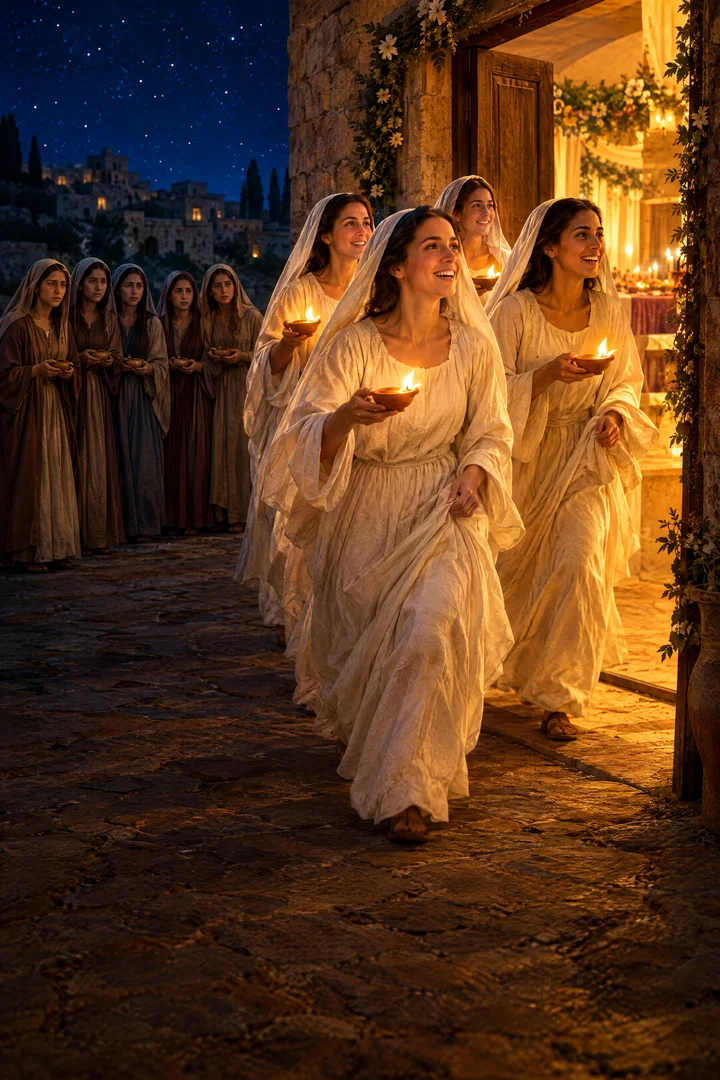
But the wise answered, saying, Not so; lest there be not enough for us and you: but go ye rather to them that sell, and buy for yourselves.
Translations
But the wise answered, saying, Not so; lest there be not enough for us and you: but go you rather to them that sell, and buy for yourselves.
King James Version, KJV Cambridge Paragraph Bible, Webster Bible
But the wise answered, saying, Not so; lest there be not enough for us and you: but go ye rather to them that sell, and buy for yourselves.
Revised Version, American Standard Version
But the wise answered, saying, Peradventure there will not be enough for us and you: go ye rather to them that sell, and buy for yourselves.
and the prudent answered, saying — Lest there may not be sufficient for us and you, go ye rather unto those selling, and buy for yourselves.
But the prudent answered saying, [ We cannot,] lest it might not suffice for us and for you. Go rather to those that sell, and buy for yourselves.
But the prudent, answered, saying—Lest once, by any means, there be not enough for us and you, be going rather unto them that sell, and buy for yourselves
Berean Standard Bible, Majority Standard Bible
‘ No,’ said the wise ones, ‘ or there may not be enough for both us and you. Instead, go to those who sell oil and buy some for yourselves.’
But the wise answered, saying, ‘ What if there isn’ t enough for us and you? You go rather to those who sell, and buy for yourselves.’
But the wise made answer, saying, There may not be enough for us and you; it would be better for you to go to the traders and get oil for yourselves.
But the wise answered, saying, Not so, lest there will not be ynough for vs and you: but goe ye rather to them that sell, and bye for your selues.
Douay-Rheims (Challoner revision)
The wise answered, saying: Lest perhaps there be not enough for us and for you, go ye rather to them that sell, and buy for yourselves.
Pictures
Cross-references
- Matthew 25:14-30
For the kingdom of heaven is as a man travelling into a far country, who called his own servants, and delivered unto them his goods.
The parable teaches servants to use their entrusted talents faithfully and answer at the reckoning.
- Matthew 25:4
But the wise took oil in their vessels with their lamps.
The wise virgins’ oil distinguishes preparedness from lack.
- Matthew 25:5
While the bridegroom tarried, they all slumbered and slept.
The bridegroom’s delay is the tarrying time, when the virgins fall asleep.
- Revelation 19:9
And he saith unto me, Write, Blessed are they which are called unto the marriage supper of the Lamb. And he saith unto me, These are the true sayings of God.
The virgins’ entry is into the marriage supper of the Lamb.
- Revelation 3:18
I counsel thee to buy of me gold tried in the fire, that thou mayest be rich; and white raiment, that thou mayest be clothed, and that the shame of thy nakedness do not appear; and anoint thine eyes with eyesalve, that thou mayest see.
Both urge people to obtain what they need before it is too late.
- Matthew 25:3
They that were foolish took their lamps, and took no oil with them:
The foolish virgins’ lamps lacked oil.
- Zechariah 4:2-3
And said unto me, What seest thou? And I said, I have looked, and behold a candlestick all of gold, with a bowl upon the top of it, and his seven lamps thereon, and seven pipes to the seven lamps, which are upon the top thereof:
The lamps and their continual supply of oil parallel the lamp’s oil in the parable.
- Luke 13:25
When once the master of the house is risen up, and hath shut to the door, and ye begin to stand without, and to knock at the door, saying, Lord, Lord, open unto us; and he shall answer and say unto you, I know you not whence ye are:
Both warn that the door may be shut when people seek to enter.
Commentary part 1 of 3
Each commentary is drawn from primary sources: the writings of Ellen G. White and Adventist pioneers and periodicals. Each commentary is separate. Its own words are not a quotation; follow the references to read the source passages.
Ellen G. White
185 sources
In the parable of the evening wedding waiting, those who are ready refuse to share their supply because they have only enough to keep their own lamps burning, and they tell the unprepared to go and obtain a supply for themselves.Ms 79, 1897, par. 3–4ST Jul 20, 1915COL 405.2–406.1 The lamp is the word of God and the outward profession of faith, while the oil is the Holy Spirit and the grace of Christ in the heart, shown in inward character, faith, love and obedience.RH Feb 3, 1903ST Aug 6, 1894RH Sep 17, 1908Ms 9, 1891, par. 38–39Ms 174, 1905, par. 12 No person can give readiness to another at the decisive moment, for character, grace and spiritual experience cannot be transferred or borrowed, even among close companions.Ms 92a, 1898, par. 1–3Ms 144, 1898, par. 2–4Ms 47a, 1898, par. 6Ms 174, 1905, par. 12Lt 6a, 1893, par. 12–13 Seeking to obtain that supply after the call comes is too late, for while the unprepared are away the bridegroom arrives, the door is shut, and they are left outside in darkness.Ms 136, 1903, par. 5Lt 161, 1903, par. 7–8Ms 92a, 1898, par. 4–6 Therefore the present probationary time is the moment for each person to seek, obtain and keep a personal supply through prayer, study, consecration and daily practice.Lt 16, 1895, par. 26Lt 25, 1895, par. 4ASCOP 28.1Ms 82, 1896, par. 6Ms 49, 1898, par. 19–20
Wedding Setting and Plot
The verse belongs to a parable set at an evening wedding, where a company waits for the bridal party in order to join its procession.COL 405.1 It was given in a prophetic discourse about the second coming, and the evening wedding procession forms the setting of the story.ST Sep 17, 1912
The story was told to disciples while looking upon such a party waiting for the bridegroom, and by the experience of the ten virgins it illustrates the experience of the church that shall live just before the second coming.COL 406.2 They represent professed Christians watching in the evening of this earth's history.16MR 271.4 All ten had gone out to meet the bridegroom with lamps and vessels for oil, showing a church where all have a knowledge of the Scriptures, all have heard the message of Christ's near approach, and all confidently expect His appearing.COL 408.2–3 The verse's place in the parable supports the call to watch for Christ's return, for a person's true condition before God is made manifest by conduct and conversation.ST Aug 6, 1894 The wise could not give oil without risking lack for themselves, so they told the foolish to go and buy their own, and while the foolish went to buy the wedding procession moved on and they missed opportunity to join it.ST Jul 20, 1915
All ten are professed believers watching for the Lord's appearing, divided between real Christians who have life and the oil of grace in themselves and spurious professors who lack it.Ms 72, 1895, par. 1–2 The parable represents the church as those watching for the Lord's appearing and earnestly seeking to be acknowledged as the Lamb's wife.Ms 144, 1898, par. 1 All have lamps and vessels for oil, all have a knowledge of the Scriptures, all have heard the message of Christ's soon approach and confidently expect His appearing, and for a time no difference is seen. All profess to serve God and await Christ, but five are unprepared when He comes, for confidence in God's promises does not make ready those who do not live as commanded, and profession alone is nothing.16MR 274.2 Among those who claim to be Christians five are true and five are false; all have a name and a call and a lamp and all claim to be doing God service and watching for His appearing, and all start apparently prepared, but five are wanting.Ms 92a, 1898, par. 33–35 In the evening of this earth's history all who claim to be Christians have a call, a name, a lamp, profess to do God's service, and apparently wait for Christ's appearing, yet five are unready and will be found surprised, dismayed, outside the banquet hall.COL 412.2–413.1
A time of waiting and slumber intervenes before the bridegroom's coming, followed by his coming.GC88 398.4–400.1GC 400.1–401.2 A time of waiting intervenes and faith is tried. During the long delay the foolish grow weary and conclude the Master is not coming because they have no supply of grace to enable them to stand test and trial.Ms 9, 1891, par. 21–22 Time is purposely taken to test and prove who has the real, genuine righteousness of Christ, whether believers can bear with patience, waiting and watching and working with more diligence to plant, to build, and to gather sheep into the fold, instead of falling into idle expectancy that refuses to work.Ms 9, 1891, par. 21–22 The foolish began to think the bridegroom would not come because he had delayed, lacking grace to endure the test, and the delay tests whether people have genuine righteousness and can patiently wait, watch, and work.10MR 272.1–2 The lamps of the waiting bridesmaids must be kept trimmed and burning as they wait, the delay gives time to repent, and from eternity the period of waiting will seem short.10MR 266.2 The bridal lamps must be kept trimmed and burning while He delays, the waiting is a period of probation that will seem short when the redeemed see its outcome, and those found watching at His coming are blessed.5T 485.1
The midnight cry, Behold, the Bridegroom cometh, awakens and calls to go out to meet Him.1T 53.3–54.316MR 267.1–2 Readiness cannot be borrowed from another when the decisive moment comes, for each must obtain oil for herself, and in the parable's application that cry was proclaimed under the first and second angels' messages calling believers to meet Christ at His second coming.Ms 92a, 1898, par. 1–3 That cry was proclaimed in 1844 and aroused thousands with hope in His coming.LSEGW 59.1–2 It frames the 1844 expectation as a call to be ready and to have a genuine experience and unmistakable evidence of acceptance with God.CET 51.1 Under the proclamation of the first and second angels' messages believers preached the second appearing in the clouds of heaven and were compelled to go out from the churches, with the message for the whole world, Behold, the Bridegroom cometh; go ye out to meet Him.16MR 267.1–2 The parable is applied to people who expected the Lord's return, some waiting in earnest devotion while others professed to look for Him but were not converted or ready, connecting that expectation with disappointment when the time passed.SG1 141.2
When asked for oil the wise answer they have only enough for their own lamps and may lack if they share, so they direct the foolish to go and buy for themselves, having themselves anticipated delay by filling extra vessels.Ms 79, 1897, par. 3–4ST Jul 20, 1915COL 405.2–406.1ST Sep 17, 1912ST Aug 6, 1894 They cannot supply what the others failed to prepare, for they have only enough for their own lamps, and the unprepared must seek and obtain oil for themselves.ST Aug 6, 1894ST Aug 6, 1894 Their advice to buy comes as the bridegroom is about to arrive, while the wise are ready to join the wedding procession.ST Aug 6, 1894
While the foolish go to buy oil for their empty lamps after the call, the Bridegroom goes in to the marriage supper with the wise and the door is shut.Ms 136, 1903, par. 5Lt 161, 1903, par. 7–8 The wise would not share because there was not enough for both groups, and the attempt to obtain oil came too late, for while they went to buy the procession entered and the door was shut, leaving them outside.Ms 92a, 1898, par. 4–6 The wise had oil only for their own lamps and told the unprepared to buy for themselves, but the foolish returned too late, for the feast had begun and the door was shut.ST Sep 17, 1912 Each had to obtain what was needed for her own readiness, but the bridegroom arrives while the foolish are away and only those ready enter the marriage.ST Apr 21, 1898 At the call, Behold the bridegroom cometh; go ye out to meet him, the foolish found no oil and went away to buy, and while they went the bridegroom came and went in with the wise and the door was shut.15MR 229.1 When the foolish afterward reached the banqueting hall they received the unexpected denial, I know you not, and were left standing without in the empty street in the blackness of the night.Ms 136, 1903, par. 515MR 229.1 It is a warning to churches generally, which are slumbering while the signs of the times are fulfilling.Ms 136, 1903, par. 5Lt 161, 1903, par. 7–8
In some treatments the verse is noted as part of the parable without further explanation of the refusal or of the direction to buy.ST Sep 17, 1912EW 46.1Ms 9, 1891, par. 10–12Lt 24, 1892, par. 5–7Lt 53, 1904, par. 27–29 It is cited as part of the parable of the ten virgins as basis for the promise that even the weakest and most humble may receive heaven's reward by following Christ in simple faith and love.COL 404.2 It belongs to the parable of the waiting virgins applied to waiting for Jesus while He goes to the Father and later returns from the wedding, emphasizing waiting and keeping garments spotless.EW 46.1 There the reply distinguishes wise from foolish, but the foolish have lamps without oil and five are wise and five foolish.Ms 9, 1891, par. 10–12 The lamp's light is to shine continually, not dimmed by selfishness, wrongdoing, harsh words, or anger.Lt 53, 1904, par. 27–29
Meaning of Lamps and Oil
The lamp is the outward form of truth and profession, the Bible and word of God, the knowledge of truth and of righteousness carried by all who profess to wait for the Lord.RH Sep 17, 1908Ms 174, 1905, par. 12COL 406.3–408.1Lt 12, 1893, par. 4–7 The oil in the vessel with the lamp is the holy oil, the Spirit and grace of Christ, the Holy Spirit joined to human effort in living experience and godly example.RH Sep 17, 1908Lt 6a, 1893, par. 12–13COL 406.3–408.1 It is inward piety as distinct from outward semblance, the Spirit of life abiding in the heart to feed the lamp so that it sends forth clear rays of heavenly light, without which all outward preparation is worthless.Lt 6a, 1893, par. 12–13COL 406.3–408.1Lt 12, 1893, par. 4–7 The foolish have lamps and knowledge and light yet lack this oil of grace and righteousness received by continual dependence on God, so their lamps go out and they are left outside in darkness when the bridegroom comes.Ms 9, 1891, par. 38–39Ms 174, 1905, par. 12Lt 6a, 1893, par. 12–13
That oil is the Holy Spirit and the grace of Christ in the heart, a vital living connection with Him by which faith, patience and love grow and the lamp burns brightly unto entrance to the feast.RH Feb 3, 1903ST Aug 6, 1894ST Aug 13, 1894 It is the work of the Spirit filling the heart with God's love, replenishing spiritual life, preserving discernment to respond to the message of the Bridegroom's approach, and making religious experience vigorous and abundant with affections set on heavenly things.ST Aug 13, 1894ST Sep 24, 1912 The wise provide it beforehand and do not postpone preparation to the crisis, but follow Jesus daily and keep their lights burning steadily to seek and save the lost in the world's moral darkness.ST Aug 6, 1894ST Sep 24, 1912 It is the Spirit emptied out of the olive trees into the lamps, and without it religious experience lacks fervor and follows the world.Ms 186, 1905, par. 3Lt 226, 1907, par. 2
The same oil denotes inward character and experienced knowledge of Christ's grace, including faith, love and patience nourished day by day, righteousness, holiness, and moral power for obedience, discernment and witness.ST Sep 17, 1912Lt 114, 1895, par. 5–6Lt 64a, 1895, par. 8–11Lt 66, 1874, par. 17–20 Character and spiritual experience cannot be transferred from one to another, so each must form character personally, nourish faith and grace before the crisis, put God-given abilities to use through union with Christ, and obtain a character purified from sin by resisting temptation, denying self and overcoming sin.Lt 114, 1895, par. 5–6Lt 64a, 1895, par. 8–11Lt 66, 1874, par. 17–20 Knowing the standard of righteousness is not enough when self-love keeps a person from receiving and valuing sustaining truth, for then truth seems unessential and faith becomes unstable, weak and open to deception.ST Aug 13, 1894ST Sep 24, 1912
That holy oil is supplied from heaven through the two anointed ones who stand by the Lord of the whole earth, emptied through two golden pipes as in Zechariah, and received only into vessels prepared for it, even clean, pure, sanctified souls made ready by humbleness of mind, wearing Christ's yoke and learning of Him.Lt 94, 1898, par. 10–15Ms 140, 1901, par. 4–13Lt 108, 1898, par. 10–11 It is the Holy Spirit in the heart working by love and purifying the soul, and without practicing the truth there is no holy oil, so those who cherish hereditary and cultivated traits misrepresenting Christ while professing discipleship are as the foolish virgins and as the man without the wedding garment of Christ's righteousness.Lt 94, 1898, par. 10–15Ms 140, 1901, par. 4–13Lt 108, 1898, par. 6–8 So received, it burns with undimmed flame through the night of watching, swelling the illumination for the bridegroom's honor and lighting the way to his home, the city of God and marriage supper of the Lamb, as God's word through the Spirit becomes transforming power implanting His principles and developing His attributes until His glory shines forth in His followers.COL 414.1–2ST Jul 20, 1915 Provision has been made so every soul may be abundantly supplied, yet at the last moment it cannot be communicated or shared from one to another.RH Sep 17, 1908Lt 108, 1898, par. 10–11Lt 44, 1900, par. 4–5
Vessels are individual hearts and lives, and every vessel must be kept filled by its own owner, for the oil of grace and spiritual life cannot be borrowed but each must kindle his own taper from the divine altar and trim his own lamp to shine.Ms 82, 1896, par. 6Ms 49, 1898, par. 19–2017MR 202.3–4 Buying means each person must personally seek, obtain and keep a supply while probationary time lasts, by earnest prayer in simple faith, longing for the sincere milk of the Word, feeling a daily burden to keep the soul in God's love, and practicing self-denial and cross-bearing.Ms 82, 1896, par. 6Ms 49, 1898, par. 19–20Lt 226, 1907, par. 217MR 202.3–4 Keeping filled means diligent use of entrusted talents, working to the utmost ability every day, disseminating light, cultivating personal piety with humble contrite heart, cherishing God's love, fearing to walk contrary to His will, and combining vigilant work with faithful waiting, watching and patient resting in the Lord.Ms 82, 1896, par. 617MR 202.3–4 Empty vessels are filled by sinking into the ocean of God's full love and drawing freely and continually, with Christ within as a well of water springing up to everlasting life, bringing spiritual life, angelic ministry, and increased ability to trade with and increase talents, an experience of Christlike character formed in daily life that no other can supply.Ms 82, 1896, par. 6Ms 49, 1898, par. 19–20Lt 6, 1907, par. 6
Loss of oil is spiritual decline, with lamps burning dim, flickering and going out for want of grace through carelessness, indifference, want of integrity, self-love, living for own pleasure and glory, and treating truth as unessential.ST Aug 13, 1894RCOC 123.3ST Sep 24, 1912Ms 82, 1896, par. 6 Those who have received much light and opportunity but fail to live by it are not prepared when the decisive moment comes, and those who think themselves full of wisdom feel so well supplied by human understanding that they do not hunger and thirst after righteousness and have no room for heavenly grace.RCOC 123.3Ms 8, 1898, par. 9 They look with pity and disgust on those who earnestly seek to know the Lord's way more perfectly, yet will awake to find their lamps going out and, with all knowledge, to have neglected the one thing needed for entrance to the marriage supper.ST Aug 13, 1894Ms 8, 1898, par. 9 When truth is enthroned in the heart the oil renews the whole nature, awakens thought, arouses conscience to decided action and adorns character, but without it experience rests on uncertain principles, unstable and vulnerable to deception.ST Sep 24, 1912Ms 144, 1898, par. 6
Keeping oil means daily replenishment by prayerfully studying God's Word and choosing to obey it, living in hourly contact and conscious communion with the principles of truth, righteousness and mercy that reveal God's attributes within the soul.Ms 74, 1899, par. 7Ms 37, 1909, par. 9Lt 75, 1896, par. 10 It requires binding up with God as the deep source of moral and intellectual power and cooperating with Him, trusting the cross of Calvary as guarantee of spiritual efficiency, skill and understanding in Scripture, and power to represent truth by precept and example.Ms 74, 1899, par. 7Lt 75, 1896, par. 10 The wise keep lamps filled and burning through good works showing inward grace, for baptism alone does not save while one clings to old habits and worldly ideas rather than being conformed to Christ, and holy grace sent from heaven must sustain the lamp so its light shines on others' paths and shows the way to those in darkness.ST Mar 17, 1898Ms 92a, 1898, par. 19Ms 37, 1909, par. 9 Thus waiting, working, watching and praying are blended, with obedience to truth and physical law, self-denial and temperance, so light glorifies God and lightens the path to the marriage supper.COL 414.1–2Ms 92a, 1898, par. 19Lt 75, 1896, par. 10
Readiness Cannot Be Shared
Readiness for the bridegroom cannot be supplied by another when the decisive moment comes, but each must have made provision beforehand for herself and obtain oil for herself.Ms 92a, 1898, par. 1–3Ms 144, 1898, par. 2–4Ms 47a, 1898, par. 6ST Apr 21, 1898 The wise had used all the oil in their vessels and had only enough for their own lamps, so they could not spare any for the foolish and told them to go and buy for themselves.Ms 144, 1898, par. 2–4ST Jul 20, 1915ST Sep 17, 1912ST Aug 6, 1894ST Aug 6, 1894 Their answer was given under the proclamation of the midnight cry in the first and second angels' messages calling believers to meet Christ at His second coming, and it applies to those living in the last days who must not follow the world's customs nor assume the Lord's coming is delayed but be personally prepared.Ms 92a, 1898, par. 1–3Ms 47a, 1898, par. 6 While the foolish went to buy, the bridegroom arrived and those who were ready entered the marriage, so preparation cannot be borrowed from others and must be made before He comes.Ms 144, 1898, par. 2–4ST Sep 17, 1912ST Apr 21, 1898 The lack of oil is a spiritual lack that leaves people unprepared when sickness and death come, for living for self-pleasing does not prepare them to close life's history, and the oil needed is grace in the heart that keeps the lamps trimmed and burning to meet the Bridegroom.MYP 387.3Lt 19, 1887, par. 14–15
Character, grace, preparation and spiritual experience cannot be transferred or borrowed from one person to another, even between close companions or family members.Ms 174, 1905, par. 12STMW7 54.1–2Lt 79, 1897, par. 3Lt 98a, 1897, par. 58–59Lt 114, 1895, par. 5–6 The oil the wise would not share is the oil of grace, the Spirit of life in Christ Jesus, the Holy Spirit abiding in the heart, feeding the lamp so it sends forth clear rays of heavenly light as distinct from the lamp of outward semblance of religion.Ms 174, 1905, par. 12Lt 6a, 1893, par. 12–13Lt 98a, 1897, par. 58–59 It is inward piety and an experienced knowledge of Christ's grace, received personally and held in one's own life, pictured by the lamp and vessel of individual preparation, growing into knowledge through earnest prayer and sustained by faith in Christ Jesus.Lt 6a, 1893, par. 12–13Lt 79, 1897, par. 3Lt 114, 1895, par. 5–6 Without it all outward preparation is worthless, leaving only enough religion to deaden the conscience, deceive the senses and ruin the soul, having the name to live while dead, and those who profess godliness yet sleep without it will at last see their defects and try to buy or borrow what they lack from the wise who have shaken off sleep, arisen and trimmed their lamps.Ms 174, 1905, par. 12Lt 6a, 1893, par. 12–13 It cannot be given from one to another and cannot be gained by high profession, ordination for the ministry, or appointment as superintendent or teacher in the Sabbath school, even with high responsibilities and a link to the work, for a person may hold those places yet have no heavenly light and no link with Jesus Christ, and those who follow natural impulses will be left without it.Lt 6a, 1893, par. 12–13Lt 98a, 1897, par. 58–59 Each must most earnestly seek God with all heart and soul for it himself in cooperation with the divine working in him, forming character personally, nourishing faith and grace before the crisis, and putting God-given abilities to use through faith's union with Christ, for the foolish have no oil to discern the clear light or accept it and cannot light their lamps to join the procession to the marriage supper of the Lamb.Lt 6a, 1893, par. 12–13STMW7 54.1–2Lt 114, 1895, par. 5–6
The wise cannot spare what they have without risking lack for all, so their refusal protects their own readiness while directing the unprepared to obtain their own supply.ST Jul 20, 1915ST Sep 17, 1912ST Aug 6, 1894 They had brought enough for their own lamps because they had anticipated delay and filled extra vessels, while the foolish had failed to prepare for delay, and their advice to buy came as the bridegroom was about to arrive while the wise were ready to join the wedding procession.ST Jul 20, 1915ST Aug 6, 1894 Spiritual readiness cannot be transferred, and those who profess to wait for Christ but have not entered into fellowship with Him will be unready at His coming and shut out from the kingdom, for outward Christian claims and works do not replace that fellowship.ST Jul 20, 1915 Readiness for the final crisis cannot be borrowed from others, and the parable warns against spiritual sleep and calls for present vigilance and preparation.STM2 13.1
Attempting to obtain oil after the call comes too late, for while the foolish are away the procession moves on, the door is shut, and those without oil are left outside.Ms 136, 1903, par. 5Lt 161, 1903, par. 7–8Ms 92a, 1898, par. 4–6ST Sep 17, 1912 The foolish go to buy for their empty lamps after the call to go out to meet the Bridegroom, and while they are gone He goes in to the marriage supper with the wise and the door is shut, so when the foolish reach the banqueting hall they receive the unexpected denial, I know you not, and are left standing without in the empty street in the blackness of the night.Ms 136, 1903, par. 5 The foolish return too late when the wedding feast has begun, and this warns the churches generally which are slumbering while the signs of the times are fulfilling in the world.Ms 136, 1903, par. 5Lt 161, 1903, par. 7–8ST Sep 17, 1912 The oil of grace must be secured during probationary time, for when the final emergency comes it will be too late to obtain it, and those who neglected to receive God's grace and form characters fit for His service will be unprepared when the call comes and may find the door shut when they seek entrance to the marriage supper once probation has ended.Lt 16, 1895, par. 26Lt 25, 1895, par. 4
The lesson therefore calls for present preparation during probationary time, since after probation ends and the door closes no further readiness can be gained.Lt 16, 1895, par. 26Lt 25, 1895, par. 4 The opportunity to obtain the oil may pass, and when it is too late having no oil in one's vessel leaves the lamp going out, for the oil is the grace needed to keep the lamp burning and must be secured without delay.ASCOP 28.1Lt 22, 1892, par. 21 Readiness for Christ cannot be gained after the final call by trying to replenish an empty lamp, but Christ must be part of a person's life now for that person to be fitted for companionship with Him in heaven, and the warning to be ready to meet the Lord means the call to go meet Him comes without delay so readiness cannot be postponed until He arrives.COL 413.2Lt 19, 1904, par. 7–8
Outward profession, knowledge, church membership, birth, talents, or another person's faith cannot substitute for personal piety and a living daily experience with God.Ms 25, 1908, par. 16Ms 72, 1895, par. 1–2 All ten are professed believers watching for the Lord's appearing with a name and a call and a lamp, claiming to do God service and starting apparently prepared, yet divided between real Christians who have life and the oil of grace in themselves and spurious professors who lack it.Ms 72, 1895, par. 1–2Ms 92a, 1898, par. 33–35 The wise have oil in their vessels with their lamps as unseen principles, open communion with God, and a character that gives entrance into the marriage supper of the Lamb and marks them as those the Lord knows, with personal faith, visible connection with God, and faith working by love in true preference, firm reliance, entire willing obedience and consecration, and complete identification with Christ so life is bound up with Christ Jesus.Ms 72, 1895, par. 1–2 Neither human birth nor descent from Abraham nor membership in any church will save any soul, and church membership alone does not secure entrance into heaven, for each is accountable for how talents and God-given abilities and opportunities are used in work for the salvation of souls.Ms 25, 1908, par. 16Ms 72, 1895, par. 1–2Lt 86, 1895, par. 12 The many foolish have only a knowledge of the truth and are not sanctified through it, thinking theoretical knowledge under great light and abundant opportunities and continuous privileges is all that is required while they are not doers of the Word, forgetting the day of trust and the day of reckoning.Lt 86, 1895, par. 12Lt 86, 1895, par. 2Ms 47, 1895, par. 1–3 They take for granted that the promises of God are theirs while they do not live as Christ enjoined, make excuses for neglecting to respond, lose much, and continually follow meetings only to be benefited by hearing more and still more, but profession by itself is nothing, no one is to take for granted that he is saved, sanctification is the work of a lifetime, and righteousness must exceed outward religion or there is no entrance into the kingdom of heaven.Ms 47, 1895, par. 1–3Ms 92a, 1898, par. 33–35
Prophetic Fulfillment in History
The waiting and slumber of the parable was followed by the midnight cry, Behold the Bridegroom cometh, which was proclaimed in the autumn of 1844 and awakened thousands to hope in Christ's coming and to prepare to meet the Lord.GC88 398.4–400.1GC 400.1–401.2LSEGW 59.1–2 That cry was made under the proclamation of the first and second angels' messages, when believers preached the second appearing of Christ in the clouds of heaven and were compelled to go out from the churches for doing so.Ms 92a, 1898, par. 1–316MR 267.1–2 It was the message for the whole world to hear at that time, Go ye out to meet Him.16MR 267.1–2
Those who heard the first and second angels' messages went forth to meet the Bridegroom expecting to live to see Christ coming in the clouds of heaven.Ms 92a, 1898, par. 1–316MR 269.316MR 267.1–2 That going forth to meet the Bridegroom took place in 1844.Lt 4, 1850, par. 45MR 91.4 In that movement two classes were revealed.GC 426.2–427.2GC88 426.2–427.2 The wise were those who had patiently prepared and looked with joy for the Lord, having both knowledge of Scripture and the Spirit and grace of God, patiently searching for clearer light through trial and earnest devotion.GC 426.2–427.2GC88 426.2–427.2GC88 426.1 The foolish acted from fear and impulse, professing to look for Him but not converted or ready, satisfied with only a theory of truth and lacking God's grace, and their expectation ended in disappointment when the anticipated time passed.GC 426.2–427.2GC88 426.1SG1 141.2
The coming of the Bridegroom first represents Christ coming as Bridegroom to the marriage, His coming to the Ancient of Days in heaven to receive His kingdom and begin the final work of mediation in the most holy place.GC 425.3–426.15MR 97.3Lt 3, 1847, par. 6–7 It is Jesus rising from His mediatorial throne and going into the holiest as Bridegroom to receive His kingdom, not His second advent to earth to deliver His people and execute judgment.GC 425.3–426.1Lt 3, 1847, par. 6–7 The midnight cry belongs to the travel of the Advent band before that move, and the Bridegroom's coming follows it, even on the tenth day of the seventh month.Lt 3, 1847, par. 6–7 This coming to the holiest settles the shut door, and that application established shut-door belief among those who received the vision.5MR 97.3Lt 3, 1847, par. 6–7
Many who went forth under the first and second messages refused the third angel's message, the last testing message and final message of mercy to be given to the world, and thus lacked the essential provision of the wise.16MR 269.3Ms 92a, 1898, par. 7–10 The truth should have been proclaimed by all ten, but only five made the provision essential to join the company who walked in the light that had come to them.16MR 269.3 Had all who claimed to believe the truth acted their part as wise virgins, the message would have been proclaimed to every nation, kindred, tongue, and people.16MR 269.3 Some who then went forth to meet the Bridegroom in 1844 have since been deceived and misled by false shepherds until they do not know where they are or what they believe and have lost understanding of what they believed.Lt 4, 1850, par. 45MR 91.4
The ten virgins also portray the church in its present state and its spiritual condition at Christ's second coming, the church that shall live just before His second coming watching in the evening of this earth's history.Ms 79, 1897, par. 3–4COL 406.216MR 271.4 They represent the church of professed Christians watching for the Lord's appearing and earnestly seeking to be acknowledged as the Lamb's wife, in which all profess to serve God and await Christ but five are unprepared when He comes.Ms 144, 1898, par. 116MR 274.216MR 271.4 The parable divides that professed church into five wise and five foolish, the foolish having lamps but no oil in their vessels with their lamps, professing to believe the truth yet remaining unconverted.16MR 274.2Ms 49, 1898, par. 44–46 Their confidence in God's promises does not make them ready, for profession alone is nothing unless those who claim to follow Christ live as He has commanded, and self in all its perverted attributes hardens the heart and closes the door against Jesus Christ so He cannot enter and abide.16MR 274.2Ms 49, 1898, par. 44–46 The question raised is whether each person will be among the wise and ready.Ms 79, 1897, par. 3–4
Doctrinal Lessons for Believers
The parable divides professed believers into five wise who are ready and five foolish who are unready, showing that about half may profess religion without the oil of grace, and that profession by itself is nothing.Ms 35, 1891, par. 32–33Lt 86, 1895, par. 2Ms 92a, 1898, par. 33–35 All have a name and a call and a lamp and all claim to be doing God service and watching for His appearing, and all start apparently prepared, but five are wanting and five are found surprised and dismayed without oil outside the wedding banquet when the door is shut.16MR 270.3–271.2Ms 92a, 1898, par. 33–35 The many foolish are people who have a knowledge of the truth but are not sanctified through the truth, who think theoretical knowledge is all that is required and are not doers of the Word.Lt 86, 1895, par. 12Lt 86, 1895, par. 2Ms 47, 1895, par. 1–3 Their foolishness is failure to realize accountability, forgetting that there is a day of trust and a day of reckoning, and everyone is committed talents with sacred responsibility to bless others by opening the precious truth to those in error.Lt 86, 1895, par. 12 No one is to take for granted that he is saved, for sanctification is the work of a lifetime and righteousness must exceed outward religion or there is no entrance into the kingdom of heaven.Ms 92a, 1898, par. 33–35
True condition is made manifest by conduct and conversation and by fruits rather than outward appearance.16MR 270.3–271.2ST Aug 6, 1894Ms 92a, 1898, par. 14–18 Human beings cannot now reliably judge who is wise or foolish, because some who hold the truth unrighteously look outwardly wise, but God's angels can distinguish them without error.16MR 270.3–271.2Ms 92a, 1898, par. 14–18 The division will be proved and revealed at last, and with the Lord at the door individual light must be sent forth in clear, steady rays that never grow dim or burn low.Lt 11b, 1892, par. 16 The church has been given truth as light, and its members must have works corresponding to their privileges and opportunities, sanctified through the truth and set apart for special service in order to correctly represent the truth.Lt 11b, 1892, par. 16
The wise are real Christians who have life and the oil of grace in themselves, in contrast to spurious professors who lack it.Ms 72, 1895, par. 1–2 They have oil in their vessels with their lamps as unseen principles, open communion with God, conformity to Christ, and a character that gives entrance into the marriage supper of the Lamb and marks them as those the Lord knows.Ms 72, 1895, par. 1–2 They are those worked by the Holy Spirit who have more than a theoretical knowledge of the truth; they are doers of the Word and God's witnesses bearing living testimony, who in humble trust and living faith search the Scriptures, walk in the light received upon justification by faith and the imputed righteousness of Christ, and communicate that precious truth to others, receiving more light as they impart what they have in cooperation with heavenly agencies.Ms 47, 1895, par. 1–3 They have perfected a Christian character by washing their robes and making them white in the blood of the Lamb, remembering how they received and heard, holding fast and repenting, and watching so Christ will not come on them as a thief at an unknown hour.Ms 92a, 1898, par. 28 Those who have not defiled their garments will walk with Christ in white because they are worthy, and every overcomer will be clothed in white raiment, will keep his name in the book of life, and will have his name confessed before the Father and before His angels.Ms 92a, 1898, par. 28 To be wise is to labor to be in right relation to truth, to obtain a right experience that brings close connection with God, to recognize Christ, to understand His will, and to fear to offend God, growing up from babes in Christ, no longer letting earthly and temporal things absorb time and attention, eating the bread of life and being fed with heavenly manna from the Word by searching its pages, so as to know there is a right to the tree of life.Ms 92a, 1898, par. 21–22Ms 111, 1909, par. 6–9 Neither human birth nor descent from Abraham nor membership in any church will save any soul, for possession of the Word and response to the gospel feast creates a personal responsibility of personal faith, a visible connection with God, and a faith that works by love revealing true preference, firm reliance, entire willing obedience and consecration, and complete identification with Christ so that life is bound up with Christ Jesus.Ms 72, 1895, par. 1–2
The foolish are careless, self-satisfied professors who profess faith in Christ but have grown cold and backslidden.ST Sep 24, 1912ST Aug 13, 1894 They know the theory of truth but lack a living and vital connection with God; their lamps lack the oil of grace, they neglect Scripture and trust their feelings, and they expect to enter heaven but have not purified their souls through obedience to the truth.ST Sep 24, 1912ST Aug 13, 1894 They cherish hidden sins and hidden faults, fail to practice Christ's lessons, and do not show His meekness, tenderness, sympathy, and love in daily life.ST Aug 13, 1894Ms 168, 1898, par. 16–18 The parable does not describe open sinners who make no profession of loving God and keeping His commandments, but those who claim to be children of God and church members yet do not practice the truth.Ms 144, 1898, par. 7 They have no burden for souls, do not deny self, do not lift the cross of Christ, and seek an enjoyable time with the world while claiming to be Christians; they wear a mask, refuse to yield to any authority, do great harm to others, and by worldly principles seduce many.Ms 144, 1898, par. 7 They are unconverted members of the church whose vessels are empty so they cannot keep their lamps replenished, remaining in character the same as before they claimed to believe the truth and living for self in place of seeking to save souls that are ready to perish.Ms 144, 1898, par. 9 They have not taken Christ as Counsellor, have not walked in the light of His Word, have not come under His yoke and worked His way, but have walked in darkness in the light of the sparks of their own kindling without the sacred fire which comes from God, and this brings the verdict I know you not.Ms 144, 1898, par. 9
Having great light without spiritual life leaves lamps without oil, with cold, fading piety and spiritual sleep.ST2 22.5STA 68.1STA 77.3–4 The sleeping virgins with lamps but no oil portray people who have received great light and knowledge but lack the spiritual life needed to be ready, who are spiritually cold and insensible and marked by feeble, waning piety.ST2 22.5STA 68.1STA 77.3–4STOM 54.1STBk 68.1 The contrast is with God's people receiving new life and power from on high and recognizing and receiving the Holy Spirit.STOM 54.1
The parable of the ten virgins, five wise and five foolish, with the whole of Matthew 25 develops the principles of eternal justice revealed in the decisions of the great day when judgment sits and the books are opened.Lt 12, 1893, par. 4–718MR 232.1 The offense of the foolish was taking no oil in their vessels with their lamps, where the lamps are a knowledge of the truth and the oil is the grace of God, a living connection with God, vitalization by His Holy Spirit, saving faith with Christ as a personal Saviour, and the moral qualifications Christ made every provision to place within reach of every sinner by clothing His divinity with humanity to bring moral power to fallen man.Lt 12, 1893, par. 4–7 The foolish made appearance of giving light as the wise but supposed themselves wise while wise only in their own sight, without saving faith, a fraud, not growing in grace and the knowledge of the Lord and Saviour Jesus Christ because they were not doers of the words of Christ.Lt 12, 1893, par. 4–7 The wise are those who look to Jesus, study the life of Christ, behold Him and are changed into His likeness, work in Christ's lines, obtain deeper knowledge of God and Jesus Christ whom He has sent, combine moral power with human effort, and become laborers together with God.Lt 12, 1893, par. 4–7 The final judgment condemns not only revolting crimes and outbreaking sins but neglecting to do what might and ought to have been done through the provision of Christ's grace.Lt 12, 1893, par. 4–7
At Christ's coming and the separation of righteous and wicked, those without purified character cannot obtain it from others or form it in time.Lt 64a, 1895, par. 8–11Lt 64a, 1895, par. 12–16Ms 45, 1899, par. 4 The oil represents Christ's righteousness and a person's character, which cannot be transferred from one person to another, and each person must obtain a character purified from sin for himself or herself beforehand.Lt 64a, 1895, par. 8–11Lt 64a, 1895, par. 12–16 Those who are ready enter the marriage, and when the door is shut those left outside cannot enter, and their claim to know the Lord is rejected.ST Feb 17, 1890 Many will then claim admission to Christ's kingdom for eating and drinking in His presence and for prophesying, casting out devils, and doing wonderful works in His name, but the answer is I know you not, depart from Me.COL 412.2–413.1 In this life they did not enter into fellowship with Christ, therefore they do not know the language of heaven and are strangers to its joy.COL 412.2–413.1 The fellowship of the Spirit which they slighted could alone make them one with the joyous throng at the marriage feast, and without it its light falls on blinded eyes, its melody on deaf ears, and its love and joy awake no gladness in the world-benumbed heart, so they are shut out from heaven by their own unfitness for its companionship.COL 412.2–413.1 The foolish without oil are unfit for the marriage supper of the Lamb because their characters have not been transformed.14MR 122.2–123.1Ms 45, 1899, par. 4
Those who have no oil in their vessels are unfit when the end comes, and their pursuit of worldly pleasures leaves them without the inward character represented by the white robe of Christ's righteousness.14MR 122.2–123.1 Those who cherish hereditary and cultivated traits of character that misrepresent Christ while professedly His disciples are the foolish virgins without oil, the same as the man coming to the gospel feast without the wedding garment of Christ's righteousness.Lt 94, 1898, par. 10–15Ms 140, 1901, par. 4–1315MR 82.1 They keep Christ out of the heart and the truth in the outer court, hearing the Word but not doing it and not putting on the robe of Christ's righteousness, and becoming too engaged in business can place a person among them.Ms 140, 1901, par. 4–1315MR 82.1 Being active in God's work alone is not enough, for vessels must still be filled with the oil of grace, shown in a life that practices Christ's lessons and displays His meekness, gentleness, sympathy, and love.Lt 71, 1895, par. 30
Calls to Present Readiness
The present is the time to trim the lamp and fill the vessel with the oil of grace, keeping it burning so its light shines today and not putting readiness off until tomorrow.Lt 29, 1897, par. 11STE 147.1–149.15T 276.2 Waiting for the Lord means vigilant, faithful service joined with personal piety, not passive devotion or absorption in worldly concerns, and constant effort is needed to prevent spiritual decline.ST Nov 20, 1884Lt 29, 1897, par. 115T 276.2 The day of the Lord may come unexpectedly and the end will come without warning, so watchfulness and light-bearing action are required while looking for his coming.LSEGW 425.3Lt 29, 1897, par. 1120MR 67.4
Readiness requires using entrusted talents, abilities and opportunities in work for the salvation of souls, spreading present truth, awakening the world to its danger, leading the perishing to Christ and warning that the end is near.Ms 25, 1908, par. 1621MR 30.3Ms 80, 1905, par. 8 Church membership alone does not secure entrance, and every kind of work should be directed toward saving souls without self-serving, joined with prayer and dependence on God, because the world is near eternity.Ms 25, 1908, par. 1621MR 30.3 Waiting does not mean merely waiting or folding the hands while expecting the close of earth's history, but vigilantly watching and working with reference to that solemn event, with none standing neutral and all actively representing Christ.SSP 9.1STBk 85.112MR 213.2–214.1 Such readiness blends quiet, prayerful meditation apart from bustle to commune with God and learn his will with earnest, energetic warning and appeal that clears the King's highway, after the example of Enoch who walked with God in obedience and bore continual witness in an impure age.STBk 85.112MR 213.2–214.1
Having a lamp is not enough, for the lamp without the oil of grace that makes it burn and give light leaves only the outward appearance of readiness.STBk 9.1STOM 7.3STA 9.1 Ministers who continue year after year without becoming like Christ, who do not absorb the truth and lack heartfelt piety, faith and love, cannot give to others what they have not practiced and do not become a light to the world through good works.ASCOP 24.15T 20.2–21.1STA 9.1 The same applies to teachers, whose lamps are to be trimmed and burning so they can be lights to students and surrounding communities, since readiness is personal and the wise cannot supply the unprepared with what they need.STBk 9.1STE 55.4–56.1
Being a wise virgin means having a lamp trimmed and burning, and fathers and mothers bear the God-given responsibility to send forth clear, distinct rays first in the home circle and then beyond to neighbors.Lt 29, 1897, par. 28–29ST Sep 10, 1894 The father fulfills this by representing the divine Lawgiver in the family and working earnestly to establish upright principles, preoccupying the soul with what enables children to form pure and virtuous characters and to render obedience to both earthly parent and heavenly Father.ST Sep 10, 1894 Everyone in the home circle must keep his own lamp constantly replenished with oil drawn from the divine source, the full and complete love of God, which makes human affection stronger, purer, more elevated, refined and holy.Lt 145, 1893, par. 10–11Ms 38, 1893, par. 13–15 When so kept, family worship exerts a continual upbuilding influence rather than standing solitary as an act performed at certain times, the whole heart becomes a reservoir of divine love and grace, thoughts are brought into captivity to Christ, and hope, sympathy and brotherly love flow forth in all associations of life.Lt 145, 1893, par. 10–11Ms 38, 1893, par. 13–15 The lamp goes out when temporal interests supply the themes for conversation and supplant eternal interest, causing the needs of the soul and the precious things of the Word, its promises, admonitions, warnings, consolations and encouragements, to fade before more absorbing interests.Lt 145, 1893, par. 10–11Ms 38, 1893, par. 13–15 No one can give spiritual readiness to another, so each household member and each church member must trim the inner lamp for self first by taking heed to self and doctrine and giving self without reserve, and when the root is holy the sanctified influence will first make the home church ready and then be carried to the assembled church.Lt 54, 1899, par. 10Ms 60a, 1895, par. 4
The oil needed for readiness cannot be supplied at the last moment by someone else, and those who have no oil in their vessels are unfit when the end comes.14MR 122.2–123.1MYP 387.3 Living for self-pleasing and pursuing worldly pleasures leaves people without the inward character represented by the white robe of Christ's righteousness, unprepared when sickness and death come to close life's history.14MR 122.2–123.1MYP 387.3Lt 57, 1895, par. 28
God's slumbering people in the perils of the last days must awake, for many who in ignorance consider themselves wise are like the foolish virgins not realizing their lamps are going out.Ms 80, 1905, par. 1–2Lt 234, 1906, par. 13–16 Believers are portrayed as sleeping and in need of awakening before the approaching time of trouble and trial, turning from unimportant things to seek the Lord's help and to be sustained through the crisis, since preparation cannot be supplied at the last moment by others.3MR 305.2–321MR 437.5 The perils are now upon us and many are asleep even among Seventh-day Adventists, their lamps going out through corruption worked by Satan upon minds thought secure from temptation, a sleeping state coming from not understanding that all unrighteousness is sin and sin is the transgression of the law.Lt 15, 1888, par. 2 Those who have slept at their post must therefore awake, trim their lamps, examine their own spiritual condition, hold firmly to the truth, and seek thorough consecration and deeper devotion to the work, for when they awake to their true condition it will otherwise be too late to obtain a fresh supply.Lt 234, 1906, par. 13–16Lt 15, 1888, par. 2Ms 80, 1905, par. 5 The urgency is sharpened by the danger that faith in the third angel's message may be destroyed.Ms 80, 1905, par. 1–2
Knowing and assenting to the theory of the truth, even the theory of the third angel's message, is not enough, for without the grace of Christ feeding the lamp there is only a sickly, formal experience, spiritual deficiency, and certain loss of eternal life.CH 128.3RH Feb 24, 19109T 155.1 When the cry announces the coming of the Bridegroom, many with lamps but no oil will be surprised and disappointed, deprived of God's rich blessings by pride, weakness of faith, formality, worldly ambition and love of self.RH Feb 24, 19109T 155.1 Each must humble the heart before the Lord, fall upon the Rock with broken repentance and confession, be born again of the divine Spirit, become a partaker of the divine nature escaping corruption through lust, and reveal the fruits of the Spirit in a purified heart, renewed mind, willing obedience and true worship.RH Feb 24, 1910 The oil is kept by purifying the soul through obeying the truth, including obedience to physical law, for without such obedience there is no growth in grace, while unjust transactions, indulgence of passion, worldly schemes and constant engrossment crowd God out, consume strength needed for his service, and cause the light to burn low and go out.Ms 91, 1910, par. 10Lt 36, 1890, par. 23–24Lt 19, 1892, par. 14 Those who know the truth must therefore have lives that agree with their faith, with sanctified works testifying to faith and exposing indulgence of appetite as a snare.Ms 91, 1910, par. 10
Receiving light is not enough; what is received must be passed on, for Christ supplies the church's light to be given to people in darkness, otherwise the light received is lost and becomes a receptacle of darkness.EDFCP 3.1–2 Filled with holy oil from the divine altar, true followers go out to give light, and as they receive new truths they impart them to others.Ms 59, 1902, par. 71 Trimming the lamp is daily receiving God's grace from heaven and imparting it to the needy and suffering, with everyone who believes the message going forth into the harvest field to do something in practical obedience instead of seeing the work and doing nothing.Lt 61, 1901, par. 24–25 Keeping the lamps burning amid moral darkness and unbelief requires circulating publications containing the messages of warning for this time, with truth going out like a lamp kept burning by heavenly oil while believers live and spread its influence.Ms 94, 1903, par. 43Lt 137, 1898, par. 14–16
Among the ten only half were wise, and wisdom means not trusting mere theory but having the oil of grace so the lamp shines and the world takes knowledge that its holder has been with Jesus.Ms 11, 1893, par. 9 The foolish condition is marked by ignorance, doubts, fear and temptation, confessing bad habits yet continuing in sin without forsaking it, wasting probationary time, and weakening others by criticism and faultfinding instead of doing spiritual work that strengthens the church.Ms 60, 1890, par. 16 The mind must be guarded every moment, because Satan watches for an unguarded moment to take possession, and he is not the horned figure of pictures but a being of intelligence once an angel of light, so those who trust their own intelligence will be led to think they can correct the Scriptures, an infidelity to be met in high places.Ms 11, 1893, par. 9 Robbing God of time for prayer and service to gain extra time for temporal business, and becoming too engaged in business, places a person among the foolish virgins with no oil, which is the same as coming to the festal supper without the wedding garment.Lt 31, 1888, par. 20–2215MR 82.1 Those with genuine experience are therefore to awake and be alert to the importance and dangers of the present time and not remain asleep or be spiritually deceived and distracted from the message they should proclaim.Ms 80, 1905, par. 6Ms 80, 1905, par. 4
Keeping the lamps burning requires readiness rather than waiting until a time of need, sustained by a living, complete connection with God today and every day, without which believers will not be ready for the harvest or receive added grace when it is especially needed.Ms 9, 1891, par. 45–46AA 55.2 Sleeping believers are called to wake, trim their lamps, fill their vessels, revive and repeat the truth, renew consecration, and be wide-awake as stewards and messengers, preparing by studying the neglected Bible so they can share present truth.Lt 58, 1906, par. 1–3Lt 6, 1907, par. 5 Repentance for neglect and seeking an understanding of the truth is joined with the promise that the Lord will pardon transgressions and forgive sin.Lt 6, 1907, par. 5 Entire consecration puts an end to vain suppositions and imaginations, rejecting sophistry and refusing to remain in skepticism or lose time in its discussion.Ms 80, 1905, par. 10 This grace, the power of the Holy Ghost, sustains with the power of God in the conflict when every form of evil springs into intense activity and evil angels unite with evil men for the last great contest, so that none is found sleeping when the battle of Armageddon comes, but wide awake, faithful, with hope, courage and valor for increased activity as trumpet after trumpet sounds and vial after vial is poured out.Lt 112, 1890, par. 12–13
Sources