Translations
American King James Version, King James Version, KJV Cambridge Paragraph Bible, Webster Bible
They that were foolish took their lamps, and took no oil with them:
Revised Version, American Standard Version
For the foolish, when they took their lamps, took no oil with them:
they who were foolish having taken their lamps, did not take with themselves oil;
They that were foolish took their torches and did not take oil with them;
For, the foolish—though they took, their torches, took not with them, oil:
The foolish ones took their lamps but did not take along any extra oil.
Those who were foolish took their lamps but did not take along any extra oil.
Those who were foolish, when they took their lamps, took no oil with them,
For the foolish, when they took their lights, took no oil with them.
The foolish tooke their lampes, but tooke none oyle with them.
Douay-Rheims (Challoner revision)
But the five foolish, having taken their lamps, did not take oil with them:
Pictures
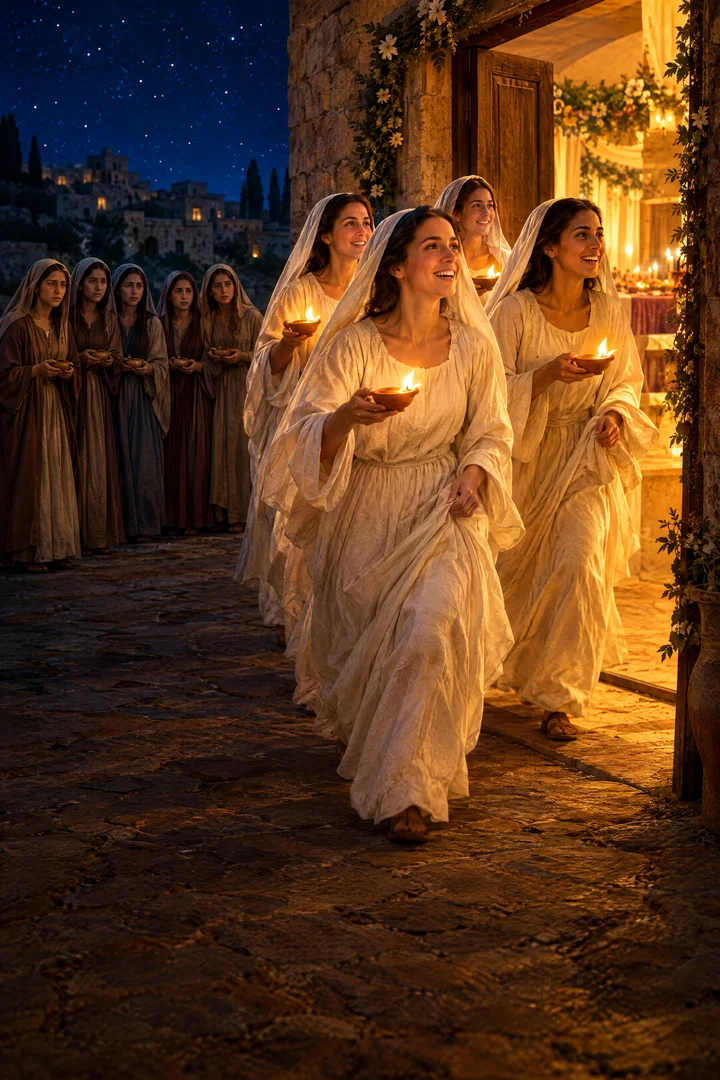
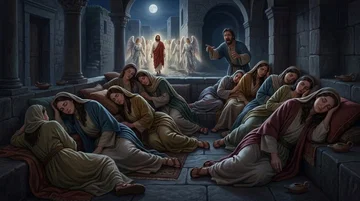
Cross-references 20 of 29
- Matthew 25:10-12
And while they went to buy, the bridegroom came; and they that were ready went in with him to the marriage: and the door was shut.
The bridegroom arrives, the door shuts, and the unready virgins are refused entry.
- Luke 12:35-36
Let your loins be girded about, and your lights burning;
Burning lamps picture servants ready and waiting for their returning Lord.
- Psalms 119:105
Thy word is a lamp unto my feet, and a light unto my path.
The parable’s lamp represents God’s word, which gives light and guidance.
- Revelation 19:9
And he saith unto me, Write, Blessed are they which are called unto the marriage supper of the Lamb. And he saith unto me, These are the true sayings of God.
The prepared are ready to enter the Lamb’s marriage supper.
- Matthew 25:13
Watch therefore, for ye know neither the day nor the hour wherein the Son of man cometh.
The parable warns to watch because the time of the Son of man’s coming is unknown.
- Matthew 25:14-30
For the kingdom of heaven is as a man travelling into a far country, who called his own servants, and delivered unto them his goods.
Both warn against burying entrusted gifts instead of using them faithfully before the reckoning.
- Zechariah 4:2-6
And said unto me, What seest thou? And I said, I have looked, and behold a candlestick all of gold, with a bowl upon the top of it, and his seven lamps thereon, and seven pipes to the seven lamps, which are upon the top thereof:
The lamp’s oil is connected with God’s Spirit, not human power.
- Luke 12:37
Blessed are those servants, whom the lord when he cometh shall find watching: verily I say unto you, that he shall gird himself, and make them to sit down to meat, and will come forth and serve them.
Blesses servants whom the Lord finds watching when he comes.
- Matthew 25:8
And the foolish said unto the wise, Give us of your oil; for our lamps are gone out.
The foolish virgins lack oil and cannot borrow it when their lamps go out.
- Mark 13:35-37
Watch ye therefore: for ye know not when the master of the house cometh, at even, or at midnight, or at the cockcrowing, or in the morning:
Both warn believers to watch and be ready for the Master’s unexpected coming.
- Luke 13:25
When once the master of the house is risen up, and hath shut to the door, and ye begin to stand without, and to knock at the door, saying, Lord, Lord, open unto us; and he shall answer and say unto you, I know you not whence ye are:
The shut door and plea to be let in echo the warning to the foolish virgins.
- Luke 12:36
And ye yourselves like unto men that wait for their lord, when he will return from the wedding; that when he cometh and knocketh, they may open unto him immediately.
Both portray servants waiting and being ready for the Lord’s return from the wedding.
- Matthew 24:42-44
Watch therefore: for ye know not what hour your Lord doth come.
The call to watch and be ready for Christ’s return leads into the virgins’ parable.
- Matthew 25:12
But he answered and said, Verily I say unto you, I know you not.
The unprepared virgins are denied entry and told they are not known.
- Zechariah 4:12
And I answered again, and said unto him, What be these two olive branches which through the two golden pipes empty the golden oil out of themselves?
Golden oil flowing from the olive branches supplies the lamps.
- John 8:12
Then spake Jesus again unto them, saying, I am the light of the world: he that followeth me shall not walk in darkness, but shall have the light of life.
Christ, the Light of the world, gives his followers the light they need.
- Luke 12:40
Be ye therefore ready also: for the Son of man cometh at an hour when ye think not.
Both call for readiness because the Son of man comes unexpectedly.
- Matthew 5:14-16
Ye are the light of the world. A city that is set on an hill cannot be hid.
Christ’s followers shine as lights for others through their good works.
- Matthew 25:7
Then all those virgins arose, and trimmed their lamps.
The virgins trim their lamps in preparation.
- Revelation 19:8
And to her was granted that she should be arrayed in fine linen, clean and white: for the fine linen is the righteousness of saints.
The passage connects readiness for the marriage supper with receiving the white robe of character, identified as Christ’s righteousness.
Commentary part 1 of 3
Each commentary is drawn from primary sources: the writings of Ellen G. White and Adventist pioneers and periodicals. Each commentary is separate. Its own words are not a quotation; follow the references to read the source passages.
Ellen G. White
106 sources
The foolish took lamps for the evening wedding procession to meet the bridegroom, but brought no reserve of oil in vessels to keep them burning through delay.COL 405.1Ms 92a, 1898, par. 1–3COL 405.2–406.1ST Sep 17, 1912COL 406.2 Their lamps are outward profession, a knowledge of Scripture and the theory of truth, while the oil is the grace of Christ and the Holy Spirit in the heart that makes the Word a living light.GC88 393.1–394.1GC 393.2–394.1GC 425.3–426.1 They are professed believers watching for the Lord, outwardly like the wise for a time, yet holding truth without practicing it and living partly for self and the world.Ms 79, 1897, par. 3–4ST Sep 17, 1912Ms 72, 1895, par. 1–2ST Feb 17, 189016MR 269.3 That oil must be secured personally in probationary time and cannot be borrowed or transferred in the final emergency, so delaying leaves lamps going out when they are most needed.ST Sep 17, 1912ST Aug 6, 1894ST Aug 6, 1894 When the midnight cry is heard they are found unready and shut outside the marriage supper, which calls everyone now to keep the inner lamp trimmed and burning by daily connection with God, obedience to truth, and working for perishing souls.Ms 79, 1897, par. 3–4Ms 9, 1891, par. 45–46ST Sep 17, 191215MR 229.1Lt 60, 1898, par. 34
Wedding Custom and Context
The verse belongs to a parable set at an evening wedding procession in which a company waits for the bridegroom to appear so they can join the procession and go to the wedding feast.COL 405.1ST Sep 17, 1912 The setting reflects the custom of the bridegroom going to meet his bride and bringing her to his home by torchlight.COL 405.1ST Sep 17, 1912 Christ told the story of the ten virgins to His disciples as He looked upon such a waiting party, and the experience it describes illustrates the experience of the church that shall live just before His second coming.COL 406.2ST Sep 17, 1912
The verse belongs to Jesus' discourse in Matthew 24-25, spoken shortly before He entered Gethsemane.ST Nov 20, 1884 That discourse teaches readiness and watchfulness for Jesus' second coming, and this verse introduces the foolish virgins in that parable of readiness.ST Nov 20, 1884ST Sep 17, 1912 The wedding language places waiting followers in the setting of the bridegroom's return: Jesus leaves to receive the kingdom and promises to return for them.EW 46.1
The foolish took lamps but made no provision of oil to replenish them, bringing lamps but no reserve oil in vessels or flasks or flagons to refill them.Ms 92a, 1898, par. 1–3COL 405.2–406.1ST Sep 17, 1912ST Aug 6, 1894ST Sep 17, 1912 They had not expected the bridegroom to be delayed and had not prepared for a long wait, so they were unprepared and unready when the wait continued and when he came.Ms 92a, 1898, par. 1–3COL 405.2–406.1ST Sep 17, 1912ST Aug 6, 1894ST Sep 17, 1912 Their distress came from having no reserve oil, not merely from seeing their lamps go out, leaving them unable to replenish their lamps when the wedding procession appeared and when their lamps needed replenishing.ST Sep 17, 1912ST Aug 6, 1894ST Aug 6, 1894 Their lights were going out when they were needed, and in the parable's application this lack of preparation belongs to those who went out to meet Christ but were not ready when He came and were left outside the wedding feast.Ms 92a, 1898, par. 1–3ST Aug 6, 1894 By contrast Luther filled his lamp from the storehouse of truth to shine brighter when the time came.Ms 92a, 1898, par. 1–3COL 405.2–406.1
In its earliest Advent application the virgins' going out represents the widespread movement under the first message.4SP 242.3 The bridegroom's delay represents the passing of the expected time and the disappointment.4SP 242.3 The detail about the foolish taking no oil is left without further explanation in that application.4SP 242.3
Prophetic Fulfillment in 1844
The parable illustrates the experience of the church living in the last days, the same church pointed out at the close of Matthew 24.GC88 393.1–394.1 It represents the spiritual condition of professed Christians watching in the evening of earth's history just before Christ's second coming.ST Apr 21, 1898COL 408.2–3Ms 92a, 1898, par. 20 All have lamps and outward readiness, yet the contrast between those with oil and those without calls each person to examine whether he will be among the wise when the Bridegroom comes.Ms 79, 1897, par. 3–4ST Sep 17, 1912ST Apr 21, 1898 For a time no difference is seen between them, for all have a knowledge of the Scriptures and confidently expect His appearing.COL 408.2–3 This includes God's people asleep just before the time of trouble such as was not since there was a nation.GC88 393.1–394.1
The coming of the Bridegroom is the coming of Christ as announced by the first angel's message.GC88 393.1–394.1 The going forth to meet Him is the widespread reformation under the proclamation of His soon coming, by whose biblical light all went forth.GC88 393.1–394.1 The midnight cry, Behold, the bridegroom cometh, was proclaimed in 1844 and aroused thousands to meet Him.GC88 398.4–400.11T 53.3–54.3CET 50.4 It had a heart-searching effect leading believers to seek a living experience for themselves and unmistakable evidence of acceptance with God.GC88 393.1–394.1CET 51.1 Believers in the messages who preached His appearing in the clouds were compelled to go out from the churches, and the cry was to be heard by the whole world.16MR 267.1–2
The waiting and slumber are followed by delay that tests faith and patience.GC88 398.4–400.1Ms 9, 1891, par. 21–2210MR 272.1–2 The foolish had no reserve of grace to sustain them through the test of waiting, and when the delay made them think He would not come they gave up hope because the wait was long.Ms 9, 1891, par. 21–2210MR 272.1–2 Passing the test means bearing with patience, watching and working with greater diligence to gather souls rather than waiting in idle expectancy.Ms 9, 1891, par. 21–22 The delay itself expresses Christ's long-suffering, not willing that any should perish but that all should come to repentance and have eternal life.Lt 21, 1886, par. 28–2910MR 266.2 It gives probationary time to employ every talent while the day lasts, which in the light of eternity will look short.Lt 59, 1893, par. 4–5Lt 21, 1886, par. 28–2910MR 266.2
The Bridegroom's coming was fulfilled when Jesus rose from His mediatorial throne and entered the Holiest to receive His kingdom.5MR 97.3Lt 3, 1847, par. 6–7 It was His coming to the Ancient of days in 1844 to begin the final work of mediation in the heavenly sanctuary.GC88 426.2–427.2GC88 426.1 It does not mean His coming to this earth to deliver His people on the tenth day of the seventh month.Lt 3, 1847, par. 6–7 Those without oil were not among those who followed Christ by faith into His heavenly work before the marriage.GC 426.2–427.2GC88 426.2–427.2GC88 426.1 This heavenly coming settles the truth of the shut door.5MR 97.3Lt 3, 1847, par. 6–7
The division into five wise and five foolish occurred among those who heard the first and second angels' messages.16MR 269.3 The foolish went forth to meet the Bridegroom under those messages but refused the third angel's message, the last testing message to be given to the world.16MR 269.3Ms 92a, 1898, par. 7–10 Only five made the provision essential to join the company who walked in the light that had come to them, and had all acted their part as wise virgins the message would ere this have been proclaimed to every nation, kindred, tongue, and people.16MR 269.3 This calls those living in the last days to make the needed preparation and accept the final message of mercy, for nominal faith without the oil of grace does not prepare to enter the marriage supper of the Lamb.Ms 92a, 1898, par. 7–10 Neglect to cultivate faith weakens it and loses the light received, which applies especially to cherishing faith in the third angel's message and walking in the light and evidence God has given.4MR 158.6–159.3Lt 97, 1895, par. 32–33
Some were later led astray by false shepherds and by scientific and spiritualistic philosophy that drew minds away from the present message, leaving them unprepared and vulnerable to deception through criticism and unbelief.Ms 80, 1905, par. 4 They failed to cherish the light of the third angel's message and the 1893 General Conference work of the Spirit.4MR 158.6–159.3 In the last days the foolish are those who claim to believe the truth yet weave in false theories.Lt 60, 1898, par. 8–13 They fill their papers with praise and exaltation of one whose main work for years has been to trample upon the seventh day and exalt Sunday as the sabbath, placing power on the side of those who make of none effect the law of Jehovah and bring oppression upon God's people, with the good woven up with the erroneous and the right all tangled up with the wrong.Lt 60, 1898, par. 8–13
What Lamps and Oil Mean
The lamps are the Bible, the Word of God, by whose light all go forth to meet the Bridegroom.GC88 393.1–394.1GC 393.2–394.1 They are received truth with its privileges and opportunities, a knowledge of the Scriptures and the theory of truth.GC 425.3–426.1Ms 72, 1895, par. 1–2 They are also outward profession and semblance of religion, the form of the truth, and the soul and a person's life and influence purchased at infinite cost, with the churches' responsibility to be the light of the world.Ms 72, 1895, par. 1–2RH Sep 17, 1908 Without supply a lamp cannot burn, give light, or be trimmed and burning, and its light burns dim and goes out for want of oil.GC88 393.1–394.1GC 393.2–394.1RH Sep 17, 1908 A Bible made into speculation through self-interest causes misunderstanding and confusion, so God's truth is to be presented simply that all may understand what it requires.RH Sep 17, 1908
The oil is the grace of God and of Christ, the Holy Spirit in the heart working by love and purifying the soul.GC88 393.1–394.1GC 393.2–394.1ST Aug 13, 1894 It is the regenerating enlightening power that renders the Word a lamp to the feet and a light to the path, implants its principles, develops God's attributes, and makes the light of His character shine forth to glorify God and lighten the path to the Bridegroom's home, the city of God and the marriage supper.GC88 393.1–394.1Lt 94, 1898, par. 10–15 It is gained by studying the Scriptures in the fear of God to learn the truth and by earnestly seeking purity of heart and life, giving personal experience and faith in God and His Word that cannot be overthrown by disappointment and delay.GC88 393.1–394.1GC 393.2–394.1 It is also experienced knowledge of Christ, His righteousness and character, faith that works by love, love, patience, and power for godly living, with faith, patience and love growing through connection with Christ.RH Feb 3, 1903ST Sep 17, 1912Ms 72, 1895, par. 1–2 Without it knowledge of truth cannot quicken the soul, sanctify the heart, or enable discernment between truth and error, and character cannot stand the test.GC 425.3–426.1RH Feb 3, 1903STMW7 54.1–2
The oil is the holy oil represented in Zechariah by the two olive trees and two olive branches emptying golden oil through two golden pipes into vessels prepared to receive it.Lt 94, 1898, par. 10–15Lt 108, 1898, par. 10–11 It is supplied by the two anointed ones who stand by the Lord of the whole earth and communicate it to the churches, with abundant supply provided.RH Sep 17, 1908Lt 98a, 1897, par. 58–59Lt 108, 1898, par. 10–11 It is emptied out of the olive trees into the lamps, and received into clean, pure, sanctified souls emptied of self and prepared to receive it.Ms 186, 1905, par. 3Lt 108, 1898, par. 10–11 It is received in answer to simple faith-filled prayer and by humbleness in wearing Christ's yoke and learning of Him, kindled by God in the chambers of the soul to burn brightly and give light to the world through good works.Lt 94, 1898, par. 10–15Lt 108, 1898, par. 10–11 Its light enables one believer to guide an individual sinner more than a showy procession, while without connection with heavenly agencies workers lack strong pure influence, the Holy Spirit is not represented in their labors, the power of godly example is lacking, and even great zeal is worthless and the work superficial and weak.RH Sep 17, 1908
The oil must be secured personally during probationary time and cannot be borrowed, transferred, or obtained in the final emergency.Lt 16, 1895, par. 26STMW7 54.1–2Lt 108, 1898, par. 10–11 Character cannot be given by another, grace to discern clear light and join the procession cannot be shared, and one person cannot communicate the oil to another.STMW7 54.1–2Lt 108, 1898, par. 10–11 Neglecting daily spiritual preparation and failing to nourish faith, love and patience through the Spirit leaves lamps going out with no reserve to replenish them.ST Sep 17, 1912ST Aug 6, 1894 Delaying to obtain it until the time of trouble or the Bridegroom's call leaves lamps going out with no time to replenish them, and going to buy oil comes too late after the door is shut.ST Aug 6, 1894Lt 16, 1895, par. 2615MR 229.1 Last-minute effort cannot make ready for the Bridegroom or the marriage supper, and neglecting the day of salvation may leave a person seeking entrance after the door has shut.ST Sep 17, 1912Lt 16, 1895, par. 26
Who the Foolish Are
The foolish are professed believers watching for the Lord's appearing, five of ten who all have a name and call and lamp and apparently wait for His coming, about half of those who claim to be ready.Ms 79, 1897, par. 3–416MR 269.3Ms 47, 1895, par. 1–3 For a time no difference is seen between them and the wise, for all have lamps in a knowledge of the Scriptures, all have heard the message of His soon approach and confidently expect His appearing, and all go forth under the light that has come.16MR 269.316MR 270.3–271.2 No human can reliably distinguish them, for some hold truth in unrighteousness yet appear outwardly just as the wise, and it is not given to human beings to read the heart from which come evil thoughts, murders, adulteries, fornications, thefts, false witness and blasphemies, or to separate tares that so closely resemble wheat.ST Sep 17, 191216MR 270.3–271.2 But fruits declare character, the angels of God make no mistake in gathering wheat from among tares, conduct and conversation reveal the true condition before God, and every plant which the heavenly Father has not planted will be rooted up.ST Sep 17, 191216MR 270.3–271.2 The division occurred among those who heard the first and second angels' messages, with the foolish going forth to meet the Bridegroom under those messages but refusing the third angel's message, the last testing message to the world, so that though all ten should have proclaimed the truth only five made the provision essential to walk in the light and join the company.16MR 269.3
They have lamps as outward profession without inward grace, with outward appearance and religious theory like the wise but without genuine conversion and without the oil of grace and the character that gives entrance into the marriage supper of the Lamb.Ms 72, 1895, par. 1–2ST Feb 17, 1890ASCOP 23.1 They claim to know and talk truth while keeping it in the outer court and not practicing it, having only theoretical knowledge and thinking theory enough, hearers but not doers who make excuses and neglect the call, Come, for all things are now ready.Ms 72, 1895, par. 1–2Ms 47, 1895, par. 1–3 Lacking oil means lacking unseen principles, open communion with God, and being known by the Lord, which cannot come by human birth, descent from Abraham, baptism, or membership in any church, but requires personal visible connection with God through personal faith in the Word of the living God that works by love to Jesus Christ in true preference, firm reliance, entire willing obedience and consecration, binding feelings, desires and interests up with Him in complete identification.Ms 72, 1895, par. 1–2 They are not open sinners who make no profession, but people who claim to be children of God and church members without practicing truth, wearing a mask, refusing to yield to authority, living by worldly principles, half with Christ and half with the world through indolence, carelessness and frivolity, seeking an enjoyable time with the world while claiming to be Christians.Ms 144, 1898, par. 7Ms 144, 1898, par. 9 Having no burden for souls, they do not deny self or lift the cross, live for self instead of seeking to save the perishing, do great harm and seduce many, and even hold the highest profession such as ordination or appointment as superintendent or teacher yet have only enough religion to deaden conscience and ruin the soul.Ms 144, 1898, par. 7Ms 144, 1898, par. 9
Their empty vessels mean they have not taken Christ as Counsellor, have not walked in the light of His Word, have worked their own way and have not come under His yoke, so their light has been darkness because they walked in the light of sparks of their own kindling and not the sacred fire from God, and they do not recognize the Holy Spirit as a positive necessity, whereas practicing the life-giving truth of the Bible makes wise unto salvation.ASCOP 23.1Ms 144, 1898, par. 9 Only a small number of those given great light, abundant opportunities and continuous privileges have more than theory, since light on justification by faith and the imputed righteousness of Christ has been shining; having oil means being worked by the Holy Spirit, bearing living testimony, searching the Scriptures, walking in received light and communicating precious truth so more light shines, rather than following meetings only to be benefited by hearing more.Ms 47, 1895, par. 1–3
The warning applies especially to ministers, younger ministers, teachers, Sabbath school teachers, and workers entrusted with high responsibilities who have received great light, ministerial training, privileges and opportunities yet remain spiritually cold with weak fading piety.STBk 9.1ASCOP 24.15T 20.2–21.1 Year after year they fail to take truth inwardly and therefore cannot impart it to others, lacking consecration to God and heart-felt piety and devotion, failing to accept and obey given light, though sent to be a light to church and world by good works as well as words and theories and therefore unable to exert powerful influence for good.ASCOP 24.15T 20.2–21.1 The lamp is the soul to be kept trimmed and replenished with the Spirit, and the oil is grace that keeps it burning and giving light, so they must not rely on eloquence, splendid endowments or busy activity but seek purification and sanctification, give themselves to God, and keep living faith and love, prayer, and a faith that works through love and purifies the soul.STBk 9.1STOM 7.3STA 9.1GW 104.3–105.1 Such ministers who remain like foolish virgins should be removed from ministry.ASCOP 24.1
Why Their Lamps Fail
The foolish acted from impulse and feeling rather than from settled conviction, their fears stirred by the solemn announcement while they rested on the faith of others and were content with flickering good emotion without thorough understanding of truth or genuine grace in the heart.GC88 393.1–394.1GC 393.2–394.1Ms 72, 1895, par. 1–2 They went forth full of hope of immediate reward, yet because they had not gained personal experience by studying Scripture in the fear of God and by earnestly seeking purity of heart and life, they were unprepared for delay and disappointment.GC88 393.1–394.1GC 393.2–394.1Lt 98a, 1897, par. 58–59 Their faith could not stand trial, so when testing came it failed and their lights burned dim.GC88 393.1–394.1GC 393.2–394.1 They knew the theory of truth and expected heaven, yet they had no vital connection with God because they trusted feelings, neglected Scripture, disobeyed truth, and cherished hidden sins that required cleansing and perfecting of holiness.ST Sep 24, 1912Ms 72, 1895, par. 1–2 Theirs was only assenting faith that says belief without practicing Christ's sayings, without feeding on His words as His flesh, without sinking the shaft deeper to gain more light to diffuse to others, and without that personal faith in the living Word which works by love, reveals true preference and firm reliance, and binds feelings, desires and interests to Christ in entire willing obedience and complete identification with Him.Ms 72, 1895, par. 1–2ST Aug 13, 1894
Self-love left them without sustaining grace to replenish their lamps, for though they had real interest in the gospel and knew the perfect standard of righteousness they lived to please and glorify themselves and treated precious life-giving truth as unessential.ST Aug 13, 1894ST Aug 13, 1894ST Sep 24, 1912ST Sep 24, 1912 The oil is truth and the grace of Christ received into the heart through the Holy Spirit, and without that supply religious life cannot burn steadily but becomes weak, fluctuating and built on uncertain principles.ST Aug 13, 1894ST Sep 24, 1912 Through pride, self-sufficiency and failure to humble the heart they felt rich and increased in goods with no room for heavenly grace, handling strange fire and bearing the strange fruit of dissension instead of unity.ST Aug 13, 1894ST Sep 24, 1912 Their blindness, ignorance and weak faith made them vulnerable to deception, so that Satan could present darkness as light.ST Aug 13, 1894ST Sep 24, 1912
They neglected the ordinances and instrumentalities that keep faith alive — time to pray, to search the Scriptures, to attend public worship, to abide in God's presence, and to lay hold on Christ's mediatorial work — while becoming absorbed in business, temporal cares, worldly company, dress and practices, unjust transactions and indulgence of passion and appetite.Lt 6, 1907, par. 5Lt 7, 1894, par. 4–8HPMMW 13.4Lt 22, 1890, par. 49–50 Keeping oil in the vessel with the lamp is the great daily necessity for a work weighty with eternal results and cannot safely be neglected, for no soul can prosper without it, and workers thrown into the society of worldlings especially need Jesus held up before them and personal labor bestowed upon them lest the worldly element steal the heart away from God.Lt 7, 1894, par. 4–8Lt 22, 1893, par. 16–19Lt 22, 1890, par. 49–50 The oil is the Holy Spirit, and its absence leaves them without the faith, love and knowledge of God and truth needed to keep lamps burning, a lack that calls sleeping ones to wake, trim lamps, study the Bible, seek understanding of truth in Jesus, share present truth with neighbors, and repent and confess.Lt 6, 1907, par. 5Lt 98a, 1897, par. 58–59 It is lost beforehand in little things, in trifling habits and unguarded thoughts shaping character, until the untrained nature cannot act on principle in great emergencies.Lt 6, 1907, par. 5Lt 98a, 1897, par. 58–59
They failed to form character in God's likeness and to do good works, for the oil is grace in the heart that enables light to shine in good works, and without providing it for the wait they had no fitness to join the procession when the call came.Ms 25, 1908, par. 16Lt 25, 1895, par. 4 Having a lamp without oil is like having a name in the church book without trading God-given capabilities for the Master in the present trading time, which calls for close critical self-examination of how opportunities are used and whether talents are put out to the exchangers, since God rewards every servant who works with self-denying, self-sacrificing zeal for souls and each one purified through belief of the truth begins at once missionary work for the perishing.Ms 25, 1908, par. 16Lt 25, 1895, par. 4 They had no burden for souls, did not deny self or lift the cross, did not kindle light by working to save the perishing, but sought an enjoyable time with the world while claiming to be Christians, wearing a mask, refusing authority and living by worldly principles to the great harm and seduction of others.Ms 144, 1898, par. 7Ms 144, 1898, par. 9Ms 144, 1898, par. 5 Their religion is false when meekness, gentleness, tenderness, sympathy and love are not practiced, when talents are buried unused, when old habits are clung to and worldly ideas woven into character, when baptism alone is trusted without conformity to Christ's image, and when the heart remains unconverted with envy, evil-surmising, vanity and love of exaltation, leaving them on the devil's ground, walking in sparks of their own kindling rather than sacred fire from God, defiling soul and body and sowing to the flesh to reap corruption.Ms 144, 1898, par. 9Ms 144, 1898, par. 516MR 271.3
They slumbered and slept instead of watching, working and praying, folding hands in neutral haphazard work with minds not strengthened to discern reasons of faith and soul-temples not purified by truth.3MR 361.2–4Ms 144, 1898, par. 5 With great light and knowledge they were spiritually cold and senseless, marked by weak fading piety for lack of the new life and power of the Holy Spirit needed for the last great conflict.ST2 22.5STBk 68.1STA 68.1STA 77.3–4STOM 54.1 They were asleep amid already-permitted disaster and asleep at their post, drawn by spiritualistic philosophy and skepticism that drew minds from the message, exalted science and inherent human powers, deemed grace and Christ's mediation unessential, and left them unaware their lamps were going out and vulnerable to deception.ST2 22.5STBk 68.13MR 361.2–4
Resulting Exclusion and Loss
The foolish took lamps with no provision to replenish them, and failed to prepare for delay, so their lights were going out just when needed.Ms 92a, 1898, par. 1–3ST Sep 17, 1912ST Jun 26, 1884 They have the lamp, the form of truth and outward profession, but no oil in the vessels, and for lack of the Spirit and grace of Christ their lamps burn dim, flicker, and go out in darkness.RH Sep 17, 1908RCOC 123.3ST Jun 26, 18845T 413.1 Abundant supply has been provided through the two anointed ones who stand by the Lord of the whole earth, but those who have received much light and opportunity yet do not live and walk in it lose spiritual light, trust profession while transgressing the law and asleep to their true condition, and are left with superficial, weak work in which zeal without the Spirit is worthless.RH Sep 17, 1908RCOC 123.3ST Jun 26, 1884 Empty lamps mean keeping Christ apart from the life here, and a life without Christ here unfits for His companionship in heaven.COL 413.2 Without the oil of grace there is no genuine experience unfolding and intensifying through vital connection with God unto continual advancement and brighter holy love, but only formal services while love declines, inability to see holiness worse than a sinner's, danger of perishing with the wicked, and despair where warnings can no longer reach unless there is soon a decided change through pity, humbling and healing.5T 413.1
When the cry, Behold, the Bridegroom, is heard, the lack is found out and they are surprised, dismayed and unready, unable to replenish in time to join the procession.ST Sep 17, 191215MR 229.1 They do not live the truth and fail to obtain the wisdom and grace that would make them complete in Christ, neglecting to have their lives filled with His grace, so profession and confidence in promises cannot make up for failing to live as commanded.Lt 60, 1898, par. 3416MR 274.2ST Aug 6, 1894 Many who expect to join the marriage supper of the Lamb are thus not ready for the coming King and fail to discern their danger, and arriving after the door has shut they cannot partake but lose their chance.ST Sep 17, 1912Lt 60, 1898, par. 34 While the wise go in with the bridegroom to the marriage and the banquet, the door is shut, and the foolish afterward meet the unexpected denial, I know you not, left standing outside in the empty street in blackness of night.ST Aug 6, 189415MR 229.116MR 274.2 There they are shut outside the banquet hall in outer darkness and despair, strangers to heaven's joy, unable to share its light, melody, love and joy despite pleading that they ate and drank in His presence, prophesied and did wonders.15MR 229.1
Waking then and trying to have empty lamps replenished cannot make them ready.ST Sep 17, 1912ST Aug 6, 1894COL 413.2 The missing oil is grace that must be secured during probationary time and daily preparation of faith, love and patience nourished by the Spirit, and it cannot be obtained or borrowed when the final emergency arrives.ST Sep 17, 1912ST Aug 6, 1894Lt 16, 1895, par. 26 Going to buy then comes too late, for probation has ended and seeking entrance after the door has shut is vain.Lt 16, 1895, par. 2615MR 229.1 Character cannot be formed or changed at His coming, and at the judgment the righteous and foolish are separated, with names blotted from the book of life for the untrained life.Lt 16, 1895, par. 2615MR 229.1
Call to Present Readiness
The foolish took lamps with no oil, and the contrast calls every person to examine before God whether they will be among the wise when the Bridegroom comes.Ms 79, 1897, par. 3–4ST Sep 17, 1912ST Aug 6, 1894 Outward readiness is not enough, for all have lamps in a knowledge of the Scriptures and have heard the message of Christ's soon approach, yet for a time no difference can be seen between wise and foolish until the waiting tries faith.Ms 79, 1897, par. 3–4 Genuine readiness is a living, complete connection with God each day, keeping the inner lamp trimmed and burning with oil in the vessel through earnest prayer, searching Scripture, worship, self-examination, humbling of heart, repentance and confession, and consecration.Ms 9, 1891, par. 45–46ST Mar 17, 1898 It blends working, waiting, watching, and praying together, neither idle expectancy nor bustle and excitement to the neglect of personal piety, and conduct and conversation reveal the true condition.ST Sep 17, 1912ST Aug 6, 1894 Having no oil is being destitute of the Holy Spirit and lacking the oil of grace that must supply the needs of the soul with constant increase in spiritual power, so the lamp must be fed with holy oil to burn and shine on the path of others.ST Mar 17, 1898 Guarding words and behavior, purifying the soul by obeying truth including physical law, and enduring in faith, love and patience keep the day from overtaking as a thief, for Jesus warns to watch because the time of His coming is unknown.ST Sep 17, 1912ST Aug 6, 1894
Having a lamp without oil is like having a name in the church book without using God-given capabilities for the Master, for the present is the trading time demanding close, critical self-examination of how opportunities have been used and whether talents are put out to the exchangers.Ms 25, 1908, par. 16 Each one who has denied self and purified the soul through belief of the truth will begin at once to do missionary work for those perishing in their sins, and God rewards every servant who works with self-denying, self-sacrificing zeal for the salvation of souls.Ms 25, 1908, par. 16 Oil in vessels with lamps keeps light burning with undimmed flame through the night of watching, swelling the illumination for the bridegroom's honor and lighting the way to the bridegroom's home, to the city of God, to the marriage feast.COL 414.1–2 Readiness to meet the Bridegroom requires a deeper experience with thoughts, motives, and desires brought under God's control, warning the world of its danger, leading perishing people to Christ, and proclaiming that the end is near.Ms 80, 1905, par. 8 The true, self-sacrificing laborer whose spiritual lamp is trimmed and burning advances the Lord's work and the interests of His institution, gaining a precious experience, recognizing God's presence, and counting it a privilege to give ability, service, and constant care, while lamps filled with holy oil go out to give light to those in darkness amid moral darkness.SSP 9.1RH Jan 4, 1906 By contrast half-hearted discipleship, idleness, and neglect of piety bear no enduring light and make even splendid gifts worthless, turning one into a receptacle of darkness instead of passing on received light in good works and publications.COL 414.1–2
The warning reaches the home, health, and final hours, for fathers and mothers must keep the lamp burning in the family by commanding the household after God, and the lamp is fed by obedience that includes appetite and physical law.Ms 92a, 1898, par. 33–35Lt 66, 1874, par. 17–20 Those who live merely to please themselves may reach sickness and death without inward readiness and find themselves unfit to close life well, and recognizing the lack too late cannot supply it.14MR 122.2–123.1MYP 387.3SPBC 148.2 The foolish have a knowledge of the truth but are not sanctified through it, forgetting the day of trust and the day of reckoning, neglecting committed talents and failing the sacred responsibility to bless others by opening precious truth to those in error.Lt 86, 1895, par. 12 They take for granted that God's promises are theirs while not living as Christ enjoins, so profession alone is nothing and taking salvation for granted is most perilous; five are wanting, surprised and dismayed without oil, left outside the wedding banquet with the door shut, crying peace when there is no peace.Ms 92a, 1898, par. 33–35 Having no oil in the lamp is lacking divine grace and moral power, and following inclination and failing to resist temptation leaves one unprepared for everlasting life, while self-denial and firm resistance to sin build spiritual strength.Lt 66, 1874, par. 17–20 The foolish are like the man without the wedding garment and those who bury talents, unlike the wise who wash robes white in the Lamb's blood, overcome, walk in white, and stand on the sea of glass, for sanctification is the work of a lifetime in self-denial, daily cross-bearing, doing and teaching the commandments, and pressing toward perfection, and redemption's great price enables all to become partakers of the divine nature complete in Christ.Ms 92a, 1898, par. 33–35Lt 66, 1874, par. 17–20
Sources
Pioneers and periodicals
468 sources
The foolish took lamps without oil while the wise took oil in vessels with their lamps, so having a lamp alone was not enough to be ready when the bridegroom was announced at midnight and the door was shut.RH May 15, 1900ST Nov 22, 1899RH Jun 9, 1851 The ten virgins are professed believers looking for Christ's coming, with the foolish as outwardly faithful professors lacking true inward life.LS 97.2–100.2RH May 15, 1900ST Mar 18, 1875RH Mar 31, 1868ST Dec 10, 1902 The lamp is the Bible and Christian witness that must be fed and kept burning, and the oil is grace and faith wrought in heart and life by God's word and Spirit, especially the Holy Spirit Himself.RH Sep 17, 1908ST Mar 18, 1875RH Jun 9, 1851RH Mar 31, 1868RH Feb 7, 1856 That inward grace and consecration cannot be given by another or supplied at the last moment, but each must obtain and keep a reserve to sustain light through delay and darkness.ST Jul 20, 1915ST Apr 6, 1888RHGSAM 148.2RH May 28, 1908 The lack was fulfilled when the Advent proclamation of 1843-1844 tested waiting believers, and it marks the marriage before the visible return when Christ entered the Most Holy in 1844 and the wise entered with Him by faith.LDT 165.1–3RH Jun 9, 1851RH Mar 12, 1867RH Nov 24, 1874RH May 29, 1856
Parable Story and Setting
The foolish took lamps but took no oil with them, while the wise took oil in their vessels with their lamps, so the difference was not in outward profession and work, in which both groups looked alike, but in inward preparation, the wise having genuine commitment to believe and act on promises while the foolish had only pretense and passing emotion.RH May 15, 1900ST Nov 22, 1899ST Apr 7, 1881GSAM 148.1 Their failure was bringing no extra supply for the nighttime wait and delay, which left them unprepared to meet the bridegroom when he tarried and all slumbered and slept.ST Nov 22, 1899ST Apr 7, 1881RH Jun 9, 1851GSAM 148.1 Having a lamp alone was therefore not enough to be ready, and the ready are admitted to the marriage while the unready are shut out.RH May 15, 1900ST Nov 22, 1899ST Apr 7, 1881 The parable met its fulfillment in the experience of God's people in 1844, whose climactic six months ended October 22, with the midnight cry given from July through October.ST Nov 22, 1899
When the bridegroom's coming was announced at midnight, the foolish lamps were going out, and they had to seek oil and asked the wise for theirs, but the wise refused to share.RH Jun 9, 1851RH Apr 2, 1872 While the foolish went away to buy oil, the bridegroom came, the prepared virgins entered with him, and the shut door left the foolish outside despite their regret and late seeking.RH Jun 9, 1851RH Apr 2, 1872 They were behind time, having neglected the essential means and the work of reformation until it was too late, which warns that readiness cannot be supplied at the last moment before an unexpected arrival.RH Apr 2, 1872 The wise needed no special ascension robes to enter.
The verse belongs to the parable of the ten virgins in Matthew 25:1-13, truly a parable known from the nature of the text and its context, about a delayed bridegroom and a waiting church whose earnest expectation evidences love.LS 97.2–100.2RH Jun 9, 1851RH Mar 10, 1868RH Jun 4, 1867RH Nov 12, 1857 The delay represents the passing of the expected time, the slumber represents believers becoming uncertain about the time and losing zeal and devotion while still holding faith, and the renewed midnight cry was meant to wake them and call them to readiness.LS 97.2–100.2RH Mar 10, 1868 The history of the eastern marriage is compared to events connected with the Advent movement, in which the virgins represent living professed believers looking for Christ's coming and kingdom.LS 97.2–100.2RH Nov 12, 1857 Some place its sequence as already past by 1867 through verse 12, with the tarrying ending in 1844 and the bridegroom's coming represented in verse 10, and with the foolish seeking entrance after the door was shut illustrating seeking Christ's presence after He ended mediation in the Holy Place and began work in the Most Holy Place from 1844 until wrath, without separately explaining the lack of oil.RH Jun 9, 1851RH Mar 10, 1868RH Jun 9, 1851RH Jun 4, 1867RH Nov 12, 1857
Its setting is an evening wedding procession with recognizable customs and ceremony, in which the bridegroom comes to meet the bride and bring her home by torchlight.ST Sep 17, 1912ST May 4, 1904 Virgins go forth by night with lighted lamps to meet the bridegroom, and others are present at the celebration.ST Sep 17, 1912ST May 4, 1904RH Aug 29, 1871 That Palestinian custom still continues, showing domestic life substantially unchanged for forty centuries and bearing witness to scriptural truth.RH Aug 29, 1871
Identity of the Virgins
The virgins are the church, living professed believers looking for Christ's coming and kingdom in the second-advent movement.LS 97.2–100.2ST Mar 18, 1875ST Nov 22, 1899RH Nov 12, 1857 The foolish are unfaithful, careless professed believers lacking true faith and the inward work of grace and Spirit, whose divided condition, half wise and half foolish, describes the last-days church waiting through apparent delay for the Bridegroom.ST Mar 18, 1875RH Mar 31, 1868ST Nov 22, 1899RH Sep 14, 1916 Their lamps are the prophetic word and God's word taken up in expectation of the immediate coming, but without oil that expectation is merely theoretical and not the abiding faith formed in heart and life by word and Spirit.ST Mar 18, 1875RH Mar 31, 1868 When the time passed and confusion came, their sleep was uncertainty about the time and loss of zeal while still holding faith, needing the renewed midnight cry to wake them to readiness.LS 97.2–100.2RH Sep 14, 1916
The equal number, five wise and five foolish, does not predict how many will be saved or lost but makes the proportion indefinite.ST Nov 22, 1899 It gives no basis for speculation about numbers and calls each hearer to examine faithfulness as revealed by conduct and conversation.ST Nov 22, 1899
The virgins are not the bride, for the bride is the New Jerusalem, the capital of the kingdom which Christ receives as the marriage.RH Jun 9, 1851RH May 29, 1856RH Feb 28, 1856 That receiving is His entrance into the Most Holy Place to cleanse the sanctuary, blot out transgressions, complete priestly work begun in 1844 and proceeding until just before the plagues, so going to the marriage marks its beginning not its completion.RH May 29, 1856RH Feb 28, 1856 The saints are guests at the marriage supper, and before that marriage the Lamb gathers from the nations children to present to the New Jerusalem when called to the supper, in which sense believers are children of the New Jerusalem.RH Feb 28, 1856RH Aug 2, 1870
The kingdom likened to ten virgins shows that a kingdom can be spoken of as a whole when only a part is intended.RH Jan 22, 1857 The foolish are a class rather than fixed individuals, so a person may at one time belong to one class and later to the other, and foolishness does not mean particular individuals are forever beyond salvation. Their presence alongside the wise, having lamps but no oil in vessels, does not make the church any less God's church.ST Oct 23, 1879
The foolish are dead professors in the church of God in all ages, having a name to live while dead, one with fruitless branches in Christ, the barren fig tree, the tares in the wheat, the plant the Father has not planted, dead faith without works, and those dead while living in pleasure.ST Jul 16, 1885 The wise are among the saved who meet Christ at His return with trimmed lamps, while the foolish with lamps but no oil are distinguished from them and will fail at last.ST Nov 22, 1899RH Jun 2, 1868RH Mar 31, 1863ST Sep 1, 1881 The lamps are expectant obedient witnesses awaiting the Bridegroom, gathered from every nation, tongue and tribe including the ancient Inca empire, keeping the commandments of God and the faith of Jesus and giving the news of His soon coming, whose placing and trimming is this gathering and active witnessing to finish the work of lightening the world.RH Jun 2, 1868RH Aug 29, 1907 The wise virgin going forth to meet her Lord is the church, and choosing a pure true woman as the symbol to represent the church honors woman and shows her virtue, influence and divine calling.RH Dec 14, 1911
Lamp and Oil Symbols
The lamps or torches are the Bible, the Word of the Lord, including the prophetic word, and Christ as the Light, and the Christian witness that guides through darkness, which must be fed with holy oil, kept clean, lit and renewed by revival.RH Jun 9, 1851RH Mar 31, 1868RHGSAM 148.2RH Jan 31, 1871 Taking lamps meant taking to the Bibles with blessed hope and joyful expectation of soon seeing the King, moved far out from the spirit and interests of this world by the judgment-hour cry.ST Mar 18, 1875RH Jun 9, 1851 This taking belongs after the fulfillment and preaching of the special signs in the sun, moon and stars that call out the two classes, so it applies to the recent Advent movement and not to a movement beginning two hundred years earlier, and it is the same movement symbolized by the angel with the everlasting gospel.RH Jun 9, 1851
The missing oil distinguishes merely theoretical faith, the theory of the truth alone, from abiding faith formed by the work of God's word and Spirit in heart and life, true inward grace and hearty interest.ST Mar 18, 1875RH Mar 31, 1868GSAM 148.2RH Jan 31, 1871 It marks neglect of the means of grace needed to understand the Bible's lessons, obey its requirements and receive its promises, and shows lack of earnest consecration that develops the graces of the Spirit in the believer.RHGSAM 148.2 The oil is faith in God's word shown by works, recognizing the waymarks to Zion, and faith and good deeds with burning lamps and plenty of oil.RH Dec 11, 1855ST Mar 18, 1875
The oil is grace from God, the grace of Christ feeding the lamp, especially faith, and the vessels are means of grace such as ministers, meetings, classes, publications and associates.RHRH Mar 18, 1873RH Without faith the word gives no light for the path, the word is darkness and the lamp is useless.ST Sep 2, 1880ST Sep 2, 1880 In the historical application the careless among the Advent believers in 1843-1844 had weak faith and darkened understanding of prophecy's fulfillment, and sought from brethren help those brethren could not provide, while lack of these means among those who remained in the churches contributed to spiritual decline.ST Sep 2, 1880RH Lack of oil is lack of the Holy Spirit and grace, the Spirit and grace of Christ abundantly supplied through the two anointed ones who stand by the Lord of the whole earth.RH Sep 17, 1908RH Feb 7, 1856 Without connection with heavenly agencies workers lack strong pure influence, the Holy Spirit is not in their labors, the power of godly example is lacking and they have no living experience to give power to truth, so even great zeal is worthless and the work is superficial and weak.RH Sep 17, 1908 Relying on the written Word while refusing the Spirit's guidance and the gifts puts out the light and leaves without what is needed to remain in truth, and turning knowledge of the Word into speculation mixed with self-interest causes misunderstanding and confusion instead of simple presentation all can understand.RH Sep 17, 1908RH Feb 7, 1856
The oil is the reality of bravery and steadfastness, and the lamp that holds it is some small, wretched, disagreeable everyday duty that becomes a person's martyrdom.ST Jul 8, 1886ST Jan 8, 1902 Delighting in the memory of martyrs who died for truth while refusing the little duty that is one's own martyrdom spills the oil, and if that duty is not done the oil is spilled and lost.ST Jul 8, 1886ST Jan 8, 1902 That refusal leaves admiration for martyrs flat and thin and unilluminated, running out over a self-indulgent life like lamps taken with no oil, leaving the lamp empty.ST Jul 8, 1886ST Jan 8, 1902 Lasting readiness requires more than outward profession: the Holy Spirit must make God's word a transforming power in the life, developing God's character so followers shine as lights and help point the way to the Bridegroom's home, with reserve oil to sustain light through the night.ST Jul 20, 1915RH Mar 18, 1873 That reserve is a sufficient supply of faith in God's word needed during the closing experience after disappointment, when darkness sets in and no prophetic period marks how long remains, for without oil the lamp goes out and leaves groping in darkness, while the New Testament keeps spiritual light burning.RH Mar 18, 1873RH May 28, 1908ST Sep 15, 1881
Sources