Matthew 3:14
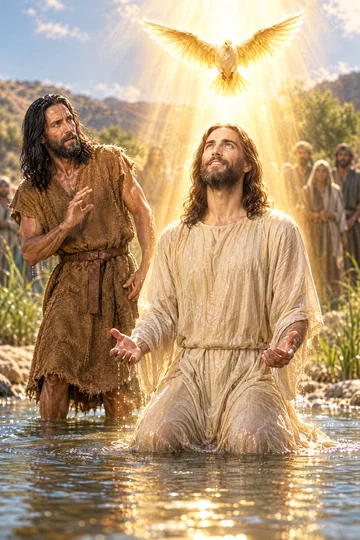
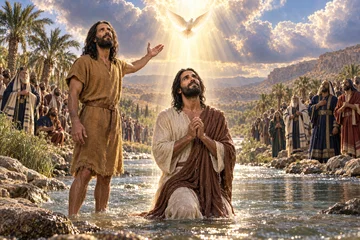
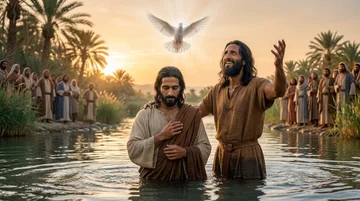
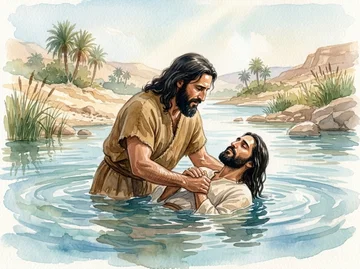
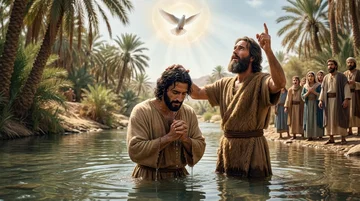
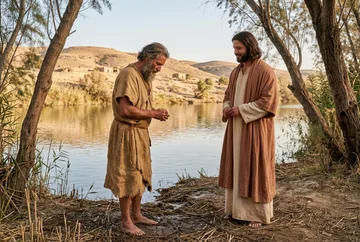
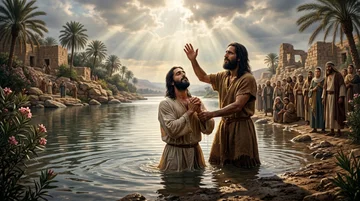
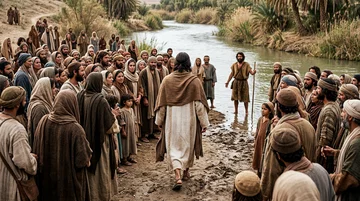
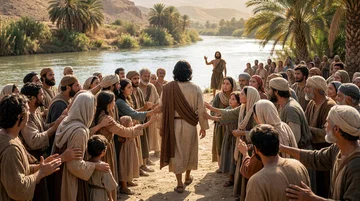
But John forbad him, saying, I have need to be baptized of thee, and comest thou to me?
Translations
But John forbade him, saying, I have need to be baptized of you, and come you to me?
King James Version, KJV Cambridge Paragraph Bible
But John forbad him, saying, I have need to be baptized of thee, and comest thou to me?
But John forbad him, saying, I have need to be baptized by thee, and comest thou to me?
Revised Version, American Standard Version
But John would have hindered him, saying, I have need to be baptized of thee, and comest thou to me?
but John was forbidding him, saying, 'I have need by thee to be baptized — and thou dost come unto me!'
but John urgently forbad him, saying, I have need to be baptised of thee; and comest thou to me?
But, he, would have hindered him, saying—I, have, need, by thee, to be immersed,—and dost, thou, come unto me?
Berean Standard Bible, Majority Standard Bible
But John tried to prevent Him, saying, “ I need to be baptized by You, and do You come to me?”
But John would have hindered him, saying, “ I need to be baptized by you, and you come to me?”
But John would have kept him back, saying, It is I who have need of baptism from you, and do you come to me?
But Iohn earnestly put him backe, saying, I haue neede to be baptized of thee, and commest thou to me?
Douay-Rheims (Challoner revision)
But John stayed him, saying: I ought to be baptized by thee, and comest thou to me?
Pictures
Cross-references 20 of 32
- Romans 6:4
Therefore we are buried with him by baptism into death: that like as Christ was raised up from the dead by the glory of the Father, even so we also should walk in newness of life.
Baptism is described as burial with Christ and rising to new life.
- Mark 1:9
And it came to pass in those days, that Jesus came from Nazareth of Galilee, and was baptized of John in Jordan.
Also records Jesus being baptized by John in the Jordan.
- Luke 3:21-22
Now when all the people were baptized, it came to pass, that Jesus also being baptized, and praying, the heaven was opened,
Jesus is baptized, and the Spirit descends with a voice from heaven.
- John 1:32-34
And John bare record, saying, I saw the Spirit descending from heaven like a dove, and it abode upon him.
The Spirit’s descent at Jesus’ baptism identifies him as the Son of God and baptizer with the Holy Ghost.
- Matthew 28:19
Go ye therefore, and teach all nations, baptizing them in the name of the Father, and of the Son, and of the Holy Ghost:
Jesus commands his disciples to baptize, as John recognizes Jesus’ authority in baptism.
- Isaiah 40:3
The voice of him that crieth in the wilderness, Prepare ye the way of the LORD, make straight in the desert a highway for our God.
The wilderness voice prepares the Lord’s way, as John’s mission did.
- Matthew 4:1-11
Then was Jesus led up of the Spirit into the wilderness to be tempted of the devil.
Christ’s wilderness temptation and victory follow His baptism.
- Mark 1:4
John did baptize in the wilderness, and preach the baptism of repentance for the remission of sins.
John’s baptism is described as repentance for remission of sins.
- John 1:29
The next day John seeth Jesus coming unto him, and saith, Behold the Lamb of God, which taketh away the sin of the world.
John identifies Jesus as the Lamb who takes away the world’s sin.
- Colossians 2:12
Buried with him in baptism, where in also ye are risen with him through the faith of the operation of God, who hath raised him from the dead.
Baptism signifies being buried and raised with Christ.
- Luke 3:3
And he came into all the country about Jordan, preaching the baptism of repentance for the remission of sins;
John administered baptism of repentance for remission of sins.
- Matthew 11:2-3
Now when John had heard in the prison the works of Christ, he sent two of his disciples,
John later asks Jesus whether he is the one who was to come.
- John 1:23
He said, I am the voice of one crying in the wilderness, Make straight the way of the Lord, as said the prophet Esaias.
John identifies himself as the foretold wilderness voice preparing the Lord’s way.
- Acts 1:5
For John truly baptized with water; but ye shall be baptized with the Holy Ghost not many days hence.
Contrasts John’s water baptism with baptism in the Holy Ghost.
- Malachi 3:1
Behold, I will send my messenger, and he shall prepare the way before me: and the Lord, whom ye seek, shall suddenly come to his temple, even the messenger of the covenant, whom ye delight in: behold, he shall come, saith the LORD of hosts.
Foretells a messenger who prepares the way before the Lord comes.
- Luke 1:15-17
For he shall be great in the sight of the Lord, and shall drink neither wine nor strong drink; and he shall be filled with the Holy Ghost, even from his mother’s womb.
John’s Spirit-filled work prepares a people for the Lord.
- John 3:22-23
After these things came Jesus and his disciples into the land of Judæa; and there he tarried with them, and baptized.
Jesus’ disciples and John baptized at the same time, and John baptized where there was much water.
- Acts 2:38
Then Peter said unto them, Repent, and be baptized every one of you in the name of Jesus Christ for the remission of sins, and ye shall receive the gift of the Holy Ghost.
Peter commands the repentant to be baptized, using the word meaning immerse.
- John 4:1-2
When therefore the Lord knew how the Pharisees had heard that Jesus made and baptized more disciples than John,
Jesus’ disciples baptized under his ministry.
- 1 Peter 3:21
The like figure whereunto even baptism doth also now save us ( not the putting away of the filth of the flesh, but the answer of a good conscience toward God,) by the resurrection of Jesus Christ:
Baptism is linked to Christ’s resurrection and a good conscience.
Commentary
Each commentary is drawn from primary sources: the writings of Ellen G. White and Adventist pioneers and periodicals. Each commentary is separate. Its own words are not a quotation; follow the references to read the source passages.
Ellen G. White
42 sources
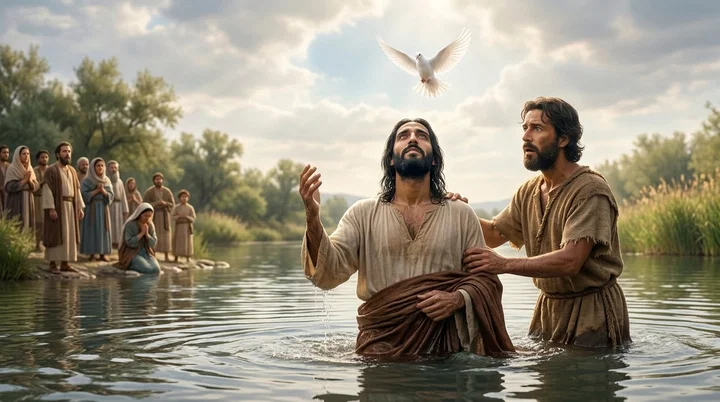
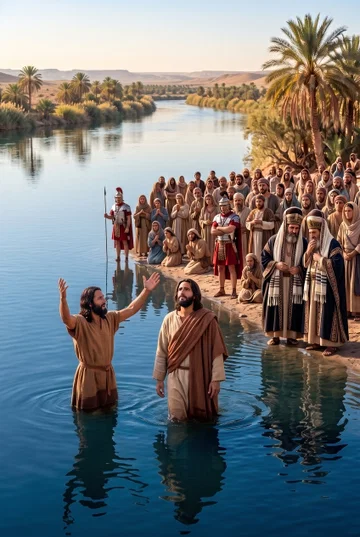
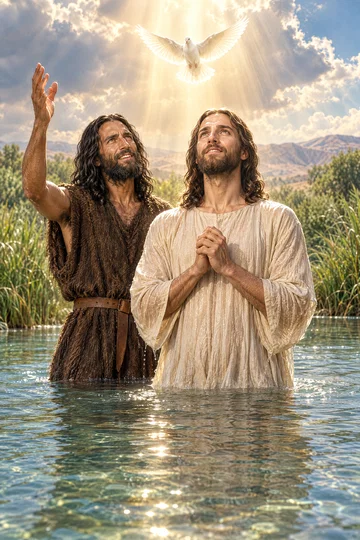
John drew back from immersing Jesus because he saw Him as holier and greater than himself and felt he himself needed cleansing from Jesus instead.Ms 95, 1908, par. 1–310MR 292.1–4Ms 144, 1901, par. 16–182SP 58.2–59.1Ms 155, 1902, par. 33–36 He could not understand why One who had never sinned should receive a rite given to repentant sinners as a sign of cleansing from guilt.2SP 58.2–59.1COS 45.2DA 110.1–111.2RH Jan 21, 1873ST Jul 7, 1887 Jesus overruled the refusal by requiring it then in order to fulfill all righteousness, and John yielded and immersed Him in the Jordan.Ms 147, 1906, par. 21–22Ms 112, 1901, par. 14–15Ms 31, 1901, par. 9–13 Though needing no repentance for Himself, as the sinless Head and representative of humanity He took the sinner's place, identifying with sinners and taking their sins upon Him while honoring the ordinance and setting the steps of conversion for all to follow.Ms 144, 1901, par. 16–18Ms 57, 1900, par. 2221MR 196.2–3Ms 155, 1902, par. 33–36COS 45.2 His prayer at the baptism opened heaven, bringing the Spirit upon Him and the Father's declaration of Him as the beloved Son, which stands as the pledge that all who believe in Him are accepted in Him.Ms 144, 1901, par. 16–18Ms 147, 1906, par. 21–22Ms 112, 1901, par. 14–15COS 45.3Ms 144, 1901, par. 20
Baptism Setting and Sequence
When Jesus came to John, John was still waiting for the sign by which God would identify the Messiah to him.ST Jul 7, 1887 He believed Jesus was the promised One, yet the secluded life Jesus had lived at Nazareth had left him uncertain, and he rested the matter in faith until God should make it plain.ST Jul 7, 1887
He had been told beforehand that the Messiah would seek baptism from him and that a sign of divine character would then be given so that he could present Him to the people.DA 109.1–3COS 44.3–4 He recognized Jesus by the holiness seen in His face.COS 44.3–4 The request belonged to the start of Christ's public ministry, when the time had come and His first act was to go to the Jordan to be baptized by John.COS 44.1 At about thirty years of age His baptism was His anointing for His mission, His inauguration and dedication for His appointed work.Ms 141, 1909, par. 1–2Ms 63, 1910, par. 7Ms 52, 1890, par. 3–5
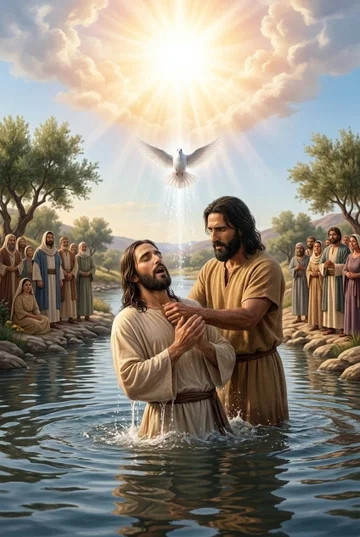
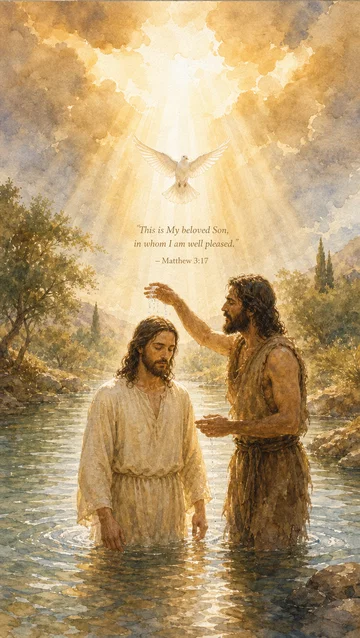
John at first resisted and forbade Him, but then yielded to His request and baptized Him.COS 45.1ST Oct 25, 1877 He led Jesus down into the waters of the beautiful Jordan and baptized Him there in the sight of all the people.COS 45.1 Newly made disciples were present and witnessed wonderful things, and from what they saw there and afterward they concluded that Jesus of Nazareth is the One Moses and the prophets wrote of.ST Apr 8, 1886
The baptism took place while Jesus was separated from Mary and before His temptation in the wilderness and His coming to the marriage at Cana.ST Apr 8, 1886 Afterward He was led by the Spirit into a desolate place, the Spirit fitting Him for the fierce temptation that followed.LC1 45.11RED 45.1 There He fasted forty days and faced the devil, yet continued on the course set for Him.LC1 45.11RED 45.1 His baptism, followed by His wilderness temptation and victory, was part of His coming to give humanity another trial, so that people through His merits can overcome temptation, especially temptation involving appetite, and gain moral power to break the hold of habit and indulgence.Ms 55, 1893, par. 5–6
John's Reluctance Explained
John drew back and forbade Jesus because he recognized Him as greater, superior and holier than himself, and he felt that he himself needed to be baptized by Jesus and questioned why Jesus came to him to be baptized.Ms 95, 1908, par. 1–310MR 292.1–4Ms 144, 1901, par. 16–18Ms 57, 1900, par. 22Ms 147, 1906, par. 21–22 At first he refused to perform the ordinance upon Christ, declaring that the need ran the other way, that he needed baptism from Christ rather than Christ needing baptism from him.10MR 292.1–4Ms 144, 1901, par. 16–18Ms 57, 1900, par. 22Ms 147, 1906, par. 21–22Ms 112, 1901, par. 14–15 His refusal belonged to Christ's coming to the Jordan to receive baptism at John's hand, the ordinance John administered to large numbers who repented.Ms 144, 1901, par. 16–18Ms 57, 1900, par. 22Ms 112, 1901, par. 14–15
He felt unworthy to baptize Him because he saw the contrast between his own sinfulness and Jesus' sinless purity.2SP 58.2–59.1Ms 155, 1902, par. 33–36DA 110.1–111.2RH Jan 21, 1873ST Jul 7, 1887 He knew himself to be a sinner in need of baptism while recognizing Christ's superiority, holiness and sinless purity.2SP 58.2–59.1Ms 31, 1901, par. 9–13DA 110.1–111.2RH Jan 21, 1873ST Jul 7, 1887 Christ's submission to the rite came before beginning His work, not as confession of personal guilt or need of repentance.Ms 155, 1902, par. 33–36Ms 31, 1901, par. 9–13DA 110.1–111.2
Because his baptism was for repentant sinners as a sign of repentance and cleansing from guilt and pollution, he could not understand why the sinless Christ would receive an ordinance that symbolized guilt and cleansing.2SP 58.2–59.1RH Jan 21, 1873ST Jul 7, 1887ST Oct 25, 1877 To him the act seemed to imply guilt, since he understood baptism as an ordinance of repentance and confession of guilt to be washed away.2SP 58.2–59.1RH Jan 21, 1873ST Jul 7, 1887ST Oct 25, 1877
His resistance also reflected his effort to direct the people's faith away from himself and toward the One who was to come.DA 108.2 His greatness in God's sight lay in the work God gave him of preparing the way for Christ's ministry.Ms 170, 1897, par. 5–7
Why Christ Sought Baptism
Jesus pressed John to permit it at that time, for it was fitting for them to fulfill all righteousness, and John gave way and baptized Him.Ms 147, 1906, par. 21–22Ms 112, 1901, par. 14–15Ms 31, 1901, par. 9–13Lt 174, 1909, par. 1–4Ms 57, 1902, par. 27 The answer overcame John's refusal and his sense that he himself needed to be baptized by Jesus, who was greater and holier than he.Ms 31, 1901, par. 9–13Lt 174, 1909, par. 1–4Ms 115, 1909, par. 12–14
To fulfill all righteousness does not bring righteousness to an end but fulfills all of God's requirements in repentance, faith and baptism, the steps of genuine conversion.10MR 292.1–421MR 196.2–3Ms 145, 1897, par. 17–19 Christ's baptism shows that baptism is a step in conversion and in entering covenant relation with God in the way of salvation.10MR 292.1–4Ms 57, 1902, par. 277MR 125.1–2 His baptism thus took its place in God's provision for repentant people who take the steps of conversion.Ms 31, 1901, par. 9–13
As the sinless Head of humanity and its Substitute, Surety and representative, He took the necessary steps of repentance, conversion and faith and received baptism in behalf of the human race.Ms 144, 1901, par. 16–18Ms 57, 1900, par. 2221MR 196.2–3Ms 145, 1897, par. 17–19 In doing so He identified Himself with sinners, took their sins upon Him, and embraced the whole sinful world who by repentance and faith would be pardoned.Ms 57, 1900, par. 22RH Jan 21, 1873ST Oct 25, 1877 He needed no repentance and did not receive baptism to confess personal guilt, for He had never sinned and His baptism was not a confession of His own guilt or a sign of repentance for His own sins.COS 45.2DA 110.1–111.2RH Jan 21, 1873ST Oct 25, 1877Ms 63, 1910, par. 7
Though wholly righteous, He submitted to the rite before beginning His work, honoring the ordinance and setting an example for everyone to follow by receiving it.Ms 155, 1902, par. 33–36COS 45.24T 40.2–4Ms 192, 1905, par. 25–26 His example shows the steps sinners must take in conversion to become children of God and heirs of heaven.4T 40.2–4 In His humanity He filled up the full measure of the law's requirements in perfect and entire obedience, magnifying the law and making it honorable and revealing its spiritual nature to heavenly beings, unfallen worlds and a disobedient world.21MR 196.2–3 He thereby declared His mission not to destroy the law or lessen obedience but to fulfill it, so that human beings by uniting their weakness to His divine nature through living faith may partake of His character and keep all God's commandments.21MR 196.2–3Ms 145, 1897, par. 17–19ST Oct 25, 1877
Heaven's Response and Witness
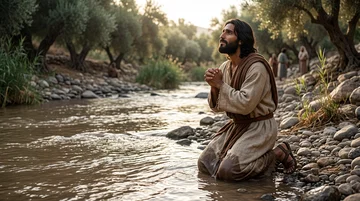
After John yielded, Jesus came straightway up out of the water and knelt on the riverbank in prayer, and as He prayed heaven was opened above Him.Ms 147, 1906, par. 21–22Ms 112, 1901, par. 14–15COS 45.3Ms 49, 1894, par. 9–12 Then the Spirit of God descended like a dove and lit upon Him, while a voice from heaven declared Him the beloved Son in whom God was well pleased.Ms 147, 1906, par. 21–22Ms 112, 1901, par. 14–15COS 45.3Ms 49, 1894, par. 9–12ST Feb 25, 1913
That opening came with a majestic voice resounding through heaven and earth like thunder, with lightnings flashing from cloudless heavens.ST Feb 25, 1913 The brightness of the Father's glory overshadowed the form of Jesus and pointed Him out in the crowd as the Son acknowledged by God with unmistakable assurance.ST Feb 25, 1913 That glory resting on Christ stood as a pledge of love for humanity.COS 45.6ST Feb 25, 1913
Satan was present on the ground witnessing the scene, and the circumstances aroused his intense hatred.ST Feb 25, 1913 He knew for certain that unless he could overcome Christ there would thenceforth be a limitation of his power.ST Feb 25, 1913 He heard in the opening heavens and the voice to the Son a death-knell to his hope that God's abhorrence of sin would forever separate God from man and break the link between heaven and earth.ST Feb 25, 1913
By that voice the Father signified His acceptance of the Son and declared Him the Son of God and the long-awaited Deliverer.Ms 147, 1906, par. 21–22ST Feb 25, 1913Ms 63, 1910, par. 7 The declaration signified that heaven was more directly accessible to man, that God would unite man more fully to Himself, and that power would be given to overcome Satan's devices.ST Feb 25, 1913 For that purpose Christ had come from the royal courts to the earth.ST Feb 25, 1913
Acceptance and Christian Example
In accepting Christ at the Jordan the Father gave a pledge to the whole human family that they through Christ might also be accepted.Ms 144, 1901, par. 16–18Ms 147, 1906, par. 21–22Ms 112, 1901, par. 14–15 His prayer on the banks of the Jordan opened heaven and opened the way for the prayers of fallen people to reach God, so that through Jesus their Advocate they are accepted by God.Ms 144, 1901, par. 16–18Ms 49, 1894, par. 9–12 That prayer embraces every son and daughter of Adam who will believe in Christ as a personal Saviour and take the same steps of repentance, conversion, faith and baptism.Ms 144, 1901, par. 16–18 All who intelligently and understandingly receive His Word will see the salvation of God, for in Christ is the only hope of salvation, and all who believe in Him and obey His commandments are accepted in the Beloved.Ms 147, 1906, par. 21–22Ms 112, 1901, par. 14–15
The baptized are buried with Christ as an emblem of His death and raised as an emblem of His resurrection to live as newborn souls, dead with life hid with Christ in God.Ms 144, 1901, par. 16–18 The three great infinite powers of Father, Son and Holy Ghost are pledged to work for them, with Christ cleaving a way through Satan's dark shadow to the throne of God so that the promise spoken to Him, accepted in the Beloved, comes to them.Ms 144, 1901, par. 16–18Ms 144, 1901, par. 20 Christ has pledged Himself to keep all who look to Him and trust in Him with abiding faith.Ms 144, 1901, par. 20
Therefore believers should expect large things, place themselves under the molding hand of God to be made vessels unto honor, and commit the keeping of their souls to Him as unto a faithful Creator.Ms 144, 1901, par. 20 They are to stand in moral dignity with life hid with Christ in God and not retaliate when untrue words are spoken.Ms 144, 1901, par. 20 His baptism, followed by His wilderness temptation and victory, makes it possible for people through His merits to overcome temptation — especially temptation involving appetite — and gain moral power to break the hold of habit and indulgence.Ms 55, 1893, par. 5–6 His example shows that God hears prayer, and even the needy, sinful and despised may approach the Father in Jesus' name and receive assurance of God's favor.Ms 147, 1906, par. 21–22COS 45.6
Sources
Pioneers and periodicals
95 sources
John tried to hold Jesus back from being baptized by him, astonished that Jesus should come to him for baptism.ST Dec 16, 1897ST Jan 6, 1904ST Sep 16, 1886ST Jan 17, 1900ST Sep 1, 1898 He did so because he recognized Jesus as greater and holier than himself, sinless with nothing to confess or have remitted, while he himself needed to be baptized by Jesus.ST Jan 6, 1904ST Oct 22, 1912RH May 23, 1854ST Sep 1, 1898 Jesus insisted on being baptized to fulfill all righteousness, not for any sin of his own but standing as substitute and representative for sinful humanity.RH Jan 21, 1873ST Mar 9, 1915ST Feb 21, 1906ST Jun 3, 1880 In this he identified himself with humanity, honored the ordinance, and set the pattern of burial by full immersion in water for believers to follow.RH Jan 21, 1873ST Oct 25, 1877RH Jan 23, 1855ST Oct 22, 1912RH Jun 25, 1872 His baptism when about thirty years old, in the autumn of A.D. 27 at the end of the sixty-nine weeks, was his anointing with the Holy Spirit and the beginning of his public ministry as Messiah.ST Jun 26, 1907ST Sep 16, 1886RH Feb 13, 1872ST Mar 3, 1909RH Oct 27, 1904
Words and Historical Setting
John forbade, hindered, held back, objected to and tried to prevent Jesus from being baptized by him.ST Dec 16, 1897ST Dec 16, 1897ST Jan 6, 1904ST Jan 25, 1899ST Mar 9, 1915 He held back because he recognized Jesus as superior to himself and felt that he himself needed baptism from Jesus rather than Jesus needing baptism from him.ST Dec 16, 1897ST Dec 16, 1897ST Jan 6, 1904ST Mar 9, 1915ST Feb 21, 1906 Jesus answered that the baptism should take place to fulfill all righteousness.ST Mar 9, 1915ST Feb 21, 1906
To be baptized means to be immersed, which is what John said he needed to receive from Jesus.RH Jan 23, 1855
John's question why Jesus had come to him expresses astonishment and asks why Jesus has come to him for baptism.ST Sep 16, 1886ST Jan 17, 1900ST Sep 1, 1898ST Jul 23, 1894ST Jan 17, 1906 He confessed his own unfitness to perform the rite and his own need to be baptized by Jesus instead, recognizing Jesus' greater holiness, purity and spiritual authority and that Jesus rather than John was the one who should baptize.ST Jan 17, 1900ST Sep 1, 1898ST Jul 23, 1894ST Jan 17, 1906ST Sep 9, 1913 Jesus nevertheless voluntarily received baptism, making his baptism an example for others.ST Jan 17, 1906ST Sep 9, 1913
Jesus came as a grown adult from Galilee and Nazareth to the Jordan, traveling to John where there was much water.RH Jun 25, 1872ST Mar 2, 1904ST May 20, 1913RH Aug 20, 1908RH Dec 2, 1873 His coming to John to be baptized by him was a voluntary act and an inconvenient journey from Galilee to Jordan to John, where he submitted to baptism in the Jordan and bowed beneath its waters.RH Jun 25, 1872ST May 20, 1913 That entering and bowing beneath the waters presents immersion as the right mode of baptism, not sprinkling, since John baptized where there was much water and Jesus went to the river to be baptized, and the waters serve as an emblem of his future grave.RH Jun 25, 1872ST Mar 2, 1904 His being grown up when he came proves baptism is for those old enough to believe and is not for babies or for adults before they believe.RH Aug 20, 1908 His journey to the Jordan and then into the wilderness belongs to the course of his ministry before the humiliation beginning in Gethsemane.RH Dec 2, 1873
The verse belongs to John's wilderness ministry preaching and preparing the people for the Messiah's coming and preparing the way for his first advent.ST Dec 11, 1879RH Nov 18, 1862ST Mar 17, 1914 He preached a call to repent and show faith because Christ's coming was near, preached forgiveness through Christ and announced him as the one who takes away sin, and directed hearers to faith in God's coming One.ST Dec 11, 1879ST Aug 28, 1901 He preached to the Pharisees and others to flee from the wrath to come, told with what and unto what he baptized, and foretold the work of Christ and the baptism of the Holy Ghost.ST Mar 10, 1898 As a restorer in the spirit and power of Elijah he preached repentance, called people back to God's law, rejected trust in man, exalted God, prepared Israel for the Son of God's appearance, and prepared a people for Christ.ST Aug 28, 1901ST Mar 17, 1914 The Messiah came while John was preaching and was baptized by him.ST Mar 11, 1886
The baptism took place when Jesus was about thirty, in A.D. 27.ST Sep 16, 1886 It was his second miraculous manifestation as Messiah, thirty years after his miraculous birth.ST Sep 20, 1910 It took place while Jesus was separated from Mary and before his temptation in the wilderness and his coming to the marriage at Cana.ST Apr 8, 1886 His newly made disciples were present and witnessed wonderful things there.ST Apr 8, 1886
John's baptizing of the Saviour occurred in the course of John's public preaching of a coming Saviour before his manifestation.RH Dec 29, 1859 It happened before John was cast into prison.RH Dec 29, 1859
Thirty years of preparation stood behind three and one-half years of actual work.ST Mar 10, 1898 John's work in connection with Christ's ministry prepared the way for Jesus, continued till the work of Jesus was well established, and then came to an end.ST Mar 10, 1898
John's Recognition of Jesus
John recognized that Jesus stood greater, superior and higher than himself in standing and spiritual authority, and that Jesus rather than John was the one who should baptize.ST Jan 6, 1904ST Oct 22, 1912RH Nov 25, 1909ST Jan 17, 1906ST Sep 9, 1913 His refusal therefore came from recognition of that superiority and from the conviction that he himself needed baptism from Jesus instead.ST Jan 6, 1904ST Oct 22, 1912RH Nov 25, 1909ST Jan 17, 1906ST Sep 9, 1913 That recognition places the baptism at the beginning of the account of Christ's work as a man, who overcame attempts to implant evil in him before preaching and practicing righteousness to overcome evil in others.ST Dec 13, 1905 Jesus nevertheless voluntarily received baptism, making his baptism an example for others, and John then baptized him after being told the act would fulfill all righteousness.ST Jan 17, 1906ST Sep 9, 1913
John recognized the greater holiness, purity, sinlessness and authority of Jesus, in contrast to those who came to confess sin.RH May 23, 1854ST Sep 1, 1898ST Jul 23, 1894ST Jun 3, 1880 Jesus had no sin to repent of, confess, or have remitted, and no need of baptism for himself.RH Jan 21, 1873RH May 23, 1854ST Jun 3, 1880 John could not understand why the sinless one should receive an ordinance of repentance signifying guilt and cleansing from pollution, and regarded Jesus as the one from whom he himself needed baptism.RH Jan 21, 1873ST Jun 3, 1880 Jesus' humble submission to baptism exemplified obedience and led into his explanation that the act fulfills righteousness, after which the Father declared his pleasure in Jesus.ST Sep 1, 1898 His fulfillment of righteousness through baptism did not abolish the ordinance, but baptism remains an example for a pardoned sinner to follow, symbolizing death to the world and new life devoted to God.RH May 23, 1854
John therefore confessed his own need to be baptized by Jesus instead, with humility, a sense of unfitness and unworthiness, and amazement that Jesus had come to him.ST Jan 25, 1899ST Jan 17, 1900ST Jan 25, 1899ST Sep 1, 1898ST Oct 22, 1912 He resisted, hindered, held back and forbade Jesus, feeling unworthy to grant the request and that the honor of baptizing him was beyond him.ST Jan 25, 1899ST Jan 17, 1900ST Jan 25, 1899ST Oct 22, 1912 He questioned why Jesus came to him for baptism, astonished that Jesus had come to be baptized by him.ST Jan 17, 1900ST Sep 1, 1898ST Oct 22, 1912 Although he believed Jesus was the promised One, Jesus' secluded life at Nazareth had left him uncertain, so he rested the matter in faith while still waiting for God's sign to identify the Messiah.ST Jul 7, 1887 His reluctance was in harmony with prophecy he had received that Christ would come to be baptized by him and the Holy Spirit would descend and remain upon him; although filled with the Holy Spirit from birth, he did not know Christ was the Messiah until he saw that promised sign, recognizing Christ's purity and divine presence.RH Feb 4, 1904
When Jesus was baptized God bore witness to his Messiahship as his beloved Son in whom he is well pleased.ST Mar 10, 1898ST Sep 27, 1910 John had preached to the Pharisees and others to flee from the wrath to come, had told with what and unto what he baptized, and had foretold the work of Christ and the baptism of the Holy Ghost, and the baptism happened in the course of that public preaching of a coming Saviour before his manifestation and before John was cast into prison.ST Mar 10, 1898RH Dec 29, 1859 Having seen the Holy Ghost rest upon Christ in bodily shape like a dove, John from prison sent his disciples to inquire if he was the Christ.RH Dec 29, 1859 That heavenly voice identifying Jesus as the Father's beloved Son was a confirmation John later recalled when doubts troubled him.ST Sep 27, 1910
Why Jesus Was Baptized
Jesus pressed forward to be baptized in order to fulfill all righteousness, and John yielded after first holding back because he felt he needed baptism from Jesus instead.ST Mar 9, 1915ST Feb 21, 1906ST Jan 17, 1906RH Feb 11, 1873ST Feb 21, 1906 That fulfilling proves he came not to abolish or change God's law but to live, suffer, die and rise again in order to fulfill it.ST Mar 9, 1915ST Feb 21, 1906 To fulfill it is to fully preach and practice it and to exalt, honor, magnify and establish it, for fulfilling a thing does not set it aside or abolish it.ST Feb 21, 1906ST Mar 9, 1915
His baptism was no confession of his own sins and sought no remission, repentance, cleansing, or righteousness for himself, since he had none to repent of, confess, wash away, or have remitted.RH Jan 21, 1873ST Oct 25, 1877ST Mar 12, 1912ST Jun 3, 1880 He took the place of the people he came to save and stood as their substitute and representative, counting himself a sinner for their sake and taking their sins upon him.RH Jan 21, 1873ST Oct 25, 1877ST Jun 3, 1880 In that place he fulfilled all righteousness on behalf of sinful humanity, and his baptism therefore presents his perfect righteousness offered to people and signifies more than a mere example to follow.ST Jun 3, 1880ST Jul 17, 1901
Though holy, he did not hold himself apart from humanity but became like human beings and drew near to them. He identified himself with his people, stood with humanity and on its behalf, and was baptized for them.RH Jan 21, 1873ST Oct 25, 1877ST Oct 22, 1912 So he took the steps required of sinners and the step required of those who repent and believe, including conversion, repentance, and baptism.RH Jan 21, 1873ST Jun 9, 1890ST Mar 12, 1912
By receiving the ordinance he honored it and fulfilled righteousness through perfect obedience to God's law.ST Oct 25, 1877 At the same time God consecrated him for his work, giving him authority and the attributes of God to reveal the Father to the world.ST Jun 9, 1890 His coming to be baptized represented complete surrender to God's will and work, and it was accompanied by the Spirit coming upon him without measure and the Father acknowledging him as Son and Saviour.RH Aug 21, 1913 He voluntarily presented himself and asked to be baptized, making an inconvenient journey from Galilee to the Jordan to John, and John then obeyed without hesitation and baptized him in the Jordan by thorough immersion.ST Oct 25, 1877ST Sep 9, 1913ST Sep 16, 1913ST May 20, 1913
Prophecy, Anointing and Beginning Ministry
Jesus was about thirty years old when John sought to hold him back, and his coming to the Jordan belongs to the autumn of A.D. 27, at the end of the sixty-nine weeks, or 483 years, counted from the decree to restore Jerusalem given in the latter part of 457 B.C.ST Jun 26, 1907ST Sep 16, 1886ST May 6, 1880 That dating fulfills the 483 years extending to Messiah the Prince, and shows the prophetic periods begin with Ezra's commission rather than with Nehemiah's later commission.RH Feb 13, 1872ST May 6, 1880 The baptism was the setting forth of Jesus as the Messiah, or Anointed One, for at his baptism the Holy Spirit descended upon him and anointed him, and Messiah means the Anointed.ST Jun 26, 1907ST Mar 3, 1909RH Oct 27, 1904
It marked his manifestation and public appearance to Israel and the beginning of his public preaching, ministry, and work in that role, rather than his birth, which is not the event connected to the fulfillment of Daniel's prophecy.ST May 6, 1880STRH Apr 9, 1908 At that anointing the Holy Ghost descended upon him in bodily form like a dove and anointed him with power, in one account without measure, and the Father spoke from heaven declaring him his beloved Son in whom he is well pleased.ST Jun 26, 1907ST Mar 10, 1898RH Feb 13, 1872 Heavenly light and glory descended upon Jesus in the form of a dove with a voice declaring him the Son of the Infinite Father, and God thereby consecrated him for his work with authority to reveal the Father.ST Feb 25, 1913ST Jun 9, 1890ST Dec 30, 1880
That baptism at the Jordan was his second miraculous manifestation as Messiah, thirty years after his miraculous birth.ST Sep 20, 1910 At his anointing by the Holy Spirit he began his work as prophet, he would become Priest after his ascension and King at the second advent, and the anointing also began the process that brought the end of Israel's human prophets, priests, and kings.ST Sep 20, 1910 It stands at the beginning of his public life and works, with thirty years of preparation behind three and one-half years of actual work.ST Oct 4, 1899ST Mar 10, 1898
Baptized with water and with the Spirit, he then set out upon his mission single-handed, and before calling for a single recruit he personally met and overcame Satan, his greatest adversary, thereby establishing his right to the dominion and his ability to maintain it without other aid than the power of the Spirit through the Word.ST Oct 4, 1899 His journey to the Jordan and then into the wilderness belongs to the course of his ministry before the humiliation that begins in Gethsemane, and his conflict with temptation and victory over the power of darkness are triumphs.RH Dec 2, 1873 His newly made disciples were present and witnessed wonderful things at the baptism, and from what they saw there and afterward they concluded that Jesus of Nazareth is the one Moses and the prophets wrote of, the long-looked-for Messiah.ST Apr 8, 1886ST Dec 30, 1880
Satan was present on the ground witnessing the scene, while heaven was opened with a majestic voice resounding through heaven and earth like thunder, with lightnings flashing from cloudless heavens, and with the brightness of the Father's glory overshadowing the form of Jesus and pointing him out in the crowd as the Son acknowledged by God with unmistakable assurance.ST Feb 25, 1913 That declaration signified that heaven was more directly accessible to man, that God would unite man more fully to himself, and that power would be given to overcome Satan's devices, for which purpose Christ had come from the royal courts to the earth.ST Feb 25, 1913 The circumstances aroused intense hatred in Satan, who knew for a certainty that unless he could overcome Christ there would thenceforth be a limitation of his power, and who heard in the opened heavens and the voice to the Son a death-knell to his hope that God's abhorrence of sin would forever separate God from man and break the link between heaven and earth.ST Feb 25, 1913 The same Jesus whom John baptized in the Jordan is the one who will return personally and visibly.ST Oct 19, 1888
Baptism's Mode and Meaning
To be baptized in this verse means to be immersed, plunged in much water.RH Jan 23, 1855ST Jul 19, 1883 Jesus went down into the water of the Jordan and came up out of it, bowed beneath the waters and was buried in them, setting the example of burial in water.RH Jun 25, 1872RH Jan 16, 1908ST Sep 16, 1880ST Mar 7, 1878RH Jan 28, 1858 Baptism therefore is full immersion, not sprinkling, not pouring, and not merely putting a drop of water on the forehead.ST Sep 16, 1880ST Sep 16, 1913RH Jan 28, 1858 The Greek word and the word Christ used literally mean immersion.ST Jul 19, 1883
John's baptism of Jesus was one single immersion in one river, not three immersions and not in three different rivers.ST Mar 19, 1885 Being baptized into the name of the Father, and of the Son, and of the Holy Spirit does not mean being dipped three times.ST Mar 19, 1885 Immersion was wisely selected because it is a delightful, ordinary, and healthful observance and because it fully expresses the design of baptism.ST Jul 19, 1883
The ordinance represents Christ's burial and resurrection and the believer's death to sin, to transgression, and to the world, with new life and resurrection by the Holy Spirit in the likeness of his resurrection.ST Dec 11, 1879RH May 23, 1854ST Jan 3, 1884ST Sep 16, 1913ST Jul 29, 1880 It commemorates his burial and resurrection and symbolizes death, burial, and resurrection.ST Jan 3, 1884ST Sep 14, 1882ST Sep 16, 1913 Through the water believers see the reflection of Calvary as the portal to resurrection power, with the waters serving as an emblem of his future grave.RH Jun 25, 1872 John preached this baptism as a call to repent and show faith because Christ's coming was near, proclaiming forgiveness through Christ as the one who takes away sin.ST Dec 11, 1879
Baptism is the marriage ceremony that connects people with the Lord. It is linked to salvation, is a divine act, and is performed by immersion.ST Sep 16, 1913 Its lesson brings out the meaning of baptism and the need to be born again.RH Sep 11, 1913
Christ's baptism presents baptism as an institution with a recorded introduction.ST Apr 20, 1915 It is an ordinance he appointed, commanded, and established by his own act, which he honored by his own example and to which he attached great importance.RH Jan 8, 1867RH Mar 26, 1914ST Jul 29, 1880 It is sacred and not an optional matter of personal preference but a solemn duty, a commandment, and a public witness or confession of faith to be formally practiced in obedience after his example rather than conceded as mere theory.ST Jul 29, 1880RH Mar 26, 1914ST Dec 4, 1901 His reply to John's protest that John needed to be baptized by Jesus makes his own baptism an example for disciples to follow throughout the gospel age.RH Jan 8, 1867
Christ nevertheless received baptism from John, setting an example for followers and attesting to the value of John's baptism.ST Jul 3, 1884ST Dec 11, 1879 John's baptism and the baptism later administered by Christ's disciples were the same in nature and character.ST Dec 11, 1879 If John's baptism were essentially different from Christian baptism, Jesus' example in receiving it would not support obedience to Christian baptism.ST Jul 3, 1884
Jesus was grown up when he came to John to be baptized, proving baptism is for those old enough to believe and is not for babies or for adults before they believe.RH Aug 20, 1908 His baptism was a physical act and did not by itself make the day on which it occurred holy, for a day becomes sacred only by divine decree.ST Oct 18, 1905 The verse is invoked against the claim that John inducted Christ into the priesthood by sprinkling, and that claim was confuted.ST Jun 13, 1878
Christ's Example for Believers
Jesus' baptism is the pattern his disciples are to follow throughout the gospel age, the example set by the church's head and Master to be imitated in obedience, including going to the waterside and being buried in water.RH May 23, 1854RH Jan 8, 1867ST Jan 17, 1906ST Sep 9, 1913ST Mar 3, 1881 He recognized no abolishing of the ordinance in fulfilling righteousness, for baptism remains for the pardoned sinner to follow as death to the world and new life devoted to God.ST Oct 25, 1877RH May 23, 1854 John had seen his greater holiness and authority and confessed his own need to receive baptism from him instead, astonished that the sinless and superior one who needed no repentance or washing should come to him, yet Jesus voluntarily received baptism and honored the ordinance by perfect obedience.ST Oct 25, 1877RH May 23, 1854ST Jan 17, 1906ST Sep 9, 1913ST Mar 3, 1881
A sense of personal unworthiness should not keep those who trust him from following him in baptism as a duty, for he who is more worthy has left the example.RH Mar 24, 1874 Those who follow the Lord in baptism should first learn its meaning from the written Word rather than take the step without understanding.RH Sep 11, 1913RH Nov 10, 1904 The teaching on baptism shows duty and brings daily conviction, leading seekers to instruction and to desire it as bringing out the need to be born again.RH Sep 11, 1913RH Nov 10, 1904ST Oct 2, 1901 So it was when one alone, finding no one to baptize him, baptized himself in the way he understood his Master had taught.ST Oct 17, 1906
God's blessing and the Spirit's witness may follow the obedient act, though manifested differently from person to person, for the Spirit's descent appeared not while Jesus stood on the bank or in the water but after he had been baptized and raised from it.ST Jan 17, 1878 Following the Master in the rite brings the privilege of receiving the baptism of the Holy Spirit, which enables believers to pass through fiery trials with joy.RH Aug 26, 1902 Baptism is a church ordinance that sets forth the truth of the gospel and teaches those who witness it.ST Jul 28, 1914RH Dec 24, 1908 His coming to be baptized established immersion, plunging and submerging in water, as the divinely appointed form after the example of the apostles and their Master, teaching that the Christian life is not a form and that at its beginning there must be death to sin and resurrection by the Holy Spirit in the likeness of his resurrection.ST Jul 28, 1914 Following the Lord Jesus Christ in it is part of the reformation from error and apostasy to which God calls believers in these last days, and brings the blessing that always attends loving obedience to the divine precepts.ST Jul 28, 1914
Those who accept the Sabbath of the Lord show their faith by following that example and being baptized.ST Nov 6, 1901 His baptism by John did not make him a member of a church organized by John, for John had followers but organized no church, while Jesus was the Founder of the Christian church.ST Mar 16, 1915 His baptism in Jordan marks the day the work of the church began and the methods he devised for establishing his kingdom, showing God's power and foresight in devising the plan for redemption and in the ways and instruments he dedicated to complete it as designed.ST Mar 16, 1915ST Oct 23, 1901 Tracing a church's origin to Christ therefore also traces it to John, by whom Jesus was baptized.ST Dec 24, 1912
The account connects his baptism with the historical Jesus and the proper mode of baptism.ST Nov 7, 1916 The verse is evoked where many Christian baptisms took place by local Christians naming the stream the Jordan.ST John baptized in the waters of the Jordan by immersion, and that same rite is followed when converts are immersed one by one in water as a joyful public service witnessed and celebrated with singing by believers.ST Oct 4, 1899
Sources