Matthew 8:12
But the children of the kingdom shall be cast out into outer darkness: there shall be weeping and gnashing of teeth.
Translations
American King James Version, King James Version, KJV Cambridge Paragraph Bible
But the children of the kingdom shall be cast out into outer darkness: there shall be weeping and gnashing of teeth.
But the children of the kingdom shall be cast out into utter darkness: there shall be weeping and gnashing of teeth.
but the sons of the kingdom shall be cast forth into the outer darkness: there shall be the weeping and gnashing of teeth.
but the sons of the kingdom shall be cast forth into the outer darkness: there shall be the weeping and the gnashing of teeth.
but the sons of the reign shall be cast forth to the outer darkness — there shall be the weeping and the gnashing of the teeth.'
but the sons of the kingdom shall be cast out into the outer darkness: there shall be the weeping and the gnashing of teeth.
Whereas, the sons of the kingdom, shall be cast forth into the darkness outside,—There, will be wailing and gnashing of teeth.
Berean Standard Bible, Majority Standard Bible
But the sons of the kingdom will be thrown into the outer darkness, where there will be weeping and gnashing of teeth.”
but the children of the Kingdom will be thrown out into the outer darkness. There will be weeping and gnashing of teeth.”
But the sons of the kingdom will be put out into the dark, and there will be weeping and cries of pain.
And the children of the kingdome shall be cast out into vtter darkenes: there shalbe weeping and gnashing of teeth.
Douay-Rheims (Challoner revision)
But the children of the kingdom shall be cast out into the exterior darkness: there shall be weeping and gnashing of teeth.
Pictures
Cross-references 20 of 27
- Luke 13:28-29
There shall be weeping and gnashing of teeth, when ye shall see Abraham, and Isaac, and Jacob, and all the prophets, in the kingdom of God, and you yourselves thrust out.
The excluded face weeping while people from every direction enter the kingdom.
- Luke 7:1-10
Now when he had ended all his sayings in the audience of the people, he entered into Capernaum.
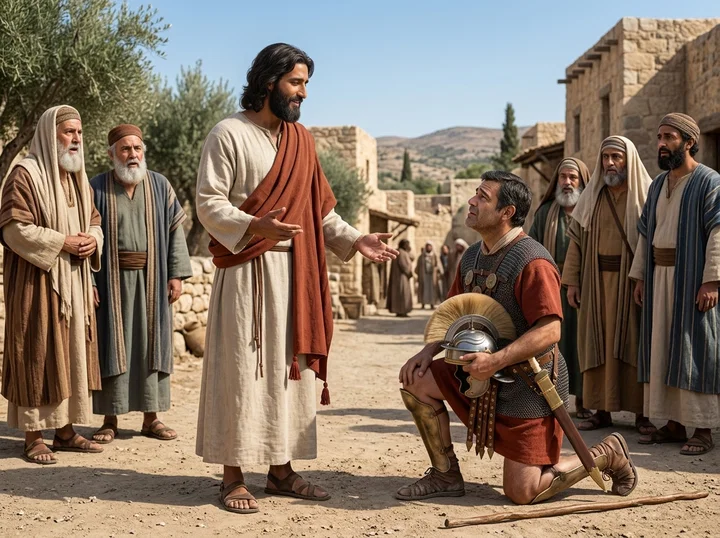
The centurion’s great faith prompts Christ’s warning.
- Matthew 25:30
And cast ye the unprofitable servant into outer darkness: there shall be weeping and gnashing of teeth.
Both describe the unfaithful cast into outer darkness.
- Ephesians 5:5
For this ye know, that no whoremonger, nor unclean person, nor covetous man, who is an idolater, hath any inheritance in the kingdom of Christ and of God.
Names those who have no inheritance in Christ’s kingdom.
- Matthew 21:43
Therefore say I unto you, The kingdom of God shall be taken from you, and given to a nation bringing forth the fruits thereof.
The kingdom is taken from those who fail to bear its fruits.
- Matthew 22:13
Then said the king to the servants, Bind him hand and foot, and take him away, and cast him into outer darkness; there shall be weeping and gnashing of teeth.
Both describe the excluded cast into outer darkness, where there is weeping and gnashing of teeth.
- Matthew 7:21-23
Not every one that saith unto me, Lord, Lord, shall enter into the kingdom of heaven; but he that doeth the will of my Father which is in heaven.
Jesus rejects those claiming religious standing who are not his, condemning them to judgment.
- 2 Peter 2:17
These are wells without water, clouds that are carried with a tempest; to whom the mist of darkness is reserved for ever.
Both describe darkness reserved for the wicked.
- Revelation 14:11
And the smoke of their torment ascendeth up for ever and ever: and they have no rest day nor night, who worship the beast and his image, and whosoever receiveth the mark of his name.
Both describe unending torment as a consequence of judgment.
- Matthew 5:19
Whosoever therefore shall break one of these least commandments, and shall teach men so, he shall be called the least in the kingdom of heaven: but whosoever shall do and teach them, the same shall be called great in the kingdom of heaven.
Breaking and teaching others to break God’s commandments brings exclusion from the kingdom.
- Matthew 13:42
And shall cast them into a furnace of fire: there shall be wailing and gnashing of teeth.
Both describe punishment with wailing and gnashing of teeth.
- Mark 9:43-48
And if thy hand offend thee, cut it off: it is better for thee to enter into life maimed, than having two hands to go into hell, into the fire that never shall be quenched:
Both describe hell’s enduring punishment, including unquenched fire.
- Jude 1:13
Raging waves of the sea, foaming out their own shame; wandering stars, to whom is reserved the blackness of darkness for ever.
Both describe darkness reserved for the wicked.
- Luke 13:24
Strive to enter in at the strait gate: for many, I say unto you, will seek to enter in, and shall not be able.
Urges striving to enter through the narrow door.
- Matthew 25:41
Then shall he say also unto them on the left hand, Depart from me, ye cursed, into everlasting fire, prepared for the devil and his angels:
The cursed are sent to everlasting fire.
- Luke 14:16-24
Then said he unto him, A certain man made a great supper, and bade many:
The invited who reject the feast are excluded as others are brought in.
- Revelation 20:14-15
And death and hell were cast into the lake of fire. This is the second death.
The wicked’s final fate is described as the second death.
- Galatians 4:30
Nevertheless what saith the scripture? Cast out the bondwoman and her son: for the son of the bondwoman shall not be heir with the son of the freewoman.
The bondwoman’s son is cast out and does not share the heir’s inheritance.
- Matthew 25:34
Then shall the King say unto them on his right hand, Come, ye blessed of my Father, inherit the kingdom prepared for you from the foundation of the world:
The blessed are invited to inherit the kingdom.
- Luke 16:24
And he cried and said, Father Abraham, have mercy on me, and send Lazarus, that he may dip the tip of his finger in water, and cool my tongue; for I am tormented in this flame.
Both depict the torment of the wicked after judgment.
Commentary
Each commentary is drawn from primary sources: the writings of Ellen G. White and Adventist pioneers and periodicals. Each commentary is separate. Its own words are not a quotation; follow the references to read the source passages.
Ellen G. White
23 sources
The children of the kingdom are the Jews by birth and privilege as heirs of the promises, yet inherited place does not guarantee acceptance and those who fail to value the truth entrusted to them will be cast out.Lt 114, 1895, par. 11–15Lt 114, 1895, par. 7–103SP 354.2–355.1 The words were spoken at Capernaum in response to the faith of the Roman centurion, who called himself unworthy and trusted in mercy and authority while the elders praised his worthiness for good deeds, spoken with sadness over Jewish rejection and joy over gathering souls from all nations.ST Aug 8, 1916DA 317.2–3AA 19.2–20.1 Outer darkness with weeping and gnashing of teeth means exclusion from the great feast of eternal life with Abraham, Isaac, and Jacob, which the Jews expected for themselves alone while Gentiles stood outside longing, bringing condemnation, grief, anguish and bitter disappointment.Lt 114, 1895, par. 11–154T 233.1–2ST May 4, 1876COL 219.1 Exclusion comes through unbelief that rejects the Messiah and the great light given despite abundant opportunity, while entry depends on faith rather than birth, as the centurion born in heathenism perceived the glory hidden from Abraham's children.Lt 114, 1895, par. 11–154T 233.1–2DA 317.2–3DA 402.2 Love and grace are not confined to race, nation or rank but salvation is offered to all nations so Gentiles become fellow-heirs and partakers of the promise, and the same fatal disappointment still threatens many in Christian lands on whom light shines only to be disregarded while souls in darkness accept grace.MH 174.2DA 317.2–3DA 402.2AA 19.2–20.1ST Jun 9, 1914
Words and Setting
The children of the kingdom are the Jews, Israel by birth and privilege, heirs of the promises who had received sacred truth and religious privilege on equal terms with none other.Lt 114, 1895, par. 11–15Lt 114, 1895, par. 7–103SP 354.2–355.13SP 356.2–3 Their inherited place and access to that truth did not guarantee acceptance, for Jewish descent by itself secures no place in the kingdom when the promised Messiah is rejected.Lt 114, 1895, par. 11–15Lt 114, 1895, par. 7–103SP 354.2–355.13SP 356.2–3
The saying was given at Capernaum in answer to the faith of the Roman centurion, whose trust showed that those outside Israel and counted unworthy by others could receive salvation.ST Aug 8, 1916DA 317.2–3AA 19.2–20.1 The Jewish elders commended the centurion as worthy because of his good deeds, while he himself declared himself unworthy and rested only on mercy and on the authority of the word to heal.ST Aug 8, 1916DA 317.2–3 It was uttered with deep sadness as the end of Jewish rejection was pictured, and at the same time with joy in looking forward to the gathering of souls from all nations into the kingdom.DA 317.2–3AA 19.2–20.1
Outer darkness with weeping and gnashing of teeth is exclusion from the kingdom, darkness outside bringing condemnation and overthrow upon unbelief that rejects great light.Lt 114, 1895, par. 11–154T 233.1–2ST May 4, 1876 It is grief, anguish and bitter disappointment, the anguish of those expelled for refusing grace after abundant privilege.Lt 114, 1895, par. 11–15ST May 4, 1876DA 317.2–3
That exclusion stands opposite the great feast of the blessings of eternal life, when many coming from east and west sit down with Abraham, Isaac, and Jacob in the kingdom of heaven.4T 233.1–2COL 219.1ST Jul 9, 1896 The Jews expected that feast for themselves alone, with Gentiles standing outside looking on with longing eyes, seeking to shut up the blessings of God for the present and future life to themselves and to deny His mercy to the Gentiles.COL 219.1
Inclusion and Warning
Exclusion comes through unbelief that rejects the promised Messiah and the great light given, bringing condemnation and overthrow, even for heirs of the kingdom by birth and privilege with access to sacred truth and abundant opportunities.Lt 114, 1895, par. 11–154T 233.1–2ST May 4, 1876 Inherited place does not guarantee acceptance, and those who presume on privileged place yet fail to value, use, and improve the truth entrusted to them will be cast out.Lt 114, 1895, par. 11–15ST Jul 16, 1896 Entry depends on faith rather than birth or privilege, for the centurion's faith shows that what is decisive is trusting Christ, not inherited standing.DA 317.2–3 Though born in heathenism and cut off by training and surroundings, he perceived the glory of the Son of God to which the children of Abraham were blinded.DA 317.2–3
Love and grace are not to be circumscribed to race, nation, or social rank, and salvation is offered to all nations beyond Israel and beyond the privileged.DA 402.2AA 19.2–20.1ST Jun 9, 1914 Gentiles become fellow-heirs with the Jews and partakers of the promise in Christ by the gospel, and the barrier between Jews and Gentiles is to be broken down.DA 402.2AA 19.2–20.1 The conversion of the centurion was direct work outside the acknowledged people of Israel to lead away from exclusiveness and Jewish intolerance.ST Apr 23, 18858RED 14.1–2ST Jun 12, 1879 That early instance foreshadowed later active and continued work when whole Gentile communities would gladly receive the gospel and glorify God, when unbelief would not prevent grafting a new Israel into the old olive-tree.ST Apr 23, 18858RED 14.1–2SLP 51.1ST Jun 12, 1879
Those who reject the invitation of mercy shut themselves out, and the slighted invitation is sent to those they despised and shunned.COL 219.1 Many outcasts who grasp the hope set before them in the gospel will enter and sit down to the feast of eternal life with Abraham, Isaac, and Jacob, while those blessed with great opportunities and great light which they did not improve will be left in outer darkness.MH 174.2COL 219.1 People are judged according to lives and works rather than presumed membership or place, and those who put selfish exaltation before God's honor and fail to keep His commandments will not receive the reward of the faithful.ST Jul 9, 1896 The same fatal disappointment still threatens many in Christian lands on whom light shines only to be disregarded, while souls in heathen darkness accept grace.DA 317.2–3
Children of the kingdom who do not honor God's cause but show the deformity of sin in life and character face outer darkness with weeping and gnashing of teeth, yet even the sinful and unworthy must be borne with in gentleness and patience in humility and tender care.12MR 289.1–2 Christ's healing and teaching reached people across social ranks, including a Roman ruler, showing that ministry is not confined to the poor, to the Jews, or to one class but is for all who will hear.ST Jun 9, 1914Ms 3, 1899, par. 12 People from other nations came seeking healing and help for loved ones, longing for what they lacked, listening and deeply moved by truth, and His words of hope and healing serve as an example for work among all humanity and for the intemperate.MH 174.2ST Jun 9, 1914Ms 3, 1899, par. 12Ms 50, 1897, par. 2
Sources
Pioneers and periodicals
70 sources
Jesus spoke the words after commending the Gentile centurion at Capernaum, who trusted His spoken word alone to heal his grievously tormented servant, and whose servant was healed in that same hour.RH Dec 6, 1906ST Oct 22, 1896 The children of the kingdom are the Jews, the natural descendants of Abraham called to heirship by birth and privilege, not by conversion, whose pride, unbelief and rejection of Christ disqualify them.ST Sep 15, 1887ST Dec 26, 1906RH Jan 14, 1873ST May 3, 1899 Birth, descent, religious name and outward place do not secure the kingdom, but Gentiles from east and west who share the centurion's humble faith that rests on Christ's living word will sit with Abraham, Isaac and Jacob while unbelieving heirs are shut out.ST Jan 23, 1893ST May 31, 1905ST Jun 2, 1881RH May 30, 1854 Outer darkness with weeping and gnashing of teeth is the figurative yet awful final punishment of the wicked excluded from the kingdom, their despairing sorrow and anguish when they realize what they have lost, ending in the second death with no return of light or hope.ST May 3, 1899RH Mar 23, 1869RH Oct 31, 1865RH Mar 23, 1869RH Dec 10, 1903 Its fulfillment is future, when the saved are gathered and glorified and the lost see them in the kingdom while themselves cast out, at the day of judgment and the final destruction by fire from heaven after the millennium.ST Aug 12, 1880RH Aug 6, 1857 So belonging outwardly to God's people does not guarantee salvation, but warns professed believers, the unready, the disobedient and those who neglect light and service to repent and be faithful while salvation lasts.RH Dec 11, 1913ST Jul 3, 1884RH Dec 1, 1859RH May 8, 1856
Historical Setting at Capernaum
The saying stands in the account at Capernaum of the centurion who pleaded for his servant lying at home sick of the palsy and grievously tormented.RH Dec 6, 1906 Jesus tested his faith by declaring He would come and heal him, and the centurion answered that he was not worthy for Jesus to come under his roof but that a spoken word alone would heal his servant.RH Dec 6, 1906 Jesus commended that faith as greater than any found in Israel and told him to go his way with healing done according to his belief, and the servant was healed in that same hour.RH Dec 6, 1906 The case stands together with the nobleman's case as recorded for admonition, rebuking fearful little faith and a faithless and perverse generation.RH Dec 6, 1906
His faith was counted exceptionally great because he trusted that the spoken word alone could heal without personal presence.ST Oct 22, 1896 That word carried power in itself to accomplish what it declared, and the servant was healed at that very hour.ST Oct 22, 1896 Such confidence was genuine faith recognizing divine power, though the Jews regarded him as a heathen Gentile.
Matthew presents the centurion as doing and saying all himself while Luke says he sent friends, because what a man does or says by his agents he does or says himself, the men sent representing him and standing in his place.ST Apr 23, 1896 The centurion's own words about his soldiers illustrate the principle.ST Apr 23, 1896 His faith was that Jesus could heal without being present by sending spiritual agents, angelic messengers, and yet the healing was Christ's after all, just as God created the world through Jesus Christ.ST Apr 23, 1896
The miracles of the chapter and the centurion's faith show the great light and favor Capernaum received, yet the city failed to heed that light and rejected Jesus.ST Jun 2, 1898 Matthew 8:1-17 as a whole shows Jesus calling and receiving those who come for mercy and healing, held out to rich and poor, masters and servants, old and young, of every class and race, to cast off sin, come without money, fall at Jesus' feet crying for mercy as blind and lost, and be saved from perishing.RH Nov 17, 1859 The healing of the centurion's servant belongs to continued teaching on miracles, paralleled in Luke 7.ST Jan 30, 1896
The surrounding account contrasts the Jewish elders, who call the centurion worthy because of his good deeds, with the centurion himself, who calls himself unworthy, relies on Jesus' mercy and authority, and comes because of his need.ST Aug 8, 1916ST Blessing from God does not rest on human worthiness.ST The centurion had favored the Jews and built them a synagogue, thereby acknowledging allegiance to the God of Israel.ST Sep 20, 1910
The healing of the Roman centurion's servant shows the gospel being brought to a Gentile as well as to the Jews.ST May 1, 1907 Jesus brought healing and teaching across social ranks, including a Roman ruler, and did not limit God's mercy to Israel or to the privileged.ST Jun 9, 1914 The centurion's conversion was an early instance of Christ's direct work beyond Israel's acknowledged people, later continued among whole Gentile communities.ST Apr 23, 1885ST Jun 12, 1879ST Jun 12, 1879
Identity of Kingdom Children
The children of the kingdom are the Jews, the literal descendants of the fathers and patriarchs who by relation to Abraham were born into the privileges of the kingdom and its natural heirship.ST Dec 26, 1906RH Jan 14, 1873 God had called them to His kingdom and intended to use them to call others, but by misusing and rejecting those privileges they rejected their own salvation.ST Dec 26, 1906 While they were counted as children of the kingdom, unbelieving Jews will be cast out into outer darkness with weeping and gnashing of teeth, while the redeemed from every direction join Abraham, Isaac, and Jacob in God's kingdom.RH Jan 14, 1873RH May 30, 1854
They bear that name because of birth and privilege, not because they were converted.ST Dec 26, 1906 They relied on natural descent from Abraham and on the covenant promises as a claim to the kingdom, while pride in ancestry kept them from humble faith, and their wicked works disqualified them from claiming those promises.ST Sep 15, 1887RH Jan 14, 1873 They had departed so far from Him that He no longer recognized them as His, and others willing to accept God's righteousness would take their place.ST May 3, 1899 Their hard hearts, unbelief, and eventual rejection of Christ as Messiah and of light and of great light received brought condemnation, overthrow, and casting into darkness.ST May 4, 1876RH Jan 14, 1873 In contrast, Gentiles from east and west will share the kingdom with Abraham, Isaac, and Jacob because, like the patriarchs, they recognized their helplessness and trusted God, showing that inheritance of the everlasting kingdom requires faith and humility.ST Sep 15, 1887
The phrase does not refer to actual little children, and those who accept Jesus' words with childlike faith and simplicity share the welcome He gave to little children.ST Dec 26, 1906 Nor does it mean that people who have already sat with the patriarchs in the kingdom will later be expelled.RH Jan 14, 1873
Being a child of the kingdom does not guarantee final salvation, for Judas was at first a child of the kingdom but later became a child of hell.ST Apr 17, 1879
In its wider application the title can mean people regarded as belonging to the church and its spiritual benefits, including the visible people of God and membership or presumed place in the kingdom.ST Jul 9, 1896ST Mar 6, 1907RH Jan 30, 1908 Belonging to the visible people of God does not itself bring the faith that receives Christ's power, for many outside the visible church may grasp that power through faith.ST Mar 6, 1907 Deeply religious souls kept outside the church are said to have more right to its spiritual benefits than many such insiders, showing that religious belonging does not ensure genuine worthiness, and those counted among the kingdom's children may be cast out.RH Jan 30, 1908 Membership or presumed place does not guarantee entry, for people are judged according to their lives and works, and those who put selfish exaltation before God's honor and fail to keep His commandments will not receive the reward of the faithful.ST Jul 9, 1896
Faith Over Birth Privilege
Many from the east and west, Gentiles like the centurion, will sit down with Abraham, Isaac and Jacob in the kingdom of heaven.ST Jul 9, 1896ST Jun 2, 1881RH May 30, 1854 Sharing a grand banquet with the patriarchs was the Jews' favorite way of picturing the blessedness the Messianic kingdom would bring, expressed in the teaching that God would spread a great table for Jews which the Gentiles would see and be ashamed.ST Jun 2, 1881 Christ reverses that picture after finding in the centurion a great faith not found in Israel, declaring that many outsiders will share that place while the children of the kingdom themselves meet rejection and despair in outer darkness with weeping and gnashing of teeth.ST Jun 2, 1881RH May 30, 1854 The excluded will see Abraham, Isaac, Jacob and the prophets in God's kingdom while people come from every direction to sit with them, pleading to enter but finding no admission when the master shuts the door at the day of judgment.RH May 30, 1854RH May 23, 1854
Belonging to the kingdom by birth, descent from Israel, heritage, status, ancestry, religious name, priestly succession or present position does not guarantee or secure a place in it.ST Jun 9, 1914ST Jan 23, 1893ST Mar 26, 1894ST May 31, 1905 Those counted as its sons and called its children can be cast into outer darkness with weeping, gnashing of teeth and anguish, while Gentiles from east and west share the kingdom with Abraham, Isaac and Jacob.ST Jan 23, 1893ST Sep 15, 1887 Pride in ancestry kept the literal descendants of Abraham from humble faith, but like the patriarchs those who enter recognize their helplessness and trust God.ST Sep 15, 1887 The faith that gives the kingdom grasps and rests on the power of Christ's living word, as the centurion did in trusting Christ to heal by a word, requiring faith in Jesus Christ with Christ formed within and His word effective in the life, with humility.ST Sep 15, 1887ST Mar 26, 1894ST May 31, 1905 Jesus brought healing and teaching across national and social ranks, including to a Roman ruler, not limiting God's mercy to Israel or to the privileged, so inherited religious standing does not secure a place and His gifts are offered beyond those boundaries.ST Jun 9, 1914
Those who have the privileges of the kingdom and belong outwardly to it may be excluded and shut out into darkness with grief and anguish when they lack faith, reject the kingdom and do not accept Christ as Saviour, while people from outside who trust God take their place.ST May 31, 1905ST Jan 23, 1893ST Oct 2, 1884 Those regarded as heirs can be excluded even as people from east and west share the kingdom with Abraham, Isaac and Jacob, the centurion's faith contrasting with the absence of such faith among many in Israel.ST May 31, 1905ST Jan 23, 1893 Unbelief cuts people off from Israel, while faith in Christ makes people of any nation heirs with the patriarchs and allows them to belong to it. The centurion's conversion was an early instance of Christ's work beyond Israel's acknowledged people, later continued among whole Gentile communities, showing that membership among that people did not guarantee a place and that Gentiles who received the gospel joined God's people.ST Apr 23, 1885
People are judged according to their lives and works, and those who put selfish exaltation before God's honor and fail to keep His commandments will not receive the reward of the faithful.ST Jul 9, 1896 Those who presume on privileged place but fail to value and use the truth entrusted to them will be cast out into outer darkness, even though they received abundant opportunities while many Gentiles enter the kingdom.ST Jul 16, 1896ST Jul 9, 1896 Belonging to the visible people of God does not itself bring the faith that receives Christ's power, for the centurion's faith in Christ's word surpassed that of anyone in Israel and many outside the visible church may grasp that power through faith.ST Mar 6, 1907 Many will be in heaven whom neighbors supposed would never enter, the very ones often regarded as hopeless whom Christ is drawing, so it is better to run a little risk in trusting them than to pass over Christ in His saints. Those who remain in bondage to sin, like the bond-servant who is not an heir, are cast out from the household into outer darkness with weeping and gnashing of teeth.ST Mar 15, 1899 The centurion, a Gentile, represents the many beyond Judaism who will enter God's kingdom while those regarded as its children may be excluded, contrasting inherited religious privilege with faith that trusts Jesus' authority.ST Jul 17, 1884
Nature of Outer Darkness
The verse speaks of the fate of the wicked and the unregenerate excluded from the kingdom, and it is terrific and awful, meant to impress their hopeless despair.RH Mar 23, 1869ST Feb 1, 1883 Darkness and sin go together and end in outer darkness apart from God, who is a sun and light with no darkness at all and would have people walk in the light as He is in the light.RH Jan 16, 1900 Even those whose guilt seems slight are included among those unfit for heaven who face this exclusion, which challenges the idea that their punishment can be light, since the exclusion and suffering are presented as lasting forever.ST Feb 1, 1883
Outer darkness with weeping and gnashing of teeth is a figurative description of the dreadful punishment of the wicked.RH Oct 31, 1865 Its hell belongs to Gehenna, the term for final punishment, rather than Hades, which can mean the grave or the condition of the dead.RH Oct 31, 1865 This darkness has no return of light or hope, and the anguish is suffered in the presence of the heavenly Jerusalem and its inhabitants.RH Mar 23, 1869 It is the second death and unending darkness with no joy or morning light, while the righteous instead enter eternal day and rest.RH Mar 23, 1869RH Dec 1, 1859 The finally lost perish completely in it, losing life and therefore consciousness, rather than continuing to live in misery, and their silence follows their destruction when God destroys them soul and body in the fire of Gehenna.RH Mar 23, 1869RH Dec 3, 1867
The weeping and gnashing of teeth is wailing, sorrow, grief, anguish, and despairing sobs at the judgment.ST May 3, 1899RH Dec 10, 1903ST May 18, 1915 It is the anguish on the final day when the lost realize what they have lost, including what had been urged upon them but refused.ST May 3, 1899 They grieve and regret their choice and long for the joy of the redeemed, a home in heaven, and the companionship of angels, which they deliberately rejected by turning from Christ's word.RH Dec 10, 1903 At the judgment the Word they heard and despised condemns them, for they recognize that they cut themselves off from eternal life by refusing its free gift.RH Dec 10, 1903 The gnashing of teeth, as taught by those who held it, is the chattering of teeth from shivering in the cold of the place of departed souls.
To be cast into outer darkness is to be counted unworthy to mingle with higher minds and banished from their company, as society banishes those ignorant in worldly matters.ST May 31, 1877 It is the final separation between those who enter the kingdom and those excluded, set against the marriage supper of the Lamb within the holy city.STST May 31, 1877 The darkness stands in contrast to the glory of the city where no sunlight is needed, and to eternal life in a home of perfect love.RH Jan 23, 1866 It is set against the righteous' eternal inheritance of gladness and glory in God's paradise beyond sorrow and danger, pictured by ancient Tyre cast down and left amid the waters. The verse also pictures the banishment of Lucifer and the angels who followed him from God's presence into darkness outside. God left all created intelligences free to choose whom they would serve, God or self; Lucifer first chose self and drew a multitude with him, and through love they were offered a second probation with the Son offering to yield His life to atone for their sins, but they rejected, scorned, and definitively refused to renounce self, so their settled choice required expulsion.
The image is applied to a man's removal from the church into the stormy night as an ejection from the church's hopeful and helpful influence.ST Jun 15, 1882 It is invoked as an image of a nation that turns from light and hope into darkness and despair.ST Jun 25, 1912 Such outer darkness represents the ruin that follows choosing evil over righteousness.ST Jun 25, 1912 Applied to the nation, it describes a state of divine rejection and misery, warning that turning from righteousness toward oppression and injustice brings God's curse and leaves the country without light or hope.ST Jul 4, 1899
Timing of Final Fulfillment
The sitting of people from east and west with Abraham, Isaac, and Jacob in the kingdom of heaven, set beside the casting of the children of the kingdom into outer darkness with weeping and gnashing of teeth, shows that the kingdom and its judgment are future and were not events that occurred in the time of the Roman Caesars. The Jews, though natural heirs of the kingdom through relation to Abraham, will be shut out when the master of the house shuts the door at the day of judgment.RH May 23, 1854 They will see Abraham, Isaac, Jacob, and the prophets in God's kingdom while people come from every direction to sit with them, and the excluded will plead to enter but will find no admission.RH May 23, 1854
The verse is fulfilled when Christ comes to be glorified in His saints, presenting His glorified saints in the presence of the resurrected wicked gathered around the camp of the saints and the beloved city after it has descended to earth.ST Aug 12, 1880 This is a thousand years after the first resurrection at the second advent, at the third advent just before the wicked are punished with everlasting destruction by fire from God out of heaven from which there is no resurrection, the second death.ST Aug 12, 1880 It is at the end of the millennium when the city of God with all the saints descends to earth and the wicked dead are raised and Satan is loosed to deceive and marshal them around the camp of the saints, for the first and only time the entire family of Adam stands together on earth.ST Aug 12, 1880 Then the wicked see Abraham, Isaac, Jacob and all the saved in the kingdom of heaven while they themselves are shut out and cast out.ST Aug 12, 1880
The weeping and gnashing of teeth is the terror of the guilty world when the day of the Son of man arrives, after the elect are gathered to safety and God's judgment breaks upon the earth and the heavens and earth are dissolved by fire.RH Aug 6, 1857 Those sentenced at the judgment to outer darkness, where there is weeping and gnashing of teeth, are astonished at that sentence.RH Sep 23, 1858 That astonishment challenges the idea that the wicked have already been consciously suffering in hell since death, for if they had they would not be startled by the judgment.RH Sep 23, 1858
The verse points to the final exclusion of the unfaithful from the kingdom, who face shame and contempt in the lake of fire outside the heavenly city, where there is weeping and gnashing of teeth.RH Mar 7, 1871ST Jan 17, 1884 Outer darkness is the fate of those shut out when Christ comes, pictured as the five foolish virgins.ST Dec 10, 1902 A religious profession without receiving Christ does not save, for at that fixed moment the contrast is between being glorified in Christ's presence and being cast out.ST Dec 10, 1902
Warnings for Professed Believers
Being counted among the children of the kingdom does not secure a place in it, for such may yet be cast out into outer darkness with weeping and gnashing of teeth.RH Dec 11, 1913 While people in many nations accept Christ and the third angel's message and prepare for translation, many youth in the church are being transformed, but thousands are drifting into the world and neglecting eternal things.RH Dec 11, 1913
Even breaking one of the least commandments and teaching others to break it makes one least in the kingdom of heaven, which is to have no part in the kingdom of Christ and of God but to be expelled into outer darkness with wailing and gnashing of teeth.ST Jul 3, 1884RH Jan 13, 1859RH Oct 13, 1874ST Jul 9, 1874 This falls still more surely on teachers sent from God who themselves break His commandments and openly teach others to do so, being corrupt in life and doctrine and leading others astray.RH Jan 13, 1859RH Oct 13, 1874ST Jul 9, 1874 It warns ministers who openly oppose God's law or teach it abolished, as well as those who live in sin or spiritual carelessness and by life or teaching lead others astray.ST Jul 3, 1884RH Oct 13, 1874ST Jul 9, 1874
The terror and grief of outer darkness awaits those unready for Christ's return, including professed lovers of Christ who do not long to see Him and would meet His appearance in the clouds with weeping and anguish.RH Dec 1, 1859 It is the portion of those who belong outwardly but are unprepared and unbelieving, the half-hearted Christian, the worldly professor, and the backslider at heart when the Lord comes.RH Dec 1, 1859ST May 20, 1889 Those who know of the kingdom yet remain undecided and unpardoned will be shut out from heaven into a night with no relief, facing the second death and unending darkness with no joy or morning light, while the righteous enter eternal day and rest.RH Dec 1, 1859RH Dec 1, 1859 Wasted opportunity and unbelief therefore call for deciding for God before death comes, fleeing to Christ, repenting, and being faithful while the day of salvation lasts.RH Dec 1, 1859RH Dec 1, 1859
Those who know the truth and refuse to obey it will be cast into outer darkness and share the fate of the wicked.RH May 8, 1856RH Feb 9, 1864 Those who have known the truth but refuse to help God's cause will be left in outer darkness facing a terrible destiny.RH Aug 4, 1874 Those who neglect God's service for worldly business and pleasure will share the fate of unbelievers, whose temporary good things are their reward in this life while their portion to come is outer darkness with weeping and gnashing of teeth.RH May 8, 1856 Those who remain outside the offered refuge are shut out from the glory of the city where no sunlight is needed and face the terrors of outer darkness.RH Jan 23, 1866
People belonging to the kingdom's favored community can be cast out if they reject the light received, bringing condemnation and overthrow.ST Jul 7, 1898 The desolation of Capernaum and nearby Chorazin shows the darkness and ruin that follow rejection of great spiritual privileges.ST Jul 7, 1898
Those who presume on standing in the kingdom while living unjustly will be shut out, while people they persecuted may be welcomed with Abraham, Isaac, and Jacob.ST Jan 22, 1902 The respectable and powerful who exploit others by dishonest gain and wrongful judgments will face God's judgment alongside those they accused.ST Jan 22, 1902
Those who stand outside the gathered worshipers, mock the gospel, and refuse the invitation to enter will face exclusion and sorrow with weeping and gnashing of teeth. Those who willfully reject and oppose from ignorance the spiritual manifestations announcing Christ's second coming and bringing holy influence meet the same fate.RH Feb 3, 1863 Myriads lost out of the entanglements of modern Babylon will have outer darkness instead of the love and life and joy of heaven, and as Israel down among the brick kilns of Babylon sent up unavailing regret for Sabbath-breaking, so they will lift a bitter, forever unavailing cry for failing the same Sabbath test.RH Mar 19, 1901
Sources