Luke 14:16
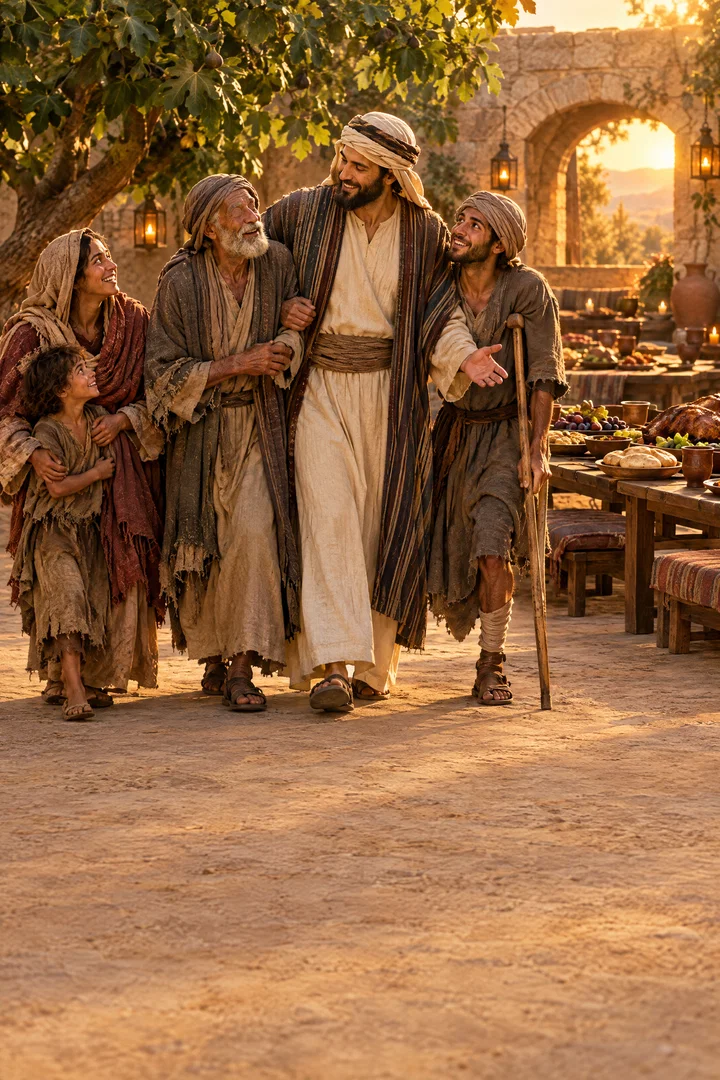
Then said he unto him, A certain man made a great supper, and bade many:
Translations
Then said he to him, A certain man made a great supper, and bade many:
King James Version, KJV Cambridge Paragraph Bible
Then said he unto him, A certain man made a great supper, and bade many:
Then said he to him, A certain man made a great supper, and invited many:
Revised Version, American Standard Version
But he said unto him, A certain man made a great supper; and he bade many:
and he said to him, 'A certain man made a great supper, and called many,
And he said to him, A certain man made a great supper and invited many.
But, he, said unto him—A certain man, was making a great supper, and invited many;
Berean Standard Bible, Majority Standard Bible
But Jesus replied, “ A certain man prepared a great banquet and invited many guests.
But he said to him, “ A certain man made a great supper, and he invited many people.
And he said to them, A certain man gave a great feast, and sent word of it to a number of people.
Then saide he to him, A certaine man made a great supper, and bade many,
Douay-Rheims (Challoner revision)
But he said to him: A certain man made a great supper, and invited many.
Pictures

Cross-references
- Revelation 19:9
And he saith unto me, Write, Blessed are they which are called unto the marriage supper of the Lamb. And he saith unto me, These are the true sayings of God.
Names the great supper as the Lamb’s marriage supper and blesses those invited.
- Luke 14:21-23
So that servant came, and shewed his lord these things. Then the master of the house being angry said to his servant, Go out quickly into the streets and lanes of the city, and bring in hither the poor, and the maimed, and the halt, and the blind.
The invitation extends to others after the first guests decline.
- Matthew 22:1-14
And Jesus answered and spake unto them again by parables, and said,
It is identified as the same parable, with Matthew detailing its earlier part.
- Luke 14:21
So that servant came, and shewed his lord these things. Then the master of the house being angry said to his servant, Go out quickly into the streets and lanes of the city, and bring in hither the poor, and the maimed, and the halt, and the blind.
The master sends servants to invite the poor and disadvantaged to the supper.
- Matthew 22:11
And when the king came in to see the guests, he saw there a man which had not on a wedding garment:
The supper invitation is joined to the need for a wedding garment.
- Isaiah 55:1
Ho, every one that thirsteth, come ye to the waters, and he that hath no money; come ye, buy, and eat; yea, come, buy wine and milk without money and without price.
Both offer a feast freely, without cost.
- Luke 14:24
For I say unto you, That none of those men which were bidden shall taste of my supper.
Those who refuse the invitation will not taste the supper.
- Revelation 22:17
And the Spirit and the bride say, Come. And let him that heareth say, Come. And let him that is athirst come. And whosoever will, let him take the water of life freely.
The invitation to receive life freely echoes the supper invitation.
- Matthew 22:8-9
Then saith he to his servants, The wedding is ready, but they which were bidden were not worthy.
same wedding call sent to others
- Matthew 22:4
Again, he sent forth other servants, saying, Tell them which are bidden, Behold, I have prepared my dinner: my oxen and my fatlings are killed, and all things are ready: come unto the marriage.
same ready marriage invitation language
- Matthew 22:10
So those servants went out into the highways, and gathered together all as many as they found, both bad and good: and the wedding was furnished with guests.
Both describe guests gathered for a great feast.
- Luke 14:22
And the servant said, Lord, it is done as thou hast commanded, and yet there is room.
repeats its plea that yet there is room
- Matthew 8:11
And I say unto you, That many shall come from the east and west, and shall sit down with Abraham, and Isaac, and Jacob, in the kingdom of heaven.
Many come from east and west to feast with the patriarchs in the kingdom.
- Matthew 22:5
But they made light of it, and went their ways, one to his farm, another to his merchandise:
same rejection for farm and merchandise
- Matthew 25:10-12
And while they went to buy, the bridegroom came; and they that were ready went in with him to the marriage: and the door was shut.
The shut door and too-late plea echo the marriage-feast warning.
- Luke 14:7-11
And he put forth a parable to those which were bidden, when he marked how they chose out the chief rooms; saying unto them,
quoted as preceding teaching in same discourse
- Luke 12:37
Blessed are those servants, whom the lord when he cometh shall find watching: verily I say unto you, that he shall gird himself, and make them to sit down to meat, and will come forth and serve them.
Both use a feast to depict the kingdom.
- Luke 22:30
That ye may eat and drink at my table in my kingdom, and sit on thrones judging the twelve tribes of Israel.
sitting at Christ's table
Commentary part 1 of 2
Each commentary is drawn from primary sources: the writings of Ellen G. White and Adventist pioneers and periodicals. Each commentary is separate. Its own words are not a quotation; follow the references to read the source passages.
Ellen G. White
103 sources
A certain man preparing a lavish evening meal and inviting many pictures God offering through the gospel every blessing for this life and the life to come, with Christ Himself as the provision and banquet of truth.ST May 4, 1915Lt 54a, 1898, par. 2–4Ms 24, 1891, par. 38–41COL 221.1–222.2 That table was spread at infinite cost, even the life of the Son of God given to rescue fallen people and meet every spiritual need for pardon and peace.Ms 9, 1898, par. 39–41RH Aug 25, 18742T 40.2 The bidding is a gracious universal call to high and low, rich and poor, old and young, and sinners of all degrees, with none excluded and all who will welcome to come humbly and receive freely without price.Lt 96, 1898, par. 10–12Ms 11b, 1894, par. 16–18Lt 54, 1898, par. 8–10 Those first bidden were the Jewish priests and elders who professed to wait eagerly for the promised Messiah, yet they let ground, oxen, business, possessions and family absorb them and with one consent made excuse, counting temporal interests of more value than eternal glory.ST May 4, 1915Lt 54a, 1898, par. 2–419MR 245.4–246.1STMW11 15.3–16.2ST Feb 10, 1898 Their refusal shuts them out from tasting the supper while the invitation goes to the poor, maimed, halt and blind in streets and lanes and to those in highways and hedges, and merely accepting is not enough, for each guest must put on the wedding garment of Christ's righteousness and servants must go out with persuasive urgent effort to compel others to come in that the house may be filled.Ms 6, 1897, par. 1–4Lt 96, 1898, par. 10–12Ms 81, 1899, par. 14Lt 20, 1893, par. 10–12Ms 109, 1901, par. 9
Setting and Occasion
The saying, Blessed is he that shall eat bread in the kingdom of God, is answered by a parable of a certain man who made a great supper and invited many.Lt 54a, 1898, par. 2–4 It follows teaching to take the lowest room with the promise that whoever humbles himself shall be exalted, and to invite the poor, the maimed, the lame and the blind with recompense at the resurrection of the just.Lt 54a, 1898, par. 2–4 At supper time the man sends his servant to those already bidden to say that all things are now ready.Lt 54a, 1898, par. 2–4 Those bidden answer with one consent by making excuse, one about buying ground, one about proving five yoke of oxen, and one about marriage.Lt 54a, 1898, par. 2–4
Christ spoke the parable while attending a dinner feast, having accepted an invitation to dine.Ms 19, 1899, par. 10–13RH Oct 2, 1900 He controlled the table talk with precious, life-giving lessons adapted to the needs of His hearers.Ms 19, 1899, par. 10–13RH Oct 2, 1900 One such lesson was given to show the way in which the invitation of the king was treated.Ms 19, 1899, par. 10–13
The supper pictures God's blessings for this life and the life to come, including the blessings of eternal life and entry into God's kingdom.COL 219.1ST May 4, 1915 It recalls the cherished hope of feasting and sitting with Abraham, Isaac and Jacob.COL 219.1ST May 4, 1915 The Jews cherished that hope while Gentiles remained outside, but those who presumed the invitation was theirs were rejecting God's offer of mercy, so the invitation would go to people they despised and shunned.COL 219.1ST May 4, 1915
The many bidden are the Jewish priests and elders.ST Feb 10, 1898 They made great professions of piety and claimed to look eagerly for the promised Messiah as King of the Jews to conquer His enemies and set up His kingdom, waiting with apparent anxious expectancy to go in immediately when called and proclaiming everywhere the great events of His coming.ST Feb 10, 1898 Their waiting was only profession, for they applied the prophecies of His second coming to His first advent, so when He came they knew Him not.ST Feb 10, 1898 Their claim to obey the law of God was also false, for the law is holy and just and good, but by exacting requirements they made it impossible for anyone to keep while they themselves constantly disobeyed it.ST Feb 10, 1898
The story continues with the first invited refusing, after which messengers call others from the streets and lanes, even the poor, the maimed, the halt and the blind.Ms 6, 1897, par. 1–4Ms 81, 1899, par. 14Lt 20, 1893, par. 10–12COL 307.2–308.1 When the servants report it is done as commanded and yet there is room, the call goes to the highways and hedges and byways to compel the most degraded and helpless to come in that the house may be filled.Ms 81, 1899, par. 14Lt 20, 1893, par. 10–12 This represents rejection by the Jewish people followed by a call of mercy to the Gentiles, so the feast is still furnished with guests, and the invitation is to reach everyone as a lifelong call extending into eternity, including a special gospel call to be given near the close of earth's history.Ms 6, 1897, par. 1–4Ms 81, 1899, par. 14Lt 20, 1893, par. 10–12COL 307.2–308.1 Those who resist mercy while boasting of their piety are shut out and excluded and will not taste the supper, while publicans and sinners who hear and seek salvation enter the kingdom before them, and those who truly receive, yield, obey and develop Christlike character are fitted for the feast in the garment of righteousness.Ms 6, 1897, par. 1–4Lt 20, 1893, par. 10–12COL 307.2–308.1 Compared with the royal wedding feast, this householder's invitation carries less authority and honor, and its rejection brings exclusion rather than destruction.COL 307.2–308.1
Meaning of Supper Invitation
The great supper pictures the blessings offered through the gospel for this life and the life to come, including eternal life and entrance into the kingdom, with Christ Himself as its provision and as the banquet of truth prepared at His own cost.ST May 4, 1915Ms 24, 1891, par. 38–41COL 221.1–222.2COL 223.2–225.1GW 350.1 The invitation to it is generous and gracious, extended to many, and it must take priority over lesser earthly interests, for response in the present opportunity decides the share in future blessing.ST May 4, 1915Ms 24, 1891, par. 38–41COL 221.1–222.2ST May 4, 1915 Those invited can disregard and slight it when worldly interests absorb them, with possessions, pleasures, family ties, or concern for prospects mattering more than eternal things, and even blessings received from God becoming barriers between people and Creator and Redeemer.ST May 4, 1915COL 223.2–225.1ST May 4, 1915
The supper was made ready at great and infinite cost, at the cost of the life of the Son of God who sacrificed Himself to rescue fallen people and offer eternal inheritance and glory.Ms 9, 1898, par. 39–41RH Aug 25, 18742T 40.2Lt 305, 1904, par. 8–9 It is a bountiful table spread for finite fallen men needing pardon and peace, a feast prepared by Jesus to meet every spiritual need, with the Bread of Life meeting that need.Lt 89, 1898, par. 12–13Ms 184, 1898, par. 50–51 The call Come for all things are now ready still sounds, given by the Lord Jesus as great Teacher out of the kindness and love of a long-forbearing God, and it is to be carried everywhere including through sanitariums that bring Bible truth to those who do not know it, where angels impress unbelieving hearts.Ms 9, 1898, par. 39–41Lt 89, 1898, par. 12–13Lt 305, 1904, par. 8–9
For professed churches in this generation the spiritual banquet is set in rich abundance so complete that nothing more could be done, meaning exaltation to privileges far greater than ancient Israel's.COL 317.2 It means revelation in ever-increasing light, the great light committed to Israel plus increased evidence of salvation through Christ, with what was type and symbol become reality, Old Testament history plus the New Testament also.COL 317.2 It means assurance of a Saviour come, crucified, risen and proclaiming Himself the resurrection and the life, the kingdom placed in the midst through knowledge of Christ and His love, and Christ revealed in sermons and chanted in songs.COL 317.2 It means freely offered to every soul the wedding garment provided at infinite cost, the righteousness of Christ, justification by faith, the exceeding great and precious promises, free access to the Father by Christ, the comfort of the Spirit, and well-grounded assurance of eternal life in the kingdom of God, a table of manna and life-giving truth whose reception brings responsibility to practice it and invite others.Ms 22, 1889, par. 60–63COL 317.2Ms 29, 1898, par. 16–18
The bidding of many is a gracious, universal invitation showing God's condescension, given to everyone who has had light, to high and low, rich and poor, old and young, and sinners of all degrees, without exception or limitation.Lt 96, 1898, par. 10–12Ms 11b, 1894, par. 16–18Ms 59, 1895, par. 60–62Lt 89, 1898, par. 12–13 No class is excluded and none should be passed by, for the gospel is given in language the poor can understand, all who come humbly are welcome, and all who will may come and receive freely without price, including Christ's righteousness pictured as a white garment.Ms 11b, 1894, par. 16–18Ms 143, 1898, par. 21Lt 89, 1898, par. 12–13 The prepared feast represents both gracious invitation to share God's future kingdom and present privileges of service with duty to respond, so that when the first invited slight it the call goes instead to those they despised and regarded as of little value.Lt 54, 1898, par. 8–10Ms 59, 1895, par. 60–62
The invitation is a call to come to Jesus Christ Himself as the way, the truth and the life, who bought each hearer by creation and redemption and has taken the church as His bride.Ms 59, 1895, par. 63–65 Coming means making peace with God, gratefully receiving truth and salvation, following Him, coming to serve, supporting His work including medical missions in new fields, and receiving the gospel and its blessings.5MR 41.2–42.1Ms 184, 1898, par. 50–51RH Apr 3, 1900Lt 4, 1899, par. 27–28 Each person bears individual responsibility that no marriage or family tie excuses, so that even if father, mother, brethren, sisters, husband, wife or children refuse light and hinder, the believer must still walk in the light, practice principle and show loyalty rather than turn from the Spirit's wooing to please family.Ms 59, 1895, par. 63–65 To hear the bidding and present frivolous excuses brings sin, spiritual loss and eternal consequence, and those who make excuses lose the opportunity while servants must carry the invitation wherever there is an opening.Lt 77, 1893, par. 48–52Ms 59, 1895, par. 63–65
The supper offers peace and happiness and joy and repose from the din and confusion of earth, from trifling and ambition, which is heaven itself.Ms 109, 1901, par. 9Lt 141, 1901, par. 16–18 Every preparation has been made to seat guests at a bountiful repast where Christ Himself serves those seated at His table, both rich and poor.Lt 141, 1901, par. 14–15Lt 141, 1901, par. 16–18 The richest gift proffered to all bidden is the wedding garment, the robe of His righteousness spotless as the pure white lily, to be secured with whole attention, and those who accept it and overcome will be in the kingdom crowned as overcomers walking with Christ in white with life measuring with the life of God.Lt 141, 1901, par. 14–15Ms 109, 1901, par. 9Lt 141, 1901, par. 16–18
Rejection and Its Consequences
Those first bidden let worldly interests absorb them, counting temporal interests of more value than eternal glory and putting property, ground, oxen, business, possessions, pleasures, family ties and concern for prospects above receiving Christ and His righteousness.ST May 4, 1915STMW11 15.3–16.2COL 221.1–222.23T 383.1–3ST Apr 22, 1875 Their minds are engrossed by the things of time, looking on things temporal and losing sight of things spiritual and eternal.ST May 4, 191519MR 245.4–246.1STMW11 15.3–16.2COL 221.1–222.2ST Sep 15, 1909 The invitation is generous and gracious, testing whether heavenly riches are valued above earthly interests, yet earthly possessions and concerns become excuses for refusing obedience and the call to follow and take part in what is ready.19MR 245.4–246.1STMW11 15.3–16.2COL 221.1–222.23T 383.1–3ST Apr 22, 1875 Professing believers let those interests outweigh the heavenly call, putting earthly concerns such as property before service for Christ and the invitation to receive His goodness and mercy.ST May 4, 191519MR 245.4–246.1STMW11 15.3–16.2ST Apr 22, 1875
Their excuses show indifference, contempt and insult to the host and to the invitation of mercy.STMW11 15.3–16.2COL 223.2–225.1ST May 4, 1915Ms 184, 1898, par. 50–51 They are frivolous, foolish and ungrateful refusals, and those who make light of the message will not share in the feast.STMW11 15.3–16.2COL 223.2–225.1Lt 19a, 1895, par. 1–2ST Sep 11, 1884 Even blessings received from God can become barriers between people and their Creator and Redeemer when worldly interests, possessions, pleasures or concern for prospects matter more than eternal things.ST May 4, 1915ST May 4, 1915 Refusing to come to Jesus or doubting that He will receive and pardon rejects the highest good and shows contempt for God.COL 223.2–225.1Ms 184, 1898, par. 50–51
The reason is that Satan presents to every mind the temptations he presented to Christ in the wilderness and carries minds away with delusion, keeping many bound to his chariot and yoke of bondage instead of accepting God's promises.ST Sep 15, 1909 Christ came to break that spell of infatuation wrought upon the human mind, to rescue those bowed down by Satan's power and set them free.ST Sep 15, 1909 He came to bring eternity to view so that heaven is not lost out of reckoning and vision extends beyond the things of this life.ST Sep 15, 1909
Religious teachers who refuse that gospel feast follow in the steps of the Jewish rulers.Ms 23, 1900, par. 15 Their refusal leaves them blind to their peril and unwilling to make an honest investigation of the Scriptures.Ms 23, 1900, par. 15 Closing the eyes against evidence prepares them to keep opposing the truth, with the first refusal making the second easier, until they show hatred for the principles of Christ's character just as the Jews did.Ms 23, 1900, par. 15 Some who heard the invitation were deeply convicted and questioned whether to accept it, but held back because they feared the hatred of the scribes, Pharisees and Sadducees.Ms 197, 1898, par. 12–13
Refusing leaves people without the blessing God intended and without the heavenly food set before them.Ms 149, 1898, par. 1–215MR 307.1–3 Those who make excuses and neglect to respond to the call lose much.15MR 307.1–3Lt 86, 1895, par. 3Ms 47, 1895, par. 1–3 Those who reject the invitation, refuse obedience, live for self, reject God's commandments, choose earthly pleasures and slight the call are excluded and will not share Christ's glory or taste the supper, while the invitation is extended to others.Ms 149, 1898, par. 1–2Lt 19a, 1895, par. 1–22T 40.2 Unreadiness can also keep others from accepting, for a person's refusal and influence can keep others from coming.Ms 184, 1898, par. 50–51
Treating the gracious bidding as a whim and refusing entreaties to obey leaves the refuser with no protection in the time of judgment.15MR 224.3–225.2Ms 59, 1895, par. 40–44 The invitation demands perfect obedience and gathering where God appoints safety.Ms 59, 1895, par. 40–44 Such excuse-making is not spared but brings the same unsparing stroke upon disobedient Hebrews as upon the Egyptians on Passover night.Ms 59, 1895, par. 40–44 Those who reject God's call and fail to act in obedience cannot expect to escape judgment.15MR 224.3–225.2Ms 59, 1895, par. 40–44
The lesson of the call to supper extends to the close of probation.15MR 14.3–5Lt 11, 1890, par. 7 It does not support the theories for which it was being used, and its meaning has been perverted and misapplied.15MR 14.3–5Lt 11, 1890, par. 7 The invitation to salvation is the proclamation of pardon and warning during probation.15MR 222.3 Those who receive it and refuse it, turning from truth to fables, will have no later opportunity to be justified after probation closes, with no second invitation to the feast and no intermediate period in which another call is made.15MR 222.315MR 217.2–219.1
Preparation Required for Guests
Accepting the privileges of the gospel supper is not enough, for each one bidden must put on the wedding garment, which is the righteousness of Christ and the character of Christ.Lt 96, 1898, par. 10–12Ms 109, 1901, par. 9 That garment is the robe of His righteousness, spotless as the pure white lily, proffered to all bidden as the richest gift that can be bestowed on mortal man and to be secured with whole attention.Lt 96, 1898, par. 10–12Ms 109, 1901, par. 9Lt 141, 1901, par. 16–18 Those who would sit at the table must strip off all miserable inherited and cultivated traits of character that dishonor God, for all who keep such traits while taking a seat make Christ ashamed of them.Lt 96, 1898, par. 10–12 Like builders who lay a tower foundation without counting the cost, they fail to finish.Lt 96, 1898, par. 10–12
Those truly fitted for the feast receive Christ, yield themselves to God, obey His commandments, develop Christlike character, practice the truth, and wear the garment of Christ's righteousness.Ms 6, 1897, par. 1–4Lt 5, 1897, par. 7–10 They must give the Lord their whole service and have the pure linen garment woven in heaven, with humanity combined with divinity united to Christ, for heaven has no place for people not united with Christ.Ms 6, 1897, par. 1–4Lt 55, 1897, par. 26–29 Merely accepting the truth in name, mere profession, or coming without Christ's righteousness and refusing to practice the truth leaves them unprepared for the feast, speechless and rejected as was the man who came without a wedding garment, and accountable for neglected service.Lt 5, 1897, par. 7–10Ms 8, 1874, par. 9–10Lt 90, 1898, par. 3Lt 55, 1897, par. 26–29 The invitation is lifelong and extends into eternity, reaching everyone including the poor, maimed, halt and blind after the first invited refused.Ms 6, 1897, par. 1–4
For some thirty years past servants have been saying Come, make ready, put on the wedding garment, be clothed with meekness, humility and truth and with the righteousness of Christ, so as to appear before Him and enter the guest chamber to sit with Him at the wedding of His Son.Ms 8, 1874, par. 6–8 The great supper is the marriage supper the King has made for His Son, the marriage supper of the Lamb in the Master's house when the Bridegroom comes, and the many bidden are those called to the marriage.Ms 8, 1874, par. 6–8Ms 8, 1874, par. 9–10 The servants sent forth are the Lord's servants sent to say Come to the marriage and make ready for Christ's soon coming to receive all the faithful to the mansions He has prepared and to partake of the feast He has prepared.Ms 8, 1874, par. 6–8 Heeding the invitation now means making ready in righteousness to gain admittance and escape the sentence that none who were bidden and refused shall taste of His supper, while those first bidden who kept excusing themselves while feasting on the pleasures of this world picture the masses at the present time.Ms 8, 1874, par. 9–10
Accepting requires obeying God fully even at loss of neighbors' approval, including keeping all God's commandments and the Sabbath by refusing to work on the Sabbath or hire others to work on it, rather than attending to farm business and selfish interests to stay in harmony with those who do not love God.Ms 9, 1898, par. 39–41Lt 143, 1895, par. 2 Each person has individual responsibility to accept and cannot give the soul into a husband's or wife's keeping, for no earthly marriage or family tie excuses refusal.Ms 59, 1895, par. 63–65 If husband or wife or relatives refuse the light and hinder, the believer must still walk in the light shining on the pathway, forsaking father, mother, sisters, brethren, husband, wife and children if needed to practice religious principles and show loyalty to God.Ms 59, 1895, par. 63–65 To hear the bidding and then present frivolous excuses and turn away from the wooing of the Holy Spirit to please family, or to refuse from fear of being thought foolish and ridiculed, from unwillingness to displease neighbors, or to care for business, is slighting and despising Christ's offer, brings sin, spiritual loss and eternal consequences, and those who despise it will not taste of His supper; refusing also includes living for self rather than God and rejecting the claims of God's commandments, and those who will not seek to know God here would not be fit to serve or live in His presence in heaven.Ms 9, 1898, par. 39–41Ms 59, 1895, par. 63–65Ms 81, 1898, par. 38 Those who accept and overcome and keep the commandments will be in the kingdom of heaven crowned as overcomers walking with Christ in white, singing the triumphant song of the conqueror, receiving the very highest honor which the world can neither give nor take away, life measuring with the life of God.Lt 141, 1901, par. 16–18
Accepting the invitation brings the rich, freely offered blessings of God's love, pardon and grace, honors the Giver, and allows the Holy Spirit to work through the whole person in Christ's service, with spiritual needs met by receiving the Bread of Life prepared by Jesus to meet every person's spiritual needs.Ms 184, 1898, par. 50–51 Refusing to come to Jesus or doubting that He will receive and pardon rejects our highest good and shows contempt for God.Ms 184, 1898, par. 50–51 A person's refusal and influence can also keep others from accepting the invitation, so believers should draw their families and relatives to Christ.Ms 184, 1898, par. 50–51
The first portion of the chapter gives preaching with divine freedom that brings the blessing of the Lord, moves newly believing hearers to bear witness for Jesus, and produces visibly changed men in spirit and countenance as a new heart.Ms 59, 1895, par. 45–46 The call to the great supper preached as a message for the people makes a deep impression upon minds and calls for a work to be done in human hearts and a reformation to take place in human characters that gives a close connection with God.2MR 259.3–260.4Ms 54, 1895, par. 1–7 That message is addressed to church members including those wandering in darkness and unbelief.Ms 54, 1895, par. 1–7
Prophetic and Historical Fulfillments
The invitation first went to a highly favored people called to come to the marriage supper of the Lamb, but that message was rejected.Ms 81, 1899, par. 14 The next call went to the poorer class — the poor, the halt, the maimed, the blind — who were not exalted by ambitious projects and might come if they would accept.Ms 81, 1899, par. 14 When the servants reported it done as commanded and yet there was room, the call went to the byways for the most degraded and helpless, to compel them to come in that the house might be filled.Ms 81, 1899, par. 14 The parable also presents the special gospel call to be given near the close of earth's history.Ms 81, 1899, par. 14
The great supper is the gospel feast, the marriage supper of the Lamb and of the King for His Son.6T 412.2GW 64.3Ms 3, 1899, par. 43–44 Its bidding of many is the last call, the last invitation and last message of mercy, which is the message of Christ's soon coming that this people are called to give to the world.6T 412.2GW 64.3Ms 44, 1905, par. 12–13 Many places and thousands of places have not yet heard it, and many who have not given it, including young men and young people, are yet to proclaim it and to sound it.6T 412.2GW 64.3Ms 3, 1899, par. 43–44 That final call now being given makes readiness urgent, with faith active in works, lamps kept burning with holy oil, souls turned from iniquity before the day of the Lord, and essential testing truths for the last days proclaimed with decided earnestness in united effort.Lt 11, 1899, par. 4Ms 44, 1905, par. 12–13
The call, Come for all things are now ready, has sounded since the Minneapolis meeting through A. T. Jones, Prescott, E. J. Waggoner, O. A. Olsen and many others at camp meetings and ministerial institutes.Ms 47, 1895, par. 1–3 It is heaven's light shining and the trumpet giving a certain sound, bringing light upon justification by faith and the imputed righteousness of Christ.Ms 47, 1895, par. 1–3 Those who made excuses and neglected to respond to the invitation extended through those messengers lost much.Lt 86, 1895, par. 3Ms 47, 1895, par. 1–3
The parable means urgent bearing of the last message of warning to a guilty world after Christ's example, by outdoor teaching outside the churches and preaching in tents in camp-meetings.Lt 182, 1909, par. 14–15 It had greater meaning and urgency in 1910 than in 1842 and 1843 and 1844.Lt 182, 1909, par. 14–15
The last call to the supper prepared at infinite cost is given through medical missionary work reaching souls ready to perish, including the poor and suffering, the intemperate enslaved in soul and body, and those who do not know the truth where they are in highways and byways.1MR 226.3–4Lt 51b, 1898, par. 7–8Ms 183, 1898, par. 28 Giving that last call was the work given to the church in Battle Creek, and after long neglect medical missionary workers are doing it, so that when neglected it was placed in Dr. Kellogg's hands to carry forward and those obstructing or refusing support stood against God's call.8T 71.2 Sanitariums are one of the means purposed for carrying the third angel's message to all parts of the world, where under Bible truth sufferers learn a better way of living, angels impress unbelievers' hearts, and many are won to Christ.1MR 226.3–4Lt 305, 1904, par. 8–9 The medical missionaries give that last invitation by calling those ready to perish to accept what God has prepared.STMW11 22.1–23.1
Applied to New York and to great wicked centers, the people are to be told that all things are ready and urged to come.Lt 132, 1901, par. 4–6 The work is not limited to the poor or to especially eloquent workers, and wealth and influence must not hinder acceptance of salvation or receiving what Christ offers.Lt 132, 1901, par. 4–6Lt 21, 1899, par. 2 The compassionate Redeemer bids rich and poor to His fully prepared bountiful repast where Christ Himself serves seated guests, and wealthy honorable men entrusted with God's goods must not be passed by but be earnestly labored for in the highways as well as others in the byways, with persevering determined effort to compel them to come in.Lt 141, 1901, par. 14–15 If influential people were won they could help lift the fallen, gather outcasts, and spread the message widely, and the message is to go first to the higher classes so they hear the invitation and help advance the truth.Lt 132, 1901, par. 4–6ST May 4, 1915Lt 18, 1898, par. 6–8 Those thus brought in receive the richest gift and highest honor, life measuring with God's life.Lt 141, 1901, par. 14–15
Applied to the Southern field, to Africa and other difficult fields, God's gracious invitation to the gospel feast is for everyone without exception or limitation, including white people and colored people however degraded and dark their condition, and men and women of all classes.Lt 188, 1899, par. 8Lt 193, 1901, par. 6 It is God's message of mercy and warning to be carried by teaching and example and by faithful unselfish work planting memorials through churches, sanitariums and schools.Lt 188, 1899, par. 87T 222.1Lt 193, 1901, par. 6 The Southern field's people should have been called through such institutions established by Christian workers, and neglect leaves the field in degradation and darkness as a condemnation against churches that received great light.7T 222.1Lt 193, 1901, par. 6
Proclaiming the Invitation Today
The compassionate Redeemer bids His servants, especially ministers of the gospel, to give the call to the supper to rich and poor, for the great supper is God's invitation to share salvation and the banquet of truth Christ prepared and bought with His precious life.Lt 77, 1893, par. 48–5215MR 307.1–3GW 350.1 When that message is brought, many make excuses and refuse the opportunity offered, and that refusal leaves them without the blessing God intended, while the work of inviting must continue wherever there is an opening.Lt 77, 1893, par. 48–5215MR 307.1–3 The servants are to go out into the highways and hedges and also byways, streets and lanes, into cities, towns, villages and retired country places, and to labor house to house opening the Scriptures to those who do not know the truth.PMMEP 19.2OEWP 36.1–37.1Ms 42, 1905, par. 3–5 That going is to be done through earnest personal labor rather than needless display, presenting truth in simplicity and love as Christ directed, with angels ministering, the Spirit impressing hearts, and heavenly intelligences cooperating to give grace, power and efficiency.OEWP 36.1–37.1Ms 42, 1905, par. 3–5 Humble workers who go house to house to save souls carry forward the invitation to what is ready rather than depending chiefly on highly educated or eloquent speakers, and those who seek bread for hungry souls are blessed, with receiving truth bringing a duty to share it.PMMEP 19.2
The invitation specifies the church's work in every locality, to invite people to God's feast and bring them in so that His house may be full.6T 294.1–2STMW10 4.2–5.1 The call to go into the highways and hedges includes people nearby, especially families the church has neglected, and all who need sympathy and help, without territorial, social or caste distinctions.6T 294.1–2 It reaches rich and poor, high and low, sinners of all degrees, outcasts, strangers, the morally weak, those enslaved by intemperance, those sunk in destructive habits and feeling unworthy, who are not to be excluded but urged to come and welcomed with patient, loving effort.6T 279.4–280.2STMW11 24.2–25.1Lt 51, 1898, par. 10–14 That final effort to bring them in is to be carried out rather than met with indifference, criticism or withdrawal, for indifference and criticism oppose the command of Jesus, and the church must not assume everyone within it is connected with God.8T 72.2STMW11 24.2–25.1Lt 51, 1898, par. 10–14 The invitation calls people living in sin to redemption and makes those who receive Bible truth responsible for using their opportunities in faithful service.STMW10 4.2–5.1
To compel them to come in means to draw them by clearly presenting the truth and the great offering, not to force them.5MR 41.2–42.1 Servants are to link with men, labor with persuasion and persevering determined effort, and bring and seat them at Christ's table where He Himself serves them at a bountiful repast with every preparation made.GW 350.1Lt 141, 1901, par. 14–15 That earnest work includes the wealthy and honorable men of the world to whom God has entrusted His goods, who must not be passed by but worked for in the highways as well as others in the byways, including people of every social rank and those in high positions.5MR 41.2–42.1Lt 141, 1901, par. 14–15
The parable's final urgent call to bring people in illustrates the work of the last message, and canvassers' persistence and ability to approach different people and adapt to circumstances prepare them for that work.LS 366.1 Canvassing from house to house is one of the best opportunities to give the invitation, carrying a warning greatly needed because it is a life-and-death question whether those invited are saved.Ms 113, 1901, par. 13–16 Those who take up this work with earnestness, consecration, willingness and unselfishness will be greatly blessed, and there is no time to lose in doing it.Ms 113, 1901, par. 13–16
Home missionary work in large cities and in towns and villages along the highways and hedges is to be done by workers distributed there rather than retained together in one place.OEWP 36.1–37.1FE 365.1–366.1 God is waiting for workers to go, including those without long centralized schooling or without centralized schooling who will still do good work in the Master's vineyard, whom God teaches and sends as missionaries into the dark parts of the earth where heavenly intelligences wait to cooperate with human agents.OEWP 36.1–37.1FE 365.1–366.1 The call Come for all things are now ready is a message of mercy proclaimed by the Lord's delegated servants to high and low, rich and poor, old and young, sinners of all degrees, through Bible subjects, sermons, Bible readings and exercises, while the Lord impresses the hearts of the hearers.STE 147.1–149.1Ms 7, 1900, par. 1 Camp meetings are one of the Lord's means for warning the world and one of the most effective methods for giving this universal call to all classes, bringing conviction and conversion to those who stayed away from church for many years and deeply stirring church members.Ms 7, 1900, par. 1 Yet the feast of heavenly things offered through meetings can be extended to many with few coming to partake, when those invited feel no need of heaven's blessings and refuse light and knowledge though eternal interests are at stake.Lt 117, 1896, par. 8
The gospel is a bountifully spread table prepared for finite fallen men in need of pardon and peace, given by the Lord Jesus as great Teacher out of the kindness and love of a long-forbearing God, and for those who know Christ it includes the righteousness of Christ, justification by faith, God's promises, access to the Father through Jesus, the comfort of the Holy Spirit and assurance of eternal life.Lt 89, 1898, par. 12–13Ms 29, 1898, par. 16–18 That abundant invitation brings responsibility, for those who have received grace and truth are to practice it, use their opportunities in faithful service, devote their talents to the work, and invite others in cooperation with God.STMW10 4.2–5.1Ms 29, 1898, par. 16–18 Giving this testing message is the work of Christians as messengers to draw souls to the table and compel them to come in, feeding the needy with the bread of life and words of comfort, while thousands who ought to do it hide their talents and prove unfaithful, slothful servants who will be called to account.Lt 89, 1898, par. 12–13 The invitation is not fulfilled by serving only people who already know the truth, but includes warning a fallen world and reaching the perishing in sin through compassionate service and practical care, including meeting physical needs to open opportunity to present Christ crucified.Ms 14a, 1897, par. 11–12Lt 55, 1897, par. 16–19Lt 83, 1897, par. 14–16 Medical missionary work is one way this gospel work enlightens and helps people, and support of missions including medical missions in new fields with needed means belongs to this same responsibility.Lt 55, 1897, par. 16–19
Sources