Matthew 8:19
And a certain scribe came, and said unto him, Master, I will follow thee whithersoever thou goest.
Translations
And a certain scribe came, and said to him, Master, I will follow you wherever you go.
King James Version, KJV Cambridge Paragraph Bible
And a certain scribe came, and said unto him, Master, I will follow thee whithersoever thou goest.
And a certain scribe came, and said to him, Master, I will follow thee whithersoever thou goest.
And there came a scribe, and said unto him, Master, I will follow thee whithersoever thou goest.
And there came a scribe, and said unto him, Teacher, I will follow thee whithersoever thou goest.
and a certain scribe having come, said to him, 'Teacher, I will follow thee wherever thou mayest go;'
And a scribe came up and said to him, Teacher, I will follow thee whithersoever thou mayest go.
And a certain scribe, coming near, said unto him,—Teacher; I will follow thee, whithersoever Thou goest.
Berean Standard Bible, Majority Standard Bible
And one of the scribes came to Him and said, “ Teacher, I will follow You wherever You go.”
A scribe came and said to him, “ Teacher, I will follow you wherever you go.”
And there came a scribe and said to him, Master, I will come after you wherever you go.
Then came there a certaine Scribe, and said vnto him, Master, I will follow thee whithersoeuer thou goest.
Douay-Rheims (Challoner revision)
And a certain scribe came and said to him: Master, I will follow thee whithersoever thou shalt go.
Pictures
Cross-references
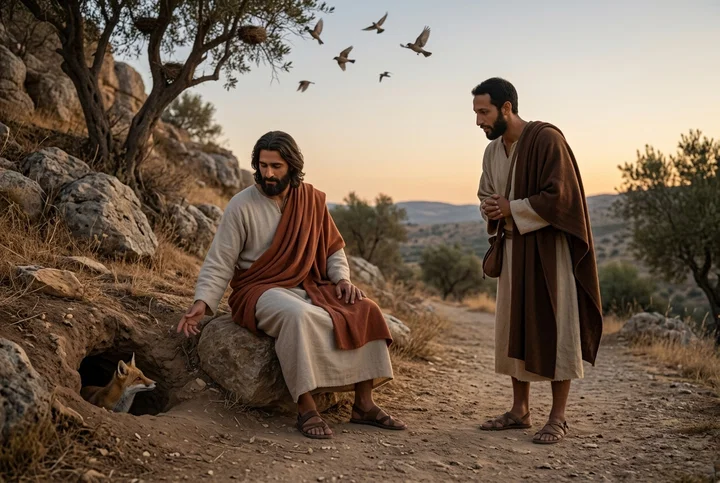
- Luke 9:57-58
And it came to pass, that, as they went in the way, a certain man said unto him, Lord, I will follow thee whithersoever thou goest.
The same offer to follow Jesus and his reply about having no place to rest.
- Matthew 10:24-25
The disciple is not above his master, nor the servant above his lord.
Disciples should expect treatment like their master received.
- Luke 9:58
And Jesus said unto him, Foxes have holes, and birds of the air have nests; but the Son of man hath not where to lay his head.
Jesus describes his hardship and lack of a settled home in response to the offer to follow him.
- Luke 14:27
And whosoever doth not bear his cross, and come after me, cannot be my disciple.
Following Jesus includes bearing the cross.
Commentary
Each commentary is drawn from primary sources: the writings of Ellen G. White and Adventist pioneers and periodicals. Each commentary is separate. Its own words are not a quotation; follow the references to read the source passages.
Ellen G. White
20 sources
A certain scribe offers to go with Jesus wherever He goes, speaking with earnest and apparently sincere willingness to become His disciple.Ms 106, 1903, par. 40DA 293.2–294.3 The speaker is Judas Iscariot, who seeks a place among the disciples in hope of gaining high position when the coming kingdom is established.DA 293.2–294.32SP 202.1–203.14RED 54.1–55.1 His mind, darkened by avarice and love of the world, takes Christ's teaching to mean that His followers will be enriched with worldly treasure, station, and wealth.3RED 81.1ST Jan 18, 18772SP 305.1 Jesus answers by declaring His own poverty and homelessness in contrast with the foxes and the birds, cutting off all expectation of temporal gain and showing that true following requires self-denial with no prospect of earthly reward.SW 1.2DA 293.2–294.32SP 202.1–203.14RED 54.1–55.1ST Jan 18, 1877
Context and Speaker
Matthew 8:19 belongs to the moment when Jesus dismisses the multitude and takes ship with His disciples for the other side of the sea.ST Jul 14, 18812SP 306.2 That farther shore was a desert compared with the shore being left, and the crossing removed them from the dwellings of men in hope of finding rest from fatigue.ST Jul 14, 18812SP 306.2 He was wearied from long and arduous labors.ST Jul 14, 18812SP 306.2 Even as they were moving off, a number of boats loaded with people followed Him because they were desirous of learning more concerning the doctrine He taught.ST Jul 14, 18812SP 306.2
The declaration to follow whithersoever He went was an earnest and apparently sincere offer to become a disciple.Ms 106, 1903, par. 40DA 293.2–294.3 Earnestness of profession did not by itself establish sincerity of commitment.Ms 106, 1903, par. 40 The speaker was Judas Iscariot, who sought a place among the disciples in hopes of gaining high position in the coming kingdom.DA 293.2–294.3
The offer was made while Jesus was preparing the twelve for ordination, and it was a great profession of devotion covering a selfish motive to obtain temporal advantage through connection with Christ.2SP 202.1–203.14RED 54.1–55.1ST Apr 19, 1877 Judas had acknowledged executive ability and influence, so the disciples commended him highly and wanted him among them and were surprised at the cool reception.2SP 202.1–203.1 Jesus neither warmly received him nor repulsed him, but read his heart and knew even then the part he would act in betrayal and execution.2SP 202.1–203.14RED 54.1–55.1ST Apr 19, 1877 He still received him to connect him with Himself so he could learn the divine mission, gain moral strength to overcome defects of character, experience entire change of heart, and ensure salvation, which was possible through Christ's help, and to avoid leading the favorably disposed disciples to question His wisdom, thus placing selfish and avaricious Judas in the most favorable position to develop mind and heart for a place in the kingdom of heaven.2SP 202.1–203.14RED 54.1–55.1ST Apr 19, 1877 Judas instead chose a course covering him with everlasting infamy and lasting disgrace.2SP 202.1–203.14RED 54.1–55.1ST Apr 19, 1877
Cost of Following Jesus
Following Jesus may mean sharing a life without a settled home, marked by hardship, rejection, and deprivation.SW 1.2Ms 6, 1891, par. 2Ms 65, 1886, par. 15–16STBk 153.2DCPP 1.2–3.1 Though He was heaven's King, even the Son of man had nowhere to lay His head, chose poverty and toil and lived humbly without worldly comfort, and depended on His followers' generosity.SW 1.2Ms 6, 1891, par. 2STBk 153.2STA 149.2DCPP 1.2–3.1 The offer to follow wherever He went was driven only by selfish interest and hope of worldly wealth and status, in the same spirit as Judas.3RED 81.1ST Jan 18, 18772SP 305.1 Having heard Him set forth truth as jewels of far greater value than hidden treasure, his mind darkened by avarice and love of the world took this to mean He would enrich His followers with worldly treasure, and he hoped He would soon establish an earthly kingdom that would bring wealth, station, and high position to His disciples; only blindness by avarice and love of the world could so misread His words.3RED 81.1ST Jan 18, 18772SP 305.1
Jesus answers by declaring His own poverty and homelessness and contrasting Himself with the foxes and the birds, underscoring His poverty and humiliation.DA 293.2–294.32SP 202.1–203.12SP 305.1 The reply cuts off any worldly expectation of status and rebukes the wish to follow Him for earthly reward, exposing that following Him offered no promise of temporal gain.DA 293.2–294.32SP 202.1–203.14RED 54.1–55.12SP 305.1ST Apr 19, 1877 The scribe wanted honor, riches, and the world with Christ, but when rebuked by Christ's poverty and humiliation he turns back crest-fallen, because following without the prospect of earthly reward requires a faith he cannot endure.3RED 81.2ST Jan 18, 1877 The verse means that true following requires self-denial and willingness to follow with no prospect of earthly reward.ST Jan 18, 1877 It exposes all who would gladly accept truth and glorify His name if discipleship brought position and wealth, yet refuse when it means joining the poor and humble under His banner.ST Jan 18, 1877
Christ's reply reveals the life of self-denial God gave the world in His only begotten Son.Ms 183, 1907, par. 18 Christ took His position in the world among the poorest, in the very humblest poverty, with a poor mother and the poor family of Joseph, so the poorest could never say He did not know the temptations of poverty.Ms 183, 1907, par. 18 A Christian must be Christlike in that same self-denial and must comply with the conditions to have the heavenly power for it.Ms 183, 1907, par. 18 The verse is applied as a lesson not to be discouraged by trials and opposition, which are part of the Christian life, but to share Christ's sufferings faithfully in hope of sharing His glory.Ms 65, 1886, par. 15–16 The verse stands in a chapter that shows how Christ united the ministry of the Word with medical missionary work, revealing the methods of the great Healer to be studied and followed by laboring as He labored.Ms 62, 1904, par. 17
Sources
Pioneers and periodicals
15 sources
A certain scribe came to Jesus just before He crossed the sea after a day of teaching and healing, offering to follow Him whithersoever He went.ST Jan 18, 1877ST Apr 19, 1877RH Oct 30, 1913 The man was Judas, professing complete devotion though he had not been summoned, while hiding avarice and selfish hope of wealth, station, and a place in an expected earthly kingdom.ST Jan 18, 1877ST Apr 19, 1877RH Oct 30, 1913 Jesus answered by warning that following Him means a life without secure shelter or settled home, for even the Son of man has nowhere to lay His head.ST May 17, 1899ST Aug 7, 1884ST Feb 12, 1880 True discipleship therefore requires self-denial from the outset, with willingness to accept hardship, toil, danger and sorrow with no prospect of earthly reward.ST Jan 18, 1877ST Aug 7, 1884ST Feb 12, 1880ST Aug 19, 1875RH Jan 26, 1864 His poverty, owning nothing and possessing no land though the world was His, was self-denying sacrifice that people may have a home with Him.ST Oct 12, 1904ST Mar 30, 1904RH Jan 6, 1910
Setting and Scribe's Motive
The offer to follow wherever he went belongs to the moment when Jesus dismissed the multitude and took ship with his disciples for the other side of the sea.ST Jul 14, 1881 That farther shore was a desert compared with the shore they were leaving, sought for rest from fatigue away from the dwellings of men.ST Jul 14, 1881 Jesus was wearied from long and arduous labors, and as they were moving off a number of boats loaded with people followed, desirous of learning more concerning the doctrine he taught.ST Jul 14, 1881 It was spoken just before he crossed the sea after a day of teaching and healing.ST Jan 18, 1877
The verse stands within Matthew 8:18-34 as a parallel to the incidents in Luke 8 that illustrate encouragement of faith.ST Feb 6, 1896 In that setting the stilling of the storm teaches faith to troubled souls and the healing of the demoniac shows its various effects.ST Feb 6, 1896 The scribe who offers to follow wherever he goes is Judas, presenting himself as a committed follower and asking to join his company though he had not been summoned.RH Oct 30, 1913 He professed complete devotion.ST Apr 19, 1877
His apparent sincerity concealed avarice and love of the world and selfish hope of gaining earthly advantage, a high place, wealth and station.ST Jan 18, 1877RH Oct 30, 1913 Having heard Jesus set forth truth as jewels of far greater value than hidden treasure, he with darkened mind took this to mean Jesus would enrich his followers with worldly treasure.ST Jan 18, 1877 He expected Jesus would soon establish an earthly kingdom, in the same spirit as Judas, rather than speaking from a changed heart.ST Jan 18, 1877ST Apr 19, 1877 His offer was driven chiefly by selfish hope of gaining earthly advantage through association with Christ.ST Apr 19, 1877
His promise was tested by the prospect of hardship and self-denial at Christ's poverty and humiliation.ST Jan 18, 1877RH Apr 14, 1904 He turned back crest-fallen and is not heard of again.ST Jan 18, 1877RH Apr 14, 1904 Though given the opportunity to learn Christ's mission, overcome defects of character, and be changed, he chose instead a course that brought lasting disgrace.ST Apr 19, 1877
Cost of True Discipleship
The ready offer to follow wherever He goes is met at once with warning that to follow means to accept a life without secure shelter, for even the Son of man has nowhere to lay His head.ST May 17, 1899 The answer makes plain from the outset that discipleship carries no promise of worldly comfort or security or a settled home.ST Aug 7, 1884ST Feb 12, 1880ST Aug 19, 1875 Those who would come after Him must understand beforehand the hardship and sacrifice involved, expecting toil and a life without a settled dwelling place.ST Aug 7, 1884ST Feb 12, 1880ST Aug 19, 1875
The exchange is thus a lesson in the cost and demands of discipleship. True following calls for self-denial and willingness to follow with no prospect of earthly reward, turning back when honor and riches and the world with Christ are not offered.ST Jan 18, 1877 That same commitment means accepting danger and sorrow and every trial while staying close to Him.RH Jan 26, 1864 In this it lays bare all who would gladly accept truth and glorify His name if discipleship brought position and wealth, yet refuse when it means joining the poor and humble under His banner.ST Jan 18, 1877
He who so answers has no home of His own, with less shelter than the foxes and the birds.ST Mar 30, 1904 During His earthly life He did not inherit or possess land.ST Oct 12, 1904 Though He owned nothing in this world, the world was His, and His poverty belongs to His self-denying sacrifice that people may have a home with Him.ST Mar 30, 1904RH Jan 6, 1910 His self-denying example teaches that worldly riches do not bring knowledge of God or Christian experience.RH Jan 6, 1910
Sources