Matthew 8:20
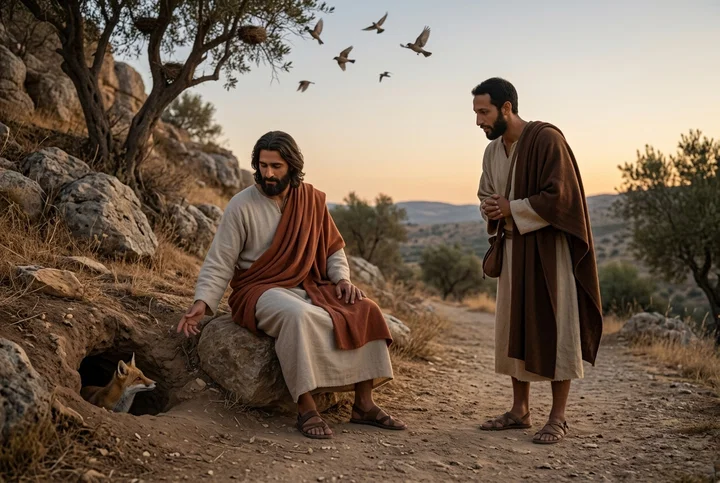
And Jesus saith unto him, The foxes have holes, and the birds of the air have nests; but the Son of man hath not where to lay his head.
Translations
And Jesus says to him, The foxes have holes, and the birds of the air have nests; but the Son of man has not where to lay his head.
King James Version, KJV Cambridge Paragraph Bible
And Jesus saith unto him, The foxes have holes, and the birds of the air have nests; but the Son of man hath not where to lay his head.
And Jesus saith to him, The foxes have holes, and the birds of the air have nests; but the Son of man hath not where to lay his head.
Revised Version, American Standard Version
And Jesus saith unto him, The foxes have holes, and the birds of the heaven have nests; but the Son of man hath not where to lay his head.
and Jesus saith to him, 'The foxes have holes, and the birds of the heaven places of rest, but the Son of Man hath not where he may lay the head.'
And Jesus says to him, The foxes have holes, and the birds of the heaven roosting-places; but the Son of man has not where he may lay his head.
And Jesus saith unto him: The foxes, have, dens, and, the birds of the heavens, nests,—but, the Son of Man, hath not where, his head he may recline.
Berean Standard Bible, Majority Standard Bible
Jesus replied, “Foxes have dens and birds of the air have nests, but the Son of Man has no place to lay His head.”
Jesus said to him, “ The foxes have holes and the birds of the sky have nests, but the Son of Man has nowhere to lay his head.”
And Jesus said to him, The foxes have holes, and the birds of heaven have a resting-place; but the Son of man has nowhere to put his head.
But Iesus saide vnto him, The foxes haue holes, and the birdes of the heauen haue nestes, but the Sonne of man hath not whereon to rest his head.
Douay-Rheims (Challoner revision)
And Jesus saith to him: The foxes have holes, and the birds of the air nests: but the son of man hath not where to lay his head.
Pictures
Cross-references 20 of 22
- 2 Corinthians 8:9
For ye know the grace of our Lord Jesus Christ, that, though he was rich, yet for your sakes he became poor, that ye through his poverty might be rich.
Christ became poor for others’ sake so they might become rich through him.
- Luke 9:58
And Jesus said unto him, Foxes have holes, and birds of the air have nests; but the Son of man hath not where to lay his head.
It records the parallel saying about Jesus having no settled home.
- Matthew 16:24
Then said Jesus unto his disciples, If any man will come after me, let him deny himself, and take up his cross, and follow me.
Jesus’ homelessness reflects the humiliation his followers must accept in following him.
- Matthew 6:31
Therefore take no thought, saying, What shall we eat? or, What shall we drink? or, Wherewithal shall we be clothed?
Jesus’ lack of a place to rest illustrates freedom from concern over material needs.
- Matthew 20:28
Even as the Son of man came not to be ministered unto, but to minister, and to give his life a ransom for many.
Both describe Jesus’ life as service rather than being served.
- Philippians 2:7-8
But made himself of no reputation, and took upon him the form of a servant, and was made in the likeness of men:
Christ took human form and humbled himself, leaving heavenly glory.
- Hebrews 13:14
For here have we no continuing city, but we seek one to come.
Both teach that there is no lasting home on earth.
- Matthew 19:29
And every one that hath forsaken houses, or brethren, or sisters, or father, or mother, or wife, or children, or lands, for my name’s sake, shall receive an hundredfold, and shall inherit everlasting life.
Jesus promises reward and everlasting life to those who give up possessions and family for his sake.
- Luke 9:57
And it came to pass, that, as they went in the way, a certain man said unto him, Lord, I will follow thee whithersoever thou goest.
Parallel account of Jesus’ reply to a would-be follower.
- Luke 19:10
For the Son of man is come to seek and to save that which was lost.
Christ came to seek and save the lost.
- Luke 14:33
So likewise, whosoever he be of you that forsaketh not all that he hath, he cannot be my disciple.
Following Jesus requires forsaking all one has.
- 1 Corinthians 4:11
Even unto this present hour we both hunger, and thirst, and are naked, and are buffeted, and have no certain dwellingplace;
The apostles’ lack of a settled dwelling echoes Christ’s self-denying path.
- Matthew 10:25
It is enough for the disciple that he be as his master, and the servant as his lord. If they have called the master of the house Beelzebub, how much more shall they call them of his household?
Followers should expect treatment like their Master.
- Matthew 19:21
Jesus said unto him, If thou wilt be perfect, go and sell that thou hast, and give to the poor, and thou shalt have treasure in heaven: and come and follow me.
Jesus calls the rich young man to give up possessions and follow him, as Christ surrendered his own comfort.
- Daniel 7:13-14
I saw in the night visions, and, behold, one like the Son of man came with the clouds of heaven, and came to the Ancient of days, and they brought him near before him.
The suffering Christ is also the Son of man given an everlasting kingdom.
- Matthew 6:19
Lay not up for yourselves treasures upon earth, where moth and rust doth corrupt, and where thieves break through and steal:
Jesus contrasts earthly treasure with his lack of a place to rest.
- John 6:27
Labour not for the meat which perisheth, but for that meat which endureth unto everlasting life, which the Son of man shall give unto you: for him hath God the Father sealed.
Both contrast earthly needs with what endures unto everlasting life.
- John 12:26
If any man serve me, let him follow me; and where I am, there shall also my servant be: if any man serve me, him will my Father honour.
Jesus calls his servants to follow him, including along a difficult path.
- Matthew 19:27
Then answered Peter and said unto him, Behold, we have forsaken all, and followed thee; what shall we have therefore?
Peter asks what the disciples will receive after leaving everything to follow Jesus.
- Matthew 25:35-40
For I was an hungred, and ye gave me meat: I was thirsty, and ye gave me drink: I was a stranger, and ye took me in:
Christ identifies himself with strangers and others in need who are welcomed and cared for.
Commentary part 1 of 2
Each commentary is drawn from primary sources: the writings of Ellen G. White and Adventist pioneers and periodicals. Each commentary is separate. Its own words are not a quotation; follow the references to read the source passages.
Ellen G. White
97 sources
Jesus declared that He had no settled home or place to rest, with less assured shelter than burrowing animals and nesting birds.Ms 35, 1885, par. 14Ms 6, 1891, par. 2Ms 65, 1886, par. 15–163T 106.2–107.1TCBMP 132.1–133.1 Though Maker, Owner and Lord of the world, He owned nothing in it and lived without a home in the world He had created, dependent on the generosity of friends.8MR 50.1Ms 25, 1890, par. 5–7Ms 34, 1892, par. 46–47 He spoke to turn away a professed follower who expected wealth, station and an earthly kingdom, cutting off all hope of temporal advantage from following Him.DA 383.1DA 293.2–294.33RED 81.1ST Jan 18, 18772SP 305.1 His homelessness was one step in a voluntary descent from heaven's glory to poverty, rejection and the cross, that through His poverty fallen humanity might be made rich and secured a home in the eternal kingdom.Ms 143, 1897, par. 3–4STB 24.1Lt 155, 1896, par. 7–9Ms 190, 1903, par. 25–2814MR 205.1–3 Following Him therefore offers no earthly riches or honors but calls for self-denial, sharing His humiliation and suffering, living the life of the poorest without disgracing poverty, and spending means and strength in humble service.Lt 90a, 1899, par. 6–8Lt 60, 1901, par. 8–10DA 383.12SP 306.1ST Jan 18, 1877
Setting and First Hearers
The saying was given after a day of teaching and healing, as Jesus dismissed the multitude to cross to the other side of the sea for rest from the fatigue of labor away from the dwellings of men.ST Jan 18, 18772SP 305.12SP 306.2 The farther shore was a desert in comparison with the shore being left, yet a number of boats loaded with people followed, desiring to learn more concerning the doctrine He taught.2SP 306.2 It answered a scribe who professed, Master, I will follow Thee whithersoever Thou goest.Ms 75, 1909, par. 182SP 202.1–203.1ST Jan 18, 18772SP 305.1 That scribe is identified as Judas professing devotion while Jesus was preparing the disciples for ordination.2SP 202.1–203.13RED 81.1ST Apr 19, 1877
Jesus read the unworthy, selfish thought of his heart and already knew the part he would act in betrayal and execution.2SP 202.1–203.1 Yet He neither warmly received him nor repulsed him, but answered with mournful pathos by declaring His own poverty in contrast with the foxes and the birds.2SP 202.1–203.1ST Apr 19, 1877 He still received him to give him opportunity to learn the divine mission, gain moral strength to overcome defects of character, experience entire change of heart, and secure salvation.2SP 202.1–203.1ST Apr 19, 1877
The offer came because the hearer had heard truth set forth as jewels of far greater value than hidden treasure.ST Jan 18, 18772SP 305.1 With mind darkened by avarice and love of the world, he supposed Jesus meant to enrich His followers with worldly treasure.3RED 81.1ST Jan 18, 18772SP 305.1 His offer to follow came from selfish interest alone, the same motive that moved Judas, hoping Jesus would soon establish His kingdom on earth and give wealth and station to His disciples.ST Jan 18, 18772SP 305.13RED 81.2 Only blindness by avarice and love of the world could so misread spiritual riches as a promise of earthly reward.3RED 81.12SP 305.1
The declaration of His own homelessness and poverty was given as a rebuke, showing that the riches He had spoken of were spiritual truth and not earthly reward.ST Jan 18, 18772SP 305.1 It was designed to cut off any hope Judas might cherish of securing temporal advantages, high position, or earthly gain through connection with Christ.DA 293.2–294.32SP 202.1–203.14RED 54.1–55.1 It exposed that He had no earthly wealth, station, or honors to give, and that following Him meant homelessness and self-denial rather than honor or gain.DA 383.12SP 305.13RED 81.2 From the first He held out to followers no hope of earthly rewards or a worldly kingdom, and those attracted by hope of a worldly kingdom must be undeceived, for He could not accept service offered in hope of having the world with Him or seeing Him exalted to an earthly throne from selfish ambition, knowing disappointment of that ambition would turn love to hatred and praise to curses.DA 383.1ST Apr 19, 1877
It also opened the minds of the disciples to His future voluntary humiliation and shameful death as a malefactor at the hands of persecutors.ST Jun 7, 18773RED 113.2–114.2 It made unmistakable that voluntary humiliation, reproach, and shame belonged to His mission, resolutely discouraging their hopes of His temporal aggrandizement and of Messiah reigning as a mighty king.ST Jun 7, 18773RED 113.2–114.2 His suffering must be followed by theirs, His crucifixion teaching them to be crucified to the world, to resign all hope of its pomp and pleasure, to bear the cross in following Him and endure corresponding humiliation if they would share His glory.ST Jun 7, 18773RED 113.2–114.2
Homelessness Less Than Animals
The saying means He had no settled home, no house of His own, no fixed place to rest or sleep, with less assured shelter than foxes that have holes and birds that have nests.Ms 35, 1885, par. 14Ms 6, 1891, par. 2Ms 65, 1886, par. 15–16Ms 25, 1890, par. 5–7Lt 60, 1901, par. 8–10 He lived without the comforts of a settled place, accepting poverty and toil as the Majesty of heaven who had left His royal throne and heavenly home to save perishing souls.Ms 35, 1885, par. 14Ms 6, 1891, par. 2Ms 65, 1886, par. 15–16Lt 2b, 1892, par. 2 His lack of worldly comfort expressed humility and self-denial, and His followers should therefore not be discouraged by trials and opposition but cheerfully share His sufferings and faithfully do their duty.Ms 35, 1885, par. 14Ms 6, 1891, par. 2Ms 65, 1886, par. 15–16
Though Maker, Owner, and Lord of the world, He owned nothing in it and lived without a home in the very world He had created.8MR 50.1Ms 25, 1890, par. 5–7Ms 34, 1892, par. 46–47Lt 2b, 1892, par. 2Ms 85, 1909, par. 3 He was unrecognized and unhonored by many while He lived and worked among people to give knowledge to the ignorant and hope to the despairing and to lead them to salvation.8MR 50.1Ms 25, 1890, par. 5–7Ms 34, 1892, par. 46–4719MR 298.2–3 His lowly condition belonged to His mission to show sinners the way to the haven of eternal rest, where they can become children of God and heirs of heaven.8MR 50.1Ms 34, 1892, par. 46–4719MR 298.2–3 His lack of earthly comfort reflected self-denial and self-sacrifice to reach the poor, and calls those who would follow Him to study His holy, self-denying example, spend no time on the vanities of this world, and conform their lives to His.Lt 2b, 1892, par. 2Ms 85, 1909, par. 3
As a traveler He had no home of His own and was sheltered only by the kindness of friends, depending on the generosity of followers.SW 1.2Ms 6, 1891, par. 2STBk 153.2STA 149.2MH 19.2 The people entrusted with sacred truth and great privileges failed to serve Him and use their gifts for the blessing of others, when faithful service would have provided for Him.Ms 19, 1898, par. 4–5 As it was, the women of Galilee followed Him and ministered to Him from their means.Ms 19, 1898, par. 4–5 His lack of worldly possessions reflects His humble life and shows that a person's worth is not measured by wealth or status.SW 1.2
For nearly three years He wandered to and fro from city to city as a patient, meek and lowly teacher and man of sorrows, without a regular bed on which to stretch His weary form at night.Ms 177, 1907, par. 33ST Mar 30, 18763RED 122.1 Night after night He slept in the open air with His disciples, and when night came the earth was often His bed, even on cold, damp nights.3T 106.2–107.1TCBMP 132.1–133.1GW92 376.2–377.1Ms 177, 1907, par. 33 His privation accompanied a life of service and submission to His Father and of blessing those who hated Him.3T 106.2–107.1TCBMP 132.1–133.1 Apart from the disciples He prayed to His Father with strong crying and agonizing petitions, and He bore every temptation so that no poor or tempted person can say He does not know poverty or temptation.Ms 177, 1907, par. 33
His homeless life was marked by toil, poverty, hunger, thirst, weariness, sorrow, and suffering, sharing the trials and hardships of people without shelter.Lt 155, 1896, par. 7–9Lt 60, 1901, par. 8–1014MR 205.1–3GW92 376.2–377.1ST Apr 26, 1905 Though Lord of life and glory and possessor of eternal riches, He lived as the poorest, often hungry and weary, and became poor for humanity's sake so that through His poverty people might be made rich.Lt 155, 1896, par. 7–9Lt 60, 1901, par. 8–1014MR 205.1–3ST Apr 26, 1905 By humiliation, suffering, rejection, and death He purchased human salvation and made it possible for man to have a home in His eternal kingdom.14MR 205.1–3 His example exposes how small our sacrifices are by comparison and sets the pattern for His followers to endure privation and suffering without murmuring or complaint.3T 106.2–107.1TCBMP 132.1–133.1ST Dec 10, 1885GW92 376.2–377.1
Humiliation for Human Salvation
He was the Majesty of heaven, the Prince in the royal courts, the Son sent by God, rich and Lord of life and glory, yet He laid aside royal robe and kingly crown with honor, riches and glory and clothed divinity with humanity.Ms 143, 1897, par. 3–4STB 24.116MR 115.3–116.1Ms 190, 1903, par. 25–2814MR 205.1–3 He lived that humanity from helpless infancy through childhood, youth and manhood, taking humanity in its deteriorated state and standing at the head of the fallen race in a world seared and marred by the curse as its example in all things, bearing all its trials and enduring all its temptations.Ms 143, 1897, par. 3–4Ms 139, 1907, par. 514MR 205.1–3 For our sakes He became poor and took the place of a servant, stooping to poverty and abasement with no settled place to rest or sleep and no home to call His own, often suffering hunger, so that His earthly homelessness was the result of that self-emptying.STB 24.116MR 115.3–116.1Lt 155, 1896, par. 7–9Ms 190, 1903, par. 25–2814MR 205.1–3
His homeless condition was one step in His descent from one humiliation to another that ended at the cross, the lowest point divine condescension could reach.Ms 139, 1907, par. 5 His life was one of sorrow, hardship, conflict, privation, poverty and friendlessness, without even the shelter beasts and birds have.Ms 139, 1907, par. 5ST Dec 16, 18802SP 95.1–96.2 That destitute condition made the third temptation the most alluring of all.ST Dec 16, 18802SP 95.1–96.2 To one so poor and homeless were offered possession of all the mighty kingdoms of the world and their glory if He would acknowledge Satan as superior, worship him and pay him homage, gaining all without suffering or peril.ST Dec 16, 1880ST Jul 14, 18872SP 95.1–96.2
He became poor for humanity's sake so that through His poverty people might be made rich with eternal riches and heaven's priceless treasure.STB 24.1Lt 155, 1896, par. 7–9Ms 190, 1903, par. 25–283T 457.23T 402.2 By humiliation, suffering, rejection and death He purchased human salvation and made it possible for man to have a home in His eternal kingdom.14MR 205.1–3 His lack of a home is the example and pattern of self-denial and self-sacrifice for the salvation of humanity, pledging those baptized in the name of the Father and the Son and the Holy Ghost to follow as co-laborers making any and every sacrifice, obeying God without seeking personal convenience or an easier path than He traveled, and resisting selfishness to give a fair share to good work and missionary labor.Lt 155, 1896, par. 7–9Ms 190, 1903, par. 25–283T 457.23T 402.2
His lowly homeless life stands in contrast to His glory at the transfiguration.3RED 122.1 For nearly three years He lived as the patient, meek and lowly teacher, wandering to and fro from city to city as a man of sorrows with no place to rest and no bed on which to stretch His weary form at night, and then the voice of God declared Him to be His Son and Moses and Elijah from heaven paid Him homage, proving He is the promised Messiah and strengthening the three chosen disciples to endure His coming humiliation and crucifixion.3RED 122.1 The Creator living in the world He made without a place to lay His head, often hungry and weary, presents humble human life alongside divine greatness, possessing eternal riches yet living as a poor man.ST Apr 26, 1905Lt 119, 1893, par. 16 His humble and difficult circumstances honored humanity, for by becoming human He revealed what humanity may become and brought life and immortality to light.Lt 119, 1893, par. 16
No Earthly Gain in Following
From the first He held out to followers no hope of earthly honors, riches, reward, station, or worldly kingdom, and the poor and humble are ranked beneath His banner.DA 383.12SP 306.1ST Jan 18, 1877 To follow Him is to accept self-denial and a share in His humiliation with no prospect of earthly gain, rather than honor or advantage.DA 383.12SP 306.1ST Jan 18, 1877 His homelessness warned the would-be disciple that discipleship meant homelessness and self-denial, and opened the truth that voluntary humiliation, reproach, and shame belonged to His mission.DA 383.1ST Jun 7, 18773RED 113.2–114.2
His suffering must be followed by theirs, for they must bear the cross after Him, endure corresponding humiliation, reproach and shame, be crucified to the world by resigning all hope of its pomp and pleasure, and suffer for His name if they would share His glory.ST Jun 7, 18773RED 113.2–114.2 The saying is therefore a rebuke to all who would follow for selfish gain and worldly advantage.2SP 306.1ST Jan 18, 1877 It exposes that the proud Pharisees, chief priests, and scribes would gladly have paid Him homage and glorified His name had discipleship brought station, honors, and wealth.2SP 306.1ST Jan 18, 1877
Many would gladly connect themselves with Him, accept the truth, and enlist in His army if there were no self-denial connected with it and if they could have the world with Christ.2SP 306.1ST Jan 18, 1877 But feeble faith cannot endure discipleship without earthly reward, so when called to follow in poverty they turn back crestfallen under its rebuke, as the scribe did.2SP 306.1ST Jan 18, 1877 Service or allegiance offered in hope of having the world with Him or seeing Him exalted to an earthly throne from selfish ambition He could not accept, knowing that disappointment of that ambition would turn love to hatred and praise to curses, so those attracted by hope of a worldly kingdom must be undeceived.DA 383.1
Despite possessing all power He did not use it for self-aggrandizement, earthly conquest, or worldly greatness, but lived without a settled place to lay His head and cast off worldly rule and honor.PK 73.1–2GC 90.4–92.2 Greatness among His disciples consists not in worldly dignity but in following Him closely in life and conduct, and those who seek worldly honor contrary to His example are not to be followed.GC 90.4–92.2 Following Him may mean having no secure earthly home or comfort, yet such loss does not make His followers poor in the lasting sense, for those who suffer for Him gain eternal riches and a home with the Saviour in heaven.SLP 283.1
Solidarity With the Poor
Jesus lived the life of the poorest, walking and working among the needy and the suffering, unrecognized and unhonored while moving in and out among the people for whom He had done so much.Lt 60, 1901, par. 8–1014MR 205.1–3MH 19.2 Though He was heaven's Majesty and Creator of the world, He claimed no part of it as a home and lived without self-seeking or the comforts of a settled place to sleep, sheltered only as a traveler by the kindness of friends.Lt 60, 1901, par. 8–10MH 19.2MYP 300.2–3 He often suffered hunger and shared the trials people face, and He worked with His hands to help support His family and did not honor people because of their wealth.Lt 90a, 1899, par. 6–8Lt 60, 1901, par. 8–10CNA 119.1–2 His lack of a settled place to rest illustrates His self-denying life devoted to doing good, relieving suffering, and meeting the needs of the destitute, making everything subordinate to His Father's will.Lt 90a, 1899, par. 6–814MR 205.1–3MYP 300.2–3
By accepting poverty and privation without even the shelter animals have, He removed the disgrace attached to poverty because of lack of worldly advantages.Lt 90a, 1899, par. 6–8Lt 90, 1899, par. 6–8CNA 119.1–2 Poverty is no disgrace, while sin is, and His poverty did not make Him disgraceful though He entered the world as a poor man without a settled place to sleep.Lt 90a, 1899, par. 6–8Lt 90, 1899, par. 6–8Lt 166, 1896, par. 5 His example teaches that the poor must not be treated with contempt, so no one can justly look down on or despise the poor.Lt 90a, 1899, par. 6–8Lt 90, 1899, par. 6–8CNA 119.1–2
A person's worth is not measured by wealth, possessions, status, or outward appearance, for His lack of worldly possessions and dependence on the generosity of His followers reflects a humble life of poverty and toil.SW 1.2DCPP 1.2–3.1RH Jul 4, 1912 Riches and high rank do not increase a person's worth in God's sight or make anyone worthy of eternal life, and those who follow Him must be willing to share His poverty, deny themselves, and take up their cross.SW 1.2DCPP 1.2–3.1RH Jul 4, 1912
He identifies Himself with the lowly, oppressed, suffering, poor and afflicted, taking human poverty and grief into His own experience and treating their hunger, thirst, homelessness, nakedness, sickness, imprisonment, and lack of food, shelter, clothing, and freedom as His own.4T 620.1–3Ms 58, 1896, par. 18–192T 25.2–3 Receiving and caring for suffering people is therefore receiving and caring for Him, and giving to those in need is giving to Him.4T 620.1–3DA 639.3–640.1Ms 58, 1896, par. 18–19 Neglecting them, refusing fellowship and help to them, is neglecting and refusing Him, for His words about having no secure place to sleep apply to the poor and suffering without shelter.DA 639.3–640.1Ms 58, 1896, par. 18–192T 25.2–3
By sharing their hardship, afflictions, and temptations He learned how the poor are treated and understood their treatment.Lt 90a, 1899, par. 6–8Lt 90, 1899, par. 6–8CNA 119.1–2 He took His place among the poorest in the humblest poverty, with less shelter than foxes with holes and birds with nests, coming among the poverty-stricken as a poor man's son of a poor family when He could have come with His angels.Lt 90a, 1899, par. 6–8Ms 183, 1907, par. 18Ms 177, 1907, par. 33 His mother was poor and Joseph's family was poor, and He lived without a home, sleeping night after night in the open air with His disciples and bearing all kinds of temptations from Satan.Ms 183, 1907, par. 18Ms 177, 1907, par. 33 So the poorest and most tempted can never say He does not know poverty or temptation, and no poor or tempted person has any excuse.CNA 119.1–2Ms 183, 1907, par. 18Ms 177, 1907, par. 33
Call to Self-Denying Service
His homeless, self-denying life is the pattern to be studied and conformed to all the way to the end of life, with no seeking of personal convenience, an easier path, or a better portion than He had.Lt 155, 1896, par. 7–9Lt 60, 1901, par. 8–10Ms 85, 1909, par. 3Ms 242, 1902, par. 4–6Ms 180, 1907, par. 37–38 Though He was the Majesty of heaven He accepted poverty and lack of a settled place to sleep, knowing hunger, thirst, weariness, and suffering hunger while living as the poorest and sharing the trials people face, becoming poor for humanity's sake so that through His poverty people might be made rich.Ms 35, 1885, par. 14Lt 155, 1896, par. 7–9Lt 60, 1901, par. 8–10 His holy, self-denying character as one who became a child of humanity and owned nothing in the world although the world was His gives a perfect example to every human being, calling followers to spend no time on the vanities and follies of this world, since seeking worldly things reveals lack of harmony with His character.Ms 85, 1909, par. 3Ms 242, 1902, par. 4–6 From His life and labors and struggles with temptation is learned how to become partakers of the divine nature and overcome corruption through lust, and walking in His footsteps brings a supply of divine grace such as sustained Him in every circumstance, while selfishness and neglect of missionary work bring shame and reproach on Him.Lt 155, 1896, par. 7–9Ms 85, 1909, par. 3 Those who hope to share His glory must expect to share His sufferings in this life, enduring privation, hardship, and lack of shelter without murmuring or complaint and remembering His suffering rather than insisting on comfort and their own wishes.3T 106.2–107.1TCBMP 132.1–133.1ExVEGW 51.3EW 54.1SG4 181.1–2 He left His royal throne and heavenly home to save perishing souls, accepting rejection, toil, sorrow, and suffering, at times with the earth for His bed when night came, in a life of service and submission to God blessing those who hated Him, so His followers should not be discouraged by trials and opposition but cheerfully share His sufferings and faithfully do their Christian duty.Ms 65, 1886, par. 15–163T 106.2–107.1TCBMP 132.1–133.1ExVEGW 51.3SG4 181.1–2
Those receiving His grace should not expect or seek an easier and better time than He had, but should give up personal spending, question each personal purchase whether it can be done without, and use means to God's glory for the cause rather than personal comfort.Ms 35, 1885, par. 143T 402.219MR 138.1RH Dec 15, 1874 Though rich in heaven's priceless treasure and adored by angels as a prince in the royal courts, He laid aside glory and heavenly riches and became poor with no place to lay His head, journeying for three years from place to place as a homeless wanderer enduring toil and poverty for humanity's salvation so that people might receive eternal riches.3T 402.24T 219.2RH Dec 15, 1874 His self-denial exposes the ingratitude of selfish men who repine and murmur at leaving a little earthly treasure for Him or laboring to save souls for whom He gave His precious life, and His followers who have far more than He had should not complain of hardships but choose sacrifice and support the work of God.4T 219.2 No one can appreciate the blessings of redemption without joyfully making any and every sacrifice for love of Him, since every sacrifice made for Him enriches the giver and every suffering and privation endured for Him increases the overcomer's final joy in heaven, which is reason to resist selfishness and give a fair share to good work.3T 402.24T 219.2 Workers for present truth must follow His lowliness, simplicity, and poverty by being willing to serve suffering people for reasonable pay without demanding a stipulated sum, large wage, high pay, position, or protection of dignity.RH Jul 30, 1914SSP 27.3STB 802.3Lt 370, 1907, par. 4–5Ms 142, 1903, par. 26–28 Though Son of the infinite God who might have come with a retinue of angels He came as a babe and suffered the privations of poverty with glory in simplicity, and His followers must wear His yoke and learn His meekness and lowliness, denying themselves to help suffering fellow beings as medical missionary workers without refusing work unless position and dignity are preserved and without following worldly customs and display.RH Jul 30, 1914SSP 27.3STB 802.3
Demanding large wages throws open the door for others to do the same, spoils the simple self-sacrificing spirit in which the cause was founded, and uses money that should be spent building up the work in other places.Lt 370, 1907, par. 4–5Ms 142, 1903, par. 26–28 Though homeless Himself He spent His life seeking to give knowledge to the ignorant and hope to the despairing, wisdom making them wise unto salvation, lightening self-imposed burdens of worldly anxiety and care by inviting them to come for rest and peace and to exchange their self-made, cumbrous, galling yoke and heavy worldly burdens for His easy yoke and light burden.13MR 239.3–240.2Ms 75, 1909, par. 18ST Apr 29, 1903 Having laid aside royal robe and crown to come as a poor man with no home of His own, making everything subordinate to His Father's will and mission while living unrecognized and unhonored among the poor and suffering, He is the pattern for believers to work for the unconverted in humbleness of mind without pompous words, not turning away from any soul but laboring for brethren, children, neighbors and all with earnest self-sacrifice because He died for each one and wants every soul to come to the truth.13MR 239.3–240.2Ms 75, 1909, par. 18ST Apr 29, 1903 His plain, lowly life and plain dress expose worldliness, vanity, and covetousness, and His truthful, holy life condemns those professing religion who prize worldly appearance, comfort, and wealth, restrains their worldly conduct, and makes those ashamed of Him wish to reject, silence, or remove Him.RH Jun 10, 1852EW 88.2–3SCEV 26.5–27.3 His lack of worldly comfort and settled rest, in contrast to even animals that have shelter, stands against luxury, vice, rich habitations, costly clothing, and worldly display in those claiming to represent Him, including leaders whose indulgence-backed wealth sustained magnificence, luxury, and vice.RH Jun 10, 1852EW 88.2–3GC88 59.14SP 62.1–3Ms 19, 1898, par. 16
Beholding His divine love and wonderful sacrifice at Calvary, where as Lord of life and glory He clothed divinity with humanity, stood at the head of the fallen race as example in all things bearing all trials and enduring all temptations, lived the life of the poorest often suffering hunger with no home to call His own, and by humiliation, suffering, rejection, and death made it possible to have a home in His eternal kingdom, fills those who love Him with desire to spend and be spent in service of the Redeemer.Ms 190, 1903, par. 25–2814MR 205.1–3RH Dec 24, 1901 True love and willingness to deny self are shown not by burying in monasteries or going on long painful pilgrimages but by working for those for whom He died, which those baptized in the name of the Father and the Son and the Holy Ghost pledge to follow by making any and every sacrifice as co-laborers with Him.Ms 190, 1903, par. 25–2814MR 205.1–3RH Dec 24, 1901 Paul, like his Master, was a homeless wanderer who lived to bless humanity, enduring homelessness, poverty, self-denial, and suffering for the truth, and his life reflected the self-sacrificing life of Christ.AA 493.2–3RH Jan 4, 1912SLP 311.2–312.1 His poverty and lack of a home did not prevent trusting God or carrying out the work, proving that wholly consecrated ministers who devote all energies to building up His cause and labor self-sacrificingly for lost souls without being influenced by wages, ease, or selfish interest, walking in their Redeemer's footsteps in sustaining God's cause, will have no lack.Ms 147, 1901, par. 25–27Ms 142, 1903, par. 26–28 His humble, self-denying life in human form, though He made the world yet claimed no part of it as a home and lived without self-seeking devoted to doing good, relieving suffering, and meeting the needs of the destitute, is the pattern and guide for soul-saving work in simplicity, economy, and plainness free from unnecessary display.OFWP 8.2MYP 300.2–3SSP 29.3–30.2RH Jul 16, 1914CH 303.2–4 His example stands against seeking the largest place for oneself and points instead to serving God in the place best suited to that service, learning His meekness and lowliness.STB 802.3SSP 29.3–30.2RH Jul 16, 1914CH 303.2–4Ms 192, 1901, par. 1–2
Sources