Luke 9:58
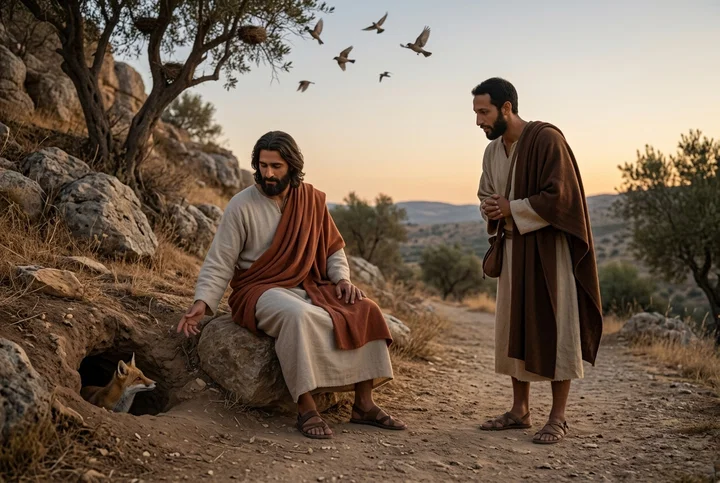
And Jesus said unto him, Foxes have holes, and birds of the air have nests; but the Son of man hath not where to lay his head.
Translations
And Jesus said to him, Foxes have holes, and birds of the air have nests; but the Son of man has not where to lay his head.
King James Version, KJV Cambridge Paragraph Bible
And Jesus said unto him, Foxes have holes, and birds of the air have nests; but the Son of man hath not where to lay his head.
And Jesus said to him, Foxes have holes, and birds of the air have nests; but the Son of man hath not where to lay his head.
Revised Version, American Standard Version
And Jesus said unto him, The foxes have holes, and the birds of the heaven have nests; but the Son of man hath not where to lay his head.
and Jesus said to him, 'The foxes have holes, and the fowls of the heaven places of rest, but the Son of Man hath not where he may recline the head.'
And Jesus said to him, The foxes have holes and the birds of the heaven roosting-places, but the Son of man has not where he may lay his head.
And Jesus said unto him—the foxes, have, dens, and, the birds of heaven, nests; but, the Son of Man, hath not where, his head, he may recline.
Berean Standard Bible, Majority Standard Bible
Jesus replied, “Foxes have dens and birds of the air have nests, but the Son of Man has no place to lay His head.”
Jesus said to him, “ The foxes have holes and the birds of the sky have nests, but the Son of Man has no place to lay his head.”
And Jesus said to him, Foxes have holes and the birds of the air have resting-places, but the Son of man has nowhere to put his head.
And Iesus saide vnto him, The foxes haue holes, and the birdes of the heauen nestes, but the Sonne of man hath not whereon to lay his head.
Douay-Rheims (Challoner revision)
Jesus said to him: The foxes have holes, and the birds of the air nests; but the Son of man hath not where to lay his head.
Pictures
Cross-references
- Matthew 8:20
And Jesus saith unto him, The foxes have holes, and the birds of the air have nests; but the Son of man hath not where to lay his head.
The parallel saying describes Jesus having no place to rest.
- 2 Corinthians 8:9
For ye know the grace of our Lord Jesus Christ, that, though he was rich, yet for your sakes he became poor, that ye through his poverty might be rich.
Christ became poor for others so they might become rich through him.
- Luke 9:23
And he said to them all, If any man will come after me, let him deny himself, and take up his cross daily, and follow me.
Jesus’ self-denying example joins the call to follow Him and bear the cross.
- Matthew 16:24
Then said Jesus unto his disciples, If any man will come after me, let him deny himself, and take up his cross, and follow me.
Jesus calls followers to self-denial and to follow Him.
- Luke 14:33
So likewise, whosoever he be of you that forsaketh not all that he hath, he cannot be my disciple.
Jesus teaches that discipleship requires forsaking all one has.
- Hebrews 13:14
For here have we no continuing city, but we seek one to come.
Both describe having no lasting home here while looking toward what is to come.
- Matthew 6:19-20
Lay not up for yourselves treasures upon earth, where moth and rust doth corrupt, and where thieves break through and steal:
Jesus’ lack of an earthly home models seeking heavenly treasure.
- Matthew 8:19
And a certain scribe came, and said unto him, Master, I will follow thee whithersoever thou goest.
Jesus responds to a promise to follow him by describing his lack of shelter.
- Matthew 8:21-22
And another of his disciples said unto him, Lord, suffer me first to go and bury my father.
Both passages stress following Jesus ahead of personal comforts and family obligations.
- 1 Corinthians 4:11
Even unto this present hour we both hunger, and thirst, and are naked, and are buffeted, and have no certain dwellingplace;
Both describe hardship and having no settled dwelling while serving Christ.
- Luke 21:37
And in the day time he was teaching in the temple; and at night he went out, and abode in the mount that is called the mount of Olives.
Jesus often spent the night on the Mount of Olives.
- Isaiah 53:3
He is despised and rejected of men; a man of sorrows, and acquainted with grief: and we hid as it were our faces from him; he was despised, and we esteemed him not.
Both describe the suffering, rejected Christ without a home.
- Philippians 2:7-8
But made himself of no reputation, and took upon him the form of a servant, and was made in the likeness of men:
same self-emptying unto death of the cross
- Mark 10:45
For even the Son of man came not to be ministered unto, but to minister, and to give his life a ransom for many.
Christ’s humble life involved service rather than privilege.
- Romans 15:3
For even Christ pleased not himself; but, as it is written, The reproaches of them that reproached thee fell on me.
Christ’s lack of a settled home exemplifies not pleasing himself.
- Mark 10:38
But Jesus said unto them, Ye know not what ye ask: can ye drink of the cup that I drink of? and be baptized with the baptism that I am baptized with?
Both portray the cost and suffering of following Jesus.
- John 17:5
And now, O Father, glorify thou me with thine own self with the glory which I had with thee before the world was.
His preexistent glory contrasts with his earthly homelessness.
Commentary
Each commentary is drawn from primary sources: the writings of Ellen G. White and Adventist pioneers and periodicals. Each commentary is separate. Its own words are not a quotation; follow the references to read the source passages.
Ellen G. White
57 sources
Jesus had less shelter than the animals, for foxes have holes and birds have nests while He had no settled home, no permanent place to sleep or rest, and no material security beyond present wants.MH 197.1Ms 139, 1898, par. 73–74Ms 106, 1903, par. 40Ms 182, 1907, par. 30–324RED 54.1–55.1 Though He was heaven's King, rich in glory, and Creator and Owner of the world, He laid aside His royalty and lived humbly among the poorest in poverty, weariness, hunger, and suffering.MH 197.1Ms 138, 1903, par. 2Ms 158, 1902, par. 31Lt 94, 1899, par. 1–7Ms 76, 1903, par. 18–19 He spoke this to one who promised to follow Him wherever He went, knowing just what answer was needed, neither warmly receiving nor repulsing the offer but setting before him a life of self-denial with mournful pathos, and while the hearer is identified in one account as Judas and in another as a scribe moved by greed and hope of riches and station, the answer still left opportunity to learn His mission and be saved.Ms 106, 1903, par. 40Ms 130, 1909, par. 28–32RH Jul 30, 19142SP 202.1–203.1Ms 183, 1907, par. 18 He accepted this poverty, hardship, and humiliation in order to save sinners, revealing the great self-denying love of God, honoring humanity, and becoming poor so that human beings might gain eternal riches.Lt 145, 1904, par. 14–17Ms 124, 1898, par. 8–9RH Jul 30, 1914RH Dec 24, 1901Lt 37, 1887, par. 22–23 His words cut off all hope of earthly gain, rank, or reward from following Him, calling disciples to share His humiliation in self-denial and self-sacrifice and making His lowly life the pattern for believers to serve the needy, avoid lavish display, and use their means for His cause.RH Jul 30, 19142SP 202.1–203.12SP 306.14RED 54.1–55.1SSP 29.3–30.2
Setting and Original Hearers
The words were given to one who promised to follow wherever He went, and He knew just what answer that man needed.Ms 106, 1903, par. 40Ms 130, 1909, par. 28–32RH Jul 30, 1914Ms 183, 1907, par. 18 The answer made clear the hardship and lack of earthly comfort involved in following Him, setting before the offerer a life of self-denial rather than gain.Ms 106, 1903, par. 40RH Jul 30, 1914Ms 183, 1907, par. 18 In one account the hearer was Judas, who said Master, I will follow Thee whithersoever Thou goest, while Jesus was preparing the disciples for ordination and instructing them in their work.2SP 202.1–203.14RED 54.1–55.1
In another account the hearer was a scribe whose offer arose from greed and from mistaking the teaching about treasure for a promise of riches and station in an earthly kingdom.3RED 81.12SP 305.1 He expected earthly wealth, rank, status, and reward from discipleship, and the answer exposed that selfish motive and cut off hope of earthly gain and temporal advantage.2SP 202.1–203.13RED 81.12SP 305.1 Jesus neither warmly received him nor repulsed him, but answered with mournful pathos.2SP 202.1–203.1
The answer was not a rejection, for it still left open opportunity to learn His mission, gain moral strength, change the heart, and be saved.4RED 54.1–55.1 The scribe turned back unwilling to accept self-denial and sharing His humiliation without prospect of earthly reward, and Judas likewise chose otherwise than to be changed.2SP 306.14RED 54.1–55.1 The saying belongs to Christ's teaching to His followers shortly before He would be taken from them, urging careful study, hearts in harmony with Him, trust in what He will do for those who follow Him, and readiness for coming trials and persecutions.Ms 72, 1911, par. 1–5
Homeless Life Described
Foxes have burrows and birds have nests for shelter, but the Son of man had nowhere to lay His head and lived with even less shelter than they have.Ms 106, 1903, par. 40Ms 182, 1907, par. 30–324RED 54.1–55.12SP 95.1–96.2 His words made clear the hardship and lack of earthly comfort involved in following Him, and His lack of a home formed part of the sorrow, hardship and conflict of His life.Ms 106, 1903, par. 402SP 95.1–96.2 His example was one of self-denial, calling for fitting up for His kingdom by self-denial and self-sacrifice.Ms 182, 1907, par. 30–32
He had no settled home, no permanent place to sleep or stay, no place to rest, and no material security or stored supply beyond present wants.MH 197.1Ms 139, 1898, par. 73–74Ms 124, 1898, par. 8–93RED 81.16MR 131.4 He accepted poverty and hardship and lived humbly among the poor, sharing their toil, privation and limited circumstances.MH 197.1 He lived in self-denial and poverty without earthly luxuries, and without worldly security or riches.Ms 139, 1898, par. 73–74Ms 124, 1898, par. 8–93RED 81.1 He gave Himself as a sinless offering so people could return to God.Ms 124, 1898, par. 8–9
Night after night He lay down upon the ground because that was the only place He had to rest for the night.Ms 9, 1910, par. 14–15 He spent night after night on the ground sleeping without a good mattress, then went out the next day to reach people, letting His humanity touch their humanity so He might win souls.Ms 130, 1909, par. 28–32 At times He slept outdoors with His disciples, having laid aside His royal status and having no home of His own.Ms 9, 1910, par. 14–15Ms 177, 1907, par. 33 Night after night He also prayed for His flock that God would give them strength to obey.Ms 9, 1910, par. 14–15
His life was marked by poverty, privation, hunger, weariness, toil, sorrow, suffering, hardship and conflict.RH Dec 24, 1901EW 54.1ExVEGW 51.3SG4 181.1–22SP 95.1–96.2 He often suffered hunger and had no place to rest, and He grew weary under humble human conditions.RH Dec 24, 1901Lt 119, 1893, par. 16 That lack of a home and lack of rest was part of His sufferings for others.SG4 181.1–22SP 95.1–96.2 It is to be remembered when believers pass through straight places instead of complaining and murmuring and demanding their own way.SG4 181.1–2
He took His position in the world among the poorest in the very humblest poverty, so that the poorest could never say He did not know the temptations of poverty.Ms 183, 1907, par. 18Ms 177, 1907, par. 33 His mother was poor and the family of Joseph was poor.Ms 183, 1907, par. 18 He lived with less material comfort than even people earning modest wages, making His life an example of poverty and restraint.Lt 146, 1896, par. 3–4 His followers' hardship and lack of food or money can be understood in light of the privation He Himself experienced.Ms 19, 1885, par. 9 In earthly provision He fared no better than believers reduced to meal, rice, flour and beans to keep from starvation, having only enough for present wants, showing that such extreme poverty does not mean God has forgotten or forsaken His servants.6MR 131.4
Divine Person Made Poor
Though He was heaven's King, the Prince of heaven, the Majesty of heaven, and rich in glory, He accepted poverty and hardship and lived humbly among the poor, sharing their toil, privation and limited circumstances and living without the comforts of a settled home.MH 197.1Ms 158, 1902, par. 31Lt 94, 1899, par. 1–7OFWP 8.2 His lowly life with no place to rest His head was chosen though He was Owner of the world, and He went unrecognized and unhonored among the people He served in a ministry of love embracing the world.Ms 158, 1902, par. 31Lt 94, 1899, par. 1–7 His example in this calls for self-denial and sacrifice and supports avoiding unnecessary display.Lt 94, 1899, par. 1–7OFWP 8.2
Though He was Creator and Owner of the world and of all worlds, to whom the whole world belonged, He claimed no part of it as His home and lived without seeking comfort or possessions.Ms 138, 1903, par. 2Ms 76, 1903, par. 18–19MYP 300.2–3Ms 42, 1890, par. 79–84Ms 192, 1901, par. 1–2 His life was marked by unselfishness and service to others, free from selfishness and devoted to doing good, relieving suffering and meeting the needs of the destitute.Ms 138, 1903, par. 2MYP 300.2–3 He bore this humiliation and sacrifice for humanity to bring many sons and daughters to God, exemplifying self-denial rather than self-pleasing.Ms 42, 1890, par. 79–84Ms 192, 1901, par. 1–2
In the heavenly courts He had a kingly crown and royal robe, with royalty and golden crown, which He laid aside to come to this earth as a man and even as a little child helping at the carpenter's trade, to live a life of poverty and self-denial.Ms 9, 1910, par. 14–15Ms 130, 1909, par. 28–32 He could have appeared with the splendor and power of a king, but His work was marked by lowliness, humility, simplicity and lack of worldly display.Ms 38, 1904, par. 89–90Ms 44, 1905, par. 6–9Lt 107, 1905, par. 7–9 His humble life stands as the example of self-denial and freedom from unnecessary display and lavishness, showing that God's work is not to be advanced through lavishness or efforts to make a display, while His giving of His life for sinful humanity shows the depth of His sacrifice.Ms 38, 1904, par. 89–90Ms 44, 1905, par. 6–9Lt 107, 1905, par. 7–9
Moving through a province of His own empire in the world He had created, He was not recognized or confessed by the nation He came to bless and save, but went unrecognized and unhonored by the many while even animals have shelter.Ms 20, 1892, par. 25–26Ms 158, 1902, par. 31Lt 37, 1887, par. 22–23 As He walked among men scattering blessing wherever He trod, no anthem of praise floated around Him, and the air was often freighted with curses and blasphemy.Lt 37, 1887, par. 22–23 As He passed to and fro among the subjects He came to save, scarcely a solitary voice called Him blessed, scarcely a solitary hand was stretched out in friendship, and scarcely a solitary roof proffered Him shelter.Lt 37, 1887, par. 22–23 His humble earthly life belongs to His mission to show people the way to the haven of eternal rest, where the sinner may rise to become a child of God and an heir of heaven.Ms 20, 1892, par. 25–26
Beneath that disguise He was still divinity, the eternal Son of God, just as mighty and just as infinitely gifted with all the resources of power, found in fashion as a man.Lt 37, 1887, par. 22–23 His lack of shelter expresses His complete self-emptying and humble servant's place in the work of salvation.Lt 117, 1903, par. 5–6Ms 76, 1903, par. 18–19 He took humanity and shared the afflictions of the human race, though Creator and rich in glory making Himself poor for humanity and living without even a settled place to sleep or rest during His ministry.Lt 117, 1903, par. 5–6Ms 76, 1903, par. 18–19
Purpose in Becoming Poor
He took poverty, hardship, humiliation and the lack of any settled home or earthly honor upon Himself in order to save sinners, giving Himself as a sinless offering so that people might return to God.Lt 145, 1904, par. 14–17Ms 124, 1898, par. 8–9RH Jul 30, 1914 Though He had created the world, He lived in it without a place He could call His own, and He bore that humiliation for humanity so that He might bring many sons and daughters to God.2SP 306.1Ms 42, 1890, par. 79–84 He suffered the privations of poverty to save a race of sinners, and that same homeless life showed that following Him meant sharing His humiliation without prospect of earthly reward.RH Jul 30, 19142SP 306.1
By accepting hungry, weary, homeless human conditions He honored humanity and revealed what human life may become through His example.Ms 20, 1892, par. 25–26Lt 119, 1893, par. 16 His humble earthly life in the world He had made, unrecognized and unhonored while even animals have shelter, belongs to His mission to show people the way to the haven of eternal rest, where the sinner may rise to become a child of God and an heir of heaven.Ms 20, 1892, par. 25–26Lt 119, 1893, par. 16
His homeless state reveals the great love of the infinite God and His great self-denial and self-sacrifice in assuming humanity and humbling Himself to die, even to die an ignominious death.RH Dec 24, 1901Lt 37, 1887, par. 22–23 Moving through a province of His own empire unrecognized and unconfessed by the nation He came to bless and save, with scarcely a voice calling Him blessed, scarcely a hand stretched out in friendship, scarcely a roof offering Him shelter, and the air often filled with curses and blasphemy, He remained beneath that disguise divinity, the eternal Son of God, just as mighty and infinitely gifted with all resources of power.Lt 37, 1887, par. 22–23 His humble, self-sacrificing life in poverty, often suffering hunger and having no place to rest, reveals divine love.RH Dec 24, 1901Lt 37, 1887, par. 22–23 He became poor so that through His poverty and humiliation human beings might come into possession of eternal riches and become partakers of the divine nature.RH Jul 30, 1914
His example removes disgrace from poverty and teaches that people must not look down on the poor because they lack worldly advantages.CNA 119.1–2Lt 166, 1896, par. 5 His poverty was no disgrace, for sin is the disgrace, and by sharing the hardships of human life He understood the poor and their treatment.CNA 119.1–2Lt 166, 1896, par. 5 Though Creator of all worlds He came as a poor man with nowhere to lay His head, and He blesses the poor rather than honoring people for wealth.CNA 119.1–2Lt 166, 1896, par. 5 His life was free from selfishness and devoted to doing good, relieving suffering and meeting the needs of the destitute, letting His humanity touch their humanity so He might win souls.Ms 130, 1909, par. 28–32MYP 300.2–3
Cost of Following Him
The words set His own poverty against the shelter of foxes and birds in order to cut off any hope of getting earthly gain and temporal advantage by following Him.2SP 202.1–203.14RED 54.1–55.1 They were spoken to Judas when he said he would follow wherever He went, while He was preparing the disciples for ordination and instructing them in their work, and He neither warmly received him nor repulsed him but answered with mournful pathos.2SP 202.1–203.1 Judas was selfish and sought connection with Him for that object.2SP 202.1–203.1 The answer was not a rejection, for it still gave opportunity to learn His mission, gain moral strength, change the heart, and be saved, but Judas chose otherwise.4RED 54.1–55.1
Discipleship would bring no promise of worldly wealth, rank, status, earthly kingdom, or reward.3RED 81.12SP 306.12SP 305.1 He had no settled place to stay and lived without worldly security or riches, with no earthly honor or riches to offer His followers.3RED 81.12SP 306.1 The scribe who offered to follow Him had mistaken His teaching about treasure for a promise of riches and station in an earthly kingdom, and his hope arose from greed and a misreading that the answer exposed as a selfish motive.3RED 81.12SP 305.1 Those unwilling to accept that self-denial without prospect of earthly reward could turn back, as the scribe did after his worldly expectations were rebuked.2SP 306.1
Following Him means sharing His humiliation and accepting a life of self-denial and self-sacrifice without prospect of earthly reward.RH Jul 30, 19142SP 306.1 He lived a life of lowliness, simplicity and poverty, with no home of His own, suffering the privations of poverty to save sinners.RH Jul 30, 1914 That following requires doing work to help suffering fellow beings right where one is, without demanding a stipulated sum, without refusing service unless placed in a position that preserves dignity, and without following worldly customs and display.RH Jul 30, 1914 He became poor so that through His poverty and humiliation human beings might come into possession of eternal riches and become partakers of the divine nature.RH Jul 30, 1914
The call requires believers to be fitted for His kingdom by self-denial and self-sacrifice.Ms 182, 1907, par. 30–32 It was spoken to one who loved His teaching and promised to follow wherever He went, and He knew just what answer that person needed.Ms 130, 1909, par. 28–32 The Son of man had no home in which to lay His head, spending night after night on the ground without a good mattress, then going out the next day to reach people, letting His humanity touch their humanity so He might win souls.Ms 130, 1909, par. 28–32 Though the great Teacher, the Son of the living God, He laid off His golden crown and laid aside His royal robes and royalty to become a little child helping at the carpenter's trade.Ms 130, 1909, par. 28–32 Believers are therefore to want heaven at the cost of all things and eternal life and souls saved, to act a part in their salvation, with every person having a work to win souls, forming character upon His divine similitude where humanity grasps divinity.Ms 130, 1909, par. 28–32 That fitting up means prizing simplicity, having a religion that works with power in the family through prayer and belief and reformation in the home, handling money as God's money, refusing to waste it on candies, bows, ribbons, and needless portions of dress, and saving pennies and small means to fund missionary efforts, educate souls, and build plain, simple, humble schoolhouses and meetinghouses to bring souls to the knowledge of the truth.Ms 130, 1909, par. 28–32Ms 182, 1907, par. 30–32
Pattern for Believers Today
His homelessness shows that though He made the world, after taking humanity He lived on earth without a settled place to sleep or stay.SSP 29.3–30.2STB 804.2–805.2RH Jul 16, 1914CH 303.2–4Lt 130, 1902, par. 17–20 His lowly, self-sacrificing divine-human life as author and finisher of faith is the pattern and guide in the work of saving souls.SSP 29.3–30.2STB 804.2–805.2RH Jul 16, 1914CH 303.2–4Lt 130, 1902, par. 17–20 That pattern teaches humility and self-denial, and requires workers to follow His self-sacrificing example rather than seeking higher wages because of talent or the importance of their work.SSP 29.3–30.2STB 804.2–805.2RH Jul 16, 1914CH 303.2–4Lt 130, 1902, par. 17–20
He lived a life of lowliness, simplicity and poverty with no home of His own, accepting the privations of poverty in order to save sinners.Lt 145, 1904, par. 14–17RH Jul 30, 1914SSP 27.3STB 802.3 Following Him therefore requires self-denial and self-sacrifice, doing work to help suffering fellow beings right where one is.Lt 145, 1904, par. 14–17RH Jul 30, 1914SSP 27.3STB 802.3 His followers are not to demand a stipulated sum, nor to refuse service merely because it offers little pay, low status, sacrifice, or loss of worldly dignity, comfort and display, nor to follow worldly customs and display.Lt 145, 1904, par. 14–17RH Jul 30, 1914SSP 27.3STB 802.3 He became poor so that through His poverty and humiliation human beings might come into possession of eternal riches and become partakers of the divine nature.RH Jul 30, 1914
His poverty and lack of outward display call believers to reject lavishness and to refuse to advance God's work through lavishness, worldly display, selfish spending, and needless display.Ms 182, 1907, par. 30–32Ms 44, 1905, par. 6–9Ms 38, 1904, par. 55–56Lt 107, 1905, par. 7–9OFWP 8.2 Money is to be handled as God's money, not wasted on candies, bows, ribbons and needless portions of dress, but pennies and small means saved to fund missionary efforts, educate souls, and bring souls to knowledge of the truth.Ms 182, 1907, par. 30–32 That same self-denial calls for plain, simple, humble schoolhouses and meetinghouses, since although He could have appeared with the splendor and power of a king He lived without even a settled place to sleep.Ms 182, 1907, par. 30–32Ms 44, 1905, par. 6–9Ms 38, 1904, par. 55–56Lt 107, 1905, par. 7–9OFWP 8.2
Those who receive His grace should not expect greater comfort for themselves than He had in toil and poverty without the comforts of a settled home.19MR 138.1 They should be willing to do without things and use their means for His cause, not complaining of hardship nor putting personal comfort ahead of supporting the Lord's work.19MR 138.1
Those who serve in His place to call people to reconciliation with God and back to God should expect to share in suffering during this life while hoping to reign with Him in glory.EW 54.1ExVEGW 51.3SG4 181.1–2 His lack of a home and settled place to rest was part of His sufferings for others, His life being marked by toil, sorrow and suffering.EW 54.1ExVEGW 51.3SG4 181.1–2 That is to be remembered when believers pass through straight places, instead of complaining and murmuring, demanding their own wishes and way, and following their own will, for forgetting it leads to unwillingness to suffer for Christ after all He suffered for them.SG4 181.1–2
Paul followed that same example, for like his Master he was a homeless wanderer who lived to bless humanity, enduring poverty, self-denial and suffering for the truth.AA 493.2–3SLP 311.2–312.1 Christ's life of poverty without a home or earthly luxury means those who truly represent Him will share that humble and self-denying character.4SP 62.1–3GC88 59.1GC 59.1 His lack of worldly luxury and comfort therefore stands in direct contrast to and exposes the wealth, indulgence, magnificence, luxury and vice of pretended representatives, including leaders sustained by taking money for indulgences.4SP 62.1–3GC88 59.1GC 59.1
He identifies Himself with the needy and afflicted, so that hardship borne by His suffering followers is His own, and turning a stranger away or neglecting the poor is treated as neglecting Him Himself.2T 25.2–3 His condition rebukes half-heartedness and complaining about having a hard time.Ms 9, 1910, par. 14–15Ms 130, 1909, par. 28–32Ms 183, 1907, par. 18 Night after night He prayed for His flock that God would give them strength to obey, then lay down upon the ground because that was the only place He had to rest, at times sleeping without a good mattress and going out the next day to reach people, letting His humanity touch their humanity so He might win souls.Ms 9, 1910, par. 14–15Ms 130, 1909, par. 28–32
He calls for daily communion with heavenly agencies, humility before God, and throwing the helpless soul upon Christ, who gives an experience of more value than gold or silver or precious stones.Ms 9, 1910, par. 14–15 Every follower is to prize simplicity, to have a religion that works with power in the family through prayer and belief and reformation in the home, to want heaven at the cost of all things, to want eternal life and souls saved and to act a part in their salvation, forming character upon His divine similitude where humanity grasps divinity.Ms 130, 1909, par. 28–32 He took His position among the poorest in the very humblest poverty, His mother being poor and Joseph's family being poor, so the poorest could never say He did not know the temptations of poverty, and the Christian is to be Christlike in that same spirit, receiving heavenly power by complying with the conditions.Ms 130, 1909, par. 28–32Ms 183, 1907, par. 18
Though King of glory and engaged in a ministry of love embracing the world, He lived without the comforts of a settled home, often suffering hunger and having no place to rest, and His humble, self-sacrificing life revealing divine love calls God's servants to self-denial and sacrifice and all who love Him to devote themselves to serving others and saving souls.Lt 94, 1899, par. 1–7RH Dec 24, 1901 Moving through a province of His own empire He was unrecognized and unconfessed by the nation He came to bless and save, with no anthem of praise around Him, scarcely a voice calling Him blessed, scarcely a hand stretched out in friendship, scarcely a roof offering shelter, and the air often freighted with curses and blasphemy, yet beneath that disguise He was still divinity, the eternal Son of God, just as mighty and infinitely gifted with all resources of power.Lt 37, 1887, par. 22–23 His homeless state reveals the great love of the infinite God and His great self-denial and self-sacrifice in assuming humanity and humbling Himself to die, even an ignominious death, teaching the need of humility and of walking humbly with God and guarding on every point, with every person having a work to win souls.Ms 130, 1909, par. 28–32RH Dec 24, 1901Lt 37, 1887, par. 22–23
Sources
Pioneers and periodicals
112 sources
Jesus contrasted the animals that have their own sheltered resting places with himself as the Son of man who had no settled home or place to rest while carrying on his traveling ministry.ST Nov 3, 1881ST Dec 11, 1893RH May 13, 1902
He spoke this to a man who offered to follow him, warning that following him offered no earthly security, wealth, fame, or temporal advantage.RH Dec 11, 1916ST Mar 24, 1909ST Jun 10, 1913
Though Creator of all things and heir of all things who once possessed heaven's glory and riches, he owned nothing in this world and had no portion of the earth, and his lack was voluntary self-denying love that refused to use his power for himself in order to save a fallen race.RH Jul 16, 1914ST Aug 21, 1893ST Jan 31, 1906RH Nov 17, 1910ST Jan 21, 1913
As Abraham's promised Seed and heir he had no inheritance or resting-place in the land during his earthly life, received neither David's throne nor earthly kingship at his first advent, and his rule over the earth and kingdom remain future.RH Dec 11, 1916RH May 27, 1915ST Apr 23, 1912ST Jan 1, 1894ST May 12, 1909
Following him therefore promises no ease, comfort, or material abundance, but requires renouncing worldly security and comfort, sharing his poverty and self-denial, and enduring hardship without seeking wages, rank, or honor.RH Jul 30, 1914ST May 14, 1894RH Jul 10, 1856RH May 13, 1902
Because he personally lived through homelessness, poverty, and sorrow, he knows human trial by experience and is able to sympathize and comfort the afflicted, while his extreme poverty rebukes selfish luxury and calls those with means to live as stewards and give freely.ST Aug 19, 1880ST Dec 21, 1882ST Aug 25, 1887RH Jul 24, 1856ST Jun 16, 1898
Words and Earthly Setting
The saying sets the Son of man below the animals in earthly shelter, for foxes have holes and birds have nests while he in his traveling ministry had no settled home, dwelling-place, or place to rest and lay his head.ST Nov 3, 1881ST Dec 11, 1893RH May 13, 1902ST Dec 21, 1882RH Jun 14, 1867 Even wild creatures had their own shelters to sleep in, yet he lived without such security and comfort as a reminder to endure hardship in service to God.ST Dec 11, 1893RH May 13, 1902 His words express the hardship and lack of shelter in his earthly life as a sorrowful sign of poverty and need that calls for compassion and hospitality toward him.
He spoke this to a man who offered to follow him in hope of temporal advantage, warning that following offered no earthly security, wealth, fame, or honor.RH Dec 11, 1916ST Mar 24, 1909ST Jun 10, 1913 He had no home when he came to redeem people from sin and bring them back to God, and no earthly wealth to offer a would-be follower, so doing God's work must take priority over personal gain and other claims.ST Mar 24, 1909ST Jun 10, 1913 His answer shows that following him means sacrifice and requires self-denial and self-sacrifice, doing work to help suffering fellow beings right where one is, without demanding a stipulated sum, without refusing unless placed in a position that preserves dignity, and without following worldly customs and display.RH Jul 30, 1914 Though he had power over demons, the forces of nature, and death, his lack of worldly comfort seemed strange to one who expected such power to bring status and wealth, for earthly wealth and rank do not make people more valuable to God or worthy of eternal life.ST Oct 4, 1910
His itinerant life meant often withdrawing to the mountain for prayer rather than to a home of his own, while his heart still longed for a home the world never gave him.ST Sep 12, 1916 During the crossing of the lake he rested in a rough fishing boat, using a board or at most a rower's cushion as his pillow.ST Nov 15, 1910 He slept, if he could find time to sleep, wherever night overtook him, and ate his daily food while toiling for others by the seashore or at the humble board of his lowly followers, or often fasted.RH Nov 11, 1873 Though weary, faint, and hungry he remained active and used every opportunity to do good because he knew the importance of his mission, and his bodily needs were real, for he was at times thirsty and faint from lack of food, yet he withstood temptation despite human frailty.ST Nov 18, 1897ST Jun 14, 1883 He went forth without knowing where he would sleep, having dedicated himself fully to his work in freedom from personal interests and complete devotion to human and divine affections, constantly employed in doing good for others and not serving self.ST Apr 1, 1913RH Nov 11, 1873
He lived without a home of his own and depended on the generous hospitality of others, and his ministry was poor and destitute, supported by women who ministered to him.RH Jul 20, 1876RH Nov 4, 1873 The Seed who was to inherit the promise was born in a manger and, after his crucifixion, was buried in a donated, borrowed tomb, living as a wayfarer without possession of the promised inheritance on earth.RH Dec 11, 1916RH May 27, 1915 He had no money to pay tax until a fish supplied it, rode into Jerusalem on a borrowed colt to fulfill prophecy, ate the Passover with his disciples in a borrowed room, owned at the cross only a seamless garment and vesture, and had no sepulcher until Joseph laid his body for three days and three nights in his own new tomb.RH Nov 4, 1873
His homelessness included living as an outcast and stranger, poor, friendless, despised, and without settled home, exposed to rejection, suffering, poverty, and disgrace in a ministry without worldly comfort or status.RH Jun 24, 1873RH May 25, 1876RH Jan 1, 1867 He himself and his special message were wholly rejected, so that when one offered to follow him he answered that he had nowhere to lay his head, expressing his sorrow as one weeping over children he would have gathered but who would not be gathered.RH Mar 18, 1875 His earthly wandering unto death on the cross for sinners was part of bringing people to a home with God, and his lack of welcome is also applied to the human heart where he stands knocking and people are urged to welcome him and let him dwell within them.RH Jun 24, 1873 He still passes in and out among people in the worn form of many a humble follower, not discerned as Lord, seeking the resting place they failed to yield him and turning with his benediction to other lands and other hearts where other hands will bathe his way-worn feet, for what is done unto the least is done unto him.
Poverty and Self Sacrifice
The verse shows extreme poverty, that while foxes and birds have homes of their own, Jesus had nothing to call His own and nowhere to rest His head.ST Aug 19, 1880ST Dec 21, 1882ST Dec 21, 1882ST Aug 25, 1881ST Dec 21, 1882 He was poorer than the animals, without even a settled place to sleep, living in self-denial and sacrifice for sinners.ST Jan 13, 1898ST Aug 19, 1880ST Aug 25, 1881ST Dec 21, 1882 His lack of comfort rebukes selfish prodigality and luxurious living for self-gratification, and calls His followers to deny self and become as the Master rather than making personal comfort their chief aim.ST Aug 19, 1880ST Dec 21, 1882ST Dec 21, 1882ST Aug 19, 1880 Spending much on splendid houses, furniture, food, gardens, comforts, and pleasure while giving comparatively little to Christ is unfaithfulness as stewards, a snare to the soul that estranges from Christ and increases love of the world and should smite the conscience.ST Dec 21, 1882ST Aug 19, 1880 His poverty is also the reason His people should care for the poor and suffering.ST Aug 25, 1881
Though Creator of all things and maker of the world, after assuming humanity He possessed no portion of the earth and owned nothing in this world.RH Jul 16, 1914ST Aug 21, 1893ST Nov 29, 1910RH Jan 6, 1910 Though heir of all things and once possessing heaven's glory, riches, and honor, He lived on earth as a man with nowhere to lay His head.ST Nov 29, 1910RH Jan 6, 1910RH Nov 17, 1910RH Jul 24, 1856 His poverty does not mean He lacked true riches, for those who belong to Him share that inheritance as Abraham's seed and joint heirs with Christ.ST Nov 29, 1910 His holy self-denying example calls followers to study and copy Him and to seek the true riches laid up for the righteous rather than the riches of this world, which can never advance knowledge of God.RH Jul 16, 1914RH Jan 6, 1910
His lack was willingly accepted and voluntary, an expression of self-emptying, self-restraint, and self-denying love.ST Jan 31, 1906RH Nov 17, 1910ST Jan 21, 1913ST Though able to command a palace, power, and resources, He lived without a settled place to rest or sleep.ST Jan 31, 1906ST Jan 21, 1913 He did not use His power to meet His own needs or for His own comfort, but gave Himself for others and for the needs of others to save a fallen race, coming not to be served but to serve.ST Jan 31, 1906RH Nov 17, 1910ST Jan 21, 1913ST
The Son of man lived without a home among the poor and needy who lacked clothing, shelter, and bread, and His lack of a settled place reflects a mission among the poor and humble rather than comfort or worldly splendor.ST Apr 22, 1880ST Oct 23, 1884RH Mar 27, 1856ST Oct 29, 1885 Born lowly of poor and humble folk, He worked as a common carpenter laboring for His bread, lived in poverty with nothing to call His own, and went from place to place in humble guise and simple dress sharing earth's wretchedness.ST Jan 25, 1899 Having no home of His own makes Him the poor man's dearest Friend who came to preach the gospel especially to the poor.RH Mar 27, 1856ST Jan 25, 1899 He associated with the poor, publicans and sinners and little with the rich, in contrast to wealthy claimants to follow Him while neglecting unselfish service.ST Feb 8, 1905
His homelessness was part of a life of constant sacrifice, toil, privation, sorrow, and hardship as the Man of Sorrows.ST Nov 1, 1910ST Jan 13, 1898ST Jun 14, 1883RH Jul 1, 1873 His shelter was more precarious than the homes of animals, and He endured hardship traveling from place to place without rest, yet though weary, faint, and hungry remained active doing good and using every opportunity because He knew the importance of His mission.ST Jan 13, 1898ST Jun 14, 1883 His lack of a place to rest illustrates the hardship, self-denial, and deprivation He endured as a witness of unimpeachable character who came to suffer and die for humanity.RH Jul 1, 1873RH Dec 1850 He lived without a settled home like a pilgrim passing through the world and endured sorrow throughout life before dying as the sacrificial Lamb.RH Jul 1, 1873RH Dec 1850ST Jan 13, 1898
Inheritance and Future Kingdom
As Abraham's promised Seed and heir of the promises, he had no inheritance, resting-place, or possession of the promised inheritance on earth during his earthly life.RH Dec 11, 1916RH May 27, 1915RH Apr 9, 1857ST May 8, 1884RH Mar 3, 1853 He lived as a wayfarer and sojourner without a settled home or place to lay his head, possessing no part of old Canaan, born in a manger and buried in a borrowed, donated tomb.RH Dec 11, 1916RH May 27, 1915ST May 12, 1909ST May 8, 1884RH Mar 3, 1853 Though the world's Maker and its destined Redeemer, he endured toil and suffering on earth with no resting place in the land, and his coming did not establish the temporal sovereignty the Jews and even his disciples expected.ST May 12, 1909ST May 8, 1884 Abraham, Isaac, Jacob and their children likewise died in faith without receiving the promised land in their lifetimes, looking to receive it afterward, so the promise to Abraham's seed had not yet been fulfilled to Christ and remained to be fulfilled.RH Apr 9, 1857RH Mar 3, 1853 He spoke this to a man seeking to join him in hope of temporal advantage, showing that following him offered no such earthly security.RH Dec 11, 1916
At his first advent he received neither David's throne nor any part of its kingdom, and his rule over the earth belongs to the future fulfillment of the promise that David's throne would be perpetuated through him.ST Jan 1, 1894ST Aug 21, 1893 Though Creator of all things, he possessed no portion of the earth and owned nothing, refusing civil office and earthly kingship because he could not of right reign over the world in its present condition.ST Aug 21, 1893ST Aug 21, 1893 His kingship, rule over the earth, and kingdom are future, and his work then was as teacher to bear witness to the truth rather than to build himself up in any way, illustrating his humble, self-denying life and lack of earthly kingship.ST Aug 21, 1893ST Aug 21, 1893 When he promised his followers a kingdom, he himself was among the poorest of earth's citizens and owned no kingdom, so the promise appears unlikely by human standards but is not empty or meaningless.ST Jun 1, 1915 His lack of a place to lay his head teaches liberty of conscience and shows that his kingdom is not of this world.ST Apr 23, 1912
His having no settled place to sleep confirms the prophecy that he would be poor.RH Sep 9, 1902 His earthly homelessness and rejection stand in contrast to the royal honor he received after ascending to heaven, where he ministers as humanity's high priest and representative.RH Dec 2, 1909 He had no settled earthly home while carrying out his work, but this did not mean he was without a home, for his true home was with his Father, which he left for a time to work for humanity and to which he returned to prepare a place for his followers. His words also sanctify the longing to be at home with loved ones.
His lack of worldly dwelling and rule stands against earthly lordship, splendor, and immense wealth claimed in his name, since his kingdom is not of this world.RH Apr 18, 1865ST Jun 4, 1902RH Dec 2, 1873 While on earth he had no permanent place to live or even a place to lay his head, wandering without a house or settled home, in contrast to the Vatican's immense wealth and splendor, the pope's luxurious palace and pomp, despite the claim to represent him.RH Apr 18, 1865RH Mar 14, 1854ST Jul 8, 1913 His lack of shelter is set against the church's grand building and elaborate worship, grand buildings and costly popular churches, while poor disciples are left without care or relief.RH Mar 14, 1854ST Jun 4, 1902 He lived a wandering life of homeless poverty as the poor, wayfaring man of grief, meek and lowly, for whom earthly splendor, chariots, royal robes, and the applause of men are out of keeping, presenting him as one who did not possess or rule the world's lands.ST Jun 4, 1902RH Dec 2, 1873 That homeless life came to its close as he traveled to his doom with the derisive crown of thorns piercing his head, the reed sceptre in his hand, his head bowed in agony, and his form writhing under the burden of his cross.RH Dec 2, 1873
Cost of Following Jesus
Following Jesus offers no promise of ease, comfort, or material abundance, for even the Son of man had no settled place to rest as foxes and birds have shelter.ST May 14, 1894RH Jul 10, 1856RH May 13, 1902ST May 14, 1894ST May 14, 1894 Discipleship requires readiness to renounce the world and all worldly tempers, giving up worldly comfort and security to follow him.ST May 14, 1894RH Jul 10, 1856ST May 14, 1894 His lack of comfort stands as a reminder to endure hardship in service to God rather than expecting ease.ST May 14, 1894RH May 13, 1902ST May 14, 1894 Because he lived without the comforts of a settled home in toil and poverty, his followers should not complain of hardship or put personal comfort ahead of supporting the Lord's work.RH May 13, 1902ST May 14, 1894
Following his lowly homeless Pattern means leaving homes and families, sacrificing all, and leaving worldly ties behind to devote oneself wholly to God's kingdom.ST Nov 3, 1881RH Dec 3, 1857 It can mean accepting even greater hardship than animals that have shelter, enduring different climates and hard travel, at times having no lodging for the night except the green earth with only the sky for covering.ST Nov 3, 1881 It can mean being prepared for privation, suffering, and the worst that might come.ST Nov 3, 1881RH Dec 3, 1857 A Christian may thus be as a tramp, moving from place to place when doing Gospel work, since Jesus had no settled place to sleep.ST Nov 1, 1905RH Dec 3, 1857 Remembering that he had no place to lay his head gives joy amid difficult travel and poor lodging while carrying the message forward.ST Nov 1, 1905
His followers must be willing to share his poverty and deny themselves, willing to be like him in having nowhere to lay the head.RH Nov 13, 1860RH Feb 12, 1861 He lived a life of lowliness, simplicity and poverty with no home of his own, suffering the privations of poverty to save a race of sinners, and following him requires self-denial and self-sacrifice in doing work to help suffering fellow beings right where one is.RH Jul 30, 1914RH Jul 16, 1914 That work is to be done without demanding a stipulated sum, without refusing unless placed in a position that preserves dignity, and without following worldly customs and display.RH Jul 30, 1914RH Nov 13, 1860 Workers are to follow his self-sacrificing example as pattern and guide in soul-saving rather than seeking higher wages according to talent or importance, for earthly wealth and rank do not make people more valuable to God or worthy of eternal life.RH Jul 30, 1914RH Jul 16, 1914 His lack of comfort is the pattern of self-denial for those willing to work to save souls, and his poverty and self-denial are the cost borne by those who left everything to follow him.RH Nov 13, 1860ST Jan 23, 1893RH Feb 12, 1861 Praying for self-denial while living in luxury and refusing this likeness exposes insincere prayer and hypocrisy.RH Nov 13, 1860ST Jan 23, 1893
His example as pilgrim and sojourner without even a place to lay his head guards his followers against love of the world, comfort, ease, and a settled resting place in this life, binding Christians to follow his self-denying way.RH Jul 13, 1869RH Dec 16, 1862RH Dec 31, 1857 He came from the glory of his Father to live without a settled place to stay, in poverty and self-denial rather than luxury and ease, in contrast to worldly riches, status, and comfort which his followers must resist, even unto his shameful death on the cross.RH Dec 16, 1862RH Dec 31, 1857ST Jan 2, 1901 His example sets the rule of plainness in manner of living and in places of worship, so that professed Christians who take the lead in luxurious living and in luxurious establishment of churches depart from his standard and leave little difference between the professed church and the world.RH Jul 13, 1869ST Jan 2, 1901ST Jun 16, 1898 Wearing a gold or silver cross on a breastpin while loaded with brilliant and costly jewels is a convenient and luxurious pretense of bearing the cross after him, opposite to his poor and self-denying life without home or resting place in this splendid world.RH Jul 13, 1869ST Jan 2, 1901 No one can truly follow the unselfish Master and great Shepherd who lived without home or comforts while taking large salaries of thousands of dollars, living in luxury, requiring the poor to sacrifice necessities to pay him, and feasting himself while thousands are hungry and destitute.ST Jan 2, 1901ST Jun 16, 1898ST Jul 7, 1898 His disciples must take the same course as one who lived without home or earthly pay, with worldly affairs almost wholly out of sight and his whole being absorbed in his Father's work of rescuing as many as possible, remaining neutrals who are not of the world even as he is not of the world.RH Dec 16, 1862ST Jun 16, 1898ST Jul 7, 1898 Comfortable government pay as army and navy chaplains contradicts that poverty and self-denial, and the fat salary can blind the eyes to the inconsistency of claiming to represent Christ while going onto the battlefield to pray for enemies to be slaughtered, when Christ commands love for enemies and leaves no place for war in a heart governed by his kind and sympathetic precepts.ST Jun 16, 1898ST Jul 7, 1898
His homelessness during earthly life was not the cause of the sufferings associated with his death, and the verse does not mean that Christians must sell their homes in order to share his sufferings.RH Nov 10, 1859 His having no home or place to rest encourages the cost of following him even to choosing loyalty to Jesus over home and family, as did a Japanese convert.RH Nov 10, 1859ST Aug 29, 1895 Paul shared the hardship of the homeless wanderer with no settled place to rest, enduring poverty, self-denial, and suffering while living to bless humanity.ST May 5, 1914ST Aug 29, 1895 His poverty and humble servant-like life without the comforts or security even animals had made him a pattern of humility for those who would be exalted in his heavenly kingdom.RH Sep 27, 1864RH Jul 14, 1868ST Apr 1, 1913 The world's Redeemer having no resting place shows that goodness and self-sacrifice can come at a cost, and going forth without knowing where he would sleep reflects freedom from personal interests and complete devotion to his human and divine affections.RH Sep 27, 1864RH Jul 14, 1868ST Apr 1, 1913
Wealth Luxury and Giving
The homelessness of the Son of man exposes the depth of his poverty, for while foxes have holes and birds have nests he had no place of his own to rest his head.ST Aug 19, 1880ST Dec 21, 1882ST Dec 21, 1882 That lack of comfort stands as a rebuke to selfish prodigality and luxurious living for self-gratification.ST Aug 19, 1880ST Dec 21, 1882ST Dec 21, 1882 It presses the question whether more is spent for personal pleasure than in service to the Lord who sacrificed so much.ST Dec 21, 1882 His followers are therefore called to deny self and imitate him, so that the servant becomes as the Master rather than living in comfort while Christ had nothing and making personal gratification the chief aim.ST Aug 19, 1880ST Dec 21, 1882
Spending much on splendid houses, furniture, food, gardens, costly clothing, ornaments, carriages and adornments for self, while giving comparatively little to Christ, is unfaithfulness as stewards of God.ST Aug 19, 1880ST Aug 19, 1880RH Jul 3, 1860 Such selfishness and extravagant expenditure should smite the conscience, for it feeds love of the world, ensnares the soul, and estranges from Christ.ST Aug 19, 1880ST Aug 19, 1880 Refusal to copy proud and fashionable neighbors in superfluities belongs to having his mind, holding earthly goods only as stewards to occupy till he comes and spending time, influence, possessions and talents in service to God and humanity.RH Jul 3, 1860 Obedience that leaves luxurious living for humble homes and gives means freely to Christ brings a new sense of his love and preciousness, with peace and joy.ST Aug 19, 1880
Moved by his love, those with wealth are to leave luxurious living, refuse to seek to get all they can and keep all they get, and use their means to support the cause.ST Dec 21, 1882ST Aug 19, 1880RH Jan 6, 1859 They are to lay up treasures in heaven rather than on earth, for without his Spirit they are none of his.RH Jan 6, 1859 So the merchant, applying the Son of man having nowhere to lay his head, gave up his splendid mansion and gave the money to Christ's cause.ST Dec 21, 1882 He who could have come as a rich man deliberately lived poor, teaching not to honor wealth apart from moral worth nor to give men high and influential position in the church because they have money, but to become poor to do good to others as the apostolic church did.RH Mar 17, 1874
His lack of wealth did not prevent him from doing more good than any other who had appeared in human form, for his pure example and spotless life were devoted to his work.RH Mar 28, 1854 Money is therefore not necessary for accomplishing God's work, since God can make people mighty by the Holy Spirit and work through the poor to bring about great changes.RH Mar 28, 1854 Poverty does not hinder spiritual growth, and outward economic conditions are secondary to the life of the soul.ST Sep 22, 1914 He chooses the poor of this world rich in faith as his peculiar followers.RH Mar 17, 1874
His poverty and his mission marked by the gospel preached to the poor contrast with a church profiting from the sale of its seats.ST Jul 24, 1884 His wandering without house or settled home is set against grand buildings and elaborate worship while poor disciples are left without care or relief.RH Mar 14, 1854 His choice to live without worldly wealth or even a settled place to sleep stands against the wealth and money-seeking of the age and against seeking riches or status.ST Aug 5, 1886RH Jun 2, 1868 Neither church spending nor national riches by themselves show religious devotion or the growth of Christian virtue.ST Sep 9, 1930
Sympathy Pilgrimage and Comfort
His homelessness was one of the griefs He Himself lived through, and therefore He knows human trials because He endured them and measures them by His own experience.ST Aug 25, 1887RH Jul 24, 1856ST Jun 16, 1898 Grief was His companion in every phase, proving Him acquainted with grief and a man of sorrows persecuted unto death, and for that reason able to sympathize with the afflicted and to help to the uttermost all who come to Him for comfort in trial.ST Aug 25, 1887RH Jul 24, 1856 When believers are sore, weary and burdened His heart is wrung with them, because He endured weariness, burden and homelessness even more deeply, so that their grief makes them like Him and becomes comfort in His coming to them.ST Jun 16, 1898
His sharing the poverty of ordinary people comforts those who lack secure or comfortable housing and possessions.RH Sep 9, 1858RH Nov 20, 1856ST Jul 18, 1878 His poverty is the reason for the poor to remember Him, serving the larger purpose that they might become rich in faith and heirs of an immortal kingdom, for which those who would inherit it should pray for a title.RH Sep 9, 1858 He knows when His followers are poor and lack fine things, and that knowledge comforts disappointment over plain clothing, teaching contentment with a simple calico dress instead of silk and finery by remembering that Christ Himself shared that lack.ST Jul 18, 1878
His having no settled earthly home or place to rest illustrates the condition of God's people, who live as pilgrims and sojourners on earth, do not look for lasting rest here, and endure hardship and crosses in furthering His cause while their lasting God-built home is still to come.RH Dec 6, 1864RH Dec 10, 1857 Poor, despised, poverty-stricken pilgrim-strangers who now share sorrow, grief and affliction with the faithful, together with the martyrs and saints of every age, will stand on Mount Zion and gaze with immortal eyes on Him whose head once wore thorns for them, whose death made the sun grow dark and who burst the bands of death, longing to hear Him say, Well done, good and faithful servant.RH May 5, 1868 His lowly homeless condition, making the hard cold earth His pillow, is the example of patient endurance, teaching His followers to keep watch in patience through every place and time, in darkness or peace, and to follow His appointed way.RH May 20, 1873
His poverty does not mean He lacked true riches, for He is heir of all things and those who belong to Him share that inheritance as Abraham's seed and joint heirs with Christ.ST Nov 29, 1910 He owned nothing in this world although the world was His, and His holy self-denying example is for followers to study and copy, calling them to seek the true riches laid up in store for the righteous rather than the riches of this world, which can never advance knowledge of God or Christian experience.RH Jan 6, 1910 He left the riches and glory of His heavenly home and accepted poverty with no settled place to rest during His earthly life, so that people could have a home with Him.ST Mar 30, 1904
His homeless life without comfort means self-denial lived out in poverty and sacrifice, setting the standard for following Christ in willingness to be like Him in having nowhere to lay the head, to do something for Christ that costs self-denial, and to seek opportunities to deny self to save souls.RH Nov 13, 1860 His humble self-sacrificing life, often suffering hunger and having no place to rest, reveals divine love and calls those who love Him to devote themselves to serving others and saving souls, bringing life, healing and joy without seeking earthly reward despite leaving riches, honor and glory.RH Dec 24, 1901ST Sep 29, 1881 His poverty is an example of self-giving love by which a husband should likewise love his wife through affliction and sickness, even when these reduce the family from affluence to poverty.RH Jun 4, 1867 Praying for self-denial while living in luxury and refusing this likeness to Christ exposes insincere prayer and hypocrisy, and to declare oneself His follower while living a prayerless, world-grasping life rushing into daily labor without communion with God is a denial of that profession.RH Nov 13, 1860RH Nov 16, 1916
His lack of welcome marks His homelessness and sorrow as one weeping over children He would have gathered but who would not be gathered, when His message was wholly rejected and He answered one who offered to follow Him that He had nowhere to lay His head.RH Mar 18, 1875 That same lot belongs to bearers of special truth now when the doors of costly popular churches are shut in their faces because they cannot and dare not preach smooth things in terrible times.RH Mar 18, 1875 The homeless child's experience echoes His condition of having no settled place to sleep, though the care that lifted him from that life meant that, whether he had a place to lay his head or not, he knew no weariness.ST Mar 13, 1884 So too persecution that drove a man from his home for opposing slavery left him with nowhere to lay his head as Jesus had none.ST Jun 24, 1880 Even the Pope's threatened loss of his home and position in Rome, facing insults, accusations, imprisonment and possibly death, was set alongside Jesus having nowhere to lay His head.RH Nov 20, 1866
He lived a life of lowliness, simplicity and poverty with no home of His own, suffering the privations of poverty to save a race of sinners, spoken to one who asked if he might follow Him.RH Jul 30, 1914 He became poor and lived poor and sorrowful and acquainted with grief, becoming poor so that believers might be made rich and dying so that they might have life, and through His poverty and humiliation human beings might come into possession of eternal riches and become partakers of the divine nature.RH Jul 30, 1914RH Jan 6, 1859 Therefore those who profess to be His disciples must have His Spirit in this respect, not seeking to get all the property they can and keep all they get, but using their means to support the cause and laying up treasures in heaven rather than on earth, for without His Spirit they are none of His.RH Jan 6, 1859
Sources