Matthew 8:9
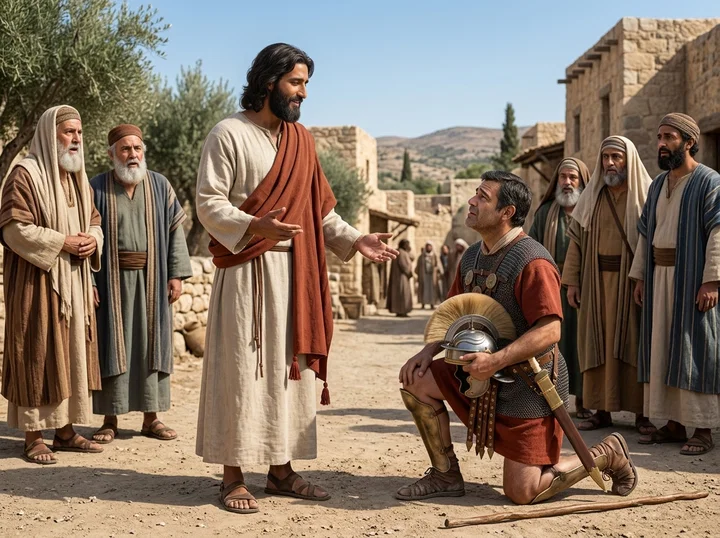
For I am a man under authority, having soldiers under me: and I say to this man, Go, and he goeth; and to another, Come, and he cometh; and to my servant, Do this, and he doeth it.
Translations
For I am a man under authority, having soldiers under me: and I say to this man, Go, and he goes; and to another, Come, and he comes; and to my servant, Do this, and he does it.
King James Version, KJV Cambridge Paragraph Bible, Webster Bible
For I am a man under authority, having soldiers under me: and I say to this man, Go, and he goeth; and to another, Come, and he cometh; and to my servant, Do this, and he doeth it.
Revised Version, American Standard Version
For I also am a man under authority, having under myself soldiers: and I say to this one, Go, and he goeth; and to another, Come, and he cometh; and to my servant, Do this, and he doeth it.
for I also am a man under authority, having under myself soldiers, and I say to this one, Go, and he goeth, and to another, Be coming, and he cometh, and to my servant, Do this, and he doth [it].'
For I also am a man under authority, having under me soldiers, and I say to this [ one], Go, and he goes; and to another, Come, and he comes; and to my bondman, Do this, and he does it.
For, I also, am a man [set] under authority, having under myself, soldiers,—and I say to this one, Go! and he goeth, and to another, Come! and he cometh, and, to my servant, Do this! and he doeth it.
For I myself am a man under authority, with soldiers under me. I tell one to go, and he goes; and another to come, and he comes. I tell my servant to do something, and he does it.”
For I myself am a man under authority, with soldiers under me. I tell one to go, and he goes, and another to come, and he comes. I tell my servant to do something, and he does it.”
For I am also a man under authority, having under myself soldiers. I tell this one, ‘ Go,’ and he goes; and tell another, ‘ Come,’ and he comes; and tell my servant, ‘ Do this,’ and he does it.”
Because I myself am a man under authority, having under me fighting men; and I say to this one, Go, and he goes; and to another, Come, and he comes; and to my servant, Do this, and he does it.
For I am a man also vnder the authoritie of an other, and haue souldiers vnder me: and I say to one, Goe, and he goeth: and to another, Come, and he commeth: and to my seruant, Doe this, and he doeth it.
Douay-Rheims (Challoner revision)
For I also am a man subject to authority, having under me soldiers; and I say to this, Go, and he goeth, and to another, Come, and he cometh, and to my servant, Do this, and he doeth it.
Pictures



Cross-references
- Luke 7:6-10
Then Jesus went with them. And when he was now not far from the house, the centurion sent friends to him, saying unto him, Lord, trouble not thyself: for I am not worthy that thou shouldest enter under my roof:
Luke records the centurion trusting Jesus’ authority to heal by a word.
- Matthew 8:13
And Jesus said unto the centurion, Go thy way; and as thou hast believed, so be it done unto thee. And his servant was healed in the selfsame hour.
Jesus grants the servant’s healing in keeping with the centurion’s faith.
- Acts 10:1-2
There was a certain man in Cæsarea called Cornelius, a centurion of the band called the Italian band,
Both texts describe a Gentile centurion devoted to God.
- John 4:50
Jesus saith unto him, Go thy way; thy son liveth. And the man believed the word that Jesus had spoken unto him, and he went his way.
The nobleman trusts Jesus’ word, and his son is healed.
- Luke 7:8
For I also am a man set under authority, having under me soldiers, and I say unto one, Go, and he goeth; and to another, Come, and he cometh; and to my servant, Do this, and he doeth it.
The centurion explains his faith through his authority over soldiers and servants.
- Luke 7:5
For he loveth our nation, and he hath built us a synagogue.
Luke describes the centurion’s regard for the Jewish people and their synagogue.
- Isaiah 55:11
So shall my word be that goeth forth out of my mouth: it shall not return unto me void, but it shall accomplish that which I please, and it shall prosper in the thing whereto I sent it.
God’s word accomplishes what it declares, as the centurion trusted.
- Psalms 103:20-21
Bless the LORD, ye his angels, that excel in strength, that do his commandments, hearkening unto the voice of his word.
God’s heavenly servants obey his commands.
- 1 Peter 3:22
Who is gone into heaven, and is on the right hand of God; angels and authorities and powers being made subject unto him.
Angels, authorities, and powers are subject to Christ.
- Matthew 9:6
But that ye may know that the Son of man hath power on earth to forgive sins, ( then saith he to the sick of the palsy,) Arise, take up thy bed, and go unto thine house.
Jesus’ word heals and demonstrates his authority to forgive.
Commentary
Each commentary is drawn from primary sources: the writings of Ellen G. White and Adventist pioneers and periodicals. Each commentary is separate. Its own words are not a quotation; follow the references to read the source passages.
Ellen G. White
24 sources
The verse is the appeal of a Roman centurion at Capernaum for his gravely ill servant, made by one who had not seen Jesus but believed reports of Him, felt unworthy to approach Him or receive Him under his roof, and cared for his servant and for the Jewish people.DA 315.2–316.1ST Aug 8, 1916 He explained his confidence from his own place as a man under higher Roman authority yet obeyed by soldiers and servants who go, come, and do as ordered without his going to them.Ms 10, 1890, par. 19Lt 114, 1895, par. 11–15Lt 114, 1895, par. 7–10 He trusted that Jesus could heal from a distance by speaking the word alone, because Jesus represents the power of the infinite God whom all created things and disease obey, with angels surrounding Him to carry His word to the sickroom.Ms 10, 1890, par. 19Lt 114, 1895, par. 11–15MH 63.1–65.1DA 316.2 His simple, unselfish faith rested on Jesus' power and mercy rather than his own worthiness or seeing a sign, and Jesus praised it as greater than any He had found in Israel.Lt 114, 1895, par. 11–15DA 315.1ST May 4, 1876 Its rewarding shows that Jesus' love and grace are not circumscribed by race or nation, so Gentiles become fellow-heirs with Jews and partakers of His promise, and those who bear His message are themselves men under higher authority who must lead by righteousness and not harsh control.DA 402.2SLP 51.1AA 19.2–20.1Ms 113, 1907, par. 12
Centurion's Setting and Words
The appeal belongs to a Roman centurion at Capernaum who sought Jesus for his servant lying gravely ill.DA 315.2–316.1ST Aug 8, 1916 He had not seen Jesus himself but had learned of Him through reports that inspired belief in His power to heal.DA 315.2–316.1ST Aug 8, 1916 He felt unworthy both to approach Jesus and to receive Him under his roof, while his plea revealed tender care for his servant and respect and kindness toward the Jewish people.DA 315.2–316.1ST Aug 8, 1916
He explained his confidence from his own experience as a man under higher authority, himself subject to Rome yet having soldiers and servants under him.Ms 10, 1890, par. 19ST Aug 8, 1916 His orders to go, to come, and to do this were obeyed without his going to them in person.Ms 10, 1890, par. 19Lt 114, 1895, par. 11–15Lt 114, 1895, par. 7–10ST May 4, 1876 As his command over soldiers was obeyed, so he reasoned Christ could heal by speaking without coming to the servant.Ms 10, 1890, par. 19ST May 4, 1876
He trusted that Jesus could heal the servant from a distance without coming to the house or under his roof, by speaking the word alone.Ms 10, 1890, par. 19Lt 114, 1895, par. 11–15MH 63.1–65.1Lt 114, 1895, par. 7–10DA 316.2 His faith did not depend on seeing a sign and did not question Jesus' power to do what was asked.Lt 114, 1895, par. 11–15DA 315.1 Only a word was needed, and that word alone would be enough to heal.MH 63.1–65.1Lt 114, 1895, par. 7–10DA 315.1ST May 4, 1876
He recognized that Jesus represents the power of the infinite God, so that all created things and disease obey His word.MH 63.1–65.1DA 316.2ST May 4, 1876ST Aug 8, 1916 Angels surround Christ, and heavenly messengers can be summoned to carry His word to the sickroom to bring healing.Ms 10, 1890, par. 19DA 316.2 By that word disease is commanded to depart and healing is brought to the sufferer.MH 63.1–65.1DA 316.2ST May 4, 1876
His confidence was a simple, unselfish faith resting on Christ's power and on His mercy rather than on his own worthiness.Lt 114, 1895, par. 11–15ST Aug 8, 1916 It did not depend on seeing and did not question, but trusted the spoken word.Lt 114, 1895, par. 11–15DA 315.1ST May 4, 1876 Jesus praised it as greater faith than any He had found in Israel.ST May 4, 1876
Gospel Beyond Israel
The rewarding of the centurion's faith at Capernaum shows that Jesus does not share Jewish intolerance and exclusiveness.DA 402.2 His love and the gifts of His grace are not to be circumscribed to race or nation.DA 402.2 There are no national or territorial boundaries to the gospel, for Gentiles too could receive salvation and share in God's promise.AA 19.2–20.1
The act teaches the hid mystery that the Gentiles should be fellow-heirs with the Jews and partakers of His promise in Christ by the gospel.DA 402.2 It is an instance of Christ working directly beyond Israel's acknowledged people and among people outside Israel.SLP 51.1AA 19.2–20.1ST Jun 12, 18793SP 356.2–38RED 14.1–2 By it He sought to lead the Jews out of exclusiveness and to bring Gentiles to the gospel.SLP 51.1 The centurion's conversion shows Gentiles recognized as children of God, converted and welcomed into the work of the gospel.ST Jun 12, 18793SP 356.2–38RED 14.1–2
That conversion anticipated the later gathering of Gentile communities into God's church.ST Jun 12, 1879 Yet the centurion had shown kindness to Israel, and still his faith was used as lesson upon lesson to disciples who were slow to learn and who thought grace was dispensed too freely.DA 402.2
Christ's work for this Roman ruler shows His deliberate study to find ways of reaching the rich while He ministered to the poor.MH 24.2 His ministry was not limited to the poor and outcast but also reached people of standing and responsibility who would hear His word.ST Jun 9, 1914Ms 3, 1899, par. 12 He sought the acquaintance of the Roman ruler together with the wealthy and cultured Pharisee and the Jewish nobleman.MH 24.2 He accepted their invitations, attended their feasts, and made Himself familiar with their interests and occupations, that He might gain access to their hearts and reveal to them the imperishable riches.MH 24.2
Pattern for Ministry Today
Matthew 8 joins the ministry of the Word with medical missionary work and gives the pattern for following Christ's methods.Ms 62, 1904, par. 17 The healings of the leper, the centurion's servant, and Peter's mother-in-law in that chapter display His humility and His tenderness and care for the erring and for those needing sympathy and love.12MR 289.1–2 Even those who have not honored God's cause and whose lives and character show the deformity of sin must therefore be borne with.12MR 289.1–2 Such forbearance comes from remembering personal sinfulness and wickedness and how Jesus still bears with us.12MR 289.1–2
Those who suppose they are to have authority in bearing a most solemn message to the world are themselves men under authority, ruled by a power higher than that of any earthly potentate.Ms 113, 1907, par. 12 A person with authority may also be under a higher authority, and leaders in Christ's work answer to God.Ms 113, 1907, par. 12 They must not use position to control others or act harshly, but are to be guided by God's Spirit and give an example of righteousness. People from other nations came to Christ for healing and help for relatives or friends, listened to His teaching, were moved by the truth, and received hope and healing.Ms 50, 1897, par. 2 Christ's dealings with them set the example for service to people throughout the world.Ms 50, 1897, par. 2
Sources
Pioneers and periodicals
58 sources
The Roman officer at Capernaum both served under higher Roman authority and commanded soldiers and a servant who instantly obeyed his spoken orders to go, come, and do.RH Mar 24, 1863ST May 31, 1905ST Jan 23, 1893ST Jun 2, 1898ST Apr 11, 1900 From his own experience of command he reasoned that Jesus could heal his dying paralyzed servant simply by speaking a word, without coming to the house or entering under his roof.ST Jun 2, 1881RH Dec 6, 1906ST Jan 23, 1893STRH Oct 7, 1915 He understood that Jesus stood under God's authority as His sent messenger, backed by the power of the infinite God far greater than Rome, so that all created things must obey His word as divine.STST May 31, 1905ST May 31, 1905ST Mar 6, 1907 Jesus can therefore command sickness and disease to depart at a distance by His word alone, healing immediately in the selfsame hour, with power the same near or far.STRH Jan 28, 1873ST Mar 26, 1894ST Oct 8, 1902ST Jan 30, 1912 That grasp of Christ's living word to accomplish what it declares was so great faith that Jesus marveled at it as greater than any in Israel, born of humility and unworthiness that trusted not in self but wholly in His mercy and power.ST Aug 8, 1916ST May 31, 1905STST Jul 17, 1884
Historical Setting
The words were spoken by the Roman centurion at Capernaum, an officer commanding about a hundred men in the small garrison stationed there while Palestine was under Roman military rule.ST Jun 2, 1881ST Mar 6, 1907ST Apr 11, 1900 He was wealthy, benevolent, kind and religious, favorably disposed toward the Jewish religion and drawn toward Judaism and the one true God.ST Jun 2, 1881ST May 31, 1905ST Mar 6, 1907ST Jun 13, 1900ST Apr 11, 1900 He loved the Jews and built them a synagogue in Capernaum, despite the contempt Romans showed for Jews.ST Jun 2, 1881ST May 31, 1905ST Jul 7, 1898ST Apr 11, 1900
His servant was a dying slave lying at home sick with paralysis and grievously tormented, fast approaching death.ST Jun 2, 1881ST May 31, 1905ST Jun 13, 1900 The centurion felt unusual tenderness for him, with the kindness of a won heart.ST Jun 2, 1881ST Jun 13, 1900 Jesus' willingness to come and heal the servant brought the centurion joy and made him feel his need of the Saviour.RH Oct 7, 1915
He had first sought healing through the Jewish elders, who called him worthy for favoring their nation and building them a synagogue.STST Jun 2, 1881 Then, when Jesus was not far from the house, he sent a second message by friends, apologizing for troubling Him and asking only for a spoken word to heal his servant.ST Jun 2, 1881 In that message he declared himself unworthy to have so holy a One come under his roof or even to approach Him, trusting not in his own goodness but in Christ's mercy.ST Aug 8, 1916STST Jun 2, 1881 He had not seen Jesus, but reports about Him had inspired faith that Jesus could heal.ST Aug 8, 1916
Matthew presents the conversation as taking place directly and the centurion as coming himself, but this is the usual condensed form where an act done by one's authority through messengers is attributed to the person himself.ST Jun 2, 1881ST Sep 15, 1887 Luke's account gives the intermediaries, and its silence about the meeting does not contradict Matthew, so the accounts are read together for the full details.ST Jun 2, 1881ST Sep 15, 1887ST Mar 26, 1894 Matthew 8:5-13 parallels the Luke 7 account and belongs with the healings of Matthew 8:1-17 where Jesus helps those who come to Him.RH Nov 17, 1859ST Jan 30, 1896
Words and Reasoning
The centurion describes himself as a man set under higher authority, subject to a superior and to Rome, while himself having soldiers and a servant under his command.ST Jan 23, 1893ST Jun 2, 1898ST Apr 11, 1900ST Sep 20, 1910ST Sep 18, 1893 His use of also makes the comparison with Jesus explicit, setting his own position under and over others alongside Christ's authority.ST Jan 23, 1893 His illustrations of saying Go and Come and Do this picture soldiers and a servant under his command who instantly obey his spoken orders, carrying them out without his having to go to them in person.ST May 31, 1905ST Mar 6, 1907ST Jul 17, 1884ST Sep 15, 1887ST Sep 20, 1910
The word rendered servant is pais, meaning a child, boy or youth rather than a slave, and the soldiers were under military authority, not held as slaves.RH Mar 24, 1863RH Mar 24, 1863 The verse therefore does not teach or justify slavery, and the sick pais may have been his child, so that rendering the word child would have been just as faithful.RH Mar 24, 1863RH Mar 24, 1863
From his own experience of command he reasoned that Jesus could heal his servant simply by speaking a word, without coming to the house or entering under his roof.RH Dec 6, 1906ST Jan 23, 1893STST Jan 23, 1893ST Oct 22, 1896 He knew what it was both to act under authority and to command those under him, and that understanding became the basis for trusting that Jesus could heal by command.RH Dec 6, 1906STRH Dec 9, 1852 His reasoning assumes that authority works through obedience and agents, so that what soldiers do at his command is treated as what he himself does.ST Apr 23, 1896RH Jan 28, 1873 In the same way he trusted that Jesus could command sickness from a distance through spiritual agents and it would obey, and the healing would still be Christ's own work.ST Apr 23, 1896RH Jan 28, 1873
Christ's Commanding Authority
The centurion understood that Jesus stood under God's authority as One sent of the Most High and as God's commissioned messenger for doing God's work.ST May 31, 1905ST Mar 6, 1907ST Mar 6, 1907 He reasoned from his own place under higher command in Rome, where authority and means are given to carry out orders, that his own orders to go, come, and do this are instantly obeyed because they carry the power of the authority behind him.ST May 31, 1905ST May 31, 1905ST Mar 6, 1907ST Mar 6, 1907 In the same way he saw that Jesus was equipped with power, means, and servants, so that speaking a word without entering the house or coming to the sick servant would be enough to heal.ST May 31, 1905ST Mar 6, 1907ST Mar 6, 1907
As his soldiers recognized his authority as supreme because he represented the power of Rome, so Jesus represents the power of the infinite God, far greater than Rome's power.STST Aug 8, 1916ST Apr 11, 1900 All created things obey Jesus' word, which reveals Him as divine and possessed of godlike power.STST Aug 8, 1916ST Sep 18, 1893ST Sep 15, 1887 The centurion therefore grasped that Christ's authority reached far beyond earthly command and could act without His bodily going to the place of need.ST Sep 18, 1893ST Apr 11, 1900ST Sep 15, 1887
For that reason Jesus can command sickness and disease to depart and it must obey Him.STRH Jan 28, 1873ST Mar 26, 1894ST Apr 11, 1900 The servant lying sick of palsy and grievously tormented was healed in the selfsame hour by that living word.ST May 31, 1905ST Mar 26, 1894 The immediate restoration at His command shows that the power behind gradual ordinary cures also resides in Christ, who can bring perfect health at His command without setting ordinary healing aside.RH Feb 8, 1906
His word alone spoken at a distance is enough, without His bodily presence or His coming to the house, demonstrating that His power is the same near or distant.ST Oct 8, 1902ST Jan 30, 1912 He can summon heavenly messengers and command invisible spiritual agents and angels to carry that word and impart healing virtue at any distance, and what they do at His command counts as His own work.ST Apr 23, 1896ST Mar 6, 1907ST Apr 11, 1900ST Sep 15, 1887ST Mar 6, 1907 The healing power is not in the human messenger but in God's living word, whose power comes by the indwelling Word through faith, requiring clean agents, so that though Christ ministers in heaven He can still send His word to heal soul and body.ST May 31, 1905ST Mar 6, 1907
Faith in His Word
The centurion's confidence that a spoken word alone could heal shows a grasp of truth and a faith so great that Jesus commended it and marveled at it as greater than any He had found in Israel.ST May 4, 1876ST May 31, 1905STST Oct 22, 1885 His trust rested on Christ's power to act at a distance without coming to the house, and that confidence itself is the strength of his faith.ST May 4, 1876ST Oct 22, 1885
That faith grasps and rests on the power of Christ's living word itself to accomplish what it declares and to produce the desired result.ST Mar 26, 1894ST Nov 19, 1896 It trusts that when Jesus speaks what He says will be fulfilled even without seeing it happen.ST Sep 21, 1915 It accepts God's Word before its workings are fully understood, with deeper understanding coming afterward by time and experience.ST
God can perform what He promises, and His living word carries life-giving power that brings healing and life.ST Oct 30, 1907ST Oct 30, 1907 That power heals both soul and body when received in faith, even as Christ ministers in heaven.ST Oct 30, 1907ST May 31, 1905ST Oct 30, 1907 The healing is not in any human messenger but in God's living word.ST May 31, 1905
The centurion grasped Christ's power apart from His bodily presence, believing His word alone carried authority to heal at a distance.ST Mar 6, 1907ST Jan 30, 1912ST May 17, 1910 Many in Israel, by contrast, believed Christ had to be physically present to heal.ST Mar 6, 1907 His faith was greater than the faith of the sisters of Lazarus, who thought presence was needed.ST May 17, 1910 It is faith to lay hold on Christ's power when He is absent, the same faith the disciples needed when Jesus went away, so that through the outpoured Spirit the conquering Christ could be made personally present to each believer everywhere.ST Jan 30, 1912ST May 17, 1910
His humility and sense of personal unworthiness led to complete reliance on divine grace and to confident appeal for help.ST Jul 17, 1884ST Jul 17, 1884 His confidence rested not on his own goodness or worthiness but on Jesus' power and mercy.ST Aug 8, 1916ST He made his great need his only argument for help.ST In the same way every human being can come to Christ, and no sinner need despair of blessing, for having nothing to recommend to God and renouncing all self-dependence, utter helplessness which makes redeeming power a necessity is the plea to urge now and ever.ST
Gospel Reach and Application
The healing belongs to Christ's direct work among people outside Israel, bringing the gospel to a Gentile and to a Roman ruler.ST Jun 12, 1879ST Jun 9, 1914ST May 1, 1907 Gentiles are thereby recognized as children of God and welcomed into the work of the gospel.ST Jun 12, 1879 The centurion stands as a pious Gentile, like others who came to Jerusalem to pray before God, and his conversion anticipates the later gathering of Gentile communities into God's church.ST Jun 12, 1879ST Jun 21, 1883 In reaching him, Jesus showed that He sought access to people of high rank as well as to the poor.ST Jun 9, 1914
Joined to the healings in Matthew 8:1-17 where Jesus helps those who come to Him, the account proves He is both able and willing to help and never calls and then refuses.RH Nov 17, 1859 It proves He cures disease and gives mercy to sinners of every class, rich and poor, masters and servants, old and young, who come to Him without money, casting off every hindrance.RH Nov 17, 1859 His story reveals Jesus in Galilee as the mighty Healer who taught and healed the ill and made evil spirits flee, who is God with us.ST Jun 13, 1900 The kind centurion's slave was fast approaching death, yet his prayer of faith from a won heart was answered, showing that Christ's power and love to heal remain unchanged today to calm pain, cure illness, and bring relief through His servants.ST Jun 13, 1900 His power is the same near or distant, while He remains a personal expression of the Father's love for humanity.ST Oct 8, 1902
The account of Matthew 8:5-13 is an example of Christ having the word to speak and of the power of believing.RH Aug 12, 1875 It therefore supports the assurance that a person may accept Christ and be saved immediately by believing, without waiting for a particular feeling.RH Aug 12, 1875
Authority is exercised through commands that those under it obey, and as the centurion directs soldiers and servants who obey, God directs His works through His appointed agencies and hosts who come or go at His command.RH Dec 14, 1869ST Feb 12, 1902 He is not personally contained in the creatures He made, but His wisdom, skill, power, and purpose are seen in creation, and His creatures serve under His direction.ST Feb 12, 1902 His active providential care extends even to small affairs, as when a fugitive bird became the means by which a poor man received the exact money he needed.RH Dec 14, 1869
One who commands others is also under authority and knows what it is to obey.RH Jan 9, 1908 This illustrates that a teacher who expects obedience from pupils must hold himself to the same standard.RH Jan 9, 1908 A person with authority may also be under a higher authority, so leaders in Christ's work must remember that they answer to God. They must not use their position to control others or act harshly, but are to be guided by God's Spirit and give an example of righteousness.
Sources