Nehemiah 2:19
But when Sanballat the Horonite, and Tobiah the servant, the Ammonite, and Geshem the Arabian, heard it, they laughed us to scorn, and despised us, and said, What is this thing that ye do? will ye rebel against the king?
Translations
But when Sanballat the Horonite, and Tobiah the servant, the Ammonite, and Geshem the Arabian, heard it, they laughed us to scorn, and despised us, and said, What is this thing that you do? will you rebel against the king?
King James Version, KJV Cambridge Paragraph Bible, Webster Bible, Revised Version, American Standard Version
But when Sanballat the Horonite, and Tobiah the servant, the Ammonite, and Geshem the Arabian, heard it, they laughed us to scorn, and despised us, and said, What is this thing that ye do? will ye rebel against the king?
And Sanballat the Horonite heareth, and Tobiah the servant, the Ammonite, and Geshem the Arabian, and they mock at us, and despise us, and say, 'What [is] this thing that ye are doing? against the king are ye rebelling?'
And Sanballat the Horonite, and Tobijah the servant, the Ammonite, and Geshem the Arabian, heard it; and they mocked us and despised us, and said, What is this thing which ye do? will ye rebel against the king?
But, when Sanballat the Horonite, and Tobiah the servant the Ammonite, and Geshem the Arabian, heard it, they laughed at us, and poured contempt upon us,—and said, What is this thing which ye would do? against the king, would ye rebel?
Berean Standard Bible, Majority Standard Bible
But when Sanballat the Horonite, Tobiah the Ammonite official, and Geshem the Arab heard about this, they mocked us and ridiculed us, saying, “ What is this you are doing? Are you rebelling against the king?”
But when Sanballat the Horonite, Tobiah the Ammonite servant, and Geshem the Arabian, heard it, they ridiculed us and despised us, and said, “ What is this thing that you are doing? Will you rebel against the king?”
But Sanballat the Horonite and Tobiah the servant, the Ammonite, and Geshem the Arabian, hearing of it, made sport of us, laughing at us and saying, What are you doing? will you go against the king?
But when Sanballat the Horonite, and Tobiah the seruant an Ammonite, and Geshem the Arabian heard it, they mocked vs and despised vs, and said, What a thing is this that ye doe? Will ye rebell against the King?
Douay-Rheims (Challoner revision)
But Sanaballat the Horonite, and Tobias the servant, the Ammonite, and Gossem the Arabian heard of it, and they scoffed at us, and despised us, and said: What is this thing that you do? are you going to rebel against the king?
Pictures
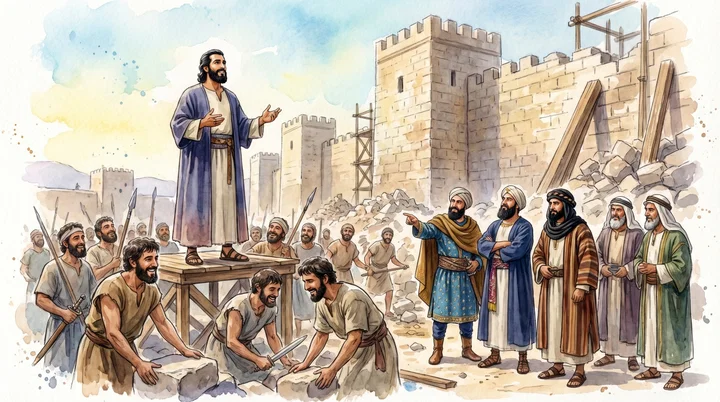
Cross-references
- Nehemiah 4:1-3
But it came to pass, that when Sanballat heard that we builded the wall, he was wroth, and took great indignation, and mocked the Jews.
Sanballat and Tobiah mock the Jews as they rebuild Jerusalem’s wall.
- Nehemiah 6:3
And I sent messengers unto them, saying, I am doing a great work, so that I cannot come down: why should the work cease, whilst I leave it, and come down to you?
Nehemiah refuses to leave his work despite his enemies’ attempts to obstruct him.
- Nehemiah 6:6
Wherein was written, It is reported among the heathen, and Gashmu saith it, that thou and the Jews think to rebel: for which cause thou buildest the wall, that thou mayest be their king, according to these words.
Geshem’s letter repeats the charge that Nehemiah seeks to rebel.
- Nehemiah 2:10
When Sanballat the Horonite, and Tobiah the servant, the Ammonite, heard of it, it grieved them exceedingly that there was come a man to seek the welfare of the children of Israel.
The same opponents are displeased by Nehemiah’s arrival.
- Nehemiah 6:1
Now it came to pass, when Sanballat, and Tobiah, and Geshem the Arabian, and the rest of our enemies, heard that I had builded the wall, and that there was no breach left therein; ( though at that time I had not set up the doors upon the gates;)
Geshem and the others continue opposing Nehemiah.
- Nehemiah 4:1-2
But it came to pass, that when Sanballat heard that we builded the wall, he was wroth, and took great indignation, and mocked the Jews.
Sanballat continues mocking the builders and their work.
- Nehemiah 4:7-8
But it came to pass, that when Sanballat, and Tobiah, and the Arabians, and the Ammonites, and the Ashdodites, heard that the walls of Jerusalem were made up, and that the breaches began to be stopped, then they were very wroth,
The opponents conspire to stop the work by force.
- Nehemiah 4:6
So built we the wall; and all the wall was joined together unto the half thereof: for the people had a mind to work.
wall advanced despite the scorn
- Nehemiah 6:15
So the wall was finished in the twenty and fifth day of the month Elul, in fifty and two days.
It notes that Nehemiah completed his assigned work in fifty-two days.
Commentary
Each commentary is drawn from primary sources: the writings of Ellen G. White and Adventist pioneers and periodicals. Each commentary is separate. Its own words are not a quotation; follow the references to read the source passages.
Ellen G. White
7 sources
Sanballat the Horonite, Tobiah the Ammonite, and Geshem the Arabian were chiefs of heathen tribes living near Jerusalem who had often shown enmity against the Jews by injury and insult.PK 635.1 Nehemiah came guarded by the power of the Persian king, with royal letters that secured honorable reception and prompt assistance from provincial rulers, so no enemy dared molest him on the journey.PK 635.1 But his arrival in Jerusalem with a military escort showing he had come on an important mission excited the jealousy of these leaders.PK 635.1 When they heard what the Jews hoped to accomplish in rebuilding Jerusalem's walls, they laughed the builders to scorn and despised them, accusing them of rebelling against the king.Ms 47, 1907, par. 5PK 628.2PK 638.4Lt 139, 1903, par. 5–6
Driven by jealousy and hatred, they watched Nehemiah's movements with critical eyes from the first and endeavored by every means to thwart his plans and hinder the work of restoration.PK 635.1ST Dec 6, 1883 These opponents had already helped stop the work once before and now sought to hinder it again.ST Dec 13, 1883 Their opposition illustrates the hindrances God's servants may face when carrying forward His work.Lt 139, 1903, par. 5–6
Such opposition cannot succeed while God's people remain faithful, united, and committed to carrying out God's will, since the enemy can gain entry only through disloyalty within.ST Dec 13, 1883 Attacks should lead God's people to rely on Him more firmly and work more resolutely.ST Dec 13, 1883 As part of the account of Nehemiah's work, the verse supports the example that God's people may ask rulers and other powerful people for help in advancing God's cause, while making such appeals prudently.Ms 47, 1907, par. 5
Sources
Pioneers and periodicals
25 sources
When Sanballat, Tobiah, and Geshem heard of the work they mocked the builders, despised them, and charged them with rebelling against the king in order to hinder the rebuilding of Jerusalem's wall, but Nehemiah went on with the task God had given him.RH Oct 8, 1908RH May 9, 1871RH Apr 8, 1902 Their ridicule was not honest doubt but hostile jealousy and hatred, watching his movements and seeking by every means to thwart his plans, discredit the work, and frustrate the rebuilding.ST Dec 6, 1883ST Oct 25, 1899RH Apr 15, 1909 The scorn belongs to Nehemiah's commission from Artaxerxes in the king's twentieth year, dated to 444 B.C., thirteen years after the decree to Ezra in 457 B.C.RH Jul 21, 1863ST Nov 1, 1877ST Feb 23, 1882 That later permission was only verbal and personal to Nehemiah, with letters for safe passage and timber, finding rulers, priests, nobles, and people already building Jerusalem under Ezra's decree, a work finished in fifty-two days, and is therefore distinguished from the earlier decree that began the city's civil and religious restoration.ST Nov 1, 1877ST Feb 23, 1882RH Jul 28, 1863 It is counted as the fourth of the acts in favor of the Jews from which Daniel's seventy weeks of 490 years may be dated, leaving Ezra's 457 B.C. decree with it as the two possible starting points, though the same commission is elsewhere dated to 445 B.C. with the 2300 years ending in 1855 or 1856, and to 455 B.C. with the work placed about 446-408 B.C.ST Aug 23, 1910RH Jul 21, 1863RH Jun 4, 1857 Their every effort to hinder the last reformation is typical of God's work in other ages, especially in the last days, and cannot succeed while His people remain faithful, united, prayerful, and resolute without delay, division, or compromise, for God prospered Nehemiah's diligent hands and carried the work to glorious success.ST Dec 13, 1883ST Jun 2, 1909ST Jun 20, 1911RH Apr 15, 1909
Mockery in Jerusalem's Rebuilding
When Sanballat the Horonite and Tobiah the servant, the Ammonite, and Geshem the Arabian heard of the purpose to rebuild Jerusalem's wall, they laughed the builders to scorn and despised them, asking what they were doing and charging them with rebelling against the king.RH Oct 8, 1908RH May 9, 1871RH Apr 8, 1902RH Dec 29, 1859 Their mockery and contempt with slander and accusation of rebellion were meant to hinder the work.RH May 9, 1871ST Oct 25, 1899 Yet Nehemiah continued with the task God had appointed him, and the taunt tested his moral courage.RH Oct 8, 1908RH May 9, 1871
Their ridicule was insincere, expressing hostility toward the work rather than honest doubt.ST Oct 25, 1899 It was rooted in jealousy and hatred, which led them to watch Nehemiah's movements and try by every means to thwart his plans and hinder the restoration of Jerusalem.ST Dec 6, 1883ST Oct 25, 1899RH Apr 15, 1909 They united in intrigue to bring the work into disrepute and frustrate the plans of rebuilding.RH Apr 15, 1909
This was the first attack on the restoration and relief of those left of the captivity.RH Apr 15, 1909 Sanballat, Tobiah, and Geshem were heathen kings of the surrounding territory who bitterly opposed the rebuilding of a national center that had been a rebuke and menace to them in past years, and they were joined by a mixed multitude inside Jerusalem itself who had no sympathy for the prosperity of Israel.RH Apr 15, 1909 These opponents had already helped stop the work and now sought to hinder it again.ST Dec 13, 1883 The encounter reflects the growing bitterness between the Jews and the Samaritans.RH Sep 21, 1916
Nehemiah met this opposition as governor, formerly cup-bearer to Artaxerxes, whose close access to the king enabled him to ask for help for Jerusalem.ST Oct 9, 1901 That work was carried out for the good of Jerusalem, the Lord's city, and the Lord's people, in the period dated about 446-408 B.C.ST Aug 23, 1910 At that time the city was surrounded by enemies, and its wall was not permanently restored until Nehemiah's time, seventy-three years after Zechariah's vision.ST Apr 19, 1883 He had been given permission to return with a colony of Jews in 455 B.C., and God prospered the work of his hands because he was ever diligent and ever zealous for God and continually brought his faithfulness before the Lord in prayer pleading for the Lord's blessing.
The verse belongs to the days of Ezra and Nehemiah, when Babylonian life forms the background of Israel's history, a background confirmed by discoveries in the ancient lands that had dealings with Israel.ST Mar 10, 1909 The book of Nehemiah is supplemental to Ezra and is called the second book of Ezra, and with Ezra gives the history of the Jews during the restoration period.
Decree and Prophetic Dating
Nehemiah 2 belongs to the commission Nehemiah received from Artaxerxes in the king's twentieth year, dated to 444 B.C., thirteen years after the decree given to Ezra in 457 B.C.RH Jul 21, 1863ST Nov 1, 1877ST Feb 23, 1882RH Jul 28, 1863RH Sep 13, 1870 That commission is considered a possible starting point for the command to restore and build Jerusalem, with the restoration meaning Jerusalem's civil state and polity and not merely the temple and its worship.RH Jul 21, 1863RH Sep 13, 1870 It is reckoned the fourth of four events that can answer that commandment, remaining with Ezra's 457 B.C. decree as one of the two possible points from which the seventy weeks, being weeks of years, 490 years in all, are to be dated.RH Jul 21, 1863RH Sep 13, 1870 Those who dated the same twentieth-year commission to 445 B.C. taught that counting the 2300 years from that date would place their end in 1855 or, at the latest, in 1856.RH Jun 4, 1857
The permission for Nehemiah to return with a colony is elsewhere dated to 455 B.C., and his work in Jerusalem for the good of the Lord's city and people falls within the period dated about 446-408 B.C.ST Aug 23, 1910 The permission Nehemiah sought and obtained to go to Jerusalem was only verbal and pertained to him individually, with nothing said about others going with him.ST Feb 23, 1882RH Jul 28, 1863RH Sep 13, 1870 The king asked how long the journey would take and when he would return, and gave him letters to the governors beyond the river to help him on his way to Judah and an order on the keeper of the king's forest for timber for beams.RH Jul 28, 1863RH Sep 13, 1870 When he arrived at Jerusalem he found rulers, priests, nobles, and people already engaged in building Jerusalem under the decree given to Ezra thirteen years before, and the work he came to accomplish was finished in fifty-two days.RH Jul 28, 1863RH Sep 13, 1870
This later, individual permission is distinguished from Artaxerxes' earlier decree to Ezra, under which the people were already rebuilding.ST Nov 1, 1877ST Feb 23, 1882ST Nov 1, 1877 Nehemiah's mission is presented as connected with rebuilding Jerusalem but not as the decree that began the restoration of the city's civil and religious life.ST Nov 1, 1877ST Feb 23, 1882ST Nov 1, 1877 The commission given to Nehemiah in Artaxerxes' twentieth year is counted among the acts in favor of the Jews considered in determining the command to restore and rebuild Jerusalem from which Daniel's seventy weeks are dated.RH Jul 21, 1863RH Jun 4, 1857RH Sep 13, 1870
Faithfulness Under Opposition
The mockery in Nehemiah 2:19 was part of every possible effort by the adversaries to hinder Nehemiah's work of restoring Jerusalem under the last reformation.ST Jun 2, 1909 That opposition is typical of God's work in other ages, especially in the last days, yet God carries the work to glorious success despite all the adversary's efforts to hinder it.ST Jun 2, 1909 Nehemiah met that bitter opposition from the factions led by Sanballat, Tobiah, and Geshem after receiving as governor, formerly cup-bearer to Artaxerxes Longimanus, permission to return with a colony of Jews in 455 B.C., and God prospered the work of his hands because he was ever diligent and ever zealous for God and continually brought his faithfulness before the Lord in prayer pleading for the Lord's blessing. Their opposition by mocking the builders, despising them, and accusing them of rebellion against the king did not stop the work, for Judah was united under Nehemiah and the people were willing to work, and God prospered their building.ST Jun 20, 1911
God moved heathen kings to support His purpose and answered prayers for help, so the opposition did not prevent God from helping Nehemiah.ST Jun 20, 1911 That help came while His people remained faithful, united, and committed to carrying out God's will, for the enemy could gain entry only through disloyalty within.ST Dec 13, 1883ST Jun 20, 1911 Attacks should therefore lead God's people to rely on Him more firmly and to work more resolutely.ST Dec 13, 1883 This was the first attack on the restoration of Jerusalem and the relief of those left of the captivity, made by heathen kings of the surrounding territory who bitterly opposed the rebuilding of a national center that had been a rebuke and menace to them in past years, joined by a mixed multitude inside Jerusalem itself who had no sympathy for Israel's prosperity, uniting in intrigue to bring the work into disrepute and frustrate the plans of rebuilding.RH Apr 15, 1909 Their opening weapon was ridicule and scorn with the charge of rebellion against the king, but it had no result because Nehemiah remained resolute in sustained loyalty and faithfulness to the great work God had given him, which admitted no delay, no bickering, and no unholy alliance or compromise.RH Apr 15, 1909
The taunt that mocked and despised the builders and challenged their work by accusing them of rebelling against the king tested Nehemiah's moral courage.RH Oct 8, 1908 His overcoming of that hardship is an example for those trying to do good, who may face similar opponents and similar mockery and contempt.ST Aug 17, 1915 The verse therefore warns hesitating church members against holding counsel with those who oppose the cause, as Sanballat and Tobiah opposed the work.RH Jan 26, 1869
Sources